Poetic meter and musical form in Tashlhiyt Berber songs (henceforth Poetic meter in Berber), with which is included a CD-ROM containing MP3 audio and marked-up Audacity files of songs referred to in the text, is an excellent case study on how words are set to music and thus deals with a research area at the interface between phonology and music (see, for example, Dell & Halle, to appear; Hayes & Kaun Reference Hayes and Kaun1996). The book does not assume prior knowledge of any particular theoretical methodology and will be of value to phonologists, those interested in the relationship between language and music, scholars of literature and verbal art, ethnomusicologists and specialists of Berber language and music. A major finding of François Dell & Mohamed Elmedlaoui's book is that metrical structure exists independent of musical structure in these songs. The authors find discrepancies between lineation and musical groupings, showing that divisions of a song text into lines is not a by-product of grouping structure in the musical domain.
Poetic meter in Berber is a generative account of textsetting in traditional songs of Tashlhiyt Berber (TB), a language spoken by five million people in Western Morocco. Dell & Elmedlaoui, the latter also ‘a fluent participant in traditional TB singing’ (48), show in this study how words are set to music by performers of amarg aqqdim ‘old poetry’, an orally transmitted song style, often composed by people without literacy. The authors apply their detailed knowledge of TB phonology to ‘Hassan Jouad's ground-breaking work on versification on TB’ (1). Whereas Jouad's analysis assumes that the (more than 100) metrical patterns of light and heavy syllables must be memorised (1), Dell & Elmedlaoui show that half their corpus of TB songs are generated by repetitions of a four-mora unit. They provide strong evidence that ‘versification is grounded in the sound pattern of the language’ (167) and demonstrate that meters traditionally regarded as aperiodic (i.e. not built up from successive repetitions of the same pattern) are actually periodic, and find parallel with a recent analysis of Sanskrit songs (Deo Reference Deo2007).
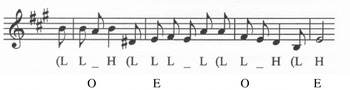
The book's ‘Introduction’ gives an overview of the TB metrical pattern. This is based on counting moras: a heavy syllable (H) has two moras and a light (L) syllable has one mora. The meter successively alternates two classes of four-mora feet: class E consists of syllables patterned LHL or LLLL; and class O consists of syllables with the pattern LLH. A line of song and its meter is shown in figure 1 (with the musical score taken from page 5 and the foot class taken from page 4), which illustrates that a foot, represented by a left parenthesis, may be truncated at either end when it occurs at the edge of lines (4).
A line of a Tashlhiyt Berber song and its meter

Mora-counting meters are also found in Northern India. One of these is the Ãryã, which can be sung and which is similarly based on counting four-mora feet (Fabb & Halle Reference Fabb and Halle2008: 233).
Maintaining ‘a sharp distinction between poetic meter and musical rhythm’ (4), Dell & Elmedlaoui show that metrical well-formedness depends only on the linguistic material in a song. In relation to well-formedness of the composite text and tune, the authors find that the second syllable of every foot aligns with the first beat of a bar (the ‘down’ beat, or tactus), as shown in figure 1.
In chapter 1, ‘The broad picture (I)’, the authors clearly articulate the aim of the book:
In the same way that children naturally become native speakers of TB through exposure to the speech of others, they become fluent participants in the TB poetic tradition through repeated exposure to poetic material. … Our aim in this book is to pave the way towards a characterization of their competence as ‘fluent participants in the TB poetic tradition’. (24)
They analyse the structure of a song as a hierarchy of constituents (where the smallest constituent is a line) which form stanzas, then strophes, episodes and finally a song. The authors view a TB song as a composite of two independent components: music and text (25). The textual component consists of both TB grammar and a metrical component which enumerates well-formed lines and assigns a metrical line for any input of text (27).
Chapter 1 describes in detail how syllables are matched to the four-mora metrical pattern (32–40) and how every fourth mora of the metrical text must then match the strong beat in the time grid (41). Representations of the metrical structure (the unit is a mora) are clearly distinguished from the rhythmic structure of the music throughout.
Chapter 2, ‘The broad picture (II)’, considers the whole corpus of TB songs, including those that do not conform to the TB meter outlined above, and discusses recent changes in TB society which are ‘paralleled by changes in professional musicians' output’ (49). It also summarises the authors' previous claims about TB phonology. As is common in verbal art, syllabification is shown to operate on lines rather than words (55). In syllabifying a text to fit the metrical pattern, a crucial point is that, if the first half of a geminate is the coda of a closed syllable, then the syllable can count as either heavy or light (e.g. |dan|ni|, where |dan| can be counted as heavy or light), whereas if the syllable is open, then it can only be counted as light (e.g. |dn|ni|). (Note that in TB a sonorant consonant can be a syllable nucleus and thus |dn| is an open syllable.) These ‘hinge codas provide poets with a powerful wild card’ (57).
The chapter further considers a sound patterning whereby a voiced obstruent other than a uvular or pharyngeal occurs on the fifth syllable position (62) as well as the functions of various types of vocables. Vocables, often dismissed in studies of song language, provide evidence of metrical structure. Dell & Elmedlaoui show how ‘lalay’ formulas (68) highlight lines with a weight violation. The chapter ends with a discussion of the tactus and symmetrical stanzas.
In chapter 3, ‘Straight metrical patterns’, Dell & Elmedlaoui argue that straight metrical patterns form a natural class as nearly all conform to the constraint Beat, which serves to exclude the first foot of a line (87). The authors also consider successive lines of straight metrical patterns that form larger straight sequences. ‘Hinge feet’ are two truncated feet of adjacent lines (one ending and one beginning with a truncated foot) that combine to yield a single metrical foot. The authors further propose ‘silent’ syllables at line boundaries, enabling metrical structure to extend to whole stanzas, and also at the end of feet. This extends their analysis to metrical patterns otherwise not considered straight. Violations of the alternating feet rule and lines with multiple differing foot structures are also discussed.
Chapter 4, ‘Prosodic continuity’, describes the matching of text and tune. While the boundaries of constituents tend to coincide, there are mismatches which the authors find to be the result of various violable and inviolable constraints. For example, sections of the melody bounded by phonetic pauses usually coincide with breaks in grammatical structure (112). However, as this is not always the case, they identify a violable constraint Stream/Word, which is violated to avoid a situation where parallel lines would have a different number of syllables for the same melody. Such parallelism is a common requirement in stanzaic songs (112).
In discussing how a grammatical structure is mapped onto lines, various mismatches reveal that a line break can occur within a word. Chapter 4 considers a range of such violations, referred to as various types of enjambments (120). Where a line break occurs within a word, the two lines are analysed as a single period. Drawing on analyses of classical Greek verse, a period is defined as ‘a minimal sequence bounded by line ends which are also word ends’ (125, see also Fabb & Halle Reference Fabb and Halle2008: 154, note 2). The relationship between sounds within a period is that of ‘prosodic continuity’. Dell & Elmedlaoui claim that ‘[a]ny general theory of metrical verse needs the notion “period” or some similar notion’ (125). The alignments of periods with line and word boundaries are inviolable constraints (149). The authors view lines and periods as part of metrical structure, yet only lines are metrical constituents (132). This is an important distinction: periods are the metrical results of adhering to the aforementioned textual constraints, whereas lines and stanzas are independently specified and are the minimal units conforming to the metrical pattern discussed in chapters 1 and 3.
According to Dell & Elmedlaoui, ‘metrical structure is the only aspect of a text that is visible to the constraints regulating constituency matching between text and music’ (150). The authors' analysis stems from observations of discrepancies in how constituents are matched in song, as these force one to realise that such constituents exist independently of one another (150).
Chapter 5, ‘Text-to-tune alignment at the syllable level’, assumes an underlying alignment of syllables with pitch events. Discrepancies in pitch/syllable alignment are motivated by the need for a pitch-bearing element in the text in order to fulfil the pitch event (i.e. for it to be sung). For example, a phonetic schwa can be inserted to enable syllables with a consonantal nucleus to carry pitch (157). Where there is no schwa insertion, the schwa-less syllable is either spoken but not sung, leaving the pitch unrealised, or sung to the preceding syllable (a melisma), and the schwa-less syllable is realised only briefly between the pitch events.
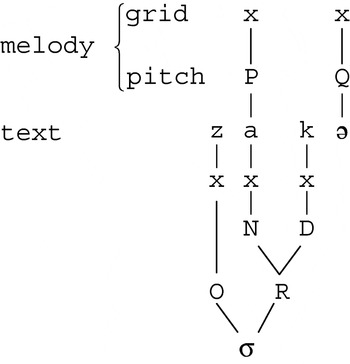
In situations where there are two notes in the melody and only one syllable in the text, this syllable is as a rule sung as a melisma. Alternatively, if the syllable has a coda and its metrical environment meets certain conditions, a schwa can be inserted to carry the second note. The authors are careful to point out that such ‘syllable splitting’ (167) does not change syllable structure, it only provides a pitch-bearing element to sing, as shown in figure 2 (169), where the syllable |zak| has a schwa inserted to carry the pitch ‘Q’.
Syllabification and textsetting of |zak|. A sequence of two notes in the melody (rhythmic units ‘x, x’ and pitch ‘P, Q’) requires two pitch-bearing elements in the text. These may be a syllable nucleus, |a|, or a non-segmental schwa [ə], thus ‘splitting’ the syllable.

To me, the Berber material presented here suggests that syllable-splitting is associated with a melodic ‘down–up’ leap, while melismas occur when the pitch moves by step. This may be related to the need for an onset when singing a leap, and could be a fruitful area to pursue in collaboration with vocal specialists.
Chapter 5 concludes with a discussion of schwa placement in relation to claims in earlier works and reiterates the distinction between underlying representations of textsetting – the correspondence between musical notes (pitches) and linguistic units (syllables) – and surface representations, ‘the execution of the melody and points in the speech chain’ (178).
Throughout the book, readers are assisted by a number of helpful features: indexed terms are marked with an asterisk, examples and figures are meticulously explained in the text, the various components of song represented are consistently distinguished in the book, and the use of capital letters for vocables and of square brackets for non-phonemic sounds distinguishes these from semantic content words.
Some aspects of the authors' presentation would have benefitted from more musical transcriptions. In discussing ‘silent syllables’ in the metrical patterns, a musical transcription would have made it clearer that these are not periods of silence, but are filled by the preceding syllable (93–98). A musical transcription of the instruments and singing might have clarified the varying number of beats per tactus in different songs. For example, in the time grid on page 79, there are five beats per tactus; on page 92, there are four beats per tactus; and on pages 74 and 103, there are three beats per tactus. On page 47, it appears that the three beats are actually uneven groupings of eight smaller beats per tactus: 3+3+2 (or possibly 3+2+3). A table of the different rhythmic meters used in TB songs would have assisted understanding of the rhythmic structure.
One of the questions to be addressed in this field is how beat structure is calculated. The fact that in some music, beat structure can be perceived differently compounds the issue (an analogy with a visual optical illusion could be drawn here). The authors give an example of two competing grids constructed by ME with different placements of the tactus (but not the time in between tactuses) and state that, in these ambiguous songs, the constraint Beat conforms to one of the rhythmic interpretations (47). This highlights the need to understand beat perception in analysis of textsetting.
To conclude, Poetic meter in Berber is a meticulous account of the relationship between text and music in TB songs, revealing a metrical structure independent from musical structure.