Introduction
Although it is increasingly recognized that ADHD is not restricted to children and younger adults, very little is known about the disorder in the later stage of life. There are several controversies surrounding ADHD. In the 90s there was an increase in the diagnosis of ADHD and in the prescription of stimulants as treatment for ADHD in children and adults. This fueled the discussion that ADHD was overdiagnosed and that stimulants were overprescribed. However, a recent review showed that this upward trend is associated with an increase in ADHD diagnosis and treatment in girls (Sclar et al., Reference Sclar, Robison, Bowen, Schmidt, Castillo and Oganov2012); a group that thus far had been neglected in ADHD research and treatment. The male to female ration of ADHD diagnosis narrowed from 3.4:1 in 1991–1992 to 2.2:1 in 2007–2008. The occurrence of ADHD remains quite stable during the lifespan with prevalence rates of 3%–7% (American Psychiatric Association, 2000) in school-aged children, 4.4% in younger adults (Polanczyk and Rohde, Reference Polanczyk and Rohde2007) and 2.8%–4.2% in older adults (Michielsen et al., Reference Michielsen2012). Since poor attention and executive functioning are core deficits in ADHD, a better understanding of cognitive functioning in older adults with ADHD is required. There is an emerging body of research examining cognitive functioning in children and younger adults with ADHD (Woods et al., Reference Woods, Lovejoy and Ball2002; Hervey et al., Reference Hervey, Epstein and Curry2004). However, only few studies have examined cognitive functioning in older adults with ADHD. The focus of these studies has been on the association between ADHD and mild cognitive impairment and Alzheimer's disease or dementia with Lewy body (DLB). No direct linkage has been found between ADHD and Alzheimer's disease (Walitza et al., Reference Walitza2007; Ivanchak et al., Reference Ivanchak2011; Reference Ivanchak, Fletcher and Jicha2012). However, significantly higher levels of preceding ADHD symptoms have been found in DLB patients when compared with controls or patients with Alzheimer disease (Golimstok et al., Reference Golimstok, Rojas, Romano, Zurru, Doctorovich and Cristiano2011). Whether ADHD and DLB are a single illness or whether early symptoms of DLB are presented as symptoms of ADHD has to be further investigated. Still, it remains unclear whether ADHD is related to lower cognitive functioning in a community sample of older adults.
Recent meta-analyses reveal that younger adults with ADHD (≥ 18 years old; mean ages: 19–41 years) have impaired cognitive functioning in a wide range of domains. Although mixed results are found, the domains of attention, behavioral inhibition, executive functioning and memory, appear to be consistently impaired. These impairments are largely similar to the ones found in children (Woods et al., Reference Woods, Lovejoy and Ball2002; Hervey et al., Reference Hervey, Epstein and Curry2004).
The relative similarity of impairments registered in children and younger adults may suggest a continuation of cognitive malfunctioning into old age. The older brain may be more vulnerable for the effects of ADHD on cognitive functioning due to a diminished reserve capacity. Cognitive decline is a common aging process for healthy people. Particular working memory and attention are likely to decrease, possibly linked to age-related decline in the prefrontal cortex (Raz, Reference Raz, Craik and Salthouse2000; Paxton et al., Reference Paxton, Barch, Racine and Braver2008). In older persons with ADHD, age-related decline in cognitive functioning may differ from the older persons without ADHD and could lead to additional problems in cognitive functioning.
In the present study, cognitive functioning of older adults with ADHD is analyzed by examining several cognitive domains, such as executive functioning, attention, working memory, and episodic memory. In the analyses, we will, among other variables, adjust for concurrent depressive symptoms, because depression has been found to be positively associated with both cognitive functioning and ADHD (Butters et al., Reference Butters2008; Van den Kommer et al., Reference Van den Kommer, Comijs, Aartsen, Huisman, Deeg and Beekman2013). A recent study showed that 20% of older adults with ADHD report clinically relevant levels of depressive symptoms (Michielsen et al., Reference Michielsen, Comijs, Semeijn, Beekman, Deeg and Kooij2013).
The aim of the present study was to examine whether older adults with ADHD performed lower on cognitive measures than older adults without ADHD. We hypothesized that older adults with ADHD will have a lower performance than older adults without ADHD on tasks measuring memory, attention, and executive functioning.
Methods
Study sample
The study was part of the LASA, an on-going population-based research on the predictors and consequences of changes in physical, cognitive, emotional and social functioning of older people in the Netherlands. Procedures, sampling, and data collection have previously been described in detail (Huisman et al., Reference Huisman2011). In short, a random sample of older men and women (55–85 years old), stratified by age and sex according to the expected five-year mortality, was drawn from the population registries of 11 municipalities in three geographic areas of the Netherlands. Data collection started in 1992–1993 (N = 3,107). Further, follow-ups were carried out every three years since then. In 2002–2003 a new cohort was added (birth years 1938–1947, N = 1,002) from the same sampling frame as the earlier cohort. Both samples were combined and follow-up was carried out every three years. In the present study, data were used from the follow-up measurement of 2008–2009 (N = 1,601). Interviews were conducted in the residents of the respondents consisting of a main and medical interview in which tests were conducted and structured interviews completed. Informed consent was obtained from all respondents according to established Dutch legislation, and the study was approved by the Ethical Review Board of the VU University Medical Center (VUmc).
The cross-sectional ADHD side study took place in 2008–2009, during which data were collected using a two-phase sampling design. Three exclusion criteria were implemented. First, low cognitive functioning, measured with the Mini-Mental State Examination (MMSE) (Folstein et al., Reference Folstein, Folstein and McHugh1975), a frequently used screening instrument for global cognitive dysfunction. Respondents with an MMSE score ≤18 were excluded. This cut point was selected for three reasons: first, in order to exclude older adults with severe cognitive disorders that could have influenced the reliability of the answers during the interview, a cut point of 17–18 is advised (Kempen et al., Reference Kempen, Brilman and Ormel1995). Second, by using a cut point lower than 23 older adults with (symptoms of) depression would not be excluded from the sample. Finally, as shown by Kempen et al. (Reference Kempen, Brilman and Ormel1995), a cut point of <24 would have resulted in an exclusion of 7%–25% of oldest adults with the lowest level of education, performing within normal ranges for their age and level of education. Since ADHD is associated with low educational outcomes in younger adults we did not want to exclude these older adults. The second exclusion criteria was experienced cognitive decline, which was defined as a difference in score of more than one standard deviation on the MMSE (≥3 points) over a period of three years. Finally, respondents with a history of strokes were excluded. In phase one, an ADHD screening list (Barkley et al., Reference Barkley, Murphy and Fischer2010) was incorporated in the medical interview. In previous research the screener showed sound validity when used in our sample (Semeijn et al., Reference Semeijn, Michielsen, Comijs, Deeg, Beekman and Kooij2013). Based on the outcomes of the screener (N = 1,494 returned, 93.3%), the sample was divided into tertiles with low, intermediate, and high a priori likelihood of ADHD. These tertiles were randomly, but non-proportionally, sampled for respondents who were approached for the diagnostic interview. In phase two, random samples of the participants in the low and intermediate groups, and all of the participants in the high group were approached for a diagnostic interview (N = 271). In total 85 (90%) respondents of the low scoring group, 80 (86%) of the moderate scoring group and 69 (82.3%) of the high scoring group consented to be interviewed. Three respondents were excluded from statistical analysis; one participant refused to answer questions about childhood because of traumatic experience in that period; one had a stroke and could not answer the questions properly and one participant was unable to recollect childhood experiences. Thus, the study sample consisted of total of 231 persons. All interviews were conducted at the respondents’ homes by specially trained and closely supervised interviewers and were tape-recorded in order to check the quality of the data.
Measures
Adhd diagnosis
The DIVA 2.0 is a semi-structured diagnostic interview used to assess ADHD in adults. It is based on the DSM-IV-TR criteria for ADHD and is widely used by mental healthcare professionals in the Netherlands and abroad (www.divacenter.eu, Kooij and Francken, Reference Kooij and Francken2012). It assesses both current and childhood symptoms and impairment. With every DSM-IV-TR criterion, several examples are given to facilitate recognition. Respondents were classified as “case” when they met the following criteria: at least four symptoms of either inattention and/or hyperactivity-impulsivity during six months or longer prior to the interview, and at least six symptoms of either inattention and/or hyperactivity-impulsivity in childhood (5–12 years of age) (Kooij et al., Reference Kooij, Buitelaar, van den Oord, Furer, Rijnders and Hodiamont2005). Following the DSM-IV-TR criteria C and D, the respondents had to have significant clinical impairment in at least two areas of daily life (work, education, family, social and relationships and self-confidence) during six months or longer prior to the interview and in childhood.
Adhd symptoms
For the total number of ADHD symptoms, the sum score of all the ADHD symptoms in present time and in childhood was calculated. The scores ranged from 0 to 36, where higher scores indicated more ADHD symptoms.
Cognitive functioning
Eight cognitive tests were selected that are sensitive measures of cognitive functioning in older persons: MMSE, Raven's Colored Progressive Matrices, Auditory Verbal Learning Test (AVLT), Alphabet Coding Task-15 (ACT-15), Stroop Color-word Test, Trail Making Task, Word Fluency Test, and Digit Span.
General cognitive functioning was measured with the MMSE (Folstein et al., Reference Folstein, Folstein and McHugh1975). The MMSE is a widely used and brief instrument applied for screening cognitive impairment. Scores range from 0 to 30, a higher score indicating better performances.
The Raven's Coloured Progressive Matrices (RCPM) was used to study non-verbal reasoning (Raven, Reference Raven1995). The respondent is presented with an incomplete design and six alternatives from which one has to be picked to complete the design. In LASA only subset A and B were used to reduce test burden for the respondent. Scores range from 0 to 24, a higher score indicating a better performance.
A translated and abbreviated version of the AVLT was used to study memory (Rey, Reference Rey1964). In three trials the interviewer read aloud a list of 15 words, after which the respondents summed up as many words as they could remember. Total recall (sum score of three trails; range 0–45) was derived from this test. After a distraction period of approximately 20 minutes, the respondent was asked to recall as many words as possible (delayed recall, range 0–15). Total recall and delayed recall were analyzed.
With an adapted version of a timed letter substitution task, the ACT-15, information processing speed was studied (Piccinin and Rabbitt, Reference Piccinin and Rabbitt1999). The respondent had to combine as many characters as possible according to the substitution key. The key showed 15 combinations of 2 characters in a row of double boxes. The task consisted of three identical one-minute trials. The score on each trial consisted of the number of correctly completed characters. The sum score of the three trials was used in the analysis. Cards I and II of the Stroop Color-word test were also used to study information processing speed (Klein et al., Reference Klein, Ponds, Houx and Jolles1997). The first card contained colored words (red, green, blue, yellow) printed in black, the second card contained printed patches in the same color, and the third card contained colored words printed in incongruent colored ink. The time to read the words and name the colors on card I and card II were used to calculate the information processing speed.
Card III of the Stroop color-word test was used to calculate the interference score. The interference score was used to study executive functioning. It was derived from the following formula: total time card III – total time card II.
To study motor speed, working memory and executive functioning, the Trail Making Task (TMT) forms A and B were used (Partington and Leiter, Reference Partington and Leiter1949). Form A consists of circled numbers (1–25) and respondents were asked to connect the circles in numerical order as quickly as possible. Form B consists of circled numbers (1–13) and letters (A–L), where respondents were asked to connect the numbers and letters in correct order as quickly as possible, alternating between numbers and letters.
The Word Fluency Test (Lezak et al., Reference Lezak, Howieson and Loring1995) consisting of two conditions, phonemic fluency and semantic fluency, was used to study verbal fluency. In the first condition, respondents were asked to name as many words as possible beginning with the letter D. In the second condition, the respondents were asked to name as many animals as possible. In both conditions the time limit was one minute. The total score was calculated by the number of unique and correct words per condition.
The digit span subtest from the Wechsler Adult Intelligence scale was used to study attention and working memory (Wechsler, Reference Wechsler1987). Respondents were asked to recall a set of numbers forward (range 0–16) and backward (range 0–14). A higher score indicates a better performance.
Possible confounders
Several variables may be related to cognitive functioning as well as ADHD and consequently could confound the examined associations. Therefore, the following variables were tested for confounding; age, sex, level of education, depression, benzodiazepine, and anti-depressant use, as well as the alcohol use.
Information regarding sex and age was derived from municipal registries. Level of education was assessed by the number of years of education. Depressive symptoms were measured with the Center for Epidemiologic Studies Depressive scale (CES-D) (Radloff, Reference Radloff1977). The CES-D is a self-report scale and consists of 20 items covering depressive symptomatology experienced in the past week. The total score of the 20 items ranges from 0 to 60, higher scores indicating more depressive symptoms. The use of benzodiazepines, tricyclic anti-depressants (TCA) and selective serotonin reuptake inhibitors (SSRI) was assessed during the medical interview, whereby the nurse interviewers recorded the medication used by the respondents. Alcohol consumption was assessed during the medical interview with a questionnaire developed and categorized according to the standards of the Netherlands Economic Institute (NEI) into no use, moderate use (1–2 glasses per day) and excessive use (3 or more glasses per day) (Central Bureau of Statistics, 1989).
Statistical analyses
Differences in the characteristics of the respondents according to diagnostic status were examined by independent sample t-test for continuous data and chi-square test for categorical data. Mann–Whitney tests were used for not normally distributed data.
To obtain a near-normal distribution, transformations were applied to the scores on the TMT (LN(TMT-A); LN(TMT-B)), the Stroop task (1/card I; 1/card II; LN(interference score)), and the Digit Span (√(span backwards)). The other cognitive tasks showed a normal distribution.
To determine which cognitive domains were covered by each individual cognitive task, an exploratory factor analysis was performed on the 13 cognitive measures (RCPM Total Score, AVLT Total Recall Score, AVLT Delayed Recall Score, ACT-15 Total Score, Stroop Card I Total Time, Stroop Card II Total Time, Stroop Interference, TMT-A Total Time, TMT-B Total Time, Fluency Animals, Fluency Letter D, Digit Span Forward, and Digit Span Backward) using oblique rotation (promax) since the final factors were expected to be inter-correlated. Factors were extracted on the basis of high primary loadings on the intended factor and lower loadings on other factors, eigenvalues of 0.7 and higher (Jolliffe, Reference Jolliffe1972), observation of the scree plot and sound interpretability of the factors. Z-scores from each individual cognitive task were calculated, and the mean z-scores of the cognitive tasks representing one cognitive domain were computed. When missing values on a single cognitive task were present, the z-scores of the remaining cognitive tasks in this domain were used. The number of persons with missing values ranged from 0 to 19 on the individual tasks, where there were mostly 0–2 persons with missing values per task.
Linear regression analyses were performed to assess the association between ADHD diagnosis and ADHD severity and cognitive functioning on the individual domains. Confounders were determined by computing correlations between ADHD, cognitive functioning and potential confounders. Possible confounders correlated with ADHD and the outcome variable (criterion: p < 0.20) were added one by one to the models to investigate whether they were confounding the association between ADHD and cognitive functioning on the separate domains, i.e. ≥ 10% change in the unstandardized regression coefficient (B) of the main predictor. Potential confounders that displayed a confounding effect on the associations studied were retained in the models. Effect sizes were calculated for the significant associations between respectively ADHD diagnosis and ADHD severity, and the cognitive domains. Effect sizes in the range 0.2–0.3 were considered small, effect sizes up to 0.5 were considered medium, and effect sizes equal too, or larger than 0.8 were considered large (Field, Reference Field2011).
Results
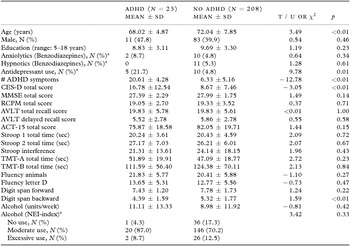
Characteristics of the sample and differences between older adults with and without ADHD in demographics and cognitive functioning are presented in Table 1. The study sample consisted of 231 participants. Older adults with ADHD were significantly younger (N = 23; mean age = 68.02 ± 4.87) than older adults without ADHD (N = 208; mean age = 72.04 ± 7.85, p< 0.01). There were no differences regarding gender distribution between those with and without ADHD (male = 47.8% vs. 39.9%, p = 0.46). More older adults with ADHD used anti-depressants, than older adults without ADHD. Older adults with ADHD scored significantly higher on the CES-D compared to older adults without ADHD and older adults with ADHD did not differ from older adults without ADHD in the performance on the cognitive tests, except for digit span backwards.
Between-group characteristics

ADHD = Attention-Deficit/Hyperactivity Disorder; RCPM = Raven's Colored Progressive Matrices; AVLT = Auditory Verbal Learning Test; ACT-15 = Alphabet Coding Task-15; TMT = Trail Making Task; NEI-index = standardized alcohol use corrected for sex. T / U for continuous variables, χ 2 for categorical variables; N reported for Mann–Whitney test. a = due to low numbers Fischer exact are reported.
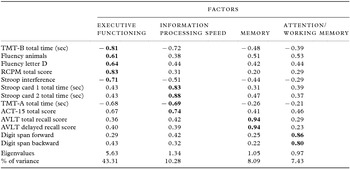
Exploratory factor analyses were performed to determine which cognitive domains were represented by the individual cognitive tests. Table 2 shows the factor loadings, eigenvalues and variances explained from the exploratory factor analysis. Four factors (cognitive domains) were obtained; all with eigenvalues above 0.97. These four factors explained 69.1% of the common variance. The four factors covering the domains were interpreted as executive functioning, information processing speed, memory and attention/working memory.
Summary of the explanatory factor analysis of the separate cognitive tasks

TMT = Trail Making Task; RCPM = Raven's Colored Progressive Matrices; ACT-15 = Alphabet Coding Task-15; AVLT = Auditory Verbal Learning Test.
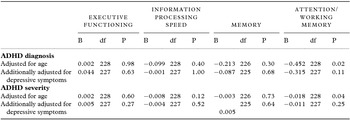
From the putative confounders, only age and depressive symptoms appeared to be significantly correlated with ADHD and cognitive functioning, therefore they were included as confounders. The associations between the ADHD diagnosis and the severity of ADHD and the four domains of cognitive functioning are shown in Table 3. When adjusted for age, the ADHD diagnosis and the severity of ADHD were associated with lower attention/working memory performances. Effect sizes were small, R = 0.22 for ADHD diagnoses and R = 0.21 for the severity of ADHD. When additionally adjusted for depressive symptoms, this association was no longer significant, while the effect sizes for the association between ADHD and attention/working memory performances remained small. No associations were found between the ADHD diagnosis or ADHD severity and the other three cognitive domains. Excluding respondents from the analysis with missing data on any of the cognitive domains resulted in the same outcomes.
Linear regression analyses to determine association between ADHD diagnosis or ADHD severity and cognitive functioning

ADHD = Attention-Deficit/Hyperactivity Disorder; ADHD severity = sum score of all ADHD symptoms in present time and in childhood.
Conclusion
In this epidemiological study, we investigated cognitive functioning in older adults with ADHD. It was hypothesized that older adults with ADHD would have lower cognitive functioning than older adults without ADHD and that the severity of ADHD would be associated with decreased cognitive performance. We found that, even after controlling for age, older adults with ADHD did not show lower cognitive performance, except in the attention/working memory domain. However, the effect sizes were small.
Initially, it was expected that older adults with ADHD would perform less well than older adults without ADHD on the memory, attention, and executive functioning tasks. However, the study did not confirm this presumption. This may have several explanations. First, we might have studied a selective sample of relatively healthy persons with ADHD. Although the LASA sample is representative for the Dutch population with an adequate sampling method, we cannot rule out that persons with severe ADHD may not have been included in our study for reasons such as death, serious illness or refusal. A second explanation could lie within intra-individual variability in cognitive performance in older persons, which is larger than in younger adults (Dixon et al., Reference Dixon, Bäckman and Nillsson2004). A larger intra-individual variability makes it more difficult to measure subtle effects in cognitive functioning. Third, it is possible that persons with ADHD were excluded from the sample due to early-onset dementia. Associations have been found between ADHD symptoms and DLB, whereby the frequency of preceding ADHD symptoms was higher in DLB cases (Golimstok et al., Reference Golimstok, Rojas, Romano, Zurru, Doctorovich and Cristiano2011). It is however unclear whether the ADHD symptoms were early symptoms of DLB or actual ADHD symptoms. The prevalence of dementia in persons under the age of 65 is also very low. A study conducted in the UK found prevalence rates of 98.1 per 100,000 in adults aged 45–64 years (Harvey et al., Reference Harvey, Skelton-Robinson and Rossor2003). The relation between ADHD and dementia in this age group is also still unknown. Although it cannot be ruled out that older adults with ADHD and concurrent early onset dementia have been excluded from the sample, it is very unlikely due to the low prevalence rates of dementia. Fourth, the current study sample is derived from a population-based sample in contrast with other studies that were conducted with clinically referred participants. Finally, the results of the current study are in line with a recent study (Das et al., 2014), which also showed that the relation between ADHD and lower cognitive function in older adults was meditated through depression.
The significant associations of ADHD with the attention/working memory domain was partly explained by depressive symptoms. A previous study from our group demonstrated a significant association between ADHD and depressive symptoms in older adults (Michielsen et al., Reference Michielsen, Comijs, Semeijn, Beekman, Deeg and Kooij2013). Medium effect sizes were found for cross-sectional and longitudinal associations between ADHD diagnosis and depression, and between ADHD severity and depression. It is generally acknowledged that depression and low cognitive functioning are closely related with aging. Both conditions are prevalent among older persons, though cognitive deficits may also be part of the depressive syndrome. Although previous studies depicted mixed results, memory, executive functioning and processing speed may be affected by depression (Alexopoulos, Reference Alexopoulos2005; Elderkinthompson et al., Reference Elderkinthompson, Mintz, Haroon, Lavretsky and Kumar2007; Bunce et al., Reference Bunce, Batterham, Mackinnon and Christensen2012; Van den Kommer et al., Reference Van den Kommer, Comijs, Aartsen, Huisman, Deeg and Beekman2013). Therefore, it seems reasonable to conclude that depression at least partly explains the association between ADHD and cognitive functioning.
Previous studies in younger adults with ADHD revealed impaired functioning in the domains of attention, executive functioning or memory. However, there are some methodological differences in the previous studies making these results difficult to interpret and compare to the current findings (Woods et al., Reference Woods, Lovejoy and Ball2002; Hervey et al., Reference Hervey, Epstein and Curry2004). First, since no agreed-upon diagnostic criteria for younger and older adults with ADHD exists, various diagnostic methods were used by a number of studies (e.g. DSM-IV TR criteria vs. Wender-Utah criteria). This may lead to heterogeneous ADHD groups. Second, participants from several studies were acquired through specialized clinics and university settings. Samples from specialized clinics are more likely to have higher rates of comorbid psychiatric conditions than community-based samples (Curry et al., Reference Curry, March, Hervey, Ollendick and March2004). Third, only a few of the studies investigated the type and degree of comorbid medical and psychiatric disorders. These effects should have been addressed, since cognitive functioning might be influenced by use of medication as well as by disorders like depression.
Interestingly, the results of the current study show impairments only in the attention/working memory domain. When taking a closer look at the attention/working memory domain and the performances on the individual tasks of this domain (digit span forward and backward), older adults with ADHD only perform lower than older adults without ADHD on the digit span backward. Digit span forward and backward tap into short-term auditory memory, attention and concentration. The digit span backward also requires manipulation of the digits and calls heavily on working memory. It can also be expected that the performance of older adults with ADHD will be lower on the Stroop and the TMT tasks, since these tasks also call on attention and divided attention. However, we did not find any differences in the performances on these tasks. Therefore it may be concluded that lower cognitive functioning of older adults with ADHD is most likely only limited to working memory.
Some limitations of this study need to be mentioned. The currently used ADHD diagnosis is based on the DSM-IV criteria, which are developed for children. These criteria have not yet been validated in younger or older adults. By using the ADHD diagnosis and the number of ADHD symptoms, we have tried to overcome this issue. Second, the small sample size of the ADHD group (N = 23) may have resulted in inability to find (subtle) effects of ADHD on cognitive functioning. Third, while LASA contains longitudinal information of the participants, there was not enough data available on cognitive functioning to retrospectively study cognitive functioning. Fourth, since external reports from a qualified informant were not available in our study, the ADHD diagnosis relied solely on the respondents’ recollection of childhood symptoms. While studies on this subject have shown inconsistent results, most researches revealed an underestimation of childhood symptoms among children and young adults (Barkley et al., Reference Barkley, Fischer, Smallish and Fletcher2002). Nonetheless, more research on linking childhood school reports with measures of ADHD in older adults is needed. A final limitation of the current study is the absence of the cognitive tasks to focus on measuring attention.
However, an important strength of the current study is that it is the first population-based study to examine the association between ADHD and cognitive functioning in a cohort of older adults. Second, multiple cognitive tests were used to test cognitive functioning in several domains. This made it possible to look at the single test results and to combine these results into relevant cognitive domains with increased power. A final strength of the study is that information about depression was available and there was the opportunity to adjust the analyses for comorbid depressive symptoms.
Results from this study indicate impaired functioning in the attention/working memory domain, which was partly explained by depressive symptoms. Since the current sample may only consist of the healthiest older adults with ADHD, results from the current study cannot be generalized to older adults with ADHD in general. Although recent studies have discovered impaired cognitive functioning in multiple domains in younger adults with ADHD, no such results were found in older adults with ADHD. Since this is one of the first studies conducted to examine and analyze cognitive functioning of older adults with ADHD, further research is needed to clarify the influence of and interaction with comorbid disorders like depression on the cognitive functioning of older adults with ADHD. Future research should also focus on the possible relation between ADHD and MCI and dementia by following up a large sample of middle-aged individuals.
Conflict of interest declaration
Sandra Kooij has been a speaker for Eli Lilly, Janssen and Shire. Aartjan Beekman has been a speaker for Lundbeck and Eli Lilly. The other authors have reported to have no competing interests.
Description of authors’ roles
ES: analysis and interpretation of data, preparation of manuscript. NK, HC: study concept and design, interpretation of data, critical review of manuscript. MM, DD, AB, SK: critical review of manuscript.
Acknowledgments
The Longitudinal Aging Study Amsterdam is largely supported by a grant from The Netherlands Ministry of Health, Welfare and Sports, Directorate of Long-Term Care. Sandra Kooij has received unrestricted research grants from Janssen and Shire for this study. Aartjan Beekman has received unrestricted research grants for this research from Eli Lilly and for another study from AstraZeneca.