12:10 pm: Wednesday. I walk to the classroom and collect Jannali for art therapy. This walk is the beginning of our session. There are two paths which can be taken to the room where we work. One takes us through the lunchroom where a large group of young children are eating; the other, around it. Every time we approach the lunchroom, I suggest we go around it. But each time he opens the lunchroom door with an energy that draws the attention of those in it. He then walks through with his head high, smiling. I constantly hope we will take the path around the lunchroom; I always take this path and wait for him at the door to our room. This time, at my suggestion to go around the lunchroom, he stops, opens the door as usual and then pauses. He closes the door. This pause is hardly recognisable, but it feels meaningful to me. In this instance he chooses to share the path with me.
Once inside the room he goes to his art kit. Next to it he finds a can of shaving foam, which I had placed there earlier. He is immediately excited by his discovery. He asks me what it is and as I begin to explain, he sprays the wall and door, covering each surface in white, velvety foam. I suggest he aims at a target, indicating the paper I had taped to the wall for him earlier. To this, he mostly obliges. I can see he is taken by the texture and sensory properties of the foam. He sprays a large mound of the shaving foam onto the table and then pours the paint from his palette over the foam. He plunges his hands into the paint and foam, spreading it all over the table. He pushes and pulls the mixture, smoothing it out one way and then pulling his fingers back through it, disturbing its velvety evenness.
As he is doing this he talks about being a ‘blackfella’, and tells me that he is a ‘blackfella’. He then asks me to put my hands in the mixture with him. His choice to walk with me today comes into my mind. He says he wants me “to feel it”. He then asks me “Are you a blackfella?” I say “No, I am a whitefella”. At this he looks me in the eye and says, “NO. You're a blackfella”.
Introduction
In this paper I invite you, the reader, to ‘walk’ with me and a 7-year-old Australian Aboriginal boy, who for the purposes of this article will be known as ‘Jannali’. Jannali and I met 25 times for art therapy throughout the course of 2015, forging a relationship with ‘mess making’ at its core. Our work together was part of an internship for my Masters of Art Therapy. Jannali's trauma had marked him as a candidate for the art therapy programme at his school. It presented in his struggle to learn, and to identify as an Aboriginal boy living in a white colonised nation. Through his ‘mess making’ and his ‘mark making’, as well as the welcoming of all his feelings in the therapeutic space, he began his journey as a learner where previously he was not. Additionally, both of us became a ‘we’ by the end of our time together, despite differences in race (and gender and age), and not without our struggles.
It is my intention for this paper to reach as broad a readership as possible, not just fellow art therapists. This is because I want art therapy to become an important modality in the healing of childhood trauma across a range of services. Since readers may not be familiar with art therapy, I will first define some key terms. As used here, ‘art therapy’ refers to a form of psychotherapy, which uses the creative process as a vehicle for healing, communication, self-expression and personal growth (Malchiodi, Reference Malchiodi2012, p. 1). It differs from traditional art making or performance in that the emphasis is on the process of creating and meaning-making, rather than on an end product, although any work produced in an art therapy session is treated as a mediation between the conscious and the unconscious, giving form to what is often ‘inexpressible or unspeakable’ (Case & Dalley, Reference Case and Dalley2006, p. 37). ‘Mess making’ in art therapy is understood to be the presentation of deep levels of distress and trauma through the use of various art mediums and play materials (Andrade del Corro, Reference Andrade del Corro, Meyerowitz-Katz and Reddick2017, p. 141). As art psychotherapists, Meyerowitz-Katz and Reddick (Reference Meyerowitz-Katz and Reddick2017, p. 187), contend ‘in existing art therapy literature there is a strong link between mess and trauma (Russell, Reference Russell2011), including relational trauma (O'Brien, Reference O'Brien2004; Reddick, Reference Reddick1999) [and] domestic violence (Case, Reference Case2003; Malchiodi, Reference Malchiodi1990).’
When I refer to ‘becoming’ and its plural ‘becomings’, I employ drama therapist Reference MayorMayor's (2012), distillation of critical race theory in the work of posthumanist scholar Haraway (Reference Haraway2008) and others (Johnson, Reference Johnson2005; Saldanha, Reference Saldanha2007 in Mayor, Reference Mayor2012). Within critical race theory, race is not conceived as fixed but rather in terms of process, being fashioned, performed and embodied when at least two bodies make contact. That is, people are not born white or black, but are always becoming their race. In this way, race, as an essentialised or static concept is shifted, and a space for transformation becomes possible (Mayor, Reference Mayor2012). In “becoming with” the other, lies the potential for change (Mayor, Reference Mayor2012, p. 216). Of special interest for this paper is Haraway's modification of the idea of the ‘colonizing gaze’. For Haraway, ‘looking back or noticing might forge a different kind of relationship through mutuality and play. In this way, both parties change and become with one another; transformation occurs through relationship’ (cited in Mayor, Reference Mayor2012, p. 216).
After each session with Jannali I recorded my impressions, which will be disclosed later on in this article to inform and strengthen my central argument: that art therapy be considered a seminal player in work with children and trauma when their trauma is inhibiting their ability to learn and flourish. Further, I contend that in cross-cultural contexts, whether or not language is present, the usefulness of art therapy is augmented. I am emboldened in these claims by the recent arguments of psychoanalyst Fonagy (Reference Fonagy2012, p. 90) who advocates that:
art therapy has the key, or perhaps a key, to our understanding of the mechanisms underpinning change in all kinds of psychological treatments. This is in part because many forms of art therapy are not principally language . . . but mostly because art therapy is closest to what we now understand to be the embodied roots of human consciousness and cognition.
I contend that the work Jannali and I did together was transformative, not only for him, but also for me. I assert that the transformation was intimately connected to a relationship shaped through my ability to bear his hunger for connection, his despair and his need to be seen, heard and witnessed, usually expressed through his ‘mess making’. Despite the sometimes disabling effects of the mess on me – occasionally, at the end of our sessions, I would stand in the middle of it, unable to move – I was able to welcome all of him and his feelings into the room.
Although, Jannali had no words for what was happening for him, he was able to show me his distress through this powerful physical communication. His ability to ‘tell’ me what was or had happened to him was unavailable to him. Trauma in this instance had ruptured his ability to verbally express his worries, concerns and distress (Charles, Reference Charles2014). Art psychotherapist O'Brien (Reference O'Brien2004, p. 12), working with a disturbed young child, states that ‘mess both accesses and responds to a chaotic and fragmented early life’. She also states, bravely, that at times she felt afraid of the material presented and that through her ability to bear what was presented to her, change was possible (O'Brien, Reference O'Brien2004, p. 12).
My thoughts of our work together tell as much about my experience as a white woman and an art therapist, as about the changes that our relationship, built on the foundation of art therapy, made to Jannali's learning and his ability to be in community, including his relationships with teachers and other students. They tell a story of the struggle for identity, the possibility of breaking the transmission of transgenerational trauma and, ultimately, how art therapy may provide a space for these issues to be considered, tested and explored. Before I move on to an exploration of our work together via my impressions and comments on them (Becomings), I will first clarify what I mean when I refer to trauma, transgenerational trauma (in relation to Australian Aboriginal people) and the connection between art therapy and the healing of trauma. I will then give some contextual information to the work with Jannali and also briefly outline some ethical issues and how they were managed.
Trauma
Trauma is an experience that is the result of an event, or events, which fracture or rupture a sense of self. It can also be said that trauma is a psychophysical event that becomes apparent through the human psyche, the relational system and the nervous systems (Schore, Reference Schore2001). Remainders of these experiences can be held within the body for a long time, or in some cases indefinitely, following the actual event (Elbrecht & Antcliff, Reference Elbrecht and Antcliff2014). Traumatic memories usually lack verbal context and narrative and are encoded in sensations and images (Herman, Reference Herman2010). Psychoanalytic theories tend to hold that it is in talking about trauma that the self can recover its wholeness. Yet a principal ambiguity inherent in this approach is that trauma affects the ability to speak (Ogden & Minton, Reference Ogden and Minton2000). The literature of early relational development (Gerhardt, Reference Gerhardt2004) theorises that a fundamental element in recovery from trauma is the ability to self-regulate. Adding to this picture, research in neuroscience (Perry, Reference Perry1998; Schore, Reference Schore2001, Reference Schore2002) advises that the right-brain favours expression in non-verbal ways, such as drawing or painting, to describe feelings or events.
Art Therapy, Trauma and Children
Heeding these research findings from early relational development and neuroscience scholarship, some art therapists (Elbrecht & Antcliff, Reference Elbrecht and Antcliff2014; Meyerowitz-Katz, Reference Meyerowitz-Katz and Reddick2017; O'Brien, Reference O'Brien2004) have found that art therapy can provide a bridge between the traumatic event and its recovery, as it offers a system of working with images and sensory materials. In art therapy, dialogue within the therapeutic relationship is not central. In this way, art therapy has been noted to offer a significant and relevant contribution to recovery from trauma.
To date, very little scholarship has emerged in the art therapy literature on the effects of trauma on children. A recent publication edited by Meyerowitz-Katz and Reddick (Reference Meyerowitz-Katz and Reddick2017) is an important offering as it goes some way towards filling this space. As art psychotherapist Rowe (Reference Rowe, Meyerowitz-Katz and Reddick2017, p. 32) maintains with regard to young children, ‘intense pre-verbal experiences are brought to the therapy space, [and] enacted in the art making’. The current article is a move in this direction and, in particular, addresses the transgenerational trauma of Australian aboriginal children and the role that ‘art therapy’ can play in attending to it.
Transgenerational Trauma
Cyclically passed from adults to children as ‘collective emotional and psychological injury, over the lifespan and across generations’ (Muid, Reference Muid2006, n.p.), transgenerational trauma for Australian Aboriginal people under colonisation has come about from many brutalities including: the loss of land and resources, the forced removal of children and physical and emotional abuse (Tracey, Reference Tracey2015). These losses undermine their culture, tradition, language and spirituality. This historic trauma has impacted all aspects of Aboriginal life and created an increased awareness by Aboriginal peoples of the relationship between such trauma and maladaptive social behaviour and distress in their own communities (Wesley-Esquimaux & Snowball, Reference Wesley-Esquimaux and Snowball2010).
Ethical Considerations
In this paper, I have seriously considered the possible impact the publication of this material might have on my client, his family, his school and his communities. As a result, I have taken great care to de-identify the client, the location, the organisation and my location in Australia. Permission was sought by his current guardian to use this material, including his artwork for publication, and the risks of identification were explained.
Further, I am aware that writing about my relationship with an indigenous child from my point of view in an academic journal could be seen to be taking an authoritative stance based in a Western knowledge system far removed from the reality of the subject of my paper, Jannali, and thus privileging my voice over his. Anthropologist, Dwight Conquergood, encapsulates this as a ‘view from above the object of inquiry: knowledge that is anchored in paradigm and secured in print’ (Reference Conquergood2002, p. 146). However, ‘knowing’ people and their social world in all their complexity takes time and understanding and there are many pitfalls when writing about ‘the Other’. Conquergood suggests that instead of speaking about ‘the Other’, one speaks to and with. It is from an ongoing conversation that a deep understanding not a definitive knowing can be achieved. Through this enduring conversation, both within and without the therapeutic relationship a deeper understanding of one's self, one's field and the Other, can come about. Conquergood's ideas have guided my ethical interests in this paper.
A Few Brief Thoughts on My Process
My relationship with Jannali developed in the early days of my work as an art therapist. My own creative process, my clinical supervision and my writing, all became important tools in processing the overwhelming feelings I often experienced when working with him. This practice of recording my thoughts and feelings via notes, voice memos, mark making, and clinical and reflective writing has become a vital part of my practice as an art therapist. I feel my own practice was echoed in the appearance of Jannali's flag images. The development of these images, both in their construction and deconstruction, seemed Jannali's way of processing his inner most thoughts and feelings. Like the path that eventually guided us to our room, reconciling these images and their embedded meaning created the thematic bearings in the reflections presented in this paper. This paper is by no means the sum of our work together, but a small important vignette.
Our Meetings
The meetings between Jannali and myself were funded by a not-for-profit organisation, which is made up of professionals, both Aboriginal and non-Aboriginal, working side by side. Attachment theory is at the very core of the organisation, and all its programmes are based in psychoanalytic theory. Art is an accessible language for many, particularly children, and is an integral part of Aboriginal culture. The art therapy programme at this organisation is centred on the recognition that a child's most intense thoughts and feelings, although hidden, might be able to find expression in art making.
Our meetings took place in an Aboriginal school in rural Australia. The sessions with Jannali took place at 12:10 pm and were 50 minutes long – an analytic hour. Our time together was sandwiched between two other art therapy sessions: the first, a small group of pre-schoolers, and then, following my session with Jannali, a primary school group. The time between each session was approximately 15 minutes, which was just enough time to document the work, clean up and prepare for the next session.
At the start of our work together, I was not briefed, nor did I ask for Jannali's history as I wished to make my own assessment. I wanted to come to know him outside of what others thought or had identified him as being. His teacher, a concerned and compassionate educator, told me he struggled with learning and referred Jannali to the art therapy programme, as he was “disruptive, distracted and unsettled in class”. These behaviours are in line with what recent neurobiological, epigenetic and psychological studies have shown: traumatic experiences in young children can lessen attention, recall, and the organisational and linguistic skills and aptitudes children need to flourish (Helping Traumatized Children to Learn). There were many difficulties engendered by Jannali's transgenerational trauma, including his problems with literacy, exposure to violence, compromised health, sensitivity to power and ‘anxiety related maladaptive behaviour’ (Atkinson, Reference Atkinson2013; Halloran, Reference Halloran2004). All these difficulties became apparent to me as our relationship developed.
Jannali's literacy was poor and throughout our time together I was able to see and feel his frustration and distress as he struggled to read or write in our sessions. I witnessed he was needy and hungry for connection, and a means to express himself, both physically and emotionally. I also witnessed the development of Jannali's ability to play and imagine, which I think opened up a space for him to learn. What I discovered about him was altogether different from his original presentation. I discovered he was gentle, smart, funny, brave, angry, willing, and a fast runner.
Art therapy is a process of becoming and unfolding into the unknown for both the client and the therapist (Mayor, Reference Mayor2012). Learning is also about the ability to go to these spaces of unknowing (Todd, Reference Todd2003). Are these liminal spaces of possibility where relationships across cultures may be built? Liminality, with its origins in the latin word ‘limen’ meaning encounters with thresholds, has been well theorised across social anthropology, especially in relation to rite of passage social rituals (see Turner, Reference Turner1969). The notion has been taken up in many other disciplines, including art therapy (see Haywood, Reference Haywood2012).
Mayor (Reference Mayor2012), has worked with the notion of liminality in reference to the roles of race and power differences in the therapeutic alliance, important in regard to my work with Jannali. Mayor (Reference Mayor2012, p. 214) emphasises the importance of playing with these roles otherwise ‘one risks missing the client altogether’. She further suggests that ‘(b)y playing at the margins and boundaries of another, new and unexpected dynamics may occur in this liminal space where both the therapist and client are transformed’ (p. 214). Art making in the therapeutic context is a liminal space where we can meet and be with another, the other. It is here in this space that I meet with Jannali.
Our First Session
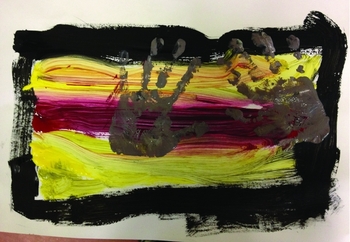
The first image he paints is of the Aboriginal flag. He renders it both on paper and onto his hand. On paper it is inset on the page with a wide, white border around it. I feel it is painted with a definite and loud ‘voice’ (Figure 1). I wonder is he telling me he is an Aboriginal? Is he asking if I am Aboriginal? Aboriginality is not identified by skin colour but by relationship. Or is he expressing his anger at the colonisation and the oppression of Aboriginal people? Or was this about the session ending?
Throughout this session, he is dominating and demanding. I do as he asks and try to stay with him throughout the session. I am not here to educate. I am here for him to explore his feelings and his possible ‘becoming’. I wonder if he sees my struggle? Is my struggle dominant, or are we struggling together?
He then paints his hand, wanting to make handprints on something. . .on anything. They are made hurriedly as he is getting ready to go back to class. He puts his print over every image he made during the 50 minutes. The feeling is frenetic as he runs around placing his painted hand on the work he has made. These images aren't destroyed in this process; in fact, his handprints feel almost like the final touches to the work. Is he making his mark? I wonder what he is claiming?
Our Second Session
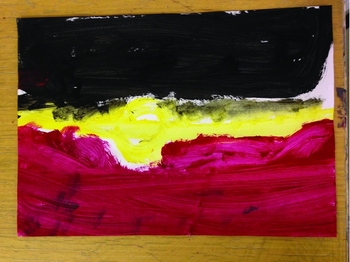
About midway through Jannali paints another flag (Figure 2). This time the paint goes to the edges and has an aesthetic/pleasing quality about it. In this session he is as demanding as before, and although I do as he demands, I also begin to engage with him about these ideas. Like the first session, he keeps his distance from me. He speaks to me in a political voice, which I feel is unusual for a young boy. I have come to know this is not so unusual in Aboriginal communities. He talks about the blacks in Africa. The 1965 Freedom Bus Ride from inner city Sydney into country New South Wales and the re-enactment of that same ride, held this year, its 50th anniversary.
‘Becomings’ 1
In reflecting on these first two sessions, two main issues are manifest: Jannali's political challenges and his ‘mark making’. As previously stated, Jannali was referred for art therapy because his teacher was concerned for him and his educational and social development. He was unable to sit still in class, to participate in set activities and commanded a great deal of her time. In our first art therapy session, he was initially distant and very demanding. I was aware that he was bringing race (and gender among other issues) to the forefront, and in doing so highlighting the differences in our ‘coming together’ (Conolly & King, Reference Conolly, King, Meyerowitz-Katz and Reddick2017, p. 62). As a white Australian woman, I was very conscious of my whiteness when working with Jannali. I was a white therapist ‘helping’ an Aboriginal person, with all the attendant associations to histories of colonisation and interventionism.
I was also aware that I was bringing a Westernised construct (therapy) to these encounters. In recognising this latter concern, I refer to the work of art therapy scholar Linnell (Reference Linnell and Galindurra2009) who argues that Indigenous people are best positioned to work with their own and if no such person is available, then very close collaboration (Atkinson, Reference Atkinson2002; Linnell & Galindurra, Reference Linnell and Galindurra2009; McKenna, Reference McKenna2013) with the elders and the community is paramount. However, as was the case with Linnell, a person was not available at the school or in the community when I started to work with Jannali. It was from this place that I had to explore the meaning of the work for me and for those I worked alongside. As Linnell states, to not work in close collaboration and consultation with the school (Gilroy & Hanna, Reference Gilroy, Hanna, Hiscox and Calish1998) and local community ‘would be to perpetuate major aspects of the colonization that I am seeking to resist ‘(Linnell, Reference Linnell and Galindurra2009, p. 187)
In regard to Jannali's ‘mark making’, at this stage I was not sure if the gesture of putting his hands on all the work and the furniture was a desire to return or if he was leaving something of himself with me. Whether one or the other, ‘mark making’ in art therapy has been theorised as having an important role to play in developing learning and the attainment of communication skills (Sandle, Reference Sandle1998, p. 4).
It is also important to think about what is lost, found or constructed in the process of ‘becoming’ in the therapeutic space. It is not my place to privilege any position such as those based on power or race, but to provide a space in which these issues and ideas can be brought forward and explored together. This makes the therapeutic work a place to bring differences; a liminal space. Through mutuality and play, the ‘colonising gaze’ (Haraway, Reference Haraway2008), mentioned earlier in this paper, is partially diverted, if only temporarily, to allow us both the possibility of change.
Our Third Session
Just towards the end, the flag is drawn again. This time it is in pencil, speedily constructed and not discussed. In this session Jannali positions himself closer to me and says he likes to spend time here and tells me he wishes to continue spending time with me. The presence of our differences is still with us, but is it now part of ‘our’ landscape and not the dominating voice. He lets me know he likes being with me, ‘Together’.
I sit on the chair while he paints on the floor. He moves his body close to mine, eventually pressing it firmly against my legs. We make contact. It feels like prior to this he has been circling me, trying to find a place to land, to settle. In this moment, I feel he has ‘landed’.
He is using the colours of red, yellow and black (the colours of the Aboriginal Flag) but there is no recognisable image of the flag. This image is then put to the side and he requests we spend some time drawing together, on the same piece of paper. He wants me to draw a line and then he will continue it. This goes on until the end of the session. I feel like this is a big move for us. We are working together, to make something. Up until now mess making has been his dominant means of expression. The mess making hasn't stopped, but the sessions now also include play, art making and talking.
A Session Towards the End of the Year
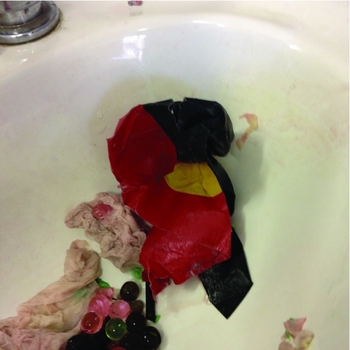
Jannali discovers a store bought Aboriginal flag stuck on the wall of the room. He takes the flag off the plastic stick, paints over it with grey paint and then screws it up. He then pushes it into a container which he fills with water. When I ask him about it he says, ‘it's something I have to do’. He then blows his nose into a tissue and puts this into the container along with some chalk and other items he has collected. All these incongruent things he has put together. . . What is he trying to reconcile? What is he trying to submerge?
I see he struggles with his identity as an Aboriginal boy, as a student, possibly as a brother and son, and perhaps in the world at large. My sense is that he is told that he should be proud of his skin, his ancestors, his family and his Aboriginality. I wonder if his experience supports this notion?
In the early part of our working together I struggled to hold his face in my mind. I wondered if this was because I am forgetful. I don't believe so! I am able to ‘see’ and ‘hold’, in my mind, all the children's faces I work with. Is it because he was struggling to see himself, to find himself, to know himself?
As he comes to find or know his broad spectrum of feelings, and challenge the information that has been imposed on him or has been given to him, I can see that he is coming up against edges, boundaries, both his and mine. As he begins to take form in my mind, is he taking his own form? (Figure 3)
FIGURE 3
Red, black and yellow.
‘Becomings’ 2
In building our relationship, Jannali and I heard the voices of dominating others: the school, members of his family, his peers, a history of oppressive whiteness and other loud overbearing voices. I could see he was expressing, both through his painting and his physical distance from me, the collision and merging of race among other forces.
In allowing a space for his becoming/s and in welcoming all his feelings through ‘mess making’, Jannali slowly came to find or know his broad spectrum of feelings, and to challenge the information imposed on him or given to him. Throughout my experience with him, the sound of his struggle was almost deafening. This wall of sound was visual, physical, emotional and spiritual. I hoped that he would come into focus for himself so that he would be able to settle as comfortably as possible into his family, his school life, communities and predominantly his own skin. I believe this seeking of his self is possible within the therapeutic relationship, particularly when art is at its centre. I am inspired by philosopher, Elizabeth Grosz, who suggests, ‘art is where life most readily transforms itself, the zone of indetermination through which all becomings must pass’ (Reference Grosz2008, p. 76).
In thinking about the therapeutic relationship, it is vital to bring in philosopher Kelly Oliver and her theorising on ‘witnessing’. For Oliver (Reference Oliver2001), witnessing is not just about the need for recognition that is the struggle for identity in the politics of recognition (queer, race, disability and so on). Recognition is a ‘symptom of the pathology of domination’ propagating the same/different and object/subject hierarchies (p. 224). Suggesting that relations with others do not have to be ‘hostile alien encounters’, Oliver argues that they can be ‘loving adventures (and) the advent of something new’ (p. 224). Oliver goes on to suggest: ‘the process of witnessing . . .gives us the power to be, together. And being together is the chaotic adventure of subjectivity’ (p. 224). Oliver's ideas resonate with my intention/desire of being in this space with (an)other, and are also my challenge.
Our Final Session
12:10 - I go to his class to collect him for our session. When he sees me at the door he gets up and comes to my side and we walk to our room, together. As we enter, I ask him if he would like a paint shirt. In answer to this he pulls off his school shirt and throws it onto a chair. Sitting down at the table, he tells me it smells like me. I ask him what smells and he tells me the T-shirt. I then wonder aloud to him: ‘how does that smell to you?‘ Pulling his shirt from his body he indicates for me to come closer and we both smell the shirt. He says, ‘nice’. I wonder what he smells. Or what does he want to smell, or be reminded of?
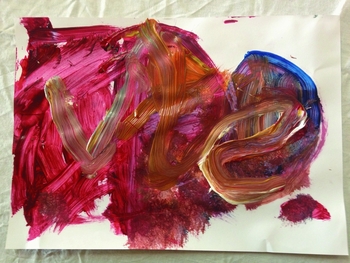
Dipping his brush into the red paint, he begins to make a letter. He is writing, trying to form a word. As usual when he writes he wants me to tell him what he has written. I sound out the word to him. I don't want to say what the word is, as I have come to know the word I think he is writing is not what he wants it to say. He continues to paint – writing, trying to form letters and words. I wonder what he is trying to form, make sense of. We sound out the letters. He paints over them, and mixes up the paint. I remind him there is a break coming up. We have one more session together before the school holidays. He begins to paint over the letters and then writes two letters, W & E. I sound out the W and then the E and say WE. He says ‘you and me’. I say, ‘you and me, WE’. He says ‘yes’. He then makes an action saying the writing is, and waves his hand around – I say ‘running writing’ – he says ‘together’. (Figure 4)
‘Becomings’ 3
In working together, Jannali and I started with no particular goals – none that he spoke of, and I definitely had none, other than to provide a space for him and what he would bring. I came to know that he was capable of reading and writing, but seemed unable to ‘fit’ anything more in. He was full; full of his and others’ unknowing and unbearableness. I also came to know he lived with a violent man, although I did not see any physical manifestations of this violent behaviour. I believe Jannali's learning suffered as a result of his, and his community's, trauma.
Towards the end of 2015, I spoke with his teacher. She told me that Jannali settled more easily in his transitions to different activities; that he seemed to play better with others at break times; and if a question was asked, he would raise his hand and say: ‘I know the answer to that, I can answer that’.
Conclusion
In this paper, I have offered my impressions of our work together to show how a relationship of great value developed between myself and Jannali, one that was transformational for us both.
Through his ‘mess making’ Jannali eventually stopped using his dissociated and repeated political responses to situations of power to avoid connection and we came together in the therapeutic space. Without words to express his feelings he was able to let me into his world, and through connection and struggle forge an identity as a learner.
When thinking about my role as an art therapist and the issues that are to be engaged with, I often return to Carmen Lawson's words: ‘(t)his is what happens when the client is with me as the counsellor or the therapist. I get to know myself too’ (McKenna, Reference McKenna2013, p. 16). Lawson, one of the first Aboriginal art therapists in Australia, explains what can happen through art therapy, particularly in regard to collaboration and connections to art, listening and witnessing. She states that ‘we have been doing art for a long time. Indigenous Australians drew the rock stories and they draw them now. I think we have been doing art therapy as long as we have been alive and in ways we can all learn from’ (McKenna, Reference McKenna2013, p. 16).





 You have
Access
12:10 pm: Wednesday. I walk to the classroom and collect Jannali for art therapy. This walk is the beginning of our session. There are two paths which can be taken to the room where we work. One takes us through the lunchroom where a large group of young children are eating; the other, around it. Every time we approach the lunchroom, I suggest we go around it. But each time he opens the lunchroom door with an energy that draws the attention of those in it. He then walks through with his head high, smiling. I constantly hope we will take the path around the lunchroom; I always take this path and wait for him at the door to our room. This time, at my suggestion to go around the lunchroom, he stops, opens the door as usual and then pauses. He closes the door. This pause is hardly recognisable, but it feels meaningful to me. In this instance he chooses to share the path with me.
Once inside the room he goes to his art kit. Next to it he finds a can of shaving foam, which I had placed there earlier. He is immediately excited by his discovery. He asks me what it is and as I begin to explain, he sprays the wall and door, covering each surface in white, velvety foam. I suggest he aims at a target, indicating the paper I had taped to the wall for him earlier. To this, he mostly obliges. I can see he is taken by the texture and sensory properties of the foam. He sprays a large mound of the shaving foam onto the table and then pours the paint from his palette over the foam. He plunges his hands into the paint and foam, spreading it all over the table. He pushes and pulls the mixture, smoothing it out one way and then pulling his fingers back through it, disturbing its velvety evenness.
As he is doing this he talks about being a ‘blackfella’, and tells me that he is a ‘blackfella’. He then asks me to put my hands in the mixture with him. His choice to walk with me today comes into my mind. He says he wants me “to feel it”. He then asks me “Are you a blackfella?” I say “No, I am a whitefella”. At this he looks me in the eye and says, “NO. You're a blackfella”.
Introduction
In this paper I invite you, the reader, to ‘walk’ with me and a 7-year-old Australian Aboriginal boy, who for the purposes of this article will be known as ‘Jannali’. Jannali and I met 25 times for art therapy throughout the course of 2015, forging a relationship with ‘mess making’ at its core. Our work together was part of an internship for my Masters of Art Therapy. Jannali's trauma had marked him as a candidate for the art therapy programme at his school. It presented in his struggle to learn, and to identify as an Aboriginal boy living in a white colonised nation. Through his ‘mess making’ and his ‘mark making’, as well as the welcoming of all his feelings in the therapeutic space, he began his journey as a learner where previously he was not. Additionally, both of us became a ‘we’ by the end of our time together, despite differences in race (and gender and age), and not without our struggles.
It is my intention for this paper to reach as broad a readership as possible, not just fellow art therapists. This is because I want art therapy to become an important modality in the healing of childhood trauma across a range of services. Since readers may not be familiar with art therapy, I will first define some key terms. As used here, ‘art therapy’ refers to a form of psychotherapy, which uses the creative process as a vehicle for healing, communication, self-expression and personal growth (Malchiodi, Reference Malchiodi2012, p. 1). It differs from traditional art making or performance in that the emphasis is on the process of creating and meaning-making, rather than on an end product, although any work produced in an art therapy session is treated as a mediation between the conscious and the unconscious, giving form to what is often ‘inexpressible or unspeakable’ (Case & Dalley, Reference Case and Dalley2006, p. 37). ‘Mess making’ in art therapy is understood to be the presentation of deep levels of distress and trauma through the use of various art mediums and play materials (Andrade del Corro, Reference Andrade del Corro, Meyerowitz-Katz and Reddick2017, p. 141). As art psychotherapists, Meyerowitz-Katz and Reddick (Reference Meyerowitz-Katz and Reddick2017, p. 187), contend ‘in existing art therapy literature there is a strong link between mess and trauma (Russell, Reference Russell2011), including relational trauma (O'Brien, Reference O'Brien2004; Reddick, Reference Reddick1999) [and] domestic violence (Case, Reference Case2003; Malchiodi, Reference Malchiodi1990).’
When I refer to ‘becoming’ and its plural ‘becomings’, I employ drama therapist Reference MayorMayor's (2012), distillation of critical race theory in the work of posthumanist scholar Haraway (Reference Haraway2008) and others (Johnson, Reference Johnson2005; Saldanha, Reference Saldanha2007 in Mayor, Reference Mayor2012). Within critical race theory, race is not conceived as fixed but rather in terms of process, being fashioned, performed and embodied when at least two bodies make contact. That is, people are not born white or black, but are always becoming their race. In this way, race, as an essentialised or static concept is shifted, and a space for transformation becomes possible (Mayor, Reference Mayor2012). In “becoming with” the other, lies the potential for change (Mayor, Reference Mayor2012, p. 216). Of special interest for this paper is Haraway's modification of the idea of the ‘colonizing gaze’. For Haraway, ‘looking back or noticing might forge a different kind of relationship through mutuality and play. In this way, both parties change and become with one another; transformation occurs through relationship’ (cited in Mayor, Reference Mayor2012, p. 216).
After each session with Jannali I recorded my impressions, which will be disclosed later on in this article to inform and strengthen my central argument: that art therapy be considered a seminal player in work with children and trauma when their trauma is inhibiting their ability to learn and flourish. Further, I contend that in cross-cultural contexts, whether or not language is present, the usefulness of art therapy is augmented. I am emboldened in these claims by the recent arguments of psychoanalyst Fonagy (Reference Fonagy2012, p. 90) who advocates that:
art therapy has the key, or perhaps a key, to our understanding of the mechanisms underpinning change in all kinds of psychological treatments. This is in part because many forms of art therapy are not principally language . . . but mostly because art therapy is closest to what we now understand to be the embodied roots of human consciousness and cognition.
I contend that the work Jannali and I did together was transformative, not only for him, but also for me. I assert that the transformation was intimately connected to a relationship shaped through my ability to bear his hunger for connection, his despair and his need to be seen, heard and witnessed, usually expressed through his ‘mess making’. Despite the sometimes disabling effects of the mess on me – occasionally, at the end of our sessions, I would stand in the middle of it, unable to move – I was able to welcome all of him and his feelings into the room.
Although, Jannali had no words for what was happening for him, he was able to show me his distress through this powerful physical communication. His ability to ‘tell’ me what was or had happened to him was unavailable to him. Trauma in this instance had ruptured his ability to verbally express his worries, concerns and distress (Charles, Reference Charles2014). Art psychotherapist O'Brien (Reference O'Brien2004, p. 12), working with a disturbed young child, states that ‘mess both accesses and responds to a chaotic and fragmented early life’. She also states, bravely, that at times she felt afraid of the material presented and that through her ability to bear what was presented to her, change was possible (O'Brien, Reference O'Brien2004, p. 12).
My thoughts of our work together tell as much about my experience as a white woman and an art therapist, as about the changes that our relationship, built on the foundation of art therapy, made to Jannali's learning and his ability to be in community, including his relationships with teachers and other students. They tell a story of the struggle for identity, the possibility of breaking the transmission of transgenerational trauma and, ultimately, how art therapy may provide a space for these issues to be considered, tested and explored. Before I move on to an exploration of our work together via my impressions and comments on them (Becomings), I will first clarify what I mean when I refer to trauma, transgenerational trauma (in relation to Australian Aboriginal people) and the connection between art therapy and the healing of trauma. I will then give some contextual information to the work with Jannali and also briefly outline some ethical issues and how they were managed.
Trauma
Trauma is an experience that is the result of an event, or events, which fracture or rupture a sense of self. It can also be said that trauma is a psychophysical event that becomes apparent through the human psyche, the relational system and the nervous systems (Schore, Reference Schore2001). Remainders of these experiences can be held within the body for a long time, or in some cases indefinitely, following the actual event (Elbrecht & Antcliff, Reference Elbrecht and Antcliff2014). Traumatic memories usually lack verbal context and narrative and are encoded in sensations and images (Herman, Reference Herman2010). Psychoanalytic theories tend to hold that it is in talking about trauma that the self can recover its wholeness. Yet a principal ambiguity inherent in this approach is that trauma affects the ability to speak (Ogden & Minton, Reference Ogden and Minton2000). The literature of early relational development (Gerhardt, Reference Gerhardt2004) theorises that a fundamental element in recovery from trauma is the ability to self-regulate. Adding to this picture, research in neuroscience (Perry, Reference Perry1998; Schore, Reference Schore2001, Reference Schore2002) advises that the right-brain favours expression in non-verbal ways, such as drawing or painting, to describe feelings or events.
Art Therapy, Trauma and Children
Heeding these research findings from early relational development and neuroscience scholarship, some art therapists (Elbrecht & Antcliff, Reference Elbrecht and Antcliff2014; Meyerowitz-Katz, Reference Meyerowitz-Katz and Reddick2017; O'Brien, Reference O'Brien2004) have found that art therapy can provide a bridge between the traumatic event and its recovery, as it offers a system of working with images and sensory materials. In art therapy, dialogue within the therapeutic relationship is not central. In this way, art therapy has been noted to offer a significant and relevant contribution to recovery from trauma.
To date, very little scholarship has emerged in the art therapy literature on the effects of trauma on children. A recent publication edited by Meyerowitz-Katz and Reddick (Reference Meyerowitz-Katz and Reddick2017) is an important offering as it goes some way towards filling this space. As art psychotherapist Rowe (Reference Rowe, Meyerowitz-Katz and Reddick2017, p. 32) maintains with regard to young children, ‘intense pre-verbal experiences are brought to the therapy space, [and] enacted in the art making’. The current article is a move in this direction and, in particular, addresses the transgenerational trauma of Australian aboriginal children and the role that ‘art therapy’ can play in attending to it.
Transgenerational Trauma
Cyclically passed from adults to children as ‘collective emotional and psychological injury, over the lifespan and across generations’ (Muid, Reference Muid2006, n.p.), transgenerational trauma for Australian Aboriginal people under colonisation has come about from many brutalities including: the loss of land and resources, the forced removal of children and physical and emotional abuse (Tracey, Reference Tracey2015). These losses undermine their culture, tradition, language and spirituality. This historic trauma has impacted all aspects of Aboriginal life and created an increased awareness by Aboriginal peoples of the relationship between such trauma and maladaptive social behaviour and distress in their own communities (Wesley-Esquimaux & Snowball, Reference Wesley-Esquimaux and Snowball2010).
Ethical Considerations
In this paper, I have seriously considered the possible impact the publication of this material might have on my client, his family, his school and his communities. As a result, I have taken great care to de-identify the client, the location, the organisation and my location in Australia. Permission was sought by his current guardian to use this material, including his artwork for publication, and the risks of identification were explained.
Further, I am aware that writing about my relationship with an indigenous child from my point of view in an academic journal could be seen to be taking an authoritative stance based in a Western knowledge system far removed from the reality of the subject of my paper, Jannali, and thus privileging my voice over his. Anthropologist, Dwight Conquergood, encapsulates this as a ‘view from above the object of inquiry: knowledge that is anchored in paradigm and secured in print’ (Reference Conquergood2002, p. 146). However, ‘knowing’ people and their social world in all their complexity takes time and understanding and there are many pitfalls when writing about ‘the Other’. Conquergood suggests that instead of speaking about ‘the Other’, one speaks to and with. It is from an ongoing conversation that a deep understanding not a definitive knowing can be achieved. Through this enduring conversation, both within and without the therapeutic relationship a deeper understanding of one's self, one's field and the Other, can come about. Conquergood's ideas have guided my ethical interests in this paper.
A Few Brief Thoughts on My Process
My relationship with Jannali developed in the early days of my work as an art therapist. My own creative process, my clinical supervision and my writing, all became important tools in processing the overwhelming feelings I often experienced when working with him. This practice of recording my thoughts and feelings via notes, voice memos, mark making, and clinical and reflective writing has become a vital part of my practice as an art therapist. I feel my own practice was echoed in the appearance of Jannali's flag images. The development of these images, both in their construction and deconstruction, seemed Jannali's way of processing his inner most thoughts and feelings. Like the path that eventually guided us to our room, reconciling these images and their embedded meaning created the thematic bearings in the reflections presented in this paper. This paper is by no means the sum of our work together, but a small important vignette.
Our Meetings
The meetings between Jannali and myself were funded by a not-for-profit organisation, which is made up of professionals, both Aboriginal and non-Aboriginal, working side by side. Attachment theory is at the very core of the organisation, and all its programmes are based in psychoanalytic theory. Art is an accessible language for many, particularly children, and is an integral part of Aboriginal culture. The art therapy programme at this organisation is centred on the recognition that a child's most intense thoughts and feelings, although hidden, might be able to find expression in art making.
Our meetings took place in an Aboriginal school in rural Australia. The sessions with Jannali took place at 12:10 pm and were 50 minutes long – an analytic hour. Our time together was sandwiched between two other art therapy sessions: the first, a small group of pre-schoolers, and then, following my session with Jannali, a primary school group. The time between each session was approximately 15 minutes, which was just enough time to document the work, clean up and prepare for the next session.
At the start of our work together, I was not briefed, nor did I ask for Jannali's history as I wished to make my own assessment. I wanted to come to know him outside of what others thought or had identified him as being. His teacher, a concerned and compassionate educator, told me he struggled with learning and referred Jannali to the art therapy programme, as he was “disruptive, distracted and unsettled in class”. These behaviours are in line with what recent neurobiological, epigenetic and psychological studies have shown: traumatic experiences in young children can lessen attention, recall, and the organisational and linguistic skills and aptitudes children need to flourish (Helping Traumatized Children to Learn). There were many difficulties engendered by Jannali's transgenerational trauma, including his problems with literacy, exposure to violence, compromised health, sensitivity to power and ‘anxiety related maladaptive behaviour’ (Atkinson, Reference Atkinson2013; Halloran, Reference Halloran2004). All these difficulties became apparent to me as our relationship developed.
Jannali's literacy was poor and throughout our time together I was able to see and feel his frustration and distress as he struggled to read or write in our sessions. I witnessed he was needy and hungry for connection, and a means to express himself, both physically and emotionally. I also witnessed the development of Jannali's ability to play and imagine, which I think opened up a space for him to learn. What I discovered about him was altogether different from his original presentation. I discovered he was gentle, smart, funny, brave, angry, willing, and a fast runner.
Art therapy is a process of becoming and unfolding into the unknown for both the client and the therapist (Mayor, Reference Mayor2012). Learning is also about the ability to go to these spaces of unknowing (Todd, Reference Todd2003). Are these liminal spaces of possibility where relationships across cultures may be built? Liminality, with its origins in the latin word ‘limen’ meaning encounters with thresholds, has been well theorised across social anthropology, especially in relation to rite of passage social rituals (see Turner, Reference Turner1969). The notion has been taken up in many other disciplines, including art therapy (see Haywood, Reference Haywood2012).
Mayor (Reference Mayor2012), has worked with the notion of liminality in reference to the roles of race and power differences in the therapeutic alliance, important in regard to my work with Jannali. Mayor (Reference Mayor2012, p. 214) emphasises the importance of playing with these roles otherwise ‘one risks missing the client altogether’. She further suggests that ‘(b)y playing at the margins and boundaries of another, new and unexpected dynamics may occur in this liminal space where both the therapist and client are transformed’ (p. 214). Art making in the therapeutic context is a liminal space where we can meet and be with another, the other. It is here in this space that I meet with Jannali.
Our First Session
The first image he paints is of the Aboriginal flag. He renders it both on paper and onto his hand. On paper it is inset on the page with a wide, white border around it. I feel it is painted with a definite and loud ‘voice’ (Figure 1). I wonder is he telling me he is an Aboriginal? Is he asking if I am Aboriginal? Aboriginality is not identified by skin colour but by relationship. Or is he expressing his anger at the colonisation and the oppression of Aboriginal people? Or was this about the session ending?
Throughout this session, he is dominating and demanding. I do as he asks and try to stay with him throughout the session. I am not here to educate. I am here for him to explore his feelings and his possible ‘becoming’. I wonder if he sees my struggle? Is my struggle dominant, or are we struggling together?
He then paints his hand, wanting to make handprints on something. . .on anything. They are made hurriedly as he is getting ready to go back to class. He puts his print over every image he made during the 50 minutes. The feeling is frenetic as he runs around placing his painted hand on the work he has made. These images aren't destroyed in this process; in fact, his handprints feel almost like the final touches to the work. Is he making his mark? I wonder what he is claiming?
Loud voice.
Our Second Session
About midway through Jannali paints another flag (Figure 2). This time the paint goes to the edges and has an aesthetic/pleasing quality about it. In this session he is as demanding as before, and although I do as he demands, I also begin to engage with him about these ideas. Like the first session, he keeps his distance from me. He speaks to me in a political voice, which I feel is unusual for a young boy. I have come to know this is not so unusual in Aboriginal communities. He talks about the blacks in Africa. The 1965 Freedom Bus Ride from inner city Sydney into country New South Wales and the re-enactment of that same ride, held this year, its 50th anniversary.
To the edges.
‘Becomings’ 1
In reflecting on these first two sessions, two main issues are manifest: Jannali's political challenges and his ‘mark making’. As previously stated, Jannali was referred for art therapy because his teacher was concerned for him and his educational and social development. He was unable to sit still in class, to participate in set activities and commanded a great deal of her time. In our first art therapy session, he was initially distant and very demanding. I was aware that he was bringing race (and gender among other issues) to the forefront, and in doing so highlighting the differences in our ‘coming together’ (Conolly & King, Reference Conolly, King, Meyerowitz-Katz and Reddick2017, p. 62). As a white Australian woman, I was very conscious of my whiteness when working with Jannali. I was a white therapist ‘helping’ an Aboriginal person, with all the attendant associations to histories of colonisation and interventionism.
I was also aware that I was bringing a Westernised construct (therapy) to these encounters. In recognising this latter concern, I refer to the work of art therapy scholar Linnell (Reference Linnell and Galindurra2009) who argues that Indigenous people are best positioned to work with their own and if no such person is available, then very close collaboration (Atkinson, Reference Atkinson2002; Linnell & Galindurra, Reference Linnell and Galindurra2009; McKenna, Reference McKenna2013) with the elders and the community is paramount. However, as was the case with Linnell, a person was not available at the school or in the community when I started to work with Jannali. It was from this place that I had to explore the meaning of the work for me and for those I worked alongside. As Linnell states, to not work in close collaboration and consultation with the school (Gilroy & Hanna, Reference Gilroy, Hanna, Hiscox and Calish1998) and local community ‘would be to perpetuate major aspects of the colonization that I am seeking to resist ‘(Linnell, Reference Linnell and Galindurra2009, p. 187)
In regard to Jannali's ‘mark making’, at this stage I was not sure if the gesture of putting his hands on all the work and the furniture was a desire to return or if he was leaving something of himself with me. Whether one or the other, ‘mark making’ in art therapy has been theorised as having an important role to play in developing learning and the attainment of communication skills (Sandle, Reference Sandle1998, p. 4).
It is also important to think about what is lost, found or constructed in the process of ‘becoming’ in the therapeutic space. It is not my place to privilege any position such as those based on power or race, but to provide a space in which these issues and ideas can be brought forward and explored together. This makes the therapeutic work a place to bring differences; a liminal space. Through mutuality and play, the ‘colonising gaze’ (Haraway, Reference Haraway2008), mentioned earlier in this paper, is partially diverted, if only temporarily, to allow us both the possibility of change.
Our Third Session
Just towards the end, the flag is drawn again. This time it is in pencil, speedily constructed and not discussed. In this session Jannali positions himself closer to me and says he likes to spend time here and tells me he wishes to continue spending time with me. The presence of our differences is still with us, but is it now part of ‘our’ landscape and not the dominating voice. He lets me know he likes being with me, ‘Together’.
I sit on the chair while he paints on the floor. He moves his body close to mine, eventually pressing it firmly against my legs. We make contact. It feels like prior to this he has been circling me, trying to find a place to land, to settle. In this moment, I feel he has ‘landed’.
He is using the colours of red, yellow and black (the colours of the Aboriginal Flag) but there is no recognisable image of the flag. This image is then put to the side and he requests we spend some time drawing together, on the same piece of paper. He wants me to draw a line and then he will continue it. This goes on until the end of the session. I feel like this is a big move for us. We are working together, to make something. Up until now mess making has been his dominant means of expression. The mess making hasn't stopped, but the sessions now also include play, art making and talking.
A Session Towards the End of the Year
Jannali discovers a store bought Aboriginal flag stuck on the wall of the room. He takes the flag off the plastic stick, paints over it with grey paint and then screws it up. He then pushes it into a container which he fills with water. When I ask him about it he says, ‘it's something I have to do’. He then blows his nose into a tissue and puts this into the container along with some chalk and other items he has collected. All these incongruent things he has put together. . . What is he trying to reconcile? What is he trying to submerge?
I see he struggles with his identity as an Aboriginal boy, as a student, possibly as a brother and son, and perhaps in the world at large. My sense is that he is told that he should be proud of his skin, his ancestors, his family and his Aboriginality. I wonder if his experience supports this notion?
In the early part of our working together I struggled to hold his face in my mind. I wondered if this was because I am forgetful. I don't believe so! I am able to ‘see’ and ‘hold’, in my mind, all the children's faces I work with. Is it because he was struggling to see himself, to find himself, to know himself?
As he comes to find or know his broad spectrum of feelings, and challenge the information that has been imposed on him or has been given to him, I can see that he is coming up against edges, boundaries, both his and mine. As he begins to take form in my mind, is he taking his own form? (Figure 3)
Red, black and yellow.
‘Becomings’ 2
In building our relationship, Jannali and I heard the voices of dominating others: the school, members of his family, his peers, a history of oppressive whiteness and other loud overbearing voices. I could see he was expressing, both through his painting and his physical distance from me, the collision and merging of race among other forces.
In allowing a space for his becoming/s and in welcoming all his feelings through ‘mess making’, Jannali slowly came to find or know his broad spectrum of feelings, and to challenge the information imposed on him or given to him. Throughout my experience with him, the sound of his struggle was almost deafening. This wall of sound was visual, physical, emotional and spiritual. I hoped that he would come into focus for himself so that he would be able to settle as comfortably as possible into his family, his school life, communities and predominantly his own skin. I believe this seeking of his self is possible within the therapeutic relationship, particularly when art is at its centre. I am inspired by philosopher, Elizabeth Grosz, who suggests, ‘art is where life most readily transforms itself, the zone of indetermination through which all becomings must pass’ (Reference Grosz2008, p. 76).
In thinking about the therapeutic relationship, it is vital to bring in philosopher Kelly Oliver and her theorising on ‘witnessing’. For Oliver (Reference Oliver2001), witnessing is not just about the need for recognition that is the struggle for identity in the politics of recognition (queer, race, disability and so on). Recognition is a ‘symptom of the pathology of domination’ propagating the same/different and object/subject hierarchies (p. 224). Suggesting that relations with others do not have to be ‘hostile alien encounters’, Oliver argues that they can be ‘loving adventures (and) the advent of something new’ (p. 224). Oliver goes on to suggest: ‘the process of witnessing . . .gives us the power to be, together. And being together is the chaotic adventure of subjectivity’ (p. 224). Oliver's ideas resonate with my intention/desire of being in this space with (an)other, and are also my challenge.
Our Final Session
12:10 - I go to his class to collect him for our session. When he sees me at the door he gets up and comes to my side and we walk to our room, together. As we enter, I ask him if he would like a paint shirt. In answer to this he pulls off his school shirt and throws it onto a chair. Sitting down at the table, he tells me it smells like me. I ask him what smells and he tells me the T-shirt. I then wonder aloud to him: ‘how does that smell to you?‘ Pulling his shirt from his body he indicates for me to come closer and we both smell the shirt. He says, ‘nice’. I wonder what he smells. Or what does he want to smell, or be reminded of?
Dipping his brush into the red paint, he begins to make a letter. He is writing, trying to form a word. As usual when he writes he wants me to tell him what he has written. I sound out the word to him. I don't want to say what the word is, as I have come to know the word I think he is writing is not what he wants it to say. He continues to paint – writing, trying to form letters and words. I wonder what he is trying to form, make sense of. We sound out the letters. He paints over them, and mixes up the paint. I remind him there is a break coming up. We have one more session together before the school holidays. He begins to paint over the letters and then writes two letters, W & E. I sound out the W and then the E and say WE. He says ‘you and me’. I say, ‘you and me, WE’. He says ‘yes’. He then makes an action saying the writing is, and waves his hand around – I say ‘running writing’ – he says ‘together’. (Figure 4)
WE.
‘Becomings’ 3
In working together, Jannali and I started with no particular goals – none that he spoke of, and I definitely had none, other than to provide a space for him and what he would bring. I came to know that he was capable of reading and writing, but seemed unable to ‘fit’ anything more in. He was full; full of his and others’ unknowing and unbearableness. I also came to know he lived with a violent man, although I did not see any physical manifestations of this violent behaviour. I believe Jannali's learning suffered as a result of his, and his community's, trauma.
Towards the end of 2015, I spoke with his teacher. She told me that Jannali settled more easily in his transitions to different activities; that he seemed to play better with others at break times; and if a question was asked, he would raise his hand and say: ‘I know the answer to that, I can answer that’.
Conclusion
In this paper, I have offered my impressions of our work together to show how a relationship of great value developed between myself and Jannali, one that was transformational for us both.
Through his ‘mess making’ Jannali eventually stopped using his dissociated and repeated political responses to situations of power to avoid connection and we came together in the therapeutic space. Without words to express his feelings he was able to let me into his world, and through connection and struggle forge an identity as a learner.
When thinking about my role as an art therapist and the issues that are to be engaged with, I often return to Carmen Lawson's words: ‘(t)his is what happens when the client is with me as the counsellor or the therapist. I get to know myself too’ (McKenna, Reference McKenna2013, p. 16). Lawson, one of the first Aboriginal art therapists in Australia, explains what can happen through art therapy, particularly in regard to collaboration and connections to art, listening and witnessing. She states that ‘we have been doing art for a long time. Indigenous Australians drew the rock stories and they draw them now. I think we have been doing art therapy as long as we have been alive and in ways we can all learn from’ (McKenna, Reference McKenna2013, p. 16).