Introduction
The Māori economy has grown in prominence, size and significance in the economic landscape of a post-Treaty settlement era in Aotearoa (Māori name for New Zealand). The economy of Aotearoa is predominantly agriculturally based, but there has been intense growth in the technological and service sectors. The Māori economy asset base is valued at $68.7 billion and the Māori economy is estimated at contributing $34 billion annually to New Zealand's GDP (Nana, Reid, Schulze, Dixon, Green, & Riley, Reference Nana, Reid, Schulze, Dixon, Green and Riley2020). Amoamo, Ruwhiu, and Carter (Reference Amoamo, Ruwhiu and Carter2018) highlight that the Māori economy may have distinctive aspects and thus greater attention is needed to ‘more accurately represent the rich diversity of Māori enterprise that has evolved’ (p. 66). Despite this growth in attention towards the Māori economy and the comprising enterprises that might deliver such growth, we still understand little about Māori enterprises. Are they similar to other Aotearoa enterprises? Given that Māori represent one of the fastest-growing ethnicities in Aotearoa, understanding the attributes, operations and impacts of Māori enterprises is an increasing priority (Statistics New Zealand, 2013). Given the identification of Māori enterprises might be difficult, we follow the Statistics New Zealand approach, whereby enterprises self-identify as Māori (Statistics New Zealand., 2016).
Other factors make the exploration of Māori enterprises compelling. Recent attention towards Māori leadership has identified important lessons that can be learned from its practices and philosophy (Haar, Roche, & Brougham, Reference Haar, Roche and Brougham2019a; Roche, Haar, & Brougham, Reference Roche, Haar and Brougham2018; Ruwhiu & Elkin, Reference Ruwhiu and Elkin2016). Studies have indicated an increased focus on Māori business activities, from tribal entities (Barr & Reid, Reference Barr and Reid2014) to private entrepreneurship (Henry & Dana, Reference Henry, Dana, de Bruin and Teasdale2019; Mrabure, Ruwhiu, & Gray, Reference Mrabure, Ruwhiu and Gray2018). There is an active investigation on the role of Māori in science, technology and innovation (Ruckstuhl et al., Reference Ruckstuhl, Haar, Hudson, Amoamo, Waiti, Ruwhiu and Daellenbach2019) and studies have shown that Māori employees might react differently to otherwise established relationships from workplace phenomena (Haar & Brougham, Reference Haar and Brougham2013, Reference Haar and Brougham2016; Haar, Roche, & Taylor, Reference Haar, Roche and Taylor2012). For example, in a cross-cultural study of six countries and seven samples, Māori employees reported the highest work-life balance (including greater than New Zealand Europeans), and this is important because greater balance is linked to superior job and wellbeing outcomes (Haar, Russo, Sune, & Ollier-Malaterre, Reference Haar, Russo, Sune and Ollier-Malaterre2014).
Beyond these observations, scholars have suggested that indigenous people, such as Māori in Aotearoa, have a unique world view that helps shape the way enterprises are formed, and the type of activities they engage in (Henry & Pene, Reference Henry and Pene2001). Henry and Wolfgramm (Reference Henry and Wolfgramm2018) note that Māori have some of the oldest forms of social technology surviving into the 21st century, potentially providing fresh insights into how enterprises are formed and managed. Amoamo, Ruwhiu, and Carter (Reference Amoamo, Ruwhiu and Carter2018) agree that more research is needed to understand potential differences in Māori enterprises. Whereas Mika and O'Sullivan (Reference Mika and O'Sullivan2014) noted there are likely to be similarities between Māori and non-Māori enterprises. Thus, it could be that Māori organisations take a different focus on the construction of organisational forms, and perhaps have different focus areas. For example, Māori enterprises are likely to have a kaupapa (purpose) that aligns more strongly with Māori values, and this might lead to different strengths such as treating the employees at the organisation with care and having a sense of responsibility towards each other (Haar & Ghafoor, Reference Haar, Ghafoor, Wall, Cooper and Brough2021). A potential weakness might include unacceptance of such culture and values from some employees or reluctance to practice these values within the enterprise. Further, it has been suggested that Māori are especially entrepreneurial (Frederick & Chittock, Reference Frederick and Chittock2006), although the empirical evidence has been criticised (see Haar and Delaney, Reference Haar and Delaney2009). Specifically, individuals who were asked about their intent to create an enterprise were not followed to confirm whether they subsequently established one.
The present study makes three main contributions. First, there is a lack of empirical evidence comparing measurable attributes of Māori businesses (with non-Māori business), and we here report the first study that captures enough data to detail potential differences and similarities. First, we examine existing enterprises across a range of sectors and enterprise sizes, to determine whether self-identified Māori enterprises are different from non-Māori enterprises, and if so, in what ways. Second, we test a range of enterprise factors to test for these potential differences specifically. These factors are intellectual capital dimensions (human and relational capital), and we extend this to include a new factor in cultural capital. We also include entrepreneurial culture and organisational performance. Third, our analysis provides important insights into understanding Māori businesses and thus their potential valuable contributions to the Aotearoa economy.
Study factors
The next section focuses on the various factors being examined regarding a number of key enterprise factors, and we define and highlight their importance towards understanding the potential impact on organisational performance. Finally, we provide a section where we develop hypotheses around expected differences and similarities between Māori and non-Māori enterprises.
Intellectual capital
Intellectual capital is broadly defined and widely incorporates a number of different enterprise factors, with Aramburu and Sáenz (Reference Aramburu and Sáenz2011) highlighting two main categories used across the literature: (1) the knowledge perspective, including human-, social- and organisational-capital, and (2) the holistic perspective, which focus on human-capital, plus the internal- and external-structures of the organisation. Singh and Rao (Reference Singh and Rao2016) defined intellectual capital as ‘the sum of all organizational knowledge resources, which resides in aspects within as well as outside the organization’ (p. 132). This builds off the arguments of Galbraith (Reference Galbraith1969), who characterised intellectual capital as the entirety of an organisation's workforce, and their related brainpower activity, knowledge, skills and intellect that are used to create value for the enterprise. This makes intellectual capital knowledge that is accessible within and outside the enterprise including known and potentially useful information that can be gained through effective HR practices and promoting knowledge contained within human capital.
Ullah, Hameed, Kayani, and Fazal (Reference Ullah, Hameed, Kayani and Fazal2019) argued that intellectual capital comprises three key elements. And beyond the typical human- and structural-capital, they included relational-capital. They argued that relational-capital was interchangeable with social-capital and thus should be also considered. Hence, enterprises with a more skilled workforce should create value that is superior to competitors whose workforce is less skilled. Consequently, enterprises become driven to recruit, select, and retain better quality human resources because they have the potential to enhance performance. Further, enterprises with better relationships internally may be able to leverage these to achieve superior performance. Overall, enterprises that maximise the utilisation of these resources are expected to outperform competitors that do not have such superior intellectual capital (Teece, Pisano, & Schuen, Reference Teece, Pisano and Schuen1997).
Theoretically, Singh and Rao (Reference Singh and Rao2016) note that knowledge can be understood as being a product of intellectual capital, which can create unique processes that competitors cannot replicate easily. Thus, higher intellectual capital is valued because it suggests that a superior mixture of resources (people, processes, partnerships) that enterprises have is harder for competitors to acquire or copied and thus can lead to superior performance (Barney, Reference Barney1991). These unique combinations of resources keep renewing an enterprise's ability to outperform competitors (Hsu & Wang, Reference Hsu and Wang2012). The present study examines three forms of intellectual capital and acknowledges that this approach encompasses the broader and holistic perspective (Aramburu & Sáenz, Reference Aramburu and Sáenz2011): (1) human capital, (2) relational capital and (3) cultural capital. This latter factor is unique to this study but fits our focus on Māori business and the business context of Aotearoa, whereby Māori are guaranteed certain rights due to their relationship with the Crown (government), via the Treaty of Waitangi (ToW) which ‘is a broad statement of principles on which the British and Māori made a political compact to found a nation state and build a government in New Zealand’ (NZ History., 2021). We briefly define these below.
Human capital
Human capital is foundational to all forms of intellectual capital arguments (e.g., Aramburu & Sáenz, Reference Aramburu and Sáenz2011; Singh & Rao, Reference Singh and Rao2016; Ullah et al., Reference Ullah, Hameed, Kayani and Fazal2019). Dakhli and De Clercq (Reference Dakhli and De Clercq2004) noted that enterprise human capital is essentially entrenched in their workforces' knowledge, skills, and expertise. Importantly, these factors are not seen as being static: a workforce can be developed and enhanced through formal or on-the-job training, as well as specific experience. As Apple develops additional models of iPhones and iPads, its design workforce has the expertise and experience to build on existing products. Something a new competitor would automatically lack in. Youndt and Snell (Reference Youndt and Snell2004) argue that it is the human resources of enterprises that are key to performance through their knowledge, stating ‘organizations, in and of themselves, do not create knowledge, people do’ (p. 332). Overall, human capital reflects an enterprise's workforce, and the associated Knowledge, Skills and Abilities (KSAs) it has.
Youndt and Snell (Reference Youndt and Snell2004) note that human capital can be enhanced through a combination of hiring (and retaining) highly skilled workers (e.g., hiring top graduates or poaching top talent from competitors) and/or internally, through various processes such as training (e.g., MBA and leadership programmes, etc.). As such, human capital is not static and can be continuously enhanced. Given these are potentially expensive activities, they are not available to all enterprises. Overall, human capital, which represents an enterprise's human resources side, is viewed as a core and fundamental aspect of an enterprise's intellectual capital. That said, the human capital operates best when structures are most beneficial and not detrimental to, say, knowledge sharing, collaboration and innovation. The next factor focuses on the ability of an enterprise's workforce to work together and forge relationships.
Relational capital
Hitt, Bierman, Uhlenbruck, and Shimizu (Reference Hitt, Bierman, Uhlenbruck and Shimizu2006) note that relational capital reflects the shared benefits to a workforce through its strong relationships, such as between co-workers, but also beyond that to include work units and departments, and even work sites (where applicable). Relational capital has been defined by Carmeli and Azeroual (Reference Carmeli and Azeroual2009) as ‘quality relationships formed and maintained between people and entailing shared meaning, commitment, and norms of reciprocity within a particular work unit and between people of one unit with people in other units in an organization’ (pp. 85–86). Thus, relational capital reflects the way employees in an enterprise can develop, share, help and respond to each other towards achieving organisational goals. The relational side of this factor is cemented in the norm of reciprocity (Gouldner, Reference Gouldner1960), whereby relationships are built on ‘give and take’ exchanges between employees that ultimately leads to greater employee attitudes and behaviours (Haar & Spell, Reference Haar and Spell2004). This give and take of information is important to senders and recipients and they act accordingly. As suggested by Ensign and Hebert (Reference Ensign and Hebert2010), employees remember the exchange of information they have in their work settings and ‘those who have taken more than given are less likely to receive information’ (p.79).
Kale, Singh, and Perlmutter (Reference Kale, Singh and Perlmutter2000) note that relational capital captures the mutual trust and respect that arises out of close workplace friendships between employees (teams, units, etc.) and other stakeholders (suppliers, customers, etc.) outside the enterprise. These mutually shared ties lead to better performance through shared meaning, enhanced commitment and communal understanding of goals, deadlines and processes. For example, being able to receive frank but insightful advice from a key client could help an enterprise create better products or services. Yang and Lin (Reference Yang and Lin2009) highlight that relational capital refers to knowledge resources an enterprise has, both internally (embedded) and externally (through networks).
Cultural capital
In addition to human capital and relational capital, the present study also creates a new factor around cultural capital. We define cultural capital as employees' knowledge and skills towards working with and respecting Māori cultural values. Māori cultural values are based on respect and balance in all aspects important to Māori. These aspects include health, family, spiritual connection with land and surroundings and the feeling of kinship (Durie, Reference Durie1998; Haar & Ghafoor, Reference Haar, Ghafoor, Wall, Cooper and Brough2021). Hook (Reference Hook2007) notes that there are contrasting cultures in Aotearoa between Māori and non-Māori, although there is legislative support for engagement with Māori culture (see Harmsworth, Reference Harmsworth2005). Durie (Reference Durie2006) notes the Treaty of Waitangi (ToW) Act acknowledges the rights of, and protection of, Māori, and has included financial settlements to tribes, to address social, psychological and economic disparities (Roche, Haar, & Brougham, Reference Roche, Haar and Brougham2018). Haar and Delaney (Reference Haar and Delaney2009) argue that ‘as indigenous populations become more influential in western economies, it is important to study the key drivers of their motivation to establish and run successful enterprises’ (p. 25). They noted that ToW settlements have enhanced the Māori economic base.
Indeed, as noted early, there is much positive rhetoric around the value of the Māori economy (Nana et al., Reference Nana, Reid, Schulze, Dixon, Green and Riley2020) including positive media coverage (e.g., Gibson, Reference Gibson2021). Our conceptualisation of cultural capital follows Hitt et al.'s (Reference Hitt, Bierman, Uhlenbruck and Shimizu2006) approach around relationships within and beyond an enterprise, but specifically targeting cultural values, processes, and follow Carmeli and Azeroual (Reference Carmeli and Azeroual2009) around quality relationships. We also draw on Dakhli and De Clercq (Reference Dakhli and De Clercq2004) around having resources (people) with specific knowledge and expertise and focus this towards te ao Māori (the Māori world view). Thus, we expect cultural capital to be captured by the way an enterprise has resources regarding knowledge of ToW, the ability to engage with and understand different cultures (e.g., Māori), and the respect given to the cultural values of others. While our approach applies specifically to Aotearoa, it has potentially wider appeal as other countries similarly seek to deal with their indigenous populations.
Entrepreneurial culture
Miller (Reference Miller1983) suggests an enterprise's entrepreneurial culture reflects the summation of its innovation, risk-taking and pro-activeness, stating an ‘entrepreneurial firm is one that engages in product-market innovation, undertakes somewhat risky ventures, and is first to come up with ‘proactive’ innovations, beating competitors to the punch’ (p. 771). This approach to an entrepreneurial culture is widely accepted and recognises an entrepreneurial culture that includes a combination of enterprise behaviours. Another definition of an entrepreneurial culture, with a strong economic focus, is ‘a firm's willingness to seek greater opportunities and take higher risks all in the pursuit of increased (sustained) profits’ (Haar & White, Reference Haar and White2013, p. 110). We suggest that not all entrepreneurial enterprises will be seeking a monetary profit but might seek out positive opportunities to develop the enterprise to be successful.
According to Lumpkin and Dess (Reference Lumpkin and Dess1996), the three factors of an entrepreneurial culture are: (1) innovation (‘tendency to engage in and support new ideas, novelty, experimentation, and creative process’, p. 142); (2) risk-taking (‘incurring heavy debt or making large resource commitments, in the interest of obtaining high returns by seizing opportunities’, p. 144); and (3) pro-activeness (‘taking initiative by anticipating and pursuing new opportunities’, p. 146). Hence, an enterprise with an entrepreneurial culture is one where they have a focus on creating new products and processes, take calculated risks, and seek opportunities rather than waiting for new opportunities to present themselves. Covin and Lumpkin (Reference Covin and Lumpkin2011) note that when these components are in alignment, they can create a sustainable competitive advantage for enterprises, as they leverage their entrepreneurial culture to outperform competitors. New Zealand evidence supports higher risk-taking and innovativeness leads to superior performance (Gibb & Haar, Reference Gibb and Haar2010). Further, a meta-analysis from Rosenbusch, Rauch, and Bausch (Reference Rosenbusch, Rauch and Bausch2013) found an entrepreneurial culture is positively related to organisational performance, highlighting its desirability in enterprises.
Organisational performance
Our final factor is organisational performance, which is probably the most studied aspect in organisational studies (e.g., Gibb & Haar, Reference Gibb and Haar2010; Jiang, Liu, Fey, & Jiang, Reference Jiang, Liu, Fey and Jiang2018). Further, some studies extend performance beyond the financial focus towards nonfinancial outcomes like employee retention (Haar & White, Reference Haar and White2013). We follow Yang and Lin's (Reference Yang and Lin2009) approach and explore organisational performance that is purposefully broad and thus applicable across industries and sectors. They followed Schuler and Jackson's (Reference Schuler and Jackson2005) suggestions around a multi-faceted approach towards organisational performance, which includes the job satisfaction of the workforce, because there is meta-analytic evidence around this being the strongest predictor of job performance (Judge, Thoresen, Bono, & Patton, Reference Judge, Thoresen, Bono and Patton2001). Similarly, the approach to organisational performance includes other nonfinancial aspects of performance like employee retention (e.g., Haar & White, Reference Haar and White2013), which aligns with calls for greater focus on performance beyond sales and profit (Lumpkin & Dess, Reference Lumpkin and Dess1996).
Hypotheses
Haar and Delaney (Reference Haar and Delaney2009) argued that as the entrepreneurship field grows, ‘it is important to encompass a wider perspective from those who are often side-lined from debate by way of their minority status’ (p. 25). Here, they specifically focus on Māori and acknowledge that little is known about Māori employees, enterprises or processes. More recently, we have seen academic research including dedicated Māori employee samples (e.g., Haar et al., Reference Haar, Russo, Sune and Ollier-Malaterre2014; Haar & Brougham Reference Haar and Brougham2016), with some research finding unique effects within Māori employee samples (e.g., Haar & Brougham, Reference Haar and Brougham2013; Haar, Roche, & Taylor, Reference Haar, Roche and Taylor2012). Despite a paucity of research around Māori business (Haar, Roche, & Brougham, Reference Haar, Roche and Brougham2019a; Roche, Haar, & Brougham, Reference Roche, Haar and Brougham2018) and these internal organisational factors especially, current research does provide evidence of Māori business leaders thriving (e.g., Roche, Haar, & Brougham, Reference Roche, Haar and Brougham2018). Māori leadership styles are found to be one of the key factors in enhancing both employee work outcomes (e.g., Haar, Roche, & Brougham, Reference Haar, Roche and Brougham2019a) and enterprise outcomes (Ruwhiu & Elkin, Reference Ruwhiu and Elkin2016). Thus, there is initial evidence to suggest that Māori business might be doing comparably well as other Aotearoa businesses. This might apply to these internal factors as well.
Within this context, we also respond to Smith's (Reference Smith1999) calls around seeking positive stories of Māori, rather than perpetuating or focusing on negative disparities. Amongst our factors, we hypothesise that the aforementioned studies (e.g., Haar and colleagues) show that Māori employees enjoy similar positive workplace experiences to other New Zealanders. However, we acknowledge there are fewer Māori in high-skilled occupations (Roche, Haar, & Brougham, Reference Roche, Haar and Brougham2018). It might be that despite structural inequality around educational achievements for Māori individuals (Statistics New Zealand., 2015), Māori businesses can still attract and retain employees in terms of skills, abilities and education similar to their non-Māori competitors, thus report similar levels of human capital. Similarly so, the recent positive focus on the Māori economy (Nana et al., Reference Nana, Reid, Schulze, Dixon, Green and Riley2020), and Māori business success in general, might indicate Māori enterprises are as successful as non-Māori enterprises on performance indicators. Hence, we hypothesise similar results between Māori and non-Māori enterprises regarding performance and suggest Māori organisations will be similar to non-Māori enterprises in Aotearoa. This leads to our first set of hypotheses.
Hypothesis 1: Māori enterprises will report (a) human capital and (b) organisational performance, at similar levels to non-Māori enterprises.
Our next hypothesis is on entrepreneurial culture, and we acknowledge there is some evidence on this topic, with this factor receiving specific attention and exploration at the Māori versus non-Māori level. Mrabure, Ruwhiu, and Gray (Reference Mrabure, Ruwhiu and Gray2018) suggest that Māori enterprises can have distinct forms of entrepreneurial culture although there is a lack of empirical evidence at present. Frederick and Henry (Reference Frederick, Henry, Stiles and Galbraith2004) noted there was a growing interest in Māori entrepreneurship in the New Zealand economy, noting that early Māori had an ‘entrepreneurial streak’ (p. 116) and traded both within Aotearoa and Australia and beyond. Further, Frederick and Chittock (Reference Frederick and Chittock2006) suggested that Māori are especially entrepreneurial, although the empirical evidence of this appears weak (Haar & Delaney, Reference Haar and Delaney2009) and deserves caution. Specifically, Frederick and Chittock (Reference Frederick and Chittock2006) asked Māori and non-Māori about their intentions to start a business within the next year, and thus this question taps into behaviour intentions rather than actual entrepreneurial behaviour. Furthermore, recent data highlight the survival rate of Māori business to be lower than the survival rate of the general population (Statistics New Zealand, 2016). However, the economic success of Māori businesses appears to have improved (Nana et al., Reference Nana, Reid, Schulze, Dixon, Green and Riley2020), and we suggest that Māori enterprises will create and be entrepreneurial at similar levels to non-Māori enterprises. Thus, we posit the following.
Hypothesis 2: Māori enterprises will report entrepreneurial culture at similar levels to non-Māori organisations.
Next, we also hypothesise that Māori organisations will do better than non-Māori organisations on the other intellectual capital factors of relational capital and cultural capital. The rationale for Māori enterprises scoring higher on cultural capital aligns with the more likely experience and focus on the Māori worldview, as well as greater cultural understanding of other cultures – whether Māori or others. This aligns with Haar and Delaney (Reference Haar and Delaney2009) around expecting Māori enterprises to embrace Māori cultural factors like whanaungatanga (networks), which we suggest means that Māori enterprises are likely to have greater cultural capital. They are also more likely to have these skills within their employees or management or networks, due to easier connections with Māori stakeholders. Mika and O'Sullivan (Reference Mika and O'Sullivan2014) noted that while Māori enterprises adopt many modern management practices, they are also likely to approach tasks ‘from a cultural lens peculiar to them, informed by cultural imperatives, stakeholder expectations, resource availability, and their particular needs and circumstances’ (p. 655). As Māori culture is rooted in kinship, respect of surroundings, land and connection with family and greater social circle (Haar & Ghafoor, Reference Haar, Ghafoor, Wall, Cooper and Brough2021), it is expected that Māori enterprise culture capital will build on these same values no matter how advanced the management practices get over time. Hence, it is expected that Māori will have greater resources within their cultural capital.
Related to these arguments (Haar & Delaney, Reference Haar and Delaney2009; Mika & O'Sullivan, Reference Mika and O'Sullivan2014) is relational capital, which encompasses shared benefits (Hitt et al., Reference Hitt, Bierman, Uhlenbruck and Shimizu2006) and quality relationships (Carmeli & Azeroual, Reference Carmeli and Azeroual2009). Thus, whanaungatanga might also provide insights into expectations of why Māori enterprises might report greater relational capital. In the Science and Technology research sphere, Ruckstuhl et al. (Reference Ruckstuhl, Haar, Hudson, Amoamo, Waiti, Ruwhiu and Daellenbach2019) highlighted that Māori have a strong interest in building relationships and relational capacity, which is also likely to permeate the business sphere. Finally, the social exchange aspect of relational capital aligns well with Māori culture, as in the concept of utu, which relates to reciprocity, exchange and obligation (King, Reference King2003). Thus, we expect Māori enterprises to have a stronger focus and inherent understanding of developing relationships and thus report greater relational capital. Thus, we posit the following.
Hypothesis 3: Māori enterprises will report higher (a) cultural capital and (b) relational capital, compared to non-Māori enterprises.
Methods
Participants and sample
We recruited participants for this study via a Qualtrics survey panel of Aotearoa enterprise managers. An initial screening question asked about management role and the position held, and those who responded ‘executive/senior manager’, ‘middle-level manager’ or ‘low-level manager’ were included, while those who responded ‘other role (e.g., supervisor)’ were removed. This was to ensure we had respondents who could adequately rate their enterprises on the factors we were interested in. The Qualtrics system ensures that respondents can only do one survey and that those responding too quickly or too leisurely are removed. Such panel data from Qualtrics have yielded positive samples (e.g., Haar, Schmitz, Di Fabio, & Daellenbach, Reference Haar, Schmitz, Di Fabio and Daellenbach2019b; Ng, Yam, & Aguinis, Reference Ng, Yam and Aguinis2019).
We used data from 230 respondents, with the majority being non-Māori enterprises (n = 206, 89.6%) but with a small and sufficient sample of Māori enterprises (n = 24, 10.4%). The sample did not include any large Māori entities associated with ToW claims (e.g., commercial arms of Māori trust boards). Thus, the sample reflects the majority of Māori businesses and excludes potential outliers due to having huge asset bases (e.g., Tainui Group Holdings, 2015 reports assets valued at over $1.2 billion).
Overall, 78.3% came from the private sector (n = 180), followed by the public sector (n = 36, 15.6%) and the not-for-profit sector (n = 14, 6.1%). Māori enterprises were more likely to be in the private sector (n = 11, 45.8%), followed by the public sector (n = 10, 41.7%). Respondents were fairly evenly split by gender (55% female), with the majority in the age category 30–40 years. The majority of respondents were executive/senior managers (43.0%), followed by middle-level managers (31.7%) and low-level managers (25.3%). The average tenure was 7.5 years (SD = 6.4 years) and hours worked were 41.9 per week (SD = 10.4 h). By organisational size, micro (10 or fewer employees) accounted for 34.3% of respondents, followed by small-sized enterprises (30.0%), then medium (51–250 employees) at 16.5%, with large-sized enterprises (251 or more employees) accounting for 19.1% of respondents. By enterprise age, they ranged from 1 to 100+ years, with an average age of 40 years (SD = 30 years).
Measures
Human Capital and Relational Capital were each measured using three items from Yang and Lin (Reference Yang and Lin2009), coded 1 = strongly disagree, 5 = strongly agree. Sample items for these dimensions were ‘Our employees continuously acquire new job-related knowledge’ (Human Capital, α = .71). A sample item for Relational Capital is ‘Our employees discover and solve problems through mutual collaboration’ (α = .76).
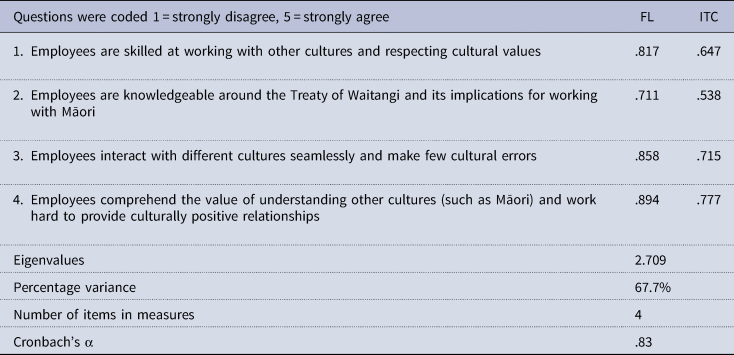
Cultural Capital was measured using four items created for this study, based on the intellectual capital construct from Singh and Rao (Reference Singh and Rao2016). The items used, coding and exploratory factor analysis results are shown in Table 1. The construct had good reliability (α = .78).
Results of exploratory factor analysis for cultural capital

ITC , corrected item–total correlations (item scores correlated with the sum of all other item scores); FL, factor loadings.
Entrepreneurial Culture was measured using five items by Zahra and Garvis (Reference Zahra and Garvis2000), coded 1 = very untrue about your firm, 5 = very true about your firm. A sample item is ‘This company takes bold, wide-ranging strategic actions, rather than minor changes in tactics’ (α = .76). This short measure has been used effectively in previous New Zealand research (e.g., Gibb and Haar, Reference Gibb and Haar2010).
Performance can focus on actual financial data (Zahra & Garvis, Reference Zahra and Garvis2000), or perceptions of performance (e.g., Gibb & Haar, Reference Gibb and Haar2010; Spanos & Lioukas, Reference Spanos and Lioukas2001) in comparison to close competitors. We chose the Organisational Performance construct (5-items) by Yang and Lin (Reference Yang and Lin2009) because the types of items used are broader than a strictly financial focus, which allows us to compare public and not-for-profit organisations. Items are coded 1 = strongly disagree, 5 = strongly agree. Sample items are ‘Our organization has a low turnover rate’ and ‘Our employee's skills and the service provided is above the industry average’ (α = .77).
Māori Enterprises were calculated following the standard Statistics New Zealand classification of asking respondents ‘Does your organisation self-identify as Maori?’. Responses are coded 1 = yes and 0 = no.
Analysis
Hypotheses were tested using t-tests (Māori enterprises vs. non-Māori enterprises).
Results
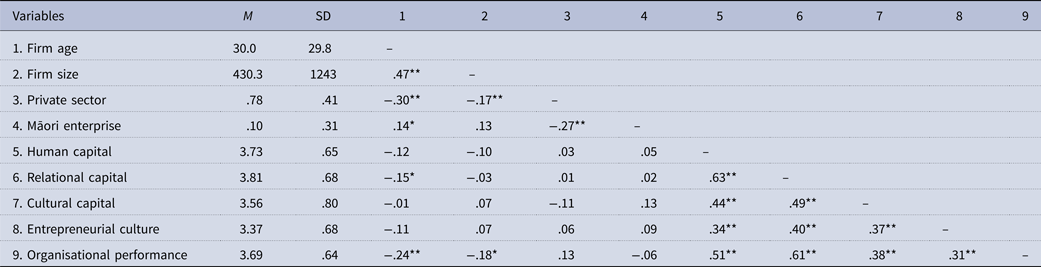
Descriptive statistics for the study variables are shown in Table 2.
Descriptive statistics and correlations

N = 230. *p < .05, **p < .01.
The mean scores are generally above the middle of the scale with relational capital (M = 3.81) and human capital (M = 3.73) being quite high, although cultural capital (M = 3.56) is lower. Paired t-tests confirm that human capital is significantly higher than cultural capital (t = 3.446, p = .001) and so is relational capital (t = 5.090, p = .000). In addition, relational capital is significantly higher (albeit a small difference) than human capital (t = 2.013, p = .045). Finally, the entrepreneurial culture mean score is relatively modest (M = 3.37), while organisational performance is higher (M = 3.69). Table 2 shows that human capital is significantly correlated with relational capital (r = .63, p < .01), cultural capital (r = .44, p < .01), entrepreneurial culture (r = .34, p < .01) and organisational performance (r = .51, p < .01). Relational capital is significantly correlated with cultural capital (r = .49, p < .01), entrepreneurial culture (r = .40, p < .01) and organisational performance (r = .61, p < .01). Finally, cultural capital is significantly correlated with entrepreneurial culture (r = .37, p < .01) and organisational performance (r = .38, p < .01), while entrepreneurial culture and organisational performance are also significantly correlated with each other (r = .31, p < .01). We also included some enterprise demographics to better understand the data, especially regarding Māori enterprises. This showed that Māori enterprises are significantly correlated with organisational age (r = .14, p < .05) and private sector (r = −.27, p < .01) when compared to the samples of non-Māori enterprises. Hence, we find Māori enterprises are likely to be older and not positioned inside the private sector as much as non-Māori enterprises.
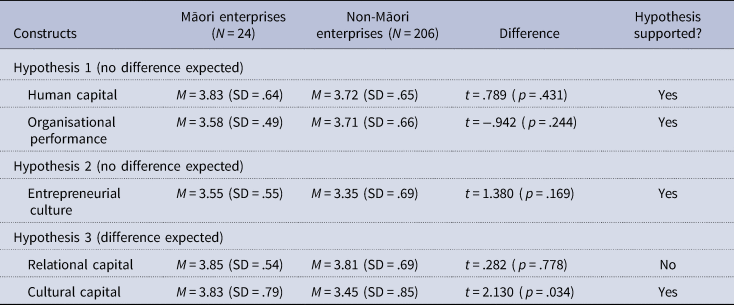
The results of the t-tests are shown in Table 3.
Independent samples t-tests

The results of the t-tests show that for human capital, Māori enterprises reported similar levels (M = 3.83) versus non-Māori enterprises (M = 3.72), and these levels did not differ significantly (t = .789, p = .431). Regarding organisational performance, Māori enterprises (M = 3.58) reported similar levels as non-Māori enterprises (M = 3.71), and again, these were not statistically different (t = −.942, p = .244). Towards entrepreneurial culture, Māori enterprises (M = 3.55) and non-Māori enterprises (M = 3.35) also reported similar levels that were not significantly different (t = 1.380, p = .169). Consequently, as expected, Māori enterprises were found to report similar levels of human capital, organisational performance and entrepreneurial culture, indicating that managers in these enterprises assessed the skills of their workforce, the happiness of workers and customers. The climate of risk-taking and opportunity-seeking was also found similar, irrespective of being a Māori or non-Māori enterprise.
The two factors where we expected Māori enterprises to outperform non-Māori enterprises produced mixed support. As expected, cultural capital in Māori enterprises (M = 3.83) was significantly higher than that in non-Māori enterprises (M = 3.45), and this was statistically supported (t = 2.130, p = .034). While we expected relational capacity to be more keenly supported in Māori enterprises, this was not the case, with them (M = 3.85) reporting similar levels to non-Māori enterprises (M = 3.81), and no significant difference (t = .282, p = .778). As such, we find support for Māori enterprises being more strongly focused on cultural factors, and while they reported high levels of relational capital overall, this was similar for non-Māori enterprises. Overall, we find support for all Hypotheses except number 3.
Discussion
The present study sought to provide greater empirical evidence around the factors that shape Māori enterprises, given that there is increased attention to the economic contribution of the Māori economy (Nana et al., Reference Nana, Reid, Schulze, Dixon, Green and Riley2020), a growth in understanding Māori employees (Haar & Brougham, Reference Haar and Brougham2013, Reference Haar and Brougham2016; Haar, Roche, & Taylor, Reference Haar, Roche and Taylor2012, Reference Haar, Russo, Sune and Ollier-Malaterre2014), Māori entrepreneurship (Henry & Dana, Reference Henry, Dana, de Bruin and Teasdale2019; Mrabure, Ruwhiu, & Gray, Reference Mrabure, Ruwhiu and Gray2018) and Māori leadership (Haar, Roche, & Brougham, Reference Haar, Roche and Brougham2019a; Roche, Haar, & Brougham, Reference Roche, Haar and Brougham2018; Ruwhiu & Elkin, Reference Ruwhiu and Elkin2016). Indeed, more sophisticated and nuanced attention is being given to Māori, such as in science and innovation (Ruckstuhl et al., Reference Ruckstuhl, Haar, Hudson, Amoamo, Waiti, Ruwhiu and Daellenbach2019); yet there is still a lot we do not know about Māori enterprises. This is surprising, given researchers have noted the unique world view of Māori (Henry & Pene, Reference Henry and Pene2001), and the likelihood that Māori enterprises might offer new insights into enterprises (Amoamo, Ruwhiu, & Carter, Reference Amoamo, Ruwhiu and Carter2018; Haar, Roche, & Brougham, Reference Haar, Roche and Brougham2019a; Henry & Wolfgramm, Reference Henry and Wolfgramm2018; Mika & O'Sullivan, Reference Mika and O'Sullivan2014).
Fundamentally, this paper argued that Māori enterprises are likely to be similar to other Aotearoa non-Māori enterprises, and this was largely supported. Intellectual capital refers to the sum of organisational knowledge (Singh & Rao, Reference Singh and Rao2016) and we expected an enterprise's expertise and KSAs of their workforce, which is typically seen as being a key to organisational performance (Youndt & Snell, Reference Youndt and Snell2004). We found that Māori enterprises reported similar levels of human capital as that of non-Māori enterprises, which indicates they do not have issues around accessing and recruiting quality and skilled workers. This finding supports the positive notions around the Māori economy and resulting positive media attention (Gibson, Reference Gibson2021). It might indicate that Māori enterprises are viewed as favourably as non-Māori enterprises, although there is likely to be higher employee identification with Māori enterprises from Māori employees, although such a link has not been tested.
The other forms of intellectual capital produced interesting findings. While we expected relationships to be especially key for Māori enterprises, they reported similar and nonsignificantly different levels as non-Māori enterprises. However, when this is put into context, it is clear that all enterprises in our sample had a strong focus on relational capital because this was the highest scored factor amongst all the variables. This highlights the importance of relationships for all businesses. However, we did find that, as expected, Māori enterprises reported higher cultural capital than non-Māori enterprises. This was in response to arguments that Māori enterprises are likely to have stronger cultural values and ties (Haar & Delaney, Reference Haar and Delaney2009; Mika & O'Sullivan, Reference Mika and O'Sullivan2014). We created a new construct to adequately capture the nature of relationships within and beyond an enterprise (Hitt et al., Reference Hitt, Bierman, Uhlenbruck and Shimizu2006), but targeting cultural processes and values that can build positive and quality relationships. Our focus on te ao Māori and the ToW relates to a more positive renaissance around Māori culture (Haar, Roche, & Brougham, Reference Haar, Roche and Brougham2019a; Roche, Haar, & Brougham, Reference Roche, Haar and Brougham2018) and presents an empirical contribution towards better understanding cultural capital in the Aotearoa context. Overall, Māori enterprises were found to have superior cultural capital, which was also found to be positively related to organisational performance.
This leads to the linkages with organisational performance. We used a generic construct (Yang & Lin, Reference Yang and Lin2009), which included workforce satisfaction and retention, but also customer satisfaction and manager skills. This enabled us to compare Māori and non-Māori enterprises across a wide range of sectors, given we might expect Māori enterprises to be less active in the private sector, which was supported with 45.8% of respondents in that sector. As expected, we found that Māori enterprises reported similar levels of organisational performance, and importantly, this was, on average, reported as indicating positive performance, albeit at not excessive levels. Again, this likely indicates that our sample of Māori enterprises perform well in the economy and thus can engage and retain employees, meet customer expectations, and have skilled managers, at similar levels to other Aotearoa enterprises.
Finally, the present study explored the role of entrepreneurship culture in Māori and non-Māori enterprises. Despite earlier findings around strong entrepreneurship within Māori individuals compared to Pākehā New Zealanders (Frederick & Chittock, Reference Frederick and Chittock2006), there are potential methodological issues with that study (Haar & Delaney, Reference Haar and Delaney2009). Indeed, we expected Māori enterprises might be as entrepreneurial as other non-Māori enterprises because of conflicting voices in the literature around being more entrepreneurial but also less likely to succeed once in business (Frederick & Chittock, Reference Frederick and Chittock2006). Overall, we find Māori and non-Māori enterprises in our sample report similar modest levels of entrepreneurial behaviours, which means they seek risk and opportunities at relatively modest levels on average. Given the present study examines entrepreneurship at the enterprise-level and with existing enterprises, we suggest this provides greater evidence of the importance and value of entrepreneurship amongst all business in Aotearoa.
Overall, our paper contributes new knowledge and insights because the empirical evidence on differences between Māori and non-Māori enterprises is exceptionally sparse. Māori enterprises reported solid levels of intellectual capital dimensions, entrepreneurial culture and organisational performance at levels similar to non-Māori organisations. This is evidence of Māori enterprises operating at similar levels as non-Māori enterprises towards business operation.
Implications
The significantly higher scores in cultural capital in Māori enterprises are indicative that Māori enterprises have some distinct characteristic and enhanced capacities. This should encourage researchers to investigate further factors that could potentially be specific to Māori enterprises, perhaps outside traditional organisational factors. For example, the process of entrepreneurship may be different and warrant further exploration. Furthermore, future research might explore the role of non-Māori respondents and non-Māori enterprises around embracing Māori culture and engaging more with Māori. Are these factors that explain such engagement which we are currently unaware of? For example, future research might explore the empathy felt towards Māori vulture by non-Māori employees. With regard to entrepreneurship, we conducted additional analysis on the individual items of the entrepreneurial culture scale (Zahra & Garvis, Reference Zahra and Garvis2000). We found that there is a significant difference on one item only: ‘Your organization is usually the first in the industry to introduce new products/services to the market’. We find that Māori enterprises (M = 3.71) versus non-Māori enterprises (M = 3.10) is significantly higher (t = 2.903, p = .004). Hence, Māori enterprises appear to engage in first-mover activities more readily. Thus, exploring organisational strategies might be a useful avenue for future research. However, overall, the levels of entrepreneurship were similar between Māori and non-Māori enterprises.
Limitations
An important limitation of this research is the single-sourced nature of the data, although this is typical of such organisational research. Similarly, while the overall sample size of Māori enterprises is small (n = 24), Bartlett, Kotrlik, and Higgins (Reference Bartlett, Kotrlik and Higgins2001) suggest the overall sample is sufficient (n = 230). In defence of our sample, the data are the first to provide sufficient numbers of Aotearoa enterprises to compare and does provide a useful starting point – especially given the sample includes a wide range of enterprises in different sectors. Thus, these results might be considered exploratory until more studies are conducted to determine generalisability. One further issue might be that the data are nonparametric in nature, and we conducted the Mann–Whitney U test and confirmed the effects reported, such that cultural capital is significantly higher in Māori organisations.
Conclusions
The present study sought to empirically test similarities and differences in Māori enterprises. Overall, we find strong support for Māori enterprises having strong intellectual capital around people and relationships, as well as superior cultural capital. They also report similar levels of entrepreneurial culture and organisational performance, indicating that they take risks and seek opportunities as often as non-Māori enterprises, and perform just as well. We hope these findings will begin a stronger study of the potential similarities and differences of Māori enterprises and ultimately push the evidence further to understand what constitutes a Māori enterprise.