Introduction
Childhood obesity is a serious public health problem in developed nations and a growing public health issue in developing countries.Reference Ng, Fleming and Robinson1 Obesity during childhood is strongly associated with health problems during childhood and later adult life including type 2 diabetes, asthma, hypertension and other cardiovascular risks.Reference Reilly, Methven and McDowell2 Obesity during childhood has multiple risk factors, and pre-pregnancy obesity is one of the strongest prenatal risk factors.Reference Woo Baidal, Locks and Cheng3
Evidence from a meta-analysisReference Yu, Han and Zhu4 has shown that pre-pregnancy obesity is a shared risk factor for high birthweight (>4000 g) and later childhood obesity. In turn, high birthweight is an established predictor of overweight/obesity during childhood and later life.Reference Schellong, Schulz, Harder and Plagemann5 A causal relationship between pre-pregnancy obesity and offspring obesity may start to develop prior to or during pregnancy,Reference Zhang, Rattanatray and Morrison6 possibly due to developmental overnutrition, and shared familial and postnatal factors.Reference Fleten, Nystad and Stigum7, Reference Tan, Roberts and Catov8 The developmental overnutrition hypothesis proposes that offspring adiposity is programmed within the intrauterine environment; exposure to excessive plasma glucose, free fatty acids and amino acids in utero causes permanent changes in fetal appetite, neuroendocrine function or energy metabolism that lead to obesity during childhood and later life.Reference Lawlor, Smith and O’Callaghan9
While a number of studiesReference Reilly, Armstrong and Dorosty10–Reference Catalano, Farrell and Thomas12 of the association between pre-pregnancy body mass index (BMI) and offspring obesity have adjusted for birthweight of the offspring, to our knowledge, only one recent studyReference Morgen, Angquist and Baker13 has examined its mediation effect. Morgen et al. Reference Morgen, Angquist and Baker13 has found stronger direct than indirect (through ponderal index [birthweight/length3]) effects of pre-pregnancy BMI on offspring’s BMI at the ages of 7 and 11 years. However, the study evaluated only one child anthropometric measure and did not account for important intermediate factors such as gestational diabetes (GDM) and hypertensive disorders of pregnancy (HDP).Reference Nehring, Chmitorz, Reulen, von Kries and Ensenauer14, Reference Davis, Lazdam and Lewandowski15
Each anthropometric index BMI-for-age, height-for-age, weight-for-age and weight-for-height may reflect a unique child nutrition status at specific ages.Reference Corsi, Subramanyam and Subramanian16 For instance, BMI-for-age indicates over- or undernutrition, whereas height-for-age reflects linear growth. Evidence also showed that childhood linear growth has significant impact on later adulthood risk of obesity.Reference Stovitz, Demerath, Hannan, Lytle and Himes17 However, most of the previous studies on the association between pre-pregnancy obesity and childhood anthropometrics focused on child BMI-for-age – limited data are available on childhood linear growth. Therefore, a comprehensive path analysis of pre-pregnancy BMI and offspring childhood anthropometrics may assist the development of targeted interventions and possibly further improve our understanding about their link.
Thus, this study aimed to quantify the mediation role of offspring’s birthweight between the association of pre-pregnancy BMI and childhood anthropometrics using a population-based cohort study of Australian mother–child pairs.
Methods
Study design and participants
We used data from the Australian Longitudinal Study on Women’s Health (ALSWH) 1973–78 cohort and Mothers and their Children’s Health (MatCH) study. For the ALSWH, 14,247 women born in 1973–78 (aged 18–23 years) were randomly selected in 1996 from the National Health Insurance database which included all Australians and permanent residents, and surveyed triennially until 2015 (aged 37–42 years). Over 20 years of follow-up, women provided comprehensive data about their health including pregnancy and birth outcomes. Full details are available on the ALSWH website (alswh.org.au) and in publication.Reference Dobson, Hockey and Brown18
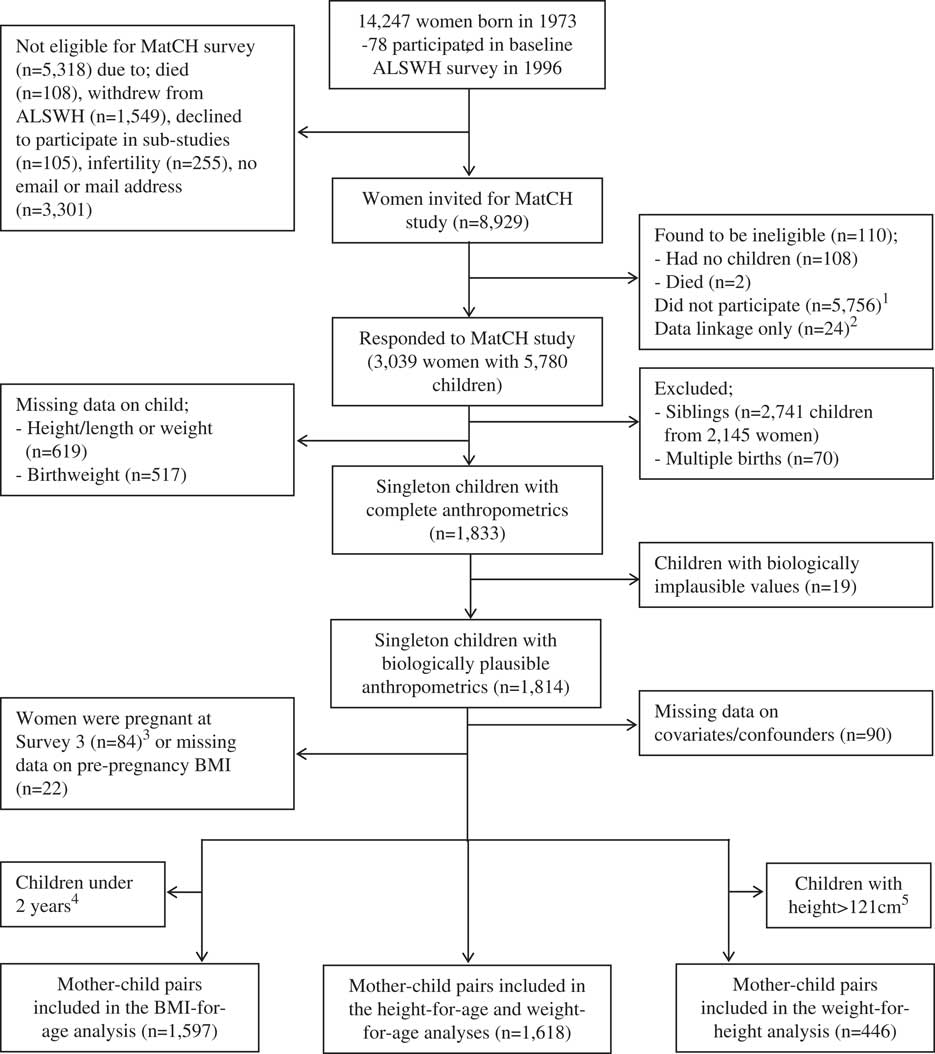
For the MatCH study, 8,929 women from the 1973–78 ALSWH cohort were invited to complete a survey about their children (up to three youngest, 12 years or younger). While all women were potentially eligible, 8,929 were invited because the remaining had died, withdrawn from the ALSWH, asked not to be contacted about sub-studies or reported infertility. During the MatCH study, conducted in 2016/2017, 3,039 women provided a range of data about their children (n = 5,780) including anthropometric measures. Of 5,780 children, 2,811 were ineligible because they were siblings (n = 2,741) or multiple births (n = 70). Among the eligible children, 1,351 were excluded mainly because of missing data on anthropometric measures: child height and/or weight (n = 619) or birthweight (n = 517). Further details about the sampling strategy and exclusion criteria are shown in Fig. 1. We conducted a complete case analyses, and the sample sizes for the analyses varied by child outcomes; 1,597 for the analysis of BMI-for-age, 1,618 for height-for-age and weight-for-age and 446 for weight-for-height. Relative to the other childhood outcomes, the sample size for weight-for-height was smaller since the weight-for-height index is designed for children with height between 45 and 121 cm, approximately aged 0–72 months.
Flow diagram of the sample for the analysis of mediation by birthweight on the association between pre-pregnancy BMI and childhood anthropometrics. ALSWH, Australian Longitudinal Study on Women’s Health; BMI, body mass index; MatCH, Mothers and their Children’s Health study.
1Of 5,756 women who did not participate, 2,551 had not reported any eligible births up to the seventh survey of ALSWH (when aged 37–42 years) so may have been ineligible.
2Twenty-four women did not do the survey, but they agreed to external data linkage for 43 children.
3Women who were pregnant in the first three surveys (surveys 1–3) were not asked to report their weight prior to pregnancy and hence were excluded as we do not have a reliable pre-pregnancy weight.
4BMI-for-age analysis excluded children under the age of 2 years (n = 21) as BMI is not available for this age group.
5Weight-for-height measure is designed for children with height between 45 and 121 cm, approximately 0–72 months of age and thus children taller than 121 cm have been excluded (n = 1,172).

Informed consent was obtained from all participants at each survey, and the Human Research Ethics Committees at the Universities of Newcastle and Queensland approved both the ALSWH and MatCH studies.
Pre-pregnancy BMI
At every ALSWH survey, women’s BMI was computed as self-reported weight (kg) divided by height square (m2) and categorized as normal weight (BMI <25), overweight (BMI 25 to <30) or obese (BMI ≥ 30). Since only 51 (3.1%) women were underweight (BMI <18.5), they were grouped with the normal weight (BMI <25) women. Pre-pregnancy BMI was recorded at the survey immediately prior to the survey interval in which the child was born. For example, maternal BMI at survey 3 [for children born between surveys 3 (conducted in 2003) and 4 (2006)] and maternal BMI at survey 4 [for children born between surveys 4 (2006) and 5 (2009)] were considered as pre-pregnancy BMI. The average time between the pre-pregnancy BMI and the child date of birth was 18 months, with ≤27 months for 75% of the study subjects. As shown in Fig. 1, children (n = 84) born to women who were pregnant at survey 3 (2003) were excluded because at surveys 1–3 women were just asked to provide their weight regardless of pregnancy status. From survey 4 (2006) onwards, pregnant women at the time of the survey have been asked to report their weight immediately prior to conception.
Children’s anthropometric measures
For the MatCH study, women were sent a measuring tape and instructions on how to measure their child’s height in centimetres and to weigh their child in kilograms on a bathroom scale. A SAS Program for the 2000 Centers for Disease Control and Prevention Growth Charts was used to calculate the sex and age-specific BMI-for-age (24–239 months of age), height-for-age (0–239 months of age), weight-for-age (0–239 months of age) and weight-for-height (children with height between 45 and 121 cm, approximately 0–72 months of age) z scores.19 The program also calculates extreme or biologically implausible values and hence 19 children were excluded because of this. Based on age and sex-specific BMI cut-off points for children between 2 and 18 years,Reference Cole, Bellizzi, Flegal and Dietz20 children were dichotomized into normal weight (includes underweight children) and overweight (includes obese children).
Covariates, confounders and mediators
Self-reported information was available on age, education, area of residence, parity, smoking and physical activity at each ALSWH survey. During the last three surveys [surveys 5 (2009) to 7 (2015)], women were also asked whether they were diagnosed or treated for GDM and/or HDP for each live birth. At these surveys, they have also reported prematurity status (born before 37 weeks of gestation or not) for each live birth. Maternal education was categorized as year 12/less, trade/apprenticeship/certificate/diploma and university/higher degree. Women’s area of residence was classified into major city, inner region and outer region/remote. Women’s parity prior to the birth of the index child (the oldest child of each mother in MatCH study was included when two or three children were available) was categorized as nulliparous, primiparous and multiparous. Pre-pregnancy smoking was grouped into never smoked, ex-smoker and current smoker. Pre-pregnancy physical activity was derived from total metabolic equivalent (MET) values which were estimated for a range of activities and categorized as sedentary/low (<600 MET min/week), moderate (600 to <1200 MET min/week) or high (≥1200 MET min/week).Reference Brown, Ford, Burton, Marshall and Dobson21 Women also reported their children’s birthweight (kg) at survey 7 (2015), and sex and age during the MatCH study.
Statistical analysis
Descriptive statistics such as means with standard deviations (s.d.) and percentages were used to summarize continuous and categorical variables, respectively. One-way analysis of variance and chi-square tests were used to compare maternal and child characteristics across pre-pregnancy BMI categories.
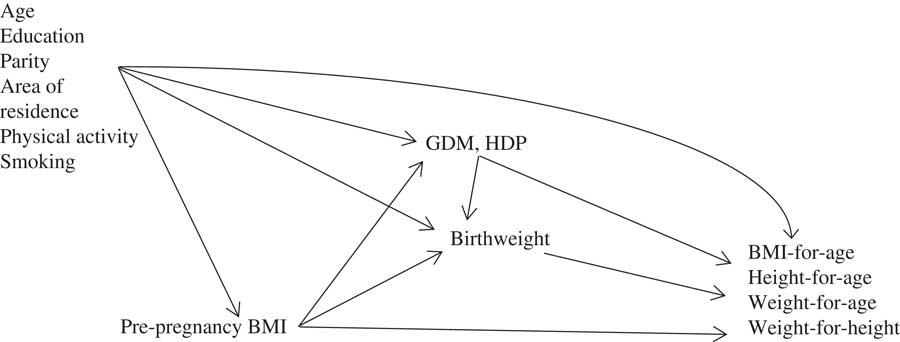
Figure 2 illustrates the potential pathways between pre-pregnancy BMI, offspring’s birthweight and childhood anthropometric measures. We employed g-computation, which handles intermediate confounders (GDM and HDP), to estimate the natural direct, natural indirect and the total causal effects of pre-pregnancy BMI on childhood anthropometric outcomes. Standard errors and the 95% confidence intervals (CI) of the estimates were computed using 1000 bootstrap samples.Reference Daniel, De Stavola and Cousens22 While the natural indirect effect represents pre-pregnancy BMI (exposure) on childhood anthropometric outcomes via offspring birthweight (mediator), the natural direct effect includes all effects of pre-pregnancy BMI operating through pathways apart from the offspring birthweight. Specifically, the natural direct effect is the difference between the mean child outcome under the observed maternal pre-pregnancy BMI and the mean potential child outcome if pre-pregnancy BMI was set at the baseline or reference value for all mothers (22 kg/m2 for continuous scale and <25 kg/m2 for categorical data), with the offspring’s birthweight assuming whatever value it would have taken at the reference or baseline value of the pre-pregnancy BMI. Whereas the natural indirect effect is the difference between the mean child outcome if the offspring’s birthweight assumed whatever value under a fixed value of the pre-pregnancy BMI and the potential child outcome if the offspring’s birthweight assumed whatever value it would have taken at a reference or baseline value of the pre-pregnancy BMI. The total causal effect is the sum of the natural direct and indirect effects.Reference Daniel, De Stavola and Cousens22, Reference Richiardi, Bellocco and Zugna23
Directed acyclic graph showing potential pathways between pre-pregnancy BMI, offspring’s birthweight and childhood anthropometric measures. BMI, body mass index.

For each child outcome (BMI-for-age, height-for-age, weight-for-age and weight-for-height), four simultaneous models were fitted: child outcome model, mediator (birthweight) model and two mediator-outcome confounder (GDM and HDP) models. As shown in Fig. 2, all models were adjusted for maternal background factors (age, parity, area of residence, education, smoking and physical activity). These factors have been previously suggested to be associated with both pre-pregnancy obesity and child outcomes and hence were included as potential confounders.Reference Woo Baidal, Locks and Cheng3, Reference Cameron, Spence and Laws24, Reference Moraeus, Lissner and Yngve25 While each child outcome model was further adjusted for birthweight, GDM and HDP, the mediator (birthweight) model was adjusted for GDM and HDP. Exposure–mediator interaction was not included in any model as it was not significantly based on our data (P value >0.5 for all child outcomes). Further analysis using categorical child BMI (normal weight v. overweight) was performed and exponentiated g-estimate coefficients provided the odds ratio (OR) and 95% CI.
In a supplementary analysis, we repeated the above models to confirm the consistency and robustness of results after excluding children born prematurely (born before 37 weeks of gestation) and/or born to women with pre-existing hypertension or diabetes.
All statistical analyses were conducted using Stata version 14 (StataCorp LP, College Station, TX, USA). A P value <0.05 was considered statistically significant, and all statistical tests were two sided.
Results
Among 1,618 children (mean age 8.6 [s.d. =3.0] years), just over half (51.9%) were boys and under two thirds (64.4%) lived in major cities. Nearly two thirds (63.8%) and about 45% of children were born to women with a university/higher degree and to women with less physical activity, respectively. About 14% of children were born to women with GDM or HDP. Approximately two thirds (64.6%), 23.2% and 12.2% of children were born to women who were of normal weight, overweight and obese pre-pregnancy, respectively (Table 1).
Maternal and child characteristics by pre-pregnancy BMI categories

Unless indicated values are n (column %), P values for group differences were from one-way analysis of variance or chi-square tests.
a BMI-for-age analysis (n = 1,597) excluded children under the age of 2 years (n = 21) as BMI is not available for this age group.
b Weight-for-height (n = 446) measure is designed for children with height between 45 and 121 cm, approximately 0–72 months of age, so 1,172 children were excluded.
As shown in Table 1, most maternal and child characteristics were associated with pre-pregnancy BMI. For instance, women with pre-pregnancy obesity were significantly more likely to be multiparous, to be less educated and to have GDM and HDP. Children born to women with pre-pregnancy obesity were significantly bigger at birth and had higher childhood BMI-for-age and other anthropometric outcomes.
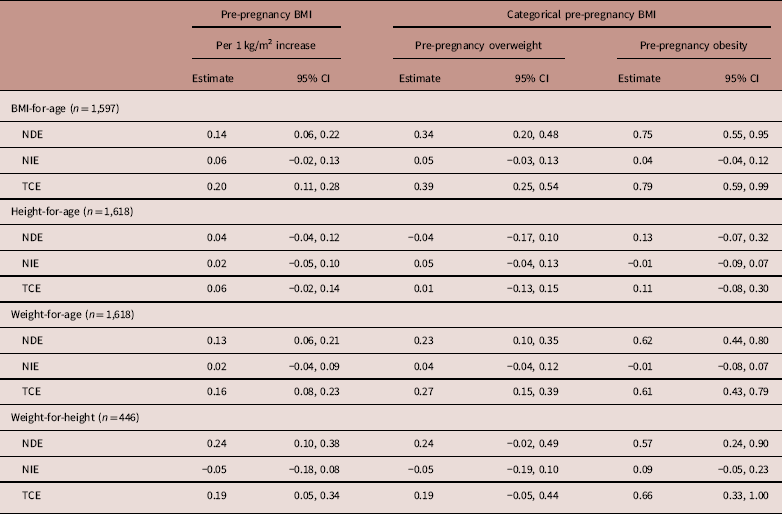
Table 2 shows the natural direct, indirect (via birthweight) and the total causal effects of pre-pregnancy BMI on the childhood anthropometric outcomes. Overall, pre-pregnancy BMI had significant natural direct and total causal effects on children’s anthropometric outcomes, particularly on BMI-for-age, weight-for-age and weight-for-height. The natural direct effects were much stronger than the natural indirect (mediated) effects and the natural indirect effects did not research statistical significance. For instance, in the fully adjusted model, the natural direct, natural indirect and the total causal effects of pre-pregnancy BMI (per 1 kg/m2 increase) on children’s BMI-for-age (z score) were β (95% CI), 0.14 (0.06, 0.22), 0.06 (−0.02, 0.13) and 0.20 (0.11, 0.28), respectively. Similar associations were observed for other childhood outcomes, particularly the weight-for-age and weight-for-height measures.
Natural direct, natural indirect (via birthweight) and total causal effects of pre-pregnancy BMI on children’s anthropometric outcomes (z scores)

BMI, body mass index; CI, confidence interval; GDM, gestational diabetes mellitus; HDP, hypertensive disorders of pregnancy; NDE, natural direct effect; NIE, natural indirect effect; TCE, total causal effect.
Note for each child outcome, four simultaneous models were fitted: child outcome model, mediator model and two mediator–outcome confounder models (GDM and HDP). All models were adjusted for maternal background factors (age, parity, area of residence, education, smoking and physical activity). The mediator (birthweight) model was further adjusted for GDM and HDP.
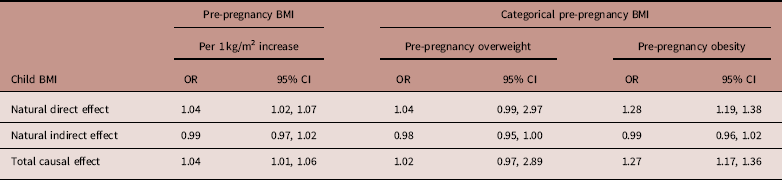
Further analysis using categorical pre-pregnancy BMI showed that the natural direct effects were stronger than the indirect effects. However, the natural direct effect of pre-pregnancy overweight on childhood weight-for-height did not reach statistical significance. The results also demonstrated that pre-pregnancy BMI had no significant effect on child height-for-age outcome (Table 2). We also found similar associations when childhood BMI was dichotomized into normal weight and overweight (Table 3).
Natural direct, natural indirect (via birthweight) and total causal effects of pre-pregnancy BMI on children’s BMI (normal weight v. overweight/obese) (n = 1,597)

BMI, body mass index; CI, confidence interval; GDM, gestational diabetes mellitus; HDP, hypertensive disorders of pregnancy; OR, odds ratio.
Note for each child outcome, four simultaneous models were fitted: child outcome model, mediator model, and two mediator-outcome confounder models (GDM and HDP). All models were adjusted for maternal background factors (age, parity, area of residence, education, smoking and physical activity). The mediator (birthweight) model was further adjusted for GDM and HDP.
The natural direct and indirect effects of pre-pregnancy BMI on childhood anthropometrics did not change considerably in a sensitivity analysis that excluded children born prematurely and/or born to women with pre-existing hypertension or diabetes (Supplemental Table S1). Overall, the effect sizes of pre-pregnancy BMI (as both a categorical scale and a continuous scale) on childhood BMI-for-age and weight-for-age outcomes were marginally smaller. The natural direct and the total causal effects of pre-pregnancy BMI (continuous scale) on weight-for-height outcome spanned the null value, but the effects of pre-pregnancy overweight on weight-for-height outcome were slightly stronger and became statistically significant.
Discussion
The results of this study demonstrated that pre-pregnancy BMI, particularly obesity, has a consistent and significant natural direct effect on childhood BMI-for-age, weight-for-age and weight-for-height outcomes. Although we observed direct and total effects, the overall effects were of small magnitude. The association was independent of maternal socoidemographic and lifestyle factors. Relative to the natural indirect (mediated) effect through offspring birthweight, the magnitude of the natural direct effect was much stronger and was not substantially changed after excluding children born prematurely and/or born to women with pre-existing hypertension or diabetes. We found no significant natural direct or indirect effects of pre-pregnancy overweight and obesity on childhood height-for-age outcome – suggesting a minimal influence of pre-pregnancy BMI on childhood linear growth.
Several studies, including meta-analyses,Reference Yu, Han and Zhu4, Reference Castillo-Laura, Santos, Quadros and Matijasevich26 have established the relationship between pre-pregnancy obesity and the risk of obesity in offspring. Supporting this, the results of the estimates for total casual effects showed a consistent positive direct association between pre-pregnancy BMI and various anthropometric measures of the children. However, whether the association between pre-pregnancy obesity and childhood obesity in children is due to an increased fetal growth, in utero programming effect or shared familial factors remains unknown. A number of studiesReference Lawlor, Smith and O’Callaghan9, Reference Catalano, Farrell and Thomas12, Reference Morgen, Angquist and Baker13, Reference Linabery, Nahhas and Johnson27 have compared the maternal–paternal effects in an attempt to unravel the link and found stronger maternal than paternal BMI associations with child BMI. This may suggest that the intrauterine environment has a lasting impact on offspring’s childhood adiposity. Alternatively, shared postnatal factors which may be more maternal-specific, such as family diet, may explain the stronger maternal BMI associations with child BMI.
Comparing the natural direct and indirect effects of pre-pregnancy BMI on child anthropometric outcomes may provide additional insight about the link. In this study, the natural direct effect of pre-pregnancy obesity was much stronger than the indirect effect. What the results suggest is that the association between pre-pregnancy obesity and child anthropometrics at 8 years has little to do with the drivers of the association between pre-pregnancy BMI and birthweight, which are thought to be mainly components of the intrauterine environment. Moreover, the other components of the intrauterine environment that do not impact birthweight may contribute to the direct effect of maternal pre-pregnancy obesity on the child’s anthropometrics. However, in addition to the effect of the intrauterine environment, childhood obesity risk has been found to have genetic predisposition,Reference Llewellyn, Trzaskowski, Plomin and Wardle28 which could be further influenced by the postnatal environment. Thus, the stronger direct effect of pre-pregnancy obesity on childhood weight-related outcomes may be partly because of shared lifestyles within families. For instance, parental, particularly mothers’ food choices and taste preferences have been found to influence their children’s dietary habit in a number of ways.Reference Kral and Rauh29, Reference Campbell, Crawford and Salmon30
The findings of the current study are consistent with a previous studyReference Morgen, Angquist and Baker13 that evaluated prenatal risk factors for childhood BMI. Morgen et al. Reference Morgen, Angquist and Baker13 found that the direct effects of parental BMI on child BMI at the ages of 7 and 11 years were stronger than the indirect effects (mediated through ponderal index and infant BMI at 5 and 12 months). In line with this, studiesReference Hinkle, Sharma and Swan31, Reference Mgutshini32 have shown a weaker mediation effect of birthweight of the offspring on the association between gestational weight gain and the child outcomes, although othersReference Liu, Xu, Liu, Hardin and Li33 have reported contrary results. This highlights the need for more studies focusing on the potential mechanisms linking pre-pregnancy obesity and gestational weight gain with childhood anthropometrics.
Our study is not without limitations. All data including maternal and child anthropometric measures were self-reported. Women may underestimate their pre-pregnancy weight and overestimate their height, thereby underestimating their pre-pregnancy BMI. There could also be a similar systematic error in reporting child weight and height. However, self-reported weight and height measures have been found to be reliable and valid estimates.Reference Craig and Adams34
High attrition and considerable missing data on child anthropometrics were the other limitations of this study. Using the most recent ALSWH survey the women completed, women who participated in the MatCH study were more likely to live in major cities (60.0% v. 54.5%) and to have a university degree (63.0% v. 46.4%). They were less likely to be a current smoker (7.7% v. 12.4%) and to be obese (21.1% v. 24.5%) as compared to non-participants. Mothers of children with missing anthropometric data were less likely to have a university degree (58.7% v. 65.8%) and more likely to be current smokers (12.1% v. 8.9%) and live in major cities (63.2% v. 58.6%). No other important variations were observed (data not shown). This may affect the representativeness of the initial sample and the results; however, we could not suggest the direction of the effect of the differential attrition on the association between pre-pregnancy BMI and child anthropometric outcomes.
Our study also has a number of strengths. This is a population-based prospective cohort study that included a nationally representative sample of women. Unlike the previous study,Reference Morgen, Angquist and Baker13 this study included a range of sociodemographic and lifestyle factors, evaluated multiple child anthropometric measures and used g-computation formula that enabled us to appropriately quantify natural direct and indirect effects in the presence of mediator–outcome intermediate confounders.
In conclusion, the results of this study demonstrated that pre-pregnancy BMI, particularly obesity, has consistent and stronger natural direct effect on childhood BMI-for-age, weight-for-age and weight-for-height outcomes compared with the natural indirect (mediated) effect through the offspring birthweight, independent of sociodemographic and lifestyle factors. Therefore, childhood obesity prevention should primarily target pre-pregnancy obesity and shared postnatal factors.
Supplementary material
To view supplementary material for this article, please visit https://doi.org/10.1017/S2040174418001137
Acknowledgements
The research on which this paper is based was conducted as part of the Australian Longitudinal Study on Women’s Health by the University of Queensland and the University of Newcastle. We are grateful to the Australian Government Department of Health for funding and to the women who provided the survey data.
Financial support
A.A.A is supported by International Postgraduate Research Scholarship (IPRS) and UQ Centennial scholarship. MatCH is funded by National Health and Medical Research Council (APP1059550), G.D.M is supported by National Health and Medical Research Council Principal Research Fellowship (APP1121822).
Conflict of interest
None.
Ethical Standards
The authors assert that all procedures contributing to this work comply with the ethical standards of the relevant national guidelines on human experimentation [NHMRC National Statement on Ethical conduct in Human Research 2007 (Updated May 2015), Australian code for the responsible conduct of research 2007, National Health and Medical Research Council Guidelines approved under Section 95 of the Privacy Act 1988 (November 2014) and Australian Privacy Principles guidelines (31 March 2015)] and with the Helsinki Declaration of 1975, as revised in 2008, and has been approved by the institutional committees (The University of Newcastle Human Research Ethics Committee reference H-2014-0246, and The University of Queensland Human Behavioural and Social Sciences Ethical Review Committee reference 2014001213).