INTRODUCTION
Despite the existence of national guidelines on the management of violence (NICE, 2005), several Royal College of Psychiatrists guidelines on the subject (Royal College of Psychiatrists, 1995; 1998; 2000), consensus statements on related medicine matters (Royal College of Psychiatrists, 2005; 2006), plus numerous best practice guidelines and reviews of the evidence by other organisations and individuals (Allen et al. Reference Allen, Currier and Carpenter2005; Aupperle, Reference Aupperle2006; Battaglia, Reference Battaglia2005; Caine, Reference Caine2006; Coburn & Mycyk, Reference Coburn and Mycyk2009; Gillies et al. Reference Gillies, Beck, McCloud and Rathbone2005; Huf et al. Reference Huf, Alexander, Allen and Raveendran2009; Marder, Reference Marder2006; Rossi & Swan, Reference Rossi and Swan2010; Taylor et al. Reference Taylor, Paton and Kapur2009; Zeller & Rhoades, Reference Zeller and Rhoades2010), currently there is no consensus as to the first line pharmacological treatment in the management of imminent violence. There are very few rigorous trials examining or comparing the efficacy and safety of agents in the management of violence, therefore much of the data that informs current practice is derived from naturalistic studies and case series. Many published recommendations are a consensus of opinions (Allen et al. Reference Allen, Currier and Carpenter2005) based on experience in clinical practice (Taylor et al. Reference Taylor, Paton and Kapur2009).
The NICE Guidelines on the matter were published five years ago, and are not expected to be reviewed until 2012. Since the publication of these guidelines there have been a number of changes in the area; newer agents have become available, and the licence of some medicines has changed.
Use of medicines to quickly calm the severely agitated patient (in order to reduce the risk of imminent and serious violence to self or others, rather than to treat the underlying psychiatric condition) is referred to as rapid tranquillisation (RT). The aim of RT is not to induce sleep or unconsciousness; the patient should be sedated but still able to participate in further assessment and treatment and able to respond to communication throughout. However there may be occasions when sedation is an appropriate goal (NICE, 2005).
PRINCIPLES OF MEDICINE USE IN RT
The use of medication in the control of violence is only one part of a comprehensive treatment plan that which includes an assessment of environmental factors and the use of other therapies to manage the risk of violence. Violent behaviour should only be managed with medicines after an assessment of risk, and once non-pharmacological interventions have been explored (Rossi & Swan, Reference Rossi and Swan2010). Medicines should only be used when it has been established that the risks of not doing so, are greater than the risk of doing so. Medication should not be used to manage aggression caused by identifiable environmental factors (such as understaffing or lack of staff skills) that could be managed by non-pharmacological means (Coburn & Mycyk, Reference Coburn and Mycyk2009).
According to the NICE Guideline on Violence and Aggression (2005), ‘All medication given in the short-term management of disturbed/violent behaviour should be considered as part of rapid tranquillisation (including pro re nata [PRN] medication)’.
In all cases the patient must be informed that medication is going to be administered and must be given the opportunity to accept oral medication voluntarily at all stages. All patients should be allowed to make an informed choice where at all possible.
The minimum effective dose of medication should be used. British National Formulary (BNF) maximum doses should only be exceeded in extreme circumstances, and with the advice of a consultant psychiatrist (NICE, 2005). If the maximum licensed dose is exceeded, more frequent and intensive monitoring of physical health should be conducted.
NICE (2005) recommends that ‘blood pressure, pulse, temperature and respiratory rate and hydration should be recorded regularly’ post RT. However there are also no nationally agreed standards or recommendations on the specific intervals or duration of monitoring physical parameters post RT, and local trust guidelines vary considerably in their detail and recommended frequencies.
PRINCIPLES OF PRESCRIBING MEDICINES FOR RT
All prescriptions for RT medicines should be tailored for the individual patient. The prescriber should consider any co-existing medical illnesses as some may predispose the patient to agitated or dysphoric states. Due consideration should be paid to potential non-psychiatric causes for the disturbed behaviour (e.g. trauma, organic, psychological, intoxication or withdrawal states (Rossi & Swan, Reference Rossi and Swan2010).
Having established the need to prescribe RT medicines, the prescriber should then consider all prescribed medication, and any recent use of illicit substances. These may interact pharmacodynamically or pharmacokinetically with the proposed rapid tranquillisation medications, leading to altered dose requirements and potential side effects. Poly-prescribing within a class of medication (e.g. antipsychotics) should be avoided, where at all possible. Choice of antipsychotic in RT should be guided in part by any existing antipsychotics the patient is taking (see Boxes 1 & 2).


Although the aim of RT is to manage the immediate acute situation and not to treat the underlying condition, the provisional diagnosis may guide the prescribers’ choice of medication. For example, if there is diagnostic uncertainty then the prescriber may prefer to avoid antipsychotic medication, until the diagnosis is established. When selecting both which medicine and the dose the prescriber should consider the patients’ past experiences with medication.
Oral (PO) and intramuscular (IM) medicines should be prescribed separately, and the abbreviation ‘oral (PO) / intramuscular (IM)’ should not be used (Joint Formulary Committee, 2010). Parenteral and oral doses have different onsets of action, and it should not be assumed that they are bioequivalent.
All PRN prescriptions for medicines used in RT should be reviewed at frequent intervals by the prescribing team. Administering PRN doses in addition to the regularly prescribed psychotropics may enable the administration of greater than BNF maximum doses (Baker, Reference Baker2008), potentially encourage polypharmacy, and put the patient at clinical risk.
ROUTE OF ADMINISTRATION AND FORMULATIONS
In general oral medication should be offered before parenteral treatment is administered. Parenteral medication has a faster onset of action than oral. A number of the newer atypical antipsychotics are available as soluble or disintegrating tablets (aripiprazole, risperidone and olanzapine) and liquids (amisulpride, aripiprazole and risperidone). However, it should be noted that the drugs are not buccally absorbed from these formulations; the tablets disperse in the saliva; when this is swallowed, the drug is absorbed via the gastro-intestinal tract. In younger children the formulation of the medicines may become even more pertinent and guide the choice of agent.
In view of the safety and actual practical considerations of restraint and administration of boluses, intravenous (IV) RT is not recommended in ‘stand alone’ or isolated psychiatric settings, especially when there is no provision to call an experienced medical resuscitation team. The 2005 NICE guidelines recommend that IV RT should only occur with when there is full access to supportive resuscitation equipment. Registered mental health nurses cannot administer IV doses unless they have completed additional training, meaning that any IV doses need to be administered by a doctor. Furthermore, staff in many psychiatric units are unlikely to have the experience required to safely administer IV medicines or manage the potentially serious side effects should they arise.
If IV RT is to be used, agents that have previously been recommended include haloperidol and diazepam (Taylor et al. Reference Taylor, Paton and Kerwin2007). Haloperidol is associated with cardiac conduction abnormalities such as torsade de pointes (Hassaballa & Balk, Reference Hassaballa and Balk2003a; Reference Hassaballa and Balk2003b) and now this route of administration is no longer licensed in the UK (Janssen-Cilag Ltd. 2010). In general, the use of IV and high doses of antipsychotics is of concern because of the potential to increase QT interval and the associated risk of tachyarrythmias, which are likely to have contributed to one of the causes of unexplained sudden deaths of acutely disturbed patients prescribed medication (Royal College of Psychiatrists, 2006). Diazepam IV has also been recommended (Taylor et al. Reference Taylor, Paton and Kerwin2007) and is licensed (Actavis UK, 2008) for use in RT, but benzodiazepines carry a risk of respiratory depression. IV diazepam carries a high risk of thrombophlebitis, although this can be reduced by using the emulsion formulation, Diazemuls® (Actavis UK, 2008).
In routine practice if parenteral administration is required there are very few situations in which IV administration would be preferable, and there are few situations where IM injections cannot be used. It is hard to administer an IV injection to a struggling and restrained patient as the injection site is specific and there is a risk of inadvertent intra-arterial administration. An IM injection does not require such a specific injection site. The onset of action following an IM injection is approximately 15 minutes, whereas onset of action following an IV injections is approximately 2–5 minutes. Parenteral IV RT medications such as Diazemuls® (diazepam) or haloperidol need to be given as slow IV boluses over at least 2–3 minutes each.
CHOICE OF AGENT IN RT
Due to the acute nature of the clinical situation and the risk of violence, generating robust evidence of the clinical efficacy of medicines in RT is inherently difficult. Trials designed for regulatory approval may have aims and endpoints that vary significantly from that in routine practice. Often they do not compare the new agent to another agent of routine practice, or are not powered to do so. The requirement for patients to consent (in writing or verbally) to participation in the trial often demonstrates the difference in level of agitation and distress in trial patients to those in routine clinical practice. It is notable that there are few rigorous trials directly comparing the efficacy and safety of agents in RT, with the exception of the recent four TREC trials (TREC Collaborative Group, 2003; Alexander et al. Reference Alexander, Tharyan, Adams, John, Mol and Philip2004; Huf et al. Reference Huf, Coutinho and Adams2007; Raveendran et al. Reference Raveendran, Tharyan, Alexander and Adams2007). Refer to Box 3 for a summary of these trials.

Some studies suggest that using a benzodiazepine alone is just as effective as using it in conjunction with an antipsychotic. However other studies suggest to the contrary (Gillies et al. Reference Gillies, Beck, McCloud and Rathbone2005). In more severe cases it is common practice to use a benzodiazepine (commonly lorazepam), in conjunction with an antipsychotic (commonly haloperidol) (Allen et al. Reference Allen, Currier and Carpenter2005). Two more recent studies (Huf et al. Reference Huf, Coutinho and Adams2007; Raveendran et al. Reference Raveendran, Tharyan, Alexander and Adams2007) suggest that the combination of haloperidol and promethazine is more effective and safer than using antipsychotics alone. All of these data studies shape the following recommendations:
• First line: In general, a short-acting benzodiazepine is recommended as the first line pharmacological treatment in rapid tranquillisation, whether orally or parenterally (Allen et al. Reference Allen, Currier and Carpenter2005; Gillies et al. Reference Gillies, Beck, McCloud and Rathbone2005; Goedhard et al. Reference Goedhard, Stolker, Heerkink, Nijman, Olivier and Egberts2006). This has been shown to have equal efficacy to antipsychotics, and lower incidence of extra pyramidal side effect (EPS). If this alone is insufficient, it may be appropriate to add an antipsychotic.
• Antipsychotics are not recommended as first line or sole agents in RT. This is because on balance, antipsychotics have greater risks over benefits compared to benzodiazepines. Various antipsychotics have a considerable risk of EPS, cardiac arrhythmia with potential cardiorespiratory collapse, and neuroleptic malignant syndrome (NMS) which is unpredictable but potentially life-threatening. Furthermore there is little difference in efficacy between benzodiazepines and antipsychotics (Gillies et al. Reference Gillies, Beck, McCloud and Rathbone2005). It is usually recommended that antipsychotics should be used in conjunction with benzodiazepines such as lorazepam, in order to increase the sedation, minimise the dose of antipsychotic required, and therefore the level of EPS experienced with typical antipsychotics.
• Antipsychotics that are more likely to cause extrapyramidal side effects (EPS) e.g. haloperidol, should be avoided where possible in antipsychotic naïve patients and those with an unknown treatment history. If they are used, this should be done with caution, and an oral and parenteral antimuscarinic (e.g. procyclidine or benzatropine) should be immediately available to reduce the risk of acute dystonic reactions and other EPS.
These are general recommendations. Care for individual patients should be individually tailored to their situation (see Box 2). For example, in patients who have significant respiratory impairment or benzodiazepine tolerance, following the first line recommendation for using a benzodiazepine alone would not be advisable. Instead an antipsychotic alone may be recommended. Many patients in acute psychiatric care also misuse substances or alcohol. For patients who are thought to have recently abused benzodiazepines or other respiratory depressants (e.g. barbiturates, and heavy alcohol use) or be chronically tolerant to benzodiazepines, following the first line recommendation for using a benzodiazepine alone would not be advisable. Again, in such circumstances an antipsychotic alone may be recommended. Furthermore, in patients who have misused amphetamines and related substances (e.g. ecstasy) it would be advisable to avoid the use of haloperidol and possibly other antipsychotics, due to their potential to affect cardiac rhythm.
Antipsychotic (IM) options
Haloperidol IM
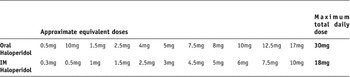
Since the demise of droperidol injection from the UK market in 2001 (MHRA, 2001) prompted by the meta-analysis by Reilly et al. (Reference Reilly, Ayis, Ferrier, Jones and Thomas2000), haloperidol has been the mainstay parenteral antipsychotic in RT in the UK (NICE, 2005; Allen et al. Reference Allen, Currier and Carpenter2005). It has been widely and probably the most studied antipsychotic in RT (TREC Collaborative Group, 2003; Alexander et al. Reference Alexander, Tharyan, Adams, John, Mol and Philip2004; Huf et al. Reference Huf, Coutinho and Adams2007; Raveendran et al. Reference Raveendran, Tharyan, Alexander and Adams2007). EPS remains a very common (>10%) and problematic side effect (Janssen-Cilag Ltd. 2010). Since then, three important changes have been made to its licence (Janssen-Cilag Ltd. 2010), which have had, and will continue to have further significant impact on its ubiquitous use in RT. Aside from discontinuing the licence for IV use, the maximum doses have reduced considerably; now 30mg/day orally (previously was 90mg/day), and 18mg/day IM. Thirdly the SPC has changed to reflect current concerns regarding electrocardiogram (ECG) abnormalities with antipsychotics. A baseline ECG is now recommended prior to treatment with IM haloperidol, especially in the elderly and those with a positive family history of cardiac disease or abnormal findings on cardiac clinical examination. During therapy, the need for ECG monitoring should be assessed on an individual basis (e.g. at dose escalation). Whilst on therapy, the dose should be reduced if the QT interval is prolonged, and discontinued if the QTc exceeds 500 ms. These recommendations, and the practicalities involved in attempting to conduct an ECG, may prompt organisations to use less haloperidol. Some guidelines already reflect this, and consider this medicine to be a choice of last resort (Taylor et al. Reference Taylor, Paton and Kapur2009).
Oral and parenteral haloperidol doses are not bioequivalent due to first-pass effect of hepatic metabolism. Therefore the maximum recommended daily dose for each route of administration is different. Refer to Table 1 to calculate total doses.
Haloperidol oral and IM equivalent doses

This conversion table can be used to calculate the total amount of haloperidol a patient has received if it has been given as both IM and oral (tablets/liquid) doses. Data source: SPC Haldol (http://emc.medicines.org.uk/)
Olanzapine IM
This short-acting injectable formulation was licensed in the UK in 2001 and became available in 2004. As can be expected from data regarding the use of oral olanzapine, IM olanzapine has a lower incidence of EPS than IM haloperidol (Belgamwar & Fenton, Reference Belgamwar and Fenton2005). This makes olanzapine a preferable IM antipsychotic for patients with a history of EPS. However its main drawback is that simultaneous administration with parenteral benzodiazepines is unlicensed (Eli Lilly & Company Ltd. 2010), due to safety concerns. Prior to licensing the safety of this practice was not formally assessed (Wright et al. Reference Wright, Birkett, David, Meehan, Ferchland, Alaka, Saunders, Krueger, Bradley, San, Bernando, Reinstein and Breier2001; Reference Wright1999), and a number of patient deaths occurred post–licensing where olanzapine IM was used in conjunction with other agents including benzodiazepines (reported in a letter [Important safety information: reported serious adverse events following use of Zyprexa intramuscular, 28th September 2004] by Eli Lilly & Company Ltd.). In trials, single doses commonly (1–10%) caused postural hypotension, bradycardia with or without hypotension or syncope, and tachycardia. More uncommonly noted (0.1–1%) were sinus pause and hypoventilation (Eli Lilly & Company Ltd. 2010). If patients given olanzapine IM are considered to additionally require parenteral benzodiazepines, this should not be given until at least one hour after olanzapine IM (Eli Lilly & Company Ltd. 2010) or vice versa. This requirement raises significant issues in terms of nursing practice. See Box 4.

Aripiprazole IM
This is the newest short-acting injectable antipsychotic for RT to the UK market. It was licensed in 2007 and has been available since 2008. Initially uptake was minimal, therefore UK clinical experience is still relatively low. Like olanzapine this injectable atypical antipsychotic has been shown in trials to have a significantly lower incidence of EPS than haloperidol (Andrezina et al. Reference Andrezina, Josiassen, Marcus, Oren, Manos, Stock, Carson and Iwamato2006; Tran-Johnson et al. Reference Tran-Johnson, Sack, Marcus, Auby, McQuade and Oren2007; Zimbroff et al. Reference Zimbroff, Marcus, Manos, Stock, McQuade, Auby and Oren2007). However, unlike olanzapine, it has been shown to be safe when given concurrently with parenteral benzodiazepines (Bristol-Myers Squibb Pharmaceuticals Ltd. 2010). As these are generally recommended as the first line therapies in RT, it could be anticipated that aripiprazole injection potentially has a greater place in therapy than olanzapine. See Box 5.

Other UK-licensed IM agents
Lorazepam IM
This has been used for over twenty years, and is the most widely used benzodiazepine for RT in the UK. It is available as a tablet that may be taken orally or sublingually, and as an injection for IM administration. After oral administration it is readily and completely absorbed from the gastrointestinal tract. It reaches peak plasma levels at approximately 2 hours. Unlike diazepam, which should not be administered IM due to its erratic pattern of absorption, IM lorazepam is reliably absorbed. It is a short acting benzodiazepine with no active metabolites, and its hepatic metabolism is not significantly affected by hepatic dysfunction.
Lorazepam injection needs to be refrigerated to stop it precipitating. Such storage requirements make its use less practicable in some clinical settings and other climates. It was not used in the four TREC trials which were conducted in India and Brazil (TREC Collaborative Group, 2003; Alexander et al. Reference Alexander, Tharyan, Adams, John, Mol and Philip2004; Huf et al. Reference Huf, Coutinho and Adams2007; Raveendran et al. Reference Raveendran, Tharyan, Alexander and Adams2007). See Boxes 3 and 6.

Promethazine IM
Promethazine is a sedating antihistamine that has often be used and studied as an alternative agent to a parenteral benzodiazepine. In 2005, the NICE guidelines stated that there was some (TREC Collaborative Group, 2003; Alexander et al. Reference Alexander, Tharyan, Adams, John, Mol and Philip2004) but insufficient evidence regarding its safety to recommend its routine use in the UK. Further data has subsequently been published (Huf et al. Reference Huf, Coutinho and Adams2007; Raveendran et al. Reference Raveendran, Tharyan, Alexander and Adams2007) demonstrating the relative safety and efficacy of the promethazine-haloperidol combination versus olanzapine IM, and versus haloperidol IM. Promethazine showed benefits as a sedative, and it potentially has a protective effect against haloperidol induced EPS (Huf et al. Reference Huf, Coutinho and Adams2007). These data support the suggestion that in situations where lorazepam cannot be used (e.g. where benzodiazepines are contra-indicated, or lorazepam supplies are unavailable), promethazine may be used, either alone or in combination with haloperidol. Promethazine injection is licensed in the UK for IM administration, and for ‘sedation’. Therefore, from a medico-legal perspective it would be preferable to follow Medicines and Healthcare products Regulatory Agency (MHRA) advice (MHRA, 2009) and use this licensed option rather than administer another injection in an unlicensed manner (e.g. midazolam IM). Promethazine IM is now more widely recommended (Taylor et al. Reference Taylor, Paton and Kapur2009).
Other ‘off-label’ and unlicensed agents
Midazolam IM
The benzodiazepine midazolam is licensed and commonly used in the UK as an intravenous sedative and induction anaesthetic. IM use has also been investigated for RT (7.5 mg–15 mg IM, maximum of 15 mg a day), and is widely used in some countries where refrigeration requirements inhibit the use of lorazepam. Midazolam has a faster onset of action than lorazepam (Huf et al. Reference Huf, Alexander, Allen and Raveendran2009) and some antipsychotics (Martel et al. Reference Martel, Sterzinger, Miner, Clinton and Biros2005), but leads to more respiratory depression than lorazepam IM (Huf et al. Reference Huf, Alexander, Allen and Raveendran2009). There is a greater risk of profound sedation and respiratory depression with midazolam IM than with lorazepam IM (TREC Collaborative Group, 2003). As with promethazine, in 2005 NICE stated that there was insufficient UK evidence regarding the safety of midazolam IM alone or in combination with haloperidol IM to recommend its routine use. NICE suggested that it should only be used in very exceptional circumstances, which should be specified and recorded, and with expressed consultant authority, as an alternative to IV benzodiazepines or haloperidol. Furthermore use for RT is an unlicensed indication in the UK (Roche Products Ltd. 2010). IM midazolam is painful, and this route should only be used in exceptional cases (Roche Products Ltd. 2010). It is classified as a schedule 4 Controlled Drug, which requires nursing staff to keep additional records of its storage and use.
Midazolam buccal and sublingual
Buccal and sublingual midazolam have been studied in a number of populations and scenarios, notably in paediatrics and learning disabilities as an emergency antiepileptic as an alternative to rectal diazepam, where the route of administration is a key feature (Sweetman, Reference Sweetman2009). Sublingual midazolam gives high bioavailability (about 75%) and reliable plasma concentrations (Schwagmeier et al. Reference Schwagmeier, Alincic and Striebel1998). The injection formulation has been administered sublingually, but midazolam has a very bitter acidic taste (British National Formulary, 2009). There is a minimal role for the use of buccal or sublingual midazolam in RT, as it requires the patient to agree to taking an oral formulation. In such cases oral lorazepam (licensed) would be a more familiar choice and in keeping with the MHRA (2009) recommendation to use licensed medicines over unlicensed medicines where available. Administering midazolam injection buccally is not licensed, and the only liquid formulation available in the UK is unlicensed (British National Formulary, 2009).
Other agents available outside of the UK
Several other parenteral agents are licensed for RT and available outside of the UK, including the following:
Ziprasidone: both the oral and IM injection formulations of this atypical antipsychotic are unlikely to be licensed in the UK, although it has been available in the US since 2001. There is increasing clinical experience with the intramuscular injection for RT (Brook et al., Reference Brook, Lucey and Gunn2000; Citrome Reference Citrome2004), including in children and adolescents (Barzman et al. Reference Barzman, DelBello, Forrester, Keck and Strakowski2007; Khan & Mican, Reference Khan and Mican2006) older adults (Barak et al. Reference Barak, Mazeh, Plopski and Baruch2006; Kohen et al. Reference Kohen, Preval, Southard and Francis2005) and the medically unwell (Martel et al. Reference Martel, Sterzinger, Miner, Clinton and Biros2005).
Perphenazine: is a phenothiazine antipsychotic, similar to chlorpromazine, its IM use is limited by its propensity to cause hypotension, sedation and EPS.
Droperidol: remains available in the US but production was discontinued in the UK in 2001 (MHRA, 2001). This was following the conclusion in a meta-analysis by Reilly et al. (2000) that it increased the risk of QT interval prolongation (cardiac repolarisation) in a dose dependant manner.
Clonazepam: this is only licensed in the UK for IV administration in status epilepticus. It is a long acting benzodiazepine, and like diazepam, has active metabolites leading to a risk of accumulation. It has a higher risk of profound hypotension than lorazepam. It is used in countries where lorazepam IM is unavailable.
MEDICO-LEGAL CONSIDERATIONS
When prescribing licensed medication for unlicensed indications (e.g. clonazepam for RT) or beyond maximum licensed doses (e.g. lorazepam >4 mg/day) or for other routes of administration (e.g. midazolam injection for buccal use, or haloperidol injection for IV administration) it is called ‘off-label’ use. When prescribing medicines ‘off-label’ and medicines that are not licensed the prescriber’s responsibility and potential liability are increased (MHRA, 2009). The use of many psychotropic medicines in children under 18 years of age is outside of their UK licence.
On occasions it may be a very rational and appropriate clinical decision to prescribe and administer >4 mg lorazepam a day (orally or IM) for specific highly disturbed individuals, thus exceeding the BNF maximum dose. Escalating the dose of this short acting benzodiazepine above BNF doses is endorsed by the NICE guidelines. Prescribing doses exceeding the licensed maximum of other agents, particularly antipsychotics, is not as safe and is therefore not recommended.
‘When using rapid tranquillisation there may be certain circumstances in which the current BNF uses and limits and [the manufacturer’s] SPC may be knowingly exceeded (for example for lorazepam). This decision should not be taken lightly and the risks should not be underestimated. A risk-benefit analysis should be recorded in the case notes and a rationale in the care plan. Where the risk-benefit is unclear, advice may be sought from clinicians not directly involved in the service user’s care.
If current BNF doses or SPC doses are exceeded: it is particularly important that frequent and intensive monitoring of a calmed service user is undertaken...’
(NICE, 2005)
CONCLUSION
Over the last ten years, particularly since the NICE guidelines in 2005, there have been a number of developments in RT including new medicines, new formulations, and changes in nursing practice. One of the most notable changes was the loss of droperidol injection from the UK market in 2001, leading to a general acceptance of haloperidol as the mainstay antipsychotic. Three years later the first atypical antipsychotic short-acting injection became available (olanzapine) followed by aripiprazole short-acting injection in 2008. Meanwhile, other significant but less obvious changes include the decreased maximum dose for haloperidol, the recommendation for baseline ECG for patients prescribed haloperidol, and its loss of license for IV administration. A number of the oral antipsychotics have become available in different pharmaceutical formulations including some as oro-dispersible tablets. In order to safely use these new medicines and formulations it is imperative that all staff involved in the prescribing and administration of medicines for RT should be familiar with the practical use of these medicines. This includes the methods of preparation and administration, the specific side effects and monitoring requirements, and their own responsibilities in regard to using these medicines.
Despite all these changes and advances, RT medicines are still hampered by inherent risks either related to the medicine itself or the physical restraint required to enable administration. There is still no medicine that can be routinely used in all patients with minimal risk. Lorazepam injection remains the nearest, with over 20 years of experience.