Introduction
As predicted life expectancy continues to rise (Christensen et al. Reference Christensen, Doblhammer, Rau and Vaupel2009), age-related illnesses such as cardiovascular disease and type 2 diabetes are of increasing public health concern (Murray et al. Reference Murray, Vos, Lozano, Naghavi, Flaxman, Michaud, Ezzati, Shibuya, Salomon, Abdalla, Aboyans, Abraham, Ackerman, Aggarwal, Ahn, Ali, Alvarado, Anderson, Anderson, Andrews, Atkinson, Baddour, Bahalim, Barker-Collo, Barrero, Bartels, Basanez, Baxter, Bell, Benjamin, Bennett, Bernabe, Bhalla, Bhandari, Bikbov, Bin Abdulhak, Birbeck, Black, Blencowe, Blore, Blyth, Bolliger, Bonaventure, Boufous, Bourne, Boussinesq, Braithwaite, Brayne, Bridgett, Brooker, Brooks, Brugha, Bryan-Hancock, Bucello, Buchbinder, Buckle, Budke, Burch, Burney, Burstein, Calabria, Campbell, Canter, Carabin, Carapetis, Carmona, Cella, Charlson, Chen, Cheng, Chou, Chugh, Coffeng, Colan, Colquhoun, Colson, Condon, Connor, Cooper, Corriere, Cortinovis, De Vaccaro, Couser, Cowie, Criqui, Cross, Dabhadkar, Dahiya, Dahodwala, Damsere-Derry, Danaei, Davis, De Leo, Degenhardt, Dellavalle, Delossantos, Denenberg, Derrett, Des Jarlais, Dharmaratne, Dherani, Diaz-Torne, Dolk, Dorsey, Driscoll, Duber, Ebel, Edmond, Elbaz, Ali, Erskine, Erwin, Espindola, Ewoigbokhan, Farzadfar, Feigin, Felson, Ferrari, Ferri, Fevre, Finucane, Flaxman, Flood, Foreman, Forouzanfar, Fowkes, Fransen, Freeman, Gabbe, Gabriel, Gakidou, Ganatra, Garcia, Gaspari, Gillum, Gmel, Gonzalez-Medina, Gosselin, Grainger, Grant, Groeger, Guillemin, Gunnell, Gupta, Haagsma, Hagan, Halasa, Hall, Haring, Haro, Harrison, Havmoeller, Hay, Higashi, Hill, Hoen, Hoffman, Hotez, Hoy, Huang, Ibeanusi, Jacobsen, James, Jarvis, Jasrasaria, Jayaraman, Johns, Jonas, Karthikeyan, Kassebaum, Kawakami, Keren, Khoo, King, Knowlton, Kobusingye, Koranteng, Krishnamurthi, Laden, Lalloo, Laslett, Lathlean, Leasher, Lee, Leigh, Levinson, Lim, Limb, Lin, Lipnick, Lipshultz, Liu, Loane, Ohno, Lyons, Mabweijano, MacIntyre, Malekzadeh, Mallinger, Manivannan, Marcenes, March, Margolis, Marks, Marks, Matsumori, Matzopoulos, Mayosi, McAnulty, McDermott, McGill, McGrath, Medina-Mora, Meltzer, Mensah, Merriman, Meyer, Miglioli, Miller, Miller, Mitchell, Mock, Mocumbi, Moffitt, Mokdad, Monasta, Montico, Moradi-Lakeh, Moran, Morawska, Mori, Murdoch, Mwaniki, Naidoo, Nair, Naldi, Narayan, Nelson, Nelson, Nevitt, Newton, Nolte, Norman, Norman, O'Donnell, O'Hanlon, Olives, Omer, Ortblad, Osborne, Ozgediz, Page, Pahari, Pandian, Rivero, Patten, Pearce, Padilla, Perez-Ruiz, Perico, Pesudovs, Phillips, Phillips, Pierce, Pion, Polanczyk, Polinder, Pope, Popova, Porrini, Pourmalek, Prince, Pullan, Ramaiah, Ranganathan, Razavi, Regan, Rehm, Rein, Remuzzi, Richardson, Rivara, Roberts, Robinson, De Leon, Ronfani, Room, Rosenfeld, Rushton, Sacco, Saha, Sampson, Sanchez-Riera, Sanman, Schwebel, Scott, Segui-Gomez, Shahraz, Shepard, Shin, Shivakoti, Singh, Singh, Singh, Singleton, Sleet, Sliwa, Smith, Smith, Stapelberg, Steer, Steiner, Stolk, Stovner, Sudfeld, Syed, Tamburlini, Tavakkoli, Taylor, Taylor, Taylor, Thomas, Thomson, Thurston, Tleyjeh, Tonelli, Towbin, Truelsen, Tsilimbaris, Ubeda, Undurraga, van der Werf, van Os, Vavilala, Venketasubramanian, Wang, Wang, Watt, Weatherall, Weinstock, Weintraub, Weisskopf, Weissman, White, Whiteford, Wiebe, Wiersma, Wilkinson, Williams, Williams, Witt, Wolfe, Woolf, Wulf, Yeh, Zaidi, Zheng, Zonies and Lopez2012). Efforts aimed at reducing the burden of ill health in later years are focusing earlier in development because the pathophysiological processes underlying age-related disease appear to start much earlier in life (Berenson et al. Reference Berenson, Srinivasan, Bao, Newman, Tracy and Wattigney1998). Animal models show that early stressful experiences influence the ontogenesis of the immune and metabolic systems that promote ill health (Cole et al. Reference Cole, Conti, Arevalo, Ruggiero, Heckman and Suomi2012; Conti et al. Reference Conti, Hansman, Heckman, Novak, Ruggiero and Suomi2012). Epidemiological surveys show that psychosocial stress in childhood plays a part in humans (Shonkoff et al. Reference Shonkoff, Boyce and McEwen2009; Brent & Silverstein, Reference Brent and Silverstein2013); evidence indicates that maltreated children grow up to have higher levels of circulating inflammation proteins (Danese et al. Reference Danese, Pariante, Caspi, Taylor and Poulton2007; Matthews et al. Reference Matthews, Chang, Thurston and Bromberger2014) and higher risk of obesity (Danese & Tan, Reference Danese and Tan2014) than their non-maltreated peers. Identifying childhood risks for age-related disease is especially important because readily available interventions focusing on risk factors in adulthood (e.g. smoking, inactivity and poor diet) have limited long-term efficacy (Braunwald, Reference Braunwald1997; Ebrahim et al. Reference Ebrahim, Beswick, Burke and Davey Smith2006). Targeting potentially malleable risk factors early in life may provide alternative strategies to limit the burden of disease in an ageing population.
We explored these issues in relation to bullying victimization, a stressor that is common in childhood (Nansel et al. Reference Nansel, Overpeck, Pilla, Ruan, Simons-Morton and Scheidt2001) and is increasingly considered a form of maltreatment alongside abuse and neglect by adults (Gilbert et al. Reference Gilbert, Widom, Browne, Fergusson, Webb and Janson2009). Bullying victimization occurs between people in the same age groups (e.g., children, adolescents, adults), where an imbalance of power makes it difficult for victims to defend themselves (Olweus, 1993 ). Victimization by bullies is associated with an increased risk of mental health disorders in childhood and adolescence (Arseneault et al. Reference Arseneault, Bowes and Shakoor2010); young victims of bullying show higher levels of anxiety and depression (Salmon et al. Reference Salmon, James and Smith1998; Bond et al. Reference Bond, Carlin, Thomas, Rubin and Patton2001; Arseneault et al. Reference Arseneault, Bowes and Shakoor2010) and also severe problems such as self-harm (Fisher et al. Reference Fisher, Moffitt, Houts, Belsky, Arseneault and Caspi2012), psychotic symptoms (Schreier et al. Reference Schreier, Wolke, Thomas, Horwood, Hollis, Gunnell, Lewis, Thompson, Zammit, Duffy, Salvi and Harrison2009; Arseneault et al. Reference Arseneault, Cannon, Fisher, Polanczyk, Moffitt and Caspi2011) and suicidality (van Geel et al. Reference van Geel, Vedder and Tanilon2014). Using the sample reported on here, we have shown that these risks persist to mid-life, and that they extend beyond mental health to affect physical and cognitive health and socio-economic outcomes (Takizawa et al. Reference Takizawa, Maughan and Arseneault2014). Bullying victimization has also been found to be associated with low-grade systemic inflammation in young adults in a US epidemiological sample (Copeland et al. Reference Copeland, Wolke, Lereya, Shanahan, Worthman and Costello2014) and obesity (Midei & Matthews, Reference Midei and Matthews2011; Qualter et al. Reference Qualter, Murphy, Abbott, Gardner, Japel, Vitaro, Boivin and Tremblay2015). At this stage, however, it is not known whether exposure to bullying is associated with other markers of age-related disease and whether any such effect persists to mid-life, when markers are commonly used to predict disease. An answer to this question would improve understanding of the mechanisms involved in the ageing process and would further our knowledge on the outcomes associated with childhood bullying victimization.
We aimed to extend previous findings by testing whether childhood bullying victimization, assessed prospectively in a 50-year British birth cohort study, exerts effects on biological risks for age-related disease at mid-life. Following other research (Whitlock et al. Reference Whitlock, Lewington, Sherliker, Clarke, Emberson, Halsey, Qizilbash, Collins and Peto2009; Wormser et al. Reference Wormser, Kaptoge, Di Angelantonio, Wood, Pennells, Thompson, Sarwar, Kizer, Lawlor, Nordestgaard, Ridker, Salomaa, Stevens, Woodward, Sattar, Collins, Thompson, Whitlock and Danesh2011; Kaptoge et al. Reference Kaptoge, Di Angelantonio, Pennells, Wood, White, Gao, Walker, Thompson, Sarwar, Caslake, Butterworth, Amouyel, Assmann, Bakker, Barr, Barrett-Connor, Benjamin, Bjorkelund, Brenner, Brunner, Clarke, Cooper, Cremer, Cushman, Dagenais, D'Agostino, Dankner, Davey-Smith, Deeg, Dekker, Engstrom, Folsom, Fowkes, Gallacher, Gaziano, Giampaoli, Gillum, Hofman, Howard, Ingelsson, Iso, Jorgensen, Kiechl, Kitamura, Kiyohara, Koenig, Kromhout, Kuller, Lawlor, Meade, Nissinen, Nordestgaard, Onat, Panagiotakos, Psaty, Rodriguez, Rosengren, Salomaa, Kauhanen, Salonen, Shaffer, Shea, Ford, Stehouwer, Strandberg, Tipping, Tosetto, Wassertheil-Smoller, Wennberg, Westendorp, Whincup, Wilhelmsen, Woodward, Lowe, Wareham, Khaw, Sattar, Packard, Gudnason, Ridker, Pepys, Thompson and Danesh2012; Singh et al. Reference Singh, Danaei, Farzadfar, Stevens, Woodward, Wormser, Kaptoge, Whitlock, Qiao, Lewington, Di Angelantonio, Vander Hoorn, Lawes, Ali, Mozaffarian and Ezzati2013), we focused on indicators of inflammatory processes [e.g. C-reactive protein (CRP) and fibrinogen] and adiposity [body mass index (BMI) and waist:hip ratio] as our main indicators of such risks. We controlled for potential confounders of bullying victimization in childhood and known correlates of the selected outcomes in adult life. We hypothesized that cohort members who had been the victims of bullying in childhood would have higher levels of inflammatory markers and adiposity at mid-life, compared with participants who were not bullied, indicating a greater liability to later age-related disease.
Method
Participants
Data were from the National Child Development Study (NCDS), the 1958 British birth cohort study (Power & Elliott, Reference Power and Elliott2006). Information was collected on 98% of all births in 1 week in 1958 in England, Scotland and Wales (n = 17 416). Subsequent follow-ups took place at ages 7, 11 and 16 years in childhood, and at ages 23, 33, 42, 45, 50 and 55 years in adult life. We report on data collected at birth, from the age 7 and 11 years childhood contacts, and from the age 45 years biomedical survey. Ethical approval for the biomedical survey was given by the South East Multi-Centre Research Ethics Committee.
Assessment of bullying
Exposure to bullying was assessed via parental interviews when participants were 7 and 11 years. At each age, parents were asked if their child was bullied by other children ‘never’, ‘sometimes’ or ‘frequently’. We combined responses from both interviews (n = 11 500) to create a three-level indicator of exposure to childhood bullying: 0 = never bullied (‘never’ at both 7 and 11 years); 1 = occasionally bullied (‘sometimes’ at either 7 or 11 years); 2 = frequently bullied (‘frequently’ at either 7 or 11 years, or ‘sometimes’ at both ages). Where only one parental interview was available (n = 2405 at age 7 years; n = 1311 at age 11 years), responses from that interview were used, providing bullying assessments on 86% of cohort members. Consistent with findings in contemporary cohorts (Nansel et al. Reference Nansel, Craig, Overpeck, Saluja and Ruan2004), bullying victimization was common in this 1950s sample: 27.7% of children had been exposed to occasional bullying, and 14.6% had been frequently bullied.
Reports of bullying victimization from mothers and children have been shown to be similarly associated with emotional and behavioural problems (Shakoor et al. Reference Shakoor, Jaffee, Andreou, Bowes, Ambler, Caspi, Moffitt and Arseneault2011). Although agreement between informants is typically low (Ronning et al. Reference Ronning, Sourander, Kumpulainen, Tamminen, Niemela, Moilanen, Helenius, Piha and Almqvist2009; Wienke Totura et al. Reference Wienke Totura, Green, Karver and Gesten2009), this suggests that both informants provide a unique and meaningful perspective on bullying victimization.
Measures of adult biomarkers
The biomedical survey was undertaken by trained nurses and included venepuncture, physical measurements and an in-home interview (Power & Elliott, Reference Power and Elliott2006). Venous blood samples were centrifuged and the aliquots of plasma stored at −70 °C. CRP was measured by high-sensitivity nephelometric analysis of latex particles coated with CRP monoclonal antibodies (BN ProSpec protein analyser; Dade Behring, Germany). Inter- and intra-assay coefficients of variation were <10%. We excluded participants (n = 210) with CRP of 10 mg/l or more. We used two indicators of CRP levels: (i) a continuous measure (log-transformed to reduce skewness); and (ii) a dichotomous low versus high risk indicator based on the Centers for Disease Control and Prevention/American Heart Association definition of high cardiovascular risk (CRP > 3 mg/l) (Pearson et al. Reference Pearson, Mensah, Alexander, Anderson, Cannon, Criqui, Fadl, Fortmann, Hong, Myers, Rifai, Smith, Taubert, Tracy and Vinicor2003). Fibrinogen was determined by the Clauss method (MDA 180 coagulometer; Biomerieux, UK). All analytes were monitored for internal quality control by Levey–Jennings plots during the assay period.
An anthropometric assessment was also conducted at the biomedical survey, providing measures of BMI [weight (kg)/height (m)2] and waist:hip ratio [waist circumference (cm)/hip circumference (cm)]. We used two indicators of BMI: (i) a continuous measure; and (ii) a dichotomous indicator identifying obese participants with a BMI of 30 kg/m2 or more.
Childhood confounders
Childhood physical status
Birth weight was taken from medical records and childhood BMI was calculated from height and weight measured at age 7 years.
Childhood cognition/behaviour
Childhood intelligence quotient (IQ) was assessed at age 11 years using a standardized 80-item general ability test (Douglas, Reference Douglas1964) with verbal and non-verbal components, and the values were standardized (mean=100, s.d.=15) in the whole sample. Childhood internalizing and externalizing problems were derived from teacher ratings on the Bristol Social Adjustment Guides (Stott, Reference Stott1969) at 7 and 11 years (Clark et al. Reference Clark, Rodgers, Caldwell, Power and Stansfeld2007). We used the mean of scores summed across these two ages where both measures were available (n = 12 366), and single-age measures for the remainder of the sample (n = 3136).
Childhood environment
Family social class in childhood was classified on the basis of the father's occupation at age 7 years, and categorized as professional/managerial/technical, other non-manual, skilled manual, and unskilled manual (Office of Population Censuses and Surveys, Reference Olweus1980). Childhood adversity was assessed from both prospective and retrospective reports. Information prospectively collected from parents and teachers was used to create an eight-item scale of low parental involvement, including indicators of the child's physical appearance and the parents’ activities with the child at ages 7 and 11 years (Power et al. Reference Power, Thomas, Li and Hertzman2012). Retrospectively at age 45 years, participants completed a 16-item questionnaire (Rosenman & Rodgers, Reference Rosenman and Rodgers2004) about their exposure to a range of childhood adversities including poverty, parental mental health and drug/alcohol problems, family conflict, and physical and sexual abuse.
Adult correlates
We also took account of a range of adult factors (health-related behaviours and other correlates) with established associations with inflammatory markers and obesity in adult life. Data from the age 42 years interviews provided a range of sociodemographic and health behaviour indicators, including: (i) adult social class of cohort member (categorized in a similar way to parental social class in childhood); (ii) smoking status (0 = never or ex-smoker; 1 = current smoker); (iii) regular exercise (0 = no; 1 = yes, regularly); (iv) diet (eating fruits and vegetables, coded from 0 = never to 6 = more than once per day).
Depressive and anxiety disorders were assessed at age 45 years using the Depression and Anxiety modules of the Revised Clinical Interview Schedule (Lewis et al. Reference Lewis, Pelosi, Araya and Dunn1992). Diagnoses were derived according to standard algorithms for International Classification of Diseases (ICD)-10 diagnoses. We used summary measures of: (i) mild, moderate and severe depressive disorders; (ii) any anxiety disorders (including generalized anxiety disorder, specific and social phobias, panic disorder and agoraphobia); and (iii) any anxiety or depressive disorders. The age 45 years assessments also included the Alcohol Use Disorders Identification Test (AUDIT; Babor et al. Reference Babor, Higgins-Biddle, Saunders and Monteiro2001), a 10-item screening questionnaire designed by the World Health Organization to identify mild alcohol dependence.
At the biomedical survey, participants were assessed for their use of medications for cardiovascular, respiratory and central nervous systems, infections, endocrine system and other problems, including systemic steroids, respiratory steroids, non-steroidal anti-inflammatory drugs, prophylactic aspirin, anti-gout medications, anti-rheumatic medications, statins and oestrogens.
Attrition
Sample retention in childhood was high (92% at age 7 and 11 years) (Power & Elliott, Reference Power and Elliott2006). Retention rates were lower in adulthood, with data available on 78% of those invited for the mid-life biomedical survey (9426/12 069). For the current analyses, we took a conservative approach and report on 7102 cohort members with complete data on bullying victimization at age 7 or 11 years, and also inflammatory markers at the biomedical survey. Non-participation was unrelated to exposure to childhood bullying (online Supplementary Table S1), but was predicted by male gender, low birth weight, low IQ, low childhood social class, low parental involvement, and childhood internalizing and externalizing problems. We derived inverse probability weights (Seaman & White, Reference Seaman and White2013) from a logistic regression analysis predicting availability of complete data on childhood bullying and biological data of blood sample, including the variables listed above. These weights were included in all analyses.
Statistical analyses
We used linear regression and ordinal logistic regression analyses to test bivariate associations between childhood bullying victimization and adult risk factors for age-related disease. To test their robustness, multivariate models were used to adjust, in separate steps, for childhood confounders (child physical status, cognition and behaviours, and child environmental risk exposure) and adult covariates (including indicators of health-related behaviours). When not considered as an outcome, adult BMI was included as a covariate. All multivariate analyses controlled for gender (males = 1; females = 2) and medication use (no = 0; yes, any = 1). We tested for gender-specific effects in all models. We present results separately by gender where an interaction between bullying victimization and gender was found to be significant. We used robust variance (sandwich-type) estimates to adjust the standard errors of the parameter estimates for the sampling weights applied to observations. All analyses were conducted in STATA version 12.1 (USA).
Results
Is childhood bullying victimization associated with mid-life risks for age-related disease?
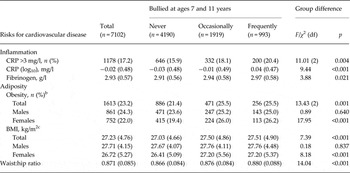
Individuals who had been frequently bullied in childhood showed higher levels of inflammation at mid-life than non-bullied participants (Table 1). We observed significant differences in CRP levels for both the clinically relevant categorical measure of CRP and also for the continuous measure. In addition, children who were frequently bullied showed elevated levels of fibrinogen. Women who had been either occasionally or frequently bullied in childhood showed greater adiposity in mid-life compared with women who had not been bullied. Differences in adiposity for bullied women were observed both for obesity and also across the full distribution of BMI. The effect of bullying generalized to a measure of central adiposity: both men and women who had been bullied in childhood showed greater waist:hip ratio at mid-life than non-bullied individuals.
Associations between bullying victimization in childhood and adult risk for cardiovascular disease a

Data are given as mean (standard deviation) unless otherwise indicated.
df, Degrees of freedom; CRP, C-reactive protein; BMI, body mass index.
a We report unweighted n, but weighted percentage, mean and standard deviation. We present results separately by gender where an interaction between bullying victimization and gender was found to be significant. Associations with categorical variables were estimated with ordinal logistic regression analyses, whereas associations with continuous variables were estimated with one-way analyses of variance.
b Group differences for obesity were not significant for males (Wald χ 2 = 0.89, p = 0.640), but significant for females (Wald χ 2 = 17.95, p < 0.001).
c Group differences for adult BMI were not significant for males (F = 0.18, p = 0.837), but significant for females (F = 8.18, p < 0.001).
Is bullying victimization associated with childhood risk factors and adult correlates of age-related disease?
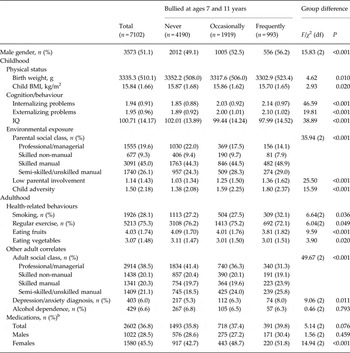
Bullying victimization was associated with several potential confounders assessed in childhood and also with adult correlates of age-related disease risks (Table 2). In terms of child characteristics, bullied participants had lower birth weight and BMI at age 7 years than those who had not been bullied; they also had elevated levels of internalizing and externalizing problems and lower IQ scores; and they experienced greater socio-economic disadvantage as they were growing up. In mid-life, participants who had been bullied in childhood were in lower social class occupations and showed higher rates of affective disorders than their non-bullied peers. They were more likely to smoke than non-bullied participants and less likely to take regular exercise or eat healthily; bullied women were also more likely to report taking medications (Table 2).
Associations between bullying victimization in childhood and childhood confounding factors and key adult variables a

Data are given as mean (standard deviation) unless otherwise indicated.
df, Degrees of freedom; BMI, body mass index; IQ, intelligence quotient.
a We report unweighted n, but weighted percentage, mean and standard deviation. Associations with categorical variables were estimated in ordinal logistic regression analyses, whereas associations with continuous variables were estimated in one-way analyses of variance.
b Gender-specific associations were found only for use of medication only.
Is childhood bullying victimization independently associated with adult risk for age-related disease after controlling for childhood confounders and adult correlates?
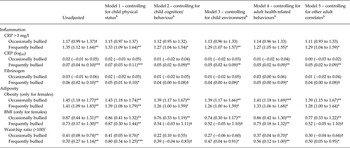
Controlling for childhood confounders and adult covariates did not modify the observed group differences in inflammation markers. Compared with those who had not been bullied in childhood, participants who had been frequently bullied showed higher CRP levels in mid-life after statistical adjustment for child physical status, cognition and behaviour, and environment, and also for adult health-related behaviours and other adult correlates (Table 3). Adjusted analyses revealed similar results for the effect of bullying on fibrinogen levels, although the association was reduced to marginal significance when we statistically controlled for childhood behavioural problems and IQ, childhood adversities, and adult social class and BMI.
Multivariate models for the associations between childhood bullying victimization and adult risk for cardiovascular disease, controlling for childhood confounders and adult key variables a

Data are given as odds ratio or β coefficient (95% confidence interval).
CRP, C-reactive protein; BMI, body mass index.
a All models controlled for effects of gender and use of medications. We present results separately by gender where an interaction between bullying victimization and gender was found to be significant.
b We report the adjusted odds ratio/β values in model 1 [child physical status (birth weight and child BMI)], in model 2 [child cognition/behaviour (internalizing problems and externalizing problems and childhood intelligence quotient)], in model 3 [child environment (parental social class, low parental involvement and child adversity)], in model 4 [adult health-related behaviours (smoking, regular exercise, diet and exercise] and in model 5 [other adult correlates (adult social class, depression/anxiety disorders, alcohol dependence and adult BMI)].
c Waist:hip ratio values were multiplied by 100 for these analyses.
Significant findings: *** p ≤ 0.001, ** p ≤ 0.01, * p ≤ 0.05, † p ≤ 0.10 (trend level).
Compared with women who had not been bullied in childhood, women who had been occasionally or frequently bullied showed significantly higher rates of adult obesity and higher BMI in mid-life after childhood confounders and adult correlates were statistically accounted for (Table 3). In relation to waist:hip ratio, associations with occasional bullying were less consistent, but links with frequent bullying remained largely significant.
When childhood confounders and adult correlates were statistically controlled for simultaneously, findings remained significant for the continuous measures of both CRP [β = 0.04, 95% confidence interval (CI) 0.00–0.07, p = 0.034] and BMI (β = 0.54, 95% CI 0.08–1.00, p = 0.022).
Discussion
We report evidence that childhood bullying victimization is associated with increased risks for age-related disease at mid-life. Our study using data from a large prospective birth cohort shows that study participants who experienced bullying victimization have higher inflammation levels than non-bullied peers, and women who had been bullied are more likely to be obese decades later. Findings are consistent across two different measures of inflammation and two different measures of adiposity. They are also independent of the effects of correlated childhood risks, and of key adult risk factors targeted by current preventive interventions.
These findings are innovative in three ways. First, they add to the growing body of evidence from human and non-human primates showing the adverse effects of early stress on inflammatory and adiposity markers. Second, they widen the spectrum of poor outcomes associated with childhood bullying victimization to risks for age-related disease. Third, they show that early psychosocial stress exerts enduring effects that remain significant into mid-life, when inflammation and obesity are used clinically to predict age-related disease risk. Bullying victimization is a concern for policy and intervention because of the extensive evidence that it contributes to suffering in childhood and adolescence (Arseneault et al. Reference Arseneault, Bowes and Shakoor2010). Recent research findings have been supporting initiatives aimed at reducing bullying behaviours. Findings from this study further suggest that preventing bullying in childhood could reduce risks for age-related disease. Our study also implies that early interventions with the victims could not only limit poor outcomes associated with being bullied in childhood but also contribute to the prevention of health problems in adulthood.
The effects of childhood bullying victimization on biological risks for age-related disease at mid-life were observed on both clinically relevant categorical measures and also across the whole continuum of the distribution of inflammation and adiposity. Therefore, tackling the effect of bullying victimization on risks for age-related disease may not only reduce the prevalence of problems at the clinical level, but also across the wider population. Clinical studies are needed to establish if the effects of childhood bullying on risks for age-related disease can be remediated before the onset of clinical symptoms. For example, in previous research we reported that bullied children are at higher risk of psychiatric disorders in adult life (Takizawa et al. Reference Takizawa, Maughan and Arseneault2014), and psychiatric disorders have been linked to prospective increase in obesity (Luppino et al. Reference Luppino, de Wit, Bouvy, Stijnen, Cuijpers, Penninx and Zitman2010). It is unclear if interventions that can relieve mental health problems in bullied individuals can also affect the biological vulnerability for age-related disease.
Future research also needs to investigate the molecular mechanisms through which exposure to psychosocial adversity, including bullying in childhood, can be translated to biological risks for disease (biological embedding; Danese & McEwen, Reference Danese and McEwen2012). Bullied children undergo epigenetic changes (Ouellet-Morin et al. Reference Ouellet-Morin, Wong, Danese, Pariante, Papadopoulos, Mill and Arseneault2013) associated with blunted neuroendocrine response to psychosocial challenges (Ouellet-Morin et al. Reference Ouellet-Morin, Danese, Bowes, Shakoor, Ambler, Pariante, Papadopoulos, Caspi, Moffitt and Arseneault2011a ). We have previously reported that these neuroendocrine abnormalities were linked to greater internalizing and externalizing problems in childhood (Ouellet-Morin et al. Reference Ouellet-Morin, Odgers, Danese, Bowes, Shakoor, Papadopoulos, Caspi, Moffitt and Arseneault2011b ). It is possible that these neuroendocrine abnormalities also contribute to the later risks for high inflammation and obesity observed here (Danese & McEwen, Reference Danese and McEwen2012).
Despite these significant effects, not all bullied children had high inflammation or were obese in adult life. Notably, the effect of childhood bullying on mid-life BMI was limited to women. This is consistent with reported effects of maltreatment in humans (Danese & Tan, Reference Danese and Tan2014), and early life stress in non-human primates (Conti et al. Reference Conti, Hansman, Heckman, Novak, Ruggiero and Suomi2012). However, we found that the effect of early life stress could be generalized across genders with regard to abdominal adiposity. The origins and mechanisms of these individual differences need to be further investigated.
Our findings should be interpreted in light of some limitations. First, attrition in the NCDS across nearly five decades of assessment was not negligible, though it is unlikely that this affected the pattern of our findings; drop-out was not associated with bullying victimization and we controlled for other effects of selective attrition by including weights throughout the analyses. Second, the associations we observed could be confounded by a number of unmeasured factors. Reassuringly, findings from our study of a large cohort of human participants are consistent with those of experimental research in non-human primates (Cole et al. Reference Cole, Conti, Arevalo, Ruggiero, Heckman and Suomi2012; Conti et al. Reference Conti, Hansman, Heckman, Novak, Ruggiero and Suomi2012) that allow greater control over potential confounders. Third, we did not assess age-related diseases per se, but rather their established risks. An unknown proportion of participants will not develop age-related disease in later life despite their known risks. For prevention schemes and policies, however, knowing about risks may be useful for deciding targets of effective interventions. Fourth, the public health significance of childhood bullying victimization could be questioned in light of the relatively small effects reported here. This may reflect associations across an extended period over the life course. The high prevalence of bullying victimization, high inflammation and obesity would, however, suggest that preventable effects in the population may still be considerable despite the low effect sizes reported here.
Regardless of these limitations, our results have potential implications for future research, clinical practice and public health. Bullying by peers appears to have a non-negligible effect on risks for age-related disease independent from those of other established risks. This and other forms of childhood adversity are not currently addressed by preventive interventions for age-related disease. In light of these findings, new models of preventive interventions for age-related disease need to consider psychosocial risk factors and life-course trajectories. The main focus of preventive interventions for age-related disease has traditionally been on physical risk factors, such as smoking, physical inactivity and unhealthy diet. These are clearly important, but interventions targeting these established risk factors in adults are challenging and of limited effect (Braunwald, Reference Braunwald1997; Ebrahim et al. Reference Ebrahim, Beswick, Burke and Davey Smith2006). Some of the root causes of these unhealthy behaviours may be traced back to childhood psychosocial adversity (Anda et al. Reference Anda, Croft, Felitti, Nordenberg, Giles, Williamson and Giovino1999) and these also need to be tackled by health promotion strategies.
Supplementary material
For supplementary material accompanying this paper visit http://dx.doi.org/10.1017/S0033291715000653
Acknowledgements
The authors thank all the participants in the 1958 NCDS; the Centre for Longitudinal Studies (CLS), Institute of Education for the use of these data; and the Economic and Social Data Service (ESDS) for making them available. However, neither the CLS nor the ESDS bears any responsibility for the analysis or interpretation of these data. We also thank Charlotte Clark and Stephen Stansfeld for the advice about the scoring of the Revised Clinical Interview Schedule and Andrew Pickles for statistical advice. This study received funding from the British Academy (MD120015) to L.A. as a Mid-Career Fellow. R.T. is a Newton International Fellow jointly funded by the Royal Society and the British Academy. The sponsors played no part in the design or conduct of the study, the analysis or interpretation of data, or the writing of the article and the decision to submit it for publication.
R.T., A.D., B.M. and L.A. are responsible for the study concept and design, interpretation of data, and drafting and revising the manuscript for important intellectual content. R.T. had full access to all the data in the study, takes responsibility for the integrity of the data and the accuracy of the data analysis.
Declaration of Interest
None.