Introduction
Much remains to be learned about how best to mobilise the participation of older people in response to natural disasters. Such mobilisation provides valuable opportunities for improving the wellbeing of participants. It also potentially contributes to the vital reconstruction of shattered and displaced communities in circumstances where resources and support personnel might be in short supply. However, to date, there are few documented case studies of effective elder mobilisation in disaster settings, and little attention has been given to the psycho-social processes fostering the effective participation of older people, or to the resulting benefits, both for participants and their wider communities. This paper aims to contribute to filling this gap through a case study of the elder-focused community support system developed in Minamisanriku town after the Great East Japan Earthquake of 2011.
Population ageing has been a United Nations priority for over 30 years (Cheng et al. Reference Cheng, Chan and Phillips2008). It is especially pertinent to Japan, where those over 65 comprise a quarter of the total population – the highest proportion in the world. The gradual shrinkage in total population (0.22% from 2011 to 2012) has left fewer working-age people (16–64) to support this group. This demographic pattern impacts the structure of households. Of all Japanese households, 41.6 per cent include over-65 s, over half of which consist of single or couple elderly occupancies (Government of Japan, Cabinet Office 2012). Only 56.1 per cent of older Japanese people participate in some form of social activities such as sports and community activities, based on the seven different categories defined by the government, with levels varying across regions (Ministry of Health, Labour and Welfare 2012). Elderly people in rural areas are least socially active, often receiving certificates of long-term care from which they get financial support and in-home nursing care services, emphasising their increased need for assistance. There is growing attention to how to maximise the wellbeing of this rapidly growing group. The 2012 Aged Society Basic Law issued by the Japanese Government provides a common policy framework for advancing wellbeing, emphasising changing the stereotypes surrounding ‘older people’, capitalising on their motivation and skills, and enhancing community-based support for the elderly. Facilitating the active participation of older people in looking after themselves and their peers at the community level is thus a national priority. However, to date, little attention has been paid to those factors that might facilitate or hinder such participation in varying contexts.
On 11 March 2011 at 2:46 pm, an earthquake measuring 9.0 on the Richter scale hit eastern Japan, the most powerful known earthquake to have struck Japan and the fifth biggest in the world since 1990. It triggered a 40-metre high tsunami that killed 18,580 people and displaced a further 390,000. At the time of our research (June 2013), many of these displaced persons were still lodged in temporary housing. The areas most affected by the tsunami were rural areas where the proportion of older people is higher than in urban areas (Government of Japan, Cabinet Office 2008). The initial policy for temporary housing was based on the notion of ‘community units’ where previous residents of particular districts were relocated in the same temporary housing villages. This was inspired by the lessons of the Great Hanshin Earthquake in 1995 which resulted in thousands of older people's kodokushi, which refers to the phenomenon of lonely death (from shock or illness) where the bodies of disaster victims lie undiscovered for a long period of time. However, after the 2011 earthquake, due to land shortages, only 30 per cent of those eligible were housed in community-allocated units. The remainder were housed according to a ballot system where individual households waited at a shelter until they were relocated to temporary sites using a random selection process. With long-standing communities almost completely dismantled, older people in some temporary housing communities suffered many physical and mental problems due to a decline in social interactions (Aldrich Reference Aldrich2011). In comparison, other similarly constituted communities were able to achieve astonishing resilience through the formation of supportive community environments. This paper aims to explore one of the latter – namely the Minamisanriku community in the Miyagi prefecture.
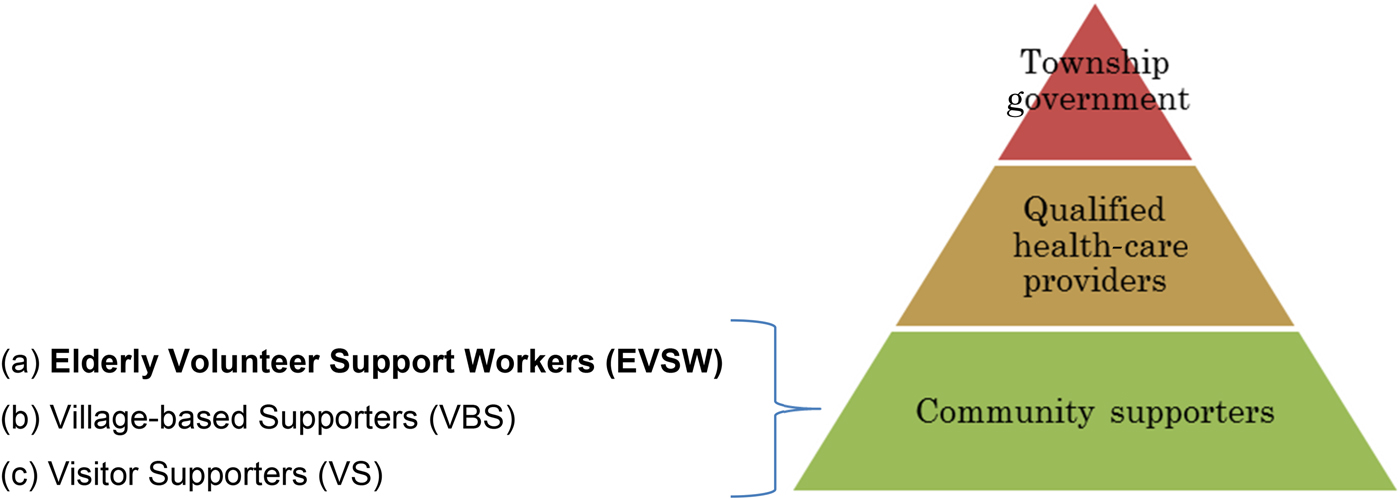
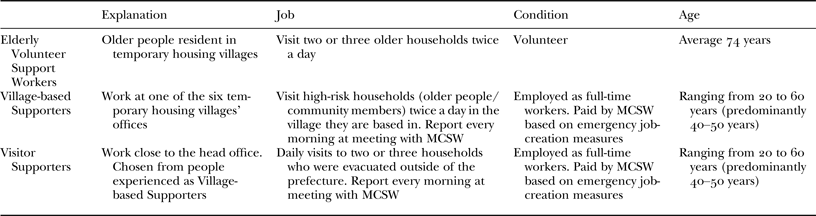
This study took place in Minamisanriku town, where 65 per cent of the population in 2013 lived in temporary housing clustered into six temporary housing village areas. Thirty per cent of these people are over 65 and almost half of all households have single or couple occupants (Minamisanriku Town Hall 2012). Fearing high levels of kodokushi, the national Government delegated emergency community support to the Minamisanriku Council of Social Welfare (MCSW) township government and other devastated areas/prefectures. What makes this town's disaster-response model unique is its prioritisation of efforts to create sustainable systems where older people work together to rebuild supportive communities both during and after their departure from the temporary houses. Due to a shortage of medical professionals and significant overstretching of the nursing system, the town diverted its focus to facilitating the participation of the disaster survivors and maximising the potential of community mobilisation. This disaster-response model had three layers: over 100 community supporters constituted the base layer; qualified employees such as nurses in the middle; and township government (MCSW) at the top (see Figure 1; Table 1).
Minamisanriku Council of Social Welfare Model.

Account of community supporters' roles

Note : MCSW: Minamisanriku Council of Social Welfare.
Community supporters had different roles divided into the following three categories: (a) Elderly Volunteer Support Workers (EVSW), (b) Village-based Supporters (VBS) and (c) Visitor Supporters (VS) (for an account of their roles, see Table 1). The unique thing about this model is that the MCSW (township government) holds meetings every morning with VBS and VS to ensure and share what they heard from the EVSW and other older people. The focus of this paper is on the disaster survivors who worked as community supporters, with particular attention to the role played by the EVSW (who constitute part of the base of the pyramid) in community support and in implementing the model.
Literature review
Social participation by older people
Historically many policy makers, practitioners and citizens have stereotyped older people as a problematic vulnerable population (Harvard School of Public Health 2004), and not as functional and beneficial citizens whose skills and expertise can be maximised (Minkler and Holstein Reference Minkler and Holstein2008; Zedlewski and Butrica Reference Zedlewski and Butrica2007). This negative portrayal of older people is pertinent to both normal and disaster contexts. In community psychology and gerontology, however, understandings of social participation are undergoing a paradigm shift, from a protection-based approach which sees older people as vulnerable beings to acknowledgement of older people as valuable social assets (Geiss Reference Geiss2007). Raymond et al. (Reference Raymond, Sevigny, Tourigny, Vezina, Verreault and Guilbert2012) highlight the facilitation of individual or group-based social involvement as a core focus for supporting older people. Social participation not only reduces loneliness (Aday, Kehoe and Farney Reference Aday, Kehoe and Farney2006; Tse Reference Tse2010) and anxiety (Dickens et al. Reference Dickens, Richards, Greaves and Campbell2011) but also enhances physical strength (Cohen et al. Reference Cohen, Perlstein, Chaplie, Kelly, Firth and Simmens2006; Fisher and Fuzhong Reference Fisher and Fuzhong2004) and self-confidence (Barnes and Bennett Reference Barnes and Bennett1998; Fujiwara et al. Reference Fujiwara, Sakuma, Ohaba, Nishi, Lee, Watanabe, Kousa, Yoshida, Fukaya, Yajima, Amano, Kureta, Ishii, Uchida and Shinkai2009) through building friendships and gaining new skills and knowledge.
However, discussions of the benefits of elder participation often fail to acknowledge the dearth of personnel and resources necessary to support such participation (Ranzijn Reference Ranzijn2010). Much of the literature reports on settings where older people have access to physical spaces for participation, such as adult day care and senior centres, and to resources such as information to enable and support their efforts. Yet older people living in minority settings (in terms of economic, geographic, ethnic, sexual and post-disaster status) are often located in poorly resourced settings, away from major centres of activity and participation. Our research seeks to expand understandings of elder participation in such resource-poor and disrupted social settings.
Coping with the impacts of earthquakes
Standard analyses of disaster coping involve an evaluation of monetary aid, governance quality, amount of damage, population density and individuals' socio-economic disparity (Aldrich Reference Aldrich2011). Literature about coping strategies in the aftermath of natural disasters can be divided into two categories: acute phase and recovery phase. The acute-phase work mainly highlights the importance of immediate disaster responses, such as triage at emergency medical services. The recovery-phase literature focuses on psychological health problems (such as post-trauma and depression) and health care in temporary housing (Kato et al. Reference Kato, Asukai, Miyake, Minakawa and Nishiyama2007). Compared to the acute phase, in recovery-phase settings the number of health-care providers sharply decreases as relief workers come to the end of temporary contracts. In less-populated and suburban settings people suffer greatly from the lack of medical care due to pre-existing vulnerabilities and poor access to home-care services. Though much of the literature highlights an awareness of the need for change in providing health care for dislocated older people, there is less focus on how this might be achieved.
Community support systems (peer-based survivor support)
Aldrich (Reference Aldrich2011) emphasises the need to create and strengthen social networks and trust among people during the recovery phase. There is a growing consensus that community-level collective action and peer support serve as tools for enhancing people's health and wellbeing. Many researchers suggest the importance of building community resilience after disasters (Norris et al. Reference Norris, Stevens, Pfefferbaum, Wyche and Pfefferbaum2008) through processes such as community planning (Pearce Reference Pearce2003) and psychiatric community consultation (Ursano, Fullerton and Norwood Reference Ursano, Fullerton and Norwood1995). However, these efforts tend to rely heavily on formal health professionals, and the research literature falls short of outlining how to maximise the capacity of local people. Peer support is a widely used strategy in community psychology, especially among adolescents and marginalised women (Campbell and MacPhail Reference Campbell and MacPhail2002; Sloane and Zimmer Reference Sloane and Zimmer1993). In relation to older people, it has the great potential to transcend the limitations of mainstream provider–user structures and to enhance mental health through building supportive relationships between older people. It also offers potential for psycho-social empowerment by helping older people to identify their own problems, reflect on them and ultimately collectively take greater responsibility for tackling them (Campbell and Jovchelovitch Reference Campbell and Jovchelovitch2000; Freire Reference Freire1973). This process is most effective in a supportive social environment, where marginalised groups have strong bridging relationships with actors and agencies that sympathise with their predicament, and the political will to help them optimise their wellbeing in challenging circumstances (Campbell and Cornish Reference Campbell and Cornish2010b ). The emphasis of Campbell and colleagues on the psycho-social benefits of social participation by marginalised groups informs our focus on the potential of peer-based survivor support in disaster contexts and the conditions that foster a supportive environment for such support.
Theoretical framework
This work is informed by two inter-linked threads of Campbell's work on the psycho-social pathways between social participation and wellbeing. The first thread is her account of the social psychological processes underlying participation. The second is her conceptualisation of those features of the health-enabling community contexts that arise out of effective participation. The social psychology of participation (Campbell and Jovchelovitch Reference Campbell and Jovchelovitch2000: 255) draws heavily on the work of Paulo Freire (Reference Freire1973, Reference Freire1998) and highlights three key psychological processes underpinning effective collective action. Firstly, participation in meaningful social activity – yielding visible benefits to oneself and to others – provides people with opportunities to rebuild a sense of confident social identity, which may have been undermined by distressing experiences of social disruption. Secondly, such participation provides people with the opportunity to reconstruct more positive representations of themselves, their place in the world and their sense of the future. Thirdly, positive identities and reframed identities are associated with an increased sense of agency and confidence in one's individual and collective strengths to improve one's life prospects, including a sense of ownership of one's life problems (rather than waiting passively for outsiders to come and solve them). All these factors have the potential to enhance health both directly and indirectly (Campbell Reference Campbell, Baron, Field and Schuller2000). However, the likelihood that these positive psycho-social processes might lead to better wellbeing is heavily shaped by the quality of support available to the social group in question.
The second thread of Campbell's work informing this study is her account of the ‘health-enabling community’ that arises from effective social participation (Campbell Reference Campbell, Baron, Field and Schuller2000). In this work, she emphasises the role of social capital in constructing contexts that enable and support the possibility of improved health amongst marginalised groups (Campbell Reference Campbell, Baron, Field and Schuller2000). In this paper, we draw on aspects of two very different conceptualisations of social capital, namely the work of Putnam (Reference Putnam2000) and Bourdieu (Reference Bourdieu1986). Putnam's (Reference Putnam2000) emphasis on the role of trust, norms and networks within small communities is referred to as bonding social capital. Bourdieu's (Reference Bourdieu1986) emphasis on those durable and positive networks that link small communities with supportive external others is referred to here as bridging social capital. We view the development of bonding social capital as a springboard for effective participation rather than the final goal, which needs to involve not only the development of strong within-community relationships, but also the existence of significant support networks between communities and more powerful groups with the will and resources to help them advance their wellbeing. Community members are most likely to improve their life situations in the context of efforts to establish supportive relationships with both others inside their community (bonding) and with external actors and agencies with greater power (bridging) (Campbell and Cornish Reference Campbell and Cornish2010a ).
Against this background, Campbell et al. (Reference Campbell, Cornish, Gibbs and Scott2010) conceptualise a health-enabling community as one where effective group participation results in five characteristics: (a) the existence of social spaces in which marginalised people can engage in dialogue about the drivers of their predicament, and about possible ways they might work together to alleviate it; (b) a sense of solidarity in tackling the social challenges that face them; (c) a sense of confidence that their group has access to skills and abilities that could make a significant contribution to this; (d) a sense of collective ownership of problems rather than waiting passively for outsiders to come and assist them; and (e) effective bridging links with external social and economic resources through support and welfare agencies.
This paper uses these intertwined understandings of (a) the social psychology of participation and of (b) the health-enabling community that arises from effective participation to frame its exploration of the role of older people in creating social contexts most likely to enhance the wellbeing of themselves and their peers, in the specific context of the post-disaster period.
Methodology
This project received ethical clearance from a review board at the London School of Economics and Political Science, where members of the research team are affiliated. Approval and signed informed consent were obtained from the participants prior to the interviews, and participants were assured of confidentiality and anonymity.
Setting
This research was conducted with the co-operation of the MCSW in the Miyagi prefecture in Japan in April 2013. Interviews were conducted face to face for between 45 and 100 minutes, averaging 74 minutes. The disaster-response model was launched on 19 July 2011 when the national government commissioned the MCSW and the Miyagi township government amongst others to build a community aiming to prevent the older people's kodokushi (solitary death). After people had spent three to seven months at initial emergency shelters (school gymnasia and public halls), they were moved to temporary housing villages scattered in different places, often with people they had never met before from a range of age groups. Minamisanriku town is located in a rural area where the major industries are agriculture farming and fisheries. The pre-earthquake lives of the displaced people had been conducted in close-knit communities in the wider region where people co-operated in their daily work. To compensate for such loss of interaction, the MCSW used emergency job-creation regulations to employ Village-based Supporters to promote wellbeing in the community (for their job descriptions, see Table 1). Gradually, these workers recruited older people to get involved in their visiting programme, inviting people to serve as supporters in each village (a cluster of temporary houses).
An EVSW's day starts around 8 am and consists of visiting and having a conversation with high-risk older people in their community (those living by themselves, and mentally ill and physically disabled people identified by the MCSW as needing support). Each is responsible for four to six households. In the evenings they knock on the same doors for further contact. Their role is to confirm the safety of at-risk peers and to share information about activities at the village common room. Since people will eventually move out of temporary housing to more permanent homes over the next few years, the disaster-response model's long-term goal is to build community-building skills amongst a cohort of older people that they will then be able to replicate in their new permanent homes, when these eventually become available.
Participants and recruitment
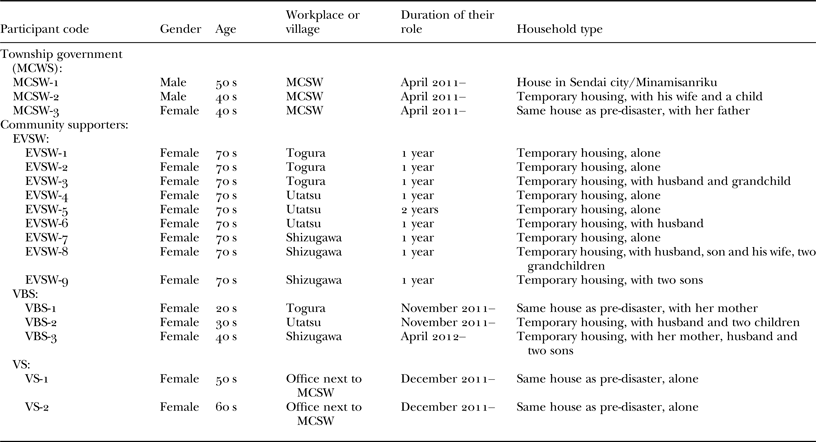
In total, 17 disaster-response participants participated in our research. These included three paid workers from the MCSW from the top layer on the pyramid in Figure 1 and 14 unpaid community volunteers from the bottom layer. The latter group was made up of nine EVSW, three VBS and two VS (see Table 2). No one refused to participate, but one interviewee did not feel comfortable being interviewed alone, so we paired her up for a joint interview with another participant.
Participant list

Notes: MCSW: Minamisanriku Council of Social Welfare. EVSW: Elderly Volunteer Supporter Workers. VBS: Village-based Supporters. VS: Visitor Supporters.
The MCSW randomly sampled potential research interviewees from their list of community volunteers. Once they had identified people in this way, the researchers conducted purposive sampling of the resulting list of names to ensure the sample included people playing different roles in the bottom layer of the disaster-response pyramid.
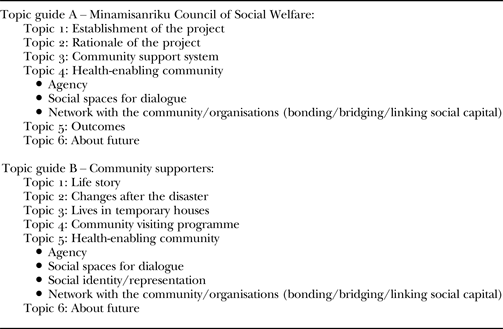
Interview topic guides
We developed two interview topic guides. The first (see Table 3) was used for MCSW staff members, and explored their understandings of the impact of their approach in relation to the five dimensions of a health-enabling community outlined above, as well as eliciting their views of the mechanisms, ethos and objectives of the model. The second topic guide (see Table 3) was used with community supporters. It started with life history questions, where informants spoke about their lives before and after the earthquakes. The second part of the interviews explored experiences of participation, again framed by the five dimensions of a health-enabling community. It also explored attitudes of supporters towards their roles.
Interview topic guide

Data collection and analysis
Participants were interviewed in April 2013. Semi-structured open-ended interviews were conducted in Japanese by the first author. All interviews were audio recorded with the consent of the research participants. The interviews were transcribed and translated into English by the first author who is fluent in both languages and with full sensitivity to culturally complex Japanese concepts underpinned by the unique regional culture. Using NVIVO, data were subjected to thematic content analysis, framed by a combination of emerging and pre-existing categories (Attride-Stirling Reference Attride-Stirling2001). After repeated reading and re-reading of the transcripts, we identified basic themes which were then clustered into organising themes and further into global themes (see Table 4).
Coding frame

Notes: MCSW: Minamisanriku Council of Social Welfare. EVSW: Elderly Volunteer Supporter Workers. VBS: Village-based Supporters.
Findings and discussion
Using our global themes as sub-headings, our findings present our analysis of interviewees' accounts of the way in which social participation created opportunities for (a) the reconstruction of positive social identities by displaced people; (b) the construction of positive social representations of older participants in the media and in society at large; (c) the re-creation of elders' disrupted sense of ownership of their lives in the face of the devastating loss of their prior possessions, community and life routines; and (d) the optimisation of possibilities for good relationships between the MCSW workers and the relocated and reconstructed community.
Global theme 1: Rebuilding and revising social identity
The ‘place’ (district) where older people lived prior to the earthquake plays an important role in constructing social identities in new temporary homes in Minamisanriku town. People understood the concept of ‘community’ as the district they live in. For older people, the loss of geographical residence represented a loss of self.
When I moved to the temporary housing from the shelter, I really didn't feel comfortable because I didn't know anyone. I thought I lost myself. I even thought it might have been better if I could have died when the disaster came. (EVSW-4)
Rebuilding solidarity in the new community through social spaces for dialogue
Talking about the past before the earthquake, many older volunteers spoke of their relationship with their neighbours in their previous community as a ‘big family’ – characterised by trust and solidarity underpinned by the cultural aspect of yui, meaning reciprocity. After moving to the temporary housing, they spoke of the role of their volunteering experiences in gradually reforming new trusting relationships through interacting both with other older people in the temporary community as well as people across generations.
We always helped each other and we trusted each other in the previous community. Do you know the cultural system of yui? In Tohoku (Eastern Japan) area, we used to help each other's rice-planting and harvesting because it's hard to do individually. If you're helped, you help in different ways because we don't want to make power differences between us. (EVSW-4)
I feel a sense of trust among other older people here. I can't understand someone's thoughts deeply, but still. It's good that we have similar issues, like, we sometimes talk about how we want to die (laugh). We have opportunities to talk a lot with people I didn't know, with young people as well. (EVSW-2)
Each of these extracts illustrates the first dimension of a health-enabling community, the existence of social spaces for dialogue around their predicament, with EVSW-2 finding comfort in spending time with similar others and sharing common issues. Their mention of how many old people talked about ‘wanting to die’ highlights the extent of the psycho-social challenges that many displaced older people faced. In addition, EVSW-2 speaks of how she works to interact with people of other generations in the temporary housing community. This dialogue serves as a space where older people can share anxieties and build networks with similar others. Safe spaces of this nature allow interlocutors to build empathetic community networks where participants come to take the perspective of the other by listening to different people's stories (Rappaport Reference Rappaport2000).
Solidarity in tackling social challenges and conceiving themselves ‘capable’
Through the process of working as volunteers, the older people describe having new opportunities for supporting and encouraging one another around a common goal and reconstructing their social identities to regard themselves as physically and mentally ‘capable’.
There is one more person who is doing Elderly Volunteer Supporter Worker in this village and I visit neighbours in alternate shift with her. When it's my turn, I wake up immediately and I prepare very quickly. I get very excited because I can meet with them! If I'm late, my neighbours will worry so I have to be on time. (EVSW-7)
I didn't know that I can do this role because we're always the one who are given help. But through the process of the visiting programme, I was more exposed to the community and I was really encouraged by other community members including older people that I'm visiting. (EVSW-2)
Recognition of being ‘capable’ was supported by the given social role, which encourages a sense of competency amongst volunteers, through feeling responsible for what they are doing and are aware of the fact that people are waiting for them.
Having opportunities to engage in constructive dialogue and playing meaningful social roles served as important tools in revising participants' identities. Older people are often seen as frail, disenfranchised people (Cheng and Heller Reference Cheng and Heller2010), representations that position them in a limited world, often as passive recipients of care and help. In our setting, positive and supportive interactions provided them with opportunities to rethink this.
When I was asked to be a supporter by the MCSW, I thought, ‘wait, am I not the one who's supposed to be cared for?’ But then I thought, it doesn't matter. If I'm asked to do it, I'll do it, and now, I know that I can do it. (EVSW-6)
Taking on the social role of an EVSW also provided a pathway through which EVSW-6 could reconceptualise herself as a provider rather than recipient of support. This also contributed to her sense of ownership from working to alleviate the community's problems. The development of opportunities to behave in new ways is key to enabling people to ‘revise’ their social identities (Campbell and Cornish Reference Campbell and Cornish2010b ).
Global theme 2: Creating positive social representations of self and future
Prior to participation in the programme, some older people conceived of themselves and saw others as stereotyping them in negative ways, as passive and frail beings incapable of fulfilling significant social roles and as a burden to others.
Before the disaster, I used to live with my son, his wife and their child who is entering elementary school next year. I felt very guilty because they had to take care of me every day. (EVSW-5)
You know, Japan is an aged society with a low birth rate. Some people actually said bad things about us just staying at our house and drinking tea with friends. It's a pity because when we were young we used to work like them. (EVSW-8)
New reputations in the community
The older people's positive sense of how their volunteering was viewed by peers and the wider community played a strong role in maintaining and enhancing their confidence in the contribution they could make to looking after themselves and others. Most of the EVSWs describe the best moment of their work as when they are thanked or positively evaluated by other people.
I was visiting neighbours with my name tag and these young men were doing constructions. They looked at my name tag and said ‘Thank you for your job’. I was very happy. (EVSW-1)
When I feel I am needed by the neighbour, I feel like I'm needed by the society as well. I became confident working as a peer-based supporter. (EVSW-4)
Social evaluation
Evaluations from the media play an important role in enhancing positive social representations.
I was asked to participate in an interview by the university. They wanted to write a book featuring 101 survivors. I talked about the day of the earthquake and the role I'm playing as a peer-based visitor. (EVSW-7)
However, although the MCSW welcomed media coverage in terms of promoting positive evaluation of the EVSW's work, they were also aware of the importance of getting positive evaluations from within the communities to sustain positive involvement of volunteers.
We are very open to media. Community supporters can learn their value of work from newspapers and television, so we kind of use them (laugh). We say ‘this is a collaborative community development with you and us’. But in reality, people's attention is decreasing after two years since the earthquake. That's why we have to shift the focus to enhancing evaluation from their community. (MCSW-1)
Both forms of social evaluation have a key role to play in enhancing and reaffirming a positive social identity for older volunteers. The action of visiting a temporary housing community allowed them to get ‘feedback’ from both media and the local community in helping them to acknowledge their positive social contributions. In other words, being seen as ‘valuable’ or ‘respected’ by other people across generations can generate empowering narratives for the older people. People gain a sense of enhanced confidence and security when positive feedback from significant others matches how they see themselves (Mead Reference Mead1934). Realistically speaking, it is true that older people are physically disadvantaged in ways that limit the extent of their potential contribution to formal work and social production. However, our volunteers said that their experiences of community participation helped both their own communities and wider society (via the media) to recognise that they still had a vitally important role to play in sustaining their communities, and that being an old person is not necessarily synonymous with withdrawing from significant productive roles.
Global theme 3: Taking ownership of their lives and future
When they had moved into temporary housing villages from the shelter two years previously, many participants said they had felt very unconfident about how they would live by themselves in the new setting.
When I moved in, I didn't have confidence to live by myself. I was totally alone. I didn't know where the supermarket was, I didn't know where I could meet people … nothing. (EVSW-8)
Older people as leaders mobilising their community
Besides their role in enhancing the wellbeing of themselves, and other elderly people, one of the most pivotal outcomes of the social participation of older volunteers was their role in creating social cohesion across the range of age groups displaced by the earthquake. During their visits they attempted to have open conversations with all members of the community.
Kids were playing football outside and they didn't look that energetic. What do you think I did? I shouted ‘Be lively!!’ And they were like, ‘yes, ma'am!!’ (laugh). (EVSW-4)
When we gather at the common room we bring what we are good at so each person can be a teacher and we learn from them. (EVSW-2)
While the first extract describes how older volunteers show care for other generations, the second extract demonstrates how elders can support other community members and elders in confidently taking up informal leadership roles.
Willingness to contribute in the future
Even when some EVSW's contracts had ended, they continued to visit their assigned households as volunteers in their own time. Likewise, others currently working as supporters expressed the will to continue to look after their community after their contracts ended.
When I was told that my contract ends this March, I was so sad. But I will continue at my own pace as a volunteer once every several days to make sure everyone is okay because I keep thinking about them. Now I know what I should do in this community and I'm confident that I can do this. (EVSW-7)
This sense of the future is fundamental to ensuring and maintaining older people's meaningful participation as well as the sustainability of their health-enabling community.
The three sub-headings above provide a strong illustration of Putnam's (Reference Putnam2000) notion of bonding social capital in action. They reflect his emphasis on the role of social participation of community members in creating health-enhancing networks and norms of trust and mutual support. Our findings highlight how elderly volunteer engagement in positive forms of collective action can lead to enhanced community relations of solidarity both amongst older people and across generations, as well as supporting the construction of more positive social representations of the elderly (traditionally a stigmatised group), associated with empowered social identities and a sense of elder ownership of and responsibility for fostering their own and their community's wellbeing.
Global theme 4: Bridging social capital: MCSW ‘getting along’ with the community
We now turn to explore the role of older people's involvement in facilitating ‘bridging capital’ understood as links between a marginalised community (in this case the elderly) and external social and economic relationships and resources provided by external support and welfare agencies – also regarded as key to enhancing community wellbeing in a sustainable way (Campbell Reference Campbell, Baron, Field and Schuller2000).
Even prior to the disaster, the MCSW's mandate was the provision of long-term care to the community, but in their previous programmes they had a far less interactive relationship with community members.
The idea of the system which involves community participation was totally new. It was very distinct in the way that it allowed us to listen to the community's voice and link them to appropriate resources. (MCSW-2)
As we will see below, links between the MCSW and the community have been strengthened through the disaster-response model through increasing older people's access to health-enabling knowledge; developing their skills in seeking out local resources; and their opportunities for listening, sharing and acting with potential support actors and networks located slightly outside their immediate everyday daily lives and struggles.
Increased access to culturally appropriate local knowledge
Cultural appropriateness was defined as a key feature of the disaster-response model which had a focus on the local context. A driving force within the model is the entrenched cultural norm which constitutes yui (defined above). This norm is embedded in historical relations of reciprocity which have long been widely practised in rice-planting and harvest activities, particularly in times of difficulty. The core idea of reciprocity is that people help each other as social equals to prevent the formation of a power hierarchy. The MCSW actively engaged this cultural norm of reciprocity in their formulation of the MCSW model.
Ideally, service providers should be able to analyse a given group's culture to identify ways in which it can be translated into services and resources that are culturally appropriate. However, there is an added layer of complexity in that cultures are enacted in specific local contexts, so local insights are also valuable in increasing the fit between services and user needs. For example, the following is a quote from a VBS who visited an older man who lives alone and was suspected of being an alcoholic:
There was a guy who was drinking alcohol from noon so we went to visit him. But he and his neighbour told me that he used to be a fisherman. This makes sense because many people used to work at sea before the disaster and it is usual that they drink from noon because their day (work) starts from midnight. They have their life routine; it does not necessarily mean that they are an alcoholic. It is just that he has a different lifestyle. He is not making trouble but we're going to continue home visiting to make sure he's okay. (VBS-1)
Here, instead of defining the man as someone with a problem that needs help, the VBS was able to develop a more nuanced understanding of his drinking behaviour. It is often the case that more powerful people's knowledge (in this case that of a social worker or volunteer) is regarded as more ‘valid’ or ‘valuable’ (Gaventa and Cornwall Reference Gaventa, Cornwall, P. and H.2001). However, behaviour may be based on an individual's local cultural background which is not immediately comprehensible in the mainstream world. In order to build collaborative partnerships, those seeking to offer support within the community and evaluators need to make every effort to learn about the cultural, social, political and environmental specifics that affect their population of interest before defining them as problematic and in need of intervention. They also need to be sensitive to individual differences in the way in which people enact culturally and locally sanctioned norms and possibilities (Harper et al. Reference Harper, Contreras, Bangi and Pedraza2003). The close, often daily, interactions between social workers and volunteers familiar with such norms enabled sharing of vital information of this nature. This example illustrates yet another benefit of the participation of local people in support efforts after disasters – in settings where those in need may be displaced from the traditional settings in which their coping norms and habits evolved prior to the disaster.
Maximising local resources: ‘capacity building’ and ‘independence support’
While sensitivity to local knowledge – what people know – is an inevitable condition of a health-enabling community, it is also necessary to take local circumstances into account and consider what they have in order to identify what they need and, further, what is possible. Applying this rationale to the Minamisanriku setting, the challenges identified by the MCSW programme were (a) the potential for kodokushi; (b) the lack of resources in the post-disaster settings; and (c) disaster survivors' housing, temporary employment and low expectations for long-term aid. In analysing these situations, the need to form a sustainable community system supportive of the older people became apparent. In particular, there was a need for a response that would equip community members to continue to restore their disrupted lives even in their new community after leaving the temporary housing. In resource-poor settings human resources can play a vital role in facing this challenge, especially in the particular context of Minamisanriku where people value and show a willingness to ‘give back what they have received’ to the society. Among the three types of community supporters, VBS and VS were employed with the specific long-term aim of serving as the future leaders of any communities that might be established when people eventually vacated the temporary housing for new places of residence.
The support we're doing is long-term livelihood support. Who are the experts of livelihood? People living here, right? They know their town and they are all victims so they can share and understand the hardships, and help each other develop and build sustainable coping skills they can take into their futures. (MCSW-1)
Importance of capacity building
In order to maximise local human coping resources, capacity building is an essential pathway. The fundamental characteristic of capacity building is the ability for marginalised groupings to solve problems collectively, given appropriate resources (Chaskin Reference Chaskin2001). In this regard, the MCSW implemented skills building in a unique way which heavily relied on the supporters' knowledge and decision making.
After we employed the Village-based Supporters we first conducted three days of formal training which were mainly about emergency treatment, basic public welfare knowledge and how to handle personal information. For many organisations maybe this is it. But we're different. We have meetings every morning at the MCSW office. We put great priority on this. It's like a case study. We learn from the community members. We give resources like lectures and handbooks to get people thinking, but we don't have a manualised programme. (MCSW-1)
Ready-made policies often lack attention to local contexts, and health and welfare professionals usually have to learn how to ‘operate’ abstract policy and system blueprints wielded as decontextualised methodological tools rather than as responses tailored to specific contexts. However, the MCSW's more responsive and context-sensitive programme offers a space to think about particular situations in a critical way by drawing on the participants' knowledge and utilising the existing resources. This approach is particularly helpful since every village has different characteristics and community members have different problems at the individual level as well.
They [MCSW] don't tell us what we have to do. They give us an aim or proposal so we take it back to our village and think together with other supporters how best to implement it. It's very hard but we learn how to think and it becomes a good motivation. Also, in order to know what older people need, we have to know the people in our community so we communicate a lot. (VBS-3)
This dialogue acts as a tool to facilitate the dynamic interaction between ‘critical thought’ and ‘critical action’ based on the ability to think holistically about the personal, cultural and social drivers of one's life challenges and about possible responses to these (Freire Reference Freire1998). Another added value of the capacity building alluded to in this extract is that it cultivates the supporters' motivation. This is extremely important in terms of developing a sense of elder community ownership of their work and their confidence to take control of what they are doing. In this way, the disaster-response model becomes their own system where they can see themselves as active initiators of particular community-response measures rather than being one of the pieces of an externally imposed system.
Importance of supporting sustainable elder independence
The MCSW saw its work in terms of an on-going process – first to build the independence of individual supporters and those that participated in the visiting programme, and then over time to expand this to building longer-term sustainable independence and interdependence across the community. They saw the development of trusting and supportive personal relationships between individual supporters and particular vulnerable older people as the springboard to the development of wider relationships reaching out more widely into the community.
Initially, the MCSW process focused on building the capacity and independence of individual elders, gradually evolving to an approach where they worked together to increase the independence of their whole community.
Our goal for the first two years was community members' individual independence. We visited every older person in the community to listen to their anxieties, problems, life stories … etc. to connect them to available resources such as health care. We now built trust among them so from this year [third year] it has shifted to community independent support. This means that we support them [older people] to connect with other older peers and community members. (VBS-1)
Most of the supporters expressed the view that at the beginning their role was not easy, because both the supporters themselves, and the elderly they sought to support, found their open-ended listening and networking role difficult to understand in a context where people expected to be relatively passive targets of services rather than collaborating with the volunteers to identify and access the types of support they needed.
When we started the supporter role we received lots of criticism from older people and other community members we visited. Like, ‘you come every day to listen to my story but you don't do anything for me’. I can't do anything for them because I'm not a nurse or a certified care worker. I was asking myself, ‘what's the purpose of doing this then?’ It took a while for me and for me and them to understand that our job is not to do something, but to listen to their voices and to connect them to the appropriate resources. (VBS-2)
However, in addition to this collaborative role, the same VBS described her job as being a ‘mental safety net’ for community members, emphasising the value of simply listening to distressed people.
I think we are a mental safety net for older people and other community members. We encourage them to be independent but if you look back, we're also here to listen to their experiences. (VBS-2)
Attachment is a lasting psychological connectedness between human beings who are available and responsive to their needs (Bowlby Reference Bowlby1969). Throughout this process, VBS and community members sought to build committed interpersonal relationships with those they visited as a stepping stone to promoting their independence.
Maximising local resources does not only involve the utilisation of existing and available human resources but it is also about the mobilisation and building of their capacity to foster possibilities for sustainable long-term community independence. In addition, capitalising on what the community ‘has’ rather than filling the shortcomings by seeking material aid from external agencies is important in terms of the sustainability of such community development.
Listening, sharing and acting
The MCSW has provided hand-in-hand and step-by-step support to the community members over the past two years since this community system started. They have created an environment that seems to be a truly ‘receptive social environment’ insofar as it is genuinely open and responsive to the needs of marginalised groupings (Campbell et al. Reference Campbell, Cornish, Gibbs and Scott2010).
As mentioned above, the daily morning meetings are the place where most of the interaction between the MCSW and VBS and VS happens. In these 30 minutes, one person from every village gathers and reports on the reflections of the visit from the previous day and discusses the situations, possible remedies and goals. In this environment, any power hierarchy is levelled. In more conventional top-down service settings, a power hierarchy often serves as an obstacle to dialogue. The MCSW addressed these power dynamics through the process of repeating the steps of listening, sharing and acting: relinquishing power, sharing power and utilising symbolic power.
Relinquishing power was present while the MCSW was actively listening to the community supporters' reflections. Everyone was encouraged to comment and give feedback freely in the meeting. While the MCSW gave constructive comments, they also attempted to discover the supporters' strengths and labelled them as their abilities.
Village-based Supporter and Visitor Supporters are the experts of the community but they are not aware of their abilities. So I always say ‘99 per cent of your visit is going to be a waste. But because you know what is normal from your 99 per cent experience, you can notice the 1 per cent which is something amiss. The fact that you can spot that 1 per cent and notice something amiss, is YOUR ability’. (MCSW-1)
Repetition of everyday visits sometimes make the supporters' unsure about the value of their work. However, over time they come to realise that the daily visits to the same household enable them gradually to construct a view of what is ‘normal’ for a particular household so they become sensitive to the trivial changes or differences that might turn into significant problems over time, or which might represent the seeds of new coping abilities that need to be identified and fostered. Constant opportunities to review visits with social workers helps to develop supporters' confidence in this regard.
The morning meetings also have a crucial function to disseminate information from and to other villages as well as to reaffirm shared goals of supporters and to develop their confidence and sense of solidarity through reminding them that they are part of a wider network of supporters that also extends to other villages.
These meetings are also the places where the MCSW shares power with supporters. Power and knowledge are inextricably related and thus interchangeably affect each other (Foucault Reference Foucault1980). In this context, the MCSW shares its expert knowledge and refines it in the light of the information received from the supporters. This constant integration of ‘expert’ and ‘volunteer’ expertise enables social workers and volunteers to construct and reconstruct their perspectives of their work mutually, and in doing so contribute to the creation of shared goals that represent both the social work ‘system’ and the ‘lifeworlds’ of volunteers and the elders that they visit (Habermas Reference Habermas1987). Empowerment through knowledge means sharing expert knowledge as well as expanding the production of expert knowledge through acknowledging the participation of the elders themselves.
Utilising symbolic power by the programme was also observed in various forms. One example is the use of media discussed above. The MCSW has made use of their communications networks to publicise the role of the disaster-response model.
Finally, the MCSW has shown flexibility and openness to change through taking supporters' advice in developing new strategies. For instance, in creating the morning exercise implemented in all villages, they replaced songs and rapid movements (from the exercise programme widely used in Japan) with more familiar classical songs and slow movements so that older people can participate easily.
Through their strategy of relinquishing, sharing and using the power they have as social workers, the MCSW has been highly proactive and responsive to the supporters' perspectives, creating empowering strategies which they hope will lead to sustainable empowerment of the older people in their care. The morning meetings serve as the local public sphere (Habermas Reference Habermas and Burger1989: 30) where individuals gather, discuss, identify problems and influence the actions of the MCSW.
Historically many have criticised the public sphere as contexts that are embedded in unequal power hierarchies, making horizontal communication a challenge (Fraser Reference Fraser1990). Nevertheless, only a few VBS and VS felt (only slightly) nervous expressing their thoughts at the meetings. They identified their source of anxiety as a lack of experience in speaking in ‘official’ and ‘public’ places. In this sense, the pre-meetings at each village where supporters gathered and talked about the problem acted as a safe space which made the morning meetings more inclusive and constructive.
The findings show that in order to ensure that the social participation of older people is effective, the MCSW consistently made efforts to include the local people's voices in ways that successfully approximate the ideal of ‘bridging social capital’. When the welfare process is self-consciously open to the inclusion of new insights arising from the life-worlds of local people, policy deliberations are more democratic and have a better chance of success (Reason and Bradbury Reference Reason and Bradbury2006). In this regard, the MCSW has been exemplary in its sensitivity to the local context, utilising existing local resources and effectively contributing to the capacity building of the community members where needed.
Conclusion
Drawing on the social psychology of participation (Campbell and Jovchelovitch Reference Campbell and Jovchelovitch2000), our work has sought to illustrate how the social participation of older people can open up opportunities for enhanced wellbeing amongst an extremely vulnerable group, namely those elders who lost their homes, communities and possessions in a devastating earthquake. We have shown how participation enabled both volunteers and those that they supported to construct more empowered social representations of themselves and of older people more generally, associated with more positive and optimistic social identities. In addition, participation brought a greater sense of and capacity for positive agency in their own lives and in the collective life of their temporary communities, and an increase in both bonding and bridging social capital. The latter is particularly important. Elsewhere we have criticised the field of community psychology for its over-emphasis on the promotion of bonding social capital (trust and support amongst vulnerable or marginalised people) without paying adequate attention to the vital parallel role that bridging social capital needs to play in creating social environments that enable and support the optimisation of such trust and support in leading to sustainable individual and community empowerment (Campbell et al. Reference Campbell, Cornish, Gibbs and Scott2010).
The positive benefits of the MCSW disaster response were crucially enabled by the powerful MCSW–elder linkage which nurtured the volunteer community to support participation. Our case study suggests that social participation has great potential to enhance the older people's wellbeing in resource-poor settings in the presence of a supportive external agency that is sensitive and reactive to their needs. We have no doubt that the presence of this agency was vital, and that without it, elder participation and peer support would have been far less extensive or effective. However, it was not simply the presence of the agency that generated such positive benefits, but also its ethos. Here we refer to the MCSW's strong commitment to respecting and including the perspectives of volunteers in every aspect of their management of the volunteer team. Too often professionals approach welfare tasks of this nature with top-down blueprints that are inadequate to the daily realities and life-worlds of those they are mandated to serve. The agency's meticulous commitment to genuine horizontal communication with older people, and to generating a sense of elder ownership of the work, serves as a powerful example of genuine community development.
Whilst we believe that this research makes a valuable contribution to the under-researched area of elder participation in responses to natural disasters, as with all research, our work has some limitations, which will need to be tackled in further research in this field. We delegated most of our sampling tasks to the MCSW and spoke to only the able-bodied and those most willing to speak, which means that our findings are likely to be skewed towards positive insights about participation.
Another limitation is that all the community supporters identified by the MCSW to participate in our study were female. Research on older people in very different contexts in the United Kingdom highlights that when participation by older men does indeed take place, opportunities to participate in social activities are associated with a significant reduction in depression and isolation in this group, who are more likely to be socially isolated than their female counterparts (Gleibs et al. Reference Gleibs, Haslam, Jones, Alexander Haslam, McNeill and Connolly2011). Amongst Japanese seniors over the age of 65 who live alone, 16 per cent of men reported having only one conversation with another person every two weeks (Ministry of Health, Labour and Welfare 2012). This number for women is 3 per cent, indicating that men may be less likely to interact with others and to participate in social activities. This raises two possibly interlinked questions. Is it that men avoid opportunities for social participation? Or is it that opportunities for social participation are offered in ways more likely to appeal to women? Historically, gender roles in Japan have nominated men as the ones who work outside the home and women as the ones who stay at home and do the housework (Brinton Reference Brinton1993). Many men construct most of their social relationships in their workplaces, and battle to adapt to the home environment after retirement. This is a rich and important area for future research.
Much work remains to be done to explore the extent to which the MCSW-type approaches might be applied to contexts beyond rural Japan and social challenges beyond earthquakes. There can be no ‘one size fits all’ method for community development, each community and context will generate specific needs, and have access to differing pools of resources. However, our study suggests that in certain circumstances older people may constitute an under-utilised resource for supporting one another in challenging situations, and highlights the importance of sensitive and context-friendly policies and interventions, and sensitive and enabling external agencies, in supporting them to actualise this potential.
Acknowledgements
Thanks to Clare Coultas for meticulous editing of the final manuscript. This project received ethical clearance from a review board at the London School of Economics and Political Science, where members of the research team are affiliated. Approval and signed informed consent were obtained from the participants prior to the interviews, and participants were assured of confidentiality and anonymity.