Introduction
Gorgonian octocorals species populate different marine ecosystem habitats, from shallow to deep waters and in cold water to the tropical marine regions, due to their genetic diversity and phenotypic plasticity permitting their adaptations to many different habitats (Todd, Reference Todd2008). Their overlapping phenotypic plasticity makes their identification and classification based on morphological features arduous (Wirshing & Baker, Reference Wirshing and Baker2015; McFadden et al., Reference McFadden, Haverkort-Yeh, Reynolds, Halàsz, Quattrini, Forsman, Ya and Toonen2017). This zoological group is ecologically important in maintaining marine ecosystem equilibrium (Ponti et al., Reference Ponti, Grech, Mori, Perlini, Ventra, Panzalis and Cerrano2016; Verdura et al., Reference Verdura, Linares, Ballesteros, Coma, Uriz, Bensoussan and Cebrian2019). Indeed, the survival of many zoological groups (e.g. amphipods, ophiourids, decapods, among others) is strongly related to the existence of gorgonian gardens (De Clippele et al., Reference De Clippele, Buhl-Mortensen and Buhl-Mortensen2015; Soler-Hurtado & Guerra-García, Reference Soler-Hurtado and Guerra-García2016).
Many important contributions were carried out by Stiasny (Stiasny, Reference Stiasny1937, Reference Stiasny1939a, Reference Stiasny1939b), Tixier-Durivault (Tixier-Durivault, Reference Tixier-Durivault1960, Reference Tixier-Durivault1961, Reference Tixier-Durivault1965) and Grasshoff (Grasshoff, Reference Grasshoff1986, Reference Grasshoff1988, Reference Grasshoff1992) on African Atlantic coasts. On the Moroccan Atlantic coasts, the knowledge on the littoral octocoral biodiversity was mainly obtained from materials collected during oceanographic expeditions that explored a very limited area. Therefore, octocorals fauna from this locality were still poorly known. The Gorgonians group represents a good example of the lack of accurate records, especially from shallow water areas. Since Grasshoff's paper (Grasshoff, Reference Grasshoff1992), no inventory of this cnidarian group has been published.
To fill this gap, an important sampling effort has been carried out since 2011 along the Moroccan Atlantic coast. Gorgonian octocorals fauna from shallow waters were collected and identified during this survey. In this study, we note new distribution data of Leptogorgia dakarensis Stiasny, 1939 and Eunicella racemosa (Milne Edwards & Haime, 1857). These species were previously observed from Senegal to Sierra Leone and from Dakhla (Southern Morocco) to Dakar (Senegal), respectively (Grasshoff, Reference Grasshoff1992).
Materials and methods
This study was conducted on Atlantic Moroccan coasts from July 2011 to July 2015. The samples were collected from three stations (Taghazoute, Aghroud and Commercial Harbour) in Agadir Bay (30°25′25″N 9°38′57″W) by scuba diving in the depth range between 5–20 m. Taghazoute and Aghroud are characterized by a sandy substrate with dispersed rocks while the Commercial Harbour is composed of concrete tetrapods submerged up to 12 m depth, and blocks of rocks up to 21 m. The colonies were photographed and transported to the laboratory for morphological analysis. All specimens were dried in laboratory conditions for final conservation. Details of colonies (e.g. branching, sclerite distribution and morphology, etc.) were obtained by the same camera using a Raynox DCR-250 Bonnette macro lens and a light microscopy Olympus CX 41 was used to photograph the sclerites. The identification was based on morphological colonies and sclerites features following the keys reported in the literature (Grasshoff, Reference Grasshoff1988, Reference Grasshoff1992). Examined materials were deposited at the Laboratory of Aquatic Ecosystems, Faculty of Sciences, Agadir-Morocco, and the personal collection of the first author (JAO).
Results
Systematics
Phylum: Cnidaria Hatschek, 1888
Class: Anthozoa Ehrenberg, 1834
Subclass: Octocorallia Haeckel, 1866
Order Alcyonacea Lamouroux, 1812
Suborder Holaxonia Studer, 1887
Family Gorgoniidae Lamouroux, 1812
Genus Leptogorgia Milne Edwards, 1857
Leptogorgia dakarensis Stiasny, 1939
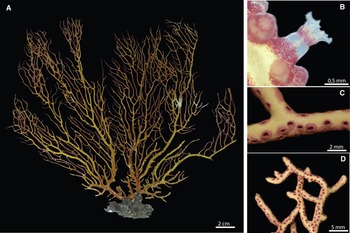
(Figures 1 and 2)
Synonyms: see Grasshoff (Reference Grasshoff1992, p. 70).
Material examined
(JAO-UIZ(G1)) Agadir commercial harbour, 30°25′25″N 9°38′57″W, 10–15 m depth, 2 May 2012, one whole colony; (JAO-UIZ(G2)) Agadir commercial harbour, 30°25′25″N 9°38′57″W, 10–15 m depth, 29 August 2012, one whole colony. (JAO-UIZ(G3)); Taghazout (Morocco), 30°32′43.8″N 9°43′39.7″W, 6–12 m depth, 2 February 2012, 8 colonies; (JAO-UIZ(G4)) Dakhla (Morocco), 28°03′37″N 12°47′25″W, 50 m depth, 22 May 2015, collected by Badiaa Iazza (no information about colony features), fragment of 6 cm; other colonies were collected and photographed by P.J. Lopez-Gonzalez and J. Abou Oualid in different regions of Agadir between 6–21 m depth.
(A) Leptogorgia dakarensis (Stiasny, 1936); (B) Polyp; (C and D) Branches and ramifications.

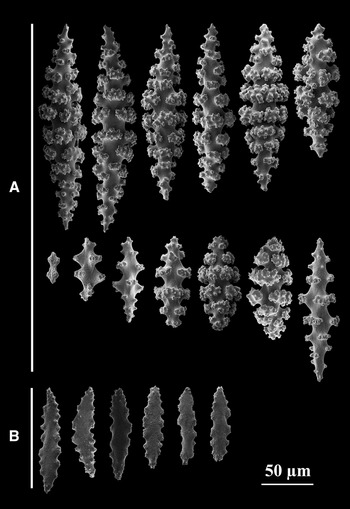
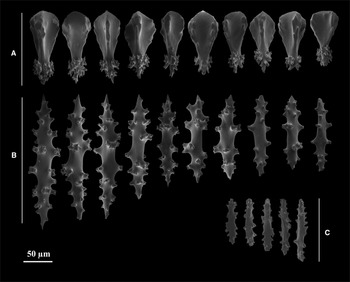
Leptogorgia dakarensis (Stiasny, 1936); (A) Conenchymal sclerites; (B) Anthocodial sclerites.

Morphology: Generally, planar growth form colonies (only one of 10 colonies was bushy), up to 30 cm in height. Ramification lateral ascendant (Figure 1A). Between 32 and 62 polyps per cm. Angle branching between 45 and 90°. Terminal twigs short, between 2–30 mm, and internode from 1–18 mm in length. Branches are generally cylindrical except for the basal parts (principal branches) where they are slightly flattened. Polyps in the lateral bands (biserial) (Figure 1C, D) Calyces low.
Sclerites: Conenchymal sclerites (Figure 2A): generally symmetric with double cone form, spindles with warts (rarely cross-form), red, yellow or bicolour, 58–220 μm in length. Anthocodial sclerites (Figure 2B): asymmetric flattened rods, red in colour, arranged ‘en chevron’ (Figure 1B), 38–59 μm in length.
Remarks
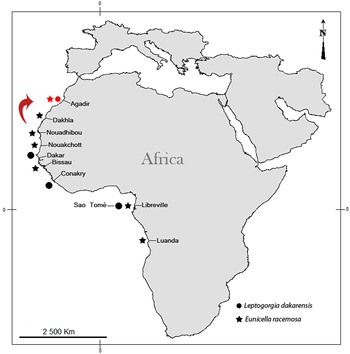
With this finding, the distribution area of Leptogorgia dakarensis is enlarged with respect to that recorded by Grasshoff (Reference Grasshoff1992) from Senegal to Sierra Leone, between 20–51 m in depth (Figure 3). This species was observed in Agadir Bay where we focused our sampling effort (2011–2015) and no colony was observed in other sampled Mediterranean stations, such as Jebha (35°12′44.0″N 4°39′28.7″W), M'diq (35°41′14.6″N 5°16′54.4″W) and Belyounech (35°54′59.4″N 5°23′47.0″W). This finding is the first record for the Moroccan Atlantic coast. Leptogorgia dakarensis is similar from a chromatic and morphological point of view to L. annobonensis (Grasshoff, Reference Grasshoff1992). According to Grasshoff (Reference Grasshoff1992), both species have colonies that are yellow with lateral polyps purple (to blue) arranged in lateral bands. Polyps without calyces in L. annobonensis, but with very low calyces in L. dakarensis. The sclerites are thick for L. annobonensis, while they are slim in L. dakarensis. Based on our personal observation, the abundance is ~2 colonies per m2.
Geographic distribution of Leptogorgia dakarensis and Eunicella racemosa in North-eastern Atlantic (Black: previous study, red: current study).

Genus Eunicella Verrill, 1869
Eunicella racemosa (Milne Edwards & Haime, 1857)
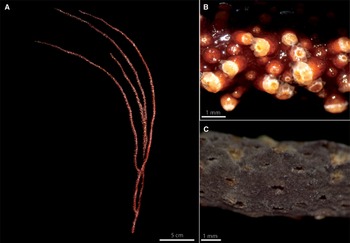
(Figures 4 and 5)
Synonyms: see Grasshoff (Reference Grasshoff1992, p. 40).
Material examined
(JAO-UIZ (G5)) Taghazout, 30°32′43.8″N 9°43′39.7″W, 10–15 m depth, 31 July 2011, 1 colony; (JAO-UIZ(G6)) Agadir commercial harbour, 30°25′25″N 9°38′57″W, 13 m depth, 29 August 2012, 1 colony.
Eunicella racemosa (Milne Edwards & Haime, 1857). (A) Whole colony. (B) and (C) Polyps arrangement on the colony.

Morphology: Colonies up to 1 m in height, ramification dichotomous, planar. Branching angle between 30–50° (Figure 4A). Branches long, cylindrical and up to 8 mm in diameter. Length of apical branches between 250–300 mm. Internodes length between 70–160 mm. Polyps numerous, with irregular distribution and dense in the apical branch, about 80 polyps per 1 cm, calyces indistinct (Figure 4, C). General colony colour dark brown.
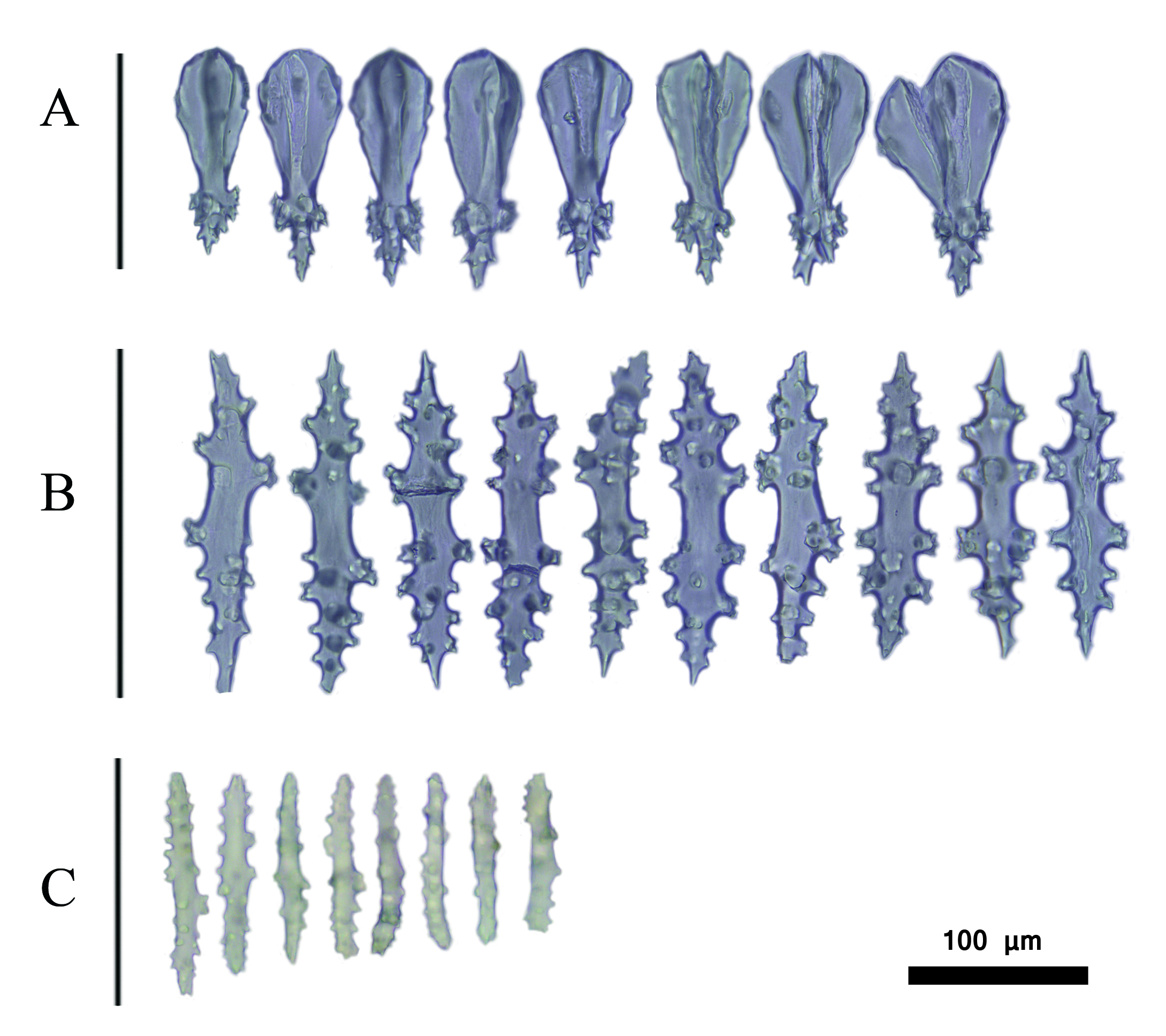
Sclerites: Conenchymal sclerites: two types of sclerites: spindles and balloon clubs, are equally dominant, all sclerites are colourless. Spindles (Figure 5A) up to 0.13 mm in length, and up to 0.2 mm wide, 6–10 whorls of warty tubercles, the middle region mostly without tubercles, some slightly curved, the ends usually sharp. Balloon club (Figure 5B) up to 0.11 mm in length, and up to 0.04 mm wide in the thick part, and 0.02 mm wide in the slim part. Anthocodial sclerites (Figure 5C) flattened rods, up to 0.08 mm in length and 0.01 mm wide, with short tubercles on the surface.
Eunicella racemosa (Milne Edwards & Haime, 1857). (A) Conenchymal balloon clubs. (B) Conenchymal spindles. (C) Anthocodial sclerites.

Remarks
Eunicella racemosa was cited in Boujdor (about 700 km south from this new record) to Senegal and from Gabon to Angola. According to Grasshoff (Reference Grasshoff1992), this species was observed in depth from 12–60 m. This record of E. racemosa increases our geographic distribution knowledge in the West African Atlantic coasts (Figure 3) and no colony was observed in the other Mediterranean sampled stations (Jebha, M'diq and Belyounech). Furthermore, the observed colonies' length is the most remarkable characteristic of this species; some colonies exceed 2 m in length (P. J. López-González, unpublished data). The abundance of this species is about 1 colony per 10 m2 (personal observation).
Discussion
Historical remarks
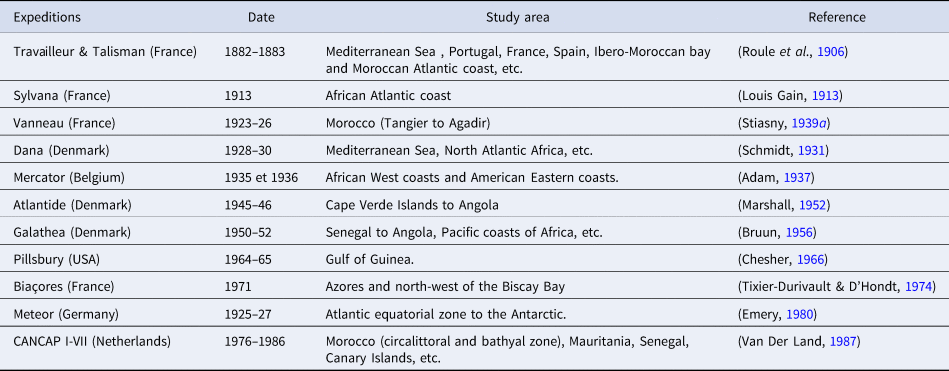
During the 19th and 20th centuries, numerous oceanographic expeditions explored marine waters from the Eastern Atlantic to puzzle out the high diversity of marine species (Table 1). However, only a few expeditions explored in detail the shallow water fauna of the Atlantic Moroccan coasts. This area is known by the presence of upwellings and the Canary current, making African North Atlantic coasts faunistically and ecologically highly interesting (Head et al., Reference Head, Harrison, Irwin, Horne and Li1996; Santana-Falcón et al., Reference Santana-Falcón, Mason and Arístegui2020). Moreover, the identification and classification of species from these cruises are, to date, a continuous subject of discussion and revision. Indeed the morphological re-examinations using informatics analyses or current molecular methods (Wall-Palmer et al., Reference Wall-Palmer, Burridge, Peijnenburg, Janssen, Goetze, Kirby, Hart and Smart2016; Sampaio et al., Reference Sampaio, Freiwald, Mora, Menezes and Carreiro-Silva2019). Hitherto, gorgonian species (and benthic fauna in general) had not been profoundly studied in Moroccan coasts. Furthermore, shallow water fauna wasn't extensively explored in the earlier expeditions compared with the deep sea (circalittoral and bathyal zone) except the ‘Vanneau Expedition, 1923–26’ (Stiasny, Reference Stiasny1939a).
Oceanographic expeditions in the 19th and 20th centuries

Consequently, sampling efforts on octocorallia were not achieved (e.g. imperfect samples conservation) as divulged in Vanneau and Travailleur & Tallisman expeditions' reports surmising that their octocorals inventories had not been reflecting the existing fauna (Roule et al., Reference Roule, Marion, Billard, Koehler, Fischer, Joubin and Calvet1906; Stiasny, Reference Stiasny1939a). The species Leptogorgia dakarensis Stiasny (Reference Stiasny1939b, p. 313), in reference to Dakar (Senegal, North West Africa), simultaneously named by Stiasny (Reference Stiasny1939b, p. 317) as L. senegalensis in reference to Senegal, has never been reported from off Senegal to Sierra Leone coasts (Grasshoff, Reference Grasshoff1992). On the other hand, the distributional area of Eunicella racemosa is larger than Leptogorgia dakarensis, but, according to Grasshoff (Reference Grasshoff1992), this species had never been observed out of the reported area until their first report from Taghazout in molecular comparison of Eunicella species (Costantini et al., Reference Costantini, Gori, Lopez-González, Bramanti, Rossi, Gili and Abbiati2016). The scarce knowledge hypothesis in Moroccan Atlantic coasts is also supported by the recent report of Eunicella gazella from Agadir coasts, Morocco (Abou Oualid et al., Reference Abou Oualid, López-González, Ait Alla and Moukrim2016), which was previously known to be distributed in European and African Eastern Atlantic except for the Atlantic Moroccan coast (Grasshoff, Reference Grasshoff1992), which justifies the geographic distribution continuity of these gorgonians along south Eastern Atlantic coasts.
Ecological remarks
The direct and indirect impact of climate change on marine ecosystems was proved in many contributions (Hoegh-Guldberg & Bruno, Reference Hoegh-Guldberg and Bruno2010; Lord et al., Reference Lord, Barry and Graves2017) including benthic anthozoans (Spalding & Brown, Reference Spalding and Brown2015). Generally, benthic and planktonic groups are increasingly affected by ocean warming, which may alter their physiological functioning, demographic traits and behaviour and can also cause massive mortality, extinction, native range shifts, ecosystem expansion or acclimatization and adaptation to the tolerable environment conditions (Doney et al., Reference Doney, Ruckelshaus, Duffy, Barry, Chan, English, Galindo, Grebmeier, Hollowed, Knowlton, Polovina, Rabalais, Sydeman and Talley2012; Barton et al., Reference Barton, Irwin, Finkel and Stock2016). Indeed, the range extension of tropical marine species related to higher temperatures due to climate change in temperate areas is increasingly reported in several areas, particularly for herbivorous fish (e.g. Vergés et al., Reference Vergés, Tomas, Cebrian, Ballesteros, Kizilkaya, Dendrinos, Karamanlidis, Spiegel and Sala2014; Osland et al., Reference Osland, Stevens, Lamont, Brusca, Hart, Waddle, Langtimm, Williams, Keim, Terando, Reyier, Marshall, Loik, Boucek, Lewis and Seminoff2021). The two species reported in this study were previously known only from tropical areas and we may therefore question a range shift of these two species, from tropical east African coasts to northern temperate coasts. This expansion or shift of species capacities may be explained by the existing suitable environmental conditions generated by climate change during the last decades (Chen et al., Reference Chen, Hill, Ohlemüller, Roy and Thomas2011; Yamano et al., Reference Yamano, Sugihara and Nomura2011) or by a diversity of successful reproduction patterns recognized in octocorals (Kahng et al., Reference Kahng, Benayahu and Lasker2011). On the other hand, given the slow growth features of gorgonian species (e.g. Sartoretto & Francour, Reference Sartoretto and Francour2012; Stone et al., Reference Stone, Malecha and Masuda2017), E. racemosa, observed in our locality, may require approximately a half-century to reach up to 2 m high (see Costantini et al., Reference Costantini, Gori, Lopez-González, Bramanti, Rossi, Gili and Abbiati2016). This makes the climate change hypothesis questionable in the case of this species knowing the intensive effects of global warming in the last five decades of the 20th century (Paltridge & Woodruff, Reference Paltridge and Woodruff1981; Levitus et al., Reference Levitus, Antonov, Boyer and Stephens2000).
Conclusion
Both Leptogorgia dakarensis and Eunicella racemosa are susceptible to be influenced by the global warming effect since gorgonians are amongst the most impacted organisms, particularly in the nearby Mediterranean region (Garrabou et al., Reference Garrabou, Coma, Bensoussan, Bally, Chevaldonné, Cigliano, Diaz, Harmelin, Gambi, Kersting, Ledoux, Lejeusne, Linares, Marschal, Pérez, Ribes, Romano, Serrano, Teixido, Torrents, Zabala, Zuberer and Cerrano2009), but their geographic distributions were scantly studied during the 19th and 20th centuries. Considering the abundance of L. dakarensis and the colony sizes of E. racemosa observed in this study, the generally slow dynamics of gorgonians let us suggest that the colonies were present in Agadir for decades and therefore their presence in Agadir seems more related to a lack of knowledge/research effort rather than a climate-driven expansion of distribution.
Supplementary material
The supplementary material for this article can be found at https://doi.org/10.1017/S0025315422000972.
Data
All data generated or analysed during this study are included in this published article.
Acknowledgements
We thank Abdellatif Zayoute, Naoufal Mohamed Tamsouri and Mohamed Iazza for their assistance with diving and logistics in Agadir; Leen van Ofwegen (Naturalis Biodiversity Center, the Netherlands) for providing a holotype photograph of Leptogorgia dakarensis ‘ZMA2770’. Special thanks to the ‘Centro de Investigación, Tecnología e Innovación de la Universidad De Sevilla (CITIUS)’ for the scanning electron microscope (SEM) facilities. We thank Dr Youness Abdellaoui for reading the manuscript and all anonymous referees for their suggestions for improving our manuscript.
Author contributions
JA, AA, AM and PJL conceived the study and contributed to the study design. JA and PJL performed data collection and species identification. JA and PJL led the writing of the manuscript. All authors read and approved the final manuscript.
Financial support
No funding was received.
Sampling and field studies
All necessary permits for sampling and observational field studies have been obtained by the authors from the competent authorities and are mentioned in the acknowledgements.