On the eve of World War I, the Convent of the Exaltation of the Cross, like female Orthodox monasticism in Nizhnii Novgorod diocese in general and the Russian Empire as a whole, was at the high point of a period of growth and transformation that showed no sign of abating. Facilitated by its reorganization on a communal basis in 1807, over the course of the previous century the convent's membership had grown from 49 to 365 and become composed overwhelmingly of younger, previously unmarried, and increasingly literate women from the peasantry and poorer strata of urban society rather than, as previously, mainly elderly widows from privileged social groups. Benefitting from its favorable location in the commercially important city of Nizhnii Novgorod, the convent had acquired by far the largest endowment of any monastic community in the diocese and engaged profitably in the production and sale of a range of religious items and other goods. While playing a prominent role in the religious life of Nizhnii Novgorod, the convent also provided a range of social welfare and educational services to the local population, reflecting the apostolic turn taken particularly by female Orthodox monasticism in late Imperial Russia.Footnote 1 This trajectory of development was radically altered by the effects of first war and then revolution, which created a confluence of economic, social, and political challenges that led to the final dissolution of the community at the convent in 1935. While this outcome is not surprising given the ideology and goals animating the Soviet regime, it was not inevitable. On the contrary, the community at the convent—like most female monastic communities in Nizhnii Novgorod diocese—demonstrated a resiliency during the decade and a half after the start of revolution in 1917 that supports Catherine Wanner's contention that religion served “as a means of forging an adaptive response to Soviet-styled modernity” by “shaping the possibilities for protest, compliance, and acquiescence” to the new regime.Footnote 2 This resiliency stemmed from the solidarity, flexibility, and leadership skills developed prior to the war by the combination of the community's religious character and practices and its communal organization. Confounding Bolshevik expectations and understandings of religion, the community of religious women who composed the Convent of the Exaltation of the Cross disappeared in the end not because it could not survive in the conditions of early Soviet socialism, but because it embodied a competing ideal of communalistic life and an alternative system of beliefs that could not be tolerated by a revolutionary regime committed to the implementation of a radical secularist vision of socialism in a society that remained predominantly religious.Footnote 3
The experience of the Convent of the Exaltation of the Cross under Soviet rule thus reflects in microcosm the conflict between established religions on the one hand and modern revolutionary regimes and projects of radical secularization on the other. Analyzing the interrelationship between modern revolutionary movements and religion, Bruce Lincoln has argued that in the process of establishing their power, revolutionary regimes invariably come into conflict with and must attempt to severely restrict or suppress the established church that helped maintain the prerevolutionary order.Footnote 4 This inherent conflict, and Bolshevik belief in its necessity, powerfully shaped early Soviet policy toward the Orthodox Church. Given the prominence of monasticism within Russian Orthodoxy prior to the revolution, it therefore is not surprising that the new Soviet government perceived monastic communities to be politically threatening and sought to subvert them as part of its effort to undermine the power and popular appeal of the church.
But as in the contemporaneous Mexican Revolution, Soviet policies toward monastic communities were also shaped by a secularist ideology that represented a radicalization of the secularizing trends initiated by the French Revolution.Footnote 5 In all three revolutions, although other factors played a role, the conjuncture of secularizing goals and revolutionary politics resulted in the expropriation of monastic property, the dissolution of monastic communities, repressive measures against monastic clergy, and—in France and Mexico—the banning of Catholic religious orders.Footnote 6 Despite this commonality, however, the experience of monastic communities during the first two decades of Soviet rule differed in important ways from those of their counterparts in revolutionary France and Mexico. In particular, in France and Mexico a series of revolutionary governments composed of shifting political groupings followed one another. As a result, a broader range of positions and policies on religion was represented at different times within these successive governments than occurred in the Russian case. In both the French and the Mexican Revolutions, this diversity produced alternating periods, with regional variations, of violent radical repression of religion and the promotion of civil alternatives and of more moderate secularization, toleration of some religious groups, and acceptance of non-public worship.Footnote 7 By contrast, although Soviet policies also varied in response to changing circumstances, after the October Revolution the revolutionary regime in Russia was dominated by a single party whose ultimate goal was the complete eradication of religion. Yet despite the Bolsheviks’ uninterrupted control over governmental power and more consistently radical secularist goal, at least in Nizhnii Novgorod province, the majority especially of women's monastic communities—including that at the Convent of the Exaltation of the Cross—survived much longer than their French and Mexican counterparts. The path of the Convent of the Exaltation of the Cross from a stable, secure, and prosperous community of religious women to the disappearance of this community in 1935 illustrates how in the particular conditions of the Russian Revolution the resiliency of these communities interacted with Soviet policies toward religion to enable them to do so.
I. War and Year One of the Revolution
Although the environment created by the revolution and Soviet rule ultimately confronted the community at the Convent of the Exaltation of the Cross with severe challenges, initially the convent's wealth and religious role helped insulate it from the difficult conditions produced first by World War I and then by the February Revolution. Like other major cities in the Russian empire during the war, Nizhnii Novgorod suffered serious economic difficulties, social dislocation, and bouts of unrest that stemmed in large part from the reorientation and disruption of the city's economy and the rapid growth of its population caused by the war. Industry in the city and surrounding settlements expanded significantly between the outbreak of the war and the February Revolution, leading to a sharp increase in the number of workers which, in part due to the large influx of refugees and war wounded, had nearly doubled the city's population—from 105,000 to 200,000—by the beginning of 1917. Although this industrial expansion greatly increased output in the city and region, production was oriented mainly toward meeting military needs. The combination of rapid population growth and an economy geared toward war production resulted in high inflation; shortages of housing, food, fuel, and other goods; and severely overstrained municipal services. These problems were exacerbated both by the disruption of normal trade networks within the region due to the war economy and by significant declines in agricultural productivity and output in the province due to the shortages of male labor and horsepower in peasant households resulting from military conscription and requisitioning. These conditions created serious hardships for peasant households while also adding to inflation and urban food shortages. Both urban and rural discontent grew as material conditions worsened, resulting in the summer of 1916 in strikes, demonstrations, and food riots in Nizhnii Novgorod and various forms of peasant protest in the countryside.Footnote 8 At the same time, however, Orthodox clergy in the city and surrounding rural districts reported a surge in religious sentiment and observance among the lay population, although in some areas concerns were also expressed about a perceived growth of religious indifference and disrespectful behavior among male youth.Footnote 9 This upsurge in religious observance substantially increased the income received by the Convent of the Exaltation of the Cross for a range of religious services, attesting to the important roles it played for the local Orthodox population. This income, in combination with the resources provided by its endowment, enabled the convent not only to cope with the difficult material conditions produced by the war but also to make modest contributions in money, kind, and services to war relief efforts—acts intended equally as expressions of Christian charity and of patriotism.Footnote 10
The convent's material situation remained relatively unchanged throughout 1917, despite the deterioration of conditions, conflicts, and dramatic events that occurred in the months following the collapse of the autocratic regime in February. Inflation, shortages of food and other goods, social dislocation, and the inadequacy of housing and public services in Nizhnii Novgorod grew progressively worse. As conditions worsened, food riots, other forms of popular protest, and general lawlessness became more frequent. The conditions of the wartime economy also made agreements between factory owners and managers and their workers over wages, hours, and other terms of employment difficult to achieve, resulting after mid-June in increased strike activity and a radicalization of both workers’ demands and forms of industrial action. Similarly, although soldiers in the local garrison initially had pledged their loyalty to the Provisional Government and supported the continuation of the war, as it dragged on, discontent within garrison units grew and soldiers became steadily more radicalized. In the countryside, as early as March, peasants voiced demands for the transfer of all private land to them, including that owned by monastic communities, although at first they expressed a willingness to defer action until the convocation of the popularly elected Constituent Assembly promised by the Provisional Government. But as the year progressed, peasants at the local level increasingly took matters into their own hands. Initially engaging in illegal timber and hay cutting, eventually they seized the land, crops, livestock, and inventory of private owners. The inability of any level of the Provisional Government to deal effectively with these various demands and discontents both undermined support for the government and deepened social and political fissures, raising questions about the possibilities for governance.Footnote 11
These developments powerfully shaped political events in the city and province after February 1917. The trajectory of events broadly followed that of the Russian Empire as a whole. Thus, the February Revolution was widely greeted with enthusiasm by the local population. Nearly all political organizations pledged support for the Provisional Government and at first cooperated with one another. Although formal governmental power was exercised by the city mayor and council (duma), the provincial commissar and executive committee, and representative provincial and district councils (zemstva), in practice authority was shared with soviets of workers’, peasants’, and soldiers’ deputies and with other popular bodies. The conflicts between these governmental and popular bodies which were experienced in many large cities were substantially mitigated in Nizhnii Novgorod, however, by the inclusion of representatives of most socialist parties in governmental institutions. By the summer of 1917, moreover, both the Nizhnii Novgorod city mayor and provincial commissar were members of the Socialist Revolutionary Party, which by that time dominated all soviets of peasants’ deputies and held pluralities in the soviets of soldiers and of workers’ deputies, the city council, and the provincial executive committee.Footnote 12 Although at first the Bolshevik faction enjoyed only modest support, by mid-August its popularity among factory workers and in the city's military garrison was rising in response to government failures to meet popular expectations and rapidly deteriorating material conditions, a trend that accelerated after the “Kornilov affair” at the end of the month.Footnote 13 Despite this development, the other socialist parties in the city and province continued to seek to resolve issues through cooperation. Reflecting this approach, most political parties in Nizhnii Novgorod opposed the local Bolsheviks’ attempt to seize power by force in October. Soviet authority consequently was not established in the city until late November and in the countryside until well into 1918 or, in some areas, early 1919.Footnote 14
The first year of the revolution also generated serious conflicts within the Orthodox Church in the province. Like the central Orthodox hierarchy, the diocesan ecclesiastical establishment and most clergy in the province accepted the revolution and pledged their loyalty to the Provisional Government.Footnote 15 The diocesan press also supported the Provisional Government and, expressing strong patriotic sentiments, continued to support the war.Footnote 16 As happened in the French and Mexican Revolutions, however, sharp divisions occurred over how the perceived principles of the revolution should be applied to internal church matters. In particular, presaging the Renovationist schism in 1922, organized factions quickly formed to promote competing programs for the reform of church governance; the relative roles of the ordained and lower clergy, women, and the laity in general in the governance and life of the church; the method for selecting bishops; and clerical compensation.Footnote 17 The most radical faction demanded the removal of the diocesan bishop, Archbishop Ioakim (Levitskii), whom they regarded as politically reactionary and hostile to progressive church reforms. Disagreement over these and other issues deeply split diocesan congresses composed of clergy and laity held in May and August in preparation for a general church council, which finally convened in Moscow in mid-August.Footnote 18 By that time, anxiety among the clergy had increased due to the rising strength of socialist parties, growing social unrest, the increased incidence of seizures of church landholdings by peasants, the removal of priests by parishes, and anticlerical violence. This anxiety led many churchmen in the province to support more conservative political parties, although disagreements on internal church matters persisted.Footnote 19
Unfortunately, an absence of sources makes it impossible to know how the leadership and sisters at the Convent of the Exaltation of the Cross viewed these internal church disputes or how they understood the political events and social conflicts swirling around them. Abbess Mariia's decision in late November to hold Sunday evening prayer services “to help Christians through these troubled times” suggests a growing apprehension on her part, as well as perhaps the belief—expressed by many clergy at the time—that Orthodoxy offered a medium for achieving social reconciliation.Footnote 20 Mariia's anxieties most likely were shared by other members of the community, even though materially the convent survived 1917 reasonably well, despite the deteriorating economic situation. While inflation significantly increased the convent's expenditures on food, fuel, and other goods and services, its income from the provision of religious services and its cemetery rose equally sharply, enabling the convent to both meet its needs and continue supporting war relief efforts.Footnote 21
II. After October: The Evolution of Soviet Policies Toward Monastic Communities
After the Bolsheviks’ seizure of power, the community at the convent was confronted by an existential challenge as a result of accelerated economic collapse, deepening social conflict, the advent of civil war in mid-1918, and the policies of the new Soviet regime. The challenge posed by the Soviet regime proved to be the most threatening. Despite the intensification of social tensions in Nizhnii Novgorod after the October Revolution, the convent appears never to have been the target of anticlerical social action, unlike some other communities in the province.Footnote 22 On the contrary, its income from religious services and donations remained robust, and on at least one occasion a sizable crowd gathered to protect the convent from actions of local Soviet authorities perceived as menacing.Footnote 23 To be sure, whether acting on their own or through the agency of local land committees, peasants seized control of the convent's forest tracts sometime in early to mid-1917, and the same fate befell its landholdings and other rural properties in either late 1917 or early 1918.Footnote 24 But these seizures formed part of the general pattern of peasant activism in 1917–1918 and arose from the convent's status as a private owner and landlord, roles not related to its religious character and functions.Footnote 25 In a context of rapidly deteriorating economic conditions, however, the convent's loss of its property holdings, the confiscation of its endowment in late 1918, and the eventual expropriation of the property of its major donors left the community's survival dependent mainly on the labor of its members and on the religious services they provided.
It was precisely these latter services that the Soviet regime sought to curtail as part of its effort to undermine clerical and ecclesiastical authority in general and monastic communities as sites of popular religious influence in particular. Although Bolshevik conceptions of religion were not homogeneous and evolved over time, the party leadership was united in professing a radical secularist ideology that held religion to be an obstacle to human liberation and incompatible with socialist modernity. According to Bolshevik understandings, religion promoted ignorance, superstition, and reliance on a transcendent power, thereby obscuring consciousness of the human ability to transform oneself, social and material conditions, and nature itself through knowledge, science, technology, and reason. Religion, furthermore, reduced productivity and welfare and impeded technological—and thereby human—progress by perpetuating traditional modes of behavior and forms of production. Politically, it enhanced the ability of ruling elites to dominate, repress, and exploit the majority of the population by legitimizing and buttressing their power. Women were perceived as being doubly oppressed, by both the ruling social-economic elite and the structures and culture of patriarchal authority that religion helped to sustain, although peasant women especially were also generally characterized by the Bolsheviks as being particularly prone to—and purveyors of—“religious fanaticism” and “superstition.”Footnote 26 For this reason, attacks on religion and religious authority constituted a prominent theme in post-October Bolshevik propaganda directed at promoting women's emancipation and attracting female support for the party.
While Bolsheviks believed that all religions had these negative effects, they considered the Orthodox Church in particular to pose a serious political threat because of its close association with the tsarist imperial order and because its empire-wide organizational structure, substantial body of clergy, and large number of lay faithful enabled it to compete nationally for the loyalty of the population. The Bolsheviks’ secularist ideology thus included both the philosophical and the political bases of secularism that José Casanova has argued are characteristic of its most radical anti-religious forms.Footnote 27 Once it gained power, the party therefore almost immediately set about trying to discredit clerical authority and dismantle the institutions of the Orthodox Church in order both to eliminate the church as a potential political rival and to further its long-term goal of overcoming religious belief entirely. Characterized in party discourse as “the main centers of the religious influence of church activists, seedbeds of parasitism, and powerful cogs in the exploiting machinery of the old ruling classes,” monastic institutions in particular needed to be weakened and eventually suppressed.Footnote 28 But when the Bolsheviks took power in October 1917, they had neither a plan nor the organizational means to accomplish either their general goals with regard to religion or those which specifically related to the Orthodox Church and its monastic communities. Party leaders disagreed, moreover, over the most efficacious way to pursue their goals, with some envisioning a long-term process involving a combination of restrictions, propaganda, and education while others favored a more direct and aggressive approach.Footnote 29
At first the Soviet regime proceeded cautiously albeit deliberately toward the realization of its secularist goals. With regard to monastic communities, Bolshevik leaders were concerned that attempts to dissolve them outright would provoke popular discontent and therefore sought ways to undermine them and weaken their influence.Footnote 30 The decree of October 26, 1917 abolishing private ownership of land, for example, legitimized and encouraged peasant seizures of monastic landholdings, a process that in Nizhnii Novgorod province was already underway by October and was completed in the first months of 1918.Footnote 31 In mid-December, schools operated by monastic communities were nominally placed under state control as part of a measure secularizing education in general.Footnote 32 Radically going beyond measures adopted or considered by the Provisional Government, the decree of January 23, 1918 on the separation of the church and the state sought more broadly to lay the foundations for a secularist social and political order by regulating all religious institutions and excluding them from public life. The decree barred religious education in all schools that offered a general education; assigned jurisdiction over such civil acts as births, deaths, and marriages to secular Soviet bodies; declared all religious associations and communities—which included monastic communities—to be private organizations; and deprived the latter of both juridical status and the right to own property. Church buildings and their contents were proclaimed to be state property, with control over them assigned to local Soviet bodies. These bodies were to decide which religious communities could use former church property and on what terms.Footnote 33 The decree, however, offered no guidance on how or by whom its provisions were to be implemented, with the result that its practical effects varied widely by locality, an outcome that in many regions was magnified by spontaneous incidents of anticlerical activity.Footnote 34
To address this problem as well as to further develop the decree of January 23, in April 1918 the Council of Peoples Commissars established a special interdepartmental commission that in turn was soon replaced by the more permanent Eighth—later changed to Fifth—Department of the Commissariat of Justice (both iterations of which were also known simply as the “Liquidation Department”).Footnote 35 In addition to responding to a high volume of questions and appeals from Soviet bodies and religious groups, the Eighth Department sought both to identify and promote the most effective methods for restricting religious authority and institutions and to create the organizational means to pursue its mandate effectively.Footnote 36 Organizationally, the Eighth Department attempted to establish a centralized administrative structure through which Soviet religious, perhaps more accurately anti-religious, policies could be transmitted and implemented. Hence the department requested provincial Soviet authorities to organize special departments to coordinate and carry out implementation of the decree of January 23 at the regional level, with these departments instructed in turn to establish counterpart departments at the district level. After collecting and sifting through reports from provincial and district departments in the summer of 1918, the Eighth Department prepared more detailed instructions on the implementation of the decree of January 23 that provided for much more stringent regulation of religious communities, including monastic communities. Confirmed by the Council of Peoples Commissars, these instructions were issued in August 1918. The instructions prohibited monastic communities from engaging in any educational or social welfare activities; permitted them to conduct outdoor religious processions and services only with the prior approval of local Soviet authorities; clarified that their capital, cemeteries, and other property now belonged to the state; and allowed their members to register as a religious community but with the proviso that any member of the Orthodox faith of either sex could join.Footnote 37 The objective was clear: to do everything possible to jeopardize monastic communities short of abolishing them outright by depriving them of resources, restricting them to very narrowly defined religious activities and spaces, and diluting their membership. In practice, however, many provincial and local Soviet authorities took more aggressive action and forcibly dissolved monastic communities, with the result that by the end of 1921 only 381 of the 1,103 communities existing at the beginning of 1918 formally remained.Footnote 38
Systematic efforts to implement Soviet policies with regard to religion in general and monastic communities in particular, apart from the seizure of land, began in Nizhnii Novgorod province only after prodding first by the special commission and then by its replacement, the Eighth Department. In response to the special commission's directives, in mid-April 1918 the executive committee of the provincial soviet established a separate department tasked with implementing the decree of January 23.Footnote 39 This department in turn, like the Eighth Department, both formulated a plan for pursuing its charge and attempted to create an organizational structure capable of doing so at the local level throughout the province. With regard to the former, the provincial department reported in December 1918 that it had largely dismantled the existing diocesan administrative structure, was in the process of secularizing education and control over civil acts, and had confiscated the diocesan candle factory, which was an important source of revenue for the local church. In the case of monastic communities, the department had confiscated the capital endowments and other funds of several communities, seized all compounds (podvor'ia) and rental properties in the city of Nizhnii Novgorod belonging to monasteries and convents, and expected to complete inventories of the property of all monastic communities in the province by early 1919.Footnote 40 Once these inventories had been completed, the provincial department planned to move on to the closure of all monastic communities but explained that it would need to proceed carefully “in order to preserve [their] riches and prevent their being plundered” by the “counterrevolutionary elements” within them.Footnote 41 Central to the department's strategy for achieving its ends was the aggravation of the class conflict that Bolsheviks commonly believed existed within monastic communities. Asserting that “monastic youth await only to be liberated but have been frightened by their benefactors, who to this very moment remain committed body and soul to Nicholaevism,” the department confidently expected to transform monastic into socialist communities by “expelling [their] parasitic upper strata and attracting the monastic laboring element to the common construction of a new life.”Footnote 42
Organizationally, by late 1918 the provincial department had prevailed upon most district soviets in Nizhnii Novgorod province to establish counterpart departments to assist in carrying out its work at the local level. But as the provincial department's reports for 1918 and subsequent years make clear, in reality it exercised little control over the district departments or over other Soviet bodies at either the provincial or the local level.Footnote 43 Throughout the civil war, the work of the department was constantly being complicated and often frustrated by conflicts over jurisdiction, resources, and priorities with and between district, provincial, and central Soviet organizations, resulting in these organizations frequently working at cross-purposes in ways that monastic communities sometimes could exploit. In a not uncommon case, for example, the sisters of the Iveron Convent in the industrial settlement of Vyksa were able to maintain the use of most of their buildings, their workshops, and much of their land and livestock by successfully negotiating a conflict between local Soviet authorities and party activists and the Commissariats of Justice and Internal Affairs on the one hand and the provincial department, the local Soviet welfare department, the Commissariat of Agriculture, and the Red Army on the other. Whereas the former grouping sought to expropriate the convent's property and distribute it among local workers and Soviet institutions, the latter ultimately prevailed in preserving the property intact and under the control of the sisters, who they argued were providing essential goods and services to the local community as well as to several Soviet agencies, including the Red Army.Footnote 44
Soviet policies on the Orthodox Church in Nizhnii Novgorod province in the first years after the October Revolution proved highly disruptive, mirroring their impact throughout the Soviet republic as a whole.Footnote 45 Central diocesan administration, for example, was severely weakened by the abolition first of the diocesan consistory in May 1918 and then of its successor, the diocesan council, in August 1921 and by steadily tightening restrictions on the convening of diocesan and district meetings. The diocesan press was suppressed in March 1919. In addition, diocesan financial resources dropped precipitously due to the loss of state subsidies, the confiscation of church capital and property, and the inability of either central church authorities or local monastic institutions and other church bodies to provide contributions. In an effort to maintain some level of episcopal direction, in December 1919 the diocese was subdivided into five bishoprics, each overseen by a vicar bishop subordinate to the diocesan bishop.Footnote 46
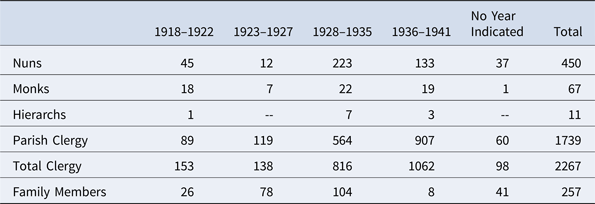
The parish clergy suffered similar disabilities. Parish clergy were deprived of political and some civil rights by the Soviet constitution adopted in July 1918, and they and their families experienced serious material hardship due to the confiscation of their property, loss of income, and the imposition of special taxes, fines, and labor requirements, including military service. The position of parish priests also grew more precarious as weakened diocesan authority and their worsening material situation made them more dependent on parish members for their selection, retention, and sustenance.Footnote 47 In addition to removal by their parishioners, many clergy were subjected to repressive actions by Soviet authorities, ranging from arrest and imprisonment for short periods to longer terms in a concentration camp, banishment, and execution (see table 1). Clearly there were members of the clergy in the province who supported White forces and engaged in oppositional activities during the civil war, although the overwhelming majority of clergy appear not to have done so. It is likely, nonetheless, that most clergy were unsympathetic to the Bolsheviks and followed some variant of the path trodden by the central church leadership, from initially resisting Soviet decrees regarding religion—or even Soviet authority in general—to attempting to work within the legal framework established by the new regime.Footnote 48 Soviet authorities, however, generally believed the clergy to be counterrevolutionary defenders of the old order and therefore tended to interpret any opposition to particular policies or a clergyman's refusal to submit to individual orders as active opposition to the Soviet regime in its entirety.Footnote 49
Repression of Clergy and Members of Clerical Families in Nizhnii Novgorod Province/Gor'kii Region, 1918–19411

Source: Aleksandr Sokolov, Stopy zhizni v gody gonenii na tserkov’ (Nizhnii Novgorod: Kvarts, 2012), 336–522.
1 People subjected to repression multiple times in different periods are counted separately for each period.
Parish life in the province was also affected by Soviet policies and actions, although in contradictory ways. On the one hand, a number of churches—mostly but not only so-called “house churches,” that is those located in public and charitable institutions and sometimes in private homes—were closed; registration as a “religious community” exposed parishes to state restrictions and surveillance and their funds were confiscated; and public religious practices such as icon processions were made subject to state approval and oversight. On the other hand, as Gregory Freeze has demonstrated, the weakening of diocesan authority reinvigorated parish life by enhancing local community control over church matters, including the selection and removal of clergy.Footnote 50
In combination, these effects generated sharp disagreements among and between diocesan authorities, the clergy, and lay faithful over resources, relative authority, and how generally to respond to both new conditions and Soviet policies. One result of these disagreements was, ironically, greater democratization as well as decentralization and disruption of diocesan governance. But despite the disagreements and strains, traditional religious life among the Orthodox faithful in the diocese persevered and in some areas even intensified—albeit more so among older members of the population and women in general than among men and especially male youth and more robustly in the countryside than in cities and industrial settlements.Footnote 51
Monastic communities within the diocese were no less affected by Soviet policies and actions, and in this regard, the experience of the Convent of the Exaltation of the Cross was typical. In late April 1918, the provincial department ordered an inventory of the convent's property. The first attempt to conduct it provoked a confrontation between Soviet officials and a large crowd of Orthodox faithful that resulted in one person being killed and several others injured.Footnote 52 After the inventory was finally completed, the provincial department confiscated the convent's capital endowment and other funds; its mill and urban properties; its gardens, orchard, and livestock; and even several pieces of furniture. In September a military archive was allocated space inside the convent.Footnote 53 In 1919 the convent's school and hospital were nationalized, thus limiting its social role and profile; several more of its buildings were confiscated for use by the military archive and to house civilians; and its cemetery was “municipalized,” which deprived the convent of an important source of income.Footnote 54 In the succeeding years, the space occupied within the convent by the military archive or other military units and by civilians steadily expanded.Footnote 55
Exacerbated by the harsh economic conditions of the civil war years, these measures imposed severe hardships on the members of the convent and significantly disrupted their communal as well as spiritual life. In 1918, for example, the substantial narrowing of the convent's sources of income and diminution of its ability to grow food led to a sharp deterioration of the material welfare of members of the convent. “Everything except [its] churches has gradually been taken from the convent,” Abbess Mariia reported to the diocesan council. “Having been deprived of the basic rental and interest income and the fruits of its orchard that are necessary for its existence, the convent has been placed in a very difficult position. The sisters of the convent must exist and support the convent almost entirely by the material means earned by their own hands and in part with the donations of believers. . . . But in the conditions of today's fearsomely high prices, these means are extremely modest. Only a strong faith in God and the hope of His help fortifies all the sisters of our Holy Cloister.” Footnote 56 As a result of these conditions, a number of younger members left the convent and returned to their native villages, and in 1918 and 1919 an unusually large number of sisters (particularly the more elderly) died. Sharing space with the Red Army and with other civilians also proved difficult. As Abbess Mariia lamented in her report to diocesan authorities for 1919: “Without a doubt this combining of those who have renounced the world with laymen who are occupied with their worldly affairs and service and living with their families has introduced into the cloister a certain disorder in the normally quiet and peaceful life of the sisters.” “Surveying the past year,” Mariia asserted, “which has brought great sorrow and sadness for those living at the cloister, I want only to say that only a powerful love of our Holy Cloister, a strong faith in God, and hope for His mercy has helped us bear all the difficulties and deprivations that have fallen to the lot of the sisters.”Footnote 57
The harsh conditions at the convent produced a steady stream of complaints and pleas for help from Abbess Mariia to Soviet and diocesan authorities, but there is no evidence of overt resistance to Soviet authority itself, although the convent did host regular talks by clergy intended to rebut Soviet anticlerical and anti-religious propaganda.Footnote 58 Local Soviet authorities usually declined Mariia's requests. While diocesan authorities were more sympathetic, their weakened state and limited resources left them unable to offer much more than advice, moral support, spiritual comfort, and occasional attempts to intercede with state officials. The latter efforts generally proved no more successful than Abbess Mariia's requests, despite the acceptance by the new bishop, Evdokim (Meshcherskii), of both the legitimacy of the Soviet regime and the principle of the separation of church and state. In a letter to the provincial soviet executive committee in December 1918, for example, Evdokim expressed confidence “that the relationship between the church and the state could without special difficulty be arranged to their mutual benefit,” a comment that reflected Evdokim's belief that a policy of cooperation with state authorities offered the best strategy for protecting parish life, the clergy, and the church in general.Footnote 59
III. Monastic Response: Resiliency and Adaptation
Despite the hardships its members endured during the early years of the Soviet regime, the Convent of the Exaltation of the Cross—like most convents in Nizhnii Novgorod diocese—nonetheless survived as a community of religious women, first officially and then unofficially. It was able to do so in significant part due to its mutually reinforcing religious character and communal organization and to the effective leadership that this combination helped produce. Collective and personal identities were fostered through shared participation in a dense web of daily and seasonal religious rituals, rites, and festivals; regular observance of common devotional practices and monastic rules; and shared occupation of space deemed sacred and veneration of the holy symbols pervading it. These bonds were reinforced by participation in an integrated array of domestic, economic, and welfare activities that provided for the spiritual, material, and emotional needs of the community as a whole and its members individually. Such activities not only entailed skills that provided the convent with considerable economic flexibility but also helped create an effective system for identifying and grooming communal leaders.Footnote 60 This combination made possible a strategy of tripartite organization that first emerged spontaneously among a few convents in the diocese in early 1919 but then was adopted generally after being endorsed by meetings of monastic representatives in June and September (and by the diocesan council in November) of that year.Footnote 61
Also approved by central church authorities, the strategy attempted to operate within the evolving Soviet legal regime by exploiting the regulations governing the formation both of religious communities and of agricultural and worker cooperatives. Thus, following this triadic organizational strategy, the members of the Convent of the Exaltation of the Cross registered formally as a religious community—effectively a parish community—an act that enabled them to legally retain the use of the convent's churches and chapels (together with their contents) and the services of its clergy. Although, legally, other Orthodox faithful of either sex could join the community, its membership and elected executive council were composed initially almost entirely of members of the convent.Footnote 62 In this way the community preserved the religious character and practices that helped bind its members together and that defined their collective and individual identities.
The second part of the triad was the formation of a worker cooperative by the so-called “laboring” members of the convent: the “First Nizhnii Novgorod Agricultural-Artisanal-Handicrafts Cooperative.”Footnote 63 This act enabled sisters to retain the use of several buildings (including residential facilities) and the convent's workshops (together with their tools), as well as to regain the use of the convent's orchard and gardens and to be assigned some arable land. Although Soviet authorities at both the central level and in Nizhnii Novgorod were caught off guard by the formation of agricultural communes and worker cooperatives by monastic communities and were uncertain of how to respond, they decided relatively quickly to approve such actions and issued rules to formalize them, mainly for two reasons. First, in the dire economic conditions then prevailing, monastic communes and cooperatives were able to maintain the production and supply of badly needed food products and the provision of other goods and services. Equally importantly, Soviet authorities believed that the deepened engagement of the “laboring sisters” in processes of economic production would further their strategy of subverting monastic communities by intensifying the divisions between the “laboring” and the “exploiting” sisters—essentially the novices and probationers and the fully vowed nuns respectively (the latter were also among the clergy deprived of electoral rights under the 1918 Soviet constitution). This intensified conflict was expected eventually to induce the “laboring sisters” to abandon their religious beliefs and embrace socialist ideals, thereby providing a model for the socialization of production in general. Hence, sisters deemed to be among the “exploiting elements,” as well as those too old or ill to work, were barred from membership in communes or cooperatives. The latter in turn were prohibited from either receiving any income from religious services or supporting monastic communities.Footnote 64 Individually, however, the members of communes and cooperatives formed by members of monastic communities could—and did—render support to their communities voluntarily. In this way, the sisters from the convent who formed the cooperative helped support the community as a whole, including elderly and infirm sisters, thereby again helping to preserve the collective identity of and bonds among members.Footnote 65
Finally, the third part of the organizational triad was simply the continued existence of the convent as such, at first formally and then informally. As long as the convent existed officially, the abbess continued to lead it and to interact with the archbishop and diocesan authorities and with local Soviet authorities. She was assisted by the convent's other officers and—in conformity with the monastic reforms adopted by the Church Council—an elected council composed of senior sisters and novices.Footnote 66 She also worked collaboratively with the elected leadership of the cooperative to assure the preservation and functioning of the convent as a community of religious women that supported its members materially while enabling them to fulfill their religious commitments and pursue their spiritual needs. In short, the combination of the convent's religious character and practices and its communal organization, reinforced by its continued occupation of common symbolic space, provided its leaders and membership with sufficient solidarity and flexibility to survive in and adapt to the radically changed conditions produced by the Revolution, civil war, and early Soviet rule. Confounding Soviet expectations, even under severe duress, the convent remained a cohesive and relatively stable community.
By mid-1921, genuinely surprised, Soviet authorities at the provincial level in Nizhnii Novgorod acknowledged that the strategy of subverting monastic communities through class conflict and socialist conversion of the laboring sisters had failed. Expressing a now widely shared attitude among provincial authorities, for example, the presidium of the provincial agricultural department declared in April that “members of the agricultural collectives formed by monastics . . . remain the same religious fanatics [as before], with their ‘bowings’ and ‘blessings.’” Far from providing a bridge to socialized agriculture, they “serve, albeit indirectly, to strengthen a monarchist-slavish-religious spirit and its influence on the surrounding population, thereby impeding its progress toward an understanding and the development of the Soviet order.”Footnote 67 Thus effectively admitting the continued support for monastic communities among the local population, the presidium argued that collectives formed by them should be either absorbed into state farms (sovkhozy), which were overseen and often managed by Soviet officials, or dissolved, with their land redistributed to peasant communes. This recommendation was approved by the provincial soviet executive committee in May 1921.Footnote 68 Similarly, in the spring or summer of 1922, the provincial party committee directed all district and regional party committees “to organize a campaign [to have] meetings of workers and peasants adopt resolutions demanding the closure of [all] monasteries [in their region] and the use [of their facilities] to meet the needs of social security, health, and education.”Footnote 69
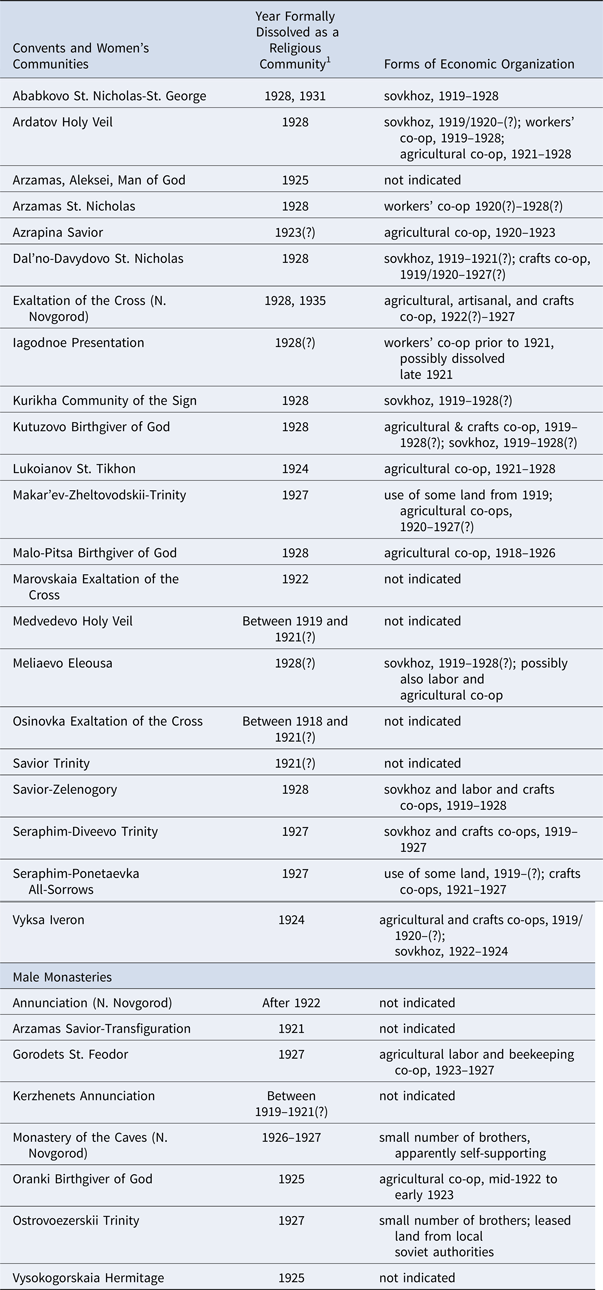
If party leaders and Soviet authorities in Nizhnii Novgorod province had now concluded that both political concerns and socialist construction required the dissolution of communes and cooperatives formed by members of monastic communities, powerful state bodies in Moscow disagreed. The Commissariat of Agriculture in particular opposed the measure adopted by the Nizhnii Novgorod provincial executive committee. Directing the latter to halt implementation of its decision, commissariat officials asserted that “these associations of monastics (especially women's collectives) are an exemplary model of strong organizations that are welded together by rational labor discipline and that pursue the well-being of the economy they enable. Work in them proceeds harmoniously, which is why not infrequently they achieve the maximum possible results with minimum means.” Citing the experience of other regions, commissariat officials added that “the conversion of monastic economies [into state farms] . . . has led to a decline in the intensity and organization of production in [their] economies . . . and been accompanied not only by violations of the normal course of work in them, but also by innumerable thefts of inventory and other harmful effects.”Footnote 70 But despite support for the commissariat's position from the All-Russian Central Executive Committee, most monastic agricultural cooperatives in Nizhnii Novgorod province eventually were converted into state farms. As it turned out, however, whatever its negative economic effects, this conversion did not lead to the socialist conversion of “laboring sisters” or prevent them from continuing to identify with and provide material support for their religious communities (see table 2).Footnote 71
Fate of Orthodox Monastic Institutions in Nizhnii Novgorod Diocese after 1917

Sources: Multiple dela in the following archival collections: TsANO, f. 56, op. 1, 4; TsANO, f. 1016, op. 1–2; TsANO, f. 1026, op. 1–2; TsANO, f. 1684, op. 1; TsANO, f. 2626, op. 1–2; GARF, f. A-353, op. 2, 3, 7; GARF, f. A-393, op. 27; and RGAE, f. 478, op. 5–7. Also Ol'ga Bukova, Zhenskie obiteli prepodobnogo Serafima Sarovskogo: Istoriia desiati nizhegorodskikh zhenskikh monastyrei (Nizhnii Novgorod: Knigi, 2003), 41–50, 77–79, 95–101, 134–143, 329–374, 406–411, 427–429, 449–452, 507–521, 548–551.
1 All monastic communities that survived beyond 1921 had formed a registered religious community by that time.
The women composing most of the convents in Nizhnii Novgorod province thus managed to preserve their communities intact through the difficult conditions of civil war and economic collapse, despite the efforts of local and provincial Soviet and party authorities to subvert them. As table 2 indicates, male monastic communities in the province, by contrast, generally proved less able to adapt to early Soviet conditions, a pattern that was typical throughout the Soviet Union during these years and that, notably, paralleled the differential responses of male and female religious in France to the decrees of 1790 and 1792 regarding religious orders.Footnote 72 This difference had several causes. At least in Nizhnii Novgorod diocese, male monastic communities were typically smaller than their female counterparts, and their economies were less often based on the type of diverse communal production that characterized convents. In addition, many male monastics were ordained and supported themselves in part through the performance of priestly activities. Monks also played a more visible role than sisters in public discourse and politics.Footnote 73 Male monastic communities thus were organizationally and functionally less able to adapt to the conditions prevailing during the early years of the Revolution and the civil war while also being more likely to be perceived by Soviet authorities—consisting overwhelmingly of young men—as politically threatening.
IV. Apparent Viability and Stability
By the end of the civil war in late 1920, the economy of Nizhnii Novgorod was in disarray and had contracted markedly, food shortages had grown worse, and the city's population had shrunk considerably. The introduction of the New Economic Policy (NEP) beginning in March 1921 helped create a more stable environment that led to improved economic and social conditions.Footnote 74 But the women at the Convent of the Exaltation of the Cross and the other surviving convents in Nizhnii Novgorod province did not initially benefit from the wider latitude for cultural expression and the regularization of legal rules and processes that also characterized the NEP period. On the contrary, concerned that the less militant and aggressive policies of the NEP would enable a resurgence of clerical influence and religious activism, the party and state leadership called for an intensification of anti-religious propaganda and between 1922 and 1924 undertook two interrelated campaigns against the Orthodox Church that together jeopardized the viability of surviving monastic communities.
The severe famine in the Volga region in 1921–1922 provided the pretext for the first of these campaigns: the confiscation of “church valuables” carried out by the Soviet regime during the late winter and spring of 1922. Supporting the call of Patriarch Tikhon (Bellavin) to Orthodox faithful to help those suffering from famine, in the summer and fall of 1921 Archbishop Evdokim urged Orthodox believers and religious communities in the diocese to make donations in aid of famine relief, an appeal to which the Convent of the Exaltation of the Cross and several other monastic and parish communities responded with sizable contributions.Footnote 75 Bolshevik leaders, however—particularly Lenin and Trotsky—saw in the famine an opportunity to both discredit the church leadership in the eyes of the faithful and promote an open split between reformist and other factions within the church, while also depriving the church of resources for the benefit of the state. They calculated, rightly, that the mandatory confiscation of all church valuables would be resisted by conservatives, thereby deepening divisions within the church and causing reformers to break away. Thus, beginning in late 1921, largely under Trotsky's guidance, a campaign to seize all church valuables was prepared and then carried out between February and July of 1922.Footnote 76 Seeking to avoid a conflict with the state, Tikhon sanctioned the voluntary contribution of liturgically nonessential and nonconsecrated valuables for famine relief in February, but this compromise was rejected by Soviet authorities. Evdokim appeared to encourage greater latitude than Tikhon in his appeals during the campaign, a position that was generally supported by several assemblies of clergy and laypeople within the diocese and that managed to avoid the violent resistance to state actions that sometimes occurred elsewhere.Footnote 77 Although women's religious communities also generally supported the campaign, sisters at the Convent of the Exaltation of the Cross openly predicted that the proceeds from it would not be used for famine relief.Footnote 78 The latter prediction proved to be largely accurate, as the proceeds in fact were used by the state for a variety of purposes.Footnote 79 This successful use of the campaign to secure funds for general state needs led to its being repeated in Nizhnii Novgorod province, including at the Convent of the Exaltation of the Cross, in 1926–1927 and again in 1928–1929.Footnote 80 Although these repeated campaigns appear never to have threatened the existence of the community at the convent, they deprived it of a substantial number of liturgical and other religious items.Footnote 81
An existential threat did arise, however, as a result of the schism between reformers, an array of constantly splintering groups known collectively as Renovationists, and supporters of the Patriarchal Church. As in 1917, the main points of conflict did not involve theological issues but instead concerned such matters as church governance, the relative authority of different groups within the church, parish organization, clerical marriage and whether married clergy could be elevated into the hierarchy, liturgical questions, and which calendar—Gregorian or Julian—to follow. Reflecting long-standing criticisms of alleged monastic shortcomings and resentments of perceived monastic privileges by parish clergy, Renovationists also generally were highly critical of monasticism. In addition, they believed that socialism and Orthodoxy were compatible and that a suitably reformed church could play an important role in shaping Soviet society.Footnote 82 The conflict between Renovationists and the Patriarchal Church thus was similar to those that split the Catholic Church into rival factions in revolutionary France and Mexico.Footnote 83 Supported by Soviet authorities (whose objective was to undermine the church by dividing it rather than to incorporate a reformed church into its socialist vision), Renovationists gained control of the central church administration in the summer of 1922 and attempted to assert their authority over the church as a whole. In Nizhnii Novgorod diocese, Evdokim supported Renovationism, as initially did the influential Metropolitan Sergii (Stragorodskii)—who at the time was Bishop of Vladimir diocese but was living at the Convent of the Exaltation of the Cross. Sergii quickly reunited with the Patriarchal Church, however, and in 1924 became the Tikhonite bishop of Nizhnii Novgorod, effectively Evdokim's competitor. The resistance to Renovationism in the diocese grew quite strong, and by April 1924, only seventy-seven of 1,322 parish communities adhered to some Renovationist group.Footnote 84
Despite its weakness among Orthodox faithful in the diocese, Renovationism strategically enjoyed the support of local Soviet authorities, which enabled the movement's leaders to threaten the existence of the religious community at the Convent of the Exaltation of the Cross. They targeted the convent partly because of its loyalty to the Patriarchal Church and its monastic character but quite likely also because of Metropolitan Sergii's residence there. Hence, in the summer of 1923, the Renovationist-dominated Supreme Church Council requested that the cathedral and other churches at the convent be transferred to its control, an action that would have entailed the dissolution of both the religious community and the cooperative at the convent. The administrative department of the Nizhnii Novgorod provincial soviet granted the request, which served its goal of disbanding all monastically based religious communities and cooperatives in the province. Appealing this decision to the presidium of the provincial soviet, the religious community at the convent noted that it had far more than the required number of members for registration as well as a valid agreement for the use of the cathedral, chapel, and other churches at the convent. Scrupulously citing relevant Soviet decrees and regulations, the community argued that not only did the decision of the administrative department violate this agreement, but also the proper procedures had not been followed for registration of the Renovationist group and the assignment of the convent's churches and other religious property to it. Reflecting both a shift in central party tactics for inciting conflict between church factions and the greater observance of legal and procedural rules that generally characterized the NEP period, the presidium found in favor of the community and annulled the decision of the administrative department.Footnote 85 But in a partial victory for the latter, the requirement that the community reregister resulted in both a more restrictive agreement and the termination of the convent's official status as a convent.Footnote 86
The community of religious women at the Convent of the Exaltation of the Cross thus survived both the campaign to seize church valuables and the Renovationist schism intact. Although one part of its triadic structure had been formally eliminated, it nonetheless remained in possession of its churches and much of the adjacent property it had formerly owned. Over the next several years, the community was able to maintain a stable existence despite several unsuccessful attempts by local Soviet bodies to occupy more of its premises. The lone exception was the closure of its chapel at the Nizhnii Novgorod fairgrounds in 1924.Footnote 87 The convent's stability was due in part to the general atmosphere of the NEP, as well as to the temporary respite afforded by disagreements within the central party leadership over the course of anti-religious policy and who should direct it.Footnote 88 Religious life within the community continued, with daily liturgies in the churches, the celebration of religious holidays and festivals, regular confession and observance of devotional practices, and the provision of religious services to the Orthodox faithful. The sisters’ liturgical role actually expanded somewhat at both their own churches and other churches in Nizhnii Novgorod because of the inadequacy of male clergy in the city.Footnote 89 Sisters provided material support for one another, including for members too old or infirm to work. They did so both through the cooperative and by engaging in a wide range of other jobs, for example, working as nurses, seamstresses, laborers, clerks, and even office workers in various Soviet organizations.Footnote 90 Thus, even though the convent was located in an urban environment—in contrast to the rural locations of the majority of surviving convents in the province—the members of the community were able to use their literacy and skills to support themselves economically in ways that were acceptable and sometimes even useful to Soviet authorities.
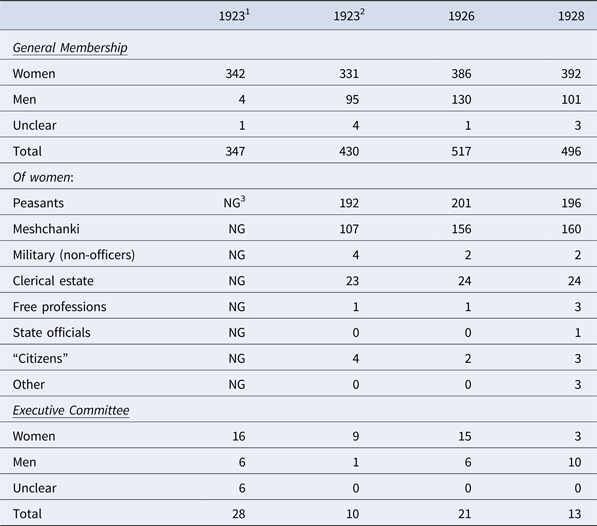
As a formally registered religious community that functioned as a parish, the community had to accept anyone of the Orthodox faith of either sex. An examination of the membership lists of the religious community for this period suggests that this situation may have resulted in a new hybrid form of community. As table 3 indicates, both the religious community and (until 1928) its executive council were composed overwhelmingly of women, in both cases predominantly women who had been members of the convent prior to its formal liquidation. Female members of the religious community fell into three broad groups: those who lived within the former convent's main precinct, were members of its cooperative, and effectively composed the primary monastic community (44–48 percent); those who were part of a family and thus simply parish members (30 percent); and single women, including several pairs of sisters, who in some cases probably had taken monastic vows and in others may have been attempting to pursue a modified form of religious life adapted to Soviet urban conditions (22–26 percent). This incorporation of the monastic community within a parish community not only intensified the ties of the former with lay faithful but also provided it with greater security while deepening the spiritual meaning and sacrality of the parish community for its other members. This hybrid character may help to explain the growth of the religious community during these years, from 430 members (at least 331 of whom were women) in 1923 to 517 (386 of whom were women) by 1926. As was the case prior to the Revolution, the majority of female members were literate and came overwhelmingly from the peasantry and the prerevolutionary meshchanstvo (see table 3). In the conditions of the NEP and in a society where religious adherence and observance in some form remained widespread, the religious community at the convent thus continued to attract mainly women from the poorer strata of urban and rural society—that is, the same groups of women targeted by Bolshevik political and emancipatory propaganda. While unsettling for Bolsheviks, the appeal of the community for such women paradoxically also appeared to confirm their perception of monastic communities as sites that embodied and promoted popular ignorance and superstition.Footnote 91
Exaltation of the Cross Orthodox Religious Community Membership: Total and Executive Committee

Source: TsANO, f. 1104, op. 1, d. 34, ll. 35–45ob, 49, 108–118, 155, 169–170ob, 156–162ob.
1 Those listed on a petition to join the community.
2 Those listed as members of the community.
3 “NG” here is used to indicate “not given.”
The formal liquidation of the convent led also to a structural and generational change in the community's leadership. Declining in health and believing herself no longer able to lead the convent in the prevailing circumstances, Abbess Mariia (then aged eighty-eight) asked to be relieved of her duties in January 1920. She was initially dissuaded by members of the community and its council, but her wishes were finally respected in May of the following year. She was succeeded by the sixty-four-year-old treasurer of the convent and member of its elected council, the nun Nazareta.Footnote 92 After the formal liquidation of the convent in 1923, however, leadership of the community was exercised by its elected executive council, the majority of the members and chairs of which, until 1928, were women in their mid-forties to early fifties who were members of the cooperative at the now former convent and who had been novices at the convent prior to the Revolution.Footnote 93 The community's structure of leadership thus conformed with the principles of monastic organization adopted by the Church Council while also adhering to the provisions of Soviet law, thereby demonstrating its ability to operate successfully within both the civil and the ecclesial realms.
A lack of sources, unfortunately, again makes it impossible to know how the members of the community at the Convent of the Exaltation of the Cross regarded the Soviet regime or interpreted their experiences of the Revolution and the first years of Soviet rule. Although clearly the community had resigned itself relatively quickly to existing within the Soviet system, and its members appear never to have actively opposed the party and state's authority, the grumblings of sisters in response to the campaign to seize church valuables in 1922 suggest that they neither trusted nor were sympathetic to the government.Footnote 94 Occasional comments by Abbess Mariia in her reports and letters (such as those quoted above) indicate that she at least viewed the Revolution and Soviet rule from the perspective of divine providence, seeing them as trials imposed by God for unfathomable reasons that had to be endured as a demonstration of faith. This understanding appears to have been common. For example, in a letter in June 1918 to Bishop Lavrentii describing the deteriorating situation at the Serafim-Ponetaevka All-Sorrows Convent, Abbess Evpraksiia stated: “What the future of the convent will be the Lord alone knows. We hope for His All-Powerful mercy and for the protection of the Most Pure and Most Holy Virgin, the Birthgiver of God, the Defender of the Christian people (rod). Let Their Holy will and pleasure be done.”Footnote 95 Similarly, in a letter to Archbishop Evdokim in November 1921 recounting recent difficulties at the Vyksa Iveron Convent, Abbess Margarita noted that she nonetheless “gazed especially calmly at the swelling waves of the threatening storm of the revolution, having committed herself and the cloister entirely to the will of God.” She concluded another letter to Evdokim a few months later by saying “hope and strong faith in a better [future] have not left me.”Footnote 96
Such comments indicate that religion played a critical role in sustaining women's religious communities and preserving solidarity within them during the Revolution and early years of the Soviet regime. Shared religious beliefs, rituals, and spaces worked in combination to reinforce among members a common identity and sense of themselves as a cohesive community that helped each member attain personal salvation, in part by serving a higher social as well as a divine purpose. In a petition to Lenin as chair of the Council of Peoples Commissars in December 1918, for example, the abbess, other officers, and senior sisters of the Makar'ev-Zheltovodskii Trinity Convent compared the convent to “that ideal family that existed among the first Christians” and characterized it as a “laboring Christian commune” that supported itself through its members’ “prodigious labors” and did “the holy work of caring for the unfortunate, [who] simply and peacefully are brought into our family as equal members.”Footnote 97 Stressing the comfort as well as strength and solidarity provided by being part of such a community, Abbess Margarita of the Vyksa Iveron Convent asserted in a letter to Archbishop Evdokim in December 1919: “I thank God day and night for the strong love of the sisters and for the unity of their spirit in the determination to suffer everything to the end. Their labor and humility give me, a sinner, the strength and desire to live and to continue serving for the common good.”Footnote 98 Emphasizing the contribution of collective participation in religious rituals and observances within shared sacred space to the formation of these strong communal bonds, Abbess Afanasiia of the Savior-Holy Trinity Convent stated in her report to Archbishop Evdokim in November 1921: “We are much comforted by the possibility of performing the Divine Liturgy in [our] church and in this way sustaining spiritual unity among the sisters.”Footnote 99 Abbess Ennafa of the Ardatov Convent of the Holy Veil expressed similar views when pleading with Archbishop Evdokim to intercede with Soviet authorities to prevent the seizure of her convent's winter church, declaring that the loss of the church “would deprive us of a dear and consoling refuge, where alone we find comfort. . . . We can patiently bear [everything], considering the present situation, but we are greatly disturbed when our church is affected.”Footnote 100 It therefore is not surprising that when Soviet authorities, admiring the collective labor and productivity of women's religious communities, urged their members to abandon their religious beliefs and practices and secularize their communities, sisters refused to do so. As the members of the Malo-Pitsa Birthgiver of God Convent responded to local Soviet officials who encouraged them to “close [their] church and throw off [their religious] dress,” “if we did that, there would be nothing for us here, and we would disperse to our homes.”Footnote 101
V. Soviet Frustration
The continued attraction of monastically based religious communities for women, especially women from the previously exploited classes of society, was alarming to Soviet officials and party activists in Nizhnii Novgorod. From their perspective, these communities not only impeded the realization of their secularist socialist vision but also competed with them for female support. They therefore represented an immediate political as well as a long-term cultural threat. Reflecting this perspective, the provincial soviet executive committee reported in early 1921 that in collaboration with the provincial department of justice—which had absorbed the department for the separation of church and state—it had been especially active in pursuing the “liquidation of various institutions of religious cults (monasteries, laboring communes, etc.).”Footnote 102 The head of the provincial administrative department similarly asserted in 1923 that monasteries should be “emptied” and “special commissions . . . [should] investigate all cooperatives composed of monastics existing within the province . . . in order to clarify whether their existence is expedient.”Footnote 103 He also called for increased surveillance of all religious communities and argued that reregistration provided an opportunity both for achieving this goal and for imposing tighter restrictions on such communities. The presidium of the provincial soviet later affirmed these proposals.Footnote 104 Underlying these attitudes and actions were the beliefs that “religious activists,” which included lay faithful as well as members of the parish and monastic clergy, were inherently counterrevolutionary and that religion and socialism could not be reconciled. Expressing these beliefs, a writer in the newspaper Nizhegorodskaia kommuna asserted in December 1922 that “religion and socialism are two incompatible and directly hostile forces. . . . Socialism is science and the workers’ struggle for liberation. Religion is obscurantism, darkness, and subordination to the ruling classes.” Referring to the recently concluded campaign to seize church valuables, the author predicted confidently that “just as the revolution recently shattered a strong counterrevolutionary force, the church, so it will go further and shatter the religious superstitions of the people.”Footnote 105
The survival, and even growth, of communities of religious women such as the one at the former Convent of the Exaltation of the Cross called this confident prediction—and the conceptual understandings regarding the nature and appeal of religion that underlay it—into question. In the context of a still predominantly religious society, the viability of these communities appeared to publicly demonstrate that a communalistic form of social life and organization that was based on religion in preference to scientific materialism and Marxist ideals was not only possible but apparently attractive for some women. The growth during the 1920s of communalistic religious groups of various types, both in Nizhnii Novgorod province and in the Soviet Union as a whole, only increased the concern among party members and state officials that their policies and approaches to religious matters were not producing the expected results.Footnote 106 By the end of the decade, frustration with this limited success was giving rise to calls within the party for a more aggressive strategy.Footnote 107
In the mid-1920s both the central leadership and the Nizhnii Novgorod branch of the Unified State Political Administration (OGPU), the main Soviet security agency, began to express increased concern regarding monastic communities as part of their heightened apprehension over the growth of religious activism in general. This concern focused particularly on the Tikhonite faction of the Orthodox Church, which was described by the central administration of OGPU in its monthly survey for January 1925 as “conducting an anti-Soviet campaign under the flag of a struggle against atheism” and “advancing its ideology as a counterbalance to communist [ideology]” in more organized and active ways, particularly via surviving monastic communities.Footnote 108 Notably, the report also expressed concerns over the activities of Metropolitan Sergii in Nizhnii Novgorod, which brought the community at the former Convent of the Exaltation of the Cross into OGPU's sights since Sergii was again resident at the convent.Footnote 109 Similarly, in a memorandum submitted in May 1927 to the provincial party committee and Soviet executive committee, the head of the Nizhnii Novgorod provincial department of OGPU asserted that nuns in the cooperative at the former Diveevo Trinity Convent were propagating anti-Soviet views, for example by claiming that “Soviet power was the power of ‘the anti-Christ’” and would soon collapse.Footnote 110 “It [therefore] is necessary,” the department head recommended in a follow-up memorandum, “to find a formal reason for a directive by the provincial executive committee to close [the convent].”Footnote 111 Both the cooperative and the community were dissolved shortly thereafter.Footnote 112
While these suspicions of monastically based cooperatives on cultural and political grounds were not new, by the late 1920s the recovery of the Soviet economy had substantially reduced the perceived utility of these cooperatives for the state, thereby weakening the pragmatic justification for their preservation. Indeed, officials in Nizhnii Novgorod now considered such cooperatives to be an impediment to the achievement of Soviet economic goals. For example, contrasting with earlier assessments, in August 1927 the provincial agricultural department criticized the allegedly low technological level of monastically based cooperatives in a report to the provincial party committee on the progress of socialized agriculture in the province. Moreover, the department asserted, because “it is difficult to separate the collective from the religious principles in these collective farms,” they could make no contribution to furthering the development of socialized agriculture among the surrounding population. The report concluded that therefore only two courses of action were possible: either “the reorganization [of these cooperatives] based on the selecting out of their working elements (novices) and the infusion of peasants into them or . . . their liquidation as false cooperatives.”Footnote 113
No longer considered economically useful and suspect culturally and politically, the surviving monastic communities in Nizhnii Novgorod province proved unable to withstand the campaign for socialist transformation via rapid industrialization, the collectivization of agriculture, cultural revolution, and urban reconstruction undertaken by the party and state at the end of the 1920s. This campaign was accompanied by a renewed assault on religion that not only swept away all remaining monastically based religious communities in the province (see table 2), and in the Soviet Union as a whole, but by 1937 had also led to the closure of nearly half of the churches, mosques, and other prayer houses in the province.Footnote 114 By 1943 only nine functioning Orthodox churches remained in the entire Gor'kii region (as an expanded Nizhnii Novgorod province was renamed in 1936), three of them in the city of Gor'kii (as Nizhnii Novgorod was renamed in 1932).Footnote 115 Ironically, as occurred in the French and Mexican Revolutions, one effect of the forced dissolution of remaining communities was to disperse a large number of disaffected sisters throughout the region, resulting in repeated complaints by party and state officials about their allegedly “counterrevolutionary” and “anti-Soviet” influence on the local population.Footnote 116 This concern quite likely contributed to the dramatic increase in the number of nuns and novices repressed by Soviet security agencies, especially between 1928 and 1935 (see table 1). Surveying Orthodox activity in Gor'kii region in the early post-war period, party officials reported that nuns from dissolved communities also regularly conducted secret liturgical services in apartments and houses throughout the region, led ritual observances at cemeteries and for venerated icons, organized pilgrimages to sacred springs and other places deemed holy, and performed various priestly functions for the local population, thereby helping to preserve Orthodox life despite the absence of functioning churches and legally recognized priests.Footnote 117
VI. Dissolution
For the community of women at the former Convent of the Exaltation of the Cross, the process of dissolution began in 1927. The process demonstrated the weakness of the community's adaptive strategy by exposing its vulnerability to the Soviet authorities' manipulation of the legal process. Already by that time, central Soviet authorities had begun to grant local officials greater latitude in closing churches and dissolving religious communities on the grounds (often merely a pretext) that the latter allegedly had violated their use agreements or failed to adequately maintain their buildings, or that these buildings were urgently needed for some social purpose.Footnote 118 The community at the convent fell victim to all three claims, with the provincial administrative department playing a central role in each case.
The community's cooperative was the first to suffer. At some point in the 1920s, the military archive located in the convent had been replaced by the staff of the 17th Infantry Division. In April 1927, the divisional staff submitted a petition to the provincial department requesting that the cathedral and the buildings within the main compound of the convent be transferred to it, arguing that the sisters were not maintaining these buildings and that the cathedral was needed for use as a cultural center. Ironically echoing but reversing Abbess Mariia's earlier lament, the petition asserted that sharing space with a religious community was detrimental to the work of the staff because “the performance of religious rituals disturbed the military preparations of a part of the armed forces, and such close proximity [with the community] therefore was undesirable.”Footnote 119 Sympathetic to the divisional staff's petition, the provincial department arranged for an inspection of the convent, which not surprisingly concluded that the buildings needed repair. As a result, the Nizhnii Novgorod provincial court ruled at the end of April that the sisters’ cooperative had violated the terms of its use agreement. The court therefore annulled the agreement and ordered the eviction of the sisters, thereby effectively dissolving the cooperative. The cathedral also was closed until appropriate repairs could be made.Footnote 120
The community lost the right to use the cathedral, as well as its chapel, shortly thereafter. In this case, in addition to the petition of the divisional staff, the city housing department requested possession of the chapel for use as a cultural center for the children of local residents. While supporting this request, the provincial department also supported a simultaneous request by a local group of Renovationists for use of the chapel. Seeking to preserve its right to use the cathedral and the sacred character of the chapel, the religious community at the convent concluded an agreement with the Renovationists to share use of the chapel, whereupon the provincial department accused it of violating its own use agreement. Citing this violation—as well as the alleged disrepair of the cathedral and the competing demands of the divisional staff, the city housing department, the Renovationist group, and the religious community at the convent—in January 1928, the provincial department recommended to the presidium of the provincial soviet executive committee that the use agreement with the latter community be annulled, the divisional staff be given the use of the cathedral, and use of the chapel be transferred to the housing department. The department argued that the former convent's Kazan Cemetery Church, which lay outside the convent's walls, would be adequate for the needs of the religious community. In February, the presidium approved these recommendations, a decision that was appealed by the community but upheld by the All-Union Central Executive Committee. As a result of these decisions, the religious community had to reconstitute itself and conclude a new agreement for use of the Kazan Church that entailed more restrictive terms.Footnote 121 Interestingly, although the community was still composed overwhelmingly of women, its executive committee now became predominantly male (see table 3).Footnote 122
Though deprived of a second part of its triadic organization and much of its sacred and domestic space, the Exaltation of the Cross community still managed to survive for nearly seven years in the form essentially of a modified urban sketic monastic community.Footnote 123 Although there is little information about the community for this period, regular participation in a shared religious and devotional life appears to have been sufficient to hold it together informally, despite the severe restrictions imposed on religious organization and activity by the revised law on religious associations adopted in April 1929.Footnote 124 The final dissolution of the community was provoked by the alleged commission of a counterrevolutionary and anti-Soviet act by its priests and the local bishop, Evgenii (Zernov). In 1935, Easter and May Day happened to coincide. As was customary, after the main Easter eve service at the Kazan Church, the convent's clergy, two other priests, and Bishop Evgenii celebrated a liturgy there the following morning. Accusing the bishop and clergy of holding the morning service deliberately to distract workers from the concurrent May Day demonstration, local Soviet authorities charged them—as well as initially the chair of the religious community's executive committee—with counterrevolutionary and anti-Soviet activity. Though the chair of the religious community was soon released, Bishop Evgenii and the other clergy were found guilty by a special tribunal of the Commissariat of Internal Affairs and sentenced to three-year terms of corrective labor, from which none of them ever returned. The internal files on the case suggest that the May Day incident was mainly a pretext for the suppression of several members of the clergy considered by local Soviet authorities to be generally troublesome, although interestingly one of them was also a police informer. At the same time, local residents—whether prodded by Soviet authorities or on their own, it is unclear—submitted a petition requesting the closure of the Kazan Church and its transfer to them for use as a cultural center particularly for youth, who were characterized as engaging frequently in hooliganism. The petitioners claimed that this antisocial behavior was due in part to the pernicious influence of the church's clergy and the religious activities taking place at the church. In June 1935, the presidium of the Nizhnii Novgorod regional soviet executive committee directed that the Kazan Church be closed, the former cemetery of the convent be transformed into a park, and all the buildings formerly belonging to the convent be transferred to a proposed new medical institute. After losing its appeal against this decision, the remaining members of the religious community at the church were absorbed into other parish communities in the city.Footnote 125 With the third part of its triadic organization now eliminated, the community of religious women that had long lived, worshipped, and worked together at the convent ceased to exist, at least in any traceable way. With further adaptation for the community as a whole now impossible, its remaining members dispersed. Much like members of the convents dissolved by Catherine II's earlier monastic reform, some members of the community continued to live together near the convent while others found ways to live a religious life either individually or in small groups.Footnote 126
VII. Female Monasticism, Revolution, and Radical Secularism
Though the community of women who composed the Convent of the Exaltation of the Cross thus ultimately succumbed to Soviet efforts to dissolve it, its survival during the Revolution and early years of Soviet rule demonstrates the weaknesses of Bolshevik understandings of religion and, particularly, of the sources and complex nature of female religiosity. Given their understandings, Bolsheviks expected that a combination of the suppression of religious institutions and discrediting of religious authority with mass education and socialist economic development would eventually lead to the disappearance of religion. Hence, the self-liquidation of monastic communities could be achieved, Bolsheviks initially believed, by the severe restriction of their resources and activities, the isolation and discrediting of their “exploiting elites,” and the socialist enlightenment of their “laboring elements” through propaganda and engagement in collective labor. The prospect of emancipation from patriarchal structures and forms of authority would provide an added incentive for the “exploited” members of female communities to abandon them and embrace the Soviet ideal of secularist socialism. This emancipatory message resonated with many non-monastic Russian women. But the community of women at the Convent of the Exaltation of the Cross, like those at the majority of convents in Nizhnii Novgorod province, proved to be far more cohesive and resilient than Bolsheviks expected. The presumed division between exploiting elites and exploited sisters turned out to be illusory, as members of the community demonstrated an impressive solidarity, exemplified by the willingness of the younger and healthier sisters to risk their own material welfare to support their elderly and infirm sisters. Given the opportunity to elect their own leadership, moreover, women at the convent and in other monastic communities generally supported their abbess and other officers.Footnote 127
The sisters’ cohesiveness and solidarity stemmed from the mutually reinforcing interaction between the community's religious character and its communal organization. This combination not only created a strong collective identity, forged powerful bonds, and fostered shared beliefs and perceptions among members of the community but also provided them with a flexible means of supporting themselves in the social, economic, and regulatory conditions of the civil war and the NEP. At least for the women who remained within the community, religion served as an effective medium for the construction and preservation of a communalistic way of life that offered material, emotional, and psychological support as well as spiritual fulfillment, even though Soviet conditions made it such that retention of the community's religious identity also threatened its members’ personal security in addition to their collective existence (see table 1). The religious worldview held by members of the community, moreover, provided them with a conceptual framework for understanding and ascribing meaning to what they and the country were experiencing, while promising them future salvation if they persevered in their faith and religious life.Footnote 128 The secularist socialist vision promoted by the Bolsheviks thus held no appeal for members of the community, whose formation of a worker cooperative consequently enabled them to preserve the religious character of their community rather than becoming—as the Bolsheviks initially hoped and expected—a medium for their socialist conversion.Footnote 129 It was precisely this combination of qualities that made communities such as that at the former Convent of the Exaltation of the Cross so incomprehensible and intolerable for Bolsheviks, whose policies toward them shifted with changing circumstances and priorities but whose ideological perception of them remained constant.
Given these competing worldviews and Bolshevik objectives, some repressive action by the Soviet regime against the community of women at the Convent of the Exaltation of the Cross and at the other convents in Nizhnii Novgorod province was unavoidable, even though the abbesses of several communities attempted to persuade Soviet authorities of their compatibility with socialism by stressing their communal organization, their self-supporting character based on the labor of their members, their plebian social composition, and the welfare they provided to others.Footnote 130 To this extent, the political vulnerability of female monastic communities in the Russian Revolution paralleled that of their counterparts in the French and Mexican Revolutions. In France and Mexico, however, the revolutionary regimes compulsorily dissolved all monastic communities and banned most religious orders relatively early in their respective revolutionary processes. In Russia, by contrast, the Bolsheviks’ conception of class conflict and their “stadial” conception of religious and social development led, in the particular circumstances of the civil war and the NEP, to a strategy predicated on the belief that monastic communities would disintegrate if deprived of resources and narrowly restricted in their activities.Footnote 131 While this strategy allowed central and local authorities to compulsorily dissolve monastic communities for various reasons, it also provided openings that especially women's communities—including that at the Convent of the Exaltation of the Cross—could use to adapt to and survive in Soviet conditions.
At least in Nizhnii Novgorod province, the majority of women's monastic communities proved able to do so. The survival of most of these communities into the late 1920s in the form of twinned parish communities and cooperatives or state farms demonstrated to both central and local party and state authorities the unviability of the party's original strategy, leading them—à la the French and Mexican revolutionary regimes—to resort to compulsory methods to achieve their goals. The conjuncture of many factors thus led to the dissolution of the community at the former Convent of the Exaltation of the Cross between 1927 and 1935: the resiliency as much as religious character of the community, the Bolsheviks’ frustration with its survival as well as perception of such communities as impediments to the realization of their socialist and emancipatory visions, the ability of Soviet authorities to employ pseudolegalistic means to subvert the community's strategy for self-preservation, and the party's embrace of an aggressive campaign for radical social, economic, and cultural transformation at the end of the 1920s. But the survival of the community for nearly two decades after the October Revolution nonetheless attests to the appeal of a communalistic monastic life for many Russian Orthodox women, the tenacity of the religious worldview held by these women, and the ability of the community they formed to adapt to even the most severely trying and radically changing conditions.
Acknowledgments
I would like to thank Marlyn Miller, Page Herrlinger, Nadieszda Kizenko, Kenda Mutongi, participants in the 2017 Kemp Symposium on the Russian Revolution at Bowdoin College, my colleagues at Williams College—particularly Alexandra Garbarini and Jim Wood, and the two anonymous Church History readers for their very helpful comments on earlier versions of this article. I would also like to thank the National Endowment for the Humanities and the International Research and Exchanges Board for their generous support of my research.