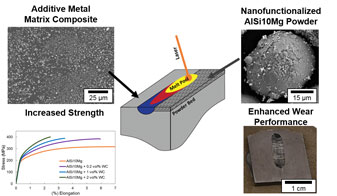

Metal matrix composites (MMCs) offer a unique set of material properties enabling their use in many specialized, high-performance applications, including brake disks and turbine blades.[Reference Kainer and Kainer1] Introducing a secondary hard phase into an otherwise ductile metal matrix can produce a composite system with improved modulus, strength, and creep life, as well as reduced wear rates.[Reference Ibrahim, Mohamed and Lavernia2–Reference Ramesh and Ahamed4] These benefits are generally only seen in specific applications due to the difficulty in processing these materials into more complex shapes.[Reference Ibrahim, Mohamed and Lavernia2, Reference Tomac, Tannessen and Rasch5] Additive manufacturing (AM), commonly referred to as three-dimensional (3D) printing, provides a processing route to complex geometries. However, there has been scant prior work on methods of producing MMCs utilizing AM.[Reference Dai and Gu6] Here we present a nanofunctionalization approach for additive feedstock that enables alloy and machine agnostic 3D printing of new aluminum MMCs with >20% increase in strength and >2 × improvement in wear characteristics over the baseline alloy system.
Methods currently used for MMC manufacturing include stir casting and powder consolidation.[Reference Thomas, Parameshwaran, Muthukrishnan and Kumaran7, Reference Ye, Liu and Hong8] The former is limited due to the reactivity of the reinforcement phase and tendency for settling during casting, while the latter is limited to simple geometries (e.g., flat sheets, prismatic sections).[Reference Gofrey, Goodwin and Ward-Close9, Reference Hashim, Looney and Hashmi10] Both are additionally susceptible to agglomeration of the reinforcement phase and generally require some form of post-processing or machining to produce a final usable geometry. This is often an expensive process due to increased tool wear from the reinforcement phase. There is no industrially relevant production route to geometrically complex MMCs. This ultimately limits the use of these alloy systems despite clear material property advantages over typical metal alloys.
AM provides a method for net shape production of components with limited post-processing and is theoretically applicable to almost any alloy system.[Reference Das, Bourell and Babu11] Recent work by Martin et al. has shown that secondary phases of nanoparticles can be incorporated during AM utilizing nanofunctionalization (Fig. 1).[Reference Martin, Yahata, Hundley, Mayer, Schaedler and Pollock12] This process involves assembly of lattice-matched nanoparticles of a target composition on the surface of metal alloy powders resulting in a uniform dispersion of the nanoparticles in the melt pool and incorporation into the alloy upon solidification. During processing in standard powder bed metal AM equipment, these nanoparticles have been shown to control the solidifying microstructure and produce crack-free, equiaxed grain structures in high strength 6000 and 7000 series aluminum alloys. While the composition of the nanoparticle functionalization, in this case, was used to control microstructure evolution during AM and not to provide a secondary reinforcement phase, the same process is equally valid for the production of MMCs, where the nanoparticles may not necessarily influence the solidification response of the matrix alloy (Fig. 1).
Additive manufacturing of metal matrix composites via nanofunctionalization. (Left) Resulting microstructure after additive manufacturing with AlSi10Mg + 5 vol% WC demonstrating distributed nanoparticulates throughout the aluminum matrix and the mechanism of Orowan bowing, which leads to increased strength through dislocation impedance. (Center) Schematic representation of the layered powder bed additive manufacturing process. (Right) Nanofunctionalized AlSi10Mg micropowder feedstock with a distribution of WC nanoparticles on the surface and the crystal structures of α aluminum and tungsten carbide with highlighted (blue) lattice planes with low disregistry.

The impressive properties of MMCs are derived from the unique microstructures that develop during processing. Typical MMCs utilize a ductile metal matrix, such as aluminum, copper, or titanium, combined with a hard ceramic reinforcement phase in the form of filaments, fibers, or, more commonly, particulates.[Reference Ibrahim, Mohamed and Lavernia2] As stress is applied to the composite system, deformation occurs due to dislocation motion in the matrix. Because the secondary phases generally have a much higher shear modulus than the matrix material, the particulate forces the dislocation to bow, requiring additional stress above the intrinsic critical resolved shear stress of the matrix to move the dislocation.[Reference Han, Zhang, Zhang, Feng and Wang13] Additionally, differences in thermal expansion of the secondary phase lead to the generation of dislocations near the particles.[Reference Xiao, Gao, Yang, Liu, Li and Xu14] The distribution of the second phase produces barriers to dislocation motion resulting in a strengthening effect described as Orowan bowing (Fig. 1), in which the shear force required to move the dislocation is inversely related to the particle size and spacing[Reference Hull and Bacon15]
 $$\tau = \displaystyle{{Gb} \over {L - 2r}},$$
where G is the shear modulus, b is the magnitude of the Burgers vector, L is the particle spacing, and r is the particle radius. This behavior is present regardless of the alloy operating temperature generally leading to improved creep and high-temperature strength. Additionally, uniform distributions of particulates are able to deflect the growth of fatigue cracks, thereby improving fatigue performance. It is therefore important to control both the size and distribution of the reinforcement phase to produce MMCs with optimal properties.[Reference Nan and Clarke16]
One of the main issues with the production of MMCs is the wettability of the reinforcement phase. This has well-known processing impacts, such as increased liquid viscosity, agglomeration, and gas entrapment. Additionally, poor wetting has deleterious effects on the final mechanical properties.[Reference Thomas, Parameshwaran, Muthukrishnan and Kumaran7, Reference Bharath, Nagaral, Auradi and Kori17] Crystallographically incoherent reinforcement phases do provide the aforementioned barrier to dislocation motion. However, increasing the second-phase coherency provides additional benefits due to the increased local strain fields and gradual change in Burgers vector near the second phase adding to the dislocation line tension.[Reference Hull and Bacon15] This results in a local increase in critical resolved shear stress further increasing the strengthening effect. Additionally, crystallographically coherent reinforcement phases generally exhibit better wettability due to the energetically favorable atomic organization at the solid–liquid interface. Due to these factors, crystallographic matching of the reinforcement phase to the primary solidification phase of the liquid was used in the selection of an appropriate reinforcement phase for the production of the AM MMCs used in this study. This approach was used to increase the tendency for wettability and improve the final material properties of the resulting additively manufactured MMC.
A typical AlSi10Mg alloy powder (Trade name CL31) provided by Concept Laser GmbH, Lichtenfels, Germany was used as the model system for a matrix alloy in this study. All processing was completed using a powder bed, selective laser melting approach on a Concept Laser M2 metal printer using the provided CL31 laser parameters. For comparison, additively manufactured CL31 specimens without the incorporation of nanoparticles were produced for both tensile testing as well as microstructure analysis. For the MMCs produced in this study, tungsten carbide (WC) was identified as the reinforcement phase due to the calculated lattice-matching compatibility (<3% strain) of the Al {111} and WC {00 $\bar 1$} planes (Fig. 1) and high shear modulus (~10× aluminum) to force bowing rather than cutting of the reinforcement phase. Determination of the minimum lattice mismatch planes of Al and WC was carried out using software developed with Citrine Informatics, and nanoparticle functionalization was conducted using an electrostatic assembly process. Details of the lattice-matching analysis, along with the nanofunctionalization process used to assemble the WC nanoparticles on the CL31 powder surface, are described in Martin et al.[Reference Martin, Yahata, Hundley, Mayer, Schaedler and Pollock12] Four different compositions were produced with increasing WC content to determine the influence of WC loading on the resulting aluminum MMC behavior. For each composition, rectangular microstructure blocks and XY tensile “dogbone” coupons were produced (Supplementary Fig. S1).
Utilizing the nanofunctionalization processing route provides several clear advantages in processing MMCs via AM. Custom alloy feedstock production can be costly and difficult to control due to high viscosity and settling during atomization of direct MMC precursor powders. Additionally, milling of direct MMC materials produces deformed, non-spherical particulates that are difficult to spread in a powder bed process or flow in a directed deposition process. Nanofunctionalization allows for a high concentration of particulates to be assembled directly onto available spherical feedstock material, which can then be used as-produced in commercially available additive equipment. This nanofunctionalization approach has advantages over other routes to additive MMC production that rely on blending of the reinforcement and matrix phases directly in the powder bed in that nanofunctionalization avoids agglomeration or non-uniform reinforcement distribution common in powder mixing processes. Because the nanoparticles are uniformly distributed on the surface of the matrix micropowder (Fig. 1), precise and uniform composition control is maintained throughout the build.
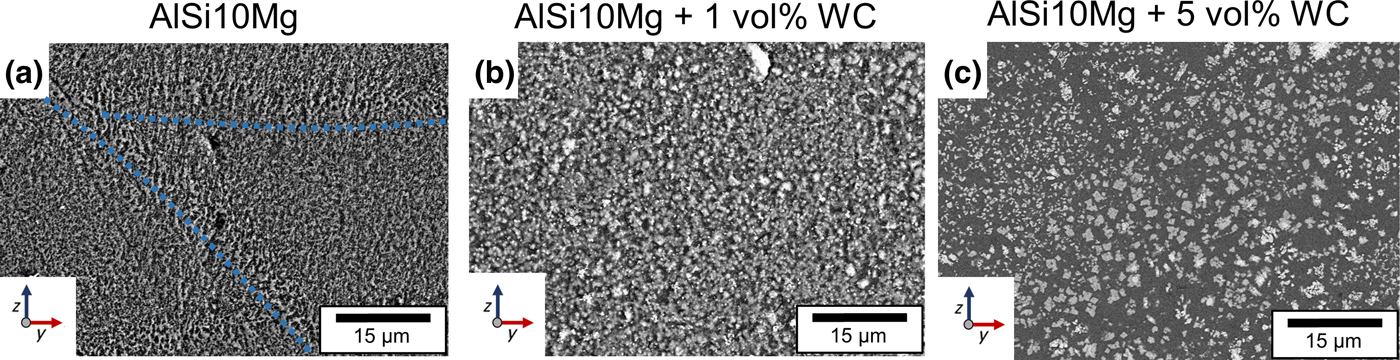
Microstructure analysis was completed on the additive aluminum MMCs produced in this study using scanning electron microscopy (Fig. 2). As shown, stock AlSi10Mg without the addition of WC shows a cellular dendritic structure typical of high silicon casting alloys.[Reference Stefanescu18] The microstructure is relatively refined, with cell spacing ranging from 1 to 2 µm, likely due to the increased cooling rate during AM.[Reference Acharya, Sharon and Staroselsky19, Reference Kurz and Fisher20] The nanofunctionalized material shows a different microstructure with uniformly distributed particulate and a more dispersed matrix structure. Due to the lattice-matching effects and the high-volume fraction of heavy WC particulates during solidification, long columnar growth is impeded leading to a more random microstructure with feature sizes <1 µm. The expected high wettability of the system, due to lattice matching, means the WC particulate is more likely to be incorporated into the solidification front rather than being pushed to the colony boundaries. This provides a composite system with well-distributed coherent particles to take full advantage of the strengthening mechanisms described previously.
As built stock Al10SiMg and nanofunctionalized microstructures. (a) Cellular dendritic microstructure typical of AM AlSi10Mg indicating larger cell spacing at the melt boundary (dashed line) and finer features in the meltpool center. (b) AlSi10Mg with 1 vol% WC indicating a non-columnar structure and uniform distribution of particulate. (c) AlSi10Mg with 5 vol% WC indicating coarsening of WC phases due to increased energy input.
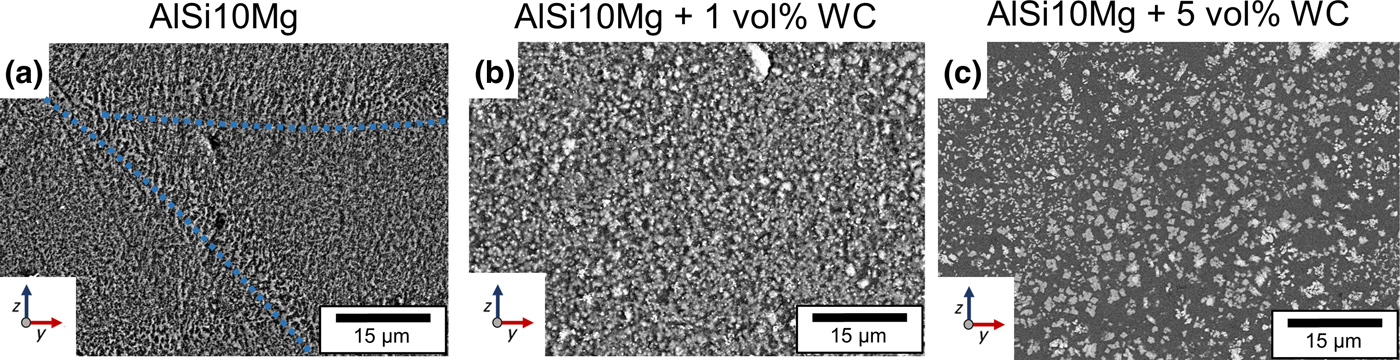
One feature common to both the functionalized and non-functionalized material was residual porosity. While residual porosity is prevalent in AM, the tendency for porosity increased with increasing volume fraction of particulate.[Reference Scipioni Bertoli, Wolfer, Matthews, Delplanque and Schoenung21] This is attributed to the increased global emissivity of the nanofunctionalized material. Aluminum has an order of magnitude lower emissivity than WC at the 1070 nm wavelength of the incident laser during processing.[Reference Ozaki and Zee22] As more WC is assembled on the surface of the aluminum powder, its absorptivity increases, meaning the delivered volumetric energy density also increases. Keyhole and vaporization porosity are a direct impact of overheating the metal during processing.[Reference Matthews, Guss, Khairallah, Rubenchik, Depond and King23] Since the machine parameters were held fixed at the manufacturer's provided parameter set, increasing WC content resulted in sequentially increased volumetric energy density leading to increased porosity as well as coarsening of the WC at higher volume fractions [Fig. 2 (c)]. This particular phenomenon had a direct impact on the observed elongation at failure, resulting in lower ductility for higher loadings of WC.
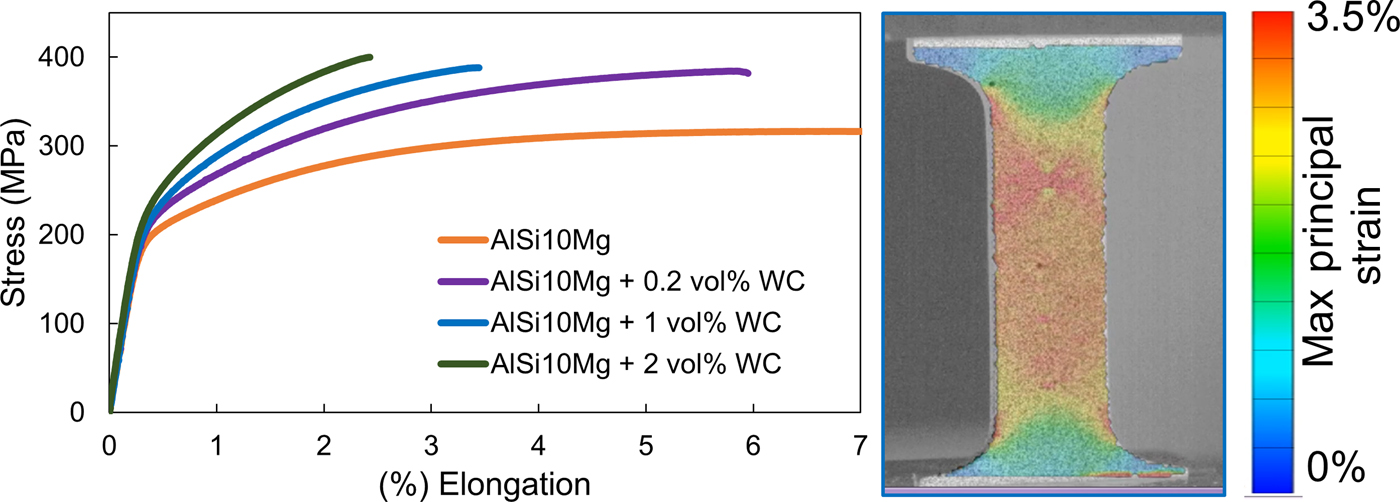
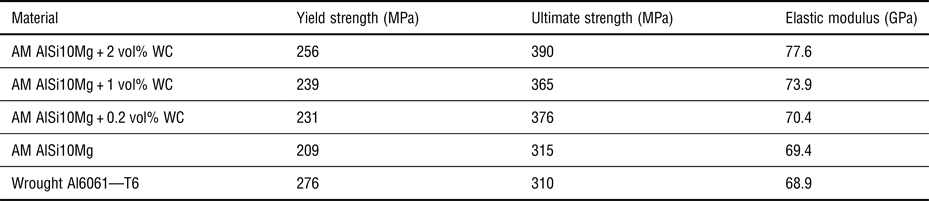
Quasi-static room temperature tensile testing was completed using a screw-driven 50 kN load cell and serrated wedge-style grips for XY specimens, which were machined to final dimensions using electrical discharge machining. During the tensile tests, deformation of the samples was monitored using an Aramis 4M digital image correlation (DIC) system and used to determine modulus, strain and localized failure events. Prior to testing, all material was aged using the manufacturer's recommended heat treatment (ramp to 240 °C in 1-h, 6-h hold, furnace cool to 100 °C and remove to ambient atmosphere).[24] This reduces residual stress and leads to a slight spherodization of the secondary silicon phase in the alloy which stabilizes the microstructure and strengthens the material.[Reference Rosenthal, Stern and Frage25] Typical results for the tested material are shown in Fig. 3 and Table I. As shown, there is a >20% increase in material strength with increasing WC content. This can be attributed to the uniform distribution of the WC strengthening phase, falling about 8–10% above the theoretical strength based on Eq. (1), likely indicating additional strengthening from a refined microstructure. An increase in modulus can be observed as well, consistent with the general rule of mixtures for composite materials, albeit closer to the upper bound assuming a modulus of 600 GPa for WC.
Tensile testing of additive AlSi10Mg and AlSi10Mg + WC. (Left) Typical stress–strain curves from the alloys tested. (Right) Principal strain contours of the AlSi10Mg + 1 vol% WC sample produced using digital image correlation (DIC) indicating a stress concentration at an area of residual porosity.
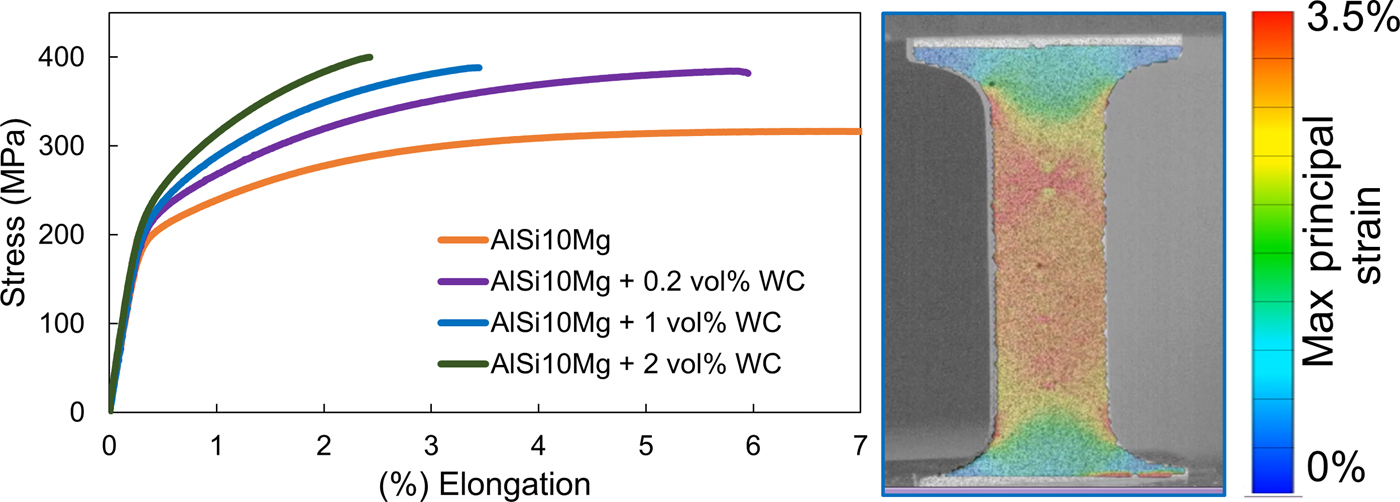
Mechanical properties of AM and wrought alloys. Increasing concentrations of WC nanoparticles show an increase in yield strength and elastic modulus. The ultimate tensile strength increases slightly but is likely underestimated due to premature fracture from residual porosity from the non-optimized build parameters.

While tensile elongation does decrease with increasing WC content, some of the decreases are attributable to process-induced porosity. As described previously, increasing WC content increases the tendency for porosity development when laser-scanning parameters are held fixed. This is most easily seen in the DIC image taken during tensile testing (Fig. 3). Contours generated by the Aramis DIC system indicate concentrations of principal strain near a defect rather than a uniform failure mechanism. Analysis of the fracture surface indicates a large processing defect surrounded by ductile fracture rather than a brittle fracture as typically indicated by the associated stress–strain curve. This implies that further process parameter improvement to eliminate large defects can provide a material with high ductility and strength, even at high levels of WC loading.
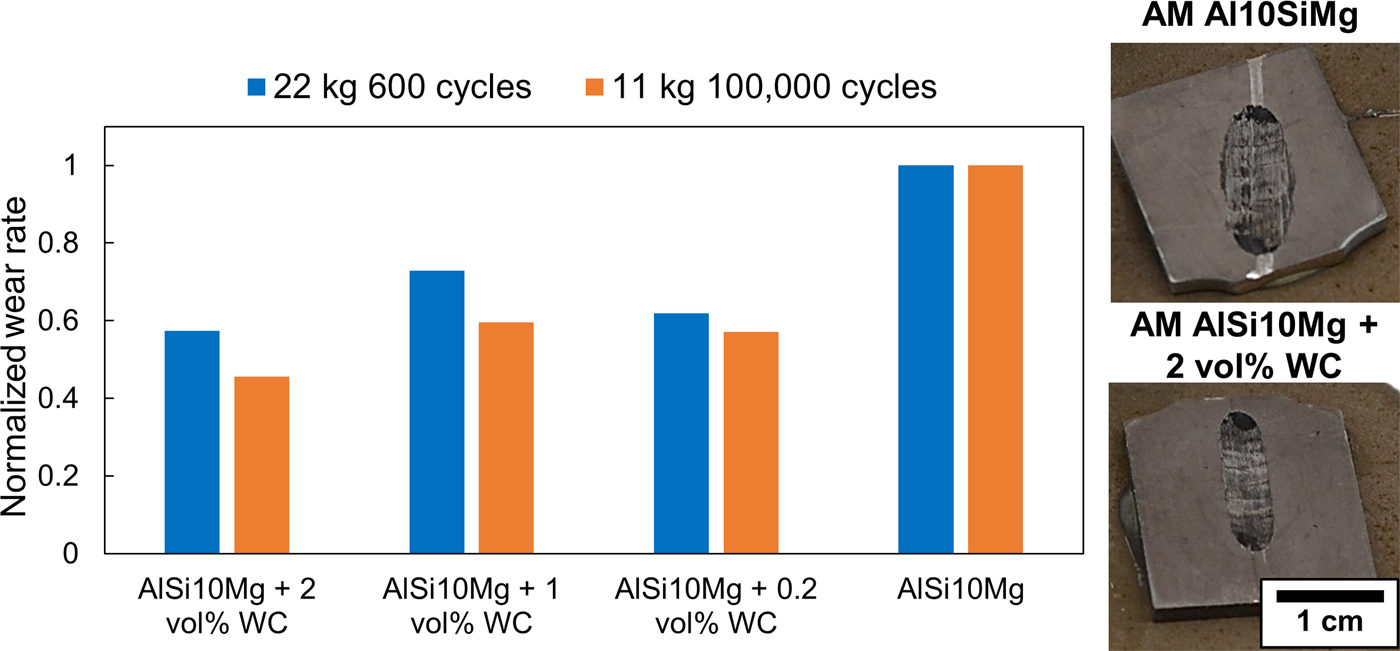
In addition to high strength, MMCs are also known for improved wear resistance.[Reference Kainer and Kainer1] This is particularly important in the case of sliding wear, commonly encountered in brakes or tooling, in which repeated mating events lead to a substantial material loss. The inclusion of hard ceramic phases was therefore expected to increase the wear performance of the underlying AlSi10Mg matrix. Testing was conducted using a linear reciprocating wear configuration with a silicon carbide pin (ASTM G133). The AlSi10Mg is already present as a two-phase microstructure including an immiscible silicon phase with an intrinsic hardness >2 × that of the aluminum matrix, indicating that the wear properties should be adequate for a typical aluminum alloy. WC has a hardness >10 × more than base AlSi10Mg system providing a large increase in presented material hardness to the wear pin. Results for sliding wear at two different loads are shown in Fig. 4 normalized to the AlSi10Mg system.
Linear reciprocating wear results of AM alloys. (Left) Wear rates are normalized to the stock Al10SiMg indicating >50% reduction in wear rate is possible with the addition of WC during additive manufacturing. (Right) Post-testing images of tested samples showing a significant difference in wear track size between the stock AlSi10Mg and WC reinforced AlSi10Mg.

The wear data indicate that the addition of WC as a reinforcement particulate produces a material with >2 × improvement in wear performance. Interestingly, there is little variation in the wear behavior of the 0.2 and 2 vol%. This is likely due to the increased residual porosity in higher WC loadings previously described, resulting in a textured wear surface more susceptible to shear deformation. Assuming this porosity effect is carried to the higher volume percentage material, additional improvements in wear performance can be expected with improved processing parameters, or post-processing techniques such as hot isostatic pressing.
A novel route to producing a MMC via AM has been presented. The model system of AlSi10Mg and WC demonstrates that >2 × improvements in tensile and wear properties are possible without modification of commercially available hardware and systems. Additional improvements in material properties are likely possible through improved processing parameters and incorporation of a higher strength matrix material, rather than the AlSi10Mg model system. While this study was restricted to a specific alloy, the nanofunctionalization approach has been demonstrated as a viable technique for processing MMCs and could be used on other systems with varying base alloy constituents and nanoparticles to additively manufacture new and existing MMC systems. Lattice matching provides a unique route to identify key crystallographic parameters necessary to provide wettability and coherence in the matrix alloy improving processability and material characteristics. Additionally, the ease of raw material production allows for rapid analysis of varying material compositions to optimize material properties for specific applications.
Supplementary material
The supplementary material for this article can be found at https://doi.org/10.1557/mrc.2018.95
Acknowledgments
The authors gratefully acknowledge the financial support by HRL Laboratories, LLC, and thank Dana Martin for her artistic contribution to the figures.