Hefei Mandarin is a Chinese dialect spoken in Hefei, the capital city of Anhui Province, China, as illustrated in Figure 1. According to The Language Atlas of China (1987), Hefei Mandarin is a sub-branch of Jianghuai Mandarin, i.e. the varieties of Mandarin dialects distributed between the Yangtze River and the Huai River. While its syllable structure is relatively simple, Hefei Mandarin has a rich vowel inventory and various types of rimes, including three contrastive high back vowels /ɯ o ɤ/, non-nasalized vs. nasalized vowels as syllable rimes such as /i/ vs. /ĩ/, and three syllabic consonants [ɹ̩ ɹ̩ʷ ɻ̩] (Li Reference Li1936; Meng Reference Meng1962, Reference Meng1997; Li Reference Li1994, Reference Li1997; Wang Reference Wang, Chen and Li1996; Kong Reference Kong2003, Reference Kong2004, Reference Kong2006; Kong & Zhang Reference Kong and Zhang2006; Kong, Wu & Li Reference Kong, Wu and Li2019).
Geographic location of Hefei. (Maps adapted from Wikipedia.)

The segments and tones of Hefei Mandarin described in this study are based on the production of a male native speaker of Hefei Mandarin, who was 41 years old at the time of the data collection. The speaker has been living in the old city area of Hefei, where the speakers’ accent is typical of Hefei Mandarin. The speaker reported no speech or hearing impairment. The recording was done at a sampling rate of 44.1 kHz in a sound attenuated booth and the acoustic measurements were performed using Praat (Boersma & Weenink Reference Boersma and Weenink2020).
Consonants


Based on the speaker’s production, a total of 24 non-syllabic consonants are identified for Hefei Mandarin. In addition to the consonants of Hefei Mandarin described in the literature (Meng Reference Meng1962, Reference Meng1997; Li Reference Li1994, Reference Li1997; Wang Reference Wang, Chen and Li1996), a consonant /ʑ/ is observed in the speaker’s production, such as the onset of the syllable [ʑĩ31] 烟 ‘cigar’, which is the voiced counterpart of the alveolo-palatal fricative /ɕ/.Footnote 1 Among the consonants, /n/ and /ŋ/ can only serve as syllable coda, such as in the syllables [tən31] 灯 ‘lamp’ and [təŋ31] 冬 ‘winter’.
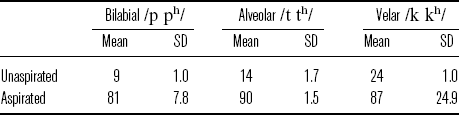
Plosives in Hefei Mandarin have three places of articulation, with a contrast between aspirated and unaspirated plosives at each place: bilabial /p pʰ/, as in [pɔ31] 包 ‘bag’ and [pʰɔ24] 跑 ‘to run’, alveolar /t tʰ/, as in [ta213] 打 ‘to hit’ and [tʰɯ213] 土 ‘soil’, and velar /k kʰ/, as in [kɔ31] 高 ‘high’ and [kʰɔ213] 考 ‘to examine’. Table 1 shows the mean VOT values of the unaspirated and aspirated plosives in different places of articulation, each based on the measurement of three tokens in Praat focusing on the interval between the release burst and the first cycle of the periodic wave of its following vowel. Apart from these plosives, a glottal stop [ʔ] appears as a coda that co-occurs with Tone 5, a short high tone transcribed phonetically as level 4 using Chao numerals, such as in the syllable [tswɐʔ4] 作 ‘to do’. It is not listed as a phonemic consonant because it exists in Hefei Mandarin only as an accompanying property of Tone 5 and it is not contrastive with any other consonants when tone is involved.
Mean VOT values (ms) of unaspirated vs. aspirated stops in Hefei Mandarin.

Affricates in Hefei Mandarin also occur at three places of articulation with a distinction between aspirated and unaspirated affricates: alveolar /ts tsʰ/, as in [tswɐʔ4] 作 ‘to do’ and /tsʰɯ31/ 粗 ‘thick’, postalveolar /tʃ tʃʰ/, as in [tʃɯ213] 主 ‘master’ and [tʃʰɔ31] 抄 ‘to copy’, and alveolo-palatal /tɕ tɕʰ/, as in [tɕɔ31] 交 ‘to submit’ and [tɕʰɔ24] 桥 ‘bridge’.Footnote 2 The postalveolar affricates /tʃ tʃʰ/ and their fricative counterpart /ʃ/ are usually referred to as retroflex sibilants in the Chinese literature of Hefei Mandarin and are consequently represented as /tʂ tʂʰ ʂ/. In Hefei Mandarin, however, they sound more postalveolar than retroflex.
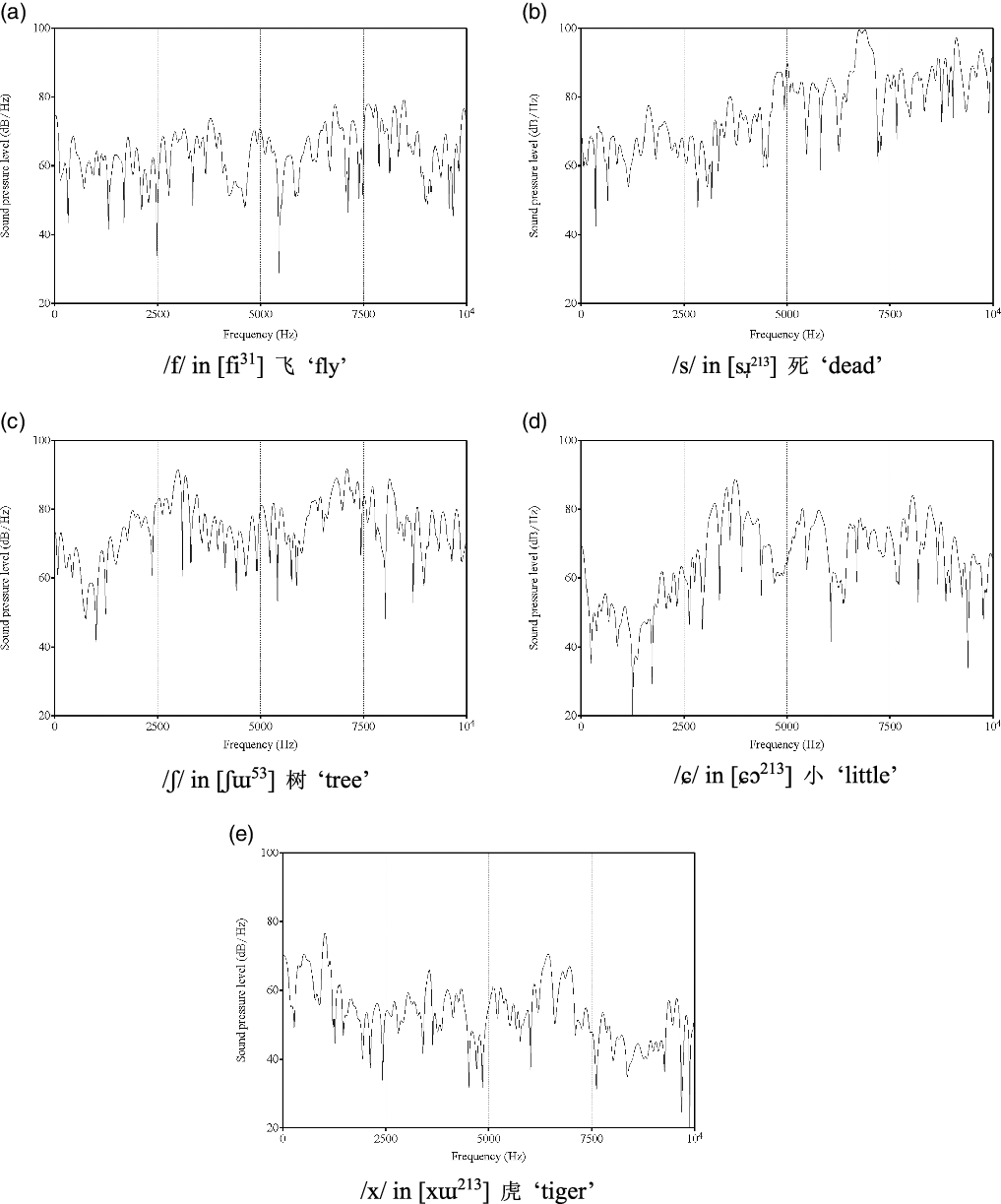
Hefei Mandarin has fricatives at five places of articulation: labiodental /f/, as in [fi31] 飞 ‘to fly’, alveolar /s z/, as in [sɹ̩213] 死 ‘dead’ and [zɹ̩ʷ213] 雨 ‘rain’, postalveolar /ʃ/, as in [ʃɯ53] 树 ‘tree’, alveolo-palatal /ɕ/, as in [ɕɔ213] 小 ‘little’, and velar /x/, as in [xɯ213] 虎 ‘tiger’. Sample FFT spectra of the voiceless fricatives in Hefei Mandarin are provided in Figure 2, sampled at the midpoint of the fricatives using a 15 ms Hamming window. As shown in Figure 2, the three sibilant fricatives differ in the distribution of their energy: /s/ has its concentration in the high frequency range above 5000 Hz; /ʃ/ has more energy than /ɕ/ above 5000 Hz; the energy of /ɕ/ is centered around 3000–4000 Hz.
Sample FFT spectra of the voiceless fricatives in Hefei Mandarin.

Syllabic consonants
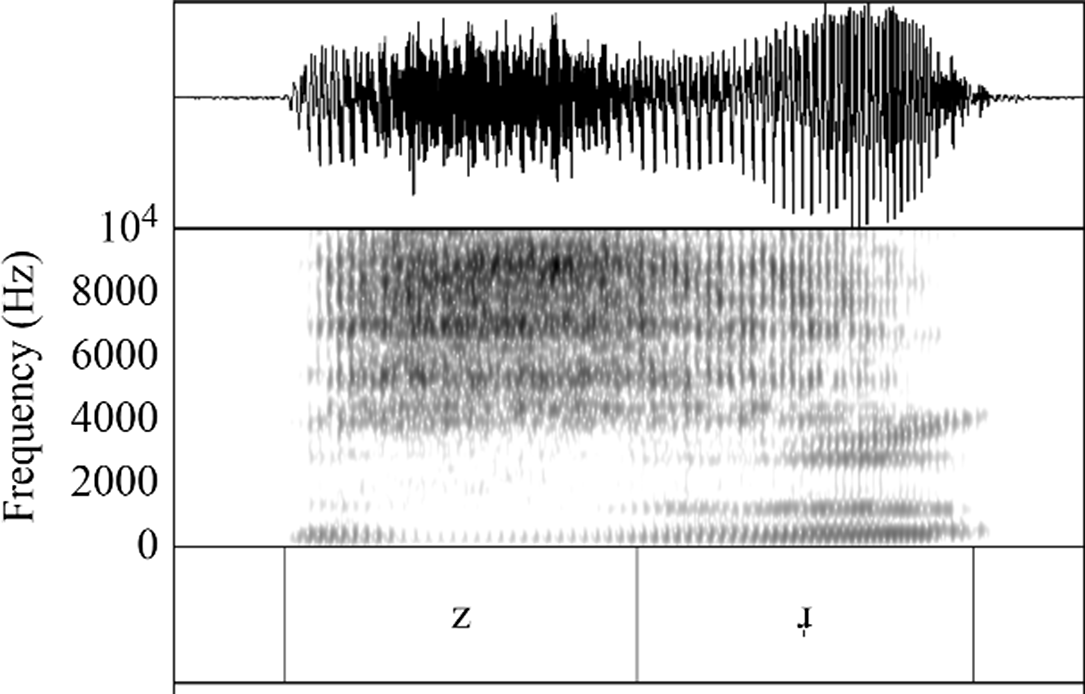
Hefei Mandarin has syllabic consonants such as the nucleus of the syllable [zɹ̩213] 椅 ‘chair’ as illustrated in Figure 3. Similar syllabic consonants in languages such as Standard Mandarin, e.g. the [ɹ̩] in [sɹ̩55] 思 ‘to think’ with the same place of articulation as its preceding consonant, are usually referred to as apical vowels (Karlgren Reference Karlgren1915/1926, Chao Reference Chao1930, Baron Reference Baron1974, Lee-Kim Reference Lee-Kim2014). The spectrogram in Figure 3 shows a distinction between the voiced alveolar fricative [z] and the alveolar syllabic segment [ɹ̩] in particular in that there is stronger frication noise in the [z] portion than in the [ɹ̩] portion.
Waveform and spectrogram of [zɹ̩213] 椅 ‘chair’ in Hefei Mandarin.

There are three syllabic consonants in Hefei Mandarin, the unrounded alveolar [ɹ̩], the rounded alveolar [ɹ̩ʷ], and the unrounded postalveolar [ɻ̩], as illustrated in Table 2.Footnote 3 The syllabic segments in Hefei Mandarin differ from those in most other languages such as Standard Mandarin in that it has the rounded alveolar [ɹ̩ʷ], which contrasts with the unrounded alveolar [ɹ̩], as in [zɹ̩213] 椅 ‘chair’ vs. [zɹ̩ʷ213] 雨 ‘rain’. In addition, the [ɹ̩] in Hefei Mandarin also distinguishes itself from its counterparts in languages such as Standard Mandarin in that, apart from appearing after homorganic consonants such as /ts tsʰ s z/, it also appears after non-homorganic consonants such as the bilabial /m p pʰ/, as in [pɹ̩213] 比 ‘to compare’, [pʰɹ̩213] 痞 ‘naughty’, and [mɹ̩213] 米 ‘rice’.
Distribution of syllabic consonants in Hefei Mandarin.

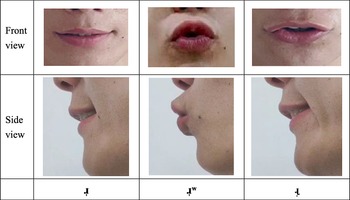
Figure 4 illustrates the speaker’s lip gestures when producing the three syllabic consonants. It can be seen that the syllabic segment [ɹ̩ʷ] involves a lip rounding that is absent from the other two syllabic segments. In addition, the vertical aperture in producing [ɻ̩]Footnote 4 is a bit larger compared with that used in producing [ɹ̩]. The syllabic consonants [ɹ̩ ɹ̩ʷ ɻ̩] in Hefei Mandarin are observed to have clear formant structures (Wan Reference Wan2014, Kong et al. Reference Kong, Wu and Li2019), similar to their counterparts in languages such as Standard Mandarin (Lee Reference Lee2005).
Lip gestures for [ɹ̩ ɹ̩ʷ ɻ̩] as in [sɹ̩213] 死 ‘dead’, [sɹ̩ʷ213] 许 ‘a surname’, and [tʃɻ̩213] 纸 ‘paper’.

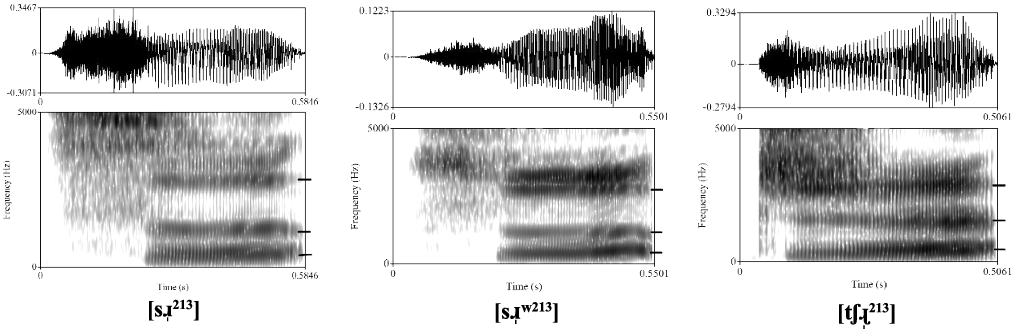
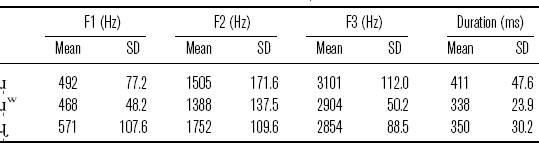
Figure 5 shows the waveform and spectrogram of [ɹ̩ ɹ̩ʷ ɹ̩] produced by the speaker. The mean values of the first three formants and durations of the three syllabic segments are shown in Table 3, each based on nine tokens. In terms of the mean values of F1, [ɹ̩ʷ] is the lowest; in terms of F2, [ɹ̩] and [ɹ̩ʷ] both are lower than [ɻ̩]; in terms of F3, [ɹ̩] is higher than [ɹ̩ʷ] and [ɻ̩]. Of the three sounds, the lowest F1 and F2 values for [ɹ̩ʷ] are presumably related to its lip rounding. The source of the relatively low F3 in [ɻ̩] awaits future instrumental investigation to find out if it predominantly originates from pharyngealization (Catford Reference Catford1988) or a large front cavity (Narayanan, Byrd & Kaun Reference Narayanan, Dani and Kaun1999).
Waveform and spectrogram of [sɹ̩213]死 ‘dead’, [sɹ̩ʷ213]许 ‘a surname’, and [tʃɻ̩213]纸 ‘paper’.

Mean F1, F2, F3 (Hz) and duration (ms) of [ɹ̩ ɹ̩ʷ ɻ̩] in Hefei Mandarin.

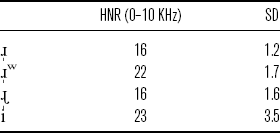
Frication noise has been observed in syllabic consonants in various Chinese languages, e.g. Xining Chinese (Zhang & Zhu Reference Zhang and Zhu1987) and Wu Chinese (Qian Reference Qian1992, Shi Reference Shi1998, Zhu Reference Zhu2004, Hu Reference Hu2007, Faytak Reference Faytak2018, Hu & Ling Reference Hu and Ling2019). While there is a clear distinction between a voiced fricative and a syllabic segment, e.g. [z] vs. [ɹ̩] as illustrated in Figure 3 above, the syllabic consonants in Hefei Mandarin have been reported to include audible fricative noise in previous studies (Hou Reference Hou2007, Reference Hou2009; Kong et al. Reference Kong, Wu and Li2019, among others). For a quantified assessment of frication noise in the syllabic consonants, harmonic-to-noise ratios (HNR) (de Krom Reference de Krom1993, Maniwa, Jongman & Wade Reference Maniwa, Jongman and Wade2009) were measured for the three syllabic segments in Hefei Mandarin, by which a higher value indicates more periodicity and a lower value indicates more noise. The results of the HNR measurement are presented in Table 4, which are based on nine tokens for each segment, with a window size of 10 ms at the middle points. The measurement of the high front vowel /i/ is added as a baseline for comparison. As shown in Table 4, the mean HNR values for [ɹ̩] and [ɻ̩] were in general lower than that of /i/, indicating a greater proportion of aperiodic energy in the two syllabic segments, consistent with the results of visual inspection in previous studies such as Kong et al. (Reference Kong, Wu and Li2019). On the other hand, Table 4 shows similar mean HNR values of /i/ and [ɹ̩ʷ], indicating that [ɹ̩ʷ] involves more periodic energy as compared with [ɹ̩] and [ɻ̩].Footnote 5
Mean HNR values of the syllabic consonants [ɹ̩ ɹ̩ʷ ɻ̩] and [i] in Hefei Mandarin.

Vowels
The speaker’s production indicated 13 monophthongs in Hefei Mandarin, including eight non-nasalized vowels and five nasalized vowels, and nine diphthongs.
Non-nasalized monophthongs

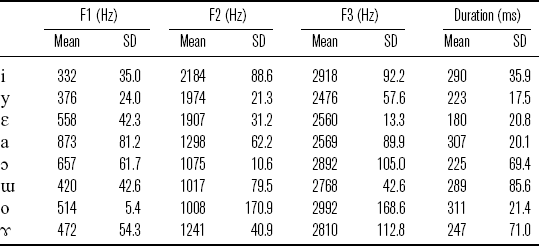
The eight non-nasalized monophthongs include /i y ɛ ɯ ɤ o ɔ a/, in which /a/ is adopted to denote a low central vowel instead of a low front vowel. For the eight monophthongs, Table 5 illustrates the mean values of their first three formants and the durations. For the first five vowels, the formant values were based on four tokens per vowel measured at the midpoints and, for the last three vowels, the measurement was based on 15 tokens per vowel.Footnote 6
Mean F1, F2, F3 (Hz) and duration (ms) of monophthongs in Hefei Mandarin.

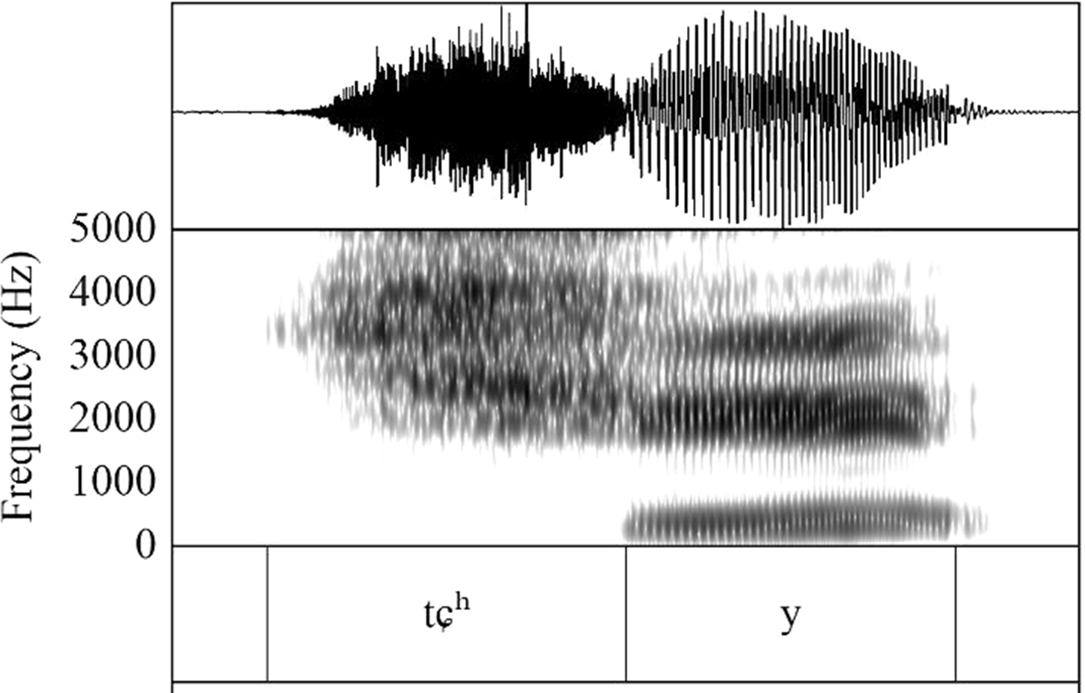
The two high front vowels /i/ and /y/ are distinguished by lip rounding. For the rounded /y/, there has been previous description of it as a diphthong [ye] (Li Reference Li1997). The production by the speaker in this study does not show characteristics of a diphthong, as in the syllable [tɕʰy24] 茄 ‘eggplant’ in Figure 6. Therefore, the vowel is transcribed as a monophthong, consistent with previous studies such as Wan (Reference Wan2014).
[tɕʰy24] 茄 ‘eggplant’ in Hefei Mandarin.

Hefei Mandarin has three contrastive high back vowels /ɯ ɤ o/, as in the monosyllabic triplet [xɯ213] 虎 ‘tiger’, [xɤ2213] 吼 ‘to shout’, and [xo213] 火 ‘fire’.Footnote 7 As shown in Table 5, in terms of F1, the mean value of /ɯ/ (420 Hz) is lower than those of /o/ (514 Hz) and /ɤ/ (472 Hz), corresponding to its relatively high tongue position; in terms of F2, the mean value of /ɯ/ (1017 Hz) is close to that of /o/ (1008 Hz), both of which are lower than the F2 of /ɤ/ (1241 Hz); in terms of F3, the mean values of /ɯ/ (2768 Hz) and /ɤ/ (2810 Hz) are lower than the F3 of /o/ (2992 Hz). The lip gestures of the three vowels are presented in Figure 7, which shows that the aperture is larger in /ɯ/ and /ɤ/ than in /o/ and that the protrusion is more obvious in /o/ than in /ɯ/ and /ɤ/. Note that the three vowels /ɯ ɤ o/ are usually transcribed as /u ɯ ʊ/, respectively, in the literature, primarily based on impressionistic description (Li Reference Li1997, Meng Reference Meng1997). The production of the speaker in this study, as illustrated in Figure 7, supported their transcription respectively as /ɯ ɤ o/.
Lip gestures of /ɯ/ /ɤ/ and /o/ in Hefei Mandarin as in the syllables [xɯ213] 虎 ‘tiger’, [xɤ2213] 吼 ‘shout’, and [xo213] 火 ‘fire’.

Nasalized vowels

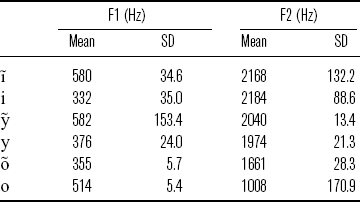
There are five nasalized vowels in Hefei Mandarin /ĩ ỹ õ æ̃ ɑ̃/, which have been recognized to historically derive from syllable rimes in the form of vowel-nasal sequences (Li Reference Li1997). Of the five, the three high nasalized vowels, /ĩ/ as in [ʑĩ31] 烟 ‘cigar’, /ỹ/ as in [ʑỹ53] 院 ‘yard’, and /õ/ as in [õ213] 碗 ‘bowl’, have non-nasalized counterparts /i y o/ respectively; the other two, /æ̃/ as in [xæ̃31] 憨 ‘good-tempered’ and /ɑ̃/ as in [xɑ̃31] 夯 ‘to strengthen’, have no non-nasalized counterparts. Table 6 presents the mean formants values (in Hz) of the nasalized vowels, each based on 3 tokens, and their non-nasalized counterparts as recalled from Table 5. It can be seen that, in terms of mean values, /ĩ/ and /ỹ/ have relatively higher F1 values and similar F2 values as compared with their non-nasalized counterparts /i/ and /y/ respectively; on the other hand, /õ/ has a relatively lower F1 and a higher F2 as compared with /o/.
Mean F1 and F2 (Hz) of nasalized vs. non-nasalized vowels.

Diphthongs
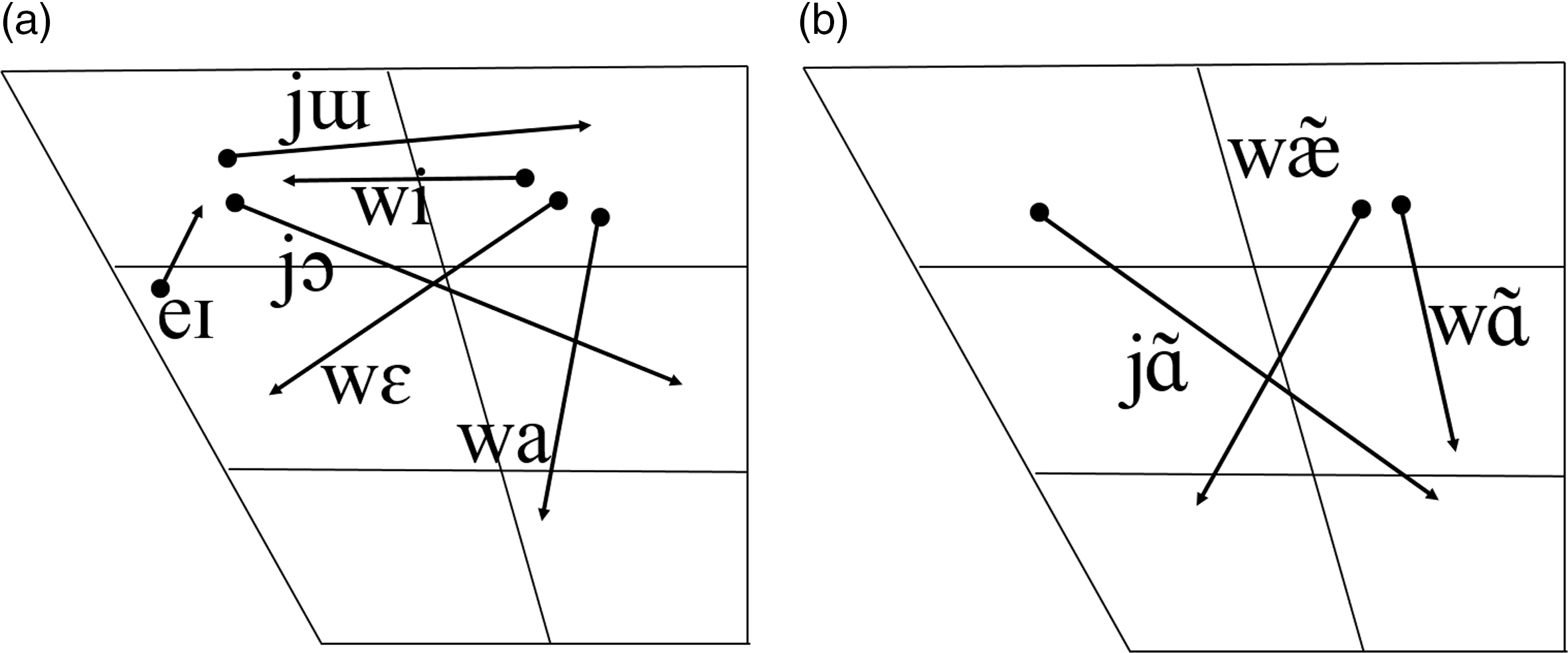
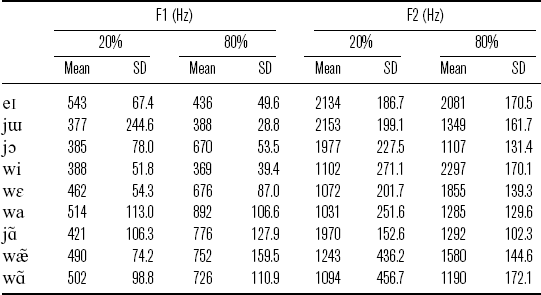
The speaker’s production showed nine diphthongs that can serve as syllabic nuclei in Hefei Mandarin, as illustrated in Figure 8. Of the nine, six do not involve nasalized vowels, i.e. /eɪ jɯ jɔ wi wɛ wa/ as in Figure 8(a), and three involve nasalized vowels, i.e. /jɑ̃ wœ̃ wɑ̃/ as in Figure 8(b). Table 7 presents the mean F1 values and F2 values of these diphthongs, each based on the measurements of four tokens at 20% and 80% of the vowels.
Schematic illustration of diphthongs in Hefei Mandarin: (a) diphthongs involving no nasalized vowels; (b) diphthongs involving nasalized vowels.

Mean F1 and F2 of the diphthongs measured at 20% and 80% of the vowels.


Of the diphthongs in Figure 9, /eɪ/ has been described as /e/ in the literature (Li Reference Li1997).Footnote 8 The production of the speaker in this study showed that the vowel surfaced as a diphthong [eɪ], e.g. the rime in [teɪ53] 队 ‘team’ as in Figure 9(a). It is interesting to observe that, in some lexical items, the vowel /e/ as reported in the literature turned out to be indistinguishable from the vowel /i/, e.g. the rime in [si53] 碎 ‘fragmentary’ in Figure 9(b), reminiscent of previous report on the similar formant values of /e/ and /i/ (Hou Reference Hou2007, Wan Reference Wan2014). It is also possible that a general neutralization of /e/ into /i/ is in progress, as embodied in the vowel difference in Figure 9(a) vs. Figure 9(b), which awaits further study to understand its detailed mechanism.
Examples of /eɪ/ and /i/ in Hefei Mandarin.

Apart from the nine diphthongs in Figure 8 above, two others are usually reported in the Chinese literature of Hefei Mandarin, i.e. [iɛ] and [ia], with example syllables such as [tɕiɛ31] 街 ‘street’ and [tɕia31] 家 ‘home’. These two are not included as diphthongs in the current study based on the fact that they appear only after the alveolo-palatal sibilants /ɕ tɕ tɕʰ/ and the assumed [i] component is brief and analyzable as the formant transition between an alveolo-palatal sibilant onset and a following vowel /ɛ/ or /a/. Following treatment of similar cases in other Chinese languages (Lee-Kim Reference Lee-Kim2014 for Standard Mandarin, Chen & Gussenhoven Reference Chen and Gussenhoven2015 for Shanghainese, and Zeng Reference Zeng2020 for Xiangxiang Chinese, among others), the relevant syllables are treated as [tɕɛ31] 街 ‘street’ and [tɕa31] respectively, in which the rimes are recognized as [ɛ] and [a].
Syllable structure
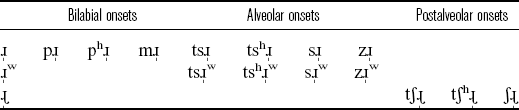
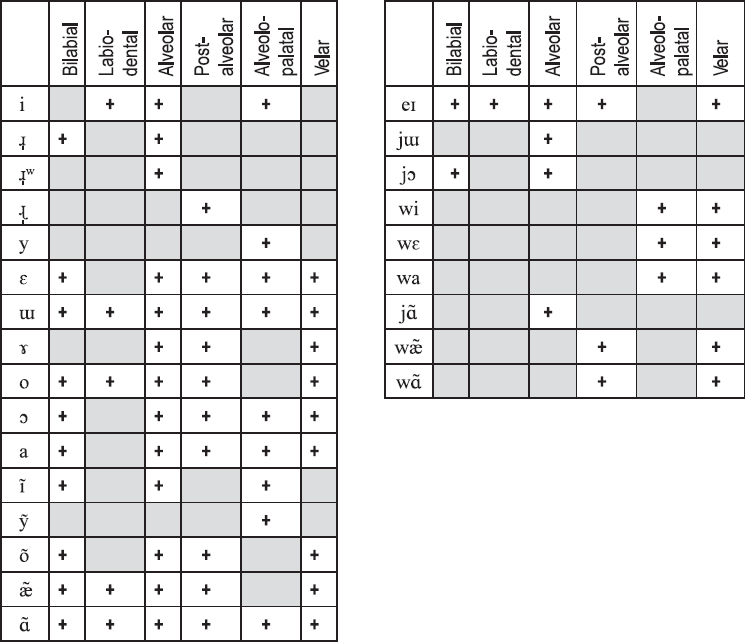
Similar to other Chinese dialects, Hefei Mandarin has a relatively simple syllable structure, which can be summarized into three types. The first type is in the form of (C)V, in which the onset (C) is optional, and all the consonants can serve as onset except [n] and [ŋ]; the vowel V is obligatory, as a monophthong, a diphthong, or a syllabic consonant. For this type of syllable, the combinations of onset consonants and vowels, including the three syllabic consonants, are summarized in Table 8.
(C)V syllables in Hefei Mandarin.

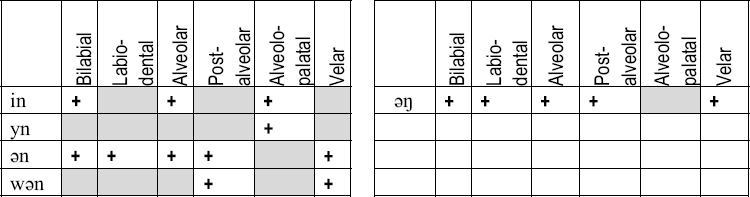
The second type has a nasal coda /n/ or /ŋ/. The rimes with nasal coda in Hefei Mandarin are listed below and their combinations with onset consonants are illustrated in Table 9. It needs to be noted that the vocalic segment /ə/ and the sequence /wə/ do not appear independently as a monophthong or a diphthong.

(C)VN syllables in Hefei Mandarin.

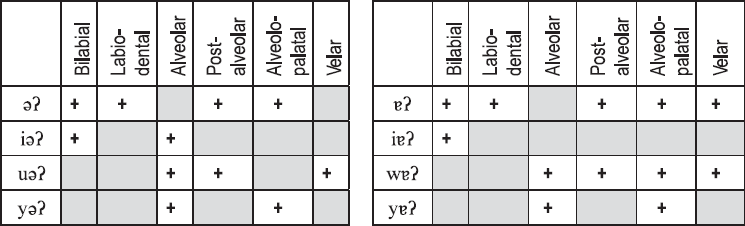
The third type includes syllables ending with a glottal stop coda, which is an accompanying property of Tone 5. The rimes with a glottal stop coda in Hefei Mandarin are listed below, with their combinations with onset consonants in Table 10. Similar to the cases in the second type of rimes, the vocalic segments [ə ɐ] and the sequences [iə wə yə iɐ wɐ yɐ] do not appear independently as monophthongs or diphthongs.

(C)VG syllables in Hefei Mandarin.

Tones
Lexical tones
Hefei Mandarin has five lexical tones, for which the speaker's production shows the following tonal values:

Of the five, Tones 1–4 appear in open syllables, such as [xɯ213] 虎 ‘tiger’, or syllables with a nasal coda, such as [kwən213] 滚 ‘to roll’. The production of Tone 3 (213) is observed to involve harsh voice and a narrow transcription of [xɯ] 虎 ‘tiger’ can be [xɯ̰]. Tone 5 is a short tone with an accompanying coda glottal stop [ʔ], such as [tʰɐʔ4] 塔 ‘tower’ (Li Reference Li1994, Reference Li1997). As is true for its counterparts in other Chinese languages, Tone 5 is conventionally referred to as an ‘entering tone’ or ‘checked tone’ in the Chinese literature and is usually represented using one digit, such as 4 in Chao numerals, indicating its short duration.
While Tone 5 in Hefei Mandarin is generally recognized as involving a glottal stop coda [ʔ], the production of the speaker showed variation as to the presence/absence of [ʔ] in the relevant syllables. As illustrated in Figure 10, the token of 塔 ‘tower’ involves a glottal stop, i.e. [tʰɐʔ4], while the token of 忽 ‘suddenly’ has no glottal stop, i.e. [xuə4], although other tokens of 忽 ‘suddenly’ may involve a glottal stop. Similar loss of glottal stops in checked-tone syllables is widely observed in Chinese languages and, in Taiwanese Min for example, over 80% of the [ʔ] codas were found to be omitted in checked-tone syllables (Pan Reference Pan2017). The variable loss of the [ʔ] is also noticeable when a Tone-5 syllable appears in sequences in Hefei Mandarin, for example, 合肥 ‘Hefei’ turned out to be [xɐ2 fi24] instead of [xɐʔ2 fi24] and 北风 ‘north wind’ surfaced as [pɐ4 fəŋ31] instead of [pɐʔ4 fəŋ31].
Variation in the presence/absence of coda stop in Tone 5.

F0 contours of lexical tones in Hefei Mandarin.

Figure 11 illustrates the f0 trajectories of the five lexical tones as in the syllable [xɯ] for Tone 1 to Tone 4 and [xuəʔ] for Tone 5. Each tonal contour was obtained by averaging across nine tokens (three repetitions of three syllables) produced by the speaker. Tone 1 surfaces as a low falling tone (31 in Chao numerals), Tone 2 a rising tone (24), Tone 3 a dipping contour tone (213), T4 a high falling tone (53), and T5 a short high tone (4), which is also the shortest among the five. For Tone 5, while its f0 trajectory may sometimes appear as a short rising contour, the short duration (usually no more than 100 ms) generally leads to a single tonal target in perception, i.e. a short high tone corresponding to 4 in Chao numerals.
Tone sandhi
As is true of many other Chinese dialects, tone sandhi occurs in Hefei Mandarin, by which a syllable bearing a lexical tone may surface with a different f0 contour when appearing in the neighborhood of another tone (Chen Reference Chen2000). Description of tone sandhi in Hefei Mandarin in the literature generally focused on disyllabic sequences (Li Reference Li1994, Meng Reference Meng1997, Kong Reference Kong2003), in which sandhi occurs to the first tone. Of the 25 disyllabic combinations of the five lexical tones, six are reported to involve tone sandhi, including (with Tone abbreviated as T) T1T1, T1T4, T3T3, T5T2, T5T3, and T5T5 (Li Reference Li1994, Meng Reference Meng1997, Kong Reference Kong2003). The production of the speaker in this study confirmed the existence of tone sandhi in all these sequences except T1T4, which was not observed to involve any sandhi. On the other hand, the combination of Tone 3 and Tone 1 (T3T1) turned out to involve a tone sandhi on the first tone, which is not well documented in the literature to the best of our knowledge. In T3T1, the initial T3 surfaces as a rising contour equal to Tone 2 /24/, i.e. /213/ [24] on the first syllable of [ɕiɑ̃24 tɕa31] 想家 homesick. The following is a summary of the six tone sandhi patterns in Hefei Mandarin using Chao numerals:
(a) T1T1: /31 + 31/ → [24 + 31]
(b) T3T1: /213 + 31/ → [24 + 31]
(c) T3T3: /213 + 213/ → [24 + 213]
(d) T5T2: /4 + 24/ → [2 + 24]
(e) T5T3: /4 + 213/ → [2 + 213]
(f) T5T5: /4 + 4/ → [2 + 4]
In (a)–(c), the initial tone in the sandhi form is indistinguishable from Tone 2 (T2) while in (d)–(f), the initial tone appears as [2], which is different from any tones in Figure 11.
These six tone sandhi sequences are illustrated in Figure 12, each averaged on three tokens, with the canonical forms indicating the f0 contour of a lexical tone in isolation. More specifically, Figure 12 shows that, in T1T1 (e.g. [ʃɔ24 pɔ31] 烧包 ‘to get carried away’), the initial T1 /㌀/ appears as a rising contour [㈀㐀];Footnote 9 in T3T3 (e.g. [ʃɯ24 pjɔ213] 手表 ‘watch’), the initial T3 /㈀㐀/ is realized as a rising contour [㈀㐀]; in T5T2 (e.g. [xɐ2 fi24] 合肥 ‘Hefei’), T5T3 (e.g. [fɐʔ2 kʰõ213] 罚款 ‘fine’), and T5T5 (e.g. [məʔ2 luəʔ4] 目录 ‘index’), the initial T5 (a short high tone as /㐀/) surfaces as a short low tone [2]. In the last three cases (T5T2, T5T3 and T5T5), the first tone is short and usually no longer than 100 ms, as lexical tones in Figure 11 and as sandhi forms in Figure 12. While the sandhi forms of the first T5 appear as a falling f0 contour in T5T2 (d), T5T3 (e), and T5T5 (f), the short duration generally leads to a perceived short low tone, similar to the recognition of a lexical Tone 5 as a short high tone in Figure 11. Therefore, the sandhi form of Tone 5 is recognized as 2 in (d), (e) and (f), instead of a contour with two digits.
F0 contours of tone sandhi in Hefei Mandarin.

Neutral tone
Neutral tone is a tonal phenomenon widely observed across Chinese languages, by which a lexical item such as a monosyllabic suffix is unspecified for tone in the lexicon or loses its lexical tone when appearing in an unstressed position (J. Wang Reference Wang, Wang and Smith1997, Reference Wang2000, Reference Wang2002; Z. Wang Reference Wang and Xu1999). For the tonal values of neutral tones, different patterns exist across Chinese languages, such as adopting a mid or low tone or taking the ending point of a preceding tone in a stressed syllable (Wang Reference Wang2002, Reference Wang, Gunnar Fant, Cao and Xu2004a, b; Li Reference Li2004).
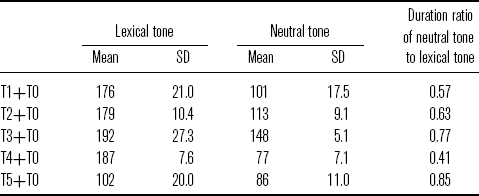
Neutral tone in Hefei Mandarin (Li Reference Li1997, Kong Reference Kong2006) mainly occurs in suffixes such as [tsɹ̩] 子 as in [pɔ31 tsɹ̩0] 包子 ‘steamed dumpling’ (‘dumpling ’+suffix). As a convention in the Chinese literature, a neutral tone is often represented as T0 to indicate its difference from the lexical tones. In Hefei Mandarin, the duration of a neutral tone is usually shorter than the duration of a normal lexical tone, except the checked Tone 5 (Kong Reference Kong2003, Reference Kong2006, Reference Kong2019). Table 11 reports the mean durations of tones in disyllabic sequences such as [pɔ31 tsɹ̩0] 包子 ‘steamed dumpling’, in which the initial tones are lexical tones and the second tones are neutral tones. The results were based on the measurements of six tokens for each tonal combination, all of which have the suffix [tsɹ̩] 子. As shown in Table 11, the neutral tone syllable is in general shorter than the initial lexical tone, including Tone 5 which is already shorter than the other four tones.
Mean durations of lexical tone and neutral tone in disyllabic sequences.

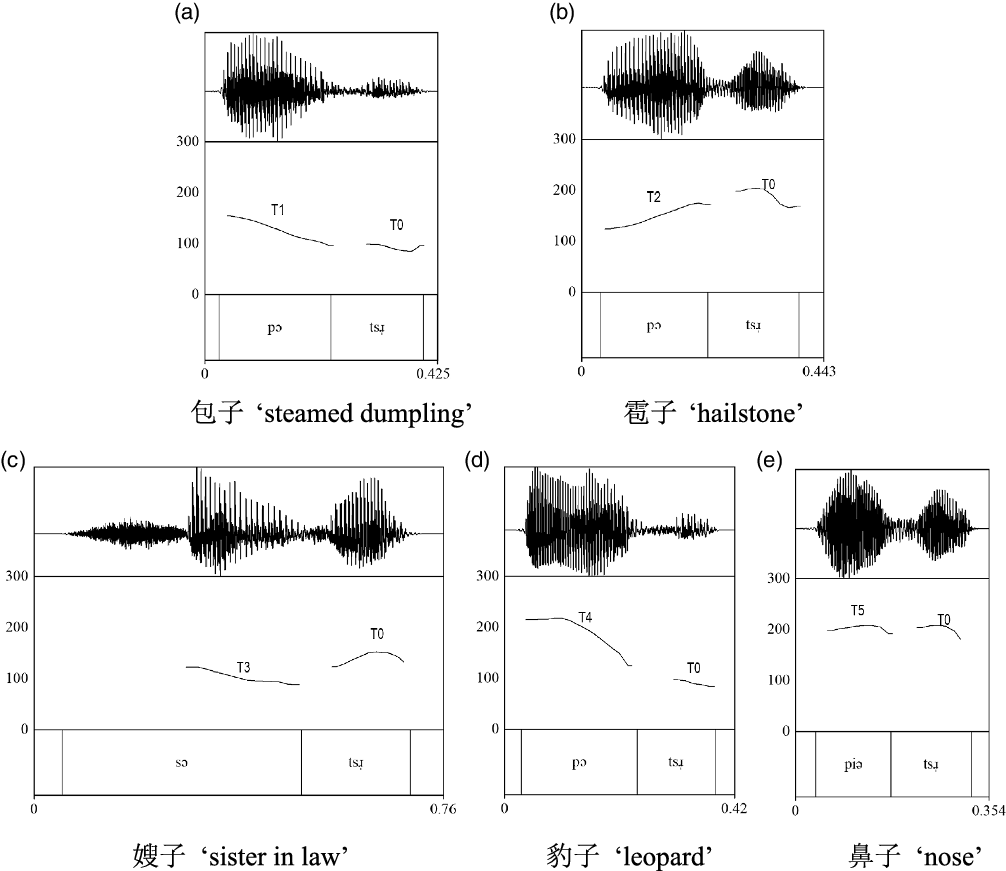
F0 contour of disyllabic sequences involving neutral tone in Hefei Mandarin.

The tonal target of neutral tone in Hefei Mandarin, as in disyllabic sequences, was reported to be relatively low when its preceding tone is Tone 1 and Tone 4, mid when its preceding tone is Tone 3, and relatively high when its preceding tone is Tone 2 and Tone 5 (Kong Reference Kong2003).Footnote 10 The production of neutral tone by the speaker in this study generally conforms with what was reported in the literature. Figure 13 gives examples of the f0 trajectories of disyllabic sequences with neutral tone as the second syllable. When the initial tone is Tone 1 (31) or Tone 4 (53), the neutral tone appears as low, as in [pɔ31 tsɹ̩0] 包子 ‘steamed dumpling’ (Figure 13(a)) and [pɔ53 tsɹ̩0] 豹子 ‘leopard’ (Figure 13(d)); when the initial tone is Tone 2 (24) or Tone 5 (4), the neutral tone surfaces as high, as in [pɔ24 tsɹ̩0] 雹子 ‘hailstone’ (Figure 13(b)) and [piə4 tsɹ̩0] 鼻子 ‘nose’ (Figure 13(e)).Footnote 11 In all these four cases, it seems that the neutral tone is an extension of the f0 contour of its preceding syllable, which is consistent with the description in Kong (Reference Kong2003). For the combination of Tone 3 and neutral tone (T3+T0), the production of the speaker showed that, as in Figure 13(c), the initial syllable surfaces as a mid-falling contour where the neutral tone hits a relatively high target. Considering the isolated form of Tone 3 as 213, it seems that the complex contour of Tone 3 is split between the two syllables in [sɔ21 tsɹ̩3] 嫂子 ‘sister in law’ (Figure 13(c)).
Transcription of the recorded passage
The transcription below is broad allophonic, i.e. with the segments transcribed phonemically and the sandhi tones transcribed as the phonetic forms. In the transcription below, line C includes the Chinese text, line B includes the broad allophonic transcription, and line T gives the English translation of the Chinese text. Tones are marked for individual syllables and, wherever applicable, sandhi tones are given in (). For syllables with a Tone 5, i.e. the checked tone, the glottalization associated with T5 is transcribed when present. The recorded passage includes some cases of lenition, presumably related to its nature as connected speech, for example, the lack of obvious closure in some affricates such as /ts/.
C: 北风跟日头
B: pɐ4 fəŋ31 kən31 ɹəʔ4 tʰɤ0
T: ‘The North Wind and the Sun’
C: 有回子北风跟日头在那奥子争论哈个本事大。
B: jɯ 213 xwi24 tsə0 | pɐ4 fəŋ31 kən31 ɹəʔ4 tʰɤ0 | tsɛ53 la53 ɔ53 tsə0 tsən31 lən53 | xa213 kə0 pən213 sɹ̩53 ta53||
T: Once, north wind and sun were there disputing whose ability is stronger
C: 争来争去,就是不分高低。第个时候,
B: ʦən31 lɛ24 ʦən31 tsʰɹ̩ʷ53 | tɕɯ53 ʃɻ̩53 pəʔ4 fən31 kɔ31(24) tsɹ̩31||ti53 kə0 ʃɻ̩24 xɤ53|
T: Arguing back and forth, there is no results who is stronger. At this time,
C: 来之一个走路的,他身上穿件厚大氅。
B: lɛ24 tʃə0 i31 kə0 tsɤ213 lɯ53 tə0||tʰa31 ʃən31 ʃã53 tʃʰwæ̃31 tɕĩ53 xɤ53 ta53 tʃʰɑ̃213||
T: there came a traveler, who were wearing a thick cloak.
C: 他们就讲好之,哈个能叫第个走路的
B: tʰa31 mən0 tɕɯ53 tɕɑ̃213(24) xɔ213 tʃə0||xa213 kə0 lən24 tɕɔ53 ti53 kə0 tsɤ213 lɯ53 tə0 |
T: They then agreed that whoever could let the traveler
C: 脱掉厚大氅,就算哈个的本事大。
B: tʰɐʔ4 tjɔ53 xɤ53 ta53 tʃʰɑ̃213 | tɕɯ53 sʊ̃53 xa213 kə0 tə0 pən213 sɹ̩53 ta53||
T: take off his cloak will be regarded as the stronger.
C: 北风就出劲吹将起来。哈晓得他吹的越凶,
B: pɐ4 fəŋ31 tɕɯ53 tʃuəʔ4 tɕin53 | tʃʰwi31 tɕɑ̃31 tsʰɹ̩213 lɛ24‖xa213 ɕɔ213 təʔ4 tʰa31 tʃʰwi31 tə0 yɐʔ4 ɕəŋ31 |
T: The north wind then blew with effort. As he did not know, the harder he blew,
C: 那个走路的就把大氅裹得越紧。
B: la53 kə0 tsɤ213 lɯ53 tə0 | tɕɯ53pa213ta53 tʃʰɑ̃213 ko213 təʔ4 yɐʔ4 tɕin213||
T: the closer the traveler wrapped himself in the cloak.
C: 后来北风没法子,只好就算之。
B: xɤ53 lɛ24 pɐ4 fəŋ31 məʔ4 fɐʔ4 tsɹ̩0 | tʃɻ̩213(24) xɔ213 tɕɯ53 sʊ̃53 tʃə0 ||
T: Later, the north wind had no way out, and he had to give up.
C: 过一霎,日头出来之。他热乎乎一晒,
B: ko53 i31 ʃɐʔ4 | ɹəʔ4 tʰɤ0 tʃʰuəʔ4 lɛ24 tʃə0‖tʰa31 ɹɐʔ4 xɯ31 xɯ31 i31 ʃɛ53|
T: After a while, the sun came out. He warmly shone for a while
C: 那个走路的跟着就把厚大氅脱的之。
B: la53 kə0 tsɤ213 lɯ53 tə0 | kən31 tʃə0 tɕɯ53 pa213 xɤ53 ta53 tʃʰɑ̃213 tʰɐʔ4 tə0 tʃə0‖
T: The traveler then took off his thick cloak
C: 第会子北风只好承认,
B: ti53 xwi31 tsɹ̩0 | pɐ4 fəŋ31 tʃɻ̩213(24) xɔ213 tʃʰən24 ɹən53 |
T: At this time, the north wind has to admit that,
C: 他两个当中还是日头本事大。
B: tʰa31 ljɑ̃213 kə0 tɑ̃31(24) tʃəŋ31 | xɛ24 ʃɻ̩53 ɹəʔ4 tʰɤ0 pən213 sɹ̩53 ta53||
T: among them, the sun is the stronger one.
Acknowledgments
The authors would like to thank Prof. Yi Xu, Prof. Xiujuan Shi, and Dr. Ruixin Sun for their valuable suggestions. We are greatly indebted to the anonymous reviewers and the editors of Journal of the International Phonetic Association, whose comments have led to great improvement of this research. The research is partly supported by Philosophical and Social Science Grant of Anhui Province (Grant No. AHSKY2019D099), Key Humanity and Social Science Project of Anhui Education Commission (Grant No. SK2019A0668), Hong Kong Baptist University Faculty Research Grant (FRG) Category II [Grant No. FRG2/17-18/076], and Hong Kong Baptist University Research Committee’s Start-up Grant for New Academics.
Supplementary material
To view supplementary material for this article, please visit https://doi.org/10.1017/S0025100322000081.
 [An OT analysis of neutral tone in three dialects].