In a recent review of neurocognitive and psycholinguistic studies of native language comprehension, Marslen-Wilson (Reference Marslen-Wilson and Gaskel2007) concluded that the decomposition of morphologically complex words is “one of the highest priorities” (p. 189) of the system. Morphological decomposition is an early process that attempts to identify possible stems, affixes, and other elements of morphological structure as soon as orthographic or phonological information starts to accumulate. Although irregular forms are typically represented and processed as undecomposable whole forms, decomposition applies to regular forms that, due to their morphological structure, do not “participate in language comprehension as whole forms but rather as bearers of inflectional morphemes and of stem morphemes” (Marslen-Wilson, p. 189).
This study examines the processing and representation of morphologically complex words in a nonnative language. We compare adult (so-called late) learners who acquired a language as a second language (L2) around or after puberty with adults who acquired the same language as a first language (L1) from birth. The background for this study is the question of how nonnative language processing differs from native language processing. Current views on this question are controversial (see Clahsen & Felser, Reference Clahsen and Felser2006a). Some researchers (Clahsen & Felser, Reference Clahsen and Felser2006a, Reference Clahsen and Felser2006b; Ullman, Reference Ullman and Sanz2005) have argued that, in particular domains of grammar, adult L2 processing is unlike L1 processing, even in L2 learners who achieve high scores in general proficiency tests. With respect to sentence processing, Clahsen and Felser (Reference Clahsen and Felser2006a) proposed that during online processing, adult L2 learners make less use of syntactic structure and abstract syntactic elements (e.g., movement traces) than native speakers and, instead, rely more on lexico-semantic information, associative patterns, and other surface cues for interpretation. A similar proposal came from Ullman (Reference Ullman2004, Reference Ullman and Sanz2005). For L1 processing, two brain memory systems are distinguished: a declarative system that subserves the storage of memorized words and phrases (and is rooted in a network of specific brain structures that include medial temporal and prefrontal cortical regions) and a procedural system that is involved in processing combinatorial rules of language (and that depends on a network that includes inferior frontal brain areas). Ullman (Reference Ullman and Sanz2005) argued that, due to maturational changes in childhood that lead to the attenuation of the procedural and to the enhancement of the declarative brain memory system, L2 processing is largely dependent on the lexical memory system, whereas reliance on the procedural system occurs to a much lesser extent than in L1 processing. Consequently, morphological computation (which engages the procedural brain system) should be underused or even absent in adult L2 processing. In contrast to these proposals, other researchers (e.g., McDonald, Reference McDonald2006; Perani & Abutalebi, Reference Perani and Abutalebi2005) have argued that L2 processing relies on the same mechanisms as L1 processing but that L2 processing may be slower, more effortful, and less automatized than in native speakers. Thus, from this perspective, L1-L2 performance differences should be attributable to general factors such as slower processing speed and working-memory limitations and should not be restricted to particular domains of language or grammar.
There is some evidence from previous studies that suggests that L1 and L2 morphological processing differ along the lines proposed by Ullman (Reference Ullman and Sanz2005). In a speeded production task on English past tense forms, Ullman, Babcock, Stowe, and Brovetto (2008) found that frequency effects showed a different pattern between regular and irregular verb forms in L1 speakers of English and two groups of L2 speakers (with Chinese or Spanish as their L1). Whereas for the L1 speakers, the magnitude of frequency effects was significantly greater for irregular than for regular verb forms, in the L2 data the frequency effect was similar for regular or irregular verb forms. Ullman et al. interpreted these results as evidence for a greater reliance on memorization of inflected forms (which include regular verb forms) in the L2 than in the L1. Another study (Silva & Clahsen, Reference Silva and Clahsen2008) revealed priming effects for regular inflection and for derived word forms of English in the L1,Footnote 1 but no priming effects for inflected word forms in L2 learners (with Chinese, Japanese, or German as the L1), and reduced effects for derived words in Chinese and German L2 learners of English, which suggests that L2 learners rely less on combinatorial processing than native speakers. Other studies, however, did not find any such L1-L2 differences in processing inflected words—for instance in the production times (Beck, Reference Beck1997; Lalleman, van Santen, & van Heuven, Reference Lalleman, van Santen and van Heuven1997) or in the priming patterns of regularly inflected word forms (Basnight-Brown, Chen, Hua, Kostić, & Feldman, 2007)—and concluded that adult L2 learners process morphologically complex words in the same way as native speakers. The empirical picture from previous studies is fragmentary and inconclusive. More L2 processing research of different morphological systems and of different languages is needed.
A better understanding of L2 morphological processing may also be achieved by adopting theoretical notions from previous psycholinguistic research. An important distinction is made in models of the mental lexicon (see, e.g., Marslen-Wilson, Tyler, Waksler, & Older, Reference Marslen-Wilson, Tyler, Waksler and Older1994) between access representations, which are modality-specific (e.g., visual or auditory recognition) and encode form-level (orthographic or phonological) information, and central lexical entries, which are modality independent and incorporate abstract phonological as well as morphological, syntactic, and semantic information. For example, consider the results from priming studies of derivational forms in native speakers of English (see Marslen-Wilson, Reference Marslen-Wilson and Gaskel2007): In crossmodal priming tasks in which primes and targets are presented in different modalities (i.e., auditory primes and visual targets), only semantically transparent pairs (e.g., calmness-calm) but not semantically opaque pairs (e.g., department-depart) produced robust priming effects. By contrast, in visual masked priming in which primes and targets are both presented visually and the prime is only shown very briefly, priming effects were found for both semantically transparent and opaque prime-target pairs. These contrasts have been taken to indicate that visual masked priming taps an early stage of lexical processing in which formal (orthographic or phonological) access representations (i.e., lexemes) are activated, whereas crossmodal priming is based on abstract representations (i.e., lemmas) in the central lexicon, a level at which, for example, department and depart have separate lexical entries due to their different semantic properties (Marslen-Wilson). Given the distinction between access and central representations, three interdependent processes in comprehending an inflected word can be distinguished: (a) segmentation of the original form, (b) form-level access, and (c) retrieval of lexical entries; at each level, the morphological structure of an inflected word may or may not play a role.
This study presents a detailed examination of one system of German inflection, past participle formation, in groups of L1 speakers and advanced adult L2 learners. Three different experimental techniques were employed: (a) acceptability judgments, to determine preferences for regular and irregular forms of noncanonical words; (b) unprimed visual lexical decision, to examine modality-specific access representations; and (c) masked priming, to determine whether participle forms are morphologically decomposed during early word recognition.
BACKGROUND
Here, the linguistic properties of participle formation in German are briefly outlined, some background on participle formation in Polish—the L2 participants’ L1—is provided, and previous psycholinguistic findings on German participles are summarized.
Participle Formation in German
Regular participles are suffixed with –t and do not exhibit any stem changes, as illustrated in (1a). Irregular or strong verbs have the ending –n and sometimes undergo (phonologically unpredictable) stem changes, as shown in (1b). Additionally, several minor classes can be distinguished—for example, the so-called A‑B‑A subclass of strong verbs that have stem changes in the past tense but not for participles, as illustrated in (1c). Moreover, both regular and irregular participles often carry the prefix ge–, which is prosodically determined and occurs whenever the stem is stressed on the first syllable, as illustrated in (1c); the prefix is not inserted when the stress occurs on another syllable, as illustrated in (1d); see Clahsen (Reference Clahsen1999) for a more detailed description, including frequency information.
Infinitive Simple past Past participle
a. kaufen kaufte gekauft
“to buy” “bought” “bought”
b. gehen ging gegangen
“to go” “went” “gone”
c. lau’fen lief gelaufen
“to run” “ran” “run”
d. verlau’fen verlief verlaufen
“go astray” “went astray” “gone astray”
(1)
Whereas both –t and –n participles have segmentable endings, the –t participle suffix is highly productive and, like the English past tense suffix –ed, readily applies to novel verbs (Clahsen, Reference Clahsen, Booij and van Marle1997), irrespective of whether they are similar to existing verbs. By contrast, verbs that take –n participles represent a lexically restricted closed class of items, and –n participle formation only generalizes to novel words that are similar to existing strong verbs (Clahsen). Consequently, Wunderlich and Fabri (Reference Wunderlich and Fabri1995) proposed a linguistic analysis of German in which –t participles are formed by the affixation rule in (2a) and –n participles such as (1d) constitute subentries of a restricted set of lexical templates as illustrated in (2b).Footnote 2
a. /–t/ [+Verb] → [ ]+part
b. [[verlauf-]en]+part “gone astray”
(2)
The rule in (2a) applies to any element of the syntactic category [+Verb], irrespective of its phonological or semantic properties, and computes a corresponding participle form as its output. It is thus the default process of participle formation in German. The rule is blocked by –n participle forms, which have internally structured lexical entries such as the one in (2b).
Participles in Polish
In Polish, the perfective passive participle endings are –n, –on, and –t, which precede any person, number, or gender suffixes (Feldstein, Reference Feldstein2001).
Infinitive Past 3sg masc Past participle
a. czyta-ć czyta-ł czyta-n-y “read 1sg masc”
b. zrobi-ć zrobi-ł zrobi-on-y “done”
c. zdją-ć zdją-ł zdję-t-y “taken off”
(3)
Verbs with stems ending in –a(j) or –e(j) have –n participles as illustrated in (3a). Verbs of the second conjugation have –on participle forms as in (3b). The –t suffix is selected by stems that end in a sonorant consonant or nasal vowel as in (3c). Thus, although both Polish and German have –t and –n participle forms, their distribution is clearly different. In Polish, the selection of one of these suffixes depends on conjugation class and on phonological properties of the stem. In German, –n participles are lexically restricted to a limited number of irregular verbs, and the –t suffix is an overall default, much like the past tense suffix –ed in English.
Previous Psycholinguistic Research on German Participles
Much previous experimental research on adult and child native speakers of German has shown differences between –t and –n participles consistent with the idea that the former are rule based and the latter are stored in lexical entries (see Clahsen, Reference Clahsen1999). In German child language, for example, the participle –t is overapplied to irregular verbs, whereas overapplications of the participle –n to regular verbs are practically nonexistent (Clahsen & Rothweiler, Reference Clahsen, Rothweiler, Booij and van Marle1993). Online data from children’s spoken production of participles in a speeded production task also revealed contrasts between regular and irregular forms (Clahsen, Hadler, & Weyerts, Reference Clahsen, Hadler and Weyerts2004). High-frequency –n participles were produced faster than low-frequency ones, whereas there was no corresponding advantage for high-frequency –t participles, which indicates that both child and adult L1 speakers directly retrieve –n (but not –t) participle forms from memory.
Turning to L2 processing of German participles, we are aware of just one previous study (Hahne, Mueller, & Clahsen, Reference Hahne, Mueller and Clahsen2006) that examined event-related brain potentials (ERPs) to morphological violations in a group of advanced adult learners with Russian as their L1 and a control group of German native speakers. Hahne et al. found that an incorrect participle form in which the irregular –n was exchanged with the regular –t (e.g., *gelauft instead of gelaufen “run”) produced similar ERP effects in both participant groups—namely, a left anterior negativity in the L1 and a bilateral anterior negativity plus a later parietal positivity (P600) in the L2 group. These ERP effects are thought to be characteristic of morphosyntactic violations, such as incorrect subject-verb agreement and gender or tense marking (see Friederici, Reference Friederici2002). In the interpretation of their results, Hahne et al. thus argued that a form like *gelauft “run” represents a case in which an irregular verb failed to block the general –t suffixation process. Although the similarities in the L1 and the L2 groups’ ERPs indicate that advanced L2 learners are sensitive to incorrect participle forms of irregular verbs, Hahne et al.’s study leaves open the question of whether L2 learners process grammatically well-formed regular and irregular participle forms in the same way as native speakers.
THE PRESENT STUDY
Three experiments tested a total of 106 adults: 40 L2 learners of German with Polish as their L1 (mean age = 24;0, SD = 2;9) and 66 German native speakers (mean age = 27;7, SD = 5;3). All L2 participants were current university students in Germany and all L1 participants were current or former university students. The L2 participants had first been exposed to German in a classroom setting in Poland. Their mean age of first exposure to German was 14;6 (SD = 2;7), and none of them had learned German before the age of 10 or considered themselves bilingual. They had all been living in Germany at the time of testing, with a mean of 2;9 years (SD = 2;2). To determine their L2 proficiency in German at the time of testing, all L2 participants completed the Goethe Institute placement test (http://www.goethe.de/dll/prf/bes/deindex.htm). They achieved a mean proficiency score of 25.5 (SD = 3.1) out of a maximum score of 30, which puts them in the highest level of so-called competent language users. All participants had normal or corrected-to-normal vision, were never diagnosed with any learning or other behavioral disorders, and were naïve with respect to the purpose of the experiments. They were paid a small fee for their participation. Most participants took part in more than one experiment, including experiments on other linguistic phenomena. The experiments were divided such that each participant performed only one of the three participle experiments per session.
ACCEPTABILITY JUDGMENT
This experiment investigated whether L2 learners rely on morphological structure when rating regular and irregular participle forms of unusual noncanonical words. The phenomenon we examined is the inflection of denominal verbs. In such cases, native speakers tend to prefer regular inflection irrespective of a word’s phonological properties. In English, it is possible to say He flied the board in the sense of putting flies onto the board; similarly, in German, it is possible to say Er hat das Brett befliegt “He flied the board,” despite the fact that both languages have homophonous verbs with irregular past tense or participle forms (to fly-flew, befliegen-beflogen).
One proposal to account for this phenomenon is that derived words prefer regular forms to ensure the distinctness from words with different meanings (Ramscar, Reference Ramscar2002). Thus, one can say Der Keller war total verspinnt “The cellar was completely spidered” to distinguish it from Sie hat die Wolle gesponnen “She has spun the wool.” Nonetheless, this phenomenon known as “semantic stretching” (Pinker, Reference Pinker1999, p. 150)—that is, an extended or metaphorical meaning given to a verb—does not necessarily lead to distinct forms of the verb. Indeed, there are many cases in which an irregular word is semantically stretched and still maintains its irregular form. The verb spinnen, for example, can also mean “to go nuts,” and the participle form is still irregular (Sie hat gesponnen “she went nuts”) even though this sense does not have much to do with the spinning of wool. Experimental studies have also confirmed that semantic factors are insufficient to explain the preference for regular inflection of derived word forms (Bandi-Rao & Murphy, Reference Bandi-Rao and Murphy2007; Gordon & Miozzo, Reference Gordon and Miozzo2008; Huang & Pinker, Reference Huang and Pinker2008).
A more promising account of a derived word’s preference for regular inflection is in terms of its grammatical structure. Derived words may either be conceived of as headless (or exocentric) or headed by a derivational affix (e.g., be– in German or de– in English, as in de-ice) that determines the word’s category (Selkirk, Reference Selkirk1982; Wunderlich, Reference Wunderlich1986). The fact that some verbs have irregular forms is a property of verb roots, but, due to the structure of derived words, verb root information is not accessible in a denominal verb. Consequently, irregular forms of denominal verbs sound odd. In contrast, the English past tense –ed and the German participle –t apply by default to any kind of verb unless blocked by an irregular form. As verb root information is not available for denominal verbs, the rule applies and regularly inflected forms are preferred in such cases.
There is evidence that child and adult native speakers of English prefer –ed past tense forms for denominal verbs (Clahsen & Almazan, Reference Clahsen and Almazan1998; Clahsen, Ring, & Temple, Reference Clahsen, Ring, Temple, Bartke and Siegmueller2004; Kim, Marcus, Hollander, & Pinker, Reference Kim, Marcus, Hollander and Pinker1991; Kim, Marcus, Pinker, Hollander, & Coppola, Reference Kim, Marcus, Pinker, Hollander and Coppola1994; Oetting & Horohov, Reference Oetting and Horohov1997). Similarly, Marcus, Brinkmann, Clahsen, Wiese, and Pinker (Reference Marcus, Brinkmann, Clahsen, Wiese and Pinker1995) found that adult native speakers of German judged –t participles of novel denominal verbs as significantly better than –n participles, even though the items were homophonous to existing irregular verbs. Semantically stretched irregular verbs, however, were still judged as better with –n than with –t participles.
For the present study, we used a modified version of Marcus et al.’s (1995) experiment. For the L1 group, we expected to replicate Marcus et al.’s findings. If L2 learners’ judgments are sensitive to morphological structure in the same way as native speakers, –t participles are expected to be preferred for denominal verbs and –n participles for underived verbs with irregular verb roots. If, on the other hand, L2 learners are insensitive to morphological structure, then all verbs that are homophonous with existing irregular verbs should have –n participles, irrespective of whether they are derived or underived.
Method
Participants. Of the pool of 106 participants, 26 L1 (mean age = 29;9, SD = 6;6; 15 males) and 34 L2 participants (mean age = 24;2, SD = 3;0; 11 males) took part in this experiment. The L2 learners had spent a mean of 3;1 years in Germany, their mean age of first exposure to German was 14;4 years, and their mean proficiency score was 26.1.
Materials. We selected 15 critical items that, when used denominally, are homophonous to verbs that take irregular participles (see Appendix A for a complete list). These were combined with 15 filler items, which consisted of verbs whose participle form ends with either –t or –n. Each of the 30 items consisted of a context paragraph and two test sentences. In the denominal condition, the context paragraph introduced a critical item as a noun, as illustrated in (4a), and in the verb root condition, the context paragraph introduced a critical item as a verb with a semantically extended meaning, as shown in (4b). The context paragraphs for the filler items presented verbs with their most common meaning. Each context paragraph was followed by two test sentences containing –t and –n participle forms of the critical or filler items; the test sentences were otherwise identical. There were four counterbalanced versions such that an individual participant saw a given verb either as a semantically extended verb root or as a denominal verb. Context paragraphs that contained critical and filler items were presented in a pseudorandomized order. The order of the two sentences was also counterbalanced such that each participant received half of the test sentences with the –t participle before those with the ‑n participle, and the other half was in the opposite order. Participants were asked to carefully read the context paragraphs and then to rate the naturalness of the two participle forms on a 5-point scale, with 1 corresponding to “very unnatural” and 5 corresponding to “very natural.” To ensure that the 15 critical verbs were familiar to the L2 participants, a multiple-choice vocabulary test was performed after the main experiment. Participants indicated which of three sentences correctly described the standard meaning of a given item. The L2 learners achieved a high accuracy mean score of 97.5% in this test. Items for which an incorrect response was given in the vocabulary test were excluded from further analysis.
a. Denominal condition (scenario based on der Wachs “the wax”):
Da Susi sehr gerne abends bei Kerzenschein sitzt, hat sie sehr viele Kerzen in ihrem Zimmer. Leider tropft das weiche Wachs der Kerzen immer auf die schönen Kerzenständer. Deshalb sind viele von Susis Kerzenständern schon ziemlich verwachst / verwachsen.
“Since Susi loves to sit by the candle-light, she has many candles in her room. Unfortunately, the melted wax of the candles always drops down onto the pretty candle holders. That’s why many of Susi’s candle holders are already quite waxed/waxen.”
b. Verb root condition (scenario based on wachsen “to grow”):
Die Pflanzen in Bernds Garten scheinen sehr schnell zu wachsen. Die letzten zwei Wochen war Bernd im Urlaub. Jetzt ist er gerade von seiner Reise zurückgekommen und muss entsetzt feststellen: Sein Garten ist total verwachsen / verwachst.
“The plants in Bernd’s garden seem to grow very fast. Bernd was on holiday for the last two weeks. He has just now returned from this trip and discovered: His garden is completely grown/growed.”
(4)
Results
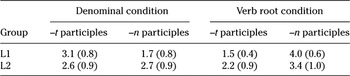
Table 1 presents mean acceptability ratings and standard deviations. A repeated measures ANOVA revealed a three-way interaction of condition (denominal, extended), participle form (–t, –n), and group (L1, L2), F 1(1, 58) = 47.04, p < .001; F 2(1, 14) = 102.07, p < .001, which indicates different preferences in the two conditions for the two participant groups. Planned comparisons showed that, in the denominal condition, the L1 group judged –t participles significantly better than the –n participles, t 1(25) = 5.18, p < .001; t 2(14) = 6.84, p < .001, and in the verb root condition, it was the opposite, t 1(25) = 18.88, p < .001; t 2(14) = 11.37, p < .001. The L2 learners exhibited a significant preference for –n participles in the verb root condition, t 1(33) = 4.27, p < .001; t 2(14) = 4.54, p < .001, and no preference in the denominal condition, t 1(33) = 0.37, p = .715; t 2(14) = 0.22, p = .829. The L1 participants rated all 15 denominal items as better in the –t participle versions and all 15 extended items as better in the –n participle versions. This preference for extended items to take the suffix –n was also present in the L2 group, which judged 12 of 15 extended items as better in the –n participle version. In contrast, for denominal items, there was no preference: Seven items were judged as better with –t and eight items were judged as better with –n participles.
Mean acceptability ratings by condition and group

Note
The SDs are in parentheses.
The results for the L1 group are parallel to those of Marcus et al. (Reference Marcus, Brinkmann, Clahsen, Wiese and Pinker1995). In the verb root condition, L1 speakers preferred –n participles, even though verb meanings were semantically stretched. Presenting the same forms as denominal verbs, however, reversed L1 participants’ preferences, with –t participles now rated as more natural. Thus, morphological structure, not mere semantic extendedness, caused the reversal of the usual preferences. The L2 learners also showed a clear preference for –n participles in the verb root condition, but unlike the L1 group, the denominal condition did not reverse their ratings. The reduced –n participle ratings in the denominal condition suggest that the L2 learners were not altogether blind to morphological structure but that the effect was simply not strong enough to reverse the usual preferences. It is possible that L2 learners do not show any preference in the denominal condition because their inflectional systems are more probabilistic than those of native speakers and because their performance in this experiment was the result of two competing factors—phonological associations favoring –n and grammatical properties favoring –t participle forms—that canceled each other out. Although this remains speculative, it seems clear that advanced L2 learners’ acceptability judgments are less affected by the morphological structure of an inflected word than native speakers’ acceptability judgments are.
VISUAL LEXICAL DECISION
The purpose of this experiment was to examine the kinds of representations L2 learners consult in recognizing morphologically complex words during reading. In word-recognition research, modality-specific access representations are assumed to mediate the mapping from the orthographic or spoken input onto lexical representations in the central lexicon (see, e.g., Marslen-Wilson et al., Reference Marslen-Wilson, Tyler, Waksler and Older1994). Much evidence from L1 processing research on lexical access of morphologically complex words comes from the investigation of frequency effects in the lexical decision task. Response times (RTs) in this task are sensitive to frequency and are generally shorter for high- than for low-frequency words. This is interpreted as a storage effect in that memory traces become stronger with additional exposure.
The present experiment used a modified version of one of the lexical decision experiments from Clahsen, Eisenbeiss, and Sonnenstuhl (Reference Clahsen, Eisenbeiss and Sonnenstuhl1997), which yielded a clear contrast between regular and irregular participles for native speakers: shorter RTs for high-frequency forms than for low-frequency forms with irregular (but not regular) participles. If lexical access to inflected words is the same in a L2 as in the L1, we should be able to replicate Clahsen et al.’s results and find that, in both participant groups, RTs for regular and irregular forms are differently affected by frequency contrasts. If, on the other hand, L2 learners rely more on lexical storage than native speakers, we would expect frequency effects for both regular and irregular participles in the L2, but not in the L1.
Method
Participants. Thirty L1 speakers (mean age = 28;8, SD = 5;8; 15 males) and 31 L2 learners (mean age = 24;3, SD = 3;1; 9 males) participated. The L2 learners had spent a mean of 3;1 years in Germany, their mean age of first exposure to German was 14;5, and their mean proficiency score was 26.3.
Materials. The whole stimulus set consisted of 270 items, equally divided between novel and existing words. There were 36 critical verbs selected from the CELEX database (Baayen, Piepenbrock, & van Rijn, Reference Baayen, Piepenbrock and van Rijn1993): 18 that take regular –t participles and 18 irregular verbs of the A-B-A subclass that take –n participles.Footnote 3 These two verb groups were further divided into two subgroups of nine items each according to their participle frequency: a high-frequency group (with a mean participle frequency of 394 in CELEX for both –t and –n participles) and a low-frequency group (with a mean frequency of 63 for the irregular participles and 62 for the regular participles). In each of the two frequency conditions, the regular and irregular participles had similar stem frequencies. In the high-frequency conditions, the mean stem frequencies were 1,281 for the irregular verbs and 1,592 for the regular verbs, and in the low-frequency conditions, the mean stem frequencies were 142 for the irregular verbs and 173 for the regular verbs. The participle forms were also similar in terms of length. In the high-frequency conditions, the mean number of letters was 8.1 for –n participles and 7.3 for –t participles, and in the low-frequency conditions, the mean number of letters was 8.3 for –n participles and 7.6 for –t participles. Appendix B provides the complete list of critical items. To prevent participants from developing expectations during the experiment, 234 filler items were added. The list of filler items included 135 novel words and 99 existing words (50 nouns, 35 adjectives, 14 participle forms of weak and strong verbs with different vowel alternation—or ablaut—patterns). The experimental and filler items were presented in a pseudorandomized order to ensure that no semantic association existed between consecutive items and that there were not more than two novel or existing words in a row.
Procedure, Data Scoring, and Analysis. Each trial started with a fixation point in the middle of the screen followed, after 600 ms, by the stimulus in the same position. The stimulus remained on screen either until a response button was pressed or disappeared after 2,000 ms if no response was given. The next trial was initiated 1,200 ms after the response or time-out. The stimuli were presented in Arial 28 point on a 14-in. monitor in white letters on a black background. Participants were instructed to decide whether a given letter string was a real German word and to press the appropriate yes (for existing words) or no (for nonwords) button on a dual push-button box. They were asked to answer as quickly and as accurately as possible. The experiment began with a short practice session that consisted of 10 trials. The presentation of the stimuli and the measurement of RTs were controlled by the new experimental setup (NESU) software package (Baumann, Nagengast, & Klaas, Reference Baumann, Nagengast and Klaas1993). The experiment was performed in a dedicated quiet room and lasted for approximately 20 min. Before the experiment, participants were given detailed instructions about the task. After the experiment, all L2 participants took a vocabulary test to ensure that they knew the meanings of the critical items tested in the lexical decision task. In this test, participants were asked to provide synonyms or paraphrases of the meanings of all 36 critical verbs. The test confirmed that all critical verbs were familiar to the L2 participants.
The data of one L1 participant were not further analyzed because, for this participant, lexical decision times were extremely slow, with an overall mean RT of 1,121 ms, which was more than two standard deviations longer than those of the remaining L1 participants (mean = 731 ms; SD = 186). Prior to the calculation of lexical decision times, incorrect responses (i.e., nonword responses to existing words and word responses to nonwords) and extreme reaction times that exceeded two standard deviations from a participant’s mean per condition were excluded from further analysis. This resulted in the removal of 2.2% of the L1 speakers’ responses and 2.5% of the L2 learners’ responses to critical items due to errors and of another 5.1% of the L1 speakers’ data and 4.1% of the L2 learners’ data due to extreme reaction times. The error data and the RTs were then submitted to repeated measures ANOVAs with the variables participle form (–t, –n), frequency (high, low), and group (L1, L2). In the analysis by subjects (F 1), frequency and participle form were treated as within-subjects factors and group was treated as a between-subjects factor. In the analysis by items (F 2), group was a within-subjects factor and frequency and participle form were between-subjects factors.
Results
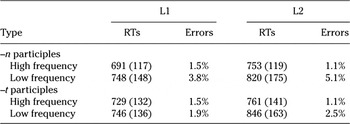
Overall RT means, standard deviations, and error rates are provided in Table 2. The error data revealed a main effect of frequency in the subjects analysis, F 1(1, 58) = 10.72, p < .05; F 2(1, 32) = 2.56, p = .119, which reflects higher error rates for the low-frequency conditions in both participant groups. There were no further significant main effects or interactions.
Mean RTs (in ms) and error rates by group, participle type, and frequency

Note
The SDs are in parentheses.
The RT data showed an interaction of participle form, frequency, and group that was significant in the subjects and marginally significant in the items analysis, F 1(1, 58) = 4.05, p < .05; F 2(1, 32) = 3.43, p = .073. Additionally, there was an interaction of frequency and group, F 1(1,58) = 5.87, p < .05; F 2(1, 32) = 5.29, p < .05, as well as main effects of frequency, F 1(1, 58) = 48.75, p < .001; F 2(1, 32) = 10.02, p < .005, and group, F 1(1, 58) = 3.87, p = .054; F 2(1, 32) = 61.16, p < .001. Planned comparisons showed a selective frequency effect in the L1 group, significantly shorter RTs for high- than for low-frequency –n participles, t 1(28) = 4.20, p < .001; t 2(8) = 4.48, p < .005, and no significant difference for –t participles, t 1(28) = 1.67, p = .107; t 2(8) = 1.11, p = .298. By contrast, the L2 learners had an overall effect of frequency—significantly shorter RTs for high-frequency forms of both –n, t 1(30) = 3.37, p < .005; t 2(8) = 4.59, p < .005, and –t participles, t 1(30) = 5.57, p < .001; t 2(8) = 4.71, p < .005.
Table 2 shows that the L2 learners’ RTs in this experiment were, on average, 70 ms longer than those of the native speakers across conditions. To examine whether this L1-L2 contrast is due to differences in speed of processing, we performed the same analysis on a subgroup of 21 L2 participants who were closely matched to the L1 group in terms of mean RTs across conditions: 730 ms (SD = 186) for the L1 group and 726 ms (SD = 180) for the fast L2 subgroup. The results were parallel to those that included all participants. Again, the L2 learners had significantly shorter RTs for high- than for low-frequency items in both conditions: –t participles (with mean RTs of 692 ms and 781 ms for high- and low-frequency participles, respectively), t 1(20) = 4.43, p < .001; t 2(8) = 4.38, p < .05, and –n participles (with mean RTs of 698 ms and 734 ms for high- and low-frequency participles, respectively), t 1(20) = 2.1, p < .05; t 2(8) = 2.45, p < .05. Thus, the contrast between a selective frequency effect in the L1 and an overall frequency effect in the L2 is unlikely to be due to differences in speed of processing.
An additional analysis was motivated by the hypothesis (Ullman, Reference Ullman2004) that women, even in their L1, rely more on the declarative memory system than men. Thus, the more widespread frequency effect we found in the L2 group could be due to the fact that there were more women in the L2 than in the L1 group (22 vs. 15, respectively). To examine this possibility, we performed the same analysis for the female participants only. The results were nevertheless parallel to those of the L1 and L2 groups as a whole. The female L2 learners showed an overall advantage for high-frequency forms in both conditions: –t participles (with mean RTs of 776 ms and 863 ms for high- and low-frequency participles, respectively), t 1(21) = 4.91, p < .001; t 2(8) = 3.02, p < .05, and –n participles (with mean RTs of 757 ms and 842 ms for high- and low-frequency participles, respectively), t 1(21) = 3.73, p < .05; t 2(8) = 2.29, p = .051. By contrast, the female L1 participants had the same selective frequency effect as the L1 group as a whole, with shorter RTs for high- than for low-frequency –n participles (with mean RTs of 675 ms and 755 ms for high- and low-frequency participles, respectively), t 1(14) = 4.19, p < .05; t 2(8) = 2.80, p < .05, and no significant advantage for high-frequency –t participles (with mean RTs of 725 ms and 743 ms for high- and low-frequency participles, respectively), t 1(14) = 1.09, p = .295; t 2(8) = 0.99, p = .354. This shows that the L1-L2 contrast we found cannot be reduced to gender differences. Instead, these results suggest that L2 learners rely more on stored representations for inflected words during lexical access than native speakers.
It should be pointed out, however, that the interpretation of frequency effects in the lexical decision task has increasingly become open to question in the L1 processing literature. Differences in lexical decision times are not simply due to frequency contrasts but have been shown to be affected by properties of the affixes involved (see, e.g., Järvikivi, Bertram, & Niemi, Reference Järvikivi, Bertram and Niemi2006). Furthermore, although lexical decision experiments may reveal frequency effects for regular and irregular word forms, other experimental techniques produced different response patterns for these forms (e.g., Sonnenstuhl & Huth, Reference Sonnenstuhl and Huth2002). From a theoretical perspective, frequency effects in lexical decision have been argued to be consistent with both a decompositional model of lexical access (Taft, Reference Taft2004) and the kinds of single-mechanism connectionist models (Davis, van Casteren, & Marslen-Wilson, Reference Davis, van Casteren, Marslen-Wilson, Baayen and Schreuder2003) that do not distinguish between storage and decomposition. For these reasons, results from lexical decision tasks should be supplemented by evidence from other techniques (e.g., priming studies).
MASKED PRIMING
This experiment investigated the role of morphological decomposition in L2 processing. In masked priming, a prime word is briefly presented (commonly with a stimulus onset asynchrony [SOA] of 30–80 ms) between a forward mask (i.e., a series of Xs) and a target word in response to which a lexical decision is made. The short SOAs do not usually allow participants to consciously recognize the prime and they reduce the possibility of episodic memory effects or of any predictive strategies, such as participants realizing that primes and targets often share common material. Potential priming effects are determined by comparing the mean RTs to the target word (e.g., drive) in the critical (test) prime-target pairs (e.g., driver-drive) with the mean RTs to the same target word in an unrelated condition (trainer-drive) and, in some studies, with the mean RTs to the target word in an identity condition (drive-drive). These two baseline conditions (i.e., unrelated and identity) reflect the minimum and maximum amount of facilitation or priming for a given lexical item. We will refer to a pattern in which there are no differences between test and identity and in which both conditions have shorter RTs than in the unrelated condition as full priming. If RTs following the test prime are shorter than in the unrelated but longer than in the identity condition, this will be referred to as partial or reduced priming. Finally, if RTs in the test condition are similar to those of the unrelated condition, this will be referred to as no priming.
Previous studies that used this technique with L1 speakers found priming effects for inflected and derived word forms in different languages that were independent of the activation of semantic information and beyond pure orthographic priming (see Marslen-Wilson, Reference Marslen-Wilson and Gaskel2007). Marslen-Wilson, Bozic, and Randall (Reference Marslen-Wilson, Bozic and Randall2008), for example, found the same priming effects for prime-target pairs that had a semantically transparent relation (bravely-brave), pairs that were weakly related in meaning (barely-bare), and pairs that were semantically opaque (archer-arch). Moreover, semantically unrelated prime-target pairs such as corner-corn in which the prime contained a pseudoaffix (–er) produced facilitation effects similar to those of truly related prime-target pairs such as driver-drive, whereas prime-target pairs such as brothel-broth, in which the segment –el is not an affix in English did not produce any priming (Rastle, Davis, & New, Reference Rastle, Davis and New2004). These results have been taken to indicate that masked priming taps morphological decomposition processes during an early form-based level of representation of the prime word.
Here, the critical (test) primes were either –t participles (e.g., geöffnet “opened”) or –n participles of A-B-A verbs (e.g., gelaufen “run”), and the targets were first-person singular present tense forms (e.g., öffne “(I) open,” laufe “(I) run”). Importantly, the prime-target pairs in both the regular and the irregular test conditions were exactly parallel in terms of their orthographic, phonological, and semantic overlap. Hence, any priming differences between these two conditions are likely to be morphological in nature. In addition to the test conditions, there were two control conditions for each target: an identity condition (e.g., öffne-öffne “(I) open-(I) open”) and an unrelated condition (e.g., wähle-öffne “(I) choose-(I) open”). A sample stimulus material used in the masked priming experiment for a regular and an irregular participle is provided in (5).
Identity primes Test primes Unrelated primes Target
Regular melde gemeldet wohne melde
“(I) report” “reported” “(I) live” “(I) report”
Irregular rufe gerufen lüge rufe
“(I) call” “called” “(I) lie” “(I) call”
(5)
With this design, we can evaluate the role of morphological decomposition in processing regular and irregular participle forms. For the L1 group, we expected to replicate results from previous masked priming studies that showed that the presence of a segmentable affix in the prime triggers morphological decomposition in this task. As both –t and –n participles contain segmentable endings, which are existing affixes in German, we would expect priming effects for both of them. If L2 learners do not rely on morphological decomposition processes or rely on them to a lesser degree, there should be no or smaller priming effects than in native speakers.
Method
Participants. Thirty-nine German native speakers (mean age = 26;6, SD = 3;7; 20 males) and 39 L2 learners (mean age = 24;1, SD = 2;9; 13 males), both from the original pool, participated in the masked priming experiment. The L2 learners had spent a mean of 3;1 years in Germany, their mean age of first exposure to German was 14;4, and their mean proficiency score was 25.7 out of a maximum score of 30.
Materials. Thirty-six pairs of morphologically related primes and targets were selected, 18 with –t participles and 18 with –n participles of A-B-A verbs (see Appendix C for a complete list of critical primes and targets). All targets were first-person singular present tense forms, and all morphologically related primes were corresponding participle forms of the same verb. All targets were matched as closely as possible for length and frequency. They were all disyllabic, their mean length (in letters) was 5.8 for regular targets and 5.1 for irregular targets, their mean word form and stem frequencies in CELEX were 10.6 and 553.5 for the regular targets, respectively, and 12.7 and 552.7 for the irregular targets, respectively. The unrelated primes had no obvious semantic relationship with the target. Additionally, the number of phonemes and letters in common between the unrelated primes and their respective targets was kept as low as possible. In the identity and the unrelated condition, each prime was disyllabic and the number of letters of primes and targets was identical. In the two test conditions, the primes had three syllables and were three letters longer, due to the presence of the ge– prefix and the –t or –n ending. The critical prime-target pairs were distributed over three experimental versions that were matched as closely as possible in terms of mean word form and stem frequency. Each version contained 36 critical prime-target pairs: 12 targets were preceded by an identity, 12 were preceded by a test, and 12 were preceded by an unrelated prime, and each target appeared only once in each version.
In addition to the critical prime-target pairs, a set of 108 semantically unrelated filler pairs was included in each experimental version, which consisted of 36 nonword-word pairs, 36 word-nonword pairs, and 36 nonword-nonword pairs. The nonwords were created by changing one to three letters of an existing verb, yielding phonotactically legal forms in German. Half of the nonword targets were created by changing the first-person singular present tense form of existing regular and irregular verbs and the other half by changing an infinitive form. All word filler targets (n = 36) were infinitive forms of existing regular and irregular verbs. All 72 nonword- and word-filler primes were based on infinitive (n = 36), participle (n = 36), or first-person singular present tense forms (n = 36) of existing regular and irregular verbs. To eliminate undesired priming effects across items, the 144 prime-target pairs in each version were pseudorandomized to ensure that no semantic association of any kind existed between consecutive items and that not more than three items of the same prime-target pair type occurred in sequence. Each of the three versions exhibited the same order of critical items and filler items.
Procedure, Data Scoring, and Analysis. Each trial involved three visual events (Forster & Davis, Reference Forster and Davis1984). First, a forward masking stimulus that consisted of a row of Xs equivalent to the length of the following prime was presented for 500 ms (which also served as a fixation stimulus). This was immediately followed by the prime word displayed for 60 ms. Finally, at the offset of the prime, the corresponding target word was presented with an interstimulus interval of 0 ms (SOA = 60 ms). Measuring of RTs started with the presentation of the target, which remained on screen for 500 ms. Primes and targets were presented in size 28 font in white letters against a black background on a 14-in. screen. To reduce the amount of pure visual priming, different fonts were used for primes and targets in each prime-target pair; in half of the prime-target pairs, the prime was in Comic Sans MS and the target was in Bookman Old Style, and in the other half, the target was in Comic Sans MS and the prime was in Bookman Old Style. Participants were not informed of the presence of any prime stimuli. In all other respects, the procedures were the same as those of the visual lexical decision task. Participants were tested individually and instructed to perform a lexical decision on the targets. A practice session with 11 prime-target pairs was completed before the main experiment, and L2 participants also took a vocabulary test on all 36 critical target words after the main experiment. The priming experiment lasted approximately 10–15 min for the L1 participants and 15–20 min for the L2 participants.
The data of two L2 participants were not further analyzed, in one case because of an extremely high overall error rate (29.2%) that was more than two standard deviations above the L2 group’s mean (11.9%, SD = 6.4) and in the other case because of an extremely high overall mean RT (1,364 ms) that was more than two standard deviations above the L2 group’s mean across conditions (759 ms, SD = 251). Eight data points also had to be excluded from the L2 learner dataset, due to errors in the vocabulary test. For the remaining 37 L2 and 39 L1 participants, we also removed erroneous responses (4% of the L1 data and 4.5% of the L2 data) and extreme RTs that were two standard deviations above or below the mean RT of each participant (2.4% of the L1 data and 1.2% of L2 data). Mean RTs and error rates were submitted to two separate ANOVAs with the variables verb type (regular, irregular), prime type (identity, test, control), and group (L1, L2). In the analysis by subjects (F 1), prime and verb type were treated as within-subjects factors and group was treated as a between-subjects factor. In the analysis by items (F 2), group was a within-subjects factor and prime and verb type were between-subjects factors.
Results
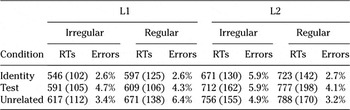
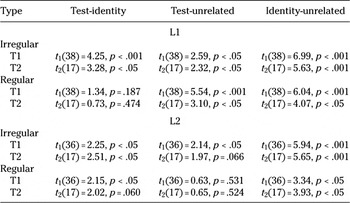
Mean target RTs (as well as standard deviations and error rates) in the three prime conditions and for the two verb types are displayed in Table 3; the results of planned comparisons are shown in Table 4. In the error data, there were no main effects or interactions (all ps > .1) except for a marginal interaction of verb type and group, F 1(1,74) = 3.38, p = .070; F 2(1, 34) = 3.10, p = .088. The RT data revealed a significant Verb type × Prime type × Group interaction in the subjects analysis only, F 1(2, 148) = 3.16, p < .05; F 2(2, 68) = 1.86, p = .164; main effects of group, F 1(1, 74) = 21.04, p < .001; F 2(1, 34) = 304.52, p < .001, prime type, F 1(2, 148) = 37.89, p < .001; F 2(2, 68) = 31.73, p < .001, and verb type, F 1(1, 74) = 66.66, p < .001; F 2(1, 34) = 10.89, p < .05, were also found. Planned comparisons showed significant repetition priming effects for both verb types and both participant groups (see Table 4)—that is, shorter target RTs after identity primes than after unrelated primes. The comparisons with the test conditions revealed a partial priming pattern for –n participles in both participant groups—in other words, significantly shorter RTs for targets after test primes than after unrelated primes in the by-subjects comparisons (marginally significant in the by-items comparisons in the L2 group) but longer target RTs in the test than in the identity condition. In contrast, the priming patterns were different for –t participles in the two groups. The L1 group exhibited a full priming effect (similar RTs for test and identity, both of which were significantly shorter than for unrelated primes), whereas there was no priming in the L2 group; that is, the test and unrelated primes yielded similar RTs, which were significantly longer than RTs in the identity condition in the by-subjects comparisons (again marginally significant for items in the L2 group).
Mean RTs (in ms) and error rates by group, verb type, and condition

Note
The SDs are in parentheses.
Planned comparisons of the mean RTs by group, verb type, and condition

Note
T1 corresponds to the by-subjects analysis and T2 corresponds to the by-items analysis.
These results show that irregular participles produced the same priming pattern in the L2 as in the L1 group, whereas for regular participles, different priming patterns were found. Before interpreting these contrasts in morphological terms, a number of potentially confounding factors need to be considered. One concern is that the observed priming effects might be due to the formal and semantic overlap between primes and targets rather than their morphological relatedness. The repetition priming effects may indeed be explained in this way. Crucially, however, these factors are insufficient to explain why regular and irregular participle primes produced different effects, even though both primes had the same formal and semantic overlap with their targets. Another potentially relevant factor is that, as in the visual lexical decision task, the L2 learners’ RTs were longer than in the L1 group (on average, 132 ms across conditions; see Table 3) and that slower processing speed may cause priming differences. To examine this possibility, we isolated the 13 fastest L2 participants, which yielded a subgroup with approximately the same mean overall RT as the L1 group: 605 ms (SD = 114) for the L1 group and 601 ms (SD = 60) for the L2 subgroup. The results for these fast L2 learners were similar to those of the L2 group as a whole: They showed partial priming for irregular participles and no priming for regular participles.Footnote 4
We suggest that the priming differences between –t and –n participles seen in the L1 group corresponds to the morphological structure of these word forms. Regular –t participles are pure combinatorial forms for native speakers and are fully decomposed, by which the base stem is isolated and directly primes the target stem. Like regular participles, irregular (–n) participles have a segmentable ending, but, unlike regular participles, –n participles constitute a lexically restricted class. The partial priming effect corresponds to the hybrid properties of these word forms. Whereas the –n ending may be segmented from a participle form, –n participles also activate separate whole-word representations, and these may prevent any direct reactivation of the base stem. The combined result of these processes is an indirect, partial stem priming effect for –n participles.
The L2 results are parallel to those of the L1 group in that the L2 learners also demonstrated significant repetition priming effects for both verb types and a partial priming effect for –n participles. It is nonetheless striking that regular –t participles produced full priming in the L1 group and no reliable priming in the L2 group. Thus, although L2 learners do not seem to segment the –t participle ending from its stem, –n participles show the same (partial) priming effect as in native speakers. One reason for this difference could be that –n is the infinitive ending of all German verbs and the most common noun plural suffix, which makes it a very prominent affix in the language and, therefore, perhaps more easily segmentable for L2 learners than the –t affix. An additional factor could be that learners attending German language classes are typically trained on irregular verbs through miniparadigms (e.g., schlafen-schlief-geschlafen “to sleep-slept-slept”) and that this way of learning may facilitate the recognition of an unmarked stem from its corresponding –n participle form. It is true that all of the L2 learners in this study received German language classes, but we do not know how they learned participles. Hence, the intriguing possibility that particular L2 learning or training methods may have long-term effects on morphological processing will have to be left to future research.
GENERAL DISCUSSION
Here, we discuss the results from these three experiments together with previous findings to identify the linguistic representations and processing mechanisms for morphologically complex words shared by a L1 and a L2 and those that are different in the L1 and the L2.
Regular and Irregular Inflection in L1 and L2 Processing
The present set of experiments revealed differences between regular and irregular inflection for the L1 group and nativelike performance in the L2 group for irregular but not for regular inflection. In the acceptability judgment task, the L1 group preferred –n participle forms for (semantically extended) irregular verb roots and –t participle forms for denominal verbs that were homophonous to irregular verb roots. The reversal of the L1 group’s preferences for denominals replicates the findings of Marcus et al. (Reference Marcus, Brinkmann, Clahsen, Wiese and Pinker1995) and was attributed to the internal morphological structure of these verbs, which precludes access to existing verb roots. Regular inflection is used as a last resort in such cases. Although the L2 participants (like the L1 group) preferred –n participles in the verb root condition, they did not have a clear preference in the denominal condition. For the L1 group, the visual lexical decision task revealed shorter lexical decision times for high- than for low-frequency irregular forms and no frequency effect for regular forms, which replicates earlier findings for native speakers of German (Clahsen et al., Reference Clahsen, Eisenbeiss and Sonnenstuhl1997). The L2 group, on the other hand, showed the same frequency effect for both regular and irregular participles. The masked priming experiment revealed a partial priming effect for irregular and a full priming effect for regular participles in the L1 group, which replicates earlier findings for native speakers of German (Sonnenstuhl, Eisenbeiss, & Clahsen, Reference Clahsen1999).Footnote 5 Whereas the L2 group demonstrated the same partial priming effect for irregular participles as the L1 group, regular participles did not exhibit any priming in the L2 group.
Together with previous findings, these results indicate that L1-L2 differences are mainly found in regular inflection rather than in irregular inflection or derivation. The finding from the acceptability judgment task that, unlike in L1 speakers, derivational processes fail to yield a preference for regular inflection in L2 learners was also obtained by Neubauer and Clahsen (Reference Neubauer and Clahsen2006) for a group of Chinese L2 learners of German and by Bandi-Rao (Reference Bandi-Rao, Skarabela, Fish and Do2002) in a rating study that compared past tense forms of denominal and semantically extended verbs in L2 learners of English with different language backgrounds. Ullman et al.’s (2008) experiment revealed shorter production latencies for high- than for low-frequency irregular past tense forms in both their L1 and L2 groups, whereas, for regular verb forms, only the L2 groups showed the same amount of facilitation as for irregular verb forms. These results are parallel to those of the visual lexical decision task in which L2 performance for irregular (but not for regular) participles was nativelike. With respect to the priming effects in the masked priming experiment, the same contrast between full priming in native speakers and no priming in nonnative speakers seen for –t participles in Polish L2 learners of German was also found for –ed past tense forms in three groups of L2 learners of English with Chinese, German, and Japanese as their L1s (Silva & Clahsen, Reference Silva and Clahsen2008). Thus, masked priming yielded the same L1-L2 contrast for regular inflection in different target languages and across a heterogeneous set of L1 backgrounds, which suggests that the L2 learners’ performance in this task was not affected by their native language.
Although questions remain as to why some studies (e.g., Basnight-Brown et al., Reference Basnight-Brown, Chen, Hua, Kostić and Feldmann2007; Beck, Reference Beck1997) did not find any clear L1-L2 contrasts for regular inflection, there are indications from a number of studies (e.g., Silva & Clahsen, Reference Silva and Clahsen2008; Ullman et al., Reference Ullman, Babcock, Stowe and Brovetto2008) that in the domain of morphology, differences between L1 and L2 processing are most likely to be found for regular inflection, even in advanced L2 learners.
Storage and Computation in L2 Processing of Inflection
For processing morphologically complex words, two basic processes can be distinguished: (a) storage of an inflected or derived form in lexical memory and (b) morphological computation by which an inflected or derived form is decomposed into its morphological constituents and possible stems and affixes are identified. There is abundant evidence that morphological decomposition plays an important role in the way native speakers process inflected and derived words and that morphological decomposition is applied early during L1 processing (Marslen-Wilson, Reference Marslen-Wilson and Gaskel2007). In contrast to the rich experimental literature on native speakers, there is, to date, little evidence on how adult L2 learners process morphologically complex words. The present study contributes new evidence on morphological processing in a nonnative language. The results from both the lexical decision and the masked priming task revealed clear L1-L2 differences, which are unlikely due to slower speed of processing, reduced proficiency, or working-memory limitations of L2 processing. Instead, we suggest that adult L2 learners, even the advanced participants in this study, rely more on memorization of inflected words and less on morphological decomposition than native speakers.
The visual lexical decision task employed unprimed lexical decision, a task that is likely to pick up traces of word forms left in memory, as it requires participants to discriminate between existing words and novel words. The results for the L1 group revealed a selective effect of frequency on the lexical decision times of –n participles. By contrast, L2 learners’ lexical decision times of both –n and –t participles were affected by frequency differences: This suggests that they are more sensitive to memory representations of these word forms than native speakers.
The results of the masked priming experiment indicate that adult L2 learners make less use of morphological decomposition than native speakers. We found full priming effects for regular –t participles in L1 German. In contrast, L2 learners did not show full priming for morphologically related prime-target pairs. If we assume that full priming is indicative of morphological decomposition, the lack of full priming in the L2 suggests that L2 processing relies less on morphological decomposition than L1 processing. The contrast between full morphological priming in the L1 and no priming in the L2 was particularly striking for regularly inflected word forms: This indicates that L2 learners do not segment these affixes from their stems during processing.
One important caveat follows from the fact that both the visual lexical decision task and the masked priming experiment are believed to tap modality-specific form-level access representations rather than modality-independent central lexical entries. Thus, it is possible that although access-level morphological processing in a L2 is different from that in a L1 (as indicated by the sharp L1-L2 contrasts in the visual lexical decision and the masked priming experiments), central-level lexical representation and processing is similar. One piece of evidence for this comes from a crossmodal priming study (Basnight-Brown et al., Reference Basnight-Brown, Chen, Hua, Kostić and Feldmann2007) in which late L2 learners showed similar amounts of facilitation for regular –ed past tense primes as native speakers of English. In a crossmodal task, primes and targets are presented in different modalities, and any priming effect in this task is thought to be mediated by modality-independent central representations. Thus, the priming effect that Basnight-Brown et al. found could be due to the fact that a prime such as walked activates the same lemma in the central lexicon as the target form walk, which suggests that processing at the lemma level might be similar in a L1 and a L2. More research is needed to explore this possibility.
CONCLUSION
This study examined one morphological system of German—participle formation—by testing advanced adult L2 learners and control groups of native speakers of German in three different experiments. The L2 learners showed nativelike patterns of performance for irregular (–n) but not for regular (–t) participles. Both the L1 and the L2 participants preferred –n participles for unusual (semantically stretched) irregular verb roots and showed a frequency effect for irregular participles in unprimed lexical decision as well as a (partial) priming effect for irregular participles in the masked priming task. By contrast, clear L1-L2 differences were found for regular inflection. Derived verbs (despite being homophonous to existing irregular verbs) yielded a preference for –t participle forms in the judgment task, but only in the L1 group. In unprimed lexical decision, RTs for regular participles were affected by frequency differences in the same way as those for irregular participles, but only in the L2 group. In the masked priming task, regular participles produced a full priming effect, but only in the L1 group. We conclude that regular inflection distinguishes L1 from L2 morphological processing and that adult L2 learners rely more on lexical storage of inflected words and are less affected by the internal morphological structure of (regularly) inflected words than native speakers.
APPENDIX A CRITICAL ITEMS FOR THE ACCEPTABILITY JUDGMENT TASK

Note
The first column contains the base verbs in their typical meanings, and the second column contains the nouns introduced to promote a denominal interpretation. The third and fourth columns describe the meanings of the denominal and the semantically extended verbs in the context paragraphs provided.
APPENDIX B CRITICAL ITEMS FOR THE VISUAL LEXICAL DECISION TASK
List of −n Participles by Frequency

List of −t Participles by Frequency

APPENDIX C CRITICAL ITEMS FOR THE MASKED PRIMING EXPERIMENT