1. Introduction
The thesis of incommensurability, that is, the claim that scientists from rival theoretical traditions cannot fully understand each other, has frequently been tied to some kind of holistic entity. In Thomas Kuhn's original version, incommensurability occurs because scientists change their worldview after a revolution (Kuhn Reference Kuhn1962), and in his later version, scientists from rival traditions face incommensurability because they construct incompatible taxonomies and classify the world in different ways (Kuhn Reference Kuhn and Horwich1993). Such a holistic interpretation of the thesis of incommensurability inevitably implies that rational comparisons between rival theories are impossible. Without compatible worldviews or taxonomies, there is not a common “platform” that can supply a base to measure the “distances” between theories and the reality (Chen Reference Chen1997).
In this paper I argue that incommensurability need not be tied to any holistic entity. In the following sections, I will first examine the differences between object and event concepts by drawing on the results of cognitive psychology, and show how incommensurability can occur locally, between an object and an event concept. I will further use a historical case to illustrate how the differences between an object and an event concept can actually cause communication breakdown. The cognitive and historical analyses will indicate that incommensurability can be a local phenomenon and will not necessarily lead to incomparability.
2. Object Concepts and Spatial Relations
Influenced by British empiricism, modern philosophy in the English-speaking world continues a long tradition in defining concepts by a group of atomistic features, such as a set of individually necessary and jointly sufficient conditions. These atomistic features are assumed to be independent components that constitute a single level of analysis, and the relations between them remain implicit. But recent cognitive studies reject this atomistic approach and convincingly argue that some kind of mental structure underlies human cognition. Experiments show that information that can be instantiated in a schema is better recalled than information that cannot easily be instantiated in a schema, and subjects with a more developed schema for a particular body of knowledge show higher recall for materials related to that knowledge. Several models have been developed to capture the underlying mental structures, such as scripts (Schank and Abelson Reference Schank and Abelson1977), schemas (Rumelhart Reference Rumelhart, Bruce and Brewer1980), and mental models (Johnson-Laird Reference Johnson-Laird1980). In this paper, I adopt a model of dynamic frames proposed by Larry Barsalou in the 1990s (Barsalou Reference Barsalou, Lehrer and Kittay1992) as a cognitive construct to represent concepts.
Instances of object concepts, such as ‘vehicle,’ ‘air,’ and ‘bird,’ are ontologically distinct to the extent that they have volume and mass, and that they are containable and storable. A frame representation for an object concept consists of a set of multivalued attributes integrated by structural connections. Figure 1 is a partial frame representation of an object concept ‘vehicle.’ The frame divides features into two groups, attributes and values. All exemplars of ‘vehicle’ share the properties in the attribute list such as ‘engine,’ ‘axle,’ and ‘wheel.’ Features in the value list, however, are activated selectively to represent the prototype of a specific subordinate concept. For convenience and clarity, activated values are indicated in Figure 1 by lines connecting them to the subordinate concepts. For example, a typical truck is a vehicle whose value for ‘engine’ is restricted to ‘diesel,’ the value for ‘axle’ to more than two, and the value for ‘wheel’ to more than four.
A Partial Frame for ‘Vehicle’.

The frame representation outlines two important kinds of intraconceptual relation. First, the frame captures hierarchical relations between features. Contrary to the conventional assumption that all features within a concept are structurally equal, the frame representation divides features into two different levels. Some are attributes, such as ‘engine,’ ‘axle,’ and ‘wheel,’ and the rest are values. A value is always attached to a particular attribute and functions as an instance of the attribute. Consequently, not all features within the superordinate concept are functionally equal: Only attributes can be used as classification standards. The second kind of intraconceptual relations represented in the frame appears as horizontal relations between features. There are connections between attributes and between values: An instance of ‘wheel’ is always physically attached to an instance of ‘axle,’ but an instance of ‘engine’ is never physically attached to an instance of ‘wheel.’ These connections between attributes, also called structural invariants, impose constraints to the activations of values and produce systematic variability in values: If the value of ‘axle’ is more than two, then the value of ‘wheel’ must be more than four, or if the value of ‘axle’ is two, then the value of ‘wheel’ must be four.
The frame also reveals important interconceptual relations—relations between the superordinate concept and the subordinates as well as among the subordinates. First, the frame naturally represents all the exemplars of the concept—each activated attribute-values pattern constitutes an exemplar. Among them, those values activated most frequently across attributes represent the prototype adopted by a community; for example, the prototype of ‘vehicle’ in American culture is gasoline in ‘engine,’ two in ‘axle,’ and four in ‘wheel.’ Furthermore, the frame specifically determines the related taxonomy and the subordinates. Since the frame of ‘vehicle’ in Figure 1 has three attributes and each of them has two possible values, there are eight possible property combinations (2 × 2 × 2) and thereby eight possible exemplars. But due to the constraints between the value sets, some of these property combinations are conceptually impossible, such as four ‘wheels,’ and more than two ‘axles,’ or more than four ‘wheels’ and two ‘axles.’ Some other combinations are not found in reality. The results are only two property combinations that form two subordinate concepts—‘car’ and ‘truck.’ Since the subordinate concepts have different values in the same attribute, there are contrastive relations among concepts within the subordinate group. Thus, ‘car’ and ‘truck’ should never be applied to the same object. It is acceptable to call a car a vehicle because ‘car’ is subordinated to ‘vehicle,’ but it is not acceptable to call it a truck. In other words, concepts belonging to the same subordinate group cannot overlap in their referents, and so no object is both a truck and a car. This is the “no-overlap principle” for object concepts. Except for the no-overlap constraint, there is no direct relation between subordinate concepts. They are related through the superordinate concept. Because all subordinate concepts share the same attribute list in the frame, they are examples of the superordinate concept and there is an inclusive relation between the superordinate concept ‘vehicle’ and the subordinate concepts ‘car’ and ‘truck.’ In this way, the frame illustrates the taxonomy of ‘vehicle.’
There is consensus among cognitive scientists that intraconceptual relations within object concepts are in essence spatial. For example, Lakoff suggests that image-schema lie at the core of object concepts. Image-schema are schematic, spatial images that constantly recur either in our everyday bodily experience or in various orientations and relations. Examples of image-schema include ‘container,’ ‘paths,’ ‘forces,’ ‘up-down,’ ‘front-back,’ ‘part-whole,’ and ‘center-periphery,’ all of which are directly derived from perceptual experiences of spatial structures (Lakoff Reference Lakoff1987). Conceptualization of an object concept involves a process of “spatialization,” in which image-schema are used to map metaphorically the spatial structures of physical space into a conceptual space. Thus, internal structures of object concepts should be understood in terms of spatial relations. In general, representing object concepts involves a process of conceptual partitioning, in which the mind extends a boundary around a portion of what would otherwise be a continuum of space, and ascribes to the contents within the boundary the property of being a single-unit entity. In such a partitioning process, contents that are perceptually salient, such as those having a clear boundary or those identifiable by shape, would be identified and ascribed quickly and frequently. Experimental studies from cognitive psychology confirm that people indeed prefer to represent object concepts by using attributes that contain rich spatial information (Rosch, et al. Reference Rosch, Mervis, Gray, Johnson and Boyes-Braem1976; Tversky and Hemenway Reference Tversky and Hemenway1984).
3. Event Concepts and Temporal Relations
Unlike object concepts, typical examples of event concepts such as ‘engine cycle,’ ‘war,’ and ‘metabolism’ have neither mass nor volume, and they are not containable or storable. However, through representing sequences of activities or series of incidents, they usually have a beginning and an end, and they always vary with time. Thus, it has been suggested that object and event concepts are ontologically distinct (Sommers Reference Sommers1971; Keil Reference Keil1979). A common method to detect the differences between object and event concepts is to examine the predicated terms. Predicates that modify object concepts cannot be applied to event concepts, nor the other way around. For example, an object designated by the concept ‘vehicle’ has the potential to be heavy even though it may not be, whereas an instance of an event concept like ‘engine cycle’ cannot be heavy. Conversely, an engine cycle can be ‘a second long’ but a vehicle cannot.
The differences between object and event concepts are not merely linguistic. Barsalou and Sewell had conducted a series of experiments in which they first asked subjects to generate examples of event concepts such as ‘writing a letter’ and ‘doing the laundry’ under unconstrained conditions, and then they asked the subjects to generate examples of these concepts in a specific order, from most to least typical. If event concepts are represented the same way as object concepts, explicitly instructing subjects to retrieve examples of actions in this manner should not decrease the rate of production, because studies have shown that exemplars of object concepts are retrieved according to their typicality—those similar to the prototypes of the superordinates are generated easily and quickly. But the subjects' performance in the experiments was affected when they were instructed to retrieve examples of actions from most to least typical. Later, Barsalou and Sewell asked the subjects to generate examples of these event concepts according to a temporal sequence; first in the forward condition, that is, from the first action of the sequence to the last, and then in the backward condition, that is, from the last to the first action in the sequence. Again, if event concepts are represented the same way as object concepts, there should not be any difference under these two circumstances—studies have shown that generating examples from object concepts according to size is always difficult, regardless of whether exemplars were produced from the smallest to the largest or from the largest to the smallest. However, Barsalou and Sewell found that subjects generated more examples in the forward condition than in the backward condition. In fact, the subjects had the best performance when actions were generated in the forward condition, that is, in their normal temporal sequence (Barsalou and Sewell Reference Barsalou and Sewell1985).
Barsalou and Sewell's experiments indicate that there are different retrieval patterns between object and event concepts. The differences in the retrieval pattern, specifically, in the rate of production, reflect significant differences in the underlying mental organizations and cognitive processes, because the fastest rate of production should be the one in which the underlying organization is followed as directly as possible. Thus, Barsalou and Sewell believe that event concepts are dimensionally organized in memory, that is, their components are chained together in memory according to increasing or decreasing values on some dimension, which explains why during the experiments the retrievals of the event concepts were fast when they took advantage of these dimensional orders.
In terms of their representations, event concepts are distinctively different from object concepts. Unlike object concepts in which intraconceptual relations are spatial, an event concept such as ‘doing the laundry’ is built primarily upon a routine series of incidents, or some kind of temporal relations. Many cognitive scientists use scripts to capture these temporal relations. A script is a knowledge structure that specifies the conditions and actions for achieving a goal. Consider the script of ‘doing the laundry.’ This script specifies the initial conditions that must be met if the goal is to be achieved; for example, dirty clothes exist, a washer and dryer are available, and laundry detergent is present. The script further specifies the sequence of actions that will achieve the goal, for example, collecting dirty clothes, turning on the washer, placing detergent in the washer, and putting clothes in the washer. There is strong evidence for scripts in goal-derived activities. Memory experiments show that actions that are parts of a script are better recalled than other actions. When people are presented with script actions in the wrong order, they rearrange them to their typical order during recall even after being instructed to recall them in their presented order (Bower, et al. Reference Bower, Black and Turner1979).
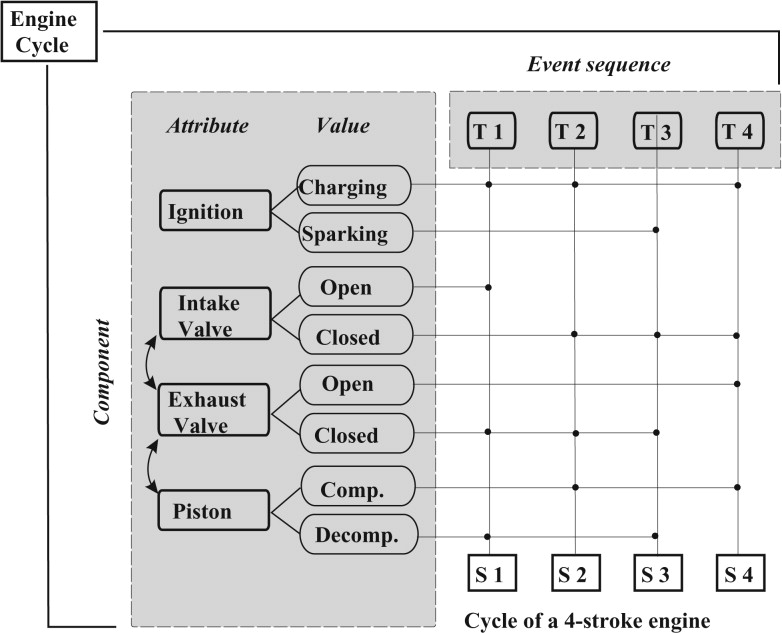
Event concepts can also be represented by frames. Barsalou uses the following frame structure (Figure 2) to represent an event concept ‘engine cycle’ (Barsalou Reference Barsalou, Lehrer and Kittay1992). A significant difference between Figure 1 and 2 is that the latter contains more than one frame. On the left-hand side of Figure 2 is a component frame and, similar to frames of object concepts, its attributes are the major parts of an engine (‘ignition,’ ‘intake valve,’ ‘exhaust valve,’ and ‘piston’). Unlike object concepts, however, the values in this frame have nothing to do with parts but represent different states of operation. For example, ‘compressing’ and ‘decompressing’ are the two states of ‘piston.’ On top of the right-hand side of the figure is another frame that captures an event sequence. The four attributes of this frame represent four different moments in the sequence, each of which takes a specific value corresponding to an attribute in the component frame. In Figure 2, for example, T1 in the event sequence takes four specific values from the four attributes in the component frame: ‘charging ignition,’ ‘open intake valve,’ ‘close exhaust valve,’ and ‘decompressing piston.’ Thus, by crossing two frames and noting all the intersections, we obtain a sequence of subordinate concepts: ‘stroke 1,’ ‘stroke 2,’ and so on, which collectively represent a specific event—the cycle of a four-stroke engine. In general, crossing a frame for an object and a frame for time provides a general means of representing event sequences.
A Partial Frame for ‘Engine Cycle’.

There are also differences between object and event concepts in conceptual relations. Evidently, the frame of an event concept does not generate a taxonomy. The subordinate concepts in Figure 2 are not examples of the superordinate concept. Instead, they are parts of ‘engine cycle.’ In other words, the intraconceptual relations of an event concept produce a partonomy built upon part-whole relations, rather than a taxonomy built upon inclusive and contrast relations. Furthermore, subordinate concepts in Figure 2 are no longer independent. They are related directly to each other through causal links—‘stroke 1’ physically causes ‘stroke 2,’ and so on.
An even more important difference between object and event concepts is the nature of the intraconceptual relations. Similar to object concepts, representing event concepts involves a process of conceptual partitioning, in which the mind extends a boundary around a portion of what would otherwise be a continuum of time. But unlike object concepts in which the partitioned space is circumscribed by properties (attributes), the ascribed time in event concepts is represented by an event sequence. When the mind represents, memorizes, and retrieves event concepts, it apparently adopts an approach different from that for object concepts. Specifically, it seems that the mind does not represent temporal relations by properties, but by dimensional organizations of temporal sequence. Barsalou and Sewell's experiments seem to support this speculation. Object and event concepts are treated by the mind differently in representation, memory, and retrieval.
How concepts are represented, memorized, and retrieved by the mind directly affects how they are learned, which is the core of conceptual change. If a transformation occurs between concepts that belong to the same ontological category, the learning process could be smooth. The old concept can be used as a guide for the acquisition of the new one; more specifically, the frame of the old concept can be used as a pattern to form a new frame for the new concept. A variety of learning techniques, such as addition, deletion, discrimination, generalization, concatenation, chunking, and analogizing can be used to transform an old concept into a new one in a piecemeal manner. Many important conceptual changes, such as the one from the Aristotelian “physical object” to the Newtonian “astronomical object” during the Copernican revolution were probably achieved in this way (Chen and Barker Reference Chen and Barker2000). However, if a transformation requires crossing concepts that belong to different ontological categories, acquisition of a new concept must proceed by teaching it independently of the old conceptual framework. Because of their distinct structures, the old concept is usually not merely useless, but also misleading. Hence, from a cognitive point of view, such a learning process could be very difficult, if not entirely impossible (Chi Reference Chi and Giere1992). It is difficult to accomplish a conceptual change from an object concept to an event concept or vice versa. Particularly, it is reasonable to expect that the differences between an object and an event concept can cause communication problems or incommensurability during conceptual change. To distinguish from incommensurability caused by taxonomic mismatches, let us call this “ontological incommensurability.”
4. An Example of Ontological Incommensurability
A good example of ontological incommensurability can be found in the conflict between the particle and wave theory of light on polarization during the early nineteenth century. Historians of optics have noticed that polarization was the most difficult subject in the conceptual change regarding the nature of light. Many wave theorists, including the “father” of the wave tradition in Britain, John Herschel (1792–1871), failed to understand the wave account of polarization, although they had no trouble in comprehending the wave theory in other optical phenomena. The special status of polarization can be accounted for by the ontological difference between object and event concepts.
Differing from other optical phenomena, the wave account of polarization requires an event concept. According to the wave theory, the differences between polarized and unpolarized light consist not in any spatial feature, because light consists of transverse disturbances and even unpolarized light is always spatially asymmetric. The distinction between polarized and unpolarized light consists in the phase difference of the two orthogonal components of a light beam. Polarized light always has a stable phase difference between its orthogonal components, but the phase difference of unpolarized light varies over time.
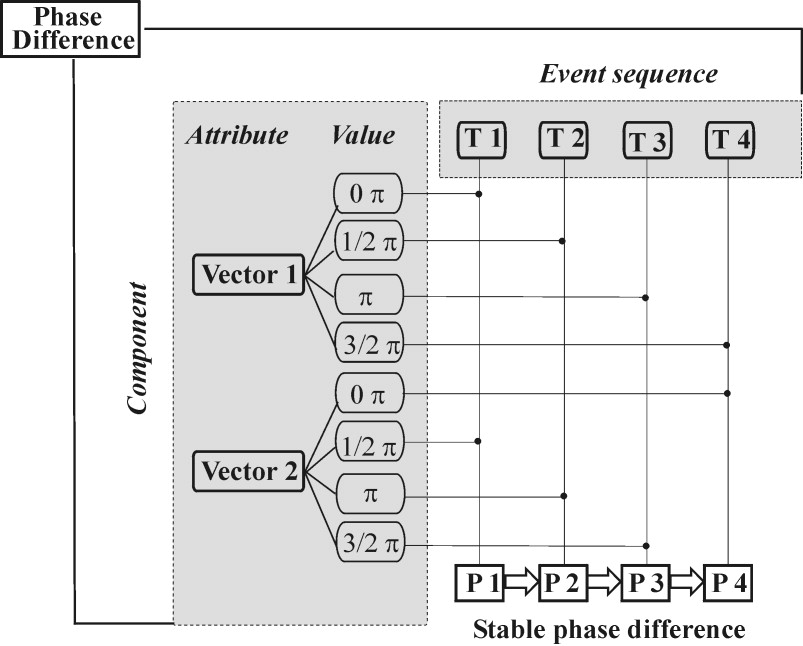
To capture the meaning of “phase difference,” we need two specific frames (Figure 3). On the left-hand side is a frame representing the orthogonal components of a light beam—its attributes represent the orthogonal parts of a disturbance (vector 1 and vector 2) and the values of these attributes describe specific states, or specific phases, of the vectors. On the right-hand side is a frame that captures an event sequence. The attributes in this frame (only four are listed for the sake of simplicity) represent different moments in the sequence, each of which takes specific value corresponding to an attribute in the component frame. For example, T1 is the moment when vector 1 is 0π and vector 2 is 1/2π, T2 is the moment when vector 1 is 1/2π and vector 2 is π, and so on. By connecting all of these moments, we obtain a sequence of subordinate concepts: ‘phase difference at T1,’ ‘phase difference at T2,’ and so on, which collectively represent an event of stable phase difference. To apply the notion ‘stable phase difference’ requires following a normal temporal sequence, and more specifically, requires observations over time. Thus, ‘phase difference’ from the wave framework is an event concept built upon our experiences of temporal sequences.
A Partial Frame for ‘Phase Difference’.

The particle account of polarization, however, appeals to the spatial asymmetry of particles. Newton felt that it was natural to account for the different paths of the ordinary and extraordinary rays in a doubly refracting crystal by different shapes, or different sides, of the particles. Later Malus assumed that spatial asymmetry is a fixed feature of every particle, and he accounted for polarization by this spatial asymmetry. Specifically, polarized light was accounted for by postulating that all particles in a ray of light are arranged in an orderly way, facing the same direction, while unpolarized light, or natural light, was understood as randomly arranged particles. ‘Side’ from the particle framework is an object concept built upon our perceptual experiences of various spatial orientations.
Herschel began his studies of polarization in the late 1810s through his experiments on chromatic polarization (Good Reference Good1982). In these experiments, a beam of light, first polarized by reflection from a plate of glass (the polarizer), was transmitted through a doubly refracting crystal, and then reflected again at the angle of polarization by another plate of glass (the analyzer), whose plane of reflection was at right angles to the polarizer. Without the doubly refracting crystal, no light was transmitted after the two reflections. But when the doubly refracting crystal was inserted between the two plates of glass, a pattern of colors similar to Newton's rings appeared. At first glance, the appearance of the tints was accounted for by the existing notion ‘side’ defined by Malus. Without the crystal, all particles are transmitted through the analyzer because their plane of polarization is perpendicular to its plane of reflection. When the crystal is inserted, it creates two beams of light with planes of polarization that are no longer perpendicular to the plane of reflection of the analyzer. Thus, some particles are reflected by the analyzer and a pattern of colors appears.
But Herschel found that, when rotating the doubly refracting crystal, the pattern of the colored rings remained the same, an observation that contradicts the existing particle account. To account for this anomaly, Herschel realized that it was necessary to add an oscillation assumption to the notion ‘side,’ an idea originally proposed by Biot. According to this assumption, when a polarized ray enters a crystal, some particles begin a series of oscillations and their planes of polarization then alter alternately to one side or other of the axis of the crystal. The period of the oscillation is analogous to the length of fit in Newton's rings, determined solely by the nature of the particles (the color of the ray). The oscillatory movement is supposed to stop when the particles emerge from the crystal to the air, and the plane of polarization of the emergent ray is determined by the last oscillation of the particles at the instant of emergence. Hence, rotating the crystal does not alter the plane of polarization at the instant of emergence, nor the pattern of the colored rings.
Herschel soon found that the refined notion of ‘side’ still could not explain the details of his experiments, in particular, the fact that colored tints appeared in places where it should be completely dark. To account for the anomaly, Herschel introduced a “color-dependent” assumption, claiming that “the axes of double refraction differ in their position in the same crystal for the differently colored rays of the spectrum, being dispersed in one plane over an angle more or less considerable, according to the nature of the substance” (Herschel Reference Herschel1820, 49–50). If particles of different colors travel in different directions in biaxial crystals, then many of them will have axes of double refraction different from the direction corresponding to the poles in the colored rings. Along this direction, many particles will be affected by polarizing forces and engaged in oscillations. Consequently, the poles should not be black but tinted.
Because of the oscillation and the color-dependence assumptions, Herschel no longer understood ‘side’ as a fixed character of particles, nor did he believe that particles with different sizes have the same spatial asymmetry. According to Herschel, a particle of light can alter its spatial asymmetry due to the impact of physical forces exerted from the crystal, and particles with different sizes can have different spatial asymmetries. But these two additional assumptions do not alter the spatial nature of ‘side.’ What mattered to Herschel was not the processes of the oscillations, but the spatial asymmetry of the particles at the instant when they emerged from the crystal. Both assumptions were used by Herschel as ad hoc mechanisms to manipulate the spatial character of particles.
The ontological difference between ‘side’ and ‘phase difference’ explains why Herschel failed to understand polarization but not other optical phenomena. Because they are ontologically distinct, the conceptual change from ‘side’ to ‘phase difference,’ necessary for the transformation from the particle account to the wave account of polarization, cannot be achieved in a piecemeal manner. The old concept ‘side’ must be abandoned before the new concept ‘phase difference’ can be comprehended. Because he was limited by his own experimental works, Herschel never gave up the spatial notion ‘side.’ He continued to use spatial asymmetry to explain his experiments, and thus he was never able to understand polarization as a temporal process—the key for the wave account of the phenomenon.
5. Conclusion
The cognitive and historical analyses show that incommensurability is not always tied to holistic entities such as paradigms or taxonomies. Instead, incommensurability can occur locally, between a single pair of concepts. Using frames to represent the internal structures of concepts, I have shown a possible cognitive mechanism responsible for incommensurability. Because the mind represents object and event concepts with distinct structures, conceptual change that involves transformation from an object concept to an event concept or vice versa can be extremely difficult to accomplish. The historical case further illustrates how the ontological difference between an object and an event concept actually causes confusion and incommensurability in the practice of science.
The cognitive and historical analyses also offer strong support for a rational account of science by drawing a distinction between commensurability and comparability. Many philosophers of science have assumed that these two issues are connected because both are tied to some kind of holistic entity, and thus they conclude that incommensurability implies incomparability. But if incommensurability can occur between a single pair of concepts, it may lead to individual failures in learning new concepts, but it does not necessarily imply global mismatches between taxonomies. Even when incommensurability occurs, it is still possible to have a common “platform” for rational comparison of the rival theories. Thus, the thesis of incommensurability does not necessarily imply incomparability.