Introduction
The nematodes Toxocara canis and Toxocara cati are cosmopolitan parasites of canids and felids, and have a wide range of paratenic hosts, e.g. birds and mammals, where larvae migrate to various tissues and survive for long periods. These parasites are also important zoonotic helminths causing human toxocariasis (Despommier, Reference Despommier2005). Humans are infected by ingestion of Toxocara spp. eggs containing third-stage larvae, due to geophagia and pica, as well as the consumption of contaminated raw meat of paratenic hosts containing larvae (Schantz, Reference Schantz1989). There are four clinical forms of toxocariasis – visceral larva migrans (VLM), ocular larva migrans (OLM), covert toxocariasis (CT) and neurotoxocariasis (NT) (Pawlowski, Reference Pawlowski2001).
A wide spectrum of paratenic hosts can be infected with Toxocara spp. larvae, and patterns of migration have been studied intensively in a variety of animals (Campos-da-Silva et al., Reference Campos-da-Silva, da Paz, Fortunato, Beltrame, Valli and Pereira2015). These infections in animals could serve as a model for human toxocariasis and give valuable information about host–parasite interactions (Strube et al., Reference Strube, Heuer and Janecek2013).
The diagnosis of human toxocariasis is based mainly on clinical, epidemiological and laboratory data, which include imaging (computed tomography scans and magnetic resonance imaging), blood examinations, eosinophilia, total IgE level and serological tests (Park et al., Reference Park, Jeong, Park, Jung, Kim, Kim and Lee2014).
Experimentally, mice, rats, monkeys, golden hamsters, Japanese quail, pigs, rabbits, chickens and gerbils have been reported as reservoirs for Toxocara spp. larvae, due to their susceptibility. The organs affected by migrating larvae, the time points of infection, as well as the relative distribution and survival of larvae, are host species dependent (Zibaei et al., Reference Zibaei, Sadjjadi and Uga2010). In chickens infected experimentally with T. canis, the highest larval burdens were found in the liver and lungs, and few larvae were recovered from other tissues. Natural infection with Toxocara larvae can be assumed to occur in chickens, considering the probable contamination of pasture with faeces from infected farm cats and dogs (Tiara et al., Reference Tiara, Saitoh, Okada, Sugiyama and Kapel2012).
Previous reports have demonstrated the transmission of Toxocara larvae from a paratenic host to others. Free-ranging poultry are especially likely to acquire T. canis larvae from contaminated soil while searching for food items, e.g. earthworms which also act as paratenic hosts (Galvin, Reference Galvin1964; Pahari & Sasmal, Reference Pahari and Sasmal1991; Azizi et al., Reference Azizi, Oryan, Sadjjadi and Zibaei2007). Tiara et al. (Reference Tiara, Permin and Kapel2003) observed that T. canis migrates through the liver and may survive for up to 3.5 years. This report suggests that poultry meat infected with Toxocara spp. constitutes a potential risk of zoonotic transmission.
The current study describes infected broiler chickens as a paratenic host for human toxocariasis, to investigate the possibility of infection with Toxocara spp. larvae through consumption of fresh poultry viscera harbouring migrating Toxocara larvae. It aimed to evaluate the detection of Toxocara species by enzymatic digestion of tissue and DNA amplification.
Materials and methods
Collection and examination of samples
Newly hatched Cobb chicks were obtained from a commercial broiler hatchery. The experiment was conducted on 33 purchased broiler chickens (both sexes), weighing between 700 and 900 g and 35–47 days old. They were kept in an environment where infected dogs and cats occurred. The chickens did not have any clear symptoms of disease before sampling.
The chickens were caught and moved to an animal pathology laboratory for necropsy. After sedation and euthanasia with thiopental, the visceral organs (duodenum, liver, heart, lungs, kidneys, brain) and skeletal muscles of the animals were fragmented with pointed forceps and examined by binocular stereomicroscopy with 20× and 40× ocular objectives. In the case of brain tissue, each piece was compressed between two glass slides and examined for the presence of larvae of Toxocara parasites (squash technique). Thereafter, the tissues were put into digestive solution containing 1% pepsin (1:10,000), 1% HCl (37%) in distilled water and were incubated at 46°C for 5 h with constant stirring. After incubation, the digests were filtered through a system of sieves with 20-μm apertures and larvae were collected from the flow-through. To recover the larvae, the filtrate liquid was poured into a centrifuge tube and centrifuged for 2 min at 1500 rpm, 2-ml samples of sediment were collected, thoroughly mixed and 0.1-ml samples were viewed for larval counts (Azizi et al., Reference Azizi, Oryan, Sadjjadi and Zibaei2007). After digestion and four washing steps with distilled water on ice, larvae were stored in 5 μl distilled water at –20°C.
Molecular analysis
DNA was extracted from larvae. In brief, 2 μl of Tris–HCl buffer (50 mm, pH 7.4–7.6) was added to tubes containing Toxocara larvae in 5 μl water and sealed with a drop of mineral oil. The mixture was incubated for 10 min at 90°C. Then 0.4 μl proteinase K (20 mg/ml) and 2.6 μl water were added and the mixture was incubated for 3 h at 48°C. Proteinase K was inactivated at 90°C for 10 min. Samples were stored at −20°C. Further DNA extractions were performed using QIAamp DNA mini kit (Qiagen, Hilden, Germany) according to the manufacturer's instructions.
The polymerase chain reaction (PCR) amplification was evaluated with DNA samples from the larva species. For this purpose, two primer pairs were used. First, JW4 (forward), which is specific for T. cati, described by Li et al. (Reference Li, Lin, Chen, Sani, Song and Zhu2007) (5′-ACTGTCGAGGATGAGCGTGA-3′) and NC2 (reverse) described by Zhu et al. (Reference Zhu, D'Amelio, Palm, Paggi, George-Nascimento and Gasser2002) (5′-TTAGTTTCTTTTCCTCCGCT-3′), to amplify partial internal transcribed spacer-1 (ITS-1), complete 5.8S and ITS-2 of rDNA. A second primer YY1 (forward), specific for T. canis, was designed by Jacobs et al. (Reference Jacobs, Zhu, Gasser and Chilton1997) (5′-CGGTGAGCTATGCTGGTGTG-3′) and combined with NC2 to amplify partial ITS-2. Reactions were carried out in a total of 25 μl containing 1 U Taq polymerase, Taq buffer (50 mm KCl, 10 ml Tris–HCl, pH 8.8), 1.5 mm MgCl2, 200 μm deoxyribonucleoside triphosphates (dNTP), 1 μm primers and 0.1% Triton X-100. Amplifications were performed in a DNA thermocycler. The PCR protocol consisted of an initial denaturation step at 95°C for 5 min, followed by 30 cycles of 94°C for 45 s, 58°C for 45 s and 72°C for 90 s, and a final extension step for 10 min at 72°C. The PCR products were analysed by electrophoresis using 1.4% agarose gel with 0.5 μg/ml ethidium bromide, and a 100-bp ladder was used as the DNA size marker for estimating the size of the amplicons. The gels were photographed with UV illumination using a photodocumentation system (Bio-Rad, Hemel Hempstead, UK).
Results and discussion
Human toxocariasis can occur as a result of ingesting infective eggs from the environment or by eating the meat of paratenic hosts containing larvae (Fisher, Reference Fisher2003). Beaver (Reference Beaver1956) hypothesized that organs or tissues of infected animals can serve as sources of Toxocara infection for humans. In the present study, T. canis and T. cati larvae were recovered (n = 37) from 5 of 33 broiler chickens (15.2%). Overall, most larvae were recovered from the liver (n = 19), diaphragm muscle (n = 8) and duodenum (n = 8). Few larvae (n = 2) were recovered from the brain tissue of naturally infected broiler chickens.
In recent years, many studies have been published using traditional methods for detection of Toxocara larvae in experimentally infected chickens (Galvin, Reference Galvin1964; Maruyama et al., Reference Maruyama, Nino, Yamamoto and Katsube1994; Tiara et al., Reference Tiara, Saitoh, Okada, Sugiyama and Kapel2012; Dutra et al., Reference Dutra, Pinto, de Avila, Dutra, Telmo Pde, Rodrigues, Silva and Scaini2014). Analysing the migration of Toxocara larvae using the pepsin digestion method, Tiara et al. (Reference Tiara, Permin and Kapel2003) found high numbers of Toxocara larvae in the duodenum, liver, lungs, heart, brain and muscles of infected chickens. There are several reports indicating infection of humans with Toxocara larvae after eating raw or undercooked infected chicken meat (Ito et al., Reference Ito, Sakaei, Okajima, Ouchi, Funakoshi, Nishimura, Ibayashi and Tsuji1986; Nagakura et al., Reference Nagakura, Tachibana, Kaneda and Kato1989), raw beef liver (Tiara et al., Reference Tiara, Saitoh and Kapel2011), raw pig liver (Stürchler et al., Reference Stürchler, Weiss and Gassner1990) and raw lamb liver (Salem & Schantz, Reference Salem and Schantz1992). In an early study, Inoue (Reference Inoue1987) experimentally inoculated T. canis eggs into the gizzard of chickens and observed migrating larvae in the liver. The infected livers were then fed to mice and were capable of infecting them. This study was the first to demonstrate that broiler chickens can be a reservoir for Toxocara species larvae.
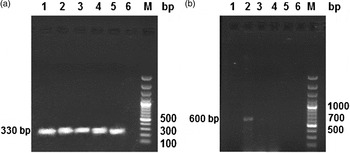
PCR based upon the amplification of ITS-1 and ITS-2 fragments revealed that 5 of 33 chickens showed a positive reaction to T. canis and T. cati. In the present study, two primer sets were selected to detect Toxocara spp. During electrophoretic analysis of PCR products, bands were observed in samples of the larvae. Under the optimized cycling conditions, primer set JW4/NC2 amplified a product of 600 bp solely from T. cati, (n = 1, 16.7%) and primer set YY1/NC2 amplified a product of 330 bp uniquely from T. canis (n = 5, 83.3%) (fig. 1). One broiler chicken was co-infected with both Toxocara species. The results of nucleotide sequences of the PCR products of genes were identical to those deposited in GenBank.
Analysis of PCR products (Toxocara species larvae) by electrophoresis on 1.4% agarose gels with ethidium bromide staining. (a) Toxocara canis with YY1/NC2 primers (lanes 1–5); negative (no DNA) control (lane 6); 100–1500 bp molecular weight marker (lane M). (b) Toxocara cati with JW4/NC2 primers (lane 2); negative control (lane 6); 100–1500 bp DNA size marker (lane M).

Molecular studies on Toxocara have been undertaken over two decades. Restriction profiles have been used not only to detect genetic, interspecific differences between T. canis and T. cati but also sexual differences (Gasser, Reference Gasser2013). Using PCR techniques, Wu et al. (Reference Wu, Nagano, Xu and Takahashi1997) located primers for the identification of members of the genus Toxocara, followed by Jacobs et al. (Reference Jacobs, Zhu, Gasser and Chilton1997) who identified species of Toxocara and other zoonotic ascaridoid nematodes. The DNA-dependent strain identification still presents one of the gold standards for molecular identification of Toxocara. The differentiation between T. canis and T. cati larvae on the basis of morphological features is difficult and inconclusive, and reliable methods for identifying species of larvae from tissues during histopathological studies are equally difficult or lacking. However, in the present study, by applying a digestive technique, larvae were recovered for genetic analysis, independent not only of the developmental stage of the larvae but also of the number of larvae. This is important, as in experimental studies for the detection of larvae more than 100 Toxocara larvae at various stages of development can be found in tissue samples. Therefore, this PCR method, which was used previously only for worms from tissue obtained from experimentally infected hosts, can be used for studies on natural infections (Zibaei et al., Reference Zibaei, Sadjjadi, Karamian, Uga, Oryan and Jahadi-Hosseini2013).
In conclusion, the results of this study demonstrate that broiler chickens can be natural paratenic hosts for the larvae of Toxocara species, and these larvae in poultry may be agents of human toxocariasis when humans consume raw, undercooked chicken meat. These findings also indicate that the molecular method has considerable potential for the detection and identification of T. canis and T. cati larvae in poultry tissues.
Acknowledgements
We wish to thank the staff of the Parasitology Laboratory, Lorestan University of Medical Sciences for their help and technical assistance.
Financial support
This research received no specific grant from any funding agency, commercial or not-for-profit sectors.
Conflict of interest
None.
Ethical standards
This study was carried out according to the ethical framework for research animal welfare and ethics of Lorestan University of Medical Sciences and was approved by the Ethical Committees of Lorestan University of Medical Sciences.