Introduction
In the Vietnamese town of Lào Cai one finds two temples that are very close to the border with China. Affectionately referred to as the ‘Mother Temple’ and the ‘Father Temple’ by local devotees, they are dedicated respectively to Mother Goddess Princess Liễu Hạnh and to Saintly Father Trần Hưng Đạo, the two most important deities of Vietnamese indigenous religion: the Four Palaces cult and the Saint Trần cult.Footnote 1 The Mother Temple, which stands directly on the border, is the Vietnamese temple closest to Chinese territory. The uniqueness of this position is evidenced not only by National Border Marker No. 102, erected in the temple's front yard in 2001, but also by three imperial edicts (see the Appendix) bestowed by kings of the Nguyen dynasty (1802–1945) as their symbolic stamps of sovereignty. Despite the Mother Temple's unique location and historical value, however, the Vietnamese state attacked it during several anti-superstition campaigns in the period of high socialism in the 1960s and 1970s, before eventually shutting it down in the late 1970s, just before the Sino-Vietnam Border War of 1979 (hereafter the 1979 Border War) destroyed its physical presence. In the early 1990s, however, local devotees reconstructed the temple without any support from the local government. Throughout the 2000s, although government control on religious activities and institutions had eased throughout Vietnam, the Lào Cai local authority continued trying to remove the Mother Goddess Temple. Those attacks only ceased in 2011 when it was finally recognized as a national heritage site. The Father Temple, on the contrary, despite being a little further from the border and with no imperial edicts to prove its historical value, has received continuous support from the state. In 1996 it was the first temple of Lào Cai to receive the prestigious national cultural and historical heritage status. Even today, it is the Father Temple, not the Mother Temple, that is chosen as one of the most important venues for state-sponsored nationalist performances in Lào Cai.
In a world where we are told that ‘national borders are political constructs, imagined projections of territorial power’,Footnote 2 it is hard to understate the importance of the Mother Temple as physical and historical proof of the continuity of Vietnam's claim to territorial sovereignty in this borderland. This raises the question of why different authorities in Lào Cai have attempted to remove the Mother Temple while maintaining strong support for the Father Temple. This intriguing question prompted me to investigate in depth the social history of these two religious institutions, within the framework of my larger research on social memory and religious nationalism in the Sino-Vietnamese borderlands since 2011. Another reason for my interest is that, despite their voluminous growth, memory studies and religious studies rarely focus on temples as ‘sites of memory’.Footnote 3 Jun Jing's work on the social history of a Confucius ancestral temple in northwest China is an exception.Footnote 4 Inspired by his work, this article aims to show how the rebuilding of the physical space of the two temples in Lào Cai and the renewing of their ritual functions are processes in which social memory and cultural memory converge. In closely examining the social history of these two temples, this article also allows for a conceptualization of how, in a borderland of great geopolitical import, the lives of not only humans but also gods and goddesses intertwine with forces of nationalism, ethnicity, and the market.
Critical to understanding the dynamics of religion, nationalism, and memory in Lào Cai is the town's geopolitical significance: it is part of Vietnam's national and ethnocultural frontier, where a bloody border war with China took place as recently as 1979. The way in which national identity operates is often expressed more clearly in a borderland than elsewhere, because the stakes there are much higher. Boundaries are symbols with which states, nations, and localities define themselves as well as their distinct territorial and cultural limits.Footnote 5 However, these moments and spaces are also fraught with the danger of transition. Borderlands have often served as spaces of demarcation not only of the nation's physical geo-body but also of its spirit, namely its distinctive culture and identity.Footnote 6 Nowhere in a nation is the rootedness of national identity as critical a factor as it is in border areas. As Beth Admiraal observed in Transylvania, border communities make more attempts to find commonalities with one another in the geographical and ethnic contours of the nation because of the presence of other, often dominant, groups or when confronted by minority groups that threaten the territorial integrity of the region.Footnote 7 This is especially true in the case of Lào Cai, where the border separates Vietnam and China. But in this region, with its variety of dominant ethnic minorities whose allegiance to the nation is always questioned and scrutinized, the national border does not coincide with ethnic boundaries.Footnote 8 Nationalism in this borderland is as much about the differentiation between ‘us’—Vietnamese—and ‘them’—Chinese—as it is about the continuous making of ‘us’ by incorporating cultural and ethnic others into the nation. The question is how religion plays a role in this nationalist project.
The social history of the Father Temple and Mother Temple of Lào Cai shows us the importance of religious ideas of sovereignty in relation to the modern secular notion of territorial sovereignty. This article's theoretical and methodological relevance is not limited to understanding Vietnamese nationalism or the Sino-Vietnamese border. By paying close attention to the ways in which religious nationalism is intertwined with the politics of gender, ethnicity, and the memory of history and geography, it shows that prenational ideas of sacred territory are sources for modern understandings of national territory but cannot be entirely absorbed by them. These ideas can produce alternative readings of territorial history and thus both support and challenge official nationalism. A broader theoretical contribution of this article is that it shows the potency of religious agency, rather than the secular agency of the state, in shaping the perception of territorial sovereignty and ethnocultural homogeneity.
Work on religion in socialist states often focuses on its potential use in resistance to the state,Footnote 9 but this model of repression and resistance obscures religion's productive role in creating and interpreting power. Gods are sources of sacred power and understanding of identity at both the individual and the societal level, especially in borderlands. At the edge of a nation, where the newness of the border questions the historicity of territorial claims and the diversity of ethnicities presents constant challenges to national unity, religious nationalism mobilizes sacred notions of space and time to sacralize modern understandings of territory, unity, and the historicity of the state. As such, it unifies, instead of divides, the state and the dominant ethnic group. While both of these sides agree on religion's ability to transcend secular difference and unify competing interests, their mutual basic agreement does not prevent conflicts when it comes to the specific treatment of religious practices or the politics of memory involved.
To support these contentions, I develop a conceptual framework to study borderland religious nationalism, then introduce Lào Cai and Vietnam's politicocultural and religious imprints in this important geopolitical borderland. Next, after analysing the role of memory and trauma in confirming and challenging contemporary nationalist projects through discourses of religious agency, I show the extent to which Kinh (Viet) residents of this borderland agree with the state's employment of the sacred to both sacralize the nation's territorial boundaries and support a claim of their cultural unity and domination in the presence of Chinese and other ethnic minorities. These Kinh residents disagree, however, with the state's favouring of the Father God (Trần Hưng Đạo) over the Mother Goddess, an iconoclastic distortion of historical truth. Finally, I conclude with an outline of the broader significance of the study of religious nationalism in borderland contexts.
Borderland religious nationalism
Nationalist imagining, as Benedict Anderson famously argued, has its roots in the nationalist concern with death and immortality, and is strongly embedded in the religious imagining of the transformation of human life's mortality and contingency into immortality, continuity, and eternity through the mystery of salvation and regeneration which links the dead and the as-yet unborn.Footnote 10 Such an imagination of the national community by way of religion is, in a number of cases, so important that one can speak of religious nationalism,Footnote 11 a distinct form of nationalism whose core discourses and practices are formed by the politicization of religion and the influence of religion on politics.Footnote 12 Yet, despite its great variety of geographical examples and theoretical coverage, scholarship on religious nationalism does not specifically explore how it operates at the geographical edge of the nation.
Even though Adrian Hastings has long suggested that the borderland situation determines the specificity of the religious-national bondFootnote 13 and Willem van Schendel has emphasized that borders are central to geopolitics,Footnote 14 few scholars in the massive field of borderland studies pay adequate attention to the links between religion, nationalism, and borderlands.Footnote 15 By focusing on the geopoliticization of the religious sphere in Lào Cai, in this article I demonstrate that these three domains are intimately connected. If geopolitics concerns the way in which borders link nation to geography, we can use the term ‘georeligious’ to describe a situation in which geography and religion are connected in a politicized and sacralized manner. If the geopolitics of Lào Cai is determined by its being both a territorial borderland and an ethnocultural frontier of Vietnam, then georeligious politics connects this national territory to the realm of the sacred and thus attributes the nation's territorial sovereignty and ethnocultural homogeneity to religious agency instead of to the secular agency of the state. The nation's geo-body is often secularized, as Thongchai Winichakul brilliantly shows, through modern cartography,Footnote 16 but the opposite also happens, namely the sacralization of the nation's geo-body and sovereignty. While the attempt made by Thomas Blom Hansen, Finn Stepputat, and others to move away from an understanding of sovereignty as a stable and finished aspect of the nation-state is certainly helpful,Footnote 17 lacking in their analysis is the relationship between traditions of sacred sovereignty and the socialist state's new project of secular sovereignty.Footnote 18 The religious configuration in Lào Cai shows the endurance of such traditions within the modern context of the socialist state. The religious and ethnic constitution of sovereignty in Lào Cai draws our attention away from a singular focus on the supposedly unitary statist project while keeping the specificity of the socialist state and its atheist ideology in view.
In examining a border region it is important to analyse the relations among the ethnic groups that live at this margin of two or more nation-states. Despite his call for a project of marginal history that would allow voices from the margins to speak and which would pay attention to the interesting ways that they construct territoriality, Thongchai almost entirely omits from his study the views of non-Siamese populations (and of non-elite Siamese) who found themselves living in a space newly demarcated by Siamese elites.Footnote 19 Prasenjit Duara points out that the linear, revolutionary history promoted by the Communist Party of China has always supported the Han majority and silenced the voices of non-Han minorities. National identity, Duara argues, is not some sort of ‘unitary consciousness’ but is located ‘within a network of changing and often conflicting representations’.Footnote 20 As elsewhere, national boundaries in Vietnam were drawn by a state that did not take into account the views and interests of local ethnicities. They are therefore highly arbitrary, posing challenges to the nations thus defined and casting doubt on their legitimacy. In Lào Cai one must bring into the focus of one's understanding of national identity in this borderland the lived experiences of both the ethnic minorities that combine to form the majority of its population and of the Kinh, who are the majority in the country but a sizeable minority here. At the same time, one must pay attention to the absence of the Hoa (Chinese) minority, which was forced out before and during the 1979 Border War. As I describe Lào Cai and the processes that made it an international border and Vietnam's geopolitically important ethnocultural frontier, I follow Peter Sahlins, David Gellner, Michiel Baud, Willem van Schendel, and others in avoiding methodological nationalism, which takes national units for granted.Footnote 21
War, peace, and memory in a Sino-Vietnamese border town
Lào Cai, with a population of 665,152 (in 2014), is the capital city of Lào Cai Province, which is in the mountainous northwest region of Vietnam and home to as many as 25 ethnic groups.Footnote 22 The name Lào Cai derives from Lão Nhai (a Vietnamese pronunciation of the Yunnanese word ‘laojie’, which means ‘an old street’), the name of an old market street in today's Cốc Lếu ward. The city shares a natural border with Hekou County, Yunnan, in southwest China, made up of the Red River and the Nậm Thi River (Nanxi in Chinese). This proximity to China has always been the source of both Lào Cai's prosperity and the violence that has fallen upon it. A flourishing trading post, it has a long, contentious history, including disruptive experiences of war and military occupation. In 1463, Lào Cai became part of Hưng Hóa Province, the foremost northern post under King Lê Thánh Tông (1442–1497) of Đại Việt. Between 1868 and 1885, under the leadership of the Hakka Chinese Liu Yongfu, the Black Flag Army, a large group of brigands comprising mostly ethnic Zhuang from southwest China who fought against both Qing authorities and the French colonial force in northern Tonkin, took control of Lào Cai and the lucrative tax revenues from opium, tin, salt, and other commodities that passed through this trading port. In 1907, after seizing full control of northern Vietnam, the French colonial government established Lao Kay Province and made Lào Cai town an important military garrison guarding what was then the Franco-Qing border. To expand their political and economic sphere in the Yunnan region, where the weakening Qing government was losing its grip, the French had a railway network built to connect Lào Cai to Hanoi and Kunming, passing through Mengzi, a mining town in Yunnan Province more than 100 kilometres north of Lào Cai.
With the weakening and cessation of French colonial rule and the subsequent Japanese occupation of Vietnam, Lào Cai and its neighbouring region fell under the control of the Vietnamese Guomindang and their Chinese allies.Footnote 23 It took the Communist Party of Vietnam several years after the victory of Điện Biên Phủ in 1954 to defeat their Guomindang enemy and local rebels (led by Hmong and Yao leaders) and seize control of the region. Throughout the 1960s and 1970s, Lào Cai enjoyed some peace. The newly established socialist authorities used the town as a base from which to launch cultural campaigns, often with Chinese Communist allies looking over their shoulder, to bring socialism to the ethnic minorities in the surrounding mountainous regions.
At the end of the Vietnam War, tension increased between Vietnam and China, resulting, in 1975, in the merger of Lào Cai with two other provinces—Yên Bái and Nghĩa Lộ—and the retreat of the provincial administration to Yên Bái Township, 170 kilometres from the border. The new province, of a grand scale in name (Hoàng Liên Sơn, or ‘Golden lotus mountain’) and size (14,125 square kilometres), was a response of the newly united and victorious Socialist Republic of Vietnam to pressure from the People's Republic of China: ‘If they have Hắc Long Giang, we have Hoàng Liên Sơn,’ retired officials in Lào Cai and Hanoi poetically explained to me.Footnote 24 In February 1979, China launched a massive military invasion and destruction of Vietnamese towns and villages along the border. Officially lasting only 17 days, in reality the Border War dragged on for ten full years, during which tens of thousands of lives were lost on both sides. Although it was mostly fought in Vietnam, the conflict pulled in soldiers from the hinterlands of both countries. It had a lasting impact on Vietnam, especially in the northern border region. Like many other border towns, Lào Cai was reduced to rubble during the war and for the next decade was a ‘white zone’ filled with land mines and occupied only by the military and ghosts.
In 1991, China and Vietnam signed a treaty to open border trade and normalize the relationship between the two countries. Lào Cai Province was re-established in October of that year. The new provincial administration encouraged former Lào Cai residents to return to the town, but as its population grew to more than 100,000 in two decades,Footnote 25 more and more of the new residents hailed from other provinces in Vietnam, without direct experience or memory of the war. The opening of the border and the increasingly large volume of trade with China quickly allowed many people to thrive and prosper in this border town. To get their share of the new wealth, most residents were eager to participate in the border economy. After Vietnam and China had held each other at gunpoint for almost ten years, their government officials began shaking hands and signing cooperation agreements, traders made transnational deals, and people frequented cross-border townships, beginning in 1991, in the Lào Cai region. Many outsiders did not realize that a war had raged in this place just a decade earlier.
The Vietnamese state has made sure that as many as possible of the nation's imprints are visible in the post-war reconstruction of Lào Cai. It would take up too much space to detail them all, but the most relevant to the issues discussed in this article is the imprint of Vietnamese nationalism on the construction of the city's spiritual landscape. Despite proclaiming itself a socialist country led by an avowedly atheist government, the Vietnamese state has used death and sacrality in imagining the nation. Patriotism and heroic death have always been central to the discourse about Vietnamese nationhood that Vietnamese leaders, be they Communist or nationalist, have promoted.Footnote 26 Heroically resisting foreign aggression, even at the cost of one's life, according to this discourse, is the ‘red thread that binds the entirety of Vietnamese national history’ (sợi chỉ đỏ xuyên suốt toàn bộ lịch sử dân tộc), as the popular saying goes. The state, which tightly controls commemorative politics and the religious sphere, has vigorously promoted the cult of fallen soldiers and, as a result, the Vietnamese landscape is today filled with war martyrs’ cemeteries.Footnote 27
In line with the East Asian tradition of deifying local heroes,Footnote 28 many of the heroes and heroines of ancient Vietnamese victories are now local saints and deities, worshipped in temples and shrines dotting the Red River delta. It was during the anti-colonial movement of the early twentieth century that nationalists such as Phan Bội Châu and Phan Chu Trinh turned these local saints and deities into ‘national’ heroes and heroines to highlight the greatness of the ancestral land and the people's resistance against foreign aggression.Footnote 29 Both the Communists and the nationalists co-opted this glorification of the national past into an official cult of heroic death, one in which heroes and heroines like General Trần Hưng Đạo and the Trưng Sisters are venerated as national gods. After Vietnamese nationalism took its ‘cultural turn’Footnote 30 following the 1986 Đổi Mới,Footnote 31 the worship of these national heroes and heroines was construed as part of the essence of Vietnamese nationhood and temples devoted to them sprouted up all over the country. Lately, the spirit of Hồ Chí Minh has joined the movement as a centre of both a state-sponsored and spontaneous popular cult.Footnote 32
Using religion to stake a claim to disputed territory is yet another example of religious nationalism in contemporary Vietnam. Recently, in the context of the South China Sea/East Sea conflict, the Vietnamese government dispatched six Buddhist monks to renovate an old, abandoned shrine on the Spratly Islands, a chain of rocky atolls and reefs.Footnote 33 This was a strategic and creative effort to tie these islands to Vietnam's cultural and religious legacy, and to establish a living presence to underpin Vietnam's territorial claims there.Footnote 34 In October 2015 the construction of a giant monument called ‘Uncle Ho with Northwest Minority Compatriots’ began in Sơn La, a multi-ethnic province bordering Laos that is one of Vietnam's poorest. Lacking basic infrastructure such as hospitals and schools, public protest ensued over its extravagant and troubling cost, estimated at 1,400 billion dong (about US$ 70 million). This is part of a central programme to disseminate at least 134 Hồ Chí Minh statues to all corners of Vietnam, with priority given to border provinces.Footnote 35 Similarly, many of the 400 temples for Trần Hưng Đạo that have been built recently are in Vietnam's northern borderlands.Footnote 36
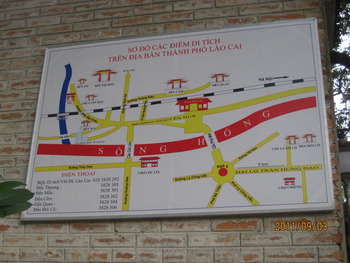
Lào Cai authorities have keenly promoted this form of patriotic nationalism in their border town through a range of nationalist and commemorative projects. Monuments for national war heroes have been constructed across the town, and a park with a memorial house for Hồ Chí Minh was built in 1998 and recently enlarged. Streets are named after national and local heroes and heroines who fought against foreign (Chinese) invasion in Vietnam's ancient and recent past. There are two memorial squares for the National Martyrs: a medium-sized one built in the middle of the old town in 1992, and a giant one built in the middle of the new town in 2007, eight kilometres from the old one. Most remarkable has been the employment of religion in demarcating the physical and spiritual space of national sovereignty by authorities who at the same time violently suppressed religious activities that they condemned as superstitious, such as the conversion to Protestantism of members of the HmongFootnote 37 and Falun Gong-style meditation among groups of urban Kinh. Since the mid-1990s, a number of temples of patriotic gods and goddesses close to the border were renovated, enlarged, or even built anew to form what state authorities hailed as ‘cultural and spiritual border markers’ (những cột mốc văn hóa tâm linh biên giới;Footnote 38 see Figure 1) which are used as the sites of nationalist and commemorative performances.
Map of heritage sites in Lào Cai city, on display at the Father Temple. Source: Photographed by the author, 2011.

Designing this spiritual map is part of the Lào Cai government's plan to become an important stakeholder in the ‘nationalist’ tourism industry, a booming economy that capitalizes on the popular desire to experience the geographical and spiritual edges of the nation by travelling to border areas and paying homage to and worshipping nationalist heroes and patriotic gods and goddesses. Such a plan is a proven success in southern Vietnam, as Philip Taylor shows in his analysis of the popularity of Bà Chúa Xứ (Lady of the Realm), a goddess who dwells on the Vietnamese-Cambodian border.Footnote 39 Starting around 2005, Lào Cai worked with two other highland provinces, Yên Bái and Phú Thọ, to create a programme called ‘Travelling Back to the Roots’ (‘Du lịch Về cội nguồn’), which offers (or created) a chain of touristic rituals and festivals at sites connected to key people and events in the formation of the Vietnamese nation.Footnote 40 This programme is hugely popular and draws a large number of domestic tourists to Lào Cai. Its Mother and Father Temples alone attract tens of thousands of local followers and out-of-town visitors each year. These festivals and the sites where they are held are excellent theatres for local authorities to stage conspicuous performances of state power. In Lào Cai, a national borderland and an ethnocultural frontier of an atheist, communist, and multi-ethnic country, these performances have audiences with quite different ideas about their meaning and quite different imaginations of the national community to which they belong. While the popular fascination with border-dwelling spirits partly reinforces the state's message about the border-marking function of these spirits, religious followers and pilgrims to the Mother Temple and the Father Temple in Lào Cai have concerns that are at odds with state policy and are critical of the state's ideological direction. It is in this conflict of interpretations and narratives that one finds a complex popular understanding of territory and sovereignty.
For example, local residents might completely support the Lào Cai government's strategy to promote religious nationalism in this border town if, besides enshrining a general who fought against the Chinese in the thirteenth century, it also gave appropriate honour to those who died to protect the border from Chinese invasion in the 1979 Border War.Footnote 41 For decades, across the nation, the war has been one of the most puzzling pieces of Vietnamese commemorative politics. As soon as it ended, both the Vietnamese and the Chinese state forbade their citizens from commemorating the war in the public domain and did everything they could to disclaim it. More than three decades later, this ‘unclaimed war’Footnote 42 remains, in both countries, one that cannot be openly discussed and is excluded from official commemorations.Footnote 43 In Vietnam—a ‘Country of Memory’Footnote 44—with a thriving culture of war remembrance, the absence of this war memory from official historiography and state commemorative venues has demanded an explanation. This demand has increased in recent years, especially since the end of 2008, when China and Vietnam disputed territorial claims in what the Chinese call the South China Sea and the Vietnamese, the East Sea. Newspaper opinion pieces, memoirs, and other literary publications discussing the causes of the war, its impact, and the state's control of its memory politics entered the public debate. Many of these were critical of the Vietnamese state and questioned the Communist Party's legitimacy and were thus quickly suppressed. Overseas Vietnamese communities used the negligence in commemorating this war as evidence that the Vietnamese Communist Party placed its loyalty to Beijing above that to the people of Vietnam, especially to those who died for the country in this particular war. Since 2012 a movement led mostly by anti-China Vietnamese activists and bloggers has staged public demonstrations on 17 February to commemorate the war in the city centre of Hanoi and Ho Chi Minh City. State authorities have tried to clamp down on these demonstrations with a combination of force and not-so-subtle methods, such as counter-demonstrations in the same locations with patriotic students dancing and singing, at higher volume, in praise of the party and Uncle Ho. In 2014, preceding the climactic moment of the standoff that occurred when China anchored the oil-exploration rig HD-981 just 150 miles off the coast of Vietnam, for the first time Vietnamese state media were allowed to publish a limited number of articles about the war. This rare coverage included the views and opinions of a number of state officials and military personnel, all of whom were retired.
If the war was reanchored, in a manner of speaking, in Vietnamese official historiography by the Chinese oil rig,Footnote 45 its position in Vietnam's contemporary ‘realms of memory’ remains precarious, especially in the border areas—the war's actual battlefields.Footnote 46 In 2014 Sino-Vietnam tension did prompt the government of Lào Cai to name three roads in the city after martyrs of the 1979 Border War, their first acknowledgement since 1989, and to erect a border-protection stele (bia trấn ải) in Pha Long district, 100 kilometres from Lào Cai city.Footnote 47 Nevertheless, no public demonstration was allowed and local authorities imposed even tighter controls than before on any discussion of the war. My research findings since 2011 show that despite, or perhaps because of, this continuing attempt by the state to control the memory of this war, Lào Cai residents who directly experienced the war continue to be haunted by this violent event.Footnote 48 The bustling scenes of border trade between the twin cities of Lào Cai and Hekou may mislead outsiders about the measure of forgiveness and friendliness in relations between Lào Cai residents and their Chinese neighbours.Footnote 49 It is not hard to notice that such friendliness is only skin-deep. While Chinese border residents may find it easy to forget the war,Footnote 50 many Vietnamese are incapable of ‘Putting aside the past, striking toward the future’ (gác lại quá khứ, hướng tới tương lai), a slogan in state propaganda about what the nation ought to do regarding its violent history. Thus, weaving their memory into the nationalist construction of Lào Cai as a geopolitically important frontier town is one of many creative ways in which residents refuse to forget the past and subtly undermine state hegemony.
Death in defence of the motherland makes its territory sacred, and in Vietnam that nationalist notion of sacrality through martyrdom is often intertwined with other manifestations of the sacred in space. Many Lào Cai residents whom I interviewed have a different interpretation of sacrality than that put on display by the state in promoting a certain version of the history of Vietnam's space and territory. A good example concerns the state's narrative of the history and cultural roles of the Mother Temple and Father Temple. Weaving their own memories into this discourse allows Lào Cai's old residents to reinterpret and challenge these narratives. This process begins with claims about the historical presence of the two Vietnamese spirits—Mother Goddess Liễu Hạnh and Saintly Father Trần Hưng Đạo—in this borderland.
Mother and father: who came here first?
Although they are now often worshipped together as a pair, Liễu Hạnh and Trần Hưng Đạo have separate cults. The cult of Mother Goddess Liễu Hạnh, popularly known as the Four Palaces cult (Đạo Tứ Phủ), is based on spirit possession of mediums who claim to be in constant and intimate contact with the goddess and her subordinates.Footnote 51 The cult emerged in the sixteenth century and became prominent after the decline of Confucianism, which created favourable conditions for the revival of folk religion in the centuries that followed.Footnote 52 As a cult favoured first and foremost by women and traders, the Liễu Hạnh cult enjoyed a significant boost in popularity thanks to a succession of wars that wrecked and divided the country for more than two centuries (1527–1786). In this period, since most men were drafted into battles, women had to shoulder not only domestic work but also trading activities. Associations with war and trade could be traced to various key events in Liễu Hạnh's legend, as well as to the strategic locations where her temples were established. Her homeland, Phủ Giày in Nam Định, was an important link between Vietnam's capital Thăng Long (now Hanoi) and the country's southern districts. Her appearance in areas of critical military importance—as the Mother of the Whole Realm (Mẫu nghi thiên hạ), for example, on the border between the northern court and the southern court during the Lê–Mạc Wars (1533–92)—reflected the determination of the northern polity (the Mạc, r. 1527–92) to demarcate its territory by placing female spirits on the fringes where its rule was weak.Footnote 53
Thanks to his victories over invading Mongol and Chinese armies in the thirteenth century, Trần Hưng Đạo has become the most prominent symbol of Vietnam's national tradition. He was worshipped as a god (Saint Trần) even before his death in 1300. His cult—which venerates him as a great lord (đại vương) whose great skill, among many others, is exorcism—developed later, around the seventeenth century, and was practised simultaneously with the Liễu Hạnh cult. Thanks to the expansion of the Liễu Hạnh cult, Trần Hưng Đạo's cult was thus distributed widely throughout the country. But it was only in the early twentieth century, as modern nationalism developed, that Trần Hưng Đạo started to be worshipped as a national hero.Footnote 54 His cult and the Four Palaces cult attract devotees not only in the north but elsewhere as well, following the migration of Kinh people from the Red River delta to the rest of the country. Only in the past two decades has the connection between the two cults been promoted, specifically as part of the quest for national cultural identity that is a feature of post-colonial nationalism.Footnote 55
Contrary to the historical evidence, the Vietnamese state has promoted the idea that Princess Liễu Hạnh and General Trần Hưng Đạo were venerated together from the start as the spiritual parents of the nation, thereby making their cults part of the essence of Vietnamese (Kinh) culture. While strictly controlling the narratives about the historical presence of both deities in the Lào Cai borderland, the authorities give clear preference to the father over the mother. Official descriptions of the two temples often focus on the Father Temple, its history and role in the nation, while often mentioning the Mother Temple only in passing and as supplementary.Footnote 56 One online article goes so far as to claim that the Father Temple was built one century before the Mother Temple, on the very spot where Trần Hưng Đạo personally commanded the Vietnamese army to fence off Chinese invaders.Footnote 57 The nationalist claim is that the Father Temple has been there for centuries as a spiritual marker of Vietnamese territory and a reminder of the nation's glorious victory over China in this borderland.
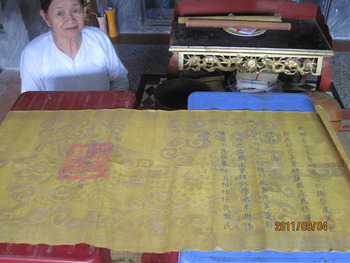
Such official claims are, however, immediately challenged by historical facts, such as the three imperial edicts that were bestowed upon the Mother Goddess Temple (Figure 2; for the translation of these edicts, see the Appendix)—two by King Tự Đức in 1853 and 1880, and one by King Khải Định in 1924. This follows the well-established Chinese pattern of including local cults in the imperial pantheon.Footnote 58 Madam Hà, the 87-year-old incense mistress of the Mother Goddess Temple, is the guardian of these edicts. As the second person in her family to hold this position, Madam Hà is especially knowledgeable about the history of both the Mother Goddess Temples and Lao Cai throughout the twentieth century. She cites the edicts to prove that the official narrative of the Father Temple being built before the Mother Temple is wrong: if it was, why were these imperial honours not bestowed on the Father Temple? Although they belong to the Mother Temple, official records mention the edicts only after this temple was recognized as a national heritage site in 2011. The reason for this ambiguity will be made clear in the next section, but at this point I want to closely examine the details of these edicts. None of them mentions Trần Hưng Đạo, but they do provide an interesting window into the level of the Nguyen dynasty's control of this borderland, as well as the Kinh claim on it. The first edict, for example, honours the Mother Goddess with a lengthy title which emphasizes her benevolence, bravery, and peacekeeping ability. That the goddess is allowed to be worshipped here is a duty as well as an honour because this worship has to be carried out with proper ‘grand grace and ceremonious rites and orderliness’. This command thus regulates not only the cult of the Mother Goddess but also the ritual life on this frontier according to the central standard of the court.
Madam Hà and the imperial edicts. Source: Photographed by the author, 2011.

Standardization, legitimation, and unification are common parts of the development of spirit cults.Footnote 59 Dynastic rulers and literati together and separately played key roles in these processes. Many scholars have pointed out that authorities promoted local spirits for a variety of reasons: dynastic rulers sought to incorporate and control ‘unorthodox’ deities, not only as signs of recognition but also to assert authority over local beliefs and practices.Footnote 60 It is interesting to note that King Tự Đức issued the first of these edicts in 1853, which was not only the 31st year of his reign but also the year in which the Taiping rebels took over Nanjing, effectively declaring their dominance over southern China and bringing their threat closer to Đại Nam (Vietnam's name in the nineteenth century). Five years later, in 1858, the French invaded Vietnam. In 1880, when King Tự Đức issued the second edict, the French had already largely colonized the court and the country's deltas and begun to work their way towards Lào Cai, where they were to fight against forces like the Black Flag Army and Yellow Flag Army. The second edict too bestows all the honorary titles on the goddess, while expressing the king's gratitude for her protection of his subjects. Although the Mother Goddess may be very powerful in the celestial realm, the son of heaven—the king—is, by definition, of higher rank than the gods and goddesses of popular religions, according to the Confucian logic of power relations, to which the Nguyen court subscribed. Acknowledging gratitude to the goddess is thus a sign of humility from the king which indicates a desperate situation. Indeed, as the Nguyen court lost its tenuous grip on Lào Cai, which was then a Sino-French town fully under the control of the French colonial authority, the third edict, issued by King Khải Định in 1924, went further, assigning two more celestial beings, the goddesses Princess Tao He and Princess Nei Chai, to help Mother Goddess Liễu Hạnh to ‘guard our state and protect our people’.
While today the Vietnamese state's control of its territory and economy appears stronger than that of its feudal predecessor, its authority is neither uncontested nor wholly convincing. The Lào Cai government's reconstruction of the temples for the Mother Goddess and Saintly Father Trần Hưng Đạo and the responsibility vested in these celestial beings to guard national sovereignty are ostensibly ingenious in the context of the complex and delicate politics of Sino-Vietnamese normalization over the past two decades. While diplomatic negotiations concerning the border have been carried out both publicly and secretly since the early 1990s,Footnote 61 publicity about the reconstruction of these temples set the tone for the Vietnamese state's cultural-nationalist agenda on this borderland. Emphasizing the presence of Mother Goddess Liễu Hạnh and Saintly Father Trần Hưng Đạo is one of the ways in which Lào Cai authorities have asserted the existence of a unified and coherent historical Vietnamese ‘nation’ here. But more than nationalists elsewhere in the country, Lào Cai authorities are aware of the arbitrariness of this claim. In fact, most claims of Vietnamese territorial sovereignty in the region are riddled with contradictions and controversies. If what are now northern and central Vietnam were indeed part of ‘the southern region’ (nanfang) for a thousand years (111 bce–938 ce),Footnote 62 the proximity of Lào Cai to contemporary China is but a reminder of the novelty of the division of this area into the modern national territories of Vietnam and China. Moreover, since the area has been mainly populated by so-called ethnic minorities and the Kinh moved in not long ago, the claim that it is part of the national territory (that is, the territory populated by the ‘real’, majority Vietnamese) is not immediately convincing—which is also true for the other side of the border, where the Han have only recently become the dominant group. Finally, while the official narrative stresses the unbroken tradition of ‘resistance against foreign aggression’, the speed of the Sino-Vietnamese territorial agreement (which some see as disadvantageous to Vietnam) and the opening of the border further put pressure on local authorities in Lào Cai to explain themselves to patriots in the country as well as to local residents, especially those whose wounds from the 1979 Border War are still open.
Father on top: who was actually worshipped at the Father Temple?
The claim that the practices of worshipping Mother Goddess Liễu Hạnh and Trần Hưng Đạo are distinctively Vietnamese is hard to sustain in the Lào Cai borderland for a number of reasons. Although today the Mother Goddess is adorned in a Vietnamese costume and entertained with Vietnamese music, she appears strikingly similar to mother goddesses in the Chinese tradition. Similarly, although Trần Hưng Đạo defeated the Mongol and Yuan armies, he is praised for his Confucian merits. His statue—with a white complexion, raised eyebrows, and an imperial army general's uniform—is easily mistaken for that of a Chinese mandarin-general. Perhaps this could be explained by the fact that Vietnamese artisans have often drawn inspiration from the Chinese depiction of deities and heroes to create their own. In many places Trần Hưng Đạo looks strikingly similar to Guandi, the Chinese warrior hero. This is but another illustration of how the popular and official parameters of Vietnamese national identity are still formed in complex relation to those elements imagined to constitute ‘Chineseness’ and ‘Vietnameseness’.Footnote 63
There is another challenge to the promotion of the historical presence of the cults of Mother Goddess Liễu Hạnh and Trần Hưng Đạo in Lào Cai as evidence of the cultural domination and hegemony of the Kinh on this frontier. The Kinh group was a minority until the past few decades. Before that, Lào Cai was home to at least 25 ethnic groups, who have cultural and religious practices that are entirely different from those of the Kinh. Although there have been deliberate attempts to incorporate ethnic minorities and some elements of their cultures (such as shamanic techniques),Footnote 64 the cults of Mother Goddess Liễu Hạnh and Trần Hưng Đạo have been exclusively practised by the Kinh people. In Lào Cai, during their rituals, Kinh spirit mediums often change into Hmong dress when they are possessed by Cô Đôi Thượng Ngàn (Second Lady of the Mountain Realm) and into Tai dress when possessed by Cô Bé Bản Đền (Little Lady of Bản Đền), both subordinates of the mother goddess. Ghosts that are exorcized during rituals in the Father Temple may sometimes turn out to have an ethnic-minority background (such as Giáy [Giáy] or Nùng [Nhắng]).Footnote 65 But members of ethnic-minority groups hardly ever participate in either cult as mediums or followers.
The status of Trần Hưng Đạo and his followers’ claim on his temple are also fiercely contested by a number of Lào Cai's former residents of Chinese ethnic origin. According to Mr Mạng, born in Lào Cai to a Cantonese merchant father and a Yao mother from Hekou, the Father Temple was originally a small temple where the god of money (Caishen) and the god of war (Guandi) were venerated. Worshippers were mostly Chinese merchants who, in fact, constituted the majority of Lào Cai's affluent, urban population from the eighteenth century until the 1960s. After Liu Yongfu died in 1917, local Chinese residents, many of whom were his former soldiers, added his statue to the temple. Mr Mạng's theory is shared by many people who used to live in Lào Cai but left for China in 1978 as the tension preceding the 1979 Border War heightened and who now live in China's Hekou County. This view was even incorporated into brochures given to Chinese tourists to make sure that they would not miss ‘Liu Yongfu's temple’ on their visit to Lào Cai. I was told that due to the objection of the Lào Cai government, the Hekou Tourism Department has recently discontinued this brochure and instructed its tour guides not to describe the Father Temple as Liu Yongfu's temple anymore.
Although she does not agree with Mr Mạng about the Chinese origin of the Father Temple, Madam Hà is critical of the Lào Cai government's narrative that it was built long ago for the worship of Trần Hưng Đạo. ‘Father had never set foot here!’ she exclaimed. ‘They just fabricated history.’ In their counternarrative, Madam Hà and three other elders whose families settled in Lào Cai more than 100 years ago asserted that the Father Temple was originally a small communal house built in the late 1920s by a wealthy man called Hoàng Đình Ninh. After a while he sent someone to Kiếp Bạc temple, the place where Trần Hưng Đạo made military and logistic preparations for the wars against the Mongols and where he was worshipped after his epic victory, to request an incense-dividing relationship. Only after that did Trần Hưng Đạo begin to be worshipped in the Lào Cai communal house.
Madam Hà and the other followers’ protests about the authentic history of the Father Temple have to do with what they see as gender discrimination in how the government treats their goddess. While the imperial edicts honour the Mother Goddess and certify the presence of her temple here since at least the mid-nineteenth century, her temple was not recognized as a national heritage site until 2011. The Father Temple, with an unclear history and no edicts, on the other hand, was not only quickly given this title in 1996 but also became central to the design and reconstruction of Lào Cai when local authorities decided to create the Constellation of Father Temple Heritage Sites (Quần thể di tích lịch sử văn hóa Đền Thượng). This plan was made to preserve the current position of the Father Temple, on the top of the city's hill. While the plan's geomantic logic is weak, according to a Buddhist monk in the nearby Tân Bảo temple, its nationalist and pragmatic reasons are strong: ‘He [Trần Hưng Đạo] is our nation's supreme father. Of course he should be on the highest seat’, a cultural official told me. An architect at the Lào Cai Bureau for Urban Planning explained to me how having the Father Temple on top of the hill allowed him and his colleagues to design the heritage sites with an eye on the long-term development of tourism, which requires a large parking area, a playground, food and drink venues, and boutique gift stores. Although most of this infrastructure has not been realized, these sites have proved efficient in accommodating ‘Travelling Back to the Roots’ events over the past few years.
Mother's displeasure: gender hierarchy in post-war nationalism
Simultaneously, both liminality and centrality characterize the place of Mother Goddess Liễu Hạnh in Vietnamese identity. On the one hand, she is indigenous and quintessentially Kinh, yet, on the other, she can be derided as a marginal object of superstition. Myths about her origin and characteristics vary and are sometimes contradictory in a way that Duara terms ‘the superscription of symbols’.Footnote 66 One common element in most of the sources about her is that her reputation and relationship to good and evil are decidedly more complicated than those of Trần Hưng Đạo. Her cult appeared only in the sixteenth century, long after Vietnamese society was first Confucianized, by which time it was thus partly shaped by certain Confucian values and moral logic.
To speak of fathers and mothers, as Phương and Eiper point out, is to speak of masculinity and femininity, and the forces that unite and divide men and women.Footnote 67 The gender dynamics that have served to differentiate the cults of Liễu Hạnh and of Trần Hưng Đạo have simultaneously shaped the characters of these deities, many of whose followers are devotees of both, which in turn helps to explain the mingling and mutual dependence that have become features of rituals devoted to them. Therefore, it is perhaps more sensible to see the imperial edicts honouring the Mother Goddess not as signs of the Nguyen court's gender-equality policy, but as evidence that Trần Hưng Đạo was not venerated in this borderland or at least that his cult was of minor significance here prior to 1924 (when the third edict was issued).
Although the dynastic assertion of hegemony was important in promoting and controlling the cult of Liễu Hạnh, as these imperial edicts show, it was the devotees themselves who were responsible for the cult's diffusion and development throughout the country up to today. The location of Liễu Hạnh's temples along heavily trafficked routes, of which Lào Cai is an excellent example, reflects the importance of traders in the dissemination of her cult—especially female traders. The cult thrived alongside the emerging commercial economy. However, this popular contribution to the expansion of the cult has not always been appreciated nor even recognized by past or present state authorities. When she requested permission from the goddess to let me view the imperial edicts, Madam Hà introduced me as ‘an anthropologist who wishes to learn the truth about the history of her hometown’, not from love of rhetorical expression but because of her belief in the other ‘truth’ of Lào Cai's history, starting with the truth about her temple's history. Madam Hà also warned me that if I were to write about the temple and its imperial edicts, I should not follow a number of narratives created by men of considerable authority who, she believed, had bent historical truths to legitimate removing the temple and appropriating its land.
The first man who wanted to remove the temple was, in fact, none other than Liu Yongfu, the notorious leader of the Black Flag Army. At the time, Madam Hà’s grandmother was serving as the temple's third incense mistress. Between 1868 and 1885, Liu made Lào Cai his military headquarters, constructing a fortress to demarcate his lines of control and collecting taxes from the lucrative trade in opium, metals, and salt that had made the region flourish.Footnote 68 The walls of the fortress encircled most residential land and temples in the area, except for the Mother Temple, which stood on a very low spot right where the Nam Thi River merged with the Red River and therefore was too low and too far away for the fortress to reach. As people from inside the walls used visits to the temple as an excuse to leave the fortress, thus making it difficult for the authorities to control them, Liu ordered the temple to be moved inside. This order was met with resistance by both people and, as they reported, the goddess: an epidemic soon spread among the soldiers of the Black Flag Army. Liu then came to Madam Hà’s grandmother and told her, ‘If your goddess is so efficient and powerful [Vietnamese: linh thiêng; Chinese: ling], ask her to cure my soldiers. If she succeeds, I will let the temple stay here. If not, the temple has to move inside the walls or I will behead anyone who resists.’ Madam Hà’s grandmother was very worried. She fasted for three days, then prepared a table of offerings and prayed to the goddess. Miraculously, the epidemic ceased. Liu kept his word, allowing the temple to stay where it was and granting its followers inside his fortress leave to visit it. This explains why Lào Cai's Mother Goddess Temple is the only temple in Vietnam that is outside a city's fortress walls.
During the anti-superstition campaigns of the 1960s and 1970s, socialist authorities made several attempts to remove or close down the Mother Temple. At one point, at the beginning of the Chinese Cultural Revolution, Chinese cadres from Hekou came to Lào Cai and ‘advised’ its authorities to shut down the temple. This advice was not taken seriously, but during the 1970s, followers of the temple had to pay visits to the goddess secretly to avoid being criticized and arrested by the authorities. In 1977, as North and South Vietnam unified, the authorities wanted to speed up the race (with China) to socialism, and consequently anti-superstition campaigns became more aggressive. This prompted Lào Cai cultural cadres to plan a demolition of the temple and its icons, including the old statues of the Mother Goddess herself. However, after the first actions, several people involved suddenly fell ill, and two even died, so the plan changed. Most of the icons were brought into a corner of the Father Temple, which was not subject to demolition, because its followers worshipped the national military hero, an activity that was seen not as superstitious but as patriotic. The Mother Temple was turned into a storehouse for a construction unit.
The 1979 Border War, as Madam Hà and other Mother Temple followers see it, was a punishment from the goddess for her mistreatment by the Lào Cai authorities. A month after the ceasefire, some residents who had fled Lào Cai secretly returned to collect their most important belongings. Madam Hà was one of them. Among the few things she took were the three imperial decrees, which she had hidden in a secret place in her house for the duration of the anti-superstition campaigns. Although, like most Vietnamese, she could not understand the messages written on the scrolls, she had learned from her grandmother that they were of historical importance and that, like her grandmother, she should guard them at all costs. In 1991, as soon as they returned to Lào Cai, Madam Hà and her family and friends laboured to clean up the former Mother Temple grounds and erected a little hut there. A number of former residents, the most important of whom was Madam Sường,Footnote 69 brought in several old statues from the temple which had been stolen, hidden, or thrown away early in the anti-superstition campaign or found among the ruins of the Father Temple. In the following four years, Madam Sường, Madam Hà, and their temple fellows travelled, calling for donations to rebuild the Mother Temple into a tile-roofed, three-room concrete house with a full collection of statues and icons.
Some soldiers in a squad still stationed nearby enthusiastically supported this reconstruction. They claimed to have personally experienced the Mother Goddess's ‘sacred and effective’ power during their posting near the temple. In the ten years of the border war, the temple grounds were used as a guarding and commanding position, and these soldiers were among those who took turns guarding this point. They recalled that at the outer corner of the grounds was a small shrine (miếu) to the forest god Sơn Thần which somehow survived the destruction of both the anti-superstition campaign and the bombing during the war. Several statues and icons were still in it. One day, bored from having nothing to do on their shift, some mischievous soldiers wanted to fool around. They went into the shrine, and one said to the statue of the forest god, ‘It's so damn quiet here! Let's bring you up there to have some fun.’ They then carried the statue to their post. One of the soldiers put his helmet on the statue, and another even hung his AK-47 over the god's shoulder. That night, all of them were suddenly attacked by severe pain in their stomachs. So, scared, their fellow soldiers quickly put together a small offering table to beg the Mother Goddess to forgive their trespassing.
In 1996 the fate of the temple and the independent status of the Mother Goddess were again threatened when the Lào Cai government issued a new plan for the border. The border port, which at that time used the structure of an old railroad bridge to China that the French authorities had built in the early twentieth century, had quickly become too small for the growing trade between the two countries. The area where the Mother Goddess Temple stands was chosen as the location for a new and bigger border gate. As soon as the plan was certified, both the Lào Cai Border Military Unit and Lào Cai Border Customs wanted to appropriate the Mother Temple's land for their headquarters. The Lào Cai Department of Trade and Commerce also had its eye on the spot as the ideal location for a duty-free shopping mall.
In the face of these powerful parties, the Mother Temple's followers felt almost helpless. In the same period, the Lào Cai government was preparing an application for the central government to recognize the Father Temple as a national heritage site. One of the application's proposals was the relocation of the Mother Goddess Temple into the area designated for the Father Temple heritage site. As part of the preparation for the application, Professor Trần Quốc Vượng, a renowned historian of Vietnamese tradition and culture, was invited to visit Lào Cai to research and write a report on the importance of the Father Temple to Vietnamese culture and nationalism. He went to the Mother Temple and was allowed to view the imperial edicts. After reading them, he told Madam Hà their meaning and the historical importance of having the Mother Goddess Temple stay in its original location. Hearing that, she and the temple's other followers had hope again. They brought the decrees to the government, hoping that the authorities would change their minds about relocating the temple. But as soon as they saw the decrees, officials at the Lào Cai Department of Culture and Information confiscated them, stating that they were part of the nation's heritage. The decrees were then used in the Father Temple's application, which the central government soon approved. In 1996, the year when its application was submitted, the Father Temple was awarded national heritage status and given funding for rebuilding and refurbishing to match its new standing.
The Lào Cai bureaucrats who misused the imperial decrees exemplify what Ken McLean describes as ‘the government of mistrust’Footnote 70 and have certainly taught Madam Hà a valuable lesson about the untrustworthiness of Vietnamese socialist bureaucrats in the governing of documents and historical truth. It is unclear whether Professor Trần included the messages in the imperial decrees in his report, if he ever wrote it, but the Lào Cai government did finally stop pursuing the plan to force the Mother Goddess to move to the Father Temple. In 2004 the government recognized the Mother Goddess cult as Đạo Mẫu, an official religion of indigenous origin rather than simply a belief or practice. This was partly due to the lobbying of academics who traced the history of this cult and its centrality to the construction of a supposed national essence. It also exemplifies the kinds of changes entailed by the cultural turn of Vietnamese nationalism after 1986, namely the broader shift in religious nationalism from tales of masculine heroism to stories of feminine nurturing and protection. Elsewhere in the country, the worship of the Mother Goddess accompanied by spirit possession is flourishing. However, in border areas like Lào Cai, even though the suppression of the Mother Goddess and the appropriation of her nurturing and protection have eased, masculine heroism still dominates the official religious-nationalist agenda. On important ritual days of the two temples, for example, as a rule, official visits of top provincial leaders such as the chair of the Provincial People's Committee or the party secretary are staged at the Father Temple, while the deputy-ranking politicians and leaders of the Provincial Women's Union go to the Mother Temple. In early 2011, after several appeals by its followers and due to the change in the Chinese-Vietnamese relationship, the Mother Goddess Temple was finally also recognized as a national heritage site and the imperial decrees returned to it. Madam Hà again hid them in a secret place with loving care.
Conclusion
After carefully and neatly rolling up the three scrolls of the imperial edicts, Madam Hà threw her chin in the direction of National Border Marker No. 102, in the Mother Temple's front yard, and whispered to me, ‘Concrete border markers like those can be put in and pulled out at men's will.’ As she tapped her pointing finger on the scrolls, her voice rose with determination: ‘Mother's presence here, evidenced by these imperial edicts, is the only supreme claim of national territorial sovereignty.’ Although still holding a grudge against the socialist state for its mistreatment of her goddess, Madam Hà was nevertheless quite happy with the recent official recognition of the temple as a national heritage site. In her view, this certification, like the imperial edicts, not only secured the temple's position in Lào Cai's official spiritual map but also acknowledged that once more the state had to resort to the Mother Goddess's power to protect its borders and sacralize its national sovereignty.
Madam Hà’s belief in the goddess's power to protect the national territory and her own lifelong struggle to protect the Mother Temple exemplify one of the many layers of borderland religious nationalism that I have uncovered in this article. Religious nationalism in borderland areas is the process of mobilizing religion and investing it with political power to sacralize the nation's territory, unity, and history. In Lào Cai, the enduring popularity of two religious institutions animates this process. The Father Temple is key to the Vietnamese state-sponsored patriarchal-military-nationalist strategy of promoting the cult of a general who defeated the Yuan in the thirteenth century and who, by that token, still inspires the Vietnamese to defeat invaders, especially those from China. As such, it is instrumental to Vietnam's geo-religious politics. The Mother Goddess is an expression of a popular religious nationalism that also emphasizes the territorial claims of the Kinh, Vietnam's majority ethnic group. In clear distinction from the General-Father God cult, the Mother Goddess cult is primarily devotional and was thus frowned upon by the Communists, which led to its marginalization and even suppression in the 1960s and early 1970s under the influence of the Chinese Cultural Revolution and its anti-superstition campaign. After Vietnamese nationalism took its cultural turn, state authorities hailed the goddess's nurturing and protective qualities. Yet she continued to suffer suppression in Lào Cai, where the state maintained the need to display a masculine, militaristic nationalism.
Historically Lào Cai and its temples have been part of a shifting landscape that cannot be reduced to the contemporary territorial claims of Vietnam and China but can be understood as belonging to a wider sphere of Nanfang (neither Chinese nor Vietnamese), in which Chinese civilization is the major cultural model and Kinh ethnic presence is relatively marginal. The Vietnamese Communist state has no choice but to accommodate the sacred in its nationalism, although it is constantly trying to control this element and use it for its own purposes of official nationalism. However, the beliefs and practices surrounding the Mother Goddess are simultaneously more potent and more difficult to control than those surrounding the General-Father God. Moreover, the conundrum of the Vietnamese state is that it must both enhance territorial nationalism, to withstand the growing power of China, and control it at the same time, to be a growing trade partner of its northern neighbour. Like elsewhere, in Vietnam sovereignty is simultaneously expressed in international relations and in domestic population control, but here with the complicating element that Vietnam as a whole is culturally dominated by civilizational trends in China (from Confucianism to Chinese Communism), while the border areas are populated not by the Kinh majority but by minorities that live on both sides of the border. Earnestly regarding the General-Father God and the Mother Goddess as their spiritual parents, whose historical presence backed their fragile claim to cultural domination in this multi-ethnic borderland, many Kinh devotees of both temples eventually sided with the state in excluding the Hoa people and other ethnic groups from the religious history and geography of the town.
Newly opened border trade with China has led the Vietnamese state to continue exercising control over the memory of the 1979 Border War, but not always with full success, while constructing new religious and political symbols to boost nationalism and national territorial sovereignty in Lào Cai. The reconstruction of Lào Cai was aimed at multiple audiences: externally, in China, to make a statement about Vietnamese national identity, and internally, in Lào Cai, as part of the project of re-creating its residents as members of an ideologized and mobilized nationalist polity. As in many other places around the world, collective memory has become an important political resource for people in Lào Cai, shaping their relations with the state in the new context of economic reform, including the opening up of the border. This is particularly visible in nationalist tourism, a new trend of travelling in post–Đổi Mới Vietnam which has become a significant impetus for the installation or reinvention of religious symbols in this borderland. The state's attempt to suppress people's memory of the war and its reinvention of Lào Cai's history continue to be contested by the people. However, this is not a simple story of domination and resistance but an account of the newness of the borderland and the contradictory imagination of national territory and identity. The dynamics of the social memory of the 1979 Border War in Lào Cai reveals a fascinating tension inherent in the relationship between state formation and religious expressions of nationalism.
Appendix
Imperial edict 1
敕柳杏公主尊神。原贈弘施普度英靈靜正妙化上等神。護國庇民、稔著X應、肆令丕膺,耿命緬念神庥。可知加贈弘施普度英靈靜正妙化莊徽上等神。仍準水尾州保勝府依舊奉事神。其相佑保我黎民。欽哉。
嗣德XX 玖月貳拾肆日
(1848–1883)
The revered goddess, imperially enfeoffed as the Princess of Willow and Apricot, was originally granted the title of First-Class Deity: (Goddess) of Miraculous Transformations, Quiescence and Propriety, Spiritual Numinosity, and Vast Dispenser of Universal Salvation. She has protected the state and aided the people—her many (miraculous) deeds have been carefully recorded. We now announce the order to greatly enhance her honours. This shining decree calls for all to constantly reflect on the goddess’ blessings. Let it be known that we have added (to her title, which is now) First-Class Deity: (Goddess) of Grand Subtlety, Miraculous Transformations, Quiescence and Propriety, Spiritual Numinosity, and Vast Dispenser of Universal Salvation. We also permit the Baosheng Prefecture of Shuiwei Commandery to continue worshipping the goddess in accordance with the ancient rites. May she continue to protect our common people. By imperial consent.
Written on the 24th day of the 9th month of the XX year of the reign of Tự Đức
(1848–1883)
Imperial edict 2
敕旨興化省水尾州保勝府從(前)奉事弘施普度英靈靜正妙化莊徽敕柳杏公主上等神節。經頒給敕封準其奉事。嗣徳三十一年正值朕五旬大慶節。經頒寶詔覃恩。禮隆登秩。特準許依舊奉事。用誌國慶而伸祀典。欽哉
嗣徳参拾参年壹月貳拾肆日
By imperial edict, the Baosheng Prefecture of Shuiwei Commandery of Xinghua Province has worshipped on the feast day of the First-Class Deity, enfeoffed as the Princess of Willow and Apricot, the (Goddess) of Grand Subtlety, Miraculous Transformations, Quiescence and Propriety, Spiritual Numinosity, and Vast Dispenser of Universal Salvation. After going through a formal announcement of the enfeoffment it is permitted to carry out the worship (of the goddess). In this 31st year of the Side reign (1878), I the emperor decree a great festival to celebrate my 50th birthday. Having announced in a precious proclamation I extend my mercy and blessings. The rites are solemn and the goddess is promoted. I grant special permission for her worship to be carried out with the ancient rites. This should be recorded as a national celebration and an extension of the state cult. By imperial decree.
3 March 1881
Imperial edict 3
敕老街省保勝州牢該社奉事敕柳杏公主尊神、總領洮河公主尊神、內差公主尊神,護國庇民,稔著靈應,肆令正值朕四旬大慶節。經頒寶詔,覃恩禮隆登秩。柳杏公主著封為莊徽翊保中興上等神。洮河公主、內差公主均著封為翊保中興靈扶尊神。準其奉事。神其相佑,保我黎民。欽哉
啟定玖年柒月貳拾五日
By imperial decree to the Laogai Village of Baosheng Commandery of Laojie Province, worship the imperially enfeoffed respected goddess the Princess of Willow and Apricot, the respected goddess of the Yao River and the respected goddess of Domestic Duties, who have all aided the state and protected the people. We have recorded their miraculous responses. I decree this is my 40th birthday. I proclaim through a Precious Edict that my mercy has been extended, the rites of worship have been made solemn and the goddesses have been promoted. The Princess of Willow and Apricot has been (further enfeoffed as) the First-Class Goddess of Grand Subtlety Who Aids and Protects (the State) and Restores the Centre. The Princess of the Yao River and the Princess of Domestic Duties both have had new titles inscribed for their promotion to Respected Deity Who Aids and Protects (the State) and Restores the Centre with Supernatural Support. It is permitted to worship these goddesses (under these new titles). They have one after the other aided my common people. By imperial decree.
7 September 1924