One of the essential research issues in associative learning is the study of the associations that form among the elements involved in the learning situation. Within instrumental learning those elements are the discriminative stimulus (SD), the instrumental response (R), and the outcome (O). Research into the contents of instrumental learning has shown that both human and nonhuman animals learn all the different binary associations between the involved elements: SD-R (e.g., Colwill, Reference Colwill1994; Gámez & Rosas, Reference Gámez and Rosas2007; Thorndike, Reference Thorndike1932), R-O (e.g., Colwill & Rescorla, Reference Colwill and Rescorla1985, Reference Colwill, Rescorla and Bower1986; Gámez & Rosas, Reference Gámez and Rosas2007; Tolman, Reference Tolman1932; Vega, Vila, & Rosas, Reference Vega, Vila and Rosas2004), and SD-O (e.g., Colwill & Rescorla, Reference Colwill and Rescorla1988; Gámez & Rosas, Reference Gámez and Rosas2005, Reference Gámez and Rosas2007; Hull, Reference Hull1930, Reference Hull1931). Also, subjects may learn hierarchical associations among the three elements involved in the instrumental learning situation, so that the R-O association is modulated by the SD (e.g., Colwill & Rescorla, Reference Colwill and Rescorla1990b; Gámez & Rosas, Reference Gámez and Rosas2007; Skinner, Reference Skinner1938). Similarly, in simple classical conditioning situations in which the conditioned stimulus (CS) is paired with the unconditioned stimulus (US) leading to the conditioned response (CR), binary CS-US associations seem to be the most commonly established (e.g., Colwill & Motzkin, Reference Colwill and Motzkin1994; Paredes-Olay, Abad, Gámez, & Rosas, Reference Paredes-Olay, Abad, Gámez and Rosas2002; Rescorla, Reference Rescorla1973). However, CS-CR associations are also likely to influence performance (e.g., Rescorla, Reference Rescorla1973). Finally, hierarchical associations can control performance in classical conditioning when the CS-US relationship is modulated by a third stimulus, such as in feature-positive and feature-negative occasion setting designs (e.g., Holland, Reference Holland, Commons, Herrnstein and Wagner1983, Reference Holland1984; Rescorla, Reference Rescorla, Miller and Spear1985).
Most studies analyzing the contents of associative learning have been conducted with nonhuman animals and have used different variations of two basic evaluation techniques: Reinforcer revaluation where the value of the reinforcer is changed after conditioning (e.g., Holland & Rescorla, Reference Holland and Rescorla1975), and outcome-based-transfer procedures (e.g., Kruse, Overmier, Konz, & Rokke, Reference Kruse, Overmier, Konz and Rokke1983). For instance, employing a conditioned-suppression procedure with rats, Rescorla (Reference Rescorla1973) carried out an experiment in which rats had to press a bar for food. A light was occasionally paired with an intense noise, so that rats suppressed bar pressing in the presence of the light. After that training, a group of rats were habituated to the intense noise that had played the role of the US during conditioning, whereas another group did not receive additional presentations of the noise. That is, the capacity of the noise to elicit fear was devalued in the first group, while it was kept intact in the second group. In a subsequent extinction test conducted with the light CS, extinction proceeded faster in the group in which the US had been devalued than in the control group. The effect of post-training devaluation of the US upon conditioned responding suggests that rats had learned a CS-US association during the conditioned suppression phase. A CS-CR association should have not been affected by devaluation of an element (the US) (see also Colwill & Motzkin, Reference Colwill and Motzkin1994; Colwill & Rescorla, Reference Colwill and Rescorla1990a; Holland, Reference Holland2004; Rescorla, Reference Rescorla1990, Reference Rescorla1992b, Reference Rescorla1993, Reference Rescorla1996; Shipley & Colwill, Reference Shipley and Colwill1996, for different examples of the use of the outcome-devaluation).
In an example of how the outcome-based transfer technique has been used for studying CS-US associations, Colwill and Motzkin (Reference Colwill and Motzkin1994) trained rats with two conditioned stimuli (CS1 and CS2) that were each paired with two different respective outcomes (O1 and O2). Subsequently, rats were trained with two instrumental responses (R1 and R2), each followed by one of the outcomes previously paired with CS1 and CS2. At the end of this training, CS1 shared the outcome with R1 while CS2 shared the outcome with R2, though the CSs and instrumental responses were never trained together. During the final test, rats were allowed to choose between R1 and R2 in the presence and in the absence of each conditioned stimulus. When no conditioned stimuli were present, rats’ choice was equally distributed between R1 and R2. However, when the CS was present, rats preferentially performed the instrumental response that was paired with the same outcome as was paired with the present CS. That is, they responded more on R1 than on R2 when CS1 was present, and more in R2 than in R1 when CS2 was present. That type of result is interpreted as showing that stimulus-outcome associations were established during the initial classical conditioning phase (see also Colwill & Rescorla, Reference Colwill and Rescorla1988; Delamater, Reference Delamater1996; Holland, Reference Holland2004; Rescorla, Reference Rescorla1991, Reference Rescorla1992a, Reference Rescorla1994, Reference Rescorla2000 for other examples of the use of the outcome-based transfer technique).
From the point of view of comparative psychology an interesting question within this line of research is whether human and nonhuman animals establish the same associative structure when confronting roughly similar situations. This issue important given that there is research suggesting that the mechanisms involved in human learning are different from the ones that may be involved in animals. For example learning relationships between two events in humans has been suggested to use rule-based (e.g., Cheng, Reference Cheng1997; Cheng & Novic, Reference Cheng and Novic1990; Perales, Catena, & Maldonado, Reference Perales, Catena and Maldonado2002; Waldman & Holyoak, Reference Waldmann and Holyoak1992), or propositional reasoning mechanisms (e.g., De Houwer, Reference De Houwer2009; De Houwer, Beckers, & Vandorpe, Reference De Houwer, Beckers and Vandorpe2005; Lovibond, Reference Lovibond2003; Mitchel, De Houwer, & Lovibond, Reference Mitchell, De Houwer and Lovibond2009), rather than the associative mechanisms apparently used by other animals (e.g., Denniston, Savastano, & Miller, Reference Denniston, Savastano, Miller, Mowrer and Klein2001; Mackintosh, Reference Mackintosh1975; Pearce & Hall, Reference Pearce and Hall1980; Rescorla & Wagner, Reference Rescorla, Wagner, Black and Prokasy1972; Wagner, Reference Wagner, Miller and Spear1985). Demonstrating the involvement of simple associative structures in human instrumental and classical conditioning situations would add to the evidence that shows our psychological similarities with other animal species without rejecting the implication that higher order processes can operate as well in basic human associative learning.
Several studies analyzing the contents of human instrumental learning have been conducted during the last decade by adapting revaluation and outcome-based transfer techniques to humans (Gámez & Rosas, Reference Gámez and Rosas2005, Reference Gámez and Rosas2007; Paredes-Olay et al., Reference Paredes-Olay, Abad, Gámez and Rosas2002; Rosas, Paredes-Olay, García-Gutiérrez, Espinosa, & Abad, Reference Rosas, Paredes-Olay, García-Gutiérrez, Espinosa and Abad2010; Vega et al., Reference Vega, Vila and Rosas2004). For instance, Vega et al. (Reference Vega, Vila and Rosas2004) used a revaluation procedure to analyze R-O associations in human instrumental conditioning. They found that increasing or decreasing the value of the outcome after learning different R-O pairings increased or decreased, respectively, the response related with the specific outcome whose value was modified. Similarly, Gámez and Rosas (Reference Gámez and Rosas2007) used the outcome-based transfer technique to assess the formation of SD-O associations. They found positive transfer between a discriminative stimulus trained with one instrumental response and a different instrumental response that shared the outcome, uncovering the role of the SD-O association in controlling instrumental performance. Additionally, they found that post-acquisition devaluation of an outcome selectively reduced the response trained with that specific outcome, revealing the control of behavior by a R-O association. These studies showed remarkable similarities between the contents of associative learning established in human and nonhuman instrumental learning situations.
To our knowledge, there are no studies specifically devoted to the study of the contents of associative learning in human classical conditioning situations (but see Walther, Gawronski, Blank, & Langer, Reference Walther, Gawronski, Blank and Langer2009, for an exploration of CS-US associations in evaluative conditioning). The use of standard classical conditioning procedures for studying learning in humans is not as common in the literature, due to the difficulties associated to the use of biologically relevant outcomes (but see, e.g., Grillon & Ameli, Reference Grillon and Ameli2001; Hermans et al., Reference Hermans, Dirikx, Vansteenwegenin, Baeyens, Van Den Bergh and Eelen2005; Hinchy, Lovibond, & Ter-Horst, Reference Hinchy, Lovibond and Ter-Horst1995; Martin & Levey, Reference Martin and Levey1991; Perruchet, Reference Perruchet1985). It is more common to study human learning by using causal or predictive learning tasks in which a cue is paired with an outcome and participants are asked to either predict the outcome in the presence of the cue (e.g., Dickinson, Shanks, & Evenden, Reference Dickinson, Shanks and Evenden1984; García-Gutiérrez & Rosas, Reference García-Gutiérrez and Rosas2003; Pineño & Matute, Reference Pineño and Matute2000; Rosas & Callejas-Aguilera, Reference Rosas and Callejas-Aguilera2006), or to give a judgment about the causal relationships between the cue and outcome on a given scale (e.g., Chapman, Reference Chapman1991; Cobos, López, Caño, Almaraz, & Shanks, Reference Cobos, López, Caño, Almaraz and Shanks2002; van Hamme, Kao, & Wasserman, Reference Van, Kao and Wasserman1993; Waldmann, Reference Waldmann2000).
Within the causal- and contingency-learning tradition, the study of the content of learning has not been a main focus of interest. The involvement of Cue-Outcome relationships in human predictive learning may be deducted from those reports in which participants are trained in a predictive situation and then requested to give a contingency judgment during the test (Cobos, Caño, López, Luque, & Almaraz, Reference Cobos, Caño, López, Luque and Almaraz2000; García-Gutiérrez & Rosas, Reference García-Gutiérrez and Rosas2003). However, as those experiments were conducted with different goals from the study of the contents of learning, it is not clear which of the possible associations developed during the specific procedure used in those studies controlled responding during testing. Indeed, we are not aware of any report exploring the contents of learning using these tasks. Related studies have focused explored the role that the frequency of requested judgments and the type of trial have on covariation learning (e.g., Catena, Maldonado, & Cándido, Reference Catena, Maldonado and Cándido1998; Catena, Maldonado, Megías, & Frese, Reference Catena, Maldonado, Megías and Frese2002; Maldonado, Catena, Cándido, & García, Reference Maldonado, Catena, Cándido and García1999), finding that participants recall quite well the different types of trials used within a covariation procedure. Such information has been used to evaluate, for instance, the stage of processing in which cue-competition type phenomena take place (e.g., Ramos-Álvarez & Catena, Reference Ramos-Álvarez and Catena2005; see also Valleé-Tourangeau, Hollingsworth, & Murphy, Reference Vallée-Tourangeau, Hollingsworth and Murphy1998).
Within the associative tradition, Paredes-Olay et al. (Reference Paredes-Olay, Abad, Gámez and Rosas2002) used the outcome-based transfer technique to explore the role of cue-outcome relationships within a predictive learning situation in which a cue was paired with the outcome (see also Rosas et al., Reference Rosas, Paredes-Olay, García-Gutiérrez, Espinosa and Abad2010). Participants were first trained in a simple video-game setting in which they had to use two different responses to destroy two different attackers, establishing two different response-outcome combinations, R1-O1 and R2-O2. Participants were then trained in a predictive learning situation in which two different cues were paired with the two original outcomes, regardless of the judgment participants gave to the cue (A-O1, B-O2). Learning about Cue-Outcome relationships was evaluated in a subsequent test in extinction in which participants had the opportunity to perform the original responses (R1 or R2) in the presence and the absence of the cues trained during the second phase. Similar to what was reported by Colwill and Motzkin (Reference Colwill and Motzkin1994) with rats, the cue enhanced the response that had been trained with the same outcome showing evidence of Cue-Outcome associations in human predictive learning through their influence on instrumental responding.
The goal of the experiments presented in this study was to explore the type of relationships established in human predictive learning in situations that do not involve instrumental training. Experiment 1 explored the role of cue-outcome relationships in human predictive learning by using a devaluation procedure. Experiment 2 used a variation of the transfer technique to evaluate whether judgment-outcome relationships were also established within a simple predictive learning situation.
Experiment 1
Paredes-Olay et al. (Reference Paredes-Olay, Abad, Gámez and Rosas2002) reported control of instrumental responding by predictive cues that were separately paired with the same outcomes as had previously followed the instrumental responses (see also Rosas et al., Reference Rosas, Paredes-Olay, García-Gutiérrez, Espinosa and Abad2010). This outcome-based transfer procedure allows for obtaining an independent measure of cue-outcome predictive relationships, as they are shown through their influence on instrumental responses that were not part of predictive training. However, to be able to work with such an independent measure, instrumental training should be conducted at some point before the test (e.g., Delamater, Reference Delamater1996; Paredes-Olay et al., Reference Paredes-Olay, Abad, Gámez and Rosas2002; Rescorla, Reference Rescorla2000; Rosas et al., Reference Rosas, Paredes-Olay, García-Gutiérrez, Espinosa and Abad2010), and such training could influence test responding as much as the kind of relationships established during predictive training. Post-training modification of the value of the outcome overcomes this problem. Outcome revaluation is conducted after training is complete, so, it should affect only the expression of the underlying associative structure, and not affect the associative structure established during training. Specifically, outcome devaluation after training should decrease performance based on cue-outcome associations. Outcome devaluation should not affect the association between the cue and the response, so performance based on that associative structure should remain intact (e.g., Gámez & Rosas, Reference Gámez and Rosas2007).
The goal of the first experiment in this series was to explore the role of cue-outcome associations in human predictive learning by using a post-training outcome devaluation procedure. The design of the Experiment is presented in the top row of Table 1. Using the videogame briefly described at the end of the introduction, participants were requested to predict whether the presence of a specific military company (cues) in a battlefield led to ship destruction, plane destruction, or no destruction at all (outcomes). After the participant gave his or her predictive judgment, and regardless of which one it was, the outcome was presented. We expected that participants would learn which cues were followed by which outcomes (A-O1 and B-O2) as trials progressed.
Design of Experiments 1, and 2

Note:
Cues A and B were two different military companies, counterbalanced. Outcomes O1 and O2 were plane and ship destruction, counterbalanced. Responses R1 and R2 were keys 1 and 2 in a standard keyboard. See text for details.
After this first phase was complete, devaluation proceeded by instructing participants that one specific attacker was now indestructible. At first sight, it might be argued whether the use of the term “outcome devaluation” is not appropriate for describing the procedure used here. However, the situation is akin to those in which food is devalued by being paired with Lithium Chloride in the sense that in both situations the treatment is expected to make the outcome unattractive for the subject, though changes in the emotional valence of the outcome should be obviously bigger in the case of devaluation by Lithium Chloride (e.g., Colwill & Rescorla, Reference Colwill and Rescorla1985). In this latter case, the outcome is inedible, in our case, the outcome is indestructible. This parallel has led us to use the traditional term of outcome-devaluation.
For half of the participants the outcome devaluated was O1, while for the other half the outcome devalued was O2. The test phase was identical to the training phase with the only difference that the test was conducted in extinction. If participants established a cue-outcome association during the training phase, they should respond less to the cue that was originally followed by the devalued outcome than to the cue that was followed by the alternative outcome.
Method
Participants
Participants were 16 undergraduate students from the University of Jaén between 18 and 20 years, and naïve to the task. In this and the following experiment, approximately 80% of participants were women and 20% were men.
Apparatus and stimuli
The experiment was conducted in isolated cubicles each of which lodged a computer. The experiment was implemented using the program SuperLab Pro (Cedrus Corporation). A yellow star and a red ellipse served as the military companies’ logos and were counterbalanced as cues A and B. Keys 1, 2, and 3 on a standard keyboard were used as responses. Finally, plane and ship destruction were counterbalanced as outcomes O1 and O2.
Procedure
The design of this study is shown in the top row of Table 1. Participants entered their cubicles and sat in front of the computer and read the instructions. These instructions were presented in Spanish on four successive screens (800 x 600 pixels), and using a black Times New Roman 26 bold font against a white background. To advance to the instruction screens participants had to press the space bar.
Training phase. The training phase began with the following instructions:
Screen 1: Welcome! You are in the Andalusian Military Control Center. In this monitor you will observe several military operations conducted to defend our territory. Andalusia is being attacked by sea and air, and two military companies are defending it. One of them is responsible for air defence, destroying planes, while the other one destroys ships. Your mission is to observe the screen carefully in order to determine the mission of the present company.
Screen 2: For each military operation you will view the logo of the company that is acting in that moment. You must press keys 1, 2 or 3, while the logo is present, according to your belief as to what the company destroys.
Screen 3: Immediately after your answer you will see whether that company has destroyed a plane, a ship, or nothing. However, sometimes this information will not appear due to fog. These instructions were presented together with the picture of a destroyed plane and a destroyed ship at the bottom of the screen. The possibility of the presence of fog was included to justify those trials in which the outcome was not presented during the test.
Screen 4: You will observe several consecutive military operations. Your goal is to discover the role of each company (whether it destroys ships, planes, or nothing). At the beginning, your answers will be random, but little by little, you will discover what each company does.
Participants received 12 trials with each cue (A or B) randomly intermixed. In each trial the cue was presented in the upper center of the screen. The following instructions appeared below the cue:
Choose a number according to your belief:
-
1. Destroys the plane.
-
2. Destroys the ship.
-
3. Does not destroy anything.
Participants had to make predictive judgments about the relationship between the cues (the figures) and their outcomes. Immediately after any response was given, either a destroyed ship or a destroyed plane was presented, depending on the cue, and independent of which response was chosen by the participant.
Devaluation phase. One of the two outcomes (either plane or ship destruction) was devalued by instructing participants that either the ships or the planes were indestructible. For example, for one of the outcomes (plane destruction) the following instruction was given:
Attention, attention! The enemy planes have now anti-missile shields that make them indestructible. Now planes are indestructible!
No other information or training was presented during this phase. After reading the instruction, participants were immediately taken to the test phase.
Test phase. Four test trials with each cue (the yellow star and the red quartered ellipse) were presented in extinction immediately after the devaluation phase. That is, no feedback (presumably because of fog) was presented regarding what what was destroyed was provided. Other than the lack of outcome, these trials were identical to the ones used during the training phase.
Dependent Variable and Statistical Analysis
The response of each participant to each cue was recorded throughout the experiment. During training, the percentage of participants given the correct choice to each signal was calculated. During the test, percentage of correct responses (defined as the response that had been correct during the acquisition training) was calculated for each participant, in both the cue that was followed by an outcome that had been devaluated and the cue that was followed by the normal outcome. These data were evaluated by analysis of variance (ANOVA). The rejection criterion was set at, p < .05, and effect sizes were reported using partial eta-squared (ηp 2).
Results and Discussion
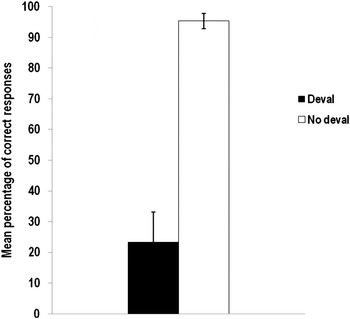
By the end of training, 100% of participants gave the correct response to each cue (A and B). Figure 1 presents mean percentage of correct responses during the test to the cue that had been followed by the devalued outcome, and to the cue that was followed by the non devalued outcome. Mean percentage of correct responses was lower when the outcome was devalued than when the outcome was not devalued, F(1, 15) = 58.77, p = .001, ηp 2 = .797.
Mean percentage of correct responses during test stage in Experiment 1, as a function of whether the outcome was previously devalued or not. Error bars denote standard errors of the mean.

Lower responding to the cue that was followed by the devalued outcome reveals that participants processed the outcome that was associated with the cue. Note that instructions indicated to participants which enemy was indestructible. This indication would have led participants to reduce responding to that given enemy during testing. However, to reduce responding to the devalued cue during the test participants would have needed to process the cue-outcome relationship. This result strongly suggests that participants learned a cue-outcome association during training, rather than giving a specific judgment to the present cue (e.g., Colwill & Motzkin, Reference Colwill and Motzkin1994). Thus, the results obtained in this experiment using a devaluation procedure are in agreement with the results obtained by Paredes-Olay et al. (Reference Paredes-Olay, Abad, Gámez and Rosas2002) using the outcome-based transfer procedure (see also Rosas et al., Reference Rosas, Paredes-Olay, García-Gutiérrez, Espinosa and Abad2010).
There are two issues that should be taken in account with respect to the results of this experiment. Note that devaluation of the outcome did not seem to eliminate the response completely. This incomplete effect of outcome devaluation suggests that participants had established a cue-response association during training that controlled part of the responding to the cue. Additionally, once participants learned the correct response to the cue, the judgment response was consistently followed by the outcome. These judgment-outcome pairings could lead to an association between the judgment and the outcome that could have controlled responding to the cue as well. The possibility of participants establishing an association between their judgment and the outcome that followed their response was explored in Experiment 2.
Experiment 2
The results obtained in Experiment 1, in combination with those reported by Paredes-Olay et al. (Reference Paredes-Olay, Abad, Gámez and Rosas2002) suggest that cue-outcome associations play an important role in human predictive learning (see also Rosas et al., Reference Rosas, Paredes-Olay, García-Gutiérrez, Espinosa and Abad2010). Similar to what has been shown in nonhuman animal conditioning (e.g., Rescorla, Reference Rescorla1973), the effects of outcome devaluation were not complete, raising the possibility that the association between the cue and the response (judgment) may also play a role in controlling performance in human predictive learning. These S-O and S-R associations are the two associations that have been traditionally discussed within Pavlovian learning situations (e.g., Delamater & Lolordo, Reference Delamater, Lolordo, Dachowski and Flaherty1991). However, there is an additional association that may be controlling behavior in Pavlovian designs that, as far as we know, has not been explored.
The design of Experiment 1 was based on standard Pavlovian conditioning designs in which the cue is followed (or not followed) by the outcome, regardless of participants’ responding. However, once the subject begins to give the predictive or anticipatory response to the cue, there are consistent pairings between subjects’ responses and the outcomes that are programmed to follow the cues. Subsequently, it is possible that this kind of coincidental CR-US pairing could lead subjects to establish CR-O associations similar to those that are assumed to be established within superstitious behavior (e.g., Dudley, Reference Dudley1999; Matute, Reference Matute1994; Ono, Reference Ono1987; Skinner, Reference Skinner1948; Zeiler, Reference Zeiler and Reese1972).
The goal of Experiment 2 was to explore whether judgment-outcome associations play a role in human predictive learning. Using instructions in humans makes exploring the role of that type of association relatively simple. The design of Experiment 2 is presented in the bottom row of Table 1. We used a variation of the outcome-based transfer procedure. Participants were trained on a predictive learning task identical to that in Experiment 1. Then they received an instruction. They were told that they should use the keys they used to give their predictive judgments during training to shoot missiles and torpedoes in the presence of each military company with the goal of destroying planes and ships. They were not instructed as to which key should be used for each attacker. After this instruction, participants entered the test phase without any additional training. During this test phase, participants had the opportunity of pressing each key in the presence and in the absence of predictive cues used during training. If participants established judgment-outcome associations during predictive training, this learning was expected to be transferred to the test phase so that they would choose the predictive response paired with the outcome that followed the present cue during the test, rather than the predictive response that was paired with the alternative outcome.
Method
Participants
Participants were 16 undergraduate students from the Universidad de Jaén with similar characteristics to those participating in Experiment 1.
Apparatus and Procedure
Apparatus and procedure were identical to the ones used in Experiment 1, except where noted. The design of Experiment 2 is presented in the bottom row of Table 1. Participants received 12 training trials with each cue before receiving what we have called “instrumental instructions”. So, training during the first phase was identical to that conduced in Experiment 1.
Instrumental instructions: “Now imagine that you have to defend Andalusia from hostile planes and ships approaching our land. You will have to use keys 1 and 2 in the keyboard to fight them. One of the keys fires anti-plane missiles (it destroys planes), whereas the other one fires anti-ship torpedoes (it destroys ships). The enemy has improved its defense, and now it is more difficult to destroy their protective shields, so that the more missiles a plane receives and the more torpedoes a ship receives, the faster they will be destroyed. In the screen you will see the closest plane and ship, and your mission will be to press keys 1 and 2, the more times the better, to destroy them. Remember, one key only destroys ships, and the other one only destroys planes. Results of each military operation may not appear in the computer’s screen due to the presence of fog. You should continue shooting nevertheless.” After reading these instructions, the transfer test began.
Transfer test. Immediately after the instrumental instructions four trials with each cue were presented. Each trial began with the presentation of the ship and the plane at the same time for 6 s (Pre period). Then, one of the cues was presented for 6 additional seconds while the plane and the ship remained on the screen together (Cue period). The test was conducted in extinction. Cue order was counterbalanced within and between participants.
Dependent Variable and Statistical Analysis
Predictive responses to each cue were recorded during training. At testing, responding on each response alternative was recorded during both, Pre and Cue periods. Rates of responding (responses per minute) were calculated for the response that was the correct judgment to the present cue during training (Same) and to the alternative that was not correct during training for the present cue (Different). During Pre periods, selection of which response was correct during training was determined by the cue that was subsequently presented during the Cue period. These data were evaluated by analysis of variance (ANOVA). The rejection criterion was set at p < .05, and effect sizes were reported using partial eta-squared (ηp 2).
Results and Discussion
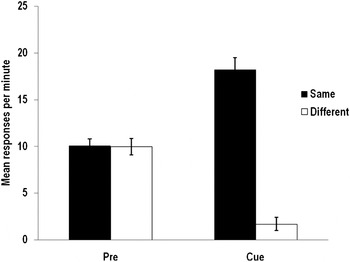
All participants gave the correct response to each cue by the last training trial. Figure 2 presents response rates on the response alternative that was the same one used to give a correct judgment during predictive training (Same), and the alternative response (Different), both, without the cue present (Pre) and when the cue was present (Cue). No differences between response alternatives were found in the absence of the cue. However, rate of responding in the Same alternative was greater than in the Different alternative when the cue was present. A 2 (Response alternative) x 2 (Period) found a Response alternative by Period interaction, F(1, 15) = 87.39, p = .001, ηp 2 = .853. Subsequent analyses conducted to explore the response alternative x period interaction found that the simple effect of response alternative was significant during the cue period, F(1, 15) = 102.96, p = .01, ηp 2 = .873, but it was not significant in the absence of the cue, during the Pre period, F < 1.
Mean responses per minute on the response alternative that was the same one used to give a correct judgment during predictive training (Same), and the response alternative that would have been an incorrect judgment during predictive training (Different), both without the cue present (Pre) and when the cue was present (Cue) during the transfer test in Experiment 2. Error bars denote standard errors of the mean.

In the absence of cues, participants equally chose both response alternatives. However, when the cue was present, participants preferentially chose the response alternative that was previously used as a predictive judgment about the relationship between the present cue and the outcome. That is, when participants had given response “1” to indicate that the plane would be destroyed in the presence of the star during predictive training, participants behave as if using key 1 would destroy planes at testing. Note that instructions only indicated to participants that they may use keys 1 and 2 to destroy planes and ships, but they were silent with respect to which key destroyed which enemy. Accordingly, any preference for using a specific key in the presence of the cue should be based on the idea that the key destroyed the enemy announced by the present cue, suggesting that part of what participants learned during predictive training was an instrumental association between the predictive judgment and the outcome. This association should have been implicitly established during predictive learning, when responding to any key was followed by the specific outcome announced by the cue. These key-outcome pairings led participants to establish judgment-outcome relationships in which cues act as discriminative stimuli indicating which judgment-outcome relationship is in effect.
Note that similar results would be predicted if Cue-Response associations would have been established during predictive training. If that were the case, participants would have also chosen to use R1 in the presence of A and R2 in the presence of B. However, given the small role played by Cue-Response associations in Experiment 1, it seems unlikely that they alone could explain the large effect on behavior observed in this experiment.
General Discussion
The general goal of the experiments reported here was to explore the structure of the relationships that human participants establish when confronted with a simple predictive learning task. Experiment 1 used a procedure akin to outcome devaluation procedures used in animals and found that post-training devaluation of the outcome led to an incomplete decrease in predictive judgments to the cue related to that outcome. Experiment 2 explored the possibility of predictive training establishing an instrumental association between the judgment and the outcome. When participants were requested to use the same response that they had used to give predictive judgments as an instrumental response to destroy the attackers, they used the predictive response that was originally the appropriate judgment to the present cue without additional instruction.
The effects of modifying the value of the outcome after predictive training were quite similar to the effect usually obtained in nonhuman animals (Colwill & Motzkin, Reference Colwill and Motzkin1994; Delamater, Reference Delamater1996; Rescorla, Reference Rescorla1973, Reference Rescorla2000). Outcome devaluation led to a decrease in predictive judgments that was specific to the cue previously paired with the devalued outcome, suggesting that participants had coded the cue-outcome association during predictive training. However, this decrease was incomplete. A residual response was observed after devaluation, with participants giving judgments about the cue-outcome relationship greater than zero even though the participants were informed that the attackers were indestructible. This residual responding may suggest that participants also established an association during predictive training that was independent of the outcome used. That is, part of participants’ behavior could be somewhat controlled by a cue-judgment association that would not be affected by changes in the outcome. This incomplete effect of devaluation training is common in animal conditioning experiments suggesting that CS-CR associations play a role in explaining conditioned behavior (e.g., Colwill & Motzkin, Reference Colwill and Motzkin1994).
The role of Cue-response associations on behavior has been reported in instrumental conditioning both in nonhuman (e.g., Colwill, Reference Colwill1994) and human animals (Gámez & Rosas, Reference Gámez and Rosas2007). Unlike CS-US associations, the role of CS-CR associations has not been explicitly demonstrated in standard classical conditioning, to our knowledge. However, Rescorla (Reference Rescorla1973) reported CS-CR associations in second-order classical conditioning. At any rate, results reported in Experiment 1 reveal a clear parallel between the contents of human and nonhuman predictive learning, even with respect to the indirect evidence of cue-response relationships playing a role in performance after predictive training.
The results reported in Experiment 2 are the first demonstration of the role of judgment-outcome associations in human predictive learning. Pairings between the judgments given by participants and the outcomes during predictive training seem to have led to judgment-outcome associations that were uncovered during the test by requesting participants to use the same responses they gave during predictive learning as instrumental responses at testing in Experiment 2. It remains to be known whether this kind of CR-US association is also learned by nonhuman animals in classical conditioning, or whether they are specific to humans and the type of task used here. The parallel between the contents of learning in human and nonhuman animals that we have demonstrated above suggests that CR-US associations may also be developed in nonhuman classical conditioning. However, that is an issue that will need to be addressed in future research.
Note that the results of these experiments do not imply that Cue-Response associations play no role in human predictive learning situations. Devaluation of the outcome did not lead to a complete elimination of responding in Experiment 1 and the design of Experiment 2 did not eliminate the possibility that responding at testing was partially due to associations between the cue and the response developed during training. It is possible that both Cue-Response and Cue-Outcome associations partially control behavior in human predictive learning situations as well as Judgment-Outcome associations. However, the involvement of Cue-Response associations on performance in this kind of situation has yet to be fully explored. These results are silent with respect to the mechanisms underlying human predictive learning. The results of the experiments reported here suggest that cue-outcome and judgment-outcome relationships play an important role on controlling responding in human predictive learning situations. However, these specific contents of learning may be established through associative or rule-based mechanisms, and no conclusions with respect to the kind of mechanisms used by participants to establish this content may be extracted from the data reported here (for a review see the special issue on human contingency learning of the Quarterly Journal of Experimental Psychology, 2007).
The results reported in this experimental series add to the pool of results suggesting that human and nonhuman animals establish similar associative structures when confronting predictive and instrumental learning situation (see also Gámez & Rosas, Reference Gámez and Rosas2007), suggesting that associative theories such as Rescorla and Wagner’s (Reference Rescorla, Wagner, Black and Prokasy1972) or Pearce’s (Reference Pearce1987) remain good candidates to explain human behavior in simple learning.