INTRODUCTION
Sturt Manning and his colleagues noted recently that there was a “fault line” dividing the establishment of radiocarbon (14C)-based chronologies in Europe and in southwest Asia when compared to the Caucasus, which has yet to gain a similar degree of resolution (Reference Manning, Smith, Khatchadourian, Badalyan, Lindsay, Greene and Marshall2018: 1531). In a paper titled “Rethinking the Kura-Araxes Genesis,” Antonio Sagona was among the first scholars to stress the importance of more nuanced chronological sequences supported by the precision of 14C dates for the Caucasus commensurate with the complex array of cultures within equally complex geographic settings (Reference Sagona2014: 23–46; Reference Sagona2018: 226). Guided by this need to redress the imbalance, a principal aim of the excavations in Rabati, in southwest Georgia, is to establish a stratigraphically defined chronological and cultural sequence underpinned by absolute dates, to complement and to expand upon the emerging research in this field (e.g., Passerini et al. Reference Passerini, Regev, Rova and Boaretto2016).
BACKGROUND: CHRONOLOGICAL AND ARCHAEOLOGICAL EVIDENCE FOR THE LATE EARLY BRONZE AGE AND EARLY KURGAN PERIODS
The second half of the third millennium BC in the Near East and in adjacent regions is marked by significant socio-cultural changes. The Kura-Araxes culture, which had existed for almost one thousand years, came to an end. Territorially, it had extended over a massive area from the Caucasus into western Iran and the Levant. This mostly agro-pastoral society is characterized by red-black handmade pottery and portable andirons found in the settlements. These locations were often large in size and village-like in spatial organization. The Kura-Araxes people buried their dead in individual or collective graves, where mostly pottery and rarely bronze objects, such as personal adornments or weapons, were included.
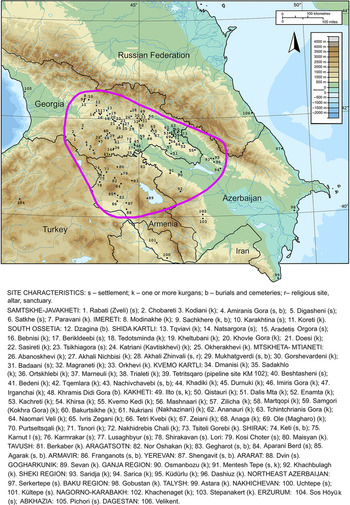
Considering its large territory, the process of dissolution of the Kura-Araxes culture unfolded differently. In the Upper Euphrates region of Anatolia, it was followed by a society characterized by large, monumental buildings with defensive walls. In Syria, the Kura-Araxes culture was replaced with an urban society (Rothman Reference Rothman2015: 9190–95; Sagona Reference Sagona2018: 299). As for the southern Caucasus and neighboring territories, which are the focus of this article, the closing years of the culture took a completely different trajectory. In these regions, the post Kura-Araxes period is known as the Early Kurgan period, which includes two material cultures: Martkopi and Bedeni. Both are localized mostly in the central part of the south Caucasus (Figure 1). The latter is generally believed to be chronologically later and it followed, but sometimes coexisted with the Martkopi culture. Some scholars consider that Martkopi pottery is the continuation of the Kura-Araxes tradition. It is also argued that Bedeni ceramic material, for which a black lustrous burnished surface is typical, is completely distinguishable from both of them (Japaridze Reference Japaridze1998: 71; Orjonikidze Reference Orjonikidze, Narimanishvili, Kvachadze, Puturidze and Shanshashvili2014: 205–215, Reference Orjonikidze2015: 11).
Sites of the Early Kurgan period in the Caucasus (late Kura-Araxes, Martkopi and/or Bedeni phases based on listings in Mindiashvili Reference Mindiashvili2012; Carminati Reference Carminati2016; Wikicommons base map, modified by C. S.).

One of the main hallmarks of the Early Kurgan period, especially during the later Bedeni phase, is the emergence of large individual kurgans (or barrows), which were accompanied by numerous, unique and precious objects attributed to an elite element of their society. Over 90 burial sites have been documented to varying degrees (Mindiashvili Reference Mindiashvili2012; Carminati Reference Carminati2016; Figure 1). Stone and earth mounds over these large kurgans sometimes reach up to 140 m in diameter such as the Tsnori kurgan in eastern Georgia (Dedabrishvili Reference Dedabrishvili1979). Among the grave goods found in these kurgans are personal gold adornments demonstrating a high standard of craftsmanship. In these kurgans, the dead were often buried with four-wheeled wagons and sometimes the burial chambers dug into the ground were covered with red ochre. These burial elements are completely novel for the south Caucasus region; all pointing to the emergence of social inequality, which emphasized the elite status and power of the people buried there (Japaridze Reference Japaridze1998: 176; Stöllner Reference Stöllner, Bartelheim, Horejs and Krauss2016: 217; Sagona Reference Sagona2018: 298). Another noticeable characteristic of the Early Kurgan period is the scarcity of their settlements. The small number of settlements that appear in this period—mostly attributed to the Bedeni culture—were comprised of wattle-and-daub dwellings that are generally poorly preserved. Such modest social investment in architecture compared to their elaborate burials sites is explained as the result of a mobile, pastoral lifestyle with less sedentary subsistence activates during the Early Kurgan period (Japaridze Reference Japaridze2003).
Although there are differences in settlement patterns in Syria, the Upper Euphrates and the south Caucasus in the post-Kura-Araxes period, in all of these locations a certain continuity of Kura-Araxes cultural features has been noted, which is mostly seen in ceramic objects with enduring Kura-Araxes characteristics (Palumbi and Chataigner Reference Palumbi and Chataigner2014: 247–60). In southern Georgia, such evidence gave substance to two different proposals concerning the emergence of Bedeni culture. One suggestion is that the appearance of Bedeni traits and the disappearance of Kura-Araxes culture in the south Caucasus was the result of a migration of people from north of the Great Caucasus mountain range. For a certain period of time, they lived side-by-side with the local Kura-Araxes population in the region until traces of the latter were finally extinguished (Japaridze Reference Japaridze1998: 176; Kohl Reference Kohl2007; Lyonnet Reference Lyonnet2014: 115–30). The second suggestion is that the Bedeni culture merged with the Kura-Araxes culture and, after a period of coexistence, both cultures disappeared at the same time (Orjonikidze Reference Orjonikidze2004: 118, Reference Orjonikidze, Narimanishvili, Kvachadze, Puturidze and Shanshashvili2014: 205–215).
The evidence for coexistence of Kura-Araxes and Bedeni cultures is found not only at settlements such as Tsikhiagora and Ilto, but also in burial complexes. In some kurgans, pottery is believed to demonstrate mixed elements typical of both Kura-Araxes and Bedeni traditions. Such examples are Kvemo-Kartli kurgan 5 and Martkopi kurgan 2 where Kura-Araxes pottery forms have Bedeni type decorations (Japaridze Reference Japaridze1998; Japaridze Reference Japaridze2003; Table 1).
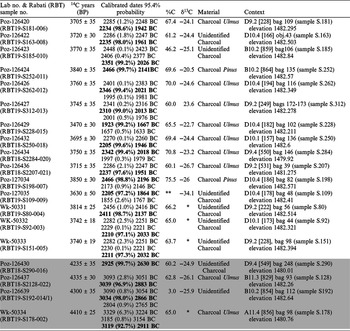
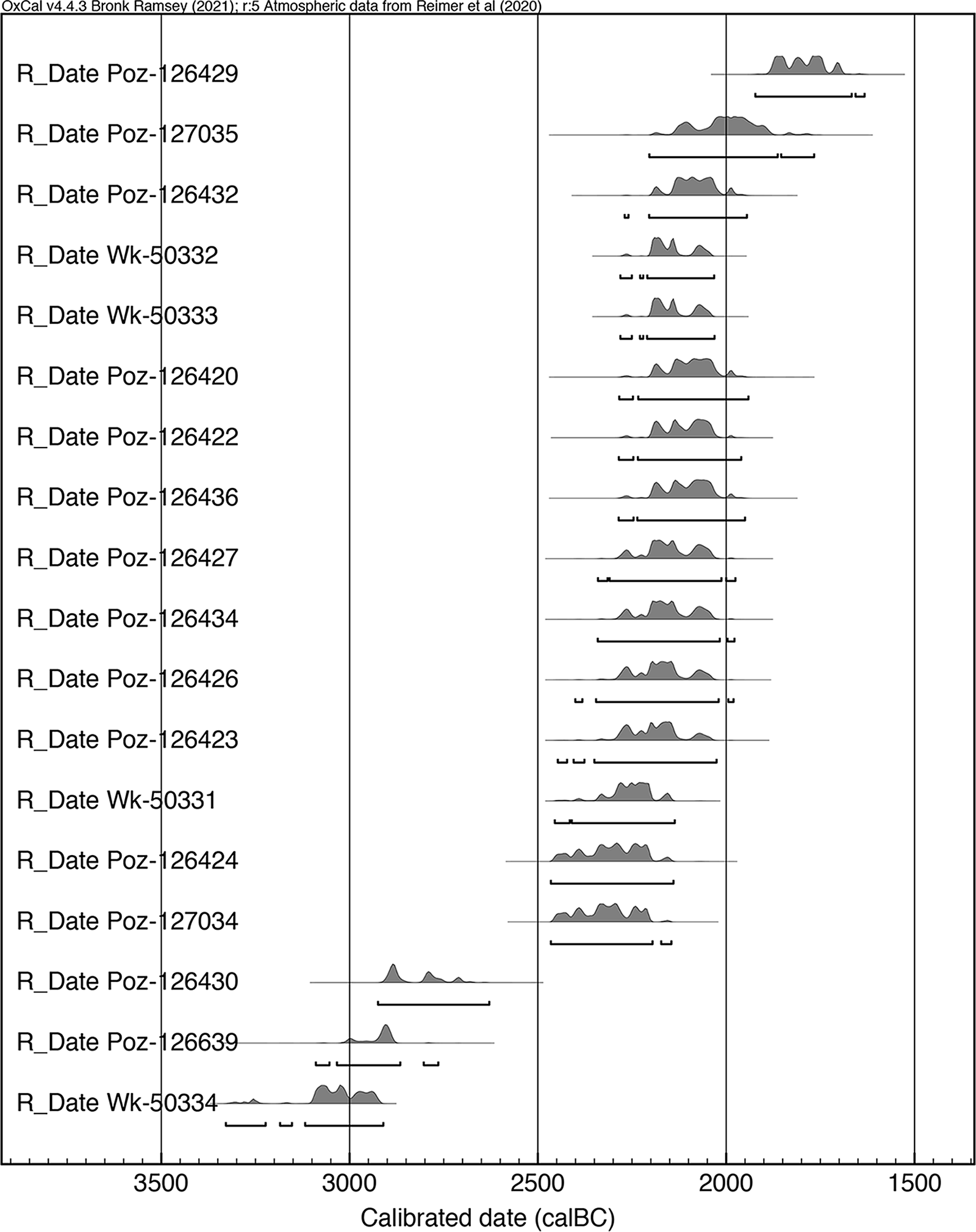
Calibrated dates from Rabati (cal BC); OxCal v4.4.3 Bronk Ramsey (2021); r:5 Atmospheric data from Reimer et al. (Reference Reimer, Austin, Bard, Bayliss, Blackwell, Bronk Ramsey, Butzin, Cheng, Edwards, Friedrich, Grootes, Guilderson, Hajdas, Heaton, Hogg, Hughen, Kromer, Manning, Muscheler, Palmer, Pearson, van der Plicht, Reimer, Richards, Scott, Southon, Turney, Wacker, Adolphi, Büntgen, Capano, Fahrni, Fogtmann-Schulz, Friedrich, Köhler, Kudsk, Miyake, Olsen, Reinig, Sakamoto, Sookdeo and Talamo2020); shaded rows list Early Bronze Age dates.

*The 13C stable isotope value (δ13C) was measured using the AMS spectrometer. The 14C date has therefore been corrected for isotopic fractionation. The AMS-measured δ13C value of the original material was not provided by the laboratory.
**Due to the small size of the sample and in order to not lose any material, the sample was not weighed before combusting, therefore %C was not determined.
All of these data suggest that despite significant changes in settlement strategies and mortuary practice, there was some continuity of population at a domestic level, even if their economy and presence in the region was evolving. In an article by Elena Rova and her colleagues, the issue of these two cultures was re-examined (Rova et al. Reference Rova, Makharadze, Puturidze, Rova and Tonussi2017: 153–71). Their study was based on the re-investigation of the Natsargora settlement located in the Shida Kartli region, which was excavated in the 1980s where, it is believed, the Kura-Araxes culture and Bedeni materials were found in the same contexts. Although their research did not confirm the coexistence of the cultures, the more convincing documentation of these two cultures occurring together in other sites, leaves the question of coexistence of Bedeni and Kura-Araxes cultures open to debate.
The problem of overlapping cultural traditions is directly connected to the nomenclature of periodization of these cultures. Boris Kuftin (Reference Kuftin1941) first distinguished two groups among the kurgans that he excavated in Trialeti, which he assigned to the Early and Middle Bronze Ages, but he erroneously attributed the Kura-Araxes culture to the Chalcolithic period. Socio-cultural changes and the emergence of kurgan cultures make it logical to attribute early kurgans together with the subsequent Trialeti cultural kurgans to the Middle Bronze Age. Preceding them, the Kura-Araxes evidence has long been considered to fall within the Early Bronze Age (Lordkipanidze Reference Lorkipanidze1991; Japaridze Reference Japaridze2003; Sagona Reference Sagona2018). If Bedeni and Kura-Araxes coexisted for a certain period of time, however, how is it possible that these two epochs (Early Bronze and Middle Bronze) were present at the same time? For this reason, many associate the “Early Kurgan” period with the Early Bronze Age, preferring to use the Early Kurgan term in order to distinguish the cultures within that category (that is the late Early Bronze Age Kura-Araxes, the Martkopi and the Bedeni) from the later, somewhat better defined Trialeti kurgan culture. For example, the book published by the Center of the Archaeological Studies in Georgia concerning the Chalcolithic and Early Bronze Age of Georgia includes the Early Kurgan cultural period within Phase IV of the Early Bronze Age, that is to a transitional period spanning into the Middle Bronze Age (Gobejishvili Reference Gobejishvili1980; Japaridze Reference Japaridze1992).
In recent years, major studies have appeared concerning the absolute dating of well excavated sites, which have preserved significant cultural deposits. These discussions have fed into a greater debate surrounding the Early Bronze Age sequence on a regional level and more are in the pipeline (e.g., Palumbi Reference Palumbi2008, Reference Palumbi2016; Sagona Reference Sagona2014; Passerini et al. Reference Passerini, Regev, Rova and Boaretto2016, Reference Passerini, Rova, Boaretto, Müller, Luciani, Ritter, Guidetti, Horejs and Schwall2018a, Reference Passerini, Rova and Boaretto2018b; Manning et al. Reference Manning, Smith, Khatchadourian, Badalyan, Lindsay, Greene and Marshall2018; Batiuk et al. in press). The emerging chronological consensus on the initial Early Bronze Age places the earliest appearance of Kura-Araxes assemblages in the south Caucasus during the latter half of the fourth millennium BC, ca. 3500/3350 BC (Sagona Reference Sagona2014). Chronometric dates are scarce for the nascent phase, with most of the earliest clustering around 3350/3300 BC. Presently, two broad developmental schemes have been proposed for the period 3500–2400 BC. One, refined and articulated by Giulio Palumbi, argues for a tripartite sequence (Kura-Araxes I–III; Palumbi Reference Palumbi2008). The other, maintained by Ruben Badalyan and based on the Armenian sequence, argues for a twofold periodization represented by three groups ([i] Kura-Araxes I: Elar-Aragats group; [ii] Kura-Araxes II: Karnut-Shengavit and [iii] Shresh-Mokhrablur groups; Badalyan Reference Badalyan2014). Sagona noted that, “Most recently Palumbi appears persuaded by this twofold scheme” (Palumbi Reference Palumbi2016; Sagona Reference Sagona2018: 226).
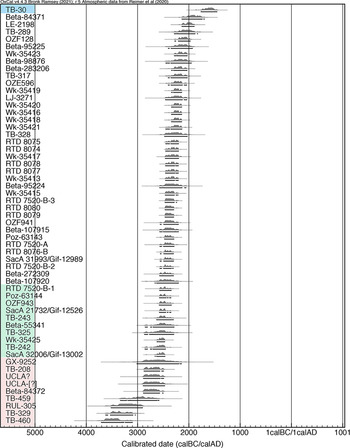
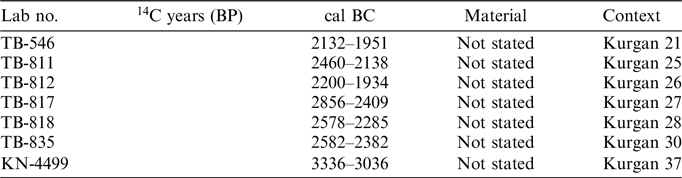
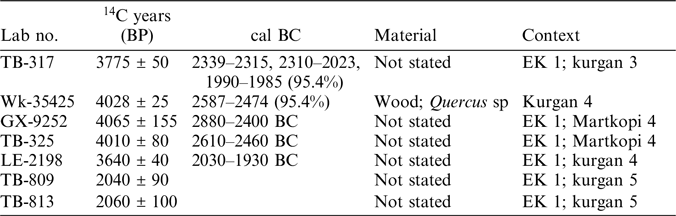
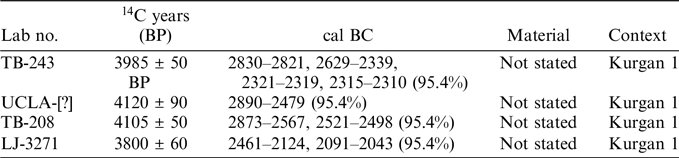
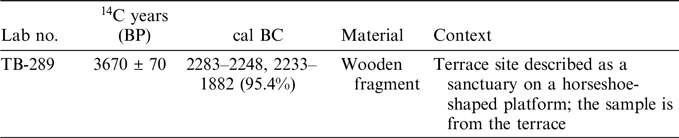
To understand Kura-Araxes and Bedeni cultural relations crucially important is the series of 14C analyses from both late Kura-Araxes and Bedeni well-stratified deposits (Figure 2). Strong arguments for the contemporaneity of late Kura-Araxes, Martkopi and Bedeni traditions are based primarily on the evidence of grave deposits in kurgans, such as Dmanisi kurgan 1, Trialeti kurgans 11 and 46, Ananauri kurgans 5 and 9, Tkemlar kurgan 2 and Martkopi kurgans 2 and 4 (Orjonikidze Reference Orjonikidze, Narimanishvili, Kvachadze, Puturidze and Shanshashvili2014: 205). It is largely from the burial mounds that we glimpse the technological and artistic developments of the late Kura-Araxes within the Early Kurgan transition period displayed in bronze and gold personal adornment, tools and weaponry. Equally impressive are advances in lithic technology as reflected in the pressure-flaked, obsidian projectile points.
The range of 14C dates associated with Early Kurgan contexts in the Caucasus and neighboring regions (includes dates for which the BP data was available): Early Bronze Age/Kura-Araxes (pink shading); transitional late Early Bronze Age, Kura-Araxes/Early Kurgan period (green shading); Early Kurgan period-Bedeni phase (no shading); Trialeti (blue shading). See the Appendix for the sites and details of context, sample, and radiocarbon results.

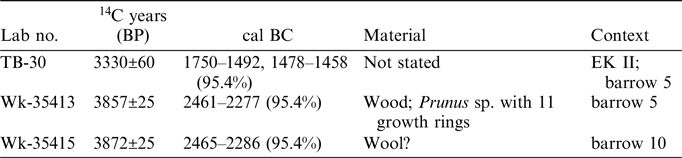
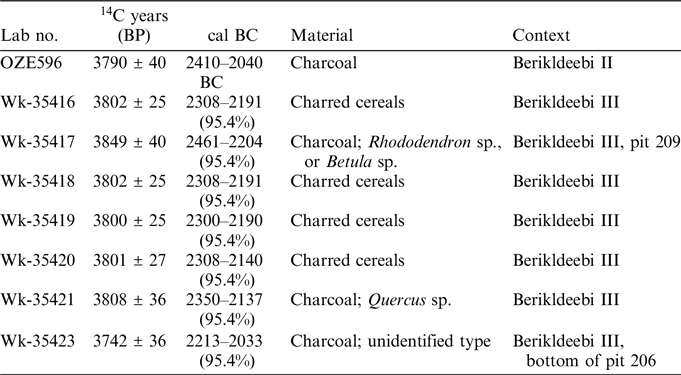
The beginning of the Martkopi phase is provided by a sample of Quercus from Martkopi kurgan 4, which yielded a reading of 2587–2474 BC (Wk-35425, at 95.4% probability). This is slightly earlier than the two dates from the Bedeni, which is probably due to the old wood effect of the oak sample. A sample of Prunus from Bedeni kurgan 5, was dated to 2461–2277 BC (Wk-35413), which corresponds to the reading from a few strands of wool from kurgan 10 dated to 2465–2286 BC (Wk-35415). Comparable to these is the reading from the Tetri Tskaro (Nadarbazevi) kurgan 2 (Wk-35426, 2474–2335 BC), taken from a loaf of desiccated baked bread, well preserved in the tomb chamber. Most important are the seven 14C readings from the Bedeni settlement at Berikldeebi (Period III), which probably defined the end of the Bedeni period in Shida Kartli. Four of the samples are charred cereals and three are charcoal, collectively they fall within a tight interlude around 2300–2100 BC (Sagona Reference Sagona2018: 302).
Notwithstanding the large body of data that is available from mortuary contexts in the region, for the purpose of this study, we think it is more productive to focus on the known settlements with Early Kurgan period. Within these contexts, lies the evidence for domestic life, spatial organization, economic strategies, and manufacturing industries. At one settlement, Berikldeebi, both Kura-Araxes and Bedeni cultures are attested (Sagona Reference Sagona2018: 296–304). Although 14C readings from the Berikldeebi settlement provide important data for the Bedeni period, the excavations have only been partially published and we do not have a complete sequence for the site nor a thorough understanding of how Bedeni culture is related to the Kura-Araxes.
There are indications emerging from the Rabati settlement that the site stratigraphy has the potential to provide important insights into the Kura-Araxes and Bedeni phases supported by 19 new 14C readings from recent excavations (two other dates concern the medieval remains). By adding these readings to the existing set of dates and close documentation of the substantial stratigraphic sequence as well as detailed analysis of the material remains, the transitional process from the Kura-Araxes to the Bedeni phase in the south Caucasus is gaining much needed clarity. Of the equally problematic Martkopi phase, as yet there are only a few pottery fragments at Rabati, which might be attributed to this tradition.
RABATI: ARCHAEOLOGICAL INVESTIGATIONS
Rabati is located in the Samtskhe-Javakheti province of southwest Georgia. The region is characterized by an abundance of Kura-Araxes sites. Prevalent are settlements comprised of drystone, rectangular-shaped dwellings built on hillside terraces. Among the thoroughly investigated sites in this region are Amiranisgora and Chobareti, which also include Kura-Araxes burials (Chubinishvili Reference Chubinishvili1963; Kakhiani et al. Reference Kakhiani, Sagona, Sagona, Kvavadze, Bedianashvili, Messager, Martin, Herrscher, Martkoplishvili, Birkett-Rees and Longford2013). Large kurgans, however, so typical of the subsequent Bedeni period are almost unknown. This might be due to the hilly and rocky landscape of this region that makes it difficult to detect burial mounds. As for the settlements, Bedeni period deposits in the Samtskhe-Javakheti region are mostly known from surveys or small scale test excavations. Until recently, no systematic study of settlements with Bedeni period deposits had been conducted in this region.
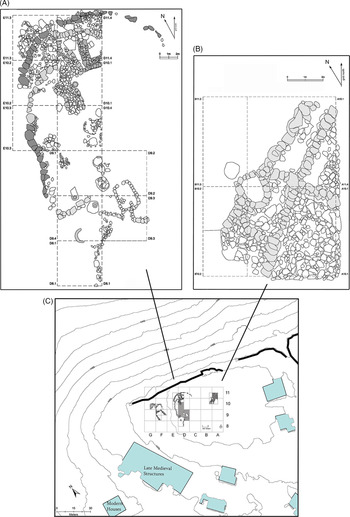
Rabati is a fortified artificial mound situated in Zveli village, on the northern edge of a promontory of Erisheti mountain overlooking the Kura valley at an altitude of 1480 m above sea level. Along the northeastern edge there is a substantial fortification wall, which probably once encircled the summit (Figure 3). The wall shows evidence of having been rebuilt several times, suggesting that the defenses were in use over a long period of time (Bedianashvili et al. Reference Bedianashvili, Sagona, Longford, Martkoplishvili, Losaberidze and Kirkitadze2019: 3).
(A) plan of trenches in the E/D 9/10 sector; (B) plan of trenches in A/B 10/11; (C) plan of Rabati indicating fortification walls to the north (bold lines) and medieval structures excavated in area F/G 9/10 to the far west; to the east and south of the excavation gridded area are historic and recent village buildings (shaded zones) (© GAIA Project).

This site was first investigated, by Georgian archaeologists, with small-scale, test-excavations in 1974 and 1977 (Chubinishvili et al. Reference Chubinishvili, Nebieridze, Pkhakadze, Grigolia, Mirtskhulava, Orjonikidze, Esakia, Gogelia and Prisheninko1976: 14–20; Gambashidze and Kvijinadze Reference Gambashidze and Kvijinadze1982: 29–31). A test trench was opened on top of the mound exposing a 3 m deep cultural deposit in which two main layers were distinguished. The upper deposit was 2.8 m thick and the lower, 0.70 m. The latter contained remains of wattle-and-daub structures, but due to the small-scale excavations it was impossible to understand their character (Bedianashvili et al. Reference Bedianashvili, Sagona, Longford, Martkoplishvili, Losaberidze and Kirkitadze2019: 4).
The Georgian National Museum and the University of Melbourne joint Georgian-Australian Investigations in Archaeology (GAIA) project commenced renewed systematic archaeological investigations at Rabati in 2016. Thus far, three seasons have been undertaken: 2016, 2018 and 2019. The focus of work has been in two areas on the top of the mound in the central and western sectors.
METHODOLOGY AND RESULTS
The Cultural Sequence and 14C Readings
The samples presented in this paper were collected during the 2018 and 2019 field seasons. In most of the secure contexts pivotal to the interpretation of the stratigraphy, only wood charcoal was present (Trenches A11.4, B10.2, B11.3, D9.4, D10.4). In D9.2 and in D10.4 locus 194, both charcoal and a large number of animal bones were collected. It was decided, however, to analyze the charcoal samples as most of the charcoal from these contexts came from twigs and small branches, which would minimize the “old wood” effect. Shortly after excavation, the charcoal samples were cleaned manually of excess soil. Botanical identifications were made by Inga Martkoplishvili (Georgian National Museum, Palaeoanthropology and Palaeobiology Research Institute) using a light microscope Motic BA310E/moticam 5+, magnification 40×. The samples revealed two wood species: Ulmus and Pinus. A few samples remained undetermined.
The 14C samples from the central and western areas at Rabati were analyzed in two laboratories (Table 1): the Waikato Radiocarbon Laboratory in Hamilton, New Zealand (four samples, 2019) and the Poznań Radiocarbon Laboratory, Poland (16 samples, 2020).The samples were measured with the accelerator mass spectrometry technique (AMS) and calibrated using latest version of the software OxCal v 4.4.3 (Bronk Ramsey 2021) and the IntCal20 atmospheric curve (Reimer et al. Reference Reimer, Austin, Bard, Bayliss, Blackwell, Bronk Ramsey, Butzin, Cheng, Edwards, Friedrich, Grootes, Guilderson, Hajdas, Heaton, Hogg, Hughen, Kromer, Manning, Muscheler, Palmer, Pearson, van der Plicht, Reimer, Richards, Scott, Southon, Turney, Wacker, Adolphi, Büntgen, Capano, Fahrni, Fogtmann-Schulz, Friedrich, Köhler, Kudsk, Miyake, Olsen, Reinig, Sakamoto, Sookdeo and Talamo2020). The chemical pretreatment carried out in the Poznan laboratory was based on the procedures used in the Oxford Radiocarbon Accelerator Unit (Brock et al. Reference Brock, Higham, Ditchfield and Ramsey2010: 103–112). Basic and similar pretreatment procedures were carried out on the samples in the Waikato laboratory: “samples were washed in hot HCl, rinsed and treated with multiple hot NaOH washes. The NaOH insoluble fraction was treated with hot HCl, filtered, rinsed and dried.” Dates from Rabati have a statistical probability of 99.7%. It should be noted that samples from the same context (locus 228) were measured by both laboratories (Poz-126420 and Wk-50333), and they yielded consistent results (Table 1). Of the samples submitted for analysis to Waikato Radiocarbon Laboratory, RBT19-S239-001 was too degraded to render a date.
The key loci are discussed here according to the area on the site where samples were taken and then by the cultural phase from the upper to lower levels; that is from the upper Bedeni to the lower Kura-Araxes cultural deposits. Samples from medieval deposits were analyzed as well, which will be the subject of a separate paper. All 14C readings presented here belong to Kura-Araxes and Bedeni periods (Figure 4). Overall, a total of 375 square meters was investigated in Rabati. In Trenches D9, D8.1, and 2; E10.2 and 3; E11.3; D11.4; D10.1; D 10.4; A11.4, B10.2, B11.3; Figure 3). Bedeni period deposits were encountered just under the modern surface and often they had been disturbed by medieval activities. There is no documented evidence of substantial architecture of Bedeni period at this stage. Fragments of plaster were scattered across almost the entire area of the excavation except in the northwestern sector, where medieval structures had been erected.
The Central Area
Bedeni Phase
Two 14C readings of Bedeni period were obtained in the central area of the mound (Trenches A11.4, A10.1, B10.2 and B11.3). Both came from the southwest corner of the trench; stratigraphically this was situated directly above a structure dated to the Kura-Araxes period (Locus 854, discussed in due course; Figures 5–6). The Bedeni level covered an area approximately 3.0 × 2.4 m with patches of brown and black soil and loose sandy silt. This deposit contained a large amount of charcoal and ceramic material (Locus 859) and was formed as a result of fire. It was located at ca. 0.5 m under the modern surface and was disturbed on all sides by medieval activities, which made it difficult to define the nature of this deposit. Undisturbed areas, however, do extend outside of the trench towards the south and west and future excavation will provide a better understanding of Bedeni levels. At this stage, it can be stated that there is no evidence of Bedeni activities inside of the Kura-Araxes structure. It would seem that when the Bedeni community settled there, the structure was already in ruins and abandoned.
14C dates from Rabati; (Poz) the Poznań Radiocarbon Laboratory Poland; (Wk) Waikato Radiocarbon Laboratory, Hamilton, New Zealand.

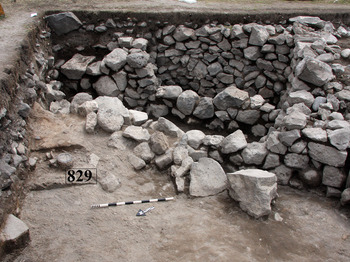
Trench A/B 10/11, locus 829, Bedeni level in foreground over the Early Bronze Age deposit; 1 m scale (© GAIA Project).

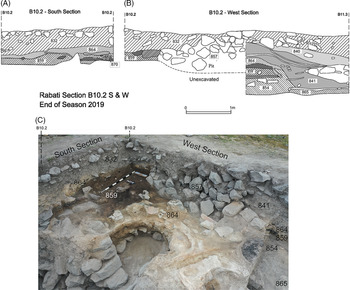
Trench B10: (A) south section; (B) west sections, 2019; (C) photograph of the sections with main loci indicated; 1 m scale (© GAIA Project).

The first sample (Poz-126423, 2351–2026 BC 99.2% probability) came from the southwest corner of the trench (Locus 859). It was associated with a small stone-lined hearth that was overlaying it. The second reading (Poz-126424, 2466–2141 BC 99.7% probability) came from Locus 864, which was brighter in color and was located next to 859. Apart from ceramic material, it also contained a stone grinding tool.
Kura-Araxes Period
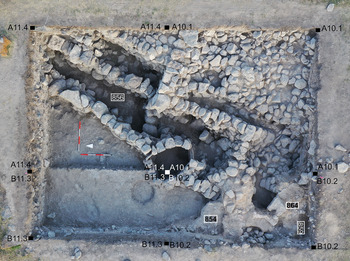
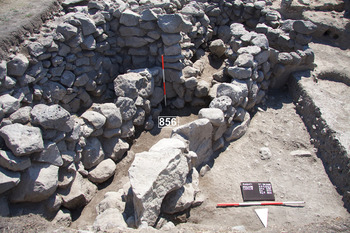
Trench A/B 10/11 revealed a dry stone structure with a 10.5-m-long wall, aligned on a northeast to southwest axis (Figure 7). The preserved height of the wall is 1.9 m (Figure 8). Ceramic material found in this structure belongs mostly to the Early Bronze Age (see Figure 14: 2–5, 7–9, 11–14). Some areas were disturbed by medieval period activities such as a hearth placed on top of the Early Bronze Age building and a stone-lined storage pit cut into one of its walls.
Aerial view of Trench A/B 10/11, 2019; 120-cm scale. 14C samples came from loci 854, 856, 859, and 864 (© GAIA Project).

Early Bronze Age architecture in Trench A/B 10/11; 120-cm scale (© GAIA Project).

Four 14C dates were obtained from Early Bronze, Kura-Araxes contexts in Rabati (Wk-50334, Poz-126639, Poz-126437, see Figure 5, and from D9 in the western sector Poz-126430). Three of them are associated with the large stone building (Trenches A11.4; B10.2 and B11.3) and one comes from the bottom of the section exposed in the western area of the mound (Trench D9.4). Of the three samples related to the stone structure, one comes from its floor (Locus 856, Wk-50334) that is, from the firm silty clay exposed in what seems to be a corridor in the building (Figure 8). The second sample (Poz-126437) comes from just outside of the northern wall of the corridor (Locus 829), where clayey silt containing a large number of ceramic fragments was exposed. As for the third sample, it comes from the southwestern corner of the same trench. It was taken from the section (Locus 854) below the deposit containing large number of distinctive Bedeni wares (Figure 6). Although at this stage of the excavation, it is difficult to say how this locus (854) is related to the stone structure, it can be stated that, stratigraphically, it is contemporary with Locus 829 documented next to the structure.
The Western Area
Bedeni and Kura-Araxes Sequences
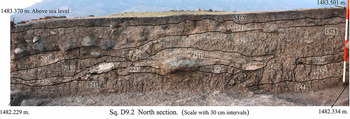
In Trench D9/10 (Figures 9–13), the Bedeni period deposition in the western sector was excavated in 2018 and 2019 to almost one meter in depth (Figure 10). Its southern half was mostly disturbed by medieval structures (Figure 11). The Bedeni deposit consisted predominantly of plaster layer fragments where large numbers of obsidian, bone tools and ceramic material were found. Apart from plaster layers, there were also fragments of fire installations built of clay and several architectural remnants. The pottery associated with this deposition belongs to the Bedeni phase. In some areas of the western part of the mound, the deposits were disturbed by medieval structures and pits (Bedianashvili et al. Reference Bedianashvili, Sagona, Longford, Martkoplishvili, Losaberidze and Kirkitadze2019: 1–133).
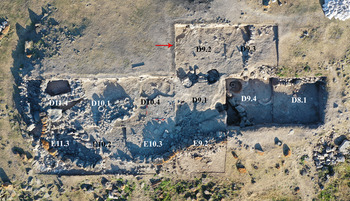
Aerial view of the western sector in Rabati, Trenches E/D 8-11, 2019; the arrow points to the northern section of D9.2 (see Figure 10); 120-cm scale (© GAIA Project).

Trench D9.2 north section; 120-cm scale (30-cm intervals) (© GAIA Project).

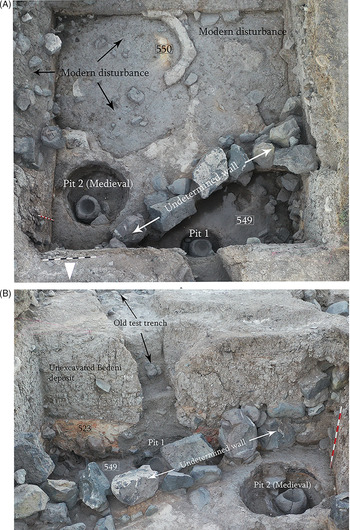
(A) Aerial view of Trench D9.4; (B) north section in D9.4 indicating undetermined wall (possibly Early Bronze Age), Bedeni and Early Bronze Age deposits, and narrow test trench made in the 1970s; 1-m scale (© GAIA Project).

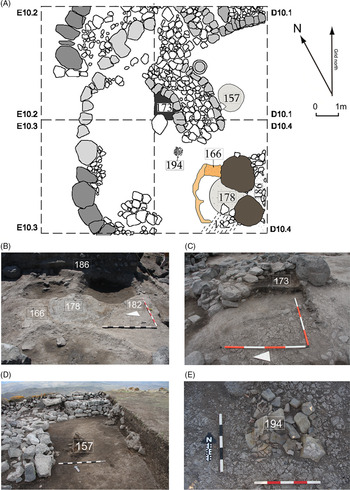
(A) Plan of Trench E/D 10: (B) D10.4 looking east, 1-m scale; (C) E10.2 looking east, 120-cm scales; (D) D10.1 looking north, 1-m scale; (E) detail of locus 194 in D10.4, 50-cm scale (© GAIA Project).

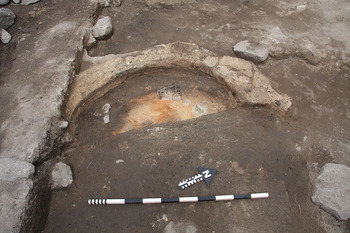
Remnant of a possible hearth in Trench D9.4, locus 550, 2019; 1 m scale (© GAIA Project).

The 14C readings from this area present a strong chronological trend ranging from ca. 2460–1900 BC, which corresponds to the Bedeni phase. Concentrations of Bedeni pottery were uncovered in Trenches D10.1–2 and D9.2. In the former trench, seven samples were analyzed, which came from the following contexts (Figure 12):
-
In a poorly preserved circular clay oven (Locus 157) Poz-126432.
-
One sample was associated with a broken pot containing charcoal and found with large number of bone tools, mostly points or awls (Locus 166) Poz-126422.
-
A black colored layer containing a large amount of charcoal, which was located below a medieval stone structure (Locus 173) WK-50332.
-
Fine ashy deposit, probably a disturbed hearth (Locus 178) Poz-127035.
-
From a deposit associated with possible Martkopi ware (Locus 182) Poz-126429.
-
A deposit containing a large number of burnt animal bones and bone tools (Locus 186) Poz-127034.
-
Among a circular concentration of stones, sherds and animal bones (Locus 194) Poz-126426.
There was also a high concentration of charcoal and animal bones. In Trench D9.2, four charcoal samples were analyzed: two came from the burnt plaster Locus 228, which extended across almost the whole northern half of the trench. It contained a large quantity of ceramic material. One of the samples (Wk-50333) was collected from the northwestern corner of the trench, where a large concentration of charcoal fragments was uncovered. The second one from Locus 228 (Poz-126420) came from the northeastern part of the trench, where fragments of a clay andiron were found. The third sample also came from the northwestern part of the trench, from Locus 222 (Wk-50331), which was a brownish silty soil with charcoal inclusions and large pieces of pottery. The fourth sample was from the central part of the northern half of the trench associated with a complete Bedeni fine ware vessel (Locus 531; Poz-126436; Figure 18: 7). All three loci (228, 222, 531) are stratigraphically and chronologically contemporary. Their stratigraphy can be equated with deposits in the northern section of trench D9.4, which remains mostly unexcavated. This trench (D9.4) has the deepest stratigraphical section in the Rabati excavation as the result of excavations in the 1970s and 1980s made during the Soviet era. In 2016 and 2018, this trench was cleaned and slightly enlarged. In the northern sector, the old test trench, which sat directly on top of the pit, was still visible (Figure 11: A–B). This area was also considerably disturbed by medieval stone structures, which had somewhat obscured the stratigraphy of this trench.
In the northern section, below the Bedeni deposit, there was a reddish-yellow, sandy clay layer (Locus 523, Figure 11: B) probably formed as the result of fire. It did not contain any cultural material. In 2018, it was possible to excavate below this layer. In the northwestern corner of this sector, a very dark greyish-brown, clayey silt with charcoal inclusions was exposed (Locus 549). The 14C reading of the sample taken from this Locus is 2925–2630 BC (99.7% probability, Poz-126430). It was clear that in this western part of the Rabati excavation, the Kura-Araxes deposit appears to be about at a depth of 2.5 m from the modern surface and it is separated from the Bedeni deposit by a distinct burnt reddish-yellow, sandy clay layer. This picture is completely different from what was documented in the central part of the excavation, where the Bedeni deposit was sitting right on top of the Kura-Araxes structure, not very far beneath the modern surface.
Another interesting 14C reading came from the central part of Trench D9.4 where a circular clay structure was unearthed (Locus 550). Only half of it has survived as it was disturbed by modern activities (Figure 13). The 14C reading (Poz-126434, 2342–2018 BC) suggests that this feature belongs to the Bedeni period, but it seems to be contemporary with the Kura-Araxes deposit because it is almost at the same level, in the same trench (Locus 549 described above; 1479.92 m above sea level), which produced a Kura-Araxes period 14C reading (Poz-126430). Unfortunately, at this stage, it is difficult stratigraphically to relate these seemingly chronologically different features to each other as the area between them was disturbed by medieval and modern activities. Overall, Bedeni contexts in Rabati are stratigraphically contemporary and, based on 14C dates, they fall between 2466 BC and 1864 BC. Only Poz-126429, 1923–1667 BC (99.2% probability), which is associated with Martkopi ware, appears to be too recent for the Early Kurgan period. In this case, the date probably reflects some ancient disturbance of the context.
Rabati Pottery—Wares and Forms
Domestic wares at Bedeni settlement sites are under-represented in the reports. The possibility that some fine wares were produced for or were the favored choice for inclusion in funerary contexts resulted in a skewed picture of the ceramic industry. Decades of excavation focused on burial sites has added a further filter. It goes without saying that the age of some excavations, the historic shifting political overlays and diverse theoretical stances have also shaped the path of academic interpretation.
Early Bronze Age, Kura-Araxes Period
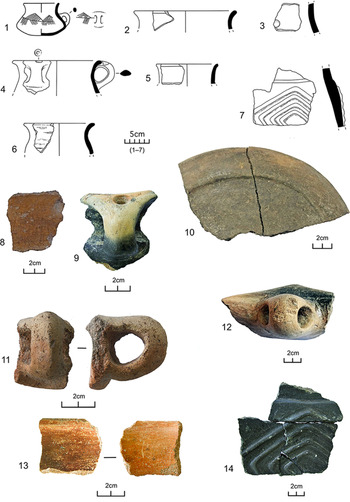
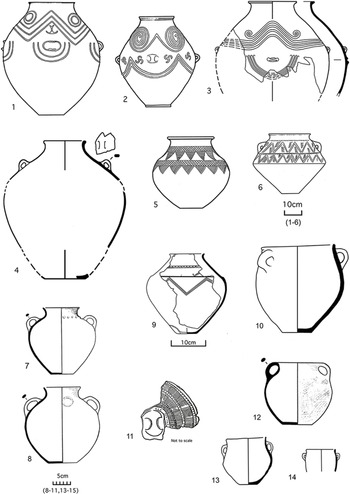
Pottery of Early Bronze date was recovered from the substantial architecture in A11 (Figure 14: 2–5, 6–9, 11–12), although this material has not yet been fully analyzed, it tends to fall into the classic Red-Black Ware range rather than the monochrome wares present in most of the houses excavated at the neighbouring site of Chobareti (with the exception of House 6), a settlement strung along a high mountain terrace, a mere 2.25 km to the west, but higher again at 1608 m asl (Kakhiani et al. Reference Kakhiani, Sagona, Sagona, Kvavadze, Bedianashvili, Messager, Martin, Herrscher, Martkoplishvili, Birkett-Rees and Longford2013). Typical forms of the period are tall necked jars (Figure 14: 2, 4–5, 13), distinctive handles with a triangular section, often quite angular down the back (Figure 14: 11) and others formed into a tunnel-like shape (Figure 14: 12). Lids, a common Kura-Araxes form (Figure 14: 10), and a shallow bowl with depressed curving wall where the handle joined forming a kind of pottery scoop have also been identified in the context of the building (Figure 14: 12). Decorated fragments, notably with dimples in the walls (Figure 14: 3, 8) and on handles and complex relief designs (Figure 14: 14) are also frequently found on Kura-Araxes vessels. From Rabati D9.4 came a squat juglet with scratched linear decoration (Figure 14: 1), which suggests a late Kura-Araxes tradition perhaps showing the influence of the Early Kurgan Martkopi phase. Overall, however, evidence for the Martkopi phase is fleeting.
Early Bronze Age, Kura-Araxes pottery from Rabati, areas D9 and A/B 10/11: (1) RSPF 549/1, D9.4 [549]; (2) RSPF 845/10, A11.4 [845]; (3) RSPF 845/8, A11.4 [845], see no. 8 for photograph; (4) RSPF 845/9, A11.4 [845], see no. 9 for photograph; (5) RSPF 855/1, A11.4 [855], see no. 13 for photograph; (6) RSPF 541/3, D9.4 [541]; (7) RSPF 845/1, A11.4 [845], see no. 14 for photograph; (8) See no. 3; (9) See no. 4; (10) RSPF 541/2, D9.4 [541] (11) RSPF 845/3, A11.4 [845]; (12) RSPF 812/3, B11.3 [812]; (13) See no. 5; (14) See no. 7; (© GAIA Project; RSPF—Rabati Special Pottery Find, inventory code).

Bedeni Fine Wares
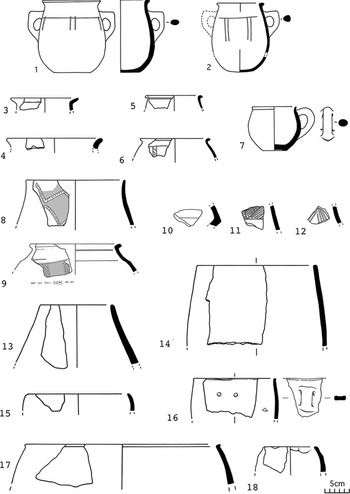
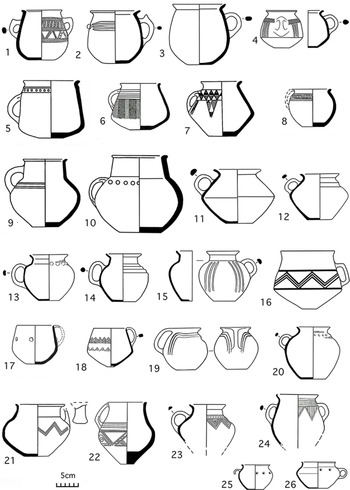
Fine ware tankards are a distinctive form in the Early Kurgan period. Very few fine wares are among the finds at Rabati, but these two-handled vessels are a hallmarks of the Bedeni phase (Figure 15: 1–6). They are thin-walled, hand-made and single- or double-handled pots, with thoroughly black burnished surface, typical of Bedeni ware (Figure 16: 1–26). Parallels occur in central and eastern Georgia in Bedeni cultural sites and in kurgan burial deposits dated to the second half of third millennium BC (Orjonikidze Reference Orjonikidze2015; Javakhishvili Reference Javakhishvili2017; Rova et al. Reference Rova, Makharadze, Puturidze, Rova and Tonussi2017: 152–171). These vessels are likely to have been used for drinking beverages and can be fitted with two distinctive, “knee-bend” handles (Figure 15: 1–2). A simple mug-like form is also represented (Figure 15: 7).
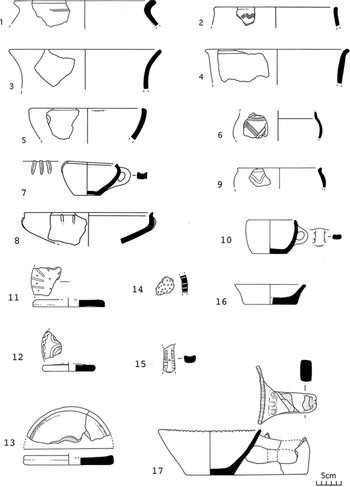
Rabati’s Bedeni Fine and Common Ware forms. Bedeni Fine Ware: (1) RSPF 208/7, D9.2 [208]; (2) RSPF 249/2, D9.2 [249] & [237]; (3) RSPF 208/3, D9.2 [208]; (4) RSPF 200/8, D9.2 [200]; (6) RSPF 507/29, D8.1 [507]; (7) RSPF 118/2, D10.4 [118]; (8) RSPF 300/16, F9.1 [300] ; (9) RSPF 111/2, D10.1 [111]; (10) RSPF 119/27, D10.4 [119] ; (12) RSPF 507/17, D9.4 [507] bag 36 (2016). Possible Martkopi: (11) RSPF 106/9, D10.1 [106]. Common Ware: (5) RSPF 508/7, D9.4 [508]; (13) RSPF 200/4, D9.2 [200]; (14) RSPF 200/10, D9.2 [200]; (15) RSPF 105/6, D10.4 [105]; (16) RSPF 200/19, D9.2 [200]; (17) RSPF 508/4, D9.4 [508]; (18) RSPF 200/12A, D9.2 [200]; (© GAIA Project; RSPF—Rabati Special Pottery Find, inventory code).

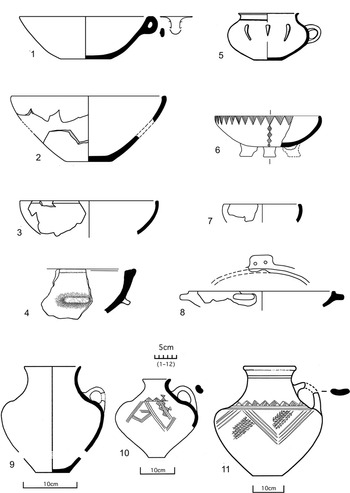
Fragments from a thin-walled jar with distinct, deeply incised and punctured linear design made prior to firing seem to have been teamed with zones of controlled firing, producing red and black patches (Figure 15: 8). A second example of this linear design combined with surface hues produced by controlled firing was found on a rim fragment from a jar (Figure 15: 9). Other jar fragments can have incised linear designs (Figure 15: 11–12). Carinated forms are known in Bedeni contexts (see Figures 16: 7, 11, 18 and 20: 6), but only one fragment has been found so far at Rabati (Figure 15: 10). At other sites, various bowl forms have been documented (see Figure 17: 1–4, 6–8); some are footed (see Figure 17: 6) and others with handles (see Figure 17: 1, 4) and attachments for lids (see Figure 17: 8).
Bedeni tankards from various sites: (1) Natsargora (after Rova, Makharadze and Puturidze Reference Rova, Makharadze, Puturidze, Rova and Tonussi2017, p. 167, fig. 23); Berikldeebi (2) inv. no. 10.994.1618; (3) inv. no. 10-994.4484; (4) inv. no. 10-994.1639 (nos. 2–4 from A. Sagona archive); (5)–(10) Khovle grave 2 in a kurgan (after Japaridze Reference Japaridze1998, pp. 147–148, figs 57–58); (11)–(15) Abanoskhevi kurgan (Gogochuri Reference Gogochuri, Sagona and Abramishvili2008, figs 29–21); (16) Tkemlar kurgan 2 (Shatberashvili et al. Reference Shatberashvili, Shatberashvili, Nikolaishvili and Gamkrelidze2010, pl. III); (17)–(18) Ananauri kurgan 1 (after Orthmann Reference Orthmann, Rova and Tonussi2017, p. 194, fig. 8); (19)–(20) Abanoskhevi kurgan (Gogochuri Reference Gogochuri, Sagona and Abramishvili2008, figs 18 & 20); (21) Akhali Nichbisi grave 1 in a kurgan (after Apakidze et al. Reference Apakidze, Nikolaishvili, Narimanishvili, Davlianidze, Sadradze, Khetsuriani, Iremashvili and Noneishvili1995, p. 176); (22) Khovle grave 1 in a kurgan (after Japaridze Reference Japaridze1998, p. 149, fig. 59); (23)–(24) Abanoskhevi kurgan (Gogochuri Reference Gogochuri, Sagona and Abramishvili2008, fig. 19:3–4); (25)–(26) Bedeni, finds from the grave above kurgan 1 (after Shatberashvili and Shatberashvili Reference Shatberashvili and Shatberashvili2014, pl. IV:1–2).

Bedeni bowls and jars from various Bedeni sites: (1)–(2) Tchintchrianis Gora kurgan (after Makharadze and Murvanidze Reference Makharadze and Murvanidze2014, pl. V:5); (3) Ananauri kurgan 3 (after Makaradze Reference Makharadze2014, fig. IX:6); (4) Zhinvali sanctuary (after Gogochuri Reference Gogochuri, Sagona and Abramishvili2008, fig. 10:2); (5) Martkhopi kurgan 3 (after Japaridze Reference Japaridze1998, p. 41, fig. 24:41); (6) Tchintchrianis Gora (after Makharadze and Murvanidze Reference Makharadze and Murvanidze2014, pl. V); (7)–(8) Ananauri kurgan 3 (after Makharadze Reference Makharadze2014, fig. IX:4, 8); (9)–(10) Ananauri kurgan 2 (after Orthmann Reference Orthmann, Rova and Tonussi2017, fig. 12); (11) Dali Gora (after Japaridze Reference Japaridze1998, fig. 40:4).

Common Wares
The predominant cultural remains in the upper levels in Trenches A/B10/11, D9, and D10-4 belonged to the Early Kurgan period. While it may be too early to speak of the true function of certain areas in the site, Trench D9 continued to surrender wares associated with foodways, especially cooking and dining. The range of cooking ware shapes is limited falling within our category of Common Ware. Vessel fragments were found in deposits often rich in organic material, which coats and permeates the pottery. Most have thinner walls than vessels of the previous Early Bronze Age, Kura-Araxes period. Typical shapes include baggy, deep and open pots (Figure 15: 13–14, 16), often with loop handles (Figure 15: 16) and cut or roughly folded rims to neaten the lip (Figure 15: 18). A number of fragments are hole mouth (Figure 15: 13) in shape with cut rounded or thin lips and everted rims (Figure 15: 9, 17). Some have flaring rims (Figure 18: 1, 3). Clay hues are usually in the pale to mid brown range, but some very dark examples approach the black surfaces of better quality Bedeni Fine Wares though falling short of the highly burnished and better finished surfaces. Sites with common domestic wares are Tsikhiagora (Makharadze Reference Makharadze1994) and Natsargora (Ramishvili Reference Ramishvili2013; Rova et al. Reference Rova, Makharadze, Puturidze, Rova and Tonussi2017: 152–171).
Rabati’s Bedeni Common ware: (1) RSPF 101/45, D10.4 [101]; (2) RSPF 102/46, D10.4 [102]; (3) RSPF 511/4, D9.4 [511]; (4) RSPF 101/44, D10.4 [101]; (5) RSPF 101/46, D10.4 [101]; (6) RSPF 505/2, D8.1 [505]; (7) RSPF 531/1, D9.2 [531]; (8) RSPF 119/38, D10.4 [119]; (9) RSPF 122/13, D10.4 [122]; (10) RSPF 117/1, D10.4 [117]; (11) RSPF 508/16, D9.4 [508]; (12) RSPF 106/10, D10.1 [106]; (13) RSPF 200/22, D9.2 [200]; (14) RSPF 314/1, F10.4 [314]; (15) RSPF 122/10, D10.4 [122]; (16) RSPF 815/1, A11.4 [815]; (17) RSPF 229/1, D9.2 [229] (© GAIA Project; RSPF—Rabati Special Pottery Find, inventory code).

An interesting aspect of the repertoire is that cups can also be produced in Common Ware. These can be quite simple in shape (Figure 18: 10). A slightly lopsided example with high shoulder carries three applied vertical rods opposite the handle (Figure 18: 7). A wide and shallow bowl with high shoulder also had applied rods at the rim (Figure 18: 8). Similar examples were found at Martkopi (cf. Figure 17: 5). Other shapes are few in number such as small pans (Figure 18: 16), wide squat pots (Figure 18: 6, 9), pitchers with one handle (Figure 17: 9–11) and open bowls (Figure 18: 5).
Although much of the Common Wares at Rabati are plain, there are examples with some patterning including lines of nested zigzags (Figure 18: 2, 6) and simple cuts down the sides of one handle (Figure 18: 15). Lids are afforded more elaborate decorations, such as pronounced ridges (Figure 18: 12) and finger impressed grooves spiraling from the center to the outer edge. Lines and puncture marks (Figure 18: 11) are used on lids and also on andirons. Other lid fragments can be simple and flat (Figure 18: 13). One other decorative technique of all-over checker or crisscross decoration on pottery fragments has been documented. Significantly, a similar design on a lid fragment was found in Trialeti kurgan 46, which held both Kura-Araxes and Bedeni pottery forms (Figure 19: 3, cf. Figure 20: 11; Orjonikidze Reference Orjonikidze, Narimanishvili, Kvachadze, Puturidze and Shanshashvili2014: pl. II after Gogadze Reference Gogadze1972).
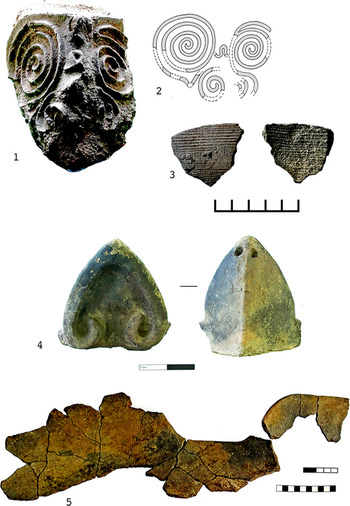
(1–2) Zhinvali sanctuary possible altar with relief spiralling face designs (photograph: C. Sagona; drawing after Gogochuri Reference Gogochuri, Sagona and Abramishvili2008, fig. 12); (3) body fragment with fine all-over linear design from Rabati, RSPF 106/4, D10.1 [106] bag 14 (2016); (4) horned triangular hearth prop—RSPF 859/2 B10.2 [859] object 73 (2019), Common ware; (5) very large tray fragment with scoop front, RSPF 200/30, D9.2 [200] bag 58 (nos. 3–5 © GAIA Project).

Bedeni large jars and common ware forms from various Bedeni sites: (1)–(2) Ananauri kurgan 1 (after Orthmann Reference Orthmann, Rova and Tonussi2017, fig. 10); (3) Ananauri kurgan 3 (after Makharadze and Murvanidze Reference Makharadze and Murvanidze2014, pl. VII); (4) Tchintchrianis Gora kurgan (after Makharadze and Murvanidze Reference Makharadze and Murvanidze2014, pl. V:1); (5) Sos Höyük (after Sagona Reference Sagona, Marro and Hauptmann2000, fig. 15); (6) Martkopi kurgan 2 (after Japaraidze Reference Japaridze1998); (7)–(8) Abanoskhevi kurgan (after Gogochuri Reference Gogochuri, Sagona and Abramishvili2008, fig. 18:1–2); (9) Ananauri kurgan 2 (after Orthmann Reference Orthmann, Rova and Tonussi2017, fig. 11); (10) Tsikhiagora (after Makharadze Reference Makharadze, Sagona and Abramishvili2008, fig. 28:4); (11) Trialeti kurgan XLVI (after Gogadze Reference Gogadze1972, pl. 13 bottom); (12) Abanoskhevi kurgan (after Gogochuri Reference Gogochuri, Sagona and Abramishvili2008, fig. 18:3); (13–14) Tsikhiagora (after Makharadze Reference Makharadze, Sagona and Abramishvili2008, fig. 28:3, 6).

During the Early Kurgan period, the pottery range in some locations included some rare forms, notably conjoined bowls known from Beshtasheni and Pichori (Pkhakadze Reference Pkhakadze2002: 29–33: pl. 1: 1–2). A few fragments of unusual handles were identified from the 2018–2019 seasons at Rabati. Seemingly shaped like a capital B, how they would have been attached to a vessel was not immediately obvious. With the discovery of a more complete vessel, it is now clear that the conjoined double (triple on another example) loop handle was attached horizontally from near the rim to the base and the handle lay flat, horizontal and level with the bowl’s resting surface (Figure 18: 17). This unusual handle form was embellished on top with three knobs near the vessel rim and two at its outer end. The simple conical bowl with wide flat floor and straight walls to which the handle was attached also had repeated cuts around the rim in the style known on Chalcolithic Sioni vessels. Until it was supported by absolute dates, there was the possibility that rim fragments of this nature, which had been appearing among the pottery were possibly of Chalcolithic date. We can confirm that it, and fragments like it, occur in contexts that are dated to the Early Kurgan, Bedeni phase.
Other handle examples found in Rabati display different decoration: one has a ridged back and double loops and another has a wavy, snake-like ridge along the back (Bedianashvili et al. Reference Bedianashvili, Sagona, Longford, Martkoplishvili, Losaberidze and Kirkitadze2019: fig. 36: 3–5). Double looped handles attached vertically to jar walls have been found among Bedeni phase vessels at Natsargora, but any similarity in shape and method of attachment to the horizontal Rabati bowl handles can be discounted (Licheli and Rusishvili Reference Licheli, Rusishvili, Sagona and Abramishvili2008: figs 13: 1, 3; 15: 1; Rova et al. Reference Rova, Puturidze and Makharadze2010: pl. 6). With this more complete Rabati example, we clearly have a rare and idiosyncratic pottery form that is virtually peculiar to Rabati. Noteworthy is the rough nature of the examples, despite the additional decorative features. In terms of fabric, the examples fit comfortably within the Common Ware range.
Equally intriguing is the continuing use of trays. Their presence in Chalcolithic contexts has been well-charted in the region (e.g., Dedabrishvili Reference Dedabrishvili1969; Orjonikidze and Jibladze Reference Orjonikidze, Jibladze and Gamkrelidze2010a; Sagona and Shapardon Reference Sagona, Shapardon, Balossi Restelli, Cardarelli, Maria Di Nocera, Manzanilla, Mori, Palumbi and Pittman2020). They are also found in Early Bronze Age contexts, certainly at Chobareti and now they appear within the Bedeni phase at Rabati. Giulio Palumbi has recognized the same longue durée of trays in Azerbaijan at Qaraçinar (pers comm. 2019). One tray from D9 is extremely large likely spanning at least 70 cm across (Figure 19: 5). It had the familiar qualities seen to varying degrees in previous finds throughout the Caucasus and into Anatolia: very thin base; rough resting surface; shallow side walls; inward curving wall in the back (kidney-shaped); a distinctly scooped lower front; poorly finished exterior and better finished interior. The very large size of this example and flimsy base relative to the overall size of the tray only serve to further indicate that it, and others like it, relied on some form of support; that it was a composite form teamed probably with basketry, wood, leather or some other organic material, now lost (Sagona and Shapardon Reference Sagona, Shapardon, Balossi Restelli, Cardarelli, Maria Di Nocera, Manzanilla, Mori, Palumbi and Pittman2020).
Large, closed jars sometimes decorated with variations of pendent triangles are not uncommon (Figures 20: 5–6, 9; 17: 10–11); small knobs and applied raised rings have also been recorded (Figure 20: 7–8). Others with distinct face designs (Figure 20: 1–3) have been found in late Kura-Araxes contexts (two more were found in Badaani; see Mirtskhulava Reference Mirtskhulava, Sagona and Abramishvili2008). Characteristics include spiral eyes, handles that can represent the nose and/or ears, other linear patterns which are suggestive of stylized possibly natural features such as wrinkles and grinning mouths. Smaller motifs (mushroom and three-spoked designs) on forehead between the eyes and on the cheeks possibly represent facial tattoos. These embellishments are particularly significant as they recall strongly the designs on Kura-Araxes pottery at the height of its development.
Hearths and andirons are enduring and characteristic forms of the Kura-Araxes culture, which carry through to the later Early Kurgan period in Rabati, admittedly with signs of evolution in shape and decoration. Indeed, one remarkable hearth fitment with obsidian eyes now on display in the Akhaltsikhe Museum was found in Bedeni contexts in Rabati during Tariel Chubinishvili’s 1974 excavation (Chubinishvili et al. Reference Chubinishvili, Nebieridze, Pkhakadze, Grigolia, Mirtskhulava, Orjonikidze, Esakia, Gogelia and Prisheninko1976; Bedianashvili et al. Reference Bedianashvili, Sagona, Longford, Martkoplishvili, Losaberidze and Kirkitadze2019: figures 32–33). Another hearth fixture from Bedeni contexts was in the form of an upright triangular prop (probably one of three) very similar in shape to those molded onto an in-ground hearth in a house in Sos Höyük (Turkey). On this example, ram’s horns decorated the back and small punctures served as eyes on the other side (Figure 19: 4).
CULTURAL AND CHRONOLOGICAL IMPLICATIONS FOR RABATI
Further work is planned in both the central and western areas on the summit of Rabati. We anticipate that we may detect transitional developments particularly in the later stages of the Kura-Araxes. As yet, the architecture uncovered at the site is far from the standard domestic structures so well-known for the Kura-Araxes period (simple rectangular or rounded buildings with back benches and central hearths; sometime built on a single-, sometimes a two-roomed plan). They have been identified, however, at nearby Chobareti.
For now, it can be said that on the Rabati summit the lower layers contained exclusively Kura-Araxes material, whereas in the upper deposits ceramic fragments of the Kura-Araxes and Early Kurgan period (Bedeni) cultures were found together perhaps as the result of ancient disturbances, and in other places only Bedeni pottery was found. As yet, no contexts have demonstrated that Bedeni and Kura-Araxes pottery were unequivocally contemporary.
All four Kura-Araxes period 14C readings from Rabati have more or less the same date: Poz-126437, 3039–2883 BC (96.9%); Poz-126639, 3034–2866 BC (98.0%); Wk-50334, 3119–2911 BC (92.7%); Poz-126430, 2925–2630 BC (99.7%). Three of these which are associated with the large stone structure, including its floor level (Locus 856), fall within ca. 3039 to 2630 BC, or in other words, to the end of the Kura-Araxes 1 and the early years of Kura-Araxes 2. They suggest that despite its large size and evidence of later modifications, use of the structure took place around the turn of the 4th to 3rd millennium BC. 14C dates from the neighboring Chobareti site indicate that it was occupied from around 3300–3000 BC (Kakhiani et al. Reference Kakhiani, Sagona, Sagona, Kvavadze, Bedianashvili, Messager, Martin, Herrscher, Martkoplishvili, Birkett-Rees and Longford2013). House 6 (excavated in 2016; Sagona Reference Sagona2018: 240) appears to be slightly later around 3106–2910 BC (based on recalibrated (OxCal v4.4.3 Bronk Ramsey 2021) dates for WK-44019, 3104–2910 BC, 99.3%; Wk-44020, 3104–2910 BC, 99.3%; WK-44023, 3106–2912 BC, 98.1%; Wk-44024, 3102–2910 BC, 99.4%; Wk-44025, 3102 2910 BC, 99.4%). Burial 9 at the site also carries a later Early Bronze Age date (Poz-56371, recalibrated to 3133–2890 BC, 93.6%). These dates are comparable to 14C readings from the Natsargora, Aradetis Orgora and the Gudabertka settlements located in the Shida Kartli region of Georgia (Rova Reference Rova2014: 47–69; Mindiashvili Reference Mindiashvili, Giemsch and Hansen2018: 158–164). This range points to a time when the Kura-Araxes culture was less homogenous and was developing regional traits.
There is no doubt that the architecture at Chobareti conforms to the typical house plans of Kura-Araxes settlements across the region. Rectangular floor plans and a dry-stone building technique are typical for the Samtskhe-Javakheti region in this period at Chobareti and at Amiranisgora (located 2.5 km and 15 km northwest from Rabati, respectively). It is the comparatively monumental architecture at Rabati that stands apart from such settlement sites, but the function of this large building was has yet to be determined. House 6 in Chobareti was roughly contemporary for a time with the Kura-Araxes settlement in Rabati.
The end of the Kura-Araxes culture in the Caucasus region is still open to debate and as already mentioned further complicated by clear instances of enduring cultural traits into the Early Kurgan period at some sites. Bayesian modeling of 14C dates from Armenia suggests that the Kura-Araxes culture came to a close around 2500 BC (Manning et al. Reference Manning, Smith, Khatchadourian, Badalyan, Lindsay, Greene and Marshall2018: 1530–51). A comparable time frame is proposed for Shida Kartli region (Rova Reference Rova2014: 47–69) and the findings of the 2017 workshop in Toronto came to similar conclusions for the Kura-Araxes generally (Batiuk et al. in press).
Nonetheless, further investigation of the Rabati settlement, especially in the lower levels of the stone structure to determine the complete plan of the building, will give better understanding of these issues.
As yet, no clear evidence in Rabati suggests a direct continuation from the Kura-Araxes into the subsequent Bedeni phase. The earliest Bedeni period date from Rabati is (Poz-126424) 2466–2141 BC and (Poz-127034) 2466–2196 BC. The 14C dates indicate that between these periods (the Kura-Araxes and Bedeni) there is the gap of at least four and a half centuries. Generally speaking, these Bedeni dates are among the earliest 14C readings for the Bedeni phase. Similar dates do come from Bedeni kurgan 5 (2461–2277 BC), Bedeni kurgan 10 (2465–2286 BC) and Tetritskaro kurgan 2 (2474–2335 BC). In addition, one Ananauri kurgan is assigned to 2370 BC (Boaretto et al. Reference Boaretto, Lev, Regev, Makakharadze, Kalandadze and Murvanidze2016: 284–88). These sites present the most well preserved and rich Bedeni burial complexes, all furnished with highly burnished black pottery which can be confidently referred to as Bedeni fine ware (Gobejishvili Reference Gobejishvili1980; Makharadze et al. Reference Makharadze, Kalandzdze and Murvanidze2016).
Despite shifting and evolving cultural trends, a stable population may have inhabited the region who held onto inherited traditions and because they returned to locations once occupied by Kura-Araxes communities, this choice may indicate an enduring sense of connection to ancestral lands. On current evidence, there appears to be a high level of regionalism, with possible lags in cultural development at some sites and cultural breaks at others. Yet, despite significant changes in settlement strategies, some persistent cultural traits suggest continuity of the population at a core domestic level, even if their economy and their presence in the region were evolving. Household tray forms span centuries and hearths which recall the domestic arrangements within the Kura-Araxes house, now appear in Bedeni habitation settings. These are represented by remnant plaster surfaces and numerous pits at sites of the period. Hence, at Rabati, dwellings are no longer clearly defined structured houses and their habitation zones are seemingly more temporary and ephemeral. Nonetheless, continuing hearth design points to deep and enduring cultural traits that surround conservative domestic practices at the heart of the home.
Burial practices were a significant development and Bedeni funerary monuments and their contents reflect growing social complexity and elitism (Stöllner Reference Stöllner, Bartelheim, Horejs and Krauss2016: 217). In these settings, there are equally blurred distinctions between the various traditions of late Kura-Araxes, Martkopi and Bedeni cultural remains. The growing monumentality of their burial mounds suggests that such features became important markers within ancestral territories.
The origins of new pottery forms in the archaeological record like the distinctive Bedeni tankards needs to be considered (Figure 16: 1–26). Based on the presence of grape seeds in sites like Badaani, practices surrounding viticulture and wine consumption had possibly developed in social terms within the later Kura-Araxes and Bedeni communities. Corresponding developments in their ceramic products to include well-made cups and tankards may reflect a drinking kit linked to growing wine consumption. This evidence rests on a longer history of wine production supported by recent findings from the Kura-Araxes period contexts (ca. 3000 BC) such as the non-pollen palynomorph analysis of zoomorphic vessel from Aredetis Orgora (Kvavadze et al. Reference Kvavadze, Boschian, Chichinadze, Gagoshidze, Gavagnin, Martkoplishvili and Rova2019). Batiuk (Reference Batiuk2013: 456) mooted that viti- and vini-culture for the Kura-Araxes communities provided “a unique economic niche in which to integrate at a macro scale into the communities where they settled, while remaining economically but more importantly, culturally independent.”
Notions of spirituality and domesticity, the sacred and profane, still appear in domestic spaces as it did within Early Bronze Age Kura-Araxes houses and hearths (Sagona Reference Sagona1998: 22–24). At Rabati, a few items suggest underlying belief systems such as the unique obsidian-eyed hearth figures, which could be linked to the anthropomorphic andirons in the Kura-Araxes settings. The ram’s horns decorating the hearth prop of Bedeni date also reinforces the concept that rituals and beliefs still surrounded the family hearth (Figure 19: 4). It is clear from the Bedeni sites of Zhinvali and Berikldeebi that some locations have similar evidence. At Rabati, the unusual and elaborate bowl with horizontal B-shaped handle, suggests it served a more complex function than as simply a household daily vessel (Figure 18: 17). It is tempting to identify this vessel as a ritual object, but like domestic trays (Figure 19: 5), it is not a high-end pottery product. If ritual, whether household or ceremonial, is woven into both forms (trays and decorated bowls), then their rustic quality may also have been significant in the role they served. Ritual depositions in pits has also been noted by Orjonikidze and Jibladze who commented that a “large number of pits with domestic and religious functions is recorded at settlements of the Kura-Araxes and Bedeni Cultures” (Reference Orjonikidze and Jibladze2010b, plate I: 2).
The nub of the problem surrounding the various pottery and other cultural traditions concerns the nature of the population in the late- and post-Kura-Araxes years. Should we speak of the extinction of the Kura-Araxes culture as a rapid event, or as a gradual fading out in the wake of new trends? Bedeni and probably Martkopi influences, too, are likely to be developments that infiltrated unevenly, over the Kura-Araxes’ wide territorial range. Mindiashvili has argued for a Bedeni origin within the Kura-Araxes culture first mooted on evidence from Qvatskhela, Levels B and C (Javakhishvili and Glonti Reference Javakhishvili and Glonti1962; Mindiashvili Reference Mindiashvili2012: 72). Importantly, their known settlements reflect a penchant to occupy the same sites as Kura-Araxes predecessors and a degree of similarity can be seen in their economic strategies, in agriculture and animal husbandry (Mindiashvili Reference Mindiashvili2012: 73–74). It is likely that the Kura-Araxes “predecessors” were in fact “ancestors.”
CONCLUSIONS
Clarity concerning the final stages of the Early Bronze Age, Kura-Araxes period and the subsequent Early Kurgan Martkopi, Bedeni and Trialeti phases is greatly needed. In many respects, there are broad trends, which indicate that Kura-Araxes populations were moving and evolving away from their distinct cultural traditions, but the subsequent Early Kurgan phases are less clearly defined.
Four absolute dates have so far been determined for the Early Bronze Age at Rabati. They fall within 3039–2630 BC, a time that corresponds to the so-called height of regionalism for the Kura-Araxes period when their classic red-black pottery was at its peak. The large structure in the central area at Rabati, which dates to the Kura-Araxes period was unexpected and it stands out in a cultural tradition characterized by modest dwellings of seemingly non-hierarchical communities. While there are a few instances of substantial, non-domestic architecture in the greater region, continued excavation of the Rabati complex is needed to better understand its complete form and function and this will be a focus of planned fieldwork in the future.
There is a substantial Bedeni presence at Rabati, which is contributing much needed settlement evidence to counter-balancing the current archaeological record weighted toward burial sites. The 14C readings collectively present a strong chronological trend ranging from 2466–1864 BC. Only Poz-126429, 1923–1667 BC (99.2% probability) appears to be too recent for the Bedeni period and although it is associated with possible Martkopi pottery fragments, clarification is needed through further excavation in order to contribute to the wider discussions surrounding the Martkopi cultural tradition. Nonetheless, while it is possible that the Kura-Araxes and Bedeni coexisted elsewhere in the region, we have yet to uncover clear contexts with their cultural traits occurring together at the site. Instead, a sense of continuity lingers in some pottery and hearth forms.
Finds at Rabati may not yet have the answers for all of the issues surrounding these cultures, but with the new suite of 14C dates from the period and the intriguing archaeological contexts so far uncovered, there are indications that the stratigraphic record will continue to provide important and long-needed insights into the Kura-Araxes and Bedeni phases.
ACKNOWLEDGMENTS
The authors would like to acknowledge with gratitude the following: Professor Dr David Lordkipanidze, Director of the Georgian National Museum, for his encouragement and full support of this collaborative project; the Waikato Radiocarbon Laboratory in Hamilton, New Zealand and the Poznań Radiocarbon Laboratory, Poland; funding from the Shota Rustaveli National Scientific Foundation of Georgia (SRNSFG; grant number FR17-415); contributions from the Antonio Sagona research fund and from private sources in Melbourne; the assistance given in the field by all team members from Georgia, Australia and elsewhere as well as by the local workers we employed; Jarrad Paul (University of Melbourne) for his assistance preparing some of the tables; and Inga Martkoplishvili (Georgian National Museum, Palaeoanthropology and Palaeobiology Research Institute) for her assistance identifying the wood species of the Rabati charcoal samples. We would like to thank the reviewers for their thorough reading of our manuscript; their suggestions and advice were very helpful.
APPENDIX
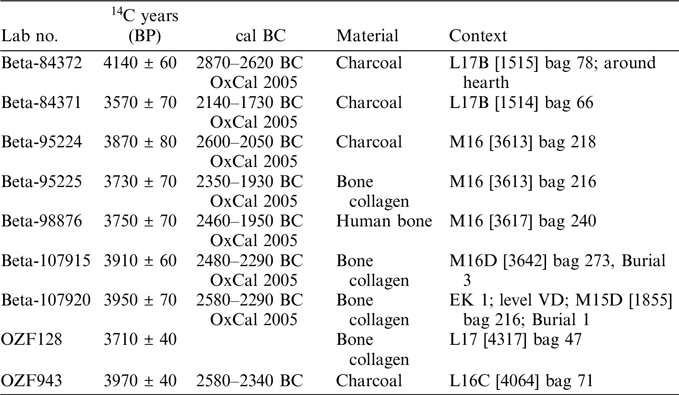
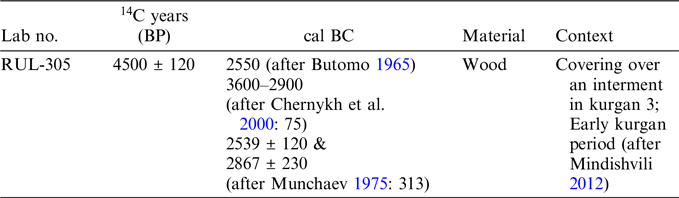
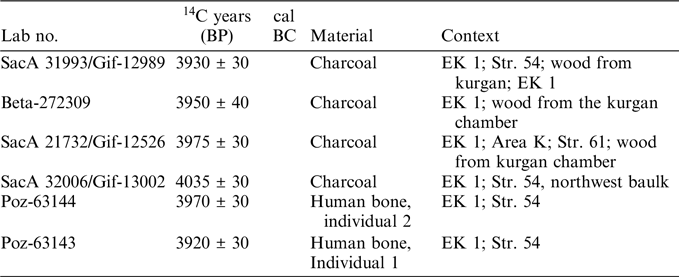
Details of 14C dates from Early Kurgan contexts in the Caucasus and neighboring regions.
Alazani, Georgia (Edens Reference Edens1995).

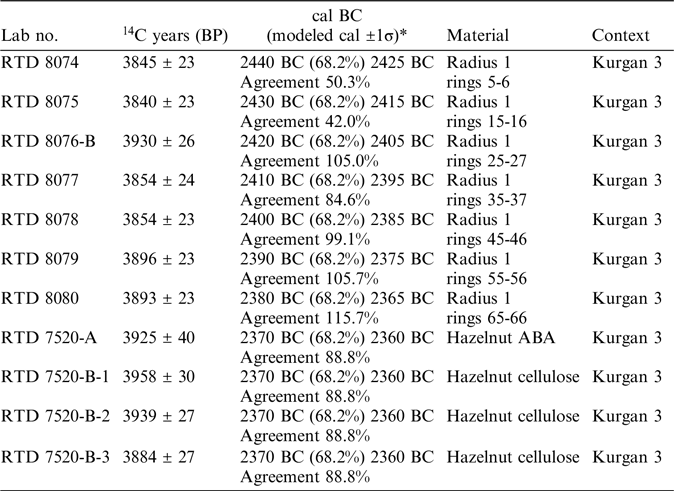
Ananauri, Georgia (Boaretto et al. Reference Boaretto, Lev, Regev, Makakharadze, Kalandadze and Murvanidze2016: 287).

* OxCal wiggle matching model (Boaretto et al. Reference Boaretto, Lev, Regev, Makakharadze, Kalandadze and Murvanidze2016: 287).
Bedeni, Georgia (Kushnareva Reference Kushnareva and Michael1997: 83; Passerini et al. Reference Passerini, Rova and Boaretto2018b: 131; Sagona Reference Sagona2018: 302).

Berikldeebi, Georgia (Kushnareva Reference Kushnareva and Michael1997: 83; Sagona Reference Sagona2018: 302).

Irganchai, Georgia (Kakhiani and Glighashvili Reference Kakhiani, Ghlighvashvili, Sagona and Abramishvili2008: 231)

Khramebi, Georgia (Edens Reference Edens1995; Kushnareva Reference Kushnareva and Michael1997: 83)

Martkopi, Georgia (Kavtaradze Reference Kavtaradze1983: 30, 31, 107; Burchuladze and Togonidze Reference Burchuladze and Togonidze1987: 252; Edens Reference Edens1995; Kushnareva Reference Kushnareva and Michael1997: 83; Japaridze Reference Japaridze1998: 200; Passerini et al. Reference Passerini, Rova and Boaretto2018b: 134).

Pichori, Abkhazia (Pkhakadze and Baramidze Reference Pkhakadze, Baramidze, Sagona and Abramishvili2008: 254, fig 3).

Tetri Tskaro Nadarbazevi, Georgia (Sagona Reference Sagona2018: 302).

Tsikhiagora, Georgia (Kavtaradze Reference Kavtaradze, Hauptmann, Pernicka, Rehren and Yalçin1999).

Tsnori, Georgia (Dedabrishvili Reference Dedabrishvili1979; Kushnareva Reference Kushnareva and Michael1997: 83).

Zeynani (Kavtaradze Reference Kavtaradze1983: 31; Kushnareva Reference Kushnareva and Michael1997: 83; Passerini et al. Reference Passerini, Rova and Boaretto2018b: 138).

Zhinvali, Georgia (Gogochuri Reference Gogochuri, Sagona and Abramishvili2008: 38).

Sos Höyük, Turkey (Sagona et al. Reference Sagona, Erkmen, Sagona and Howells1997: 192; Sagona Reference Sagona, Marro and Hauptmann2000: 353; Sagona Reference Sagona2014: 37; Passerini et al. Reference Passerini, Rova and Boaretto2018b).

Büyüktepe Höyük, Turkey (Sagona et al. Reference Sagona, Pemberton and McPhee1993).

Shengavit, Armenia (Simonyan and Manaseryan Reference Simonyan, Manaseryan, De Gupere, Linseele and Hamilton-Dyer2013: 193, Tab. 1).

Uch-Tepe, Azerbaijan (Butomo Reference Butomo1965: 227, no. 32; Lyonnet Reference Lyonnet2014: 127, n 30 after Chernykh et al. Reference Chernykh, Avilova and Orlovskaja2000; and Munchaev Reference Munchaev1975).

Mentesh Tepe, Azerbaijan (Lyonnet et al. Reference Lyonnet, Guliyev, Helwing, Aliyev, Hansen and Mirtskhulava2012: 92; Lyonnet Reference Lyonnet2014: 119, 125, fig 9; Lyonnet et al. Reference Lyonnet, Guliyev, Baudouin, Bouquet, Bruley-Chabot, Samzun, Foutugne, Degorre, Husson, Raymond, Helwing, Aaliyev, Lyonnet, Guliyev, Hansen and Mirtskhulava2017: 138; Passerini et al. Reference Passerini, Rova and Boaretto2018b: 134).

Velikent, Dagestan (Kohl Reference Kohl, Rubinson and Smith2003).