Introduction
Cystic echinococcosis (CE) caused by the metacestode of Echinococcus granulosus remains highly endemic in North Africa (Khan et al., Reference Khan, El-Buni and Ali2001; Bardonnet et al., Reference Bardonnet, Benchikh-Elfegoun, Bart, Harraga, Hannache, Haddad, Dumon and Vuitton2003; Azlaf & Dakkak, Reference Azlaf and Dakkak2006; Lahmar et al., Reference Lahmar, Rebaï, Boufana, Craig, Ksantini, Daghfous, Chebbi, Ftériche, Bédioui, Jouini, Dhibi, Makni, Ayadi, Ammous, Kacem and Ben Safta2009; Dakkak, Reference Dakkak2010; Hotez et al., Reference Hotez, Savioli and Fenwick2012). Livestock infection maintains the life cycle of E. granulosus as offal is often consumed by dogs (McManus et al., Reference McManus, Zhang, Li and Bartley2003). The infection also leads to economic losses due to the condemnation of livers and to lowered meat and milk production (Torgerson, Reference Torgerson2003). There has been a modest reduction in the mean annual surgical incidence rate from 15 to 12.7 cases/100,000 inhabitants during the past 2 decades (Anon., 1993; Chahed et al., Reference Chahed, Bellali, Touinsi, Chérif, Ben Safta, Essoussi and Kilani2010). Nevertheless, the human population is still exposed to E. granulosus as the prevalence of the adult tapeworm in dogs is over 10% (Lahmar et al., Reference Lahmar, Kilani and Torgerson2001; Alaya, Reference Alaya2008; Mehrez, Reference Mehrez2011; Ferchichi, Reference Ferchichi2012). In Tunisia, the annual cost of CE was estimated by Majorowsky et al. (Reference Majorowsky, Carabin, Kilani and Ben Salah2005) to reach US$ 19 million.
In previous studies carried out in Tunisia, CE prevalence varied from 40 to 65% (Lahmar et al., Reference Lahmar, Kilani, Torgerson and Gemmell1999, Reference Lahmar, Sarciron, Ben Chéhida, Hammou, Gharbi, Guérardi, Lahmar, Ghannay and Pétavy2007) and was up to 10% (Lahmar et al., Reference Lahmar, Debbek, Zhang, McManus, Souissi, Chelly and Torgerson2004) in sheep and dromedaries, respectively. However, there are no reports on the prevalence and intensity of E. granulosus hydatid cysts in cattle and goats, and data on cyst fertility and viability in cattle and small ruminants are lacking. Knowledge of local baseline data of CE infection in all intermediate host species is essential to implement effective strategies for disease control. This study aims to determine epidemiological baseline data, particularly on age-stratified prevalence and age-stratified intensity of E. granulosus infection in cattle and goats, and to update the same data for sheep and dromedaries.
Materials and methods
Abattoir surveys
A survey on CE in livestock was undertaken in different regions of Tunisia within both urban and government abattoirs during the period from 2003 to 2010. A total of 10,818 animals (3913 cattle, 2722 sheep, 3779 goats and 404 dromedaries) were examined. The slaughterhouses were located in the north (Mateur), the north-west (Le Kef), the north-east (Nabeul, Korba), the eastern central region (Hammam-Sousse, Kalâa-Kébira, Akouda, Sfax), the south-west (Tozeur, Nefta) and the south-east (Gabès, Mareth, El-Hamma, Médenine). The north of Tunisia has humid, semi-humid and semi-arid bioclimatic areas and a well-developed livestock industry comprising both cattle and small ruminant species. The central region of the country has an arid climate and is favourable for sheep breeding, whereas the southern areas are characterized by a Saharan climate with dromedaries and a limited number of cattle and small ruminants.
Examination of slaughtered animals and cysts
Information provided by the animals' owner as well as the stage of dentition at the time of slaughter was used to estimate the age of the animals. Sheep, goats and dromedaries having only milk teeth were classed as being less than 1 year old (Faye, Reference Faye1997; Vatta et al., Reference Vatta, Abbot, Villiers, Gumede, Harrison, Krecek, Letty, Mapeyl and Pearson2006), while cattle with the same type of teeth were considered to be less than 2 years of age (www.nda.agric.za/cattle/cattleteeth.htm). With one pair of permanent incisors, age was estimated to be 1 year for sheep and 2 years for goats, whereas 2-year-old sheep and 3-year-old goats possess two pairs of permanent incisors, respectively. Three-year-old sheep have three pairs of incisors, as in the case of 4-year-old goats, whereas both 5-year-old sheep and goats possess a full set of teeth (www.smallstock.info/tools/sheep/aging.htm). One-year-old camels possess four cheek teeth on each side of the upper jaw and three cheek teeth on each side of the lower jaw, while 3-year-olds have 4–5 cheek teeth on each side of the upper jaw and 3–4 cheek teeth on each side of the lower jaw (www.fao.org/docrep/T0690E/t0690e09.htm). All animals, regardless of species, were subsequently grouped into five age classes: 1, 2, 3, 4 and ≥ 5 years. Gender was recorded for each animal. Hydatid cysts were identified by gross examination and palpation of the lungs and livers at post-mortem and the number, size, localization and type of cysts were recorded. Degenerated hydatid cysts (caseated and calcified) were considered as infertile. When examined under the microscope, caseated cysts corresponded to a necrotic degeneration containing fragments of germinal layer and occasionally rostellar hooks. The small and completely calcified cysts, less than 5 mm in diameter were not included in this study because it was difficult to differentiate them from other metacestode lesions. Hydatid fluid was aspirated from each cyst and examined to determine fertility rate. Protoscolex viability was determined by the uptake of 0.2% eosin (Smyth & Barrett, Reference Smyth and Barrett1980). Viability of protoscoleces was determined for each fertile cyst per animal species and organ.
Data analysis
For all species, the variation of prevalence and age was analysed by a mathematical model first proposed by Roberts et al. (Reference Roberts, Lawson and Gemmell1986). Data were imported in the statistical software R (http://www.r-project.org/) and a non-linear generalized modelling approach was used to analyse the data. The optimx package (http://cran.r-project.org/web/packages/optimx/index.html) was used to find the maximum likelihood estimate of parameter values (Nash & Varadhan, Reference Nash and Varadhan2011). Confidence intervals (CIs) of parameters were estimated through the profile likelihood of the parameter values. Roberts et al. (Reference Roberts, Lawson and Gemmell1986) described the variation of prevalence P(t) with age (t) according to the equation:
 $$ P ( t ) = 1 - exp( - \beta t ) $$
where β is the prevailing infection pressure defined as the proportion of animals infected per year or proportional incidence. This model gives an asymptotic relationship with the prevalence of infection approaching 1 (or 100%) in older animals. Data were also analysed to check the fit of a competing model where the asymptote can be less than 1:
 $$ P ( t ) = \gamma \,\lcub 1 - exp( - \beta t )\rcub $$
where γ is the asymptotic prevalence. This may occur if a proportion of the population is resistant to infection or is not exposed to the parasite.
In addition, as data were collected from several different regions of the country it was possible to analyse whether the infection pressure varied with district and gender of the animal. This was achieved by modelling the parameter β as varying between districts (d) and between males and females (g) as fixed effects.
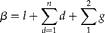 $$ \beta = l + { \sum _{ d = 1}^{ n } }\, d + { \sum _{1}^{2} }\, g $$
Competing models with separate parameters for district and gender were compared with simpler models by the likelihood ratio test to determine the most parsimonious model. This analysis therefore provided evidence for variations of infection pressure β with gender or district.
Likewise the abundance model reported by Roberts et al. (Reference Roberts, Lawson and Gemmell1986) was also used to fit the parasite count data. First, the data were fitted to the non-linear model which allows for the development of immunity in the intermediate host. This was compared to the competing non-linear model where parameters relating to the establishment of immunity are set to zero, resulting in a linear model of the form:
 $$ M ( t ) = ht $$
where M(t) is the mean abundance at age t and h is the infection pressure in cysts per year. The abundance data were analysed in terms of mean and variance, which indicated they were overdispersed. Consequently, the maximum likelihood estimates of all parameters were made assuming the parasite abundance data followed a negative binomial distribution. Further details of the procedures used to estimate the parameters can be found in Torgerson et al. (Reference Torgerson, Burtisurnov, Shakenov, Rysmukhambetova, Abdybekova and Ussenbayev2003).
In addition, any variation in h or k, the negative binomial constant of aggregation, were tested according to age (t), gender (g) and district (d) of origin of the animals
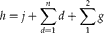 $$ h = j + { \sum _{ d = 1}^{ n } }\, d + { \sum _{1}^{2} }\, g $$
and
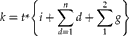 $$ k = t \ast \left { i + { \sum _{ d = 1}^{ n } }\, d + { \sum _{1}^{2} }\, g \right } $$
where k is the negative binomial constant of aggregation, i and j are constants. Like the prevalence models, this approach examined the influence of district and gender as fixed effects. Again, competing models were compared by the likelihood ratio test and the most parsimonious model was chosen which described the infection pressure h and the variation of h with district and gender and the variation of k with age, gender and district of origin.
The Fisher test was used to compare the CE prevalence among ruminant species and organ distribution of the cysts (Schwartz, Reference Schwartz1993).
Results
Prevalence
Of the 10,818 examined carcasses, 915 animals were infected with E. granulosus larvae (8.45%). Sheep had the highest prevalence of 16.42% (447/2722). The lowest prevalence was found in goats, with 2.88% (109/3779), while CE prevalence in cattle and dromedaries was 8.56% (335/3913) and 5.94% (24/404), respectively (P< 0.0001).
CE prevalence increased with age according to the asymptotic models (equations 1 and 2). In all species the asymptote converged on one. The intercept (parameter l in equation 3) for the infection pressure β was 0.105 (CIs 0.094–0.118) in sheep. Infection pressure was significantly lower in male animals as compared to females (parameter g= − 0.0994, CIs − 0.087 to − 0.113) and was higher in the central region of the country compared to other districts (parameter d= 0.126, CIs 0.092–0.164). In goats, infection pressure had an intercept (l) of 0.011 (CIs 0.008–0.017) and was higher in the south-west district (d= 0.037, CIs 0.024–0.054). In dromedaries there was no significant variation in infection pressure between male and female animals or between districts, with a uniform infection pressure of 0.022 being observed (CIs 0.015–0.033). In cattle (intercept l= 0.141, CIs 0.126–0.158), female animals (g= 0.14, CIs 0.13–0.16) or animals from the north (d= 0.0065, CIs 0.0021–0.013) had an increase in infection pressure compared to other animals.
The number of parasitic cysts acquired per year, h, also varied between species, district and gender. Cattle had the highest infection pressure (1.06 cysts per year, CIs 0.88–1.30) which did not vary with gender or district. Dromedaries had the lowest infection pressure (0.038 cysts per year, CIs 0.024–0.062), again with no evidence of variation between district and gender. The baseline infection pressure in female sheep (parameter j or intercept l) was 0.881 cysts per year (CIs 0.742–1.048). This decreased in male sheep (parameter g= − 0.851, CIs − 1.010 to − 0.720) and increased in the central region (parameter d= 0.195, CIs 0.090–0.455). The baseline infection pressure in goats was 0.32 cysts per year (CIs 0.235–0.460), which did not vary by gender but was higher in the south-west region (d= 0.063, CIs 0.032–0.109).
The negative binomial constant k increased with age in sheep, goats and cattle (parameter t, equation 6, was 0.043, CIs 0.038–0.049; 0.009, CIs 0.006–0.011 and 0.020, CIs 0.0171–0.22, respectively). In sheep there was a further increase in k for animals originating from the central region (parameter d, equation 6, was 0.195, CIs 0.09–0.455) and a similar increase in k was observed for goats from the south-west region (d= 0.039, CIs 0.018–0.063). In camels k was a constant 0.075 (CIs 0.038–0.145) and did not vary with age, gender or district.
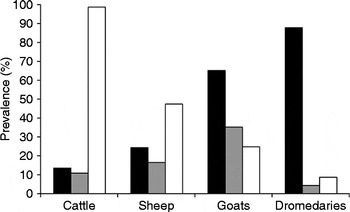
Livers and lungs were the only organs observed to be infected. A significant difference was observed in infection prevalence of the liver and lungs in all slaughtered carcasses of cattle (P< 0.0001), sheep (P< 0.0001), goats (P= 0.008) and dromedaries (P= 0.008). Prevalence of hepatic hydatid cysts (13.43%, 24.16%, 65.13% and 87.5%, respectively for cattle, sheep, goats and dromedaries) was higher than that of pulmonary cysts (10.74%, 16.33%, 34.86% and 4.16%, respectively). There were also many hepatic and pulmonary co-infections in cattle, sheep, goats and dromedaries (98.50%, 47.42%, 24.77% and 8.33%, respectively). Co-infection of both liver and lungs was less common in dromedaries than infection of liver alone (fig. 1).
The prevalence (%) of hepatic, pulmonary and both hepatic and pulmonary cysts in cattle, sheep, goats and dromedaries. Black bars, liver; grey bars, lungs; white bars, co-infection.

Size, fertility and viability of cysts
Cyst size varied between 1 and 80 mm in diameter for each animal. Mean diameter of hepatic and pulmonary cysts ranged from 3 to 45 mm in cattle, from 2 to 80 mm in sheep, from 1 to 60 mm in goats and from 1 to 40 mm in dromedaries.
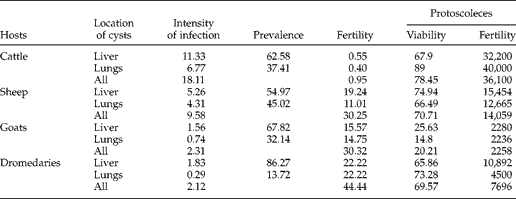
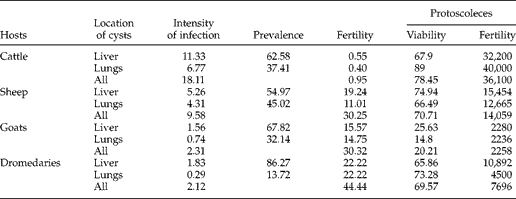
Cysts from dromedaries were more fertile (44.44%) than those from sheep (30.25%), goats (30.32%) and cattle (0.95%). While the viability of protoscoleces from fertile cysts of cattle (78.45%) was higher than that from sheep (70.71%) and dromedaries (69.57%), the viability recovered from goats was the lowest (20.21%). The mean number of protoscoleces/ml from fertile cysts was 36,100, 14,059, 2258 and 7696, in cattle, sheep, goats and dromedaries, respectively.
The fertility rate of viable hepatic cysts was similar to that of the pulmonary cysts for dromedaries (22.22%). However, in cattle, sheep and goats liver cysts (0.55%, 19.24% and 15.57%) were more fertile than lung cysts (0.40%, 11.01% and 14.75%) (table 1).
The prevalence (%) and intensity of infection of cysts in cattle, sheep, goats and dromedaries, together with cyst fertility (%) and the viability (%) and fertility rates (number/ml) of protoscoleces.
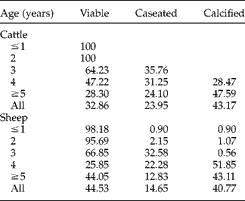
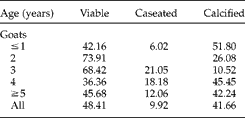
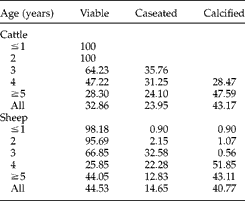
The percentage of viable cysts was highest in cattle, sheep and goats of up to 3 years of age. Older animals had a higher proportion of dead cysts (tables 2 and 3). In sheep and goats more than 5 years old, the percentage of viable (44.5% and 45.68%, respectively) and dead (55.94% and 54.3%, respectively) cysts was similar (tables 2 and 3). In dromedaries over 5 years of age there were 26.47% viable cysts and a further 64.70 calcified cysts. In young dromedaries only very small calcified cysts were found (table 3).
The proportion (%) of hepatic and pulmonary cyst lesions in cattle and sheep, relative to host age.
The proportion (%) of hepatic and pulmonary cyst lesions in goats and dromedaries*, relative to host age.
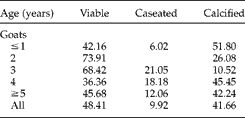
* Calcified cyst lesions in dromedaries occur in 100% of age groups < 1–4 years, and in age group ≥ 5 years 26.4%, 8.82% and 64.7% of cyst lesions are viable, caseated and calcified, respectively.
Discussion
The current study, conducted in several abattoirs over the past 8 years, indicated that CE is highly endemic in Tunisia, with statistically significant differences in prevalence between species. Sheep had the highest CE prevalence (16.42%), followed by cattle (8.56%), dromedaries (5.94%) and goats (2.88%). Differences are also seen in model parameters which reflect infection pressure both in terms of proportion of animals exposed per year and number of cysts acquired per year. These model parameters incorporate the age of the animals in the model estimate and thus give a better reflection of exposure, since there are different numbers of animals in different age classes across the various species. Infection pressure appears to be highest in cattle rather than sheep, with dromedaries and goats having the lowest infection pressure. Consequently the lower crude prevalence recorded in cattle is a reflection of a higher proportion of young animals in the sample compared to sheep.
The mean prevalence of hepatic E. granulosus cysts in slaughtered sheep throughout Tunisia was previously reported to be 65% (Lahmar et al., Reference Lahmar, Kilani, Torgerson and Gemmell1999). The comparatively lower prevalence of hepatic and pulmonary hydatid infection in sheep recorded in this study (16.45%) is partly due to the large proportion of lambs within the current sample. In addition, the previous β value, although only applicable to liver cysts, was higher (0.423) (Lahmar et al., Reference Lahmar, Kilani, Torgerson and Gemmell1999) than that observed in this study. This confirms that transmission rates are lower in the present study. It further highlights the importance of appropriate data analysis, in particular the use of age stratification rather than crude prevalence, in investigating the epidemiology of this parasitic infection. Sheep have the highest overall rate of infection (16.45%) reaching 69.76% in the oldest age group with 19.24% and 11.01% of fertile cysts in the liver and the lungs, respectively, and a high (70.71%) proportion of viable protoscoleces from fertile cysts (liver, 74.94% and lungs, 66.49%). They may thus be considered as the most important intermediate host for E. granulosus in Tunisia. However, the high infection pressure recorded in cattle suggests that this latter species may play an important role in the epidemiology of echinococcosis.
In the present study, hydatid cyst infection in dromedaries was 5.94%. The proportion of animals sampled that were less than 3 years old was 66.58%, while older animals (> 5 years of age) constituted 20.54% of the test sample. Thus, the higher reported hydatidosis prevalence of 10.1% in a previous study undertaken in the same area was due to a larger number of older dromedaries in that particular sample (Lahmar et al., Reference Lahmar, Debbek, Zhang, McManus, Souissi, Chelly and Torgerson2004). This is confirmed by the parameter β which was 0.025 in the previous study (Lahmar et al., Reference Lahmar, Debbek, Zhang, McManus, Souissi, Chelly and Torgerson2004) as compared to that observed in the current study (0.022). Similarly, there was no significant difference in the parameter h recorded for the two studies. The importance of dromedaries in the transmission of E. granulosus in the south of Tunisia is highlighted by the high cyst fertility rate of 44.44% (liver, 22.22% and lungs, 22.22%), a mean number of 7696 protoscoleces per ml of hydatid fluid and a protoscolex viability of 69.57% (liver, 65.86%; lungs, 73.28%).
In contrast, this study revealed a low CE prevalence in goats (2.88%) which may be a reflection of animal husbandry practices where goats may have lower contact with shepherd dogs and do not go to summer pastures. In a previous study in Jordan it was hypothesized that the lower infection pressure in goats compared to sheep was due to their grazing behaviour (Torgerson et al., Reference Torgerson, Williams and Abo-Shehada1998). Like cattle, the crude prevalence in goats may be biased by the larger number of young animals in the sample. However, the infection pressure parameters are much lower than those of sheep, which confirms that goats acquire far fewer cysts when age is accounted for. Although compared to sheep, goats are relatively infrequently infected, they could also play a role in hydatidosis transmission due to their high proportion of fertile cysts (30.32%) and non-negligible viability of protoscoleces (20.21%).
Despite the low cyst fertility rate (0.95%), cattle appear to contribute to the transmission of CE in Tunisia. This is evidenced by the high percentage (65.89%) of cattle aged over 5 years harbouring 28.30% of viable cysts and a mean number of 36,100 protoscoleces per ml of hydatid fluid.
Genetic characterization of E. granulosus isolates from Tunisia indicated the circulation of the G1 strain in cattle, sheep, goats and dromedaries (Lahmar et al., Reference Lahmar, Debbek, Zhang, McManus, Souissi, Chelly and Torgerson2004; Farjallah et al., Reference Farjallah, Busi, Mahjoub, Slimane, Said and D'Amello2007). Additionally, the camel strain (G6 genotype) has also been reported to occur in dromedaries (M'rad et al., Reference M'rad, Filisetti, Oudni, Mekki, Belguith, Nouri, Sayadi, Lahmar, Candolfi, Azaiez, Mezhoud and Babba2005). It is not clear, however, whether the discrepancies in prevalence between sheep and camel species observed in this study are due to genotypic variation of the parasite.
Cystic echinococcosis is common in neighbouring countries. In Algeria condemnations of 20.88% of lungs and 14.8% of livers in cattle due to echinococcosis is indicative of the high prevalence of E. granulosus (Bentounsi et al., Reference Bentounsi, Meradi, Ayachi and Cabaret2009). In Morocco, CE prevalence was lower both in sheep (10.58%), reaching 31.65% in the north-west, and in goats (1.88%). However, the prevalence was higher in cattle (22.98%) and dromedaries (12.03%) (Azlaf & Dakkak, Reference Azlaf and Dakkak2006). In Libya, dromedaries and sheep are the species with the highest prevalence of 48% and 37.9–50.9%, respectively (Ibrahem & Gusbi, Reference Ibrahem, Gusbi, Andersen, Ouhelli and Kachani1997), with sheep having the highest cyst fertility rate (75%) (Khan et al., Reference Khan, El-Buni and Ali2001). Goats and cattle have a lower prevalence of 8.2% and 6.4%, respectively (Al-Khalidi, Reference Al-Khalidi1998; Ibrahem & Craig, Reference Ibrahem and Craig1998). In Egypt CE prevalence was 0.3% in small ruminants, 6.4% in cattle and 2.53% in dromedaries (Haridy et al., Reference Haridy, Ibrahim, Elshazly, Awad, Sultan, El Sherbini and Morsy2006). Although such comparisons of crude prevalence have some utility, they must be viewed with caution as differences in prevalence may also be due to differences in the age of the animals examined. The modelling approach used in this study utilizes the parameters of infection pressure which are not influenced by the age distribution of the sample, but by the stratified prevalence and abundance of parasites in each age group, and thus is a better parameter for comparison. In this respect the increase in the number of cysts with age and the proportion of animals infected can be compared directly to a number of other studies where this modelling approach has been utilized (e.g. Roberts et al., Reference Roberts, Lawson and Gemmell1986 in New Zealand; Ming et al., Reference Ming, Tolley, Anderson, Chai and Sultan1992 in China; Torgerson et al., Reference Torgerson, Williams and Abo-Shehada1998, Reference Torgerson, Burtisurnov, Shakenov, Rysmukhambetova, Abdybekova and Ussenbayev2003 in Jordan and Kazakhstan, respectively; and Dueger & Gilman, Reference Dueger and Gilman2001 in Peru).
There were some significant variations in infection pressure between the different regions where animals were slaughtered. This would be consistent with animals being slaughtered at their local regional slaughterhouse and there being some differences in the infection pressure within Tunisia. Ibrahim (Reference Ibrahim2010) reported that optimal environmental conditions, such as high humidity with lower temperatures and sunlight, promote the transmission of the parasite in Saudi Arabia. Such conditions lead to a higher viability of E. granulosus eggs, which can then infect intermediate hosts more intensively. However, a previous study undertaken in Tunisia, on the transmission dynamics of E. granulosus in dromedaries, revealed that the number of cysts per infection depended on the animal's grazing behaviour. Thus, even though the infection pressure in dromedaries (Lahmar et al., Reference Lahmar, Debbek, Zhang, McManus, Souissi, Chelly and Torgerson2004) was lower than that of sheep (Lahmar et al., Reference Lahmar, Kilani, Torgerson and Gemmell1999), the number of cysts per infection in dromedaries was similar to that of sheep. This was possibly due to the ingestion of fewer clusters of viable eggs by dromedaries rather than their lower viability in the southern areas.
There may also be variations in infection pressure with year. However, it is not possible to explore this hypothesis as the model assumes a constant infection pressure over time and thus the age of the host is a proxy for time in the transmission model. Indeed, if there was a variation of infection pressure with time, then non-linear patterns in the age-stratified abundance may have been detected.
The significant linear increase of the prevalence with age has previously been reported in sheep (Lahmar et al., Reference Lahmar, Kilani, Torgerson and Gemmell1999) and dromedaries (Lahmar et al., Reference Lahmar, Debbek, Zhang, McManus, Souissi, Chelly and Torgerson2004) from Tunisia. In the present study, cattle, sheep, goats and camels presented the same fit for the age prevalence model described by Roberts et al. (Reference Roberts, Lawson and Gemmell1986), implying the absence of regulating immunity in all these intermediate hosts. Similar to other studies on CE infection in intermediate hosts, hydatidosis prevalence was higher in old than in young animals (Kamhawi et al., Reference Kamhawi, Hijjawi, Abu-Gazeleh and Abbas1995; Cabrera et al., Reference Cabrera, Haran, Benvidez, Valledor, Perera, Lioyd, Gemmell, Baraibar, Morana, Maissonav and Carballo1996; Torgerson et al., Reference Torgerson, Burtisurnov, Shakenov, Rysmukhambetova, Abdybekova and Ussenbayev2003; Umur, Reference Umur2003; Azlaf & Dakkak, Reference Azlaf and Dakkak2006; Amin Pour et al., Reference Amin Pour, Hosseini and Shayan2011; Beyhan & Umur, Reference Beyhan and Umur2011; Kamal et al., Reference Kamal, Romig, Kern and Rihab2011).
The increase of viable cysts with age is consistent with new infections acquired throughout life, and therefore females have an important role in CE transmission, particularly as they are more heavily infected and live longer than males (Kamhawi et al., Reference Kamhawi, Hijjawi, Abu-Gazeleh and Abbas1995; Ibrahim, Reference Ibrahim2010; Amin Pour et al., Reference Amin Pour, Hosseini and Shayan2011; Beyhan & Urmur, 2011). In our analysis there appeared to be a significantly lower infection pressure in male sheep. This indicates that males either have a lower exposure to the parasite or greater resistance to infection following exposure.
In the present study, cattle, sheep, goats and dromedaries were more likely to have hepatic than pulmonary infections. Liver cysts from sheep were more fertile (19.24%) than pulmonary cysts (11.01%), while fertility rates of liver and lungs from other animal species were similar. The same organ distribution of cysts was observed in Libya in the intermediate hosts, where the liver was the predominant infected site, with prevalence values of 86% and 100% in sheep and goats (Ibrahem & Craig, Reference Ibrahem and Craig1998). Likewise, in Tanzania, the livers of sheep and goats were found to be more infected (21%) than the lungs (19.3%) (Nonga & Karimuribo, Reference Nonga and Karimuribo2009). In contrast, the lungs were the most frequently infected organs in camels (85.4%) and in cattle (22.5%), respectively, in Libya and Tanzania (Ibrahem & Craig, Reference Ibrahem and Craig1998; Nonga & Karimuribo, Reference Nonga and Karimuribo2009) as well as in buffaloes (47.06%) from the Black Sea Region of Turkey (Beyhan & Umur, Reference Beyhan and Umur2011) or from some Iranian provinces (Amin Pour et al., Reference Amin Pour, Hosseini and Shayan2011). In Ethiopia, cattle and sheep lungs were the organs most commonly infected (55.2% and 55%) followed by liver (37.1%), while in goats, the liver was the most frequently infected organ (55.6%) followed by the lungs (33.3%) (Getaw et al., Reference Getaw, Beyene, Ayana, Megeria and Abunna2010). In Morocco, Azlaf & Dakkak (Reference Azlaf and Dakkak2006) found that the lungs were the predominant site of the CE in cattle, but the liver was more infected than lungs in sheep, goats and dromedaries.
In conclusion, CE is widespread in slaughtered domestic ruminants throughout Tunisia. All intermediate hosts play a role in the maintenance of the E. granulosus cycle and act as reservoirs of human infection through the dominant G1 strain. This strain was found previously in all intermediate host species (Farjallah et al., Reference Farjallah, Busi, Mahjoub, Slimane, Said and D'Amello2007) and in humans (Lahmar et al., Reference Lahmar, Rebaï, Boufana, Craig, Ksantini, Daghfous, Chebbi, Ftériche, Bédioui, Jouini, Dhibi, Makni, Ayadi, Ammous, Kacem and Ben Safta2009) in Tunisia. The present study has shown that sheep are the most highly infected domestic ruminants. This is similar to the situation in Jordan (Abdel-Hafez et al., Reference Abdel-Hafez, Al-Yaman and Said1986; Abo-Shehada, Reference Abo-Shehada1993), Morocco (Azlaf & Dakkak, Reference Azlaf and Dakkak2006), Turkey (Umur, Reference Umur2003) and Ethiopia (Erberto et al., Reference Erberto, Zewde and Kumsa2010). However, our model analysis suggests that the infection pressure may actually be higher in cattle than sheep and that the higher crude prevalence in sheep is likely to reflect differences in the age of the sampled animals. Uncontrolled slaughtering of these animals, extensive animal husbandry and ignorance of the parasite life cycle are all factors that help maintain CE infection. Understanding the life cycle of E. granulosus and the risk factors contributing to human infections constitutes the biggest challenge for hydatidosis control (Heath et al., Reference Heath, Yang, Li, Xiao, Chen, Huang, Yang, Wang and Qiu2006). Integrated preventive approaches could be implemented in a control programme, which should include improvement of slaughter facilities and animal husbandry practices, regular praziquantel treatment of dogs, with two treatments per year, culling of unwanted dogs and the use of Eg95 vaccine (Lightowlers et al., Reference Lightowlers, Lawrence, Gauci, Young, Ralston, Maas and Health1996) in sheep to prevent the development of E. granulosus cysts. This would lead to a lower number of cysts in older animals while young animals remain free of infection. However, costs and source of funding in Tunisia probably constitute the other challenges facing the implementation of such a CE control programme.
Acknowledgements
The authors are grateful to Professor Mohamed Gharbi from the National School of Veterinary Medicine, Sidi Thabet, for his statistical help and Dr Belgees Boufana from the Biosciences Research Institute, University of Salford, for her helpful comments on the manuscript. This research received no specific grant from any funding agency, commercial or not-for-profit sectors.