Introduction
CHD is one of the most common congenital anomalies, occurring in approximately 1 in 100 children. Reference Liu, Chen and Zuhlke1 Although advances in surgical techniques and perioperative management have significantly improved the survival of affected infants, concerns remain regarding the long-term growth and neurodevelopmental outcomes in these children, particularly those undergoing early cardiopulmonary bypass surgery. Reference Gaynor, Stopp and Wypij2–Reference Bellinger, Bernstein, Kirkwood, Rappaport and Newburger7
The brains of children with severe CHD may be affected during the fetal period due to complex cardiac structural abnormalities. Reference Hovels-Gurich8 These vulnerabilities may be exacerbated by medical and surgical interventions during the neonatal period and infancy, which further influence neurodevelopmental outcomes. Reference Howell, Zaccario and Kazmi9 Previous studies have identified several risk factors for neurodevelopmental impairment in children with CHD, including univentricular repair (UV), low gestational age (GA), low birth weight, small for gestational age, male sex, prolonged hospitalisation, genetic anomalies, and social factors such as low maternal education, maternal and paternal mental health diagnoses, and Caucasian race. Reference Gaynor, Stopp and Wypij2,Reference Huisenga, La Bastide-Van Gemert, Van Bergen, Sweeney and Hadders-Algra10–Reference Miles, Gal and Farkas17 In Asian countries, one study from India identified syndromic association, duration of mechanical ventilation, and head circumference as risk factors for delayed motor development, while syndromic association, duration of hospital and ICU stay, and socioeconomic status were risk factors for delayed psychomotor development. Reference Raj, Chattopadhyay and Gupta18
In addition, elevated lactate levels after surgery and multiple cardiac surgeries are associated with worse outcomes. Reference Gunn, Beca and Hunt15 Importantly, the timing of initial cardiopulmonary bypass surgery may also influence neurodevelopment. For example, delayed surgery in patients with hypoplastic left heart syndrome has been linked to white matter injury, Reference Lynch, Buckley and Schwab19 and subsequent surgery has been associated with lower intelligence quotient scores at school age. Reference Heye, Rousson and Knirsch20 Although several studies have compared the neonatal and non-neonatal timing of surgery, Reference Loomba, Buelow and Woods21,Reference Ghimire, Chou, Devoe and Moon-Grady22 the optimal window for intervention remains unclear.
Despite these findings, few studies have investigated growth and neurodevelopmental outcomes in Japanese children with severe CHD. Therefore, this study was conducted at a tertiary care centre in Japan, where a national health insurance system is well established, and active medical interventions such as fetal screening, advanced medical and surgical management for CHD after birth, and nutritional support are all widely provided.
The primary aim of this study was to evaluate growth and neurodevelopmental outcomes at 18–22 months of age in term infants who underwent cardiopulmonary bypass surgery for CHD. The secondary aim was to identify risk factors for growth and neurodevelopmental impairment, including the timing of the initial surgical intervention.
Methods
Patients and setting
This was a retrospective study that included singleton term infants with a GA of 37 + 0 to 41 + 6 weeks born between October 1, 2015, and June 30, 2021, who underwent cardiopulmonary bypass surgery for CHD at Osaka Women’s and Children’s Hospital. Patients with chromosomal abnormalities were excluded from this study. Perinatal, perioperative, growth, and neurodevelopmental outcome data were retrospectively reviewed from the medical records. The patients were classified into the UV and biventricular repair (BV) groups. This study was approved by the review board of our institution (approval no. 1650), and the requirement for informed consent was waived because of its retrospective design.
Institutional policy for CHD management
In our institution, conservative management with medical treatment is generally preferred when patients have stable oxygenation and other systemic conditions. However, when intervention is required, surgical treatment is conducted even before 28 days of age. We closely monitor the infants’ growth over time, providing interventions when deemed necessary. When an infant’s growth deviates from the expected growth curve, nasogastric (NG) tube feeding is introduced as required to ensure adequate nutritional support.
Outcomes
The primary outcomes of the study were growth and neurodevelopmental outcomes at 18–22 months of age according to the type of CHD (UV or BV). The secondary outcome was the risk factors associated with growth and neurodevelopmental impairment at 18–22 months of age.
Physical assessments, including weight and height, were performed on children aged 18–22 months old, and growth was assessed using standard growth charts for Japanese children. Reference Isojima, Kato, Ito, Kanzaki and Murata23 Growth impairment was defined as weight and height below the tenth percentile. Neurodevelopmental assessments were performed using the Kyoto Scale of Psychological Development (published in 2002) in children aged 18 and 22 months of age. 24 The Kyoto Scale of Psychological Development test is an individualised test performed in person by experienced psychologists to assess a child’s development in the following three areas: postural–motor functions (P-M; fine and gross motor functions), cognitive–adaptive functions (C-A; nonverbal reasoning or visuospatial perceptions assessed using materials), and language–social functions (L-S; interpersonal relationships, socialisation, and verbal abilities). For each of the three areas, the sum score was converted to the overall developmental age (DA). The DAs for the three specific areas and the overall DA were divided by the child’s chronological age and multiplied by 100 to yield four developmental quotients (DQ: P-M DQ, C-A DQ, L-S DQ, and total DQ). Infants were assessed as either normal (DQ ≥ 85), borderline (70 < DQ < 85), or abnormal (DQ ≤ 70) when compared with ordinary children of the same age. The developmental characteristics on the Kyoto Scale of Psychological Development showed good correlation with those on the Bayley III in very low birth weight infants. Reference Kono, Yonemoto and Kusuda25 The P-M DQ, C-A DQ, and L-S DQ in the KSPD have also been shown to be strongly correlated with the corresponding motor, cognitive, and language composite scores of the Bayley-III, respectively. Reference Kono, Yonemoto and Kusuda25 In this study, neurodevelopmental impairment was defined as a DQ score < 85.
Statistical analysis
We compared study groups with respect to background factors and outcomes. Fisher’s exact test was used to examine categorical variables, whereas the Mann–Whitney nonparametric U test was used for continuous variables. The adjusted risk and 95% confidence interval (CI) of neurodevelopmental impairment were determined using logistic regression analysis adjusted for birth weight, sex, the type of CHD (UV or BV), and timing of initial cardiopulmonary bypass surgery (<28 days or ≥28 days). These factors were predetermined based on previous studies that reported their association with neurodevelopment in CHD. Reference Gaynor, Stopp and Wypij2,Reference Huisenga, La Bastide-Van Gemert, Van Bergen, Sweeney and Hadders-Algra10–Reference Goff, Luan and Gerdes16 The findings are presented as unadjusted results and results adjusted for all possible predictors.
Data management and statistical analyses were performed using EZR (Saitama Medical Center, Jichi Medical University, Saitama, Japan), a graphical user interface for the R software (version 4.3.0; The R Foundation for Statistical Computing, Vienna, Austria). Reference Kanda26 Statistical significance was defined as p < 0.05.
Results
Population characteristics
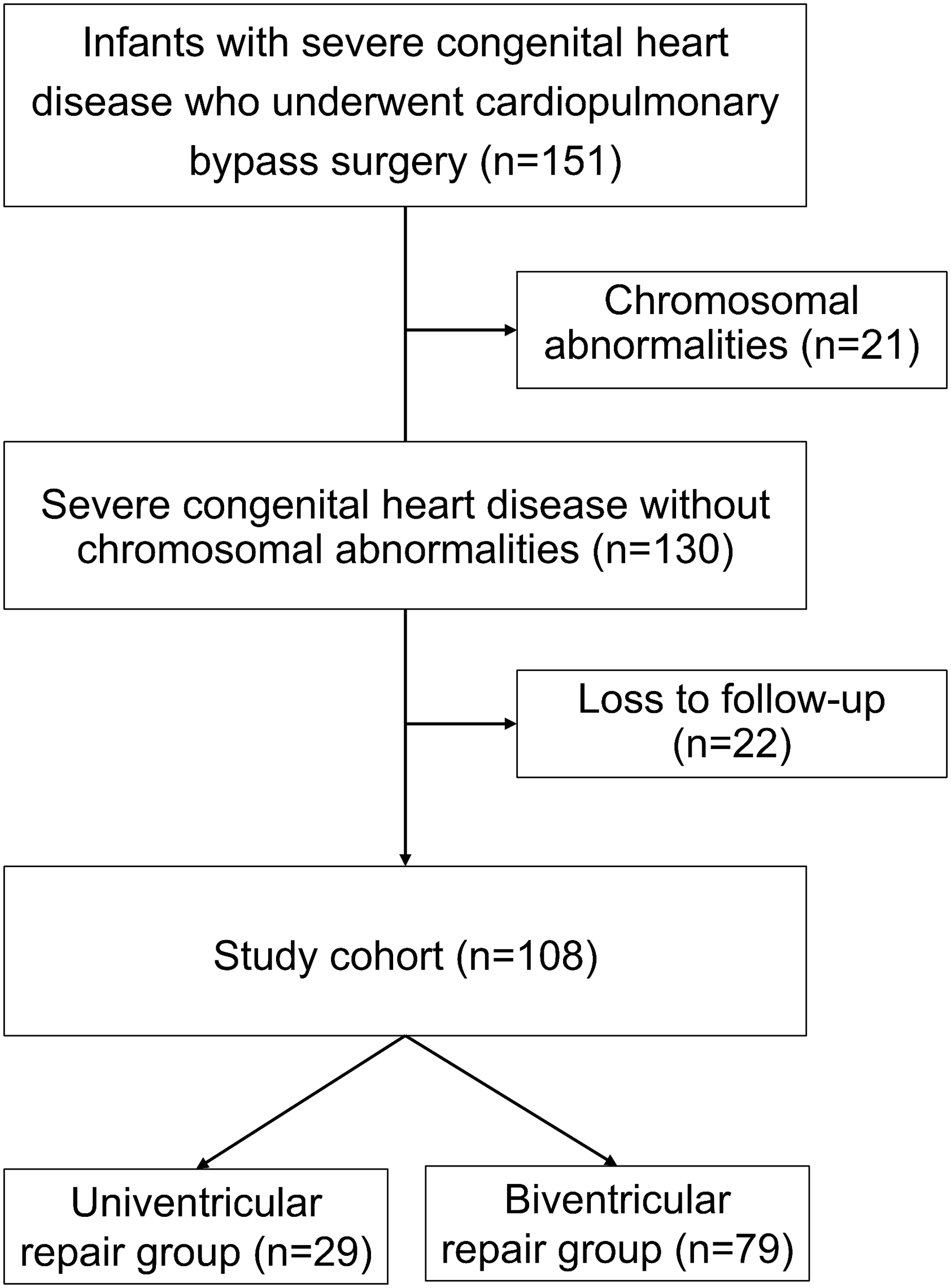
Of 151 singleton term infants with CHD born between 2015 and 2021 who underwent cardiopulmonary bypass surgery, 108 were included in the analysis (Figure 1). We excluded 21 children with chromosomal abnormalities and 22 for whom development could not be evaluated at 18–22 months. The UV group included patients with functional UV (n = 16), hypoplastic left heart syndrome (n = 5), pulmonary atresia (n = 7), and Ebstein anomaly (n = 1). The BV group included patients with ventricular septal defects (n = 7), atrial septal defects (n = 1), tetralogy of Fallot (n = 15), double-outlet right ventricle (n = 14), transposition of the great arteries (n = 18), atrioventricular septal defects (n = 1), total anomalous pulmonary venous connections (n = 6), partial anomalous pulmonary venous connections (n = 2), coarctation of the aorta (n = 9), interruption of the aortic arch (n = 3), mitral valve prolapse (n = 1), mitral stenosis and regurgitation (n = 1), and tricuspid atresia (n = 1).
Population characteristics.

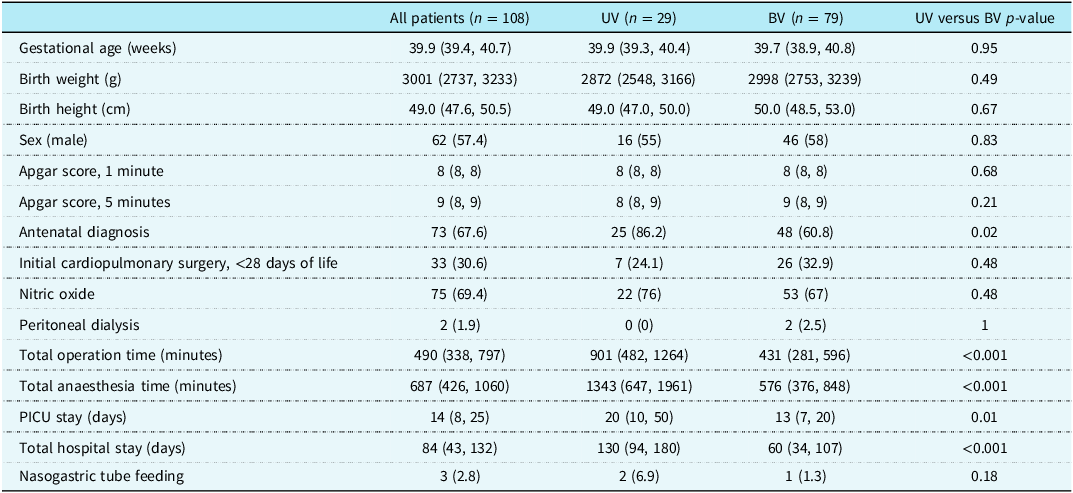
The background factors stratified by CHD type are listed in Table 1. There were no significant differences in gestational age, birth weight, birth height, sex, or Apgar scores (at both 1 and 5 min) between the UV and BV groups. The number of antenatal diagnoses was significantly higher in the UV group than that in the BV group (25/29 = 86.2% vs. 48/79 = 60.8%, p = 0.02). Furthermore, the total operation time, total anaesthesia time, length of stay in the paediatric ICU, and total hospital stay were significantly longer in the UV group than in the BV group. Regarding nutritional intervention, NG tube feeding was required in 1.3% (1/79) of the BV group and 6.9% (2/29) of the UV group, yielding no significant inter-group differences.
Comparison of background factors of the study cohort

UV = univentricular repair group; BV = biventricular repair group; PICU = Pediatric Intensive Care Unit. Data are expressed as median (interquartile range) or number (%).
Growth and neurodevelopmental outcomes at 18–22 months
The growth outcomes at 18–22 months of age are shown in Figure 2. One patient in the BV group had missing height data, and at 18–22 months of age, both groups exhibited lower body weights and heights than the standard values. The body weight (SD) was significantly lower in the UV group than in the BV group. Additionally, the neurodevelopmental outcomes at 18–22 months of age are shown in Figure 2. The total DQ, P-M DQ, and C-A DQ were significantly lower in the UV group than in the BV group.
Growth and neurodevelopmental outcomes at 18–22 months of age. UV = univentricular repair group; BV = biventricular repair group; DQ = developmental quotient; P-M = postural–motor functions; C-A = cognitive–adaptive functions; L-S = language–social functions.

Factors associated with growth and neurodevelopmental impairment at 18–22 months
Of the 107 children assessed, 32 (29.9%) were below the tenth height percentile, which was outside the normal height range. In addition, of the 108 children assessed, 37 (34.3%) were below the tenth weight percentile and also fell outside the normal weight range. After adjusting for potential risk factors, no statistically significant differences in risks were noted between UV and BV cohorts (Supplementary Table S1).
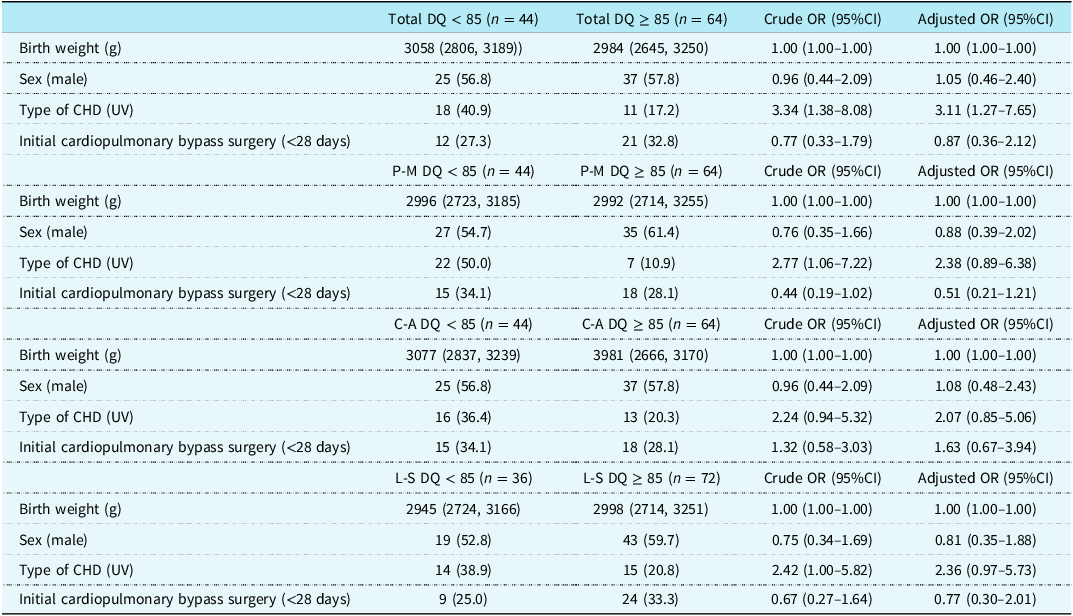
Of the 108 children assessed, 44 (40.7%) had total DQ, PM DQ, and CA DQ scores below 85, which were outside the normal range. In addition, 36 children (33.3%) had L-S DQ scores below 85, which were also outside the normal range (Table 2). After adjustment for potential risk factors for neurodevelopmental impairment, the UV group showed a higher risk of neurodevelopmental impairment than the BV group in the total DQ (adjusted odds ratio 3.11; 95%CI 1.27–7.65). Contrary to our hypothesis, the timing of the initial cardiopulmonary bypass surgery was not associated with outcomes.
Factors associated with neurodevelopmental impairment at 18–22 months of age

DQ = developmental quotient; OR = odds ratio; CHD = congenital heart disease; UV = univentricular repair group; P-M = postural–motor functions; C-A = cognitive–adaptive functions; L-S = language–social functions. Data are expressed as median (interquartile range), number (%), or odds ratio (95% confidence interval [CI]).
Discussion
In this study, we evaluated the growth and neurodevelopmental outcomes at 18–22 months of age in term infants with CHD who underwent cardiopulmonary bypass surgery during the neonatal or infancy period at a tertiary centre in Japan. Our findings revealed that both growth and DQs were below average in this population, particularly in those who underwent UV repair. Notably, UV repair remained a significant risk factor for neurodevelopmental impairment after adjusting for key perinatal variables.
The growth restriction observed in both UV and BV groups was consistent with previous reports of impaired somatic growth in infants undergoing early cardiac surgery. Reference Daymont, Neal, Prosnitz and Cohen27–Reference Trivedi, Browning Carmo, Jatana, James‐Nunez and Gordon29 In particular, the UV group exhibited a significantly lower body weight at follow-up than the BV group. Although no significant differences in height were observed between the groups in our cohort, previous studies have shown long-term height deficits in older patients at older ages. Reference Daymont, Neal, Prosnitz and Cohen27 This discrepancy may be due to differences in the timing of the outcome assessment or the limited sample size of our study. Furthermore, the growth restriction observed in both the UV and BV groups in the present study occurred despite these nutritional interventions. Although the intervention rate was not particularly high, the need for a continuous nutritional support programme remains clear.
With respect to neurodevelopment, the total DQ, P-M DQ, and C-A DQ were significantly lower in the UV group than in the BV group. These differences persisted even after adjusting for potential confounders, thus highlighting the greater neurodevelopmental vulnerability associated with UV physiology. Impaired cerebral oxygen delivery during fetal life, delayed brain maturation, and white matter injury due to hypoxia and haemodynamic instability may have all been implicated in the pathophysiology of neurodevelopmental delay in CHD. Reference Khalil, Suff and Thilaganathan11–Reference Hansen, Henriksen, Bach and Matthiesen14,Reference Watanabe, Matsui and Matsuzawa30
Although several prior studies have compared the neonatal and non-neonatal timing of surgery, Reference Loomba, Buelow and Woods21,Reference Ghimire, Chou, Devoe and Moon-Grady22 the optimal window for intervention remains unclear. In the present study, the timing of the initial cardiopulmonary bypass surgery (<28 days or ≥28 days) was not found to be associated with neurodevelopmental impairment. Although we observed some variability in the underlying diseases, this result may indicate that improvements in surgical techniques, including advancements in cardiopulmonary bypass management, and enhanced perioperative care have contributed to maintaining favourable outcomes, even when surgery is performed before 28 days of age. Additionally, the timing of the outcome assessment and the limited sample size of this study may have influenced these results.
This study had several limitations that should be noted when interpreting our findings. First, the retrospective, single-centre design limits the generalisability our findings, and the relatively small cohort may have constrained our ability to detect associations with known risk factors, such as male sex and low birth weight. Second, neurodevelopment was assessed only at 18–22 months of age, which may not capture the full extent of long-term cognitive or behavioural outcomes. Third, although chromosomal abnormalities were excluded, comprehensive genetic testing was not performed in all of the patients, which leaves the possibility of undiagnosed syndromic conditions. Fourth, analyses were adjusted for birth weight, sex, type of CHD, and timing of surgery; however, other important variables, such as reoperation and perioperative complications, were not considered. Fifth, the definition of neurodevelopmental impairment (DQ < 85) included borderline scores (70 < DQ < 85), which may overestimate impairment compared with stricter cutoffs (DQ ≤ 70). In addition, neuroimaging data were not available, thus precluding a detailed evaluation of structural brain abnormalities. Finally, the loss to follow-up may have introduced bias, including the possibility of unrecorded post-discharge mortality. Although no post-discharge deaths have been reported to date, such scenarios may have occurred and not been recorded.
Despite these limitations, this study is among the few to examine growth and neurodevelopmental outcomes after neonatal and infant cardiopulmonary bypass surgery for CHD in Japan, where neonatal survival rates are high and long-term outcomes are increasingly important. These findings highlight the need for structured, long-term neurodevelopmental follow-up programmes similar to those established in North America, Reference Marino, Lipkin and Newburger31 as well as the importance of ongoing nutritional support.
In conclusion, infants with CHD who underwent cardiopulmonary bypass surgery during the neonatal period or infancy exhibited impaired growth and neurodevelopmental outcomes at 18–22 months of age. Particularly, the UV group had a significantly higher risk of developing neurodevelopmental impairments. The early identification of at-risk populations and implementation of longitudinal neurodevelopmental surveillance are essential for improving long-term outcomes in this vulnerable group.
Supplementary material
The supplementary material for this article can be found at https://doi.org/10.1017/S1047951125110238.
Acknowledgements
The authors thank the medical staff of the Osaka Women’s and Children’s Hospital for their support during this study.
Financial support
This research received no specific grant from any funding agency, commercial or not-for-profit sectors.
Competing interests
None.