


6.1 Introduction
In today’s interconnected world, the landscape of financial crime has significantly evolved. This is facilitated by fast advancements in technology and globalisation. As a result, it has never been easier to commit cross-border financial crime and to do so in many EU countries at the same time (Liu, Tian, and Shao, Reference Liu, Tian and Shao2022; Rebovich, Kim, and Layne, Reference Rebovich, Kim and Layne2021). For instance, financial transactions and communications now transcend borders of EU Member States with a lot of ease thanks to the integrated Single Market of the EU, which offers freedom of movement for assets, people, companies, goods, and services (European Commission, 2025). This poses significant challenges for law enforcement agencies (LEAs) charged with combating financial crimes. In Chapter 6, we seek to explore the transformative power and potential of artificial intelligence (AI) in harnessing cross-border investigations, providing a critical analysis on how AI technologies intersect with the pursuit of justice in relation to cross-border investigation of financial crime.
Although the digital revolution has facilitated the lives of many people and organisations significantly, it has also contributed to the sophistication and mutation of financial crimes such as money laundering and cyber enabled financial crimes. Criminals often take advantage of digital technologies to carry out their activities with impunity, by exploiting the seamless flow of information and the ease of digital transactions. The evolving landscape of financial crime and technological advancements requires LEAs to develop capabilities and strategies to address these emerging threats.
AI is a pivotal tool in enhancing the efficiency and effectiveness of investigations. AI technologies such as predictive analytics, natural language processing, and machine learning algorithms have transformed the identification, tracking, and prosecution of financial criminals across the EU (Europol, Reference Lucero2024; Europol, Reference Lucero2020). These technologies provide LEAs with the capability to unravel complex financial transactions, predict suspicious activities, and analyse vast datasets for patterns that indicate financial crime. Thus, despite significant benefits in cross-border corporation and use of AI, challenges remain. These include variations in resource allocation and investigative capabilities across EU Member States, differing interpretations of EU law, fragmented digital evidence, and the increasing complexity of transnational crime, notably cybercrime and organised crime, which necessitate innovative cross-border strategies and collaboration (Europol, Reference Lucero2024; Europol, Reference Lucero2020).
This chapter explores how AI is reshaping and can revolutionise cross-border financial crime investigation in the EU. It addresses key technological advancements, financial crime landscape, cross-border regulatory challenges, and trust-based collaboration dynamics. In this regard, in the following four sections, we first elaborate on the evolving nature of cross-border financial crime and AI. We argue that cross-border cooperation is needed more than ever before. Second, we present key LEA cooperation arrangements in the EU and elaborate on general problems in law enforcement cooperation. Understanding these arrangements and general challenges is important because technology is only one element in a cooperative relationship. Third, we critically discuss how technology can harness or hinder cooperation, while the fourth section concludes the chapter.
6.2 Evolving Nature of Cross-Border Financial Crime and AI
Crime evolves as society evolves. The nature of crime has been in a constant state of flux, reflecting the ever-changing social, economic, and technological landscape of our world. Technology has always, since its emergence and by extension its use in the functioning of societies, played a predominant role in traditional crimes and has continued to enhance and constitute a key driver in the creation of new forms of crime.
As borders become increasingly permeable and digital technologies advance, criminal activities have taken on an unmistakably cross-border character (Burton et al., Reference Lee, Bradford and Posch2025). The rise of transnational organised crime groups, coupled with the ease of moving funds and information across jurisdictions, has significantly challenged LEAs. Major stakeholders such as Europol and the Federal Bureau of Investigation (FBI) have warned about the spike in AI crime from 2022 onwards (Europol, Reference Loring and Lee2025; FBI, Reference Lugo and Faiella2024). This has also been confirmed by research such as the Alan Turing Institute and Centre for Emerging Technology and Security report on AI and serious online crime warning about the alarming rise in AI-driven crime (Burton et al., Reference Lee, Bradford and Posch2025).
Today’s crime landscape is not only geographically unbound but is also evolving at the speed of technological innovation. Digital connectivity allows criminal actors to operate from anywhere in the world, executing illicit activities in multiple jurisdictions without ever leaving their country of origin (Europol, Reference Loring and Lee2025). This global reach, combined with the instantaneous nature of digital communication, has compressed the timeline of criminal operations, allowing crimes to be planned, launched, and executed at unprecedented speeds and from several different places around the globe. Organised crime previously was concentrated to one place or area, but nowadays we see that this is challenged by new technologies. Emerging technologies are not only used for communication purposes among criminals but also to commit relevant crimes.
Emerging technologies, particularly AI, have profoundly transformed both the methods and scale of criminal enterprise (Europol, Reference Loring and Lee2025). Criminals not only rely on AI but also on other emerging technologies such as blockchain and quantum computing which enable them to accelerate their criminal activities (Europol, Reference Loring and Lee2025). AI-enabled tools have opened new avenues for criminal exploitation beyond traditional cybercrime. Technologies such as deepfake generation, algorithmic profiling, autonomous botnets, and automated hacking tools now empower criminals to engage in identity theft, large-scale fraud, and sophisticated scams with minimal human effort (Burton et al., Reference Lee, Bradford and Posch2025). These AI-driven innovations not only scale up existing crimes but are also spawning entirely novel forms of digital transgressions that exploit gaps in regulatory and enforcement frameworks.
One particularly alarming consequence is the immense expansion in the number of potential victims. AI-generated phishing emails, fake customer service bots, and deepfake impersonations can target millions of individuals simultaneously. In addition, social media play a major part in people’s everyday life where most of the victims are targeted (King et al., Reference Mahadevkar2019). People spend more time online as it was the case some years ago. Although the financial damage to any single victim may be minor, the aggregate profits for criminals can be enormous, while the dispersed harm reduces incentives for victims to report incidents to LEAs, hampering detection and prosecution efforts.
Anonymity further compounds the challenge. Criminals can mask their identities more effectively than ever before, using encrypted communication channels, anonymisation networks, and AI-generated digital personas (FBI, Reference Lugo and Faiella2024). For instance, encrypted communication technologies which were originally designed for cybersecurity, protection of personal data and privacy, are now major tool for criminal networks (Europol, Reference Loring and Lee2025). Moreover, the rise of cryptocurrencies and decentralised financial products has made the traceability of illicit assets increasingly difficult (Carlisle, Reference Carlisle2023). Transactions can be rapidly executed, fragmented, and laundered across multiple platforms, eroding the traditional tools LEAs rely on for tracking and seizing criminal proceeds.
The barrier to entry for engaging in AI-assisted crime has also fallen dramatically. The increasing low-threshold accessibility and usability of sophisticated technologies mean that criminals no longer need advanced technical expertise. User-friendly AI platforms, readily available malware-as-a-service offerings, and preconfigured hacking toolkits have democratised access to powerful criminal capabilities, enabling even low-skilled individuals to participate in complex illicit networks. Criminals have also resources to facilitate money laundering and to participate in corruption both at local and international levels. These criminal activities happen online, and the advent of AI can only accelerate these phenomena (Europol, Reference Loring and Lee2025).
On the other side, LEAs and regulatory bodies are racing to integrate AI into policing and investigative processes, deploying algorithmic surveillance, predictive analytics, and AI-driven cyber agents (Burton et al., 2024). However, the co-evolutionary nature of AI-enabled crime and AI-assisted law enforcement demands constant innovation. Criminals rapidly adapt, develop countermeasures, and exploit emerging technologies faster than legal systems can respond (Nerantzi and Sartor, Reference Nerantzi and Sartor2024).
As the criminal landscape continues to evolve at pace, it is imperative that policymakers, law enforcement, and the public develop strategies that match the borderless, AI-driven dimensions of crime. International collaboration, robust regulatory frameworks, continuous investment in cutting-edge technology, and a deep understanding of the intricate interplay between criminal innovation and enforcement responses will be crucial to navigating this new era of technologically accelerated, globally dispersed criminality.
6.3 Cross-Border Cooperation Between LEAs in the EU
European police cooperation has undergone a dramatic transformation since its inception, evolving from largely bilateral arrangements to a complex system of multilateral frameworks and legal instruments designed to combat transnational crime and terrorism. Early cooperation faced significant obstacles, including diverse national legal systems, differing priorities, and limited information sharing mechanisms. The establishment of Europol in 1992, based on the Treaty on European Union (TEU), marked a pivotal shift towards a more coordinated approach, providing a central platform for information exchange, operational support, and strategic analysis. However, Europol’s authority and effectiveness have been a subject of continuous debate, particularly concerning data protection under the Charter of Fundamental Rights of the European Union, 2000, and the delicate balance between national sovereignty and supranational policing powers.
Key instruments that underpin cooperation include the Prüm Treaty 2008, which facilitates the rapid exchange of DNA profiles, fingerprints, and vehicle registration data between participating Member States (European Union, Reference Loring and Leen.d.). This Treaty, while not directly establishing a new EU body, has significantly enhanced practical cross-border investigations (FDFA, 2025). To further enhance cross-border cooperation in matters covered by Part III, Title V, Chapters 4 and 5 of the Treaty on the Functioning of the European Union (TFEU), the EU has promulgated the Prüm II Regulation (i.e., Regulation (EU) 2024/982 on the automated search and exchange of data for police cooperation).
The Directive (EU) 2017/541 on combating terrorism and replacing Council Framework Decision 2002/475/JHA and amending Council Decision 2005/671/JHA as well as subsequent framework decisions on specific crime areas have further harmonised legal bases and procedural rules across the EU. The creation of Eurojust in 2002, based on the Treaty of Amsterdam, 1999 added another layer of cooperation, providing a structure for judicial cooperation in criminal matters.
The activation of Secure Information Exchange Network Application (SIENA) has been central to cross-border information exchange, acting as Europol’s information hub for law enforcement across the EU. Through SIENA, European competent authorities can share ‘information in a swift, secure, and user-friendly way, with each other, Europol, and a number of third parties’ (European Commission, n.d.1). The databases of SIENA provide cooperation facilitation for cross-border law enforcement whereby EU Member States can identify common investigations, making it possible for strategic and thematic analysis to be conducted. Additionally, Directive (EU) 2023/977 on the exchange of information between the law enforcement authorities of Member States has established harmonised rules for the adequate and rapid exchange of information between the competent law enforcement authorities for the purpose of preventing, detecting, or investigating criminal offences. Another important instrument is the European Criminal Records Information System (ECRIS), which was established in April 2012 to enhance information exchange on criminal records across the EU. This system not only ensures that there is uniform, fast and compatible information exchange on convictions between EU Member States but also it provides judges and prosecutors with easy access to comprehensive information on the criminal history of persons concerned (European Commission, Reference Liun.d.2). In relation to information exchange on financial matters, Directive (EU) 2019/1153, laying down rules facilitating the use of financial and other information for the prevention, detection, investigation, or prosecution of certain criminal offences, has facilitated access to and the use of financial information and bank account information by relevant competent authorities across the EU.
Furthermore, the ongoing development and implementation of the Schengen Information System II (SIS II) provides a crucial tool for exchanging real-time information on wanted persons, stolen property, and other relevant data. The European Public Prosecutor’s Office (EPPO), established in 2017 under Regulation (EU) 2017/1939, represents a significant step towards centralised prosecution of EU-wide crimes, primarily focusing on offences against the EU’s financial interests. However, its jurisdiction is currently limited to participating Member States, highlighting the ongoing challenges in achieving complete harmonisation.
The Council of Europe Convention on Cybercrime, 2001 (Budapest Convention) significantly enhances international cooperation in gathering and sharing information crucial for investigating and prosecuting cybercrimes, indirectly impacting the fight against white-collar crime. By establishing harmonised legal frameworks for accessing and transferring electronic evidence across borders, the Convention facilitates investigations into complex financial schemes often concealed online. The Convention’s provisions on computer-related offences, data protection, and mutual legal assistance streamline the process of obtaining crucial digital evidence, such as financial records or communications, which are frequently central to white-collar crime cases. This improved information flow allows for more effective cross-border investigations and prosecutions, thereby increasing the likelihood of apprehending perpetrators and recovering illicit assets.
The EU Electronic Evidence Legislative Package, 2023 (European Commission, n.d.3) has built upon the above Europe-wide Convention and contextualised cross-border electronic information exchange in the EU. It seeks to ensure easier and faster electronic evidence exchange between law enforcement and judicial authorities in investigating and prosecuting criminals. The package consists of Regulation (EU) Reference Marcus, Hargrave, Marcus and Hargrave2023/1543 on European Production Orders and European Preservation Orders for electronic evidence in criminal proceedings and for the execution of custodial sentences following criminal proceedings, and Directive (EU) 2023/1544 laying down harmonised rules on the designation of designated establishments and the appointment of legal representatives for the purpose of gathering e-evidence in criminal proceedings, which has: created a European Production Order (for information exchange between authorities); created a European Preservation Order; included strong safeguards; created a decentralised IT system through which all communication between authorities and service providers can take place in a secure and reliable way, ensuring authentication of all participants; obliged service providers to designate an establishment or appoint a legal representative in the Union; and provided legal certainty for businesses and service providers (European Commission, n.d.3).
Application and admissibility of AI is limitedly covered in these mechanisms. One of the twelve key recommendations of the TRACE Project on electronic evidence is for the EU to ‘develop a robust and harmonised legal framework for collection, processing, preserving, production, and admissibility of electronic evidence from both traditional computer systems and emerging technologies such as AI, machine learning, blockchain’ (Turksen et al., Reference Turksen2024), internet of things (IoT), virtual reality (VR), and augmented reality (AR). The use of AI in facilitating cross-border exchange of electronic evidence is particularly important.
These instruments are some of the key mechanisms that form the legal backbone of the EU’s approach to law enforcement cooperation and information exchange, ensuring that national authorities can share data securely and efficiently; access criminal records and biometric data, coordinate investigations across borders, and respond to terrorism and serious and organised crimes in a harmonised legal framework. Therefore, to counter cross-border crimes and terrorism, the EU has put in place several mechanisms to ensure ‘a quicker, safer, and more structured law enforcement cooperation’ (European Commission, 2024) across Member States both physically and electronically.
Generally speaking, the EU’s instruments for law enforcement cooperation and information support the use of AI (even if implicit), particularly for data analysis, predictive policing, and evidence processing, in so far as they comply with the EU AI Act, the General Data Protection Regulation (GDPR) and related protection mechanisms. High-risk AI applications must meet strict obligations. Data protection instruments such as Directive (EU) 2016/680 ensure that AI systems respect privacy of people, thus, balancing security needs with fundamental rights. Ongoing developments on AI and future technologies indicate a dynamic landscape, with a need for continuous monitoring to address implementation challenges and emerging risks.
6.3.1 General Barriers to Cross-Border Cooperation
The burgeoning field of AI offers transformative potential for criminal investigations, streamlining processes and enhancing efficiency. However, the increasing transnational nature of crime presents significant cross-border challenges in the deployment and regulation of AI-powered investigative tools.
One primary obstacle is the conflict between data sovereignty laws and the need for seamless data sharing across jurisdictions. AI algorithms, particularly those employing machine learning, rely heavily on vast datasets. The collection, storage, types, and processing of this data are governed by differing national and regional regulations. Sharing data across jurisdictions necessitates navigating complex legal frameworks, raising concerns about compliance, consent, and the potential for misuse. The lack of harmonised legal standards creates fragmentation and hampers the ability of international investigative teams to effectively leverage AI’s capabilities.
AI algorithms are trained on data, and biases present in that data can be amplified and perpetuated by the algorithm itself (Barocas and Selbst, Reference Barocas and Selbst2016). This is particularly problematic in cross-border contexts, where datasets may reflect existing societal biases and/or different methods and standards of data or evidence collection in different jurisdictions. An algorithm trained primarily on data from one country might perform poorly or even exhibit discriminatory outcomes when applied to data from another, raising serious ethical and legal concerns regarding fairness, reliability, and due process. Addressing this necessitates rigorous auditing of algorithms and datasets, coupled with international collaboration to establish common standards for algorithmic fairness, reliability, and transparency.
Different LEAs may utilise diverse AI tools and platforms, leading to interoperability challenges in international investigations. The lack of standardised data formats, communication protocols, and analytical approaches hinders effective data exchange and collaboration. This necessitates the development of common standards and protocols, fostering a more interconnected and efficient global network for AI-assisted policing. International collaboration and the establishment of interoperable systems are paramount for overcoming these barriers.
The use of AI in investigations inevitably involves the processing of sensitive personal data. Ensuring the privacy and security of this data across borders is crucial, requiring robust data protection measures and mechanisms for secure data transfer. Concerns surrounding potential surveillance abuses and the risk of data breaches are amplified in cross-border contexts, where oversight and accountability mechanisms may be less robust. International agreements and cooperation are essential for establishing effective safeguards and ensuring responsible data handling practices.
The deployment of AI in LEA investigations raises complex ethical questions regarding accountability and transparency. Determining responsibility when AI-powered tools make errors or contribute to wrongful convictions requires careful consideration of legal frameworks and accountability mechanisms that span national borders. International cooperation is vital in establishing ethical guidelines and ensuring accountability for the actions of AI systems in cross-border investigations.
One other primary obstacle to cross-border law enforcement cooperation is the lack of comprehensive multi-national, bi-national, and national frameworks on information exchange (Birdi et al., Reference Birdi, Griffiths, Turgoose and Vonaș2021) and the absence of a shared Criminal Procedure Code (Basic & Yakhlef, Reference Basic and Yakhlef2022). This lack of legal frameworks for information sharing can lead to information being handled too restrictively or too informally, because of uncertainty among police officers, violate legal procedures and undermine data protection as well as privacy rights of suspects or witnesses (Birdi et al., Reference Birdi, Griffiths, Turgoose and Vonaș2021). Furthermore, different national Criminal Procedure Codes, as well as the distribution of competences (e.g., whether public prosecutors or judges have the authority to determine certain investigative measures) and the fragmentation of LEA compositions (e.g., when different LEAs are assigned to different ministries or different regional authorities) can hinder cooperation (Peters et al., Reference Mao and Shi-Kupfer2016; Salom Lucas & Llambés Sánchez, 2021).
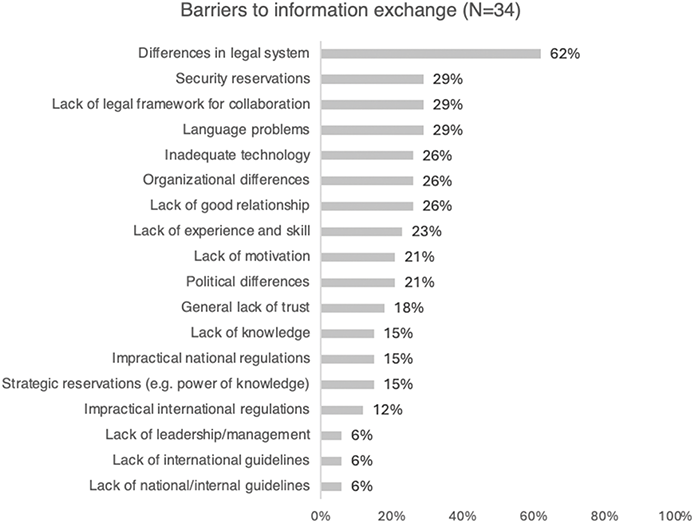
These findings are mirrored in our study in TRACE, where we surveyed LEA and personnel of judicial agencies on the topic of cooperation using an online questionnaire, as well as interviews and focus groups (Kreissl et al., 2023). A detailed description of the methods and data as well as an overview of the sample composition and description, including information on the interview partners referred to in the following paragraphs via the different interview codes are provided in Chapter 4. For example, 62 per cent of the survey respondents considered differences in legal systems to be the main barrier to information exchange (Figure 6.1). Likewise, the interview participants identified differences in national legal systems, especially in criminal law and criminal procedure law, as the most significant barriers to cooperation.
Perceived barriers for information exchange and cooperation.
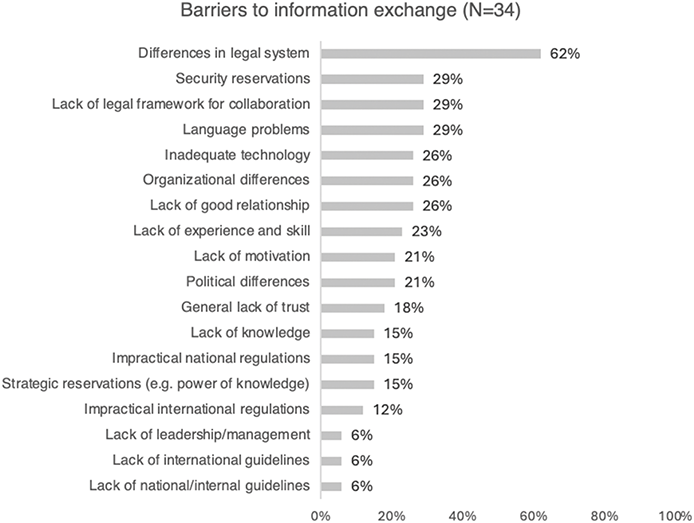
Figure 6.1 Long description
The figure displays a bar chart summarising survey responses on obstacles to cross-border cooperation among E U law enforcement. The highest reported barrier is differences between national legal systems (62 percent). Other significant barriers are security reservations, lack of legal framework for collaborations and language problems (29 percent each); organisational differences, inadequate technology and lack of good relationships (26 percent each); political stances, and lack of motivation (21 percent each); and lack of mutual trust (18 percent). The least is lack of national or internal guidelines (6 percent). The figure indicates that legal fragmentation is dominant. At the same time, socio-organisational and technical factors are also significant.
Typically, differences in criminalisation of offences and the different legal requirements for the authorisation of investigative measures (e.g., wiretapping, or comparable surveillance measures) are mentioned as a crucial barrier. For instance, the differences in the regulation of tax offences or money laundering (e.g., different legal provisions and law enforcement practices applied to these types of crimes) hinder joint investigations required in cross-border financial crimes (Turksen et al., Reference Matthews2023; Erken & Turksen, Reference Turksen2024). TRACE project research also revealed that the definition and criminalisation of tax offences can vary considerably depending on the member state, or that in some Member States (such as Austria) money laundering is still only punishable in connection with legally regulated predicate offences (Ip2_Po_AT). In practice the mentioned differences in the legal systems can lead to severe imbalances. One of the German police officers (Ip1_PO_DE) described a Joint Investigation Team (JIT) case with Italy where both sides sought intrusive surveillance measures. While common in Italian Mafia investigations, such measures in Germany require strict judicial oversight and approval. Consequently, surveillance requested by German officers was conducted in Italy, providing them with intelligence, but the reverse was not possible, due to the stricter German regulations.
However, not only formal regulations but also the informal policing and prosecution practices can hinder cooperation. Here, national disparities can result in a ‘hierarchy of offences’ (Ip3_Po_DEI). A law enforcement officer from Estonia (Ip_7_PO_EST) for example explained, that while the seizure of several kilos of marijuana is a rare case in Estonia and thus prompts intensive investigations, in Spain the same quantity is considered minor. Thus, if the Estonian police suspects links to Spain and, therefore, sends a cooperation requests, this may receive little interest from Spanish authorities, as the investigative effort outweighs the potential benefits.
Besides regulatory barriers the most common constraint for cooperation and knowledge exchange is the lack of trust (e.g., Aden Reference Landers and Behrend2016; Basic & Yakhlef Reference Basic and Yakhlef2022; Block Reference Laperuque2008; Hufnagel & McCartney Reference Madiega2017; Lefebvre Reference Lefebvre2003; Venema Reference Meijer and Wessels2020; Yakhlef Reference Meinzer, Rixen and Dietsch2023). In the context of police cooperation, trust is a multi-level construct that not only exist between individual officers, but also at the organisational and state level. Trustworthy relationships have several prerequisites, including good bi-national political relations, a general cultural closeness, good historical relations, and a common language (Venema Reference Meijer and Wessels2020). This picture is also – at least partially – reflected in our survey data. About one-third of respondents identified language barriers as a challenge to cooperation. For roughly a quarter (26 per cent), the main issue was poor inter-agency relationships. Additionally, around one-fifth cited differing political stances between countries (21 per cent) and a general lack of trust in LEAs from other nations (18 per cent) as significant obstacles (see Figure 6.1).
Further barriers are highlighted in the qualitative interviews, where participants mentioned organisational constraints such as limited resources, the underestimation of information management, or the lack of recognition of international experience. One law enforcement officer from Germany noted that smaller regional police departments struggle with cross-border cooperation due to the high demands on time and workload, personnel, and resources (Ip1_Po_DE). In terms of knowledge management, participants stressed the lack of organisational strategies. Trusted personal contacts, which are key to effective cooperation, are often tied to individual officers. When these officers retire or change roles, their knowledge and networks are frequently lost due to inadequate transfer mechanisms (Ip7_Po_EST). This issue is exacerbated by a prevailing ‘silo mentality’ where officers limit knowledge-sharing to enhance their own value within the organisation. This silo mentality extends beyond individuals to entire organisations. When and what information is exchanged is thus often determined by different organisational self-interests (e.g., in the case of arrests or the seizure of illegal assets), which can hinder cooperation even between authorities from the same country (Ip2_PO_AT). Another barrier is the lack of intra-organisational recognition of international secondments like Europol postings. In some countries such secondments are still treated as having little organisational value (Ip2_PO_AT) and can lead to a ‘career setback’ (Ip8_Ep_EU).
Finally, also the attitudes and behaviours of employees have an impact on information exchange and cooperation. As one of the German officers put it, modern criminal policing requires ‘globally thinking’ (Ip1_Po_DE) officers. Yet, also at the personal level, the most important factor for successful information exchange and effective cooperation remains that officers have trusting international relationships.
6.3.2 Facilitators of Cross-Border Cooperation
In terms of facilitators for effective information sharing, studies highlight the importance of supranational level, multilateral and bilateral agreements (Birdi et al. Reference Birdi, Griffiths, Turgoose and Vonaș2021). Such agreements and strategies should always be developed with the involvement of practitioners since top-down solutions may overlook their needs. Other enablers include the harmonisation of knowledge transfer processes and system among EU Member States (Griffiths et al. Reference Griffiths, Birdi, Andrei and Mouhanna2016). Maybe even more important than having an appropriate legal and policy framework is the need to establish trustworthy cooperation between LEAs. Block describes this trust-based direct contacts between police officers as the backbone of successful operational police cooperation in Europe (Block Reference Laperuque2008).
One reason for this is that trust-based personal contacts provide informal connections and communication pathways, which enable a low-threshold flow of information and increases the effectives and speed of exchange even where there are legal, cultural and political obstacles (Machado & Granja Reference Mantelero2019). Building trust between officers requires personal contact and exchange via joint investigations or operations, meetings, conferences, or training courses. In contrast, mere formal cooperation is not enough to build trustworthy relationship, as officers have been found to prefer personal information networks over formal channels to share intelligence (Cotter Reference Cotter2017). Moreover, trustworthy relations require shared norms and values (Hufnagel Reference Hufnagel2017).
In this regard, Basic and Yakhlef (Reference Basic and Yakhlef2022) show how the development of shared values involves the formation of a common identity, the perception as an ‘in-group’ and the establishment of a shared moral order via collaborative work. Therefore, sustainable cooperation in the form of common contact points and joint institutions like Police and Customs Cooperation Centres (PCCCs) or the Liaison Officer system (Block Reference Lebid and Veits2010; Mészáros Reference Mantelero and Fanucci2016) are paramount, as these provide the setting for regular direct face to face exchange of information (Birdi et al. Reference Birdi, Griffiths, Turgoose and Vonaș2021; Guille Reference Guille2010).
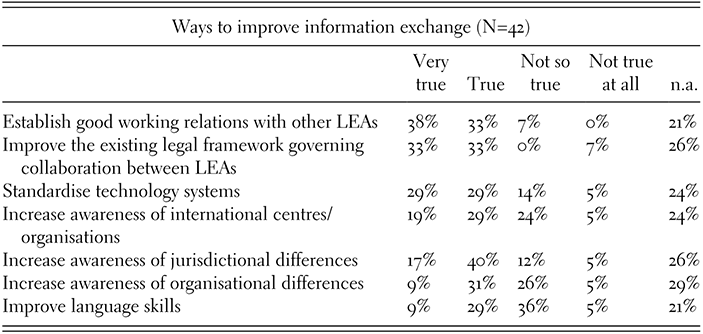
The importance of trust is also evident from our analysis. In the TRACE survey, as can be seen in Table 6.1, respondents ranked improving good working relationships with other LEAs (38 per cent) as the most important factor for improving information exchange. This is followed by improving the legal framework (33 per cent). Standardisation of technological tools and platforms for information sharing was also endorsed by nearly a third of respondents (29 per cent). When combining agreement (‘very true’) and agreement (‘true’), greater awareness of legal differences is also considered important (67 per cent), in fact, ranking this factor second place. By contrast, improved language skills are considered the least important. The same is true for raising awareness for organisational differences.
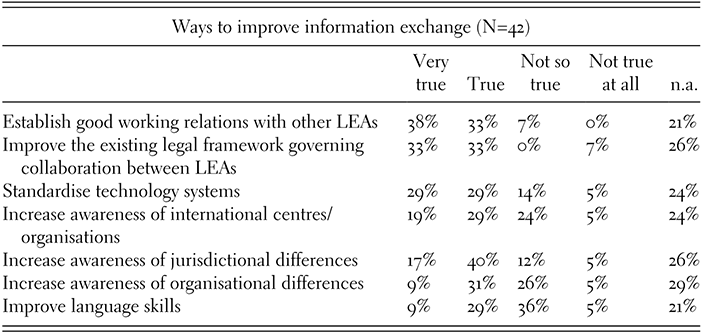
Table 6.1 Long description
The table reports survey results on which changes would most improve cross-border information exchange. Respondents prioritised building good working relationships (38 percent), strengthening the legal framework (33 percent), and standardising technological systems (29 percent). Improving language skills (9 percent) and general organisational awareness (9 percent) were rated least important compared to trust-based relationships, legal harmonisation and technology standardisation.
The interview and focus group participants offer similar perspectives. Trusting contacts, the harmonisation of legal frameworks and the standardisation of technology for the exchange of information (e.g., in the form of dedicated messenger services) are described as a major facilitator for improved cooperation and information exchange. While the first two points require comprehensive political and legal commitment, the bureaucratic and regulatory scope of which can hardly be estimated, strengthening trusting relationships requires comparatively little effort. In this regard, our research suggests three pathways for developing and fostering such relations. First, existing cooperation systems should be strengthened, whether they are designed for long-term and non-case-specific cooperation (e.g., liaison officers) or for case-specific cooperation (in particular JITs).
Second, further training and education programmes, such as those offered by the European Union Agency for Law Enforcement Training (CEPOL), should be further expanded and more closely linked to national police education and training programmes. Third, and connected to this, the EU and its Member States should consider whether, in the future, a dedicated Erasmus-like programme should be developed for the exchange of police officers. This could be an expansion of CEPOL’s General Exchange Programme. The centrepiece of such a programme, which initially could be tested in different European border regions, would have to be the integration of seconded officers into (at least parts of) the everyday work of police officers in the host country. This way, both a comprehensive understanding of the work of foreign LEAs and close and lasting personal relationships can be built.
6.4 Technology as a Facilitator and Barrier to Cross-border Cooperation
Previous research reports that technology often slows down or hinders cross-border cooperation and information sharing, because systems lack interoperability or due to legal and security restrictions (Birdi et al. Reference Birdi, Griffiths, Turgoose and Vonaș2021; Griffiths et al. Reference Griffiths, Birdi, Andrei and Mouhanna2016; Guille Reference Guille2010). Other practical issues are the insufficient technical proficiency of police staff (Griffiths et al. Reference Griffiths, Birdi, Andrei and Mouhanna2016) or the lack of trust in the security of digital information networks (Cotter Reference Cotter2017). Yet, modern policing is hardy imaginable without the use of technology. Thus, the role of (AI-supported) technology for cross-border police cooperation proves to be ambivalent. Although in our study interviewees and the focus group participants in general acknowledged the benefits of modern and AI-supported technologies, they tended to do so at an abstract level and with some reservations.
On the one hand, there are well established European LEA information exchange systems such as the SIENA, the Schengen Information System II (SIS II) or the Europol Information System (EIS) which participants highly valued. All these systems were described having a high degree of usefulness and were seen as an important part of the wider EU LEA information network. What these platforms have in common, however, is that they are not intended to support concrete, case-related, and structured cooperation between specific LEAs. In this regard, as the results of the online survey and the interviews show, there is a lack of appropriate technology. As presented in Figure 6.1, 26 per cent of survey participants believe that inadequate technology is a barrier to cooperation, and as shown in Table 6.1, 58 per cent think that one way to improve cooperation is to standardise technological system.
A major problem however is that different countries use different technological equipment, and this applies to both hardware and software (Guille Reference Guille2010). While this problem already existed a decade ago, it is now exacerbated by the rapidly growing technology market, coupled with the different national security regulations. Such differences are already often present within a country, and in some countries, such as Germany, differences in technological equipment even exist between the various regional police forces (Ip1_Po_DE, Ip3_Po_DE). Yet, the situation is certainly most problematic in cross-border circumstances. At the same time, in some areas, such as simple communication services, interviewees reported the lack of secure applications LEA officers could use in cross-border cooperation to communicate sensitive information securely. Participants pointed out that they themselves already have made use of the products of private telecommunications providers, some of which are based outside the EU, in the course of sharing information or to organise operational meetings.
Finally, participants described the practical limits of technologically supported investigative cross-border work, using the example of automatically generated translation (natural language processing and translation). Such systems would, in practice, be confronted with the problem of identifying cultural codes. According to several participants, it is therefore not enough to simply have an AI-supported natural language processing system, but what is needed is an interpreter who is familiar with the specific cultural and linguistic codes, intonations, dialects, and so on. In the best-case scenario, the interpreter has many years of experience in working with the police and similar institutions, is familiar with the dialects and local customs of the suspects, and so on.
6.5 Conclusion
The use of AI in cross-border investigations of financial crimes such as money laundering and financing of terrorism characterises a transformative frontier in pursuing crime and justice. As financial crime becomes increasingly sophisticated and transnational, AI technologies do present unique capabilities to LEAs to identify, analyse, track, and prosecute offenders. Chapter 6 has critically analysed the evolving nature of financial crime in a complex cross-border environment of the EU, providing a nuanced perspective on the significant role AI plays in improving cross-border investigations.
AI tools, such as machine learning algorithms and advanced data analytics, have revolutionised how financial crimes are detected and investigated. AI has enabled LEAs to unpack complex financial transactions, predict illicit activities, analyse, and visualise vast datasets for patterns that show existence of financial crime. Using real-world cases backed by TRACE research, we have demonstrated how AI equips LEAs with necessary tools to navigate the complex dynamics of financial crime in ways that secure more efficient and effective investigative processes.
The deployment of AI in cross-border investigations, however, has several challenges – some of which we have highlighted in this chapter. For instance, data sovereignty laws, which vary across the EU, foster fragmentation and undermine seamless sharing of data between LEAs. Further, LEAs from different jurisdictions face interoperability issues drawn from the diverse AI tools and platforms they use. It is, therefore, necessary to develop common standards and protocols to facilitate interoperability between different LEAs. Data protection issues also arise in cross-border investigations. As it is crucial for LEAs to ensure the privacy and security of sensitive personal data across the EU, robust data protection measures and mechanisms for secure data transfer are needed – a challenge, which can frustrate or slow down investigation of financial crimes. Additionally, biases in datasets can be amplified by AI algorithms, which raise ethical and legal concerns in relation to fairness and due process.
This chapter demonstrates that it is crucial to ensure effective cross-border cooperation and information exchange for countering cross-border financial crimes. In this regard, it is necessary to sustain trust-based relationships between LEAs, which are facilitated by personal contact and exchange through joint investigations, meetings, conferences, and training courses. Cross-border cooperation is further enhanced by multilateral, bilateral, and supranational agreements, as well as harmonisation of knowledge transfer processes, and standardised technological tools. The TRACE project has provided useful insights into the barriers and facilitators of cross-border cooperation, providing practical recommendations for improving cross-border collaboration and sharing of information.
The chapter provides a guide for professionals and researchers that seek a nuanced understanding of the synergy between AI and cross-border investigations. The germane challenges, solutions, and opportunities we have provided in the use of AI for cross-border investigations do contribute to EU’s efforts towards the development of more effective strategies and tools for countering financial crime. Continued enhancement of elements such as trust-based collaboration, ethical considerations, innovation, and technological capability building, public private partnerships, increased investment in AI for law enforcement, and interoperability are key to harnessing the full potential of AI in combating cross-border financial crime. Future developments are likely to focus on strengthening digital capabilities, improving information sharing, streamlining investigative procedures, addressing the evolving nature of crime, and further reinforcing the legal framework for EU police cooperation, while continually addressing the crucial balance between security needs and the fundamental rights of individuals.

 Open access