Introduction
The central question of this paper is how social networks influence the practical and emotional support available to people aged over 60 years in Great Britain – referring to both networks through formal organisations such as clubs and churches, and informal ties with friends and neighbours. This is a key policy question for an ageing population (seeSocial Exclusion Unit 2006) and in investigations of loneliness amongst older people (e.g. Wenger et al. Reference Wenger, Davies, Shahtahmasebi and Scott1996; Victor et al. Reference Victor, Scambler, Shah, Cook, Harris, Rink and de Wilde2002; Demakakos Reference Demakakos2006). The positive effect of strong social networks on elders' health, especially psychological health, has been much evinced and discussed (Grundy and Sloggett Reference Grundy and Sloggett2003). Social capital has been defined in the literature in many different ways. A brief review is provided as a backcloth to this paper's conceptual approach, which defines social capital as the array of social contacts that give access to social, emotional and practical support. The support that is available is an outcome of network ties, the quality of relations with others, their practical availability, the values that they hold, and the trust placed in them. Social ties may be with kin, particularly spouses and adult children, with neighbours and friends, or with fellow members of organisations (including churches or other religious groups, social clubs, tenants' groups and sports clubs). The effect of the social network on social support may vary by gender, social class and neighbourhood type.
The British Household Panel Survey (BHPS) provides a rich source of data on these variables. This longitudinal survey of Great Britain has been carried out by the University of Essex annually since 1991.Footnote 1 It permits the analysis of several questions concerning membership and activity in organisations, informal social contacts, and individuals' expectations of practical and emotional support from others. Individuals can be ‘tracked’ over several years to see how their responses change on these and other variables. Like the analysis by Li, Pickles and Savage (Reference Li, Pickles and Savage2005), this paper uses data from the BHPS to examine perceived social support. The determinants of social support amongst people aged 60 or more years are examined using data from the first wave of the survey in 1991 and from the latest available wave in 2003. The analysis has studied 1,924 individuals who were present at both waves, particularly how their perceived social support changed over the 12 years (1991–2003), and how the effectiveness of different forms of social capital changed during that period. Further details of the variables, data and methods are given in the methodology section. The next section examines concepts of social capital and how they can be used in the analysis of older people's social support. The third section considers the findings of previous studies on social support, social networks and loneliness amongst elders.
Social capital and social support: a discussion of basic concepts
According to Putnam (Reference Putnam2000), social capital is a public good that resides in the shared values and mutual trust of the members of a community and is available to them all. He argued that ties between individuals, particularly voluntary co-operation within clubs, churches and other formal associations, help to increase social capital in the community as a whole. Lowndes (2000) criticised Putnam's emphasis on formal organisations, in particular those concerned with leisure pursuits, and contrasted the ‘really useful’ social capital that women especially create through informal networks of mutual aid (for example through personal care) rather than formal associations. Civic participation may, moreover, be the result of friendships rather than their source (Warde and Tampoboulon Reference Li, Savage, Tampoboulon, Warde and Tomlinson2002).
Bourdieu (Reference Bourdieu, Halsey, Lauder, Brown and Wells1997) regarded social capital not as a public good but as an asset of the individual or group that participates in social networks, which can be used to obtain information and assistance of various kinds. Following Bourdieu, in this paper social capital is seen as an individual resource, which is partly developed by the individual's own past and present activities, but is also contingent on the attitudes of others. People can choose with whom to associate – subject to the constraints of their health and mobility, their neighbourhood, family and social environment, and barriers of class, ethnicity and gender – but they cannot choose how helpful their friends, neighbours and relatives are when needed, or whether these people have the time, physical capacity and above all the inclination to talk, help and visit. Thus, even if social capital is considered an individual resource, the support available for individuals depends partly on social capital as a collective resource, and that is shaped by prevailing norms and values. This inter-dependence reveals the complementarity of Putnam's concept of social capital as a public good (Putnam Reference Putnam2000) and Bourdieu's emphasis that social capital varies among individuals.
This paper defines social support not as an element of social capital itself, but as an outcome of social capital. The analogy between productive (economic) capital and social networks implies that these networks are productive for those who can draw upon them, and that the help derived from friends and associates is their ‘output’. This approach follows both Giddens (Reference Giddens2000: 78), who said that ‘social capital refers to trust networks that individuals can draw on for social support’, and Coleman (Reference Coleman1988: 98), who argued that social capital is ‘productive’ of something than cannot otherwise be achieved. This approach contrasts with that of Bowling and Gabriel (2004), who distinguished between ‘personal social capital’, comprising social activities, social support and the frequency and intensity of a sense of loneliness, and ‘external social capital’, comprising the quality, safety and neighbourliness of the area. The ‘input-output’ approach used here also contrasts with that of Li, Pickles and Savage (Reference Li, Pickles and Savage2005), who treated social support as one type of social capital, and described it as the ‘social network’. This they measured by ‘the extent to which people feel they have supportive networks’ (2005: 112).Footnote 2 The view taken here, however, is that social support is an outcome of social capital rather than an element of it. The dependent variable can then be defined as the perception that help is available when needed (as measured by an index of social support).
The hypothesis to be tested is that social support is influenced by social ties and contextual variables such as gender, class and housing tenure. Social ties are measured by organisational involvement, meeting people and perceived neighbourhood relations, and the aspects of social capital that engender social support or at least its expectation. Social capital and its outcomes are in a dynamic relationship, and a feedback effect of social support on the activities that increase or diminish it is possible. Social networks are time limited by the members' lifespans. Elders typically have cross-generational relationships with younger kin, whilst their non-kin networks are vulnerable to loss because focused on their peers. In the words of Samuel Johnson, ‘If a man does not make new acquaintance as he advances through life, he will soon find himself left alone’.Footnote 3 ‘Bridging’ social capital takes on a new meaning in this context. As their peers' mobility and physical capacities fade, elders need contacts with those younger than themselves to secure continuity of emotional and practical support, which is a considerable challenge for those without children. Around 20 per cent of women aged 85 or more years in the United Kingdom were childless in 2000, although only 16 per cent of those aged exactly 60 years were so.Footnote 4 The proportion of childless amongst future cohorts of older people is likely to be much higher given the fall in fertility among those born after 1960.
Trends in social support for older people
If social support is an outcome of social capital – that is, of the ensemble of social networks from which elders derive help and friendship – what are the trends in their social networks and in the quality of support generated by these networks? One recurring narrative in recent studies has been the ‘declining solidarity of (family) care’, and another, the increased dependence of adults of all ages on a ‘personal community’ that is increasingly focused on friends as opposed to kin. The increased importance of non-kin leads some authors to consider sources of inequality in the social capital derived from ‘personal communities’. Such inequalities may be related to elders' social class, marital status or health, or the age of their social contacts whether elderly peer group or younger adults. A third important group of studies has examined ways of measuring both social support and loneliness amongst older people, and the relationship of both to different forms of social network.
The ‘declining solidarity’ of care
Johnson (1995: 249) suggested that recent changes in family patterns – the increased dispersion of generations and the rising employment rate of women – have engendered a ‘fading solidarity of care’. In 1995, about 11 per cent of men aged 45–64 years and 15 per cent of women in the same age group were caring for a parent or parent-in-law (Department of Health 1995). A study of trends in caring in the United Kingdom between 1985 and 1995 found that caring by adult children and children-in-law fell, and caring by the older person's spouse grew, despite the increase during this period in the proportion of people aged over 65 with at least one grown-up child (Pickard 2002). Pickard argued that these trends could not be explained entirely by more people having spouses to care for them, although by 1995 more elders were married, and their spouses had survived longer than 10 years earlier. The decline in inter-generational help appears to be partly a cultural change, perhaps associated with more daughters and daughters-in-law being in employment, although the extent of paid work amongst those who did care for their parents or parents-in-law increased. Pickard also observed that more elders were entering residential care, which could be because daughters had less time. The United Kingdom Retirement Survey 1988 showed that 16 per cent of people aged 55–69 years ‘regularly or frequently’ helped their parents. Comparing this to the Time Use Survey 2000 suggests that there was a decline in help to parents. In 2000, only 6.4 per cent of men aged 55–69 years had helped their parents in the last four weeks, and 8.6 per cent of women (but the methodologies of the two surveys were not fully comparable).
The importance of non-kin in personal communities and of kin with increasing age
If help for older people from relatives (other than partners) is declining, how do those without partners fare? Are non-kin replacing kin as a source of support? Pahl and Spencer (Reference Pahl and Spencer2004) argued that in contemporary Britain, ‘personal communities’ are becoming less kin-based and more oriented towards chosen friends. If so, difficulties may arise if friendships with non-kin diminish as people grow older, placing the very old at greater risk of isolation from the death or absence of kin than they would be in a more family-oriented society. As individuals age, relatives increasingly replace non-kin as close friends (Pahl and Pevalin Reference Pahl and Pevalin2005; Wenger, Burholt and Scott Reference Wenger, Burholt and Scott2001). Pahl and Pevalin analysed the relative importance of family and non-family friends in 1991 and 2001 by analysing responses to the BHPS question that asked people whether their best friend was their partner, another relative or a non-relative. Excluding those who named their partners, the respondents were much more likely to say that their best friend was a relative once they passed 55-years-of-age. Wenger, Burholt and Scott (Reference Wenger, Burholt and Scott2001) confirmed this tendency from a longitudinal study of older people in Wales. Elders depend mainly on family members for personal care and advice on personal problems, whilst friends and neighbours ‘were significant as people to talk to when feeling depressed, to borrow small items and as a source of lifts’ (2001: 45).
Loneliness and social networks amongst older people
Alongside the suggested declining ‘solidarity of care’ is a concern about extensive and possibly increasing loneliness. It is said that 10 per cent of people over 65 often feel lonely, and the percentage rises with age (Social Exclusion Unit 2006: 55). Barnes et al. (Reference Barnes, Blom, Cox and Lessof2006) analysed ‘exclusion from social relationships’ using the first wave of the English Longitudinal Study of Ageing (ELSA). Their definition of ‘exclusion’ corresponds to an absence of the resources that are defined in this paper as ‘social support’. They found that 12 per cent of people aged over 50 years exhibited some degree of exclusion from social relationships, and that the figure rose to 25 per cent amongst those aged over 80 years. Loneliness, feeling a lack of social support, and having a deficit of reliable or frequent contacts with friends or relatives are closely inter-related. Bowling and Gabriel (2004) analysed the Quality of Life Survey (of 1,000 people aged 65 or more years in Great Britain in 2000–01), and found that ‘personal social capital’ and frequency of loneliness were amongst the most important determinants of the quality of life. Using the second wave of ELSA, Demakokos (Reference Demakakos2006) found that isolation or a lack of companionship was one of the most important components of a poor quality of life, and that the prevalence rose sharply above 75-years-of-age. Married people, higher income groups and those with frequent contact with their children were least at risk.
Victor et al. (Reference Victor, Scambler, Shah, Cook, Harris, Rink and de Wilde2002), however, have questioned the ‘widespread presumption that loneliness and isolation have become more prevalent in Britain in the period since the Second World War as a result of the decline in multi-generational households and changes in family structure’. Comparing four surveys by different authors between 1948 and 2001, they found that sampling error could explain the apparent rise in reported loneliness between the two dates. Moreover, there were methodological differences between the surveys. They noted that each age-cohort might interpret loneliness in a different way, but that nonetheless there had been a significant decrease in the percentage of people who said they were ‘never lonely’. Wenger et al. (Reference Wenger, Davies, Shahtahmasebi and Scott1996) agreed that the incidence of loneliness and isolation amongst elders had been exaggerated. It had sometimes been seen as a problem of the very old, but this was contingent on events that were hazards of advancing age: widowhood, outliving one's cohort, relocation and even retirement. Bury and Holme (Reference Bury and Holme1990) found among a sample of people aged 90 or more years that 61 per cent said they were never lonely; one should remember, however, that many survivors to this age retreat from living alone, to living with relatives or in sheltered accommodation.
Wenger et al. (Reference Wenger, Davies, Shahtahmasebi and Scott1996) analysed data on loneliness amongst elders from the first (1979) phase of the Bangor Longitudinal Study of Ageing. This had a sample of 534 people aged over 65 or more years resident in Wales, and administered questions that provide valuable material for the study of social capital amongst elders. They considered three different ways of measuring loneliness and related issues, which included a five-point self-assessment scale of loneliness, similar to those of the earlier studies discussed by Victor et al. (Reference Victor, Scambler, Shah, Cook, Harris, Rink and de Wilde2002). Wenger's team compared the responses with two other complex measures to obtain a more objective and wide-ranging assessment of the individual's situation: an ‘isolation measure’ based on eight objective indicators,Footnote 5 and a ‘loneliness’ measure based on eight questions about how people feel.Footnote 6 These measures have strong similarities with the questions on social support, neighbour relations and friendships in the BHPS that are analysed in this paper.
Wenger and colleagues' findings are instructive for the study of social capital. Although they found that loneliness was more common amongst those living alone, they argued that there was no direct causal connection and that close relationships outside the household sometimes compensated for not having a spouse or resident children. The individual's type of social network was found to be the most important determinant of the loneliness score, and the second or third most influential factor for self-assessed loneliness (after marital status and possibly household composition), and the fourth most important factor for isolation (after marital status, number of years widowed and social class). Of the five network types identified by the Bangor survey, the most successful in terms of avoiding loneliness and isolation was the ‘locally integrated support network’, which is characterised by ‘close relationships with local family, friends and neighbours’ and is ‘usually based on long-term residence and active community involvement in church and voluntary organisations in the present or recent past’. Such involvements may be identified with strong ‘social capital’, although the authors did not use the term. In another paper on the same data, Wenger, Burgholt and Scott (Reference Wenger, Burholt and Scott2001) noted that people with locally-integrated or family-dependent support networks were unlikely to need statutory services to help with personal care. Both these networks were more common in stable communities. The least effective network type for combating loneliness and isolation was the ‘private restricted support network’, which is focused on the household, particularly of a married couple, and characterised by a low level of external contact even with kin (who may be lacking). Of this network, the authors remarked that ‘in many cases a low level of social contact represents a lifelong adaptation’.
The role of organisational memberships in building and maintaining social networks
The need for new ties to non-kin to replace absent kin and strengthen weak networks – particularly for the widowed or childless – raises the question about how new friendships are made. As noted earlier, Putnam (Reference Putnam2000) argued that memberships of clubs, societies and churches are important in building individual social networks. Two recent studies of recent trends in organisational membership in Britain have suggested a decline in organisational activity amongst working-class people aged less than 65 years, especially men. In so far as support-giving social networks are contingent on organisational participation, this may magnify class inequality in ‘social capital’. Li, Pickles and Savage (Reference Li, Pickles and Savage2003b) compared BHPS 1992 data with the Social Mobility Inquiry of 1972, and found that men's number of organisation memberships had fallen over 20 years, particularly for manual workers. As with Hall's (Reference Hall1999) landmark study of post-war trends in organisational membership, Li et al. (Reference Li, Savage, Tampoboulon, Warde and Tomlinson2002) pointed to the decline in working-class organisations (trades unions and working men's social clubs), which was leading to increasing class inequality in organisational attachments amongst those of working age. They noted that between 1992 and 1999, the proportion of either gender that was not a member of any organisation increased, especially amongst working-class people. These are important findings, but the trends amongst older people are uncharted. Perren, Arber and Davidson (Reference Perren, Arber and Davidson2003) used BHPS 1999 data to analyse involvement in associations by men aged 65 or more years. They found that former occupational status was important for both social support and social activity. As with younger age groups, middle-class older men were more likely to take part in volunteering and clubs than working-class men, although social-club membership was more common amongst the working class. Poor health had a negative influence on sports' club membership amongst working-class men but was associated with higher membership amongst middle-class men.
Differences in social networks by class and marital status
Pahl and Pevalin (Reference Pahl and Pevalin2005) noted a class difference in social networks. When asked by the BHPS who was their closest friend, working-class and less-educated people were more likely to nominate kin or partners, and less likely to nominate non-kin than middle-class people. This implies a greater dependence on relatives among the working class, which for those who are childless or without a partner compounds their relative disadvantage in ‘social capital’. Consistent with this hypothesis, Wenger et al. (Reference Wenger, Burholt and Scott2001) found that loneliness is more common amongst working-class elders. If this group have a greater need than middle-class elders to find new friends to replace deceased or non-existent kin, the pattern of organisational participation suggests they are at a disadvantage for forming friendships in this way. As working men's clubs decline, the class difference in organisational participation of other kinds may imply that working-class people are at particular risk of relative exclusion from the non-family contacts that might generate friendship and support. Class is not the only factor, however, for, at least amongst men, there are important differences in ‘joining’ behaviour by marital status. Perren, Arber and Davidson (Reference Perren, Arber and Davidson2003) found that never-married men were less likely to belong to any organisation than those who were or had been married – religious activities being the exception. Divorced men had a relatively low rate of joining sports or social clubs, whilst widowed men compensated for their isolation by joining these organisations more than married men. Perren and colleagues suggested that the increasing number of divorced older men may be at relatively high risk of isolation.
Health and the capacity to reciprocate
Several studies have identified a positive association between social support and good health (Grundy and Sloggett Reference Grundy and Sloggett2003). Is this entirely because social support promotes health, or alternatively is good health needed to attract help and social contact? Older people frequently reciprocate social support as well as receive it. As Wenger (1984: 113) found from the Bangor study, ‘the majority of elderly people are capable, competent adults who give as well as receive’. They help each other with shopping, gardening, lifts, domestic help and care of keys or pets, although helping others diminishes sharply at over the age of 80 years. The question then is whether access to help continues for those no longer able to give it. In his classic study of older people in Bethnal Green, an inner suburb of London, Townsend (1957) pointed out that even rather frail elders usually continued to reciprocate help by cooking meals or caring for grandchildren. Those who received least help were the ones not in a position to give anything in exchange. Thus, poor health may limit the capacity to reciprocate, which in turn may mean attracting less help. In the relationship between health and social support, the direction of causation is not entirely clear.
Boneham and Sixsmith (Reference Boneham and Sixsmith2006) qualified the notion that poor health necessarily diminishes the capacity to reciprocate, thus reducing the individual's social contacts and social support. Their findings showed that even the very old and housebound had the potential to give help. In their sample of women in a deprived urban area of northern England, older women benefited from the concern of their peers about each other's health. ‘Health talk’ facilitated sharing information and advice, the effective use of medical services, and checks whether friends and neighbours were in difficulty. Reciprocity was evident: talking, telephoning and keeping in touch were forms of help that a sick person can often give. Whilst Boneham and Sixsmith highlighted the benefits to older women of dialogue and interaction with their peers, one must see this in the context of the risk of outliving them.
Methodology
On the basis of the literature review, the main questions to be addressed in the new analysis of BHPS data were:
1. What are the determinants of social support for elders and how do these vary in relation to various contextual variables (marital/partnership status, having children, class, education, health, gender, age, type of neighbourhood)? Does poor health lead to an erosion of social support over time through inability to make new friends and/or reciprocate favours?
2. Controlling where necessary for the contextual variables, what is the influence of social networks on social support? In particular, what are the relative influences of civic participation and informal social ties? Are some types of civic participation more creative of social support than others? Is there class inequality in social capital amongst elders?
3. Has social support risen or fallen over the BHPS survey period, and is the trend for elders different from that for younger people?
4. Does social support rise or fall with increasing age, and what contextual variables and social network features help to sustain it?
The adopted methodology has much in common with that of Li, Pickles and Savage (Reference Li, Pickles and Savage2005) (hereafter LPS Reference Li, Pickles and Savage2005), who used the BHPS to explore the effect of social capital on social trust. They examined the loading or influence of each item or question on the underlying ‘dimension’ of social capital. These dimensions were ‘neighbourhood attachment’, ‘social network’ and ‘civic participation’. They analysed the effect of each dimension on social trust, controlling for age group, gender, class and education. They found that ‘neighbourhood attachment’ had more effect on trust than ‘social network’, and that ‘civic participation’ had no significant effect. LPS Reference Li, Pickles and Savage2005 concluded that social-capital research has over-emphasised civic participation as a source of network resources, and correspondingly under-emphasised the informal ties that are especially important for working-class people. The analysis presented here will qualify this conclusion by examining the effect of different kinds of civic participation, and by analysing active participation rather than just membership.
The outcome measures
In common with several other studies of civic participation (e.g. Hall Reference Hall1999; Grenier and Wright Reference Grenier and Wright2004; Lee Savage and Pickles 2003 b; Perren, Arber and Davidson Reference Perren, Arber and Davidson2003), LPS Reference Li, Pickles and Savage2005 regarded membership as the key indicator of participation in organisations. It may be more important whether people actually meet other members – rather than, for example, just paying a subscription or reading the magazine. The BHPS asked respondents in which organisations they were active, which may be a better index of interactions with other members. For civic participation, this paper uses the criterion of being active in a particular organisation, rather than membership. Grenier and Wright (Reference Grenier and Wright2004) argued that the membership of organisations is becoming more dominated by ‘middle-class joiners’, many of whom are members of several organisations, and that increasingly lower-income groups are members of none. This increased concentration of organisational membership, they suggested, may have brought about a decline in actual interactions – and hence the potential of membership for generating social capital.
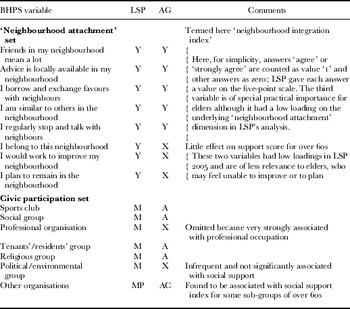
Taking all those aged 60 or more years in the Wave M (2003) sample of the BHPS who were also in Wave A (1991), an index of personal social support was constructed using some of the same items that LPS Reference Li, Pickles and Savage2005 selected as indicators of a respondent's ‘social network’. Differences in the indicators are detailed in Table 1. This index (the ‘support score’) measures the social resources available to the older person, and is considered here as an output of individual social capital. It is derived from questions about personal support from people outside the household. The five items used in LPS Reference Li, Pickles and Savage2005 to construct iSSUP, the ‘social network score’ are:
1. Is there anyone who you can really count on to listen to you when you need to talk?
2. Is there anyone who you can really count on to help you out in a crisis?
3. Is there anyone who you can totally be yourself with?
4. Is there anyone who you feel really appreciates you as a person?
5. Is there anyone who you can really count on to comfort you when you are very upset?
The emphasis of these questions and variables, chosen by the BHPS designers, is on emotional support and self-esteem, but the second also captures a need for practical help. Respondents could answer ‘no one’, ‘one person’, or ‘more than one person’. Less than four per cent of those aged 60 or more years said ‘no one’ to any of the five items. Counting a reply of ‘more than one person’ as ‘2’, ‘one person’ as ‘1’ and ‘nobody’ as zero, the replies to all five items were aggregated to form an index with a range from zero to 10. The iSSUP personal support index or score is similar to LPS Reference Li, Pickles and Savage2005's index of ‘social network’, except that they added three other items: whether the respondent had anyone outside the household to help when depressed (to which 75 per cent of respondents said ‘yes’); to help get a job; or to lend money. In LPS Reference Li, Pickles and Savage2005 these last three had a low ‘loading’ on the underlying ‘social network’ dimension described by the eight items (see their Table 1). In any case, most older people of course do not seek jobs. The variable about help when depressed has affinities with the first and fifth of the listed variables, which effectively capture the same effect. The iSSUP personal support score was therefore derived from only the five items.
Use of BHPS variables by Lee, Savage and Pickles and in this analysis

Notes: LSP: used by Li, Pickles and Savage (Reference Li, Pickles and Savage2005) to explore the effect of social capital on social trust. AG: used in this paper to analyse influences on social support. A: Active in organisation. AC: Active in ‘other community group’. BHPS: British Household Panel Survey. M: Member. MP: Member of ‘pooled’ other types of organisation. X: Not used. Y: Yes, used.
Amongst the variables to be tested here as determinants of support scores, a distinction was made between direct ‘inputs’ to social capital and the contextual factors that influence the individual's social activities. The inputs to social capital were taken to be civic participation, the frequency of meeting people outside the household, the frequency of talking with neighbours, and an index of neighbourhood integration. The next step was to examine the effect on the support scores of several contextual independent variables.
The contextual variables
Beginning with class and education, as in LPS Reference Li, Pickles and Savage2005, this analysis used the Goldthorpe social class indicator that has four occupational categories: professional/managerial; intermediate employees; routine/manual employees, and self-employed persons (Goldthorpe with Llewellyn Reference Goldthorpe and Llewellyn1980). It was believed crucial to carry out separate analyses for men and women, which meant that the over-60s sample was too small to distinguish the self-employed from intermediate employees. For education, the chosen variable was whether or not the respondent had post-school qualifications. Finer distinctions were again impeded by the sample size. For the effects of living arrangements, relationships were examined between partnership status, living alone, and change in person's partnership status over the 12 years and the absolute change in the iSSUP support score. The measure of tenure was a dichotomy, ‘renting council housing’ or ‘other’ (mainly home ownership, for less than five per cent of the analysis sample rented privately in either 1991 or 2003). Two kinship variables were included: whether the individual ever had children (including adopted ones); and whether the closest friend was a relative. The second variable is taken from Wave J (2000), and was unavailable for 1991 or 2003.
Social capital input variables
The indicators of ‘social activities’ were: (a) how often respondents talked to their neighbours; (b) how often respondents met people; (c) civic participation; and (d) neighbour relations, as an indicator of opportunities for socialising and social support from neighbours. These variables were not available for 1991. Five of the eight variables used by LPS Reference Li, Pickles and Savage2005 were aggregated as an index of social capital inputs; three were excluded because individually they had little effect on the support scores for the over 60s, and because two of them had a low ‘loading’ on the underlying ‘neighbourhood attachment’ dimension analysed by LPS Reference Li, Pickles and Savage2005 (see Table 1). To examine the relationship of these variables to the support score among the elders-only sample, the five-category BHPS response scale was reduced to a dichotomy: ‘agree’ or ‘strongly agree’ responses were pooled as ‘yes’, and other categories pooled as ‘no’.
The focus of this paper is not on the overall number of organisations with which the respondents were involved, but on particular organisations. Each one that involved more than two per cent of the sample as ‘activists’ in both years was tested for its effect on social support, with the exceptions of voluntary service and Women's Institute groups, for it was found that participation in these two was strongly associated with religious activity. The independent variables indicate being active in a particular organisation rather than simply being a member, as has been the case in most previous studies of the BHPS participation data (Li, Pickles and Savage Reference Li, Pickles and Savage2003a, Reference Li, Pickles and Savageb, Reference Li, Pickles and Savage2005; Hall Reference Hall1999). To reiterate, the rationale is that being active invariably involves social interaction with other members whilst just being a member does not, but nonetheless the number of memberships had more influence on the support score than the number of organisations in which someone was active. This is counter-intuitive because if taking part in organisations influences support score at all, it must be through actual interaction with members. It may occur because middle-class people (found to have higher support scores, as shown later) join more organisations, or there may be a feedback effect – that people with high support scores have a greater number of informal social contacts, so are more likely to become involved with organisations, but this effect manifests more in joining than in active participation. Whichever the direction of causation, the number of organisations that people are involved in, as either members or ‘activists’, was positively associated with the frequency with which they talked to their neighbours or met people.
The determinants of social support
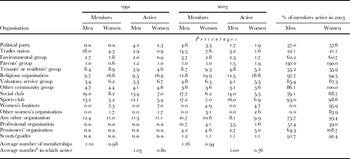
The relationships between organisational activity, the contextual variables and informal ties with social support were examined. Like LPS Reference Li, Pickles and Savage2005 and several other studies of civic participation using the BHPS, it was found that organisational memberships were more common amongst the middle class, and that neighbourhood attachment was more common amongst working-class people. Women were more likely to draw on neighbours for social support, and they were affiliated to a different mix of organisations than men (Table 2). Women also had higher neighbourhood attachment and stronger social networks and social support than men. Older people had higher neighbourhood attachment and greater levels of voluntary group engagement, but weaker social networks/social support than younger people.
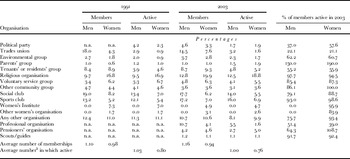
Activism in and membership of organisations among people aged 50 or more years, Great Britain 1991 and 2003
Note: n.a. Not available. 1. Number of organisations.
Source: British Household Panel Survey (for details see text).
Around 45 per cent of men and 55 per cent of women aged over 60 years were active in one or more organisations in 1991, and the percentages were similar in 2003. Over the 12 years, religious organisations and sports clubs had rising membership and active participation for both genders. Being active in political parties and the Women's Institute fell, but it rose slightly in environmental and tenants'/residents' groups. As expected, men were more active than women in trades unions, sports' and social clubs. Women were more active than men in religious organisations and in community and voluntary-service groups. The proportion of members who were active varied greatly by type of organisation, from very low in trades unions and political parties, to over 90 per cent in religious organisations (Table 2). In parents' groups, the number of activists exceeded the number of members, presumably because some parents help with activities like fund-raising and school trips without being members.
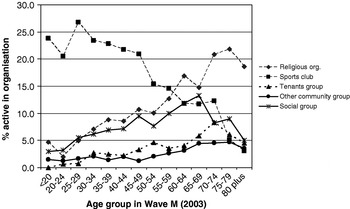
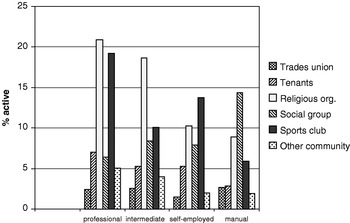
Involvement with organisations declines in old age, except that religious affiliations are more likely to be maintained. The pattern is similar for men and women and corroborates Perren and colleagues' (Reference Perren, Arber and Davidson2003) findings for older men. Trades union activism tailed off to almost nothing after age 65 years, and being active in sports' clubs declined sharply after 75 years. Being active in tenants' and community-groups and religious organisations peaked among those aged in the seventies. Figure 1 shows that the five most common types of active participation varied with age. The most common of all among the over-sixties was participation in a religious organisation: it involved over one-in-five of those aged over 70 years. There were striking differences by socio-economic class in the number of organisations in which the respondents were active: professionals and intermediate employees were more involved in religious organisations and more likely to join sports clubs and other community groups, whilst manual workers were more likely to join social clubs (Figure 2).
Level of active participation in organisations by age, GB 2003, people aged 50 or more years.

Proportion of sample over 60 who were active in different types of organisation, 2003.

Among the five types of organisation in which the older respondents were most active, participation in tenants'/residents' groups, sports, religious and ‘other’ community groups were associated with being active in other organisations.Footnote 7 By contrast, being active in social clubs, the most common form for retired manual workers, was likely to be the individual's only active membership. LPS Reference Li, Pickles and Savage2005 found that membership of religious organisations, tenants'/residents' groups, political or environmental groups (found here to be highly correlated with tenants' group membership) and professional organisations, and the number of memberships in other organisations, all had large positive loadings on the ‘underlying dimension’ of civic participation, whilst trades union and social club membership appeared to be associated with a different dimension.
The determinants of the support scores
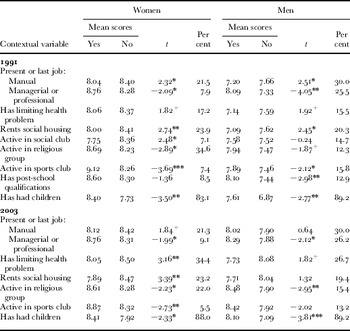
The next stage was to examine the level and determinants of the respondents' personal support scores in both 1991 and 2003. Many variables and their interaction effects were tested, but only the statistically significant results are reported. The main contextual influences on support scores were social class, health, being a renter of social housing, and whether the respondent had ever had children (Table 3). The last was the most important, and was significant for both genders in both years. Only 11.5 per cent of those aged 60 or more years in 2003 had never had children. In 1991, when the respondents' minimum age would have been 48 years, almost one-quarter still had children living with them. Among those who had had children, one-quarter named a son or daughter as their closest friend. In general, however, whether the closest nominated friend outside the household was a relative did not influence the iSSUP support score,Footnote 8 but socio-economic status was associated with the score. Having (now or formerly) a professional or managerial job raised the support score for both genders in both years. Manual occupations were associated with low support scores for both genders in 1991 but not in 2003. Education had less effect than social class and was significant only for men, and then only in 1991. Social housing had a negative effect for women in both years, but for men only in 1991.
Mean support scores by contextual and participation variables, people aged 60 or more years, Great Britain 1991 and 2003

Significance levels: *** p<0.001, ** p<0.01, * p<0.05.
Turning to active participation, being active in sports clubs was associated with significantly higher support scores in both years for both genders, as was being active in a religious organisation (although for men in 1991 only at the 10 per cent level of significance). The effect of religious activity disappeared when frequency of meeting people was taken into account, which suggests that it is through the raised social opportunities that religious activity affected the support score.Footnote 9 By contrast, the apparent effect of sports activity was independent of neighbour relations or the frequency of meeting people, which suggests that its association with the support score was partly through the health benefits or a selection effect – people with health problems may be less likely to engage in sport and less likely to sustain a wide social network.
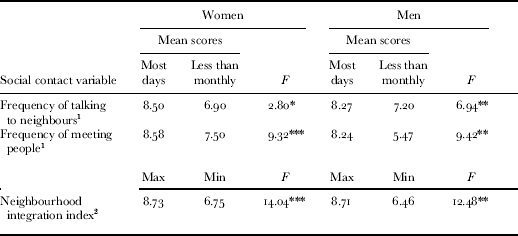
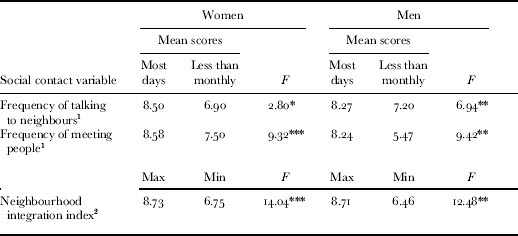
Informal social relationships (measured by frequency of talking to neighbours and frequency of meeting people, both available only for 2003) had a stronger effect on the support scores than any of the examined organisational activities (Table 4). Those who met people most days enjoyed an average support score in 2003 of 8.5, against only 6.9 for people who met friends less than weekly. The strongest effect was from the neighbourhood integration index (as defined earlier). Comparing those who ‘agreed’ or ‘strongly agreed’ with no more than one of the five items in the index with those who gave such answers to all five, men's mean support score differed by two points, and the difference for women was only slightly less. There appears to be a socio-economic difference in the quality of social capital. A high neighbourhood integration index strongly boosted the professional/managerial respondents' support scores; in other words, middle-class social contacts were more productive of personal support. Similarly, social renters' support scores were much more dependent on frequent meetings with other people than were the support scores of those in other housing tenures, suggesting that the quality of social support from neighbour contacts was poorer on public-housing estates. Another finding that may reflect a class difference in the quality of social capital is that activity in religious organisations did not affect the support scores of manual workers but had a significant effect for other occupational groups.Footnote 10
Mean support scores by social contact variables, people aged 60 or more years, Great Britain 2003
Notes: 1. Three categories. 2. Five categories.
Significance levels: *** p<0.001, ** p<0.01, * p<0.05.
The determinants of support score change
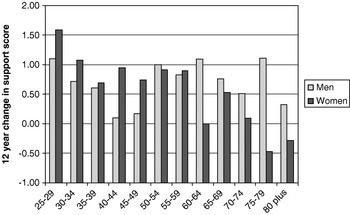
Turning to the change in support scores over time, it was found that all age groups had higher scores in 2003 than people of the same age in 1991. The mean score for all respondents rose from just under 8.0 to 8.4 over the 12 years. At both dates, the mean support score declined with increasing age. The combination of the two trends meant that whilst older men on average had more social support in 2003, older women did not (Figure 3). Although women aged over 60 years in 1991 had higher support scores than men, they hardly rose as they aged, whilst men's improved perceptibly (by 0.47). Table 5 shows that being single (without a partner) in both years associated with a lower support score; this applied to one-quarter of older women but only nine per cent of older men. Controlling for partnership status, the effect of gender on the change in support score disappeared; it is an artefact of the greater proportion of women who were single in both years.
Change in support scores for those present in both waves (1991 and 2003).

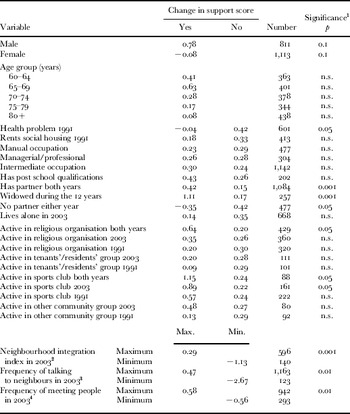
Determinants of change in support scores between 1991 and 2003, individuals aged 60 or more years in both years

Notes: 1. Difference between mean score of stipulated category and that of all others in the sample, or between the score for those with and without the attribute (t tests). For the last three variables (not available in 1991), analyses of variance (F tests). 2. Five categories. 3. Three categories: maximum ‘most days’, minimum ‘less than once a month’. 4. Three categories: maximum ‘most days’, minimum ‘less than once a week. n.s. not significant (>0.05).
Curiously, those who were widowed during the 12 years had a marked increase in their support score, by 1.11 for men (only 10 per cent became widowers) but by only 0.17 for women (17 per cent became widows). Many widows may have experienced an intensive period of caring for an ailing partner before he died, during which social activities beyond the household were difficult; some recovery of social contacts and activities may take place after their bereavement. Widowers may have followed a similar trajectory. The men who became widowers were also the oldest of all the six gender-by-partnership categories, with a mean age in 2003 of 79 years. Their support score may have risen so much partly because they were seen as particularly needy by relatives, friends and neighbours.
To analyse the influences on support score change, to obtain a reasonable sample size it was necessary to combine the male and female sub-samples for most variables (not all the respondents were present at both waves). Of the variables examined earlier for their relationship to the support score, apart from gender and marital/partnership status, only six were significantly (p<0.05) associated with the 12-year change (Table 5). These were health status, continuous religious activity, sports activity (continuously or just in 2003), the neighbourhood integration index, frequency of talking to neighbours and frequency of meeting people. One cannot tell whether a high level of informal social contacts in 1991 affected the trajectory of the support score over the 12 years, because the variables for meeting people and neighbourhood integration were available only for 2003. A high frequency of meeting people or talking to neighbours in 2003, and a high neighbourhood-integration index in that year, were associated with a more positive change in support score over the 12 years; but the causal links may have been either way.
Religious activity was positively associated with the change in support score over the 12 years, but only if sustained in both 1991 and 2003. Sports club activity in 2003 raised support score change, whilst the same in 1991 did not, but among those who reported sports activity in both years there was a substantial increase in the support score. Thus persistent activity in either type of organisation had more effect on social support than activity in just one of the two years. In the case of religious activity, this is perhaps because it implied more numerous or more significant friendships with other members; the effect of persistent religious activity was not independent of the frequency of meeting friends in 2003. On the other hand, the influence of persistence in sports activity was independent of the frequency of meeting friends – suggesting that sport may influence social support through a health effect. Hardly any of those who were persistently active in sports' clubs had a limiting health problem in 2003.
Having a limiting health problem that restricts daily activities had a very weak association with the social support score. Table 3 shows a significant association only for women in 2003, when women with health problems reported less social support than ‘healthy’ women. If poor health attracts extra support from friends and from kin, one would expect that people with health difficulties would start with a higher level of support than others and that, given the likely persistence of health problems, with increasing age the level would either be sustained or rise. But neither was the case: both men and women with health problems had, if anything, lower support than others at both dates. Worse still, having poor health in 1991 was one of only two factors that were associated with a fall in the individual's support score over the following 12 years (the other being lack of a partner in both years). Amongst those who had a limiting health problem in 1991, those who still had one by 2003 saw their support score fall by 0.20, whilst among those who no longer suffered it rose by 0.94.
Discussion and conclusion
Reviewing the influences on social support in both 1991 and 2003, it has been shown that managerial and professional groups had higher support scores in both years, confirming that there was class inequality in social capital, as noted by several earlier studies. There was also a class difference in the quality of social contacts, because there was a positive relationship between neighbourhood contacts and support scores for retired professionals but not for manual workers. Similarly, religious activity raised social support for former non-manual workers but not for manual workers. There were also strong associations between occupational class, neighbourhood quality and the support score, with social housing tenants having lower support scores than homeowners.
Much social support is clearly from kin, so that childless, especially single, elders were disadvantaged by very low support scores as well as declining support as they aged through 1991–2003. The presented analysis suggests that, whilst men and women in most age groups enjoyed a slight rise in social support during the study period, those living without a partner throughout the 12 years experienced decreased support. This occurred for both genders but was particularly marked among women aged over 75 years. The apparent decline in social support for single elders must be interpreted in the light of the evidence from previous studies that, whilst personal communities are generally shifting towards a greater proportion of non-kin, advancing age reduces the chances of having a non-kin ‘best friend’. With increasing age, care and support are increasingly provided either by spouses or non-kin, rather than adult children and other relatives. The BHPS data confirm the previous findings that unpartnered elders increasingly depend for social support on friendships that they themselves develop. In particular, they need to develop ‘bridging’ social capital in the form of contacts with younger people who will outlive them. Certain neighbourhood milieus – especially those of middle-class homeowners – are conducive to developing informal social contacts from which support may come. Alternatively, supportive friendships may arise from participatory activities but, as the analysis has shown, only of certain types – in sports and religious organisations, for active membership in other types of organisation made no difference.
Neighbourhood contacts and the frequency of meeting people had a greater effect on the support scores than being active, partnership status or having had children. Neighbourhood contacts were also relatively important influences on change in the support score over time. Just as Li, Pickles and Savage (2005) concluded that it is informal ties which count in generating social trust, one may conclude from the analysis that practical and emotional support emanating from friendships and neighbourliness provide help (even a little) to at most only one older person in four – the one-quarter of the over-sixties who are active in religious or sports' organisations. The effect of religion is moreover shown to be contingent on frequent meetings with others and the quality of neighbourhood contacts.
The effect of sports' club participation, on the other hand, was not contingent on informal ties and may influence social support through an association with good health – since health in turn influences the capacity to interact with people and to reciprocate friendship and favours. Consistent with Townsend's (1957) observation that help to elders is contingent on the capacity to reciprocate, the findings of this analysis have shown that people in poor health tend to experience a reduction in social support as they age. The health benefits of strong social networks noted by Grundy and Sloggett (Reference Grundy and Sloggett2003) may be difficult to realise if this is the case. Frail or sick elders in the community may depend for social support on the unreciprocated solidarity of others, which raises the question of how this can be secured when personal communities are becoming less kin-based.
One cannot tell whether being active in organisations facilitates greater interactions with friends and neighbours or vice versa. Obviously anyone can take part in an organisation and hope to increase their social contacts; there is evidence that older middle-class people do this on first moving to a new area as a way of getting to know others (Bulmer Reference Bulmer1986). The fact that someone can join an organisation without having any social contacts does not imply, however, that it is most likely to happen this way round. It may be more frequently the case that people join organisations in which people they know participate. Further qualitative research is clearly needed to clarify the processes by which social contacts and social support are generated. We need to find out more about how older people develop and sustain relationships with neighbours, co-religionists and fellow members of recreational groups, to help us meet the challenges posed by an ageing society in which an increasing proportion will be childless.
Acknowledgement
The author is grateful to the Economic and Social Research Council (Grant M570255001) for their financial support of the research reported in this paper.