

Introduction
Over recent decades, the labour-force participation and employment rates of older workers have steadily declined in most OECD countries.Footnote 1 The main cause of the reduction in the duration of working life has been the spread of early retirement, especially among higher-income workers. At the same time, lower fertility rates and more years of education have reduced the entry of very young adults into work. As a result, the average age of the workforce has increased, raising new issues and concerns and, in some cases, controversies about the health conditions and capabilities of older workers. Over the last few decades, however, mean life expectancy at birth and in middle-age has increased and many health services have improved, but as the International Labour Organisation (ILO 2001) lamented, these improvements have not been accompanied by longer working lives. As a consequence, welfare systems in the richest countries now sustain large cohorts of healthy and employable retirees (Auer and Fortuny Reference Auer and Fortuny2000). Further, a body of literature claims that early retirement is mainly explained by the benefits of health insurance, which are usually superior for the wealthiest workers. In general, from this perspective, it is claimed that many people of late working age are in sufficiently good health to be productive (Rogowski and Karoly Reference Rogowski and Karoly2000).
More and more regulations protect older workers against discrimination, as documented by Ursel and Amstrong-Stassen (Reference Ursel and Amstrong-Stassen2007) and critically discussed by Duncan (Reference Duncan2008). It has been argued that firms tend unjustifiably to downgrade the rewards, benefits and support offered to older workers, as with access to training in new procedures. This alleged discrimination is largely based on the stereotype that older workers experience poor health and physical decline that may affect their job performance (Posner Reference Posner1995), but research on occupational health has produced inconsistent findings about the impact of age on working capabilities (Kowalski-Trakofler, Steiner and Schwerha Reference Kowalski-Trakofler, Steiner and Schwerha2005). Some studies unequivocally associate age with the deterioration of working capabilities. Ageing is regarded as the biological process of functional decline that hinders the ability to perform and learn new work-related tasks (Rabbitt and Lowe Reference Rabbitt and Lowe2000). Physical ageing is also associated with the deterioration of attributes such as joint mobility, manual dexterity, muscular strength, reaction times and aerobic capacity. On the other hand, some researchers reject the assertion that increasing age necessarily leads to the diminution of capabilities (McMahan and Phillips Reference McMahan and Phillips1999), and emphasise that it associates with the accumulation of knowledge and skills, which improves the safety and productivity of daily work. The theory of compensation, for example, argues that increasing age fosters many positive characteristics, such as wisdom, mental health, maturity and experience, which to a great extent offset a decline in physical capacities.
The effect of age on occupational health is attracting growing attention from researchers and policy makers.Footnote 2 The United Kingdom (UK) Age and Employment Network (TAEN), for example, recently published two reviews on the issue, by Doyal and Payne (Reference Doyal and Payne2006) for older women and by Granville and Evandrou (Reference Granville and Evandrou2008) for older men, both of which acknowledged the need for further research on the impact of age in working life. Messing and Stellman (Reference Messing and Stellman2006) stressed that the available evidence is particularly sparse for female workers. This emerging social interest is also reflected in the growing number of studies that have investigated the impact of age on health in general and on occupational health and work performance. These have emanated from several disciplines, including public health (McMahan and Phillips Reference McMahan and Phillips1999), occupational health (Musshauser et al. Reference Musshauser, Bader, Wildt and Hochleitner2006), ergonomics (Vitasalo et al. Reference Vitasalo, Era, Leskinen and Heikkenen1985), psychology (Salthouse and Hambrick Reference Salthouse and Hambrick1999), occupational safety (Laflamme and Menckel Reference Laflamme and Menckel1995) and organisational studies (Czaja and Sharit Reference Czaja and Sharit2003).
In general, previous research has analysed the effects of age on certain health conditions or pathologies using small and specific samples. This approach is useful for identifying the risk factors and consequences of some disorders, but provides little basis for comparisons and generalisations. Additionally, most previous studies have specified age as linear using either continuous (years) or discrete (age groups) forms of the variable. This could be a limitation because linear models by definition do not consider non-linearity in the age relationship, which can be done by using a power function of age. As will be explained, such analysis may usefully identify the ages (or inflection points) at which ageing intensifies its effects on occupational health.
The principal aim of the present study is to analyse the age-effect for an entire working population, using the UK as a case study. A sample of 123,321 randomly selected individuals from the government's Labour Force Survey (LFS) has been used. The second goal is to compare and analyse the age functions for 16 different types of health problem using multinomial logit regressions. This technique estimates nominal categorical variables (types of health problems) and ensures the full comparability and interpretation of the estimated coefficients. Finally, the study focuses on the non-linear effects of age. Such an analysis may contribute to the limited empirical evidence (Granville and Evandrou Reference Granville and Evandrou2008) on the cumulative effect of working lives on health.
Data and methods
The respondents
The analysis draws on micro data from the UK LFS for the first (winter) quarter of 2007. The questionnaire had more than 100 questions using definitions consistent with the European LFS (European Commision 2003). The dependent variable is the type of health problem that affected the amount and/or kind of paid work. It was derived from the answers to questions about: (a) whether the health problem affected the kind/amount of paid work the respondent did, and for affirmative answers, (b) the respondent's main health problem. The analysis sample was restricted to the 68,975 employed participants (34,692 males and 34,283 females) in the entire sample of 123,321.
While the measures of ‘economic activity status’ are straightforward, namely in paid employment or not, some of the specified health problems require explanation. Sight problems (visual impairment) were recorded as a health problem only if not compensated by wearing glasses or contact lenses. A hearing difficulty was considered a problem only if not compensated by a hearing aid. The heart and blood pressure category excluded hay fever and seasonal allergic rhinitis. Learning difficulties included dyslexia, dyscalculia and mental impairment. Mental illness included conditions related to mental functioning, but excluded behavioural disorders such as a disposition to commit physical or sexual abuse, exhibitionism and voyeurism. Progressive (or chronic) illnesses were only recorded if they affected the respondent's normal day-to-day activities.
The multinomial logit regression model
We define the likelihood of a health problem (health problem) as the function:

where pi (hpj) is the probability of worker i suffering health problem j, a i is the worker's age and x i represents a set or vector of s control variables. In order to estimate the slope and non-linearity of the function, we specify a quadratic function:

where kj is the constant term, the beta (β) terms are the m-logit regression coefficients and u i is the error term for individual i. The marginal effect of age (the slope of the function) is then given by the first differential of the function, in Lagrange's or prime notation:

and the non-linearity (sign of the marginal effect) by the second derivative:

Examination of the non-linearity of the health problem likelihood function shows the magnitude of the age effect at different ages. There are three possibilities. First, if β2=0, the marginal effect of age will be constant and equal to β1. In this case, a unit change in age (of say one year) at any age will affect function (1) at the same marginal rate. The marginal effect of a unit increase in age is therefore the same for young and old workers or, in other words, independent of age. The second possibility is that the marginal impact of age on function (1) increases with age. In this case, the relationship is convex and β2>0. Such convexity implies that a unit change in age will have a stronger impact on older workers than on young workers. The third possibility is that β2<0, which indicates that the age effect decreases with age or a concave relationship, i.e. the strongest effects of an increase of the worker's age are in the early working years. All these possibilities are discussed in the next section.
The multinomial logit regression model assumes that the probability of each worker reporting any of the 16 health problems is a stochastic multinomial discrete choice or an independent event. The procedures estimate categorical-nominal dependent variables; that is, categories (like health problems) that have no particular order or cannot be ranked. The coefficients are the estimates of the log odds of observing any health problem (j), against the probability of the reference category, which in this analysis is ‘no problem’. The coefficients given in Tables 2 and 3 represent the increase (positive) or decrease (negative) of the likelihood of any of the 16 health problems with a change in age of one year. As specified above, the proposed model includes the variables age (a), age squared (a 2) and a set of control variables (vector x) as covariates. The control variables are intended to capture age-independent effects that are likely to have an impact on the likelihood of having a health condition that is a problem in the workplace. They include commonly accepted socio-demographic, labour and economic factors, and specifically were: (a) region of residence, (b) industry of occupation, (c) type of occupation, (d) tenure in current job, (e) net wage, (f) working part-time, (g) temporary contract, (h) British nationality and (i) self-employment.
Results
Frequencies by age-group and sex
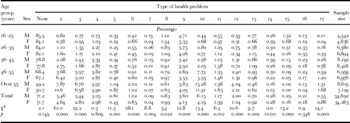
The frequencies of the types of health problem affecting work by age and sex are shown in Table 1. The last two rows have the chi-squared statistics for differences by sex and the significance levels. The figures show that overall the percentage of workers not reporting any health problem decreased with increasing age. As expected, young workers enjoyed better general health, but the increments between successive age groups were not consistent; that is, the age relationship was not linear. Among both men and women, the percentage of workers reporting no health problem sharply decreased in the 46–55 and over 55 age groups. In the entire sample, 71.5 per cent did not have a health problem, and a little surprisingly, the prevalence for men and women did not differ significantly (χ2=2.1), but the types of reported health problems varied by gender. The disorders that were significantly more common among men were: heart, blood and circulation (χ2=13.4), diabetes (χ2=10.6), hearing (χ2=28.1), legs and feet (χ2=23.2), learning difficulties (χ2=13.2), difficulty in seeing (χ2=11.3) and speech impediment (χ2=8.8). Women were more frequently affected than men by the following health problems: arms and hands (χ2=61.0), progressive illness (χ2=24.1), depression and bad nerves (χ2=9.7), digestive system (χ2=6.3) and skin conditions and allergies (χ2=5.4).
Types of health problem affecting work by gender and age-group, United Kingdom, 2007

Notes: M: males. F: females. N: sample size. p: Asymptotic significance. Key to health problems: 2. With arms and hands. 3. With legs and feet. 4. With back and neck. 5. Difficulty in seeing. 6. Difficulty in hearing. 7. Speech impediment. 8. Skin conditions, allergies. 9. Chest, breathing. 10. Heart, blood and circulation. 11. Digestive system. 12. Diabetes. 13. Depression, bad nerves. 14. Epilepsy. 15. Learning difficulties. 16. Mental illness, phobias. 17. Progressive illness.
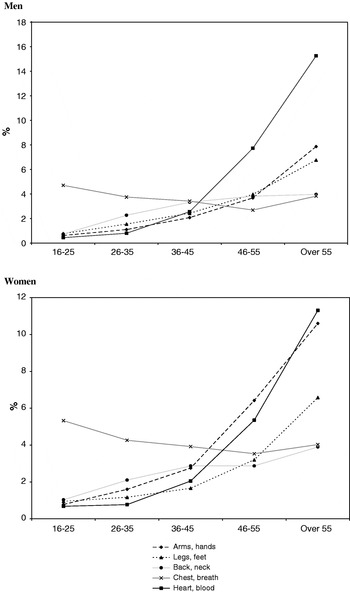
The conditions reported as affecting work also varied considerably by age group. In the youngest three age groups (16–45 years), the most prevalent were chest and breathing problems, but in the two older age groups (46 or more years), heart, blood and circulation problems were reported far more frequently than any other health problems. Among men, the percentage that mentioned heart-related problems rose from 2.6 per cent at ages 36–45 years to 15.3 per cent for those over 55, while among women, the equivalent age-specific frequencies rose from 2.1 to 11.3 per cent. There were also strong age-related increases for musculoskeletal problems; that is, problems with arms and hands (particularly for women) and with legs and feet. On the other hand, the percentage of back and neck problems was relatively stable by age-group and sex. Depression and nervous problems were most often reported by those aged 26–45 years, particularly women.
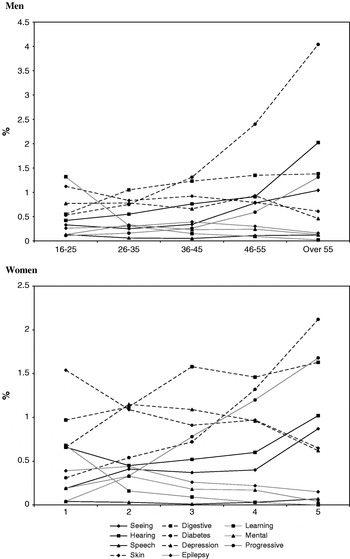
Figure 1 presents the age relationships with high-prevalence health problems (defined as over 4 per cent among those aged 55 or more years). The two plots for males and females show that with increasing age the percentage of workers affected by health problems generally rose. The age gradient was steepest for problems related to heart and blood pressure, and arms and legs – with sharp rises in the prevalence after 36 years of age, particularly among women. For both men and women, the percentages of older workers suffering from leg and feet problems were also comparatively high, especially for those aged over 55 years. On the other hand, the percentages for chest and breathing problems steadily decreased with age from the youngest age group until 46–55 years, but increased among those aged 55 or more years. Finally, back and neck problems increased with age but less steeply. Figure 2 depicts the frequencies of low-prevalence health problems. Among these, the highest prevalence was for diabetes, and there was a strong positive relationship with age, particularly among men. The other prevalence rates were generally below two per cent and various non-linear relationships with age can be seen. It is important to note that the univariate prevalence rates should be interpreted with care, as other factors, such as type of occupation and experience, have not been taken into account. A better understanding of the age effects emerges from the multivariate analyses, to which we now turn.
Age relationships with high-prevalence health problems.

Age relationships with low-prevalence health problems.

The age functions
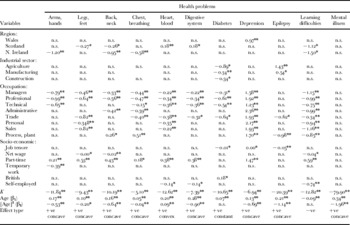
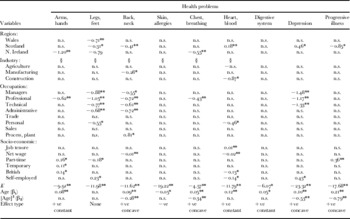
Tables 2 and 3 report the results of the multinomial logit regression analyses that were conducted separately for men and women. In both regressions, the models predicted a similar and significant percentage (11–12) of the variance. Beginning with the age effects or functions, five types of effect were observed: positive constant, positive convex, positive concave, negative and independent. For men, ten of the 16 health problems were positively correlated with age, and for women, seven of the 16 did so. Positive age effects were observed for both sexes for problems with: arms and hands, back and neck, chest and breathing, heart and blood, the digestive system, diabetes, depression and mental illness. Positive effects for legs and feet, diabetes and epilepsy were exclusive to men.
Multinomial logit regression estimates: men

Notes: N=34,692, R 2 (Cox and Snell)=0.12. Chi-squared: 3,528.59**. Only health problems with a significant overall effect are tabulated. For others, some variables were significant: having job tenure raised the likelihood of sight problems (coefficient 0.26**); living in Northern Ireland (−0.90*) and working in personal services (−0.61*) decreased the likelihood of hearing problems, but being in an administrative occupation (+0.76**) raised the likelihood; having job tenure (0.26*) raised the likelihood of speech problems; being self-employed (−0.33*) lowered the likelihood of skin allergies; and living in Scotland (−0.85*) lowered the probability of progressive diseases, while being in part-time work (0.64*) raised it. The reference groups were: for Region, England; for Industrial Sector, Services; for Occupational Group, Elementary.
Significance levels: ** p<0.01, * p<0.05, n.s.: not significant.
Multinomial logit regression estimates: women

Notes: N=34,283, R 2 (Cox and Snell)=0.11 Chi-squared: 2,228.59**. Only health problems with a significant overall effect (and problems with legs, feet) are tabulated. For others, some variables were significant: having job tenure lowered the likelihood of depression (coefficient −0.04**), of having learning difficulties (−0.01*) and of mental illness (−0.01*). Occupational group significantly related to the likelihood of depression for managers (−1.19**), professional (−1.01**), technical (−1.52**, administrative −0.82), personal services (−0.83*), and process and plant operatives (+0.74*). Being in part-time work (−0.45*) also reduced the likelihood of diabetes. The reference groups were: for Region, England; for Industrial Sector, Services; for Occupational Group, Elementary.
Significance levels: ** p<0.01, * p<0.05, n.s. not significant.
The analysis of the non-linearity yielded three different results. For men, concave functions were found for health problems affecting work with arms and hands, legs and feet, back and neck, chest and breathing, the digestive system, depression, epilepsy and mental illness (Table 2). For these problems, the unit rate of increase (the positive effect) decreased with age. Only for heart and blood did the marginal rate increase with age (the coefficient for age-squared was +0.09), while for diabetes it was zero (the rate of increase was invariant with increasing age). The results for women differed (Table 3). Very low and insignificant coefficients were more common, as for problems that affected work with arms and legs, chest and breathing, heart and blood, and the digestive system. All other effects were concave, that is the unit increase decreased significantly with age, as for back and neck, depression and progressive illness. In sum, the results reveal that the effect of increasing age on male workers was stronger, although in most cases it decreased with age. Women, by contrast, were less prone to certain health problems, but among the problems that were reported, the increasing prevalence with age was more often at a constant rate than for men.
An interesting insight from these results is the large number of age-independent and negative age effects on the reported prevalence of health problems. Both for men and women, the probability of work being affected by difficulties in seeing and hearing, speech impediments, skin disorders and allergies, and learning difficulties did not increase with age. For women, the same held for problems with legs and feet, diabetes and mental illness. Furthermore, the results also show that the frequency of some health problems diminished with age. This was the case for learning difficulties among men, and for skin disorders and allergies among women. In general, the results reveal considerable heterogeneity in the associations between age and the health problems that affect work.
The effects of the control variables
Regarding the control variables, the results show a limited impact of region of residence. Differences from the reference category (England) were not consistently observed, but some marginal divergences persisted. For example, musculoskeletal problems were less likely in Scotland and Northern Ireland, while depression was more likely among men in Wales and among women in Scotland. The results also show that type of occupation affected the likelihood of reporting a health problem that affected work more than industry (or the sector of the economy). The strongest effect was for Services or the tertiary sector (the reference category): employees in this sector were significantly more prone to report diabetes as affecting work. On the other hand, the type of occupation significantly associated with the frequency of reporting most health problems. In general, people in white-collar occupations (e.g. managers and professionals) and in skilled occupations (e.g. technical, administrative and personal services staff) had lower probabilities of certain health disorders, particularly musculoskeletal, chest and breathing and heart-related problems. On the other hand, men in elementary occupations less frequently reported depression and nervous problems as affecting work. Finally, the other examined socio-economic variables affected the probability of reporting a health problem in only limited ways. In particular, there was a beneficial effect (or negative relationship) between net wage and problems with legs and feet, and back and neck. On the other hand, part-time working increased the likelihood of problems with arms and hands, legs and feet, back and neck, chest and breathing, heart and blood pressure, the digestive system and, very significantly, depression.
Discussion
This paper has analysed the non-linearity of the relationship between increasing age and the likelihood of reporting 16 types of health problem that affect work for men and women in the UK. Although the overall prevalence of health problems was similar for men and women, both the prevalence and the age-functions for individual health problems differed greatly for the two sexes. Overall the results show considerable heterogeneity in the relationships between age and the various health problems. In particular, five broad types of relationships between age and the prevalence of the reported problems were identified: negative, independent, positive concave, positive convex and positive constant.
Starting with musculoskeletal disorders, the results only partially support previous findings on the effects of age and sex. In line with Messing (Reference Messing1998), age-related increases in prevalence were shown. For men, the age functions were positive but concave, while for women, the increases with age were more moderate but constant. The reduced rate of increase in musculoskeletal disorders among older workers may be explained by changes in the labour market over recent decades. Granville and Evandrou (Reference Granville and Evandrou2008) noted that a progressively more flexible labour market means that older workers have more options, such as multiple part-time jobs, consultancy and freelance assignments, and reduced working hours, which may have enabled men with musculoskeletal disorders more job opportunities and have moderated the age-related increase in these disorders being problematic for work.
The results do not totally support de Zwart and colleagues (Reference De Zwart, Broersen, Frings-Dressen and Van Dijk1997) finding that musculoskeletal problems are more likely among women than men – only for problems with arms and hands was the prevalence higher among women than men, in line with Strazdins and Bammer's (Reference Strazdins and Bammer2004) results for upper-body musculoskeletal disorders. The LFS data show clearly that leg and feet disorders were more likely to be problems at work for men than women. For these health problems, furthermore, the increasing prevalence with age was significant for men but not so for women. Back and neck problems were equally reported by men and women. The findings suggest that gendered differentiation of occupations, by which women are clustered in lower-status jobs (Doyal and Payne Reference Doyal and Payne2006) and perhaps in jobs that require upper-body dexterity, as in retailing and catering, lie behind such gender differentials in various health disorders being problematic at work.
Very strong age-related effects were found for problems with the chest and breathing and with heart and blood (pressure), especially among men. This is no surprise, as medical research recognises the strong association of age with these pathologies. The American Health Association, for instance, suggests that ages 45 years for men and 50 years for women are critical thresholds after which the risk of heart attacks increases significantly (Ornato and Hand Reference Ornato and Hand2001). Additionally, research on occupational health has consistently shown the relationship between job stress and heart disease. Clays et al. (Reference Clays, Leynen, De Bacquer, Kornitzer, Kittel and Karasek2007) showed that higher job demands for men aged 40–64 years were related to high blood pressure. Pelfrene et al. (Reference Pelfrene, De Backer, Mak, De Smet and Kornitzer2002) associated job strain with diastolic blood pressure for male workers aged 50 or more years. Previous research is therefore consistent with the observed positive concave effects for men and with the more moderate positive age effect for women.
The results also show relationships between age and the prevalence of psychological and mental disorders that were problems at work. For men, increasing age raised the likelihood of depression and mental illness, while for women, only depression had the age effect. For both men and women, the age effect on depression was positive and concave. This is consistent with Clark, Oswald and Warr's (Reference Clark, Oswald and Warr1996) finding that the prevalence of mental health problems does not have a linear relationship with age and indeed that most prevalence functions are U-shaped. The present results indicate that depression and bad nerves were significantly more likely among women (Table 1), and that among women the prevalence of depression increased from the youngest to the middle-aged groups, and decreased for the oldest workers. Nelson and Burke (Reference Nelson and Burke2000) also observed that women workers are significantly more likely than men to report work-related psychological distress. Once again, it may be that the types of jobs in which women are over-represented may provoke psychological distress and depression. The results reveal several other strong gender differences in the prevalence of different health conditions that are problematic at the workplace. While white-collar occupations were more likely to be associated with depression among men, they reduced its likelihood among women. These associations, which clearly require further investigation, suggest that men and women cope differently with responsibility and self-esteem.
Several implications for the ageing workforce can be drawn from the presented evidence. First, there is the need to consider some specific risks in the early and middle stages of working life. The results show that the risk of some health problems is higher for young workers; consequently, they should be the priority for occupational health attention and interventions. This is very much the case with learning and speech difficulties, where policies to increase and improve labour-market participation should target the specific needs of the youngest workers and students. The analysis also reveals that some of the measures taken over the last decades have been effective in counteracting the effects of age. In cases such as seeing and hearing problems, and skin conditions and allergies, health promotion and surveillance systems have effectively tackled the negative impact of age on the work-disabling effect of these physical disabilities. This reduction could also be explained by age-related increases in awareness of the impact of work on certain risks. Second, it was found that most of the positive age effects were concave, particularly for men. Only for the important categories of heart and respiratory disorders was the prevalence strongly associated with increasing age. Contrary to the usual idea of health problems being especially associated with older workers, the many concave relationships show that occupational health problems are found in all age groups. From the occupational health perspective, this evidence underlines the need to intervene at the appropriate time, when preventive measures may prevent the exacerbation of the problem and its disabling effects.
In sum, the evidence from the UK Labour Force Survey is in line with the proposition that health problems affect the entire working population, not only older workers. The main argument for specifying the associations with health and working capacity from an early age is that it increases the imperative for occupational health preventive interventions (Ilmarinen Reference Ilmarinen2001). This idea is consistent with the broader and increasingly popular concept of ‘workability’, which emphasises the balance between human resources and work demands. This includes the consideration of human resource dimensions, such as physical and mental capacities, social functioning and attitudes and values, together with work dimensions, such as job strain, environment, management and leadership. From this point of view, employers, health-care providers and governments should establish occupational health care as a system with a remit to promote health and capacities at all stages of the working life. To deal with ageing as a process, a proactive rather than reactive approach to health promotion is needed. This will entail considering additional dimensions of human wellbeing, such as satisfaction, social recognition and self-realisation, changes in which may explain part of the marginal increase in the risk of occupational health problems with age, but which are not usually seen as health-care priorities. The analysis of such dimensions could facilitate the early detection of future medical problems and, to some extent, reverse the negative effects of ageing.
Acknowledgements
The author acknowledges the financial support of the Spanish Ministry of Education and Science under the project SEC2007-67737-C03-02/ECON and is grateful to Dr Joaquin Aldaz for his comments and advice.