Acute viral myocarditis is common in the developing countries,Reference Aziz1 so that in one study 20% of children admitted to a children’s hospital with cardiac failure had acute myocarditis.Reference Younas, Rathore and Sadiq2 Acute myocarditis is consistently reported in both children and adults in the developed world.Reference Chan, Iwahara, Benson, Wilson and Freedom3–Reference Burch8 The clinical presentation of viral myocarditis varies from asymptomatic to fulminant and severe decompensation of the left ventricle,Reference McCarthy, Boehmer and Hruban9 to chronic dilated cardiomyopathyReference Spotnitz and Lesch10–Reference Ciszewski, Bilinska and Lubiszewska12 to presentation as arrhythmias and masked myocarditis.Reference Balaji, Wiles, Sens and Gillette13, Reference Ino, Okubo, Akimoto, Nishimoto, Yabutak Kawais and Okada14 On account of varied presentation the specific treatment has not been standardised, apart from cardiovascular support in the acute stage and anti-remodelling strategies with β-blockers in the chronic dilatation phase. The incidence of viral myocarditis in the developing countries is maximum in the winter months when upper respiratory viral infections are at the peak.Reference Aziz1 The clinical course of viral myocarditis shows significant mortality of 23–50% and significant spontaneous cure rate from 26% to 50%.Reference Aziz1, Reference Burch8 The chronic phase of persistent left ventricular failure has been observed in as high as 56% with acute myocarditis, the majority leading to cardiac failure.Reference Aziz1, Reference Spotnitz and Lesch10
The diagnosis of acute myocarditis poses significant problems and the treatment is empirical and the role of specific therapies, such as antiviral and immunosuppression, has not been established. It is reported that acute myocarditis results in significant mortality and morbidity requiring cardiac transplantation.Reference Burch8 A retrospective study involving 151 children with acute myocarditis was conducted at the National Institute of Cardiovascular Diseases, Karachi, Pakistan, and the experience revealed a clinical picture of the acute onset of left ventricular failure, echocardiographically confirmed, following an upper respiratory infection, which was fairly typical of the diagnosis.Reference Aziz1 Our non-randomised observations in children with acute myocarditis suggested that if corticosteroids were given at 3 months or later after the onset of myocarditis, nearly half of the children with persistent left ventricular failure improved.Reference Aziz1
With this background a prospective randomised study was planned to evaluate the effect of steroids in acute myocarditis of 3-month duration. We hypothesised that prednisolone, when given at 3 months of the onset of acute myocarditis with persistent left ventricular failure, would show a significantly greater early improvement and long-term cure rate compared with those with left ventricular failure who were not given steroids.
Materials and methods
The children, aged 3.7 plus or minus 2.9 years, were admitted to the National Institute of Cardiovascular Disease during July, 2001 to February, 2007. A total of 173 children were admitted with the diagnosis of acute myocarditis. The diagnosis was made clinically by the history of acute upper respiratory infection, respiratory distress, oedema and cardiac failure, and cardiomegaly on chest X-ray with or without pulmonary oedema. The electrocardiogram characteristically showed left atrial hypertrophy and left ventricular hypertrophy with ST change, and at times low voltages on the electrocardiogram. The echocardiograms that were obtained to document left ventricular dysfunction and exclude structural abnormalities were performed by one person and the average of at least three measurements was used for analysis. The causes of fever in the tropics, such as rheumatic fever, typhoid, malaria, diphtheria, collagen diseases, and hepatitis were excluded in all cases.Reference Aziz1 Viral antibody studies for Coxsackie virus, adenovirus, and enterocytopathic human orphan virus were carried out at the time of admission in 130 of 173 children. The inclusion criterion before randomisation was the duration of symptoms for more than 3 months and continued left ventricular failure and reduced ejection fraction.
Blood culture, erythrocyte sedimentation rate, anti-streptolysin O titre, total and differential blood picture, and search for malarial parasites and liver functions were performed on all children. Since the criterion for the randomisation was at the completion of 3 months of the symptoms, the children with symptoms of more than 3 months duration were excluded. An echocardiogram was obtained at admission and again at 3 months of the disease; children who had the disease for less than 3 months were stabilised and given an appointment for echocardiography at the completion of 3 months of the disease. Those children who completed 3 months were given a second echocardiogram and were included for randomisation. Parental informed consent for inclusion in the study was obtained for all randomised children.
Of the 173 children 93 were excluded before randomisation, 53 did not show up for randomisation at 3 months of the onset of symptoms, 18 had ejection fraction more than 50% at the 3-month echocardiogram and 22 children were admitted but not registered for the study. A total of 80 children at the 3-month onset of symptoms were randomised to treat or not to treat by drawing the chit from the box containing an equal number of chits marked to give steroids or not to give. Examination including echocardiograms was done at the end of 1 month of the randomisation. Twelve children were excluded from the analysis for not showing up at 1 month of randomisation, so that the analysis was possible for 68 of 80 randomised children. The prednisolone-treated group comprised 44 of 49 randomised children who were given prednisolone and anti-failure medication and the control group included 24 of the 31 randomised children who were only given anti-failure medication.
Prednisolone in a dose of 2 milligrams per kilogram per day was given for 1 month and then tapered off over a period of 15 days. Both groups of children were treated with digoxin, diuretics, captopril, an angiotensin-converting enzyme inhibitor, and spironolactone. An intravenous immune globulin was not given to any of the children. Cardiovascular support was provided with dobutamine when required. In all, 36 children of the prednisolone-treated group were followed in the outpatient unit for a period of 15.1 plus or minus 9.2 months and 17 control group children for 13.6 plus or minus 10.6 months. The number of children decreased as the follow-up proceeded in both the groups.
Progress was followed with clinical examination and echocardiography. Statistical analysis was performed using the Microsoft Excel, Statistica, and EP statistical packages. The means and standard deviations were calculated and comparisons of the means were made by Student’s t-test and group comparisons were made using the χ2test.
Results
Serum antibodies were detected in 73 of 130 children (56%). The majority, 60.2% of the children had antibodies against coxasackie viruses followed by adenovirus antibodies in 23.3% and ECHO viral antibodies in 8.2% (Table 1).
Results of 73 positive results of serum viral antibody studies undertaken in 130 of 172 children with acute viral myocarditis.

A total of 38 of the 49 children (77.6%) in the prednisolone-treated group and 19 of 31 (61.3%) in the control group had virology studies, 22 (73.7%) in the prednisolone-treated group, and 9 (47.4%) in the control group had positive titres for viral antibodies. In the prednisolone-treated group, the Coxsackie group was most common in 15 of 22 children (68.2%). In the adenovirus group, there were five (22.7%) children and in the enterocytopathic human orphan virus group there were two children (9.1%). In the control group, six of nine children (66.7%) had antibodies against Coxsackie, against the adenovirus in two (22.2%), and against enterocytopathic human orphan in one child (11.1%). There was no difference in the type of viral antibody patterns between the groups.
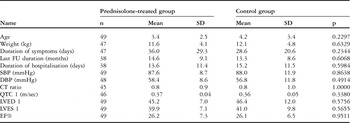
The prednisolone-treated group and the control group were matched for the various characteristics of the severity of the disease and there were no significant differences (Table 2). The ejection fraction at the time of randomisation was not significantly different between the groups, 30.3 plus or minus 7.8% in the prednisolone-treated group versus 29.4 plus or minus 6.1% in the control group (p = 0.627).
Comparison of characteristics of severity between the Prednisolone treated and control groups.

CT ratio, cardio thoracic ratio; DBP, diastolic blood pressure; EF%, ejection fraction percentage; FU, follow-up; LVED, left ventricular diastolic dimension; LVES, left ventricular systolic dimension; QTc I, QTc interval; SBP, systolic blood pressure
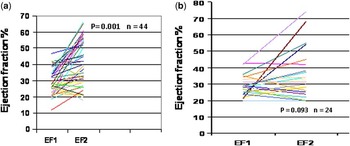
In the 44 prednisolone-treated group children, the ejection fraction was compared before and after 1 month of prednisolone therapy, the ejection fraction increased from a mean of 30.3 plus or minus 7.8% to 41.9 plus or minus 14.3%, a significant improvement at the end of the prednisolone therapy (p < 0.001), whereas in the control group of 24 children without prednisolone therapy the ejection fraction did not change significantly from a mean of 29.4 plus or minus 6.1% to 35 plus or minus 14.8% after 1 month (p = 0.09; Fig 1a and b).
Ejection fraction before (EFI) and after 1 month (EF2) of prednisolone therapy (a) in 44 prednisolone-treated group and (b) in 24 control group.

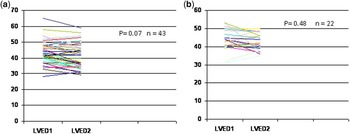
Comparing the ejection fraction at the end of 1 month of randomisation in both groups the improvement in the prednisolone- treated group was significant at p = 0.06. The end-diastolic dimensions decreased in the prednisolone-treated group from a mean of 43.93 plus or minus 7.1 millimetres to 41.05 plus or minus 7.4 millimetres in 43 children (p = 0.07) compared with change from 44.0 plus or minus 5.9 millimetres to 42.8 plus or minus 4.63 millimetres in the control group (p = 0.48), an insignificant difference (Fig 2).
Change in left ventricular end-diastolic dimensions before (LVEDI) and 1 month after (LVED2) randomisation (a) in prednisolone-treated group and (b) in control group.

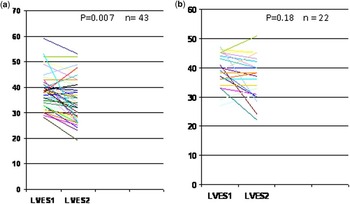
The end-systolic dimensions in the 43 children in the prednisolone-treated group decreased significantly from a mean of 38.9 plus or minus 6.72 millimetres to 34.4 plus or minus 8.38 millimetres (p = 0.007) while there was no significant decrease from a mean of 39.2 plus or minus 5.6 millimetres to 36.5 plus or minus 7.4 millimetres in the 22 control group children (p = 0.183; Fig 3). Comparing the early improvement in the ejection fraction between the two groups after 1 month of randomisation to less than 40% or more, 20 of the 44 children in the prednisolone-treated group had an ejection fraction of less than 40% and 24 children had more than 40% ejection fraction, whereas in the control group, 18 of the 24 children had an ejection fraction of less than 40% and six had more than 40% so that the improvement was significantly more in the prednisolone-treated group (p = 0.029). The discrete comparative analysis of change in the ejection fraction from randomisation to after 1 month was made between the groups by using the χ2 test and showed that in the prednisolone-treated group 20 children had a greater than 10% change in the ejection fraction from that at randomisation, 16 had less than 10% change, and while eight had no change in comparison with the control group children only four had more than 10% change in the ejection fraction, nine had less than 10% and 11 had no change so that the prednisolone-treated group had a significant improvement than the control group (p = 0.019).
Change in left ventricular end-systolic dimensions before (LVES1) and 1 month after (LVES 2) randomisation (a) in prednisolone-treated group and (b) in control group.

Follow-up was available for 36 children in the prednisolone-treated group and 17 in the control group. The mean follow-up period in the prednisolone-treated group was 15.1 plus or minus 9.2 months and in the control group it was 13.8 plus or minus 10.6 months. The comparison of the ejection fraction between the groups at the follow-up visits showed that 21 of 36 children in the prednisolone-treated group achieved an ejection fraction of greater than 60% and 15 children had an ejection fraction of less than 60%, whereas in the control group 5 of 17 had an ejection fraction greater than 60% and 12 had an ejection fraction of less than 60%, so that the greater number in the prednisolone-treated group was cured compared with the control group (p = 0.049).
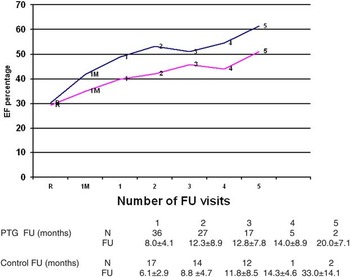
The follow-up plots of the ejection fraction at various follow-up visits showed that the greater improvement in the ejection fraction in the prednisolone- treated group after 1 month of prednisolone therapy was maintained through the follow-up visits (Fig 4).
Ejection fraction in groups on follow-up visits; FU, follow up visits; EF, ejection fraction; N, numbers; PTG, prednisolone-treated group; 1 M, 1 month after randomisation; R, randomisation.

Discussion
Our randomised study showed that the administration of prednisolone, after the completion of the 3-month duration, from the onset of symptoms of acute myocarditis, the increase in the ejection fraction in the prednisolone-treated group was significantly greater compared with the control group. At the end of the follow-up visits the cure rate in the prednisolone-treated group was also significantly greater in the prednisolone-treated group.
Recent pathological studies show a three-phase course of acute myocarditis. First, an early acute phase of acute myocarditis, which is that of viral invasion of the myocardium and consequent myocyte damage. In animals after 2–6 weeks of onset, a second phase begins with the development of immune complexes, which when overexpressed within the myocytes, leads to necrosis of the myocytes. The second phase may also be dominated by myocardial viremia as well as immune complexes. This is followed by a third chronic phase of ventricular dilatation.Reference Liu and Mason15–Reference Feldman and McNamara17 The therapeutic interventions in the past studies have not been based on the above pathological course. The rational therapeutic intervention needs be appropriate for the various phases so that the antiviral agents would be appropriate in the acute phase of viral invasion, immune suppression in the second phase of autoimmune complexes’ overexpression, and cardiovascular support and anti-remodelling therapy in the chronic phase. The results in our study showing effectiveness of prednisolone can be explained by the fact that by the third month of the onset of the myocarditis, the immune complexes are well developed and improvement presumably occurred in those children in whom the immune complexes were causing the persistence of left ventricular failure. It is conjectured that non-responders were those in which persistence of virus was the cause of left ventricular decompensation. In the reported series the lack of improvement when steroids were administered early in the disease can similarly be explained as in the early stages viral infestation is the cause of myocyte damage, when immune therapy would not be expected to succeed.
The diagnosis in our study was based on clinical and echocardiographic demonstration of the left ventricular dysfunction in the absence of the structural disease and the presence of viral antibodies .The antibodies to Coxsackie’s group were the most common followed by adeno- and enterocytopathic human orphan groups of viruses. The type of infecting virus was not significantly different among the groups; the Coxsackie virus being dominant in both. We could not show any relationship between the severity of the myocarditis and the type of viral infection.
We did not perform endomyocardial biopsies because biopsy acquisition in sick children is not without risk and because the diagnostic sensitivity of myocardial biopsies, even when complemented with histochemical detection of immune complexes, is low.Reference Burch8, Reference Mason, Billingham and Ricci18 The polymerase chain reaction technology of viral replication,Reference Martin, Webber and Fricker19 viral culture, and serum viral antibody studies has also not been helpful in the diagnosis in all cases.Reference Liu and Mason15, Reference Martin, Webber and Fricker19–Reference McNamara, Holubkov and Starling21 The biopsy may help to rationalise the therapy after 3 months of persistent left ventricular failure by showing the presence of immune complexes in the myocardium or continued myocardial viremia. Recently, serum levels of cytokines, anti-myosin antibodies,Reference Lauer, Niederau and Kuh22 Fas and Fas ligands have been shown to be higher in acute myocarditis.Reference Fuse, Kodoma and Okura23 These markers, along with magnetic resonance imaging, are expected to enhance the diagnostic power.
The studies showing the effectiveness of the immunosuppressive therapy in children are few and randomised studies are scanty.Reference Burch8, Reference Hia, Yip, Tai and Quek24 Immune therapy has been reported to be useful in non-randomised studies,Reference Aziz1, Reference Chan, Iwahara, Benson, Wilson and Freedom3, Reference Lee, McCrindle and Bohn5, Reference Balaji, Wiles, Sens and Gillette13, Reference Ino, Okubo, Akimoto, Nishimoto, Yabutak Kawais and Okada14, Reference Ducker, Colan and Lewis25, Reference Takada, Kishimoto and Hiraoka26 and not useful in other studies.Reference English, Janosky, Ettedgui and Webber6, Reference Burch8, Reference Ciszewski, Bilinska and Lubiszewska12, Reference Jones, Herskowitz and Aulchins27–Reference Levi and Alejo29 In one randomised study in adults, immune therapy was shown not to be advantageous compared with controls.Reference McCarthy, Boehmer and Hruban9 The time of administering the immune suppression therapy, as our study showed, is critical as immune complexes develop late in the course of the disease and are the cause of persistent carditis.
Based on our previous experienceReference Aziz1 we selected a 3-month duration of an acute phase for intervention with immunosuppression therapy. The time of the development of auto-destructive immune complexes in humans is not determined yet and it may be that somewhat earlier intervention than 3 months of disease may be as effective in preventing the development of persistent cardiac failure. In a recent study involving children it has been suggested that in the combination of immune-suppressing agents there was a significant improvement.Reference Gagliardi, Bevilacqua and Bassono30 Interferon-β in the acute phaseReference Kuhl, Pauschinger and Schwimmbeck31–Reference Matsumori, Tomioka and Kawai33 and OKT3, a powerful inhibitor of all of the immune responses of the body,Reference Ahdoot, Galindo and Alijos34 have shown promise. These forms of therapies may be relevant in fulminant carditis with circulatory insufficiency that is not responsive to supportive therapy, immune globulins, and corticosteroids. In the developing countries the cost of treatment needs to be economised. Steroids are relatively cheaper than immune globulins and are readily available. In our study, a short course of steroids did not show any serious untoward effects. In acute viral myocarditis, the spontaneous rate of cure is 25–50%; randomised studies need a large sample. We did manage to register a large number of children, but more than half did not show up for the randomisation at 3 months of the disease. This degree of drop-out on follow-up after discharge from the hospital is a common problem in our part of the world.Reference Aziz1 Nonetheless, we were able to show a significant early improvement and late cure rate in the immune-suppressed group compared with the control group. The weakness of our study is that we were only able to randomise for analysis less than half of the children that were registered. Some of this may be due to the strict protocol of the study, which required a revisit for randomisation at 3 months of the disease. In a previous study, we had shown that 30% of the children were lost to follow-up, and significant mortality and morbidity being noted in the one followed in the outpatient such that 30% of children developed persistent left ventricular failure.Reference Aziz1 This study was designed to address the treatment of this large group of children with persistent left ventricular failure. In conclusion, we believe that we have shown that immunosuppression with steroid administration at 3 months of the onset of myocarditis in those with persistent left ventricular failure produced a significant cure rate compared with the treated group with conventional therapy. Our study has shown an important role for corticosteroids in the treatment of persistent left ventricular failure due to viral myocarditis.