Introduction
Cyperaceae (sedges) are characterised by leaves that are arranged in three (eventually twisted) rows ([spiro]tristichous phyllotaxis), a reduced or lacking perianth, fruit an achene (nutlet), and unique conical silica bodies (Judd et al., Reference Judd, Campbell, Kellogg, Stevens and Donoghue2016). Inflorescences are a complex arrangement of small spikes (spikelets). The family has a worldwide distribution and includes about 5600 species (Govaerts et al., Reference Govaerts, Koopman, Simpson, Goetghebeur, Wilson, Egorova and Bruhl2018). Spalink et al. (Reference Spalink, Drew, Pace, Zaborsky, Starr, Cameron, Givnish and Sytsma2016) suggested that Cyperaceae originated in South America in the late Cretaceous. Two major genera besides Carex L. (∼2000 spp.), which has a cosmopolitan distribution with a concentration in cold Holarctic regions, are Cyperus L. (∼950 spp.) and Fimbristylis Vahl (∼300 spp.), two mainly tropical genera extending towards the temperate regions (Govaerts et al., Reference Govaerts, Koopman, Simpson, Goetghebeur, Wilson, Egorova and Bruhl2018). Several Cyperaceae genera follow the C4 photosynthetic pathway (Bruhl & Wilson, Reference Bruhl and Wilson2007), which is associated with Kranz anatomy, i.e. the presence of a green sheath of Kranz cells around the vascular bundles. Multiple origins of C4 photosynthesis out of C3 lineages associated with variants of the Kranz anatomy (e.g. in Cyperus and Fimbristylis; Goetghebeur, Reference Goetghebeur and Kubitzki1998) have recently been confirmed by phylogenetic analysis (e.g. Besnard et al., Reference Besnard, Muasya, Russier, Roalson, Salamin and Christin2009).
There has been much recent phylogenetic work on Cyperaceae worldwide. Muasya et al. (Reference Muasya, Simpson, Verboom, Goetghebeur, Naczi, Chase and Smets2009), based on an analysis of the plastid rbcL, trnL intron and trnL–F intergenic spacer regions, found two primary clades in Cyperaceae, which led them to revise the previous subfamilial classification based on morphological characters (Bruhl, Reference Bruhl1995; Goetghebeur, Reference Goetghebeur and Kubitzki1998). They recognised two subfamilies, Mapanioideae and Cyperoideae, and so merged the subfamilies Cyperoideae, Caricoideae and Sclerioideae of Goetghebeur (Reference Goetghebeur and Kubitzki1998) into a single large subfamily, Cyperoideae, which is sister to Mapanioideae. Larridon et al. (Reference Larridon, Reynders, Huygh, Bauters, Van de Putte, Muasya, Boeckx, Simpson, Vrijdaghs and Goetghebeur2011a, Reference Larridon, Bauters, Reynders, Huygh, Muasya, Simpson and Goetghebeur2013) performed phylogenetic studies in the large genus Cyperus using the nuclear ETS 1f and the plastid rpl32–trnL and trnH–psbA regions. They established that the eucyperoid C3 lineages of Cyperus are distributed over several basally branching clades, and that the clade containing all C4 Cyperus species, which are of the chlorocyperoid anatomy type, is nested in the C3 grade. However, the species sampled for the molecular phylogenetic studies so far are not evenly distributed among tribes (Muasya et al., Reference Muasya, Simpson, Verboom, Goetghebeur, Naczi, Chase and Smets2009) nor among regions of the world. To date, there are few sequence data for Cyperaceae from mainland Southeast Asia (the Indochinese Peninsula) and none from Cambodia.
In September 2010, during an excursion to Cambodia by members of the Institute of Botany of the University of Natural Resources and Life Sciences, Vienna, we had the opportunity of sampling specimens of Cyperaceae. The taxa sampled belong to various tribes of the large subfamily Cyperoideae. Our aim was to contribute DNA sequences of these taxa to the overall phylogeny of the family by focusing on the rapidly evolving nuclear ribosomal internal transcribed spacer (ITS), a useful marker for species-level phylogenetic studies (Nieto Feliner & Rosselló, Reference Nieto Feliner and RossellÓ2007). This region has already been widely used in Cyperaceae phylogenetics, for example in Carex (Global Carex Group, 2016), Cyperus (Reid et al., Reference Reid, Carter and Urbatsch2014), Abildgaardieae (Ghamkhar et al., Reference Ghamkhar, Marchant, Wilson and Bruhl2007) and Schoeneae (Viljoen et al., Reference Viljoen, Muasya, Barrett, Bruhl, Gibbs, Slingsby, Wilson and Verboom2013). Based on the integration of the new sequence data with existing data, we were specifically interested in the phylogenetic placement and the biogeographical relationships of the Cambodian taxa. We also aimed to detect taxonomically unclear groups with need for further investigation. Finally, our study should help advance floristic knowledge of Cambodian Cyperaceae.
Materials and Methods
Plant material
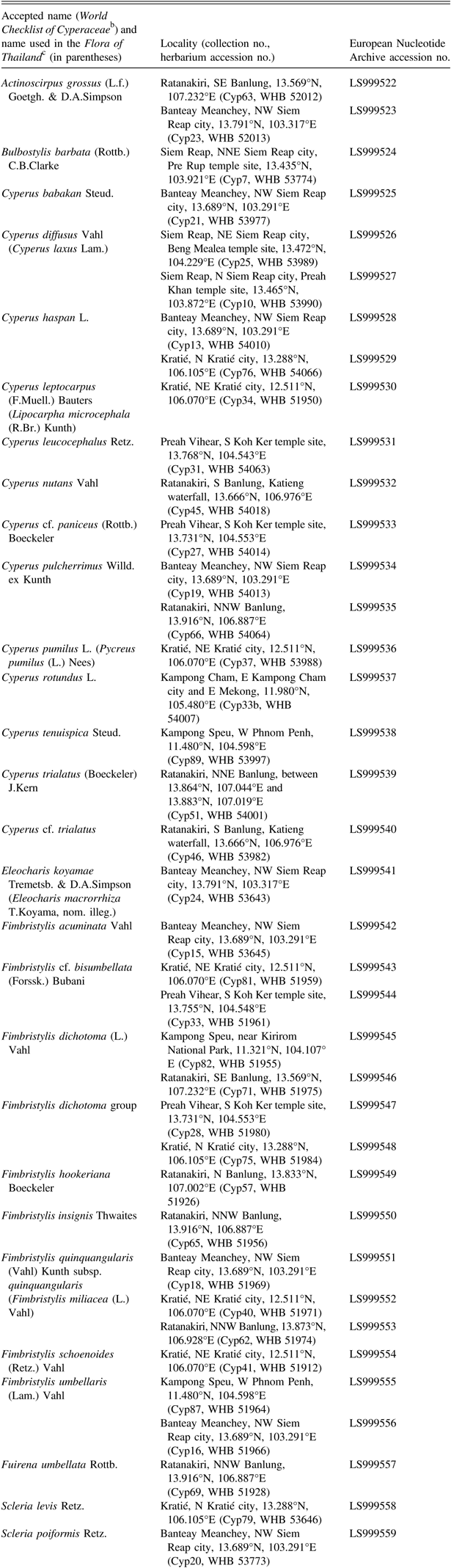
The field trip was carried out in the framework of a university course for master’s degree students in Landscape Architecture and Landscape Planning. The excursion was led by Karl-Georg Bernhardt, Klaus Hackländer, Steffen Hameister and Hermann Schacht. Thirty-one people, including 23 students, participated. Various regions of Cambodia were visited, from Sihanoukville Province in the south to Banteay Meanchey Province in the northwest and Ratanakiri Province in the northeast. Habitats explored included wetlands, secondary forests, agricultural and forestry land, beaches and mangroves, and historic temple complexes. Species of Cyperaceae were collected from 9 to 25 September 2010 (Table 1). Leaf material was preserved in silica gel and vouchers of all samples were deposited in the herbarium of the Institute of Botany of the University of Natural Resources and Life Sciences, Vienna (WHB). We determined the specimens using the Flora of Thailand (Simpson & Koyama, Reference Simpson and Koyama1998) and verified the determination by direct comparison of our vouchers with vouchers deposited at the herbarium of the Royal Botanic Gardens, Kew (K). We then updated the species names with the accepted names by accessing the World Checklist of Cyperaceae (Govaerts et al., Reference Govaerts, Koopman, Simpson, Goetghebeur, Wilson, Egorova and Bruhl2018).
Samples of Cambodian Cyperaceae species used for DNA sequencing in the present studya

a All samples collected by K.-G. Bernhardt and M. M. Wernisch. Vouchers are deposited at WHB. The internal transcribed spacer sequences are available from the European Nucleotide Archive browser at http://www.ebi.ac.uk/ena/data/view/PRJEB27967.
b Govaerts et al. (Reference Govaerts, Koopman, Simpson, Goetghebeur, Wilson, Egorova and Bruhl2018).
c Simpson & Koyama (Reference Simpson and Koyama1998).
DNA extraction and sequencing
We ground silica gel–dried leaf material with glass beads in a TissueLyser II and extracted DNA from the ground material using the DNeasy Plant Mini Kit (Qiagen, Hilden, Germany). For amplification of ITS, we used the primer combinations ITS5/ITS4 (White et al., Reference White, Bruns, Lee, Taylor, Innis, Gelfand, Sninsky and White1990) or, alternatively, ITSL (Hsiao et al., Reference Hsiao, Chatterton, Asay and Jensen1994)/ITS4.
The PCR mix contained 2.5 µL of 10× DreamTaq Buffer, 0.125 µL of 5 U/µL DreamTaq DNA Polymerase and 0.25 µL of 100 mM dNTP Mix (25 mM each; Thermo Scientific; Thermo Fisher Scientific, Waltham, Massachusetts, USA), 1 µL of forward primer and 1 µL of reverse primer (each at 10 µM), 19.125 µL of water and 1 µL of template DNA. The PCR program involved initial denaturation at 95°C for 3 min; 35 cycles of 95°C for 1 min, 51°C for 1 min and 72°C for 2 min; and a final extension at 72°C for 7 min. Samples that produced single bands on the agarose gel were treated with 0.5 µL of Exonuclease I (20 U/µL) and 1 µL of FastAP Thermosensitive Alkaline Phosphatase (1 U/µL; Thermo Scientific). Single bands of samples that produced multiple bands on the agarose gel were extracted from the gel with the Hi Yield Gel/PCR DNA Fragment Extraction Kit (Süd-Laborbedarf, Gauting, Germany).
Cycle sequencing was done in both directions with the same primers that were used in the PCR. The cycle-sequencing reaction mix contained 1.5 µL of BigDye Terminator v3.1 5× Sequencing Buffer and 1 µL of BigDye Terminator v3.1 Ready Reaction Mix (Applied Biosystems; Thermo Fisher Scientific), 1 µL of 3.5 µM forward or reverse primer, and 6.5 µL of purified PCR product. The program for cycle sequencing was 96°C for 1 min followed by 35 cycles of 96°C for 10 s, 50°C for 5 s and 60°C for 4 min. Ten microlitres of the cycle-sequencing products was purified on Sephadex G-50 Fine (GE Healthcare; General Electric, Boston, Massachusetts, USA) columns prepared in MultiScreen-HV (Merck Millipore; Merck, Darmstadt, Germany) filter plates. The flow-through was resuspended in 10 µL of Hi-Di Formamide and loaded on a 3500 Genetic Analyzer (Applied Biosystems).
Sequence analysis
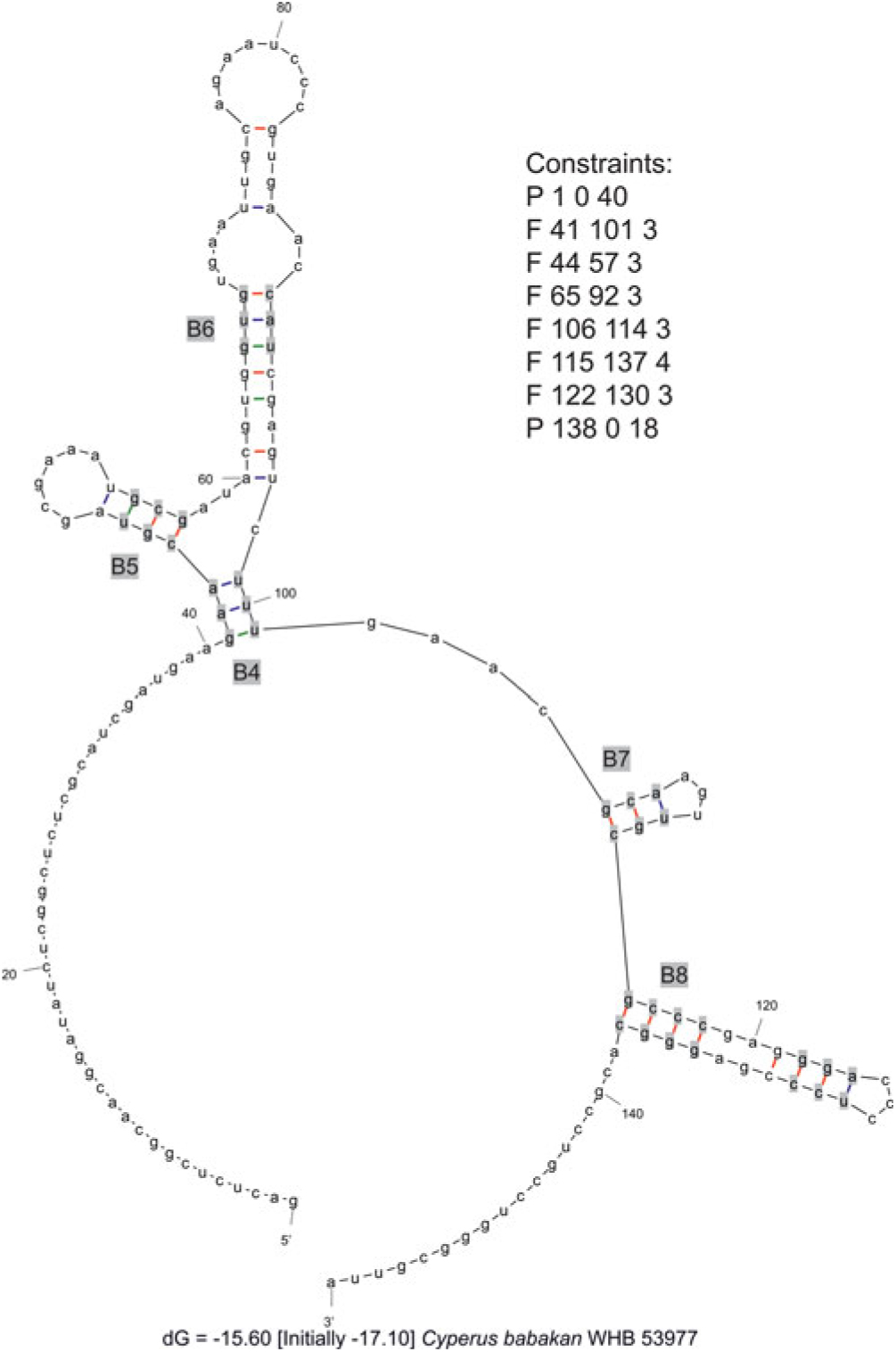
Forward and reverse sequences were assembled and edited in Geneious version 8.0.4 (Biomatters, Auckland, New Zealand). Hidden Markov Models were used for ITS2 delimitation by comparison with a conserved structural motif in the 5.8S/26S rDNA regions (proximal stem of the ITS2) of the Viridiplantae model available via the ITS2 Database at http://its2.bioapps.biozentrum.uni-wuerzburg.de/ (Keller et al., Reference Keller, Schleicher, Schultz, Müller, Dandekar and Wolf2009). To exclude possible pseudogenic sequences, we verified the presence of the conserved angiosperm 5.8S rDNA motifs M1, M2 and M3 and reconstructed the 5.8S rRNA secondary structure following Harpke & Peterson (Reference Harpke and Peterson2008). The reconstructions were done at a folding temperature of 37°C using the RNA-folding form of the mfold version 4.7 web server (http://unafold.rna.albany.edu/?q=mfold/RNA-Folding-Form; Zuker, Reference Zuker2003), with the same constraints for base pairings for the helices B4–B8 as denoted in Harpke & Peterson (Reference Harpke and Peterson2008).
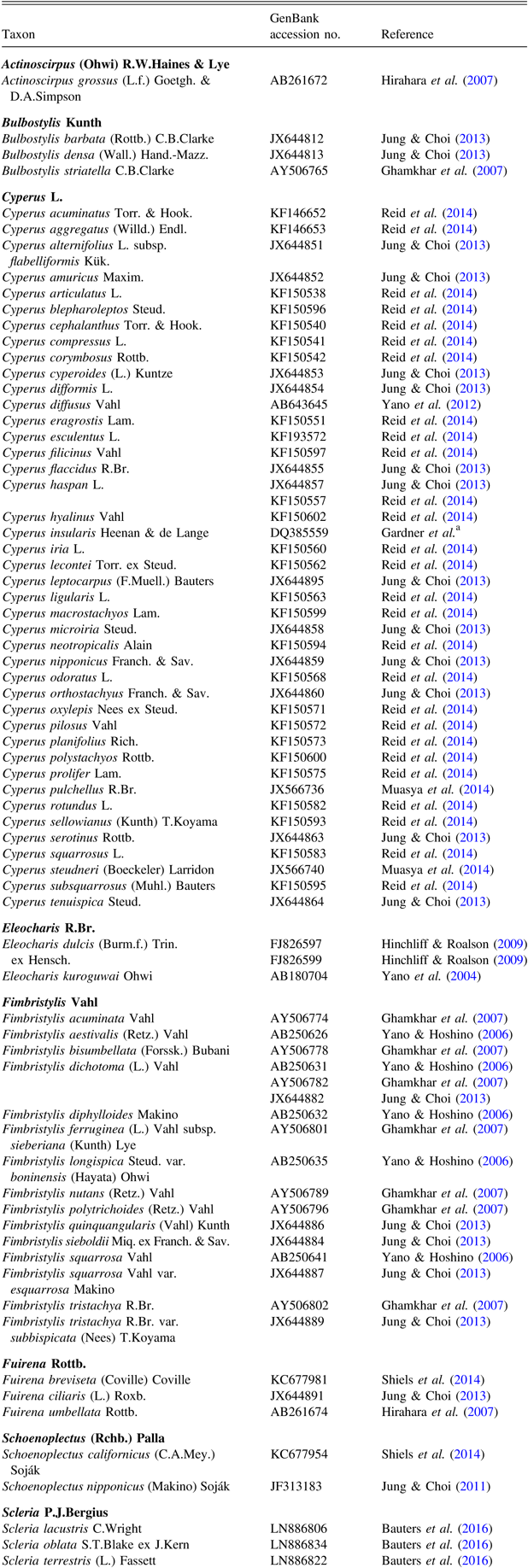
We then merged our sequences with highly similar sequences downloaded from the National Center for Biotechnology Information GenBank for phylogenetic analysis (Appendix I), applying taxon names to the downloaded sequences according to the World Checklist of Cyperaceae (Govaerts et al., Reference Govaerts, Koopman, Simpson, Goetghebeur, Wilson, Egorova and Bruhl2018). We carried out global alignments of ITS1 and ITS2 separately by using the Q-INS-i strategy, which incorporates structural information of non-coding RNAs (Katoh & Toh, Reference Katoh and Toh2008), implemented in the online version of MAFFT version 7 (https://mafft.cbrc.jp/alignment/server/; Katoh et al., Reference Katoh, Rozewicki and Yamada2017), with the following settings: unalignlevel = 0.0, try to align gappy regions anyway, scoring matrix for nucleotide sequences = 200PAM/κ = 2, gap opening penalty = 1.53, offset value = 0.0, and n is treated like a wildcard. We then used RAxML version 8.2.10 for maximum likelihood phylogenetic inference (1000 searches starting from 1000 maximum parsimony starting trees; Stamatakis, Reference Stamatakis2014), specifying that individual base frequencies, GTR rates (Rodríguez et al., Reference Rodríguez, Oliver, Marín and Medina1990), and shape parameters α of the gamma model of rate heterogeneity (i.e. individual GTR+G models of nucleotide substitution) should be estimated separately for the partitions 18S rDNA, ITS1, 5.8S rDNA, ITS2 and 26S rDNA. We also conducted 1000 standard non-parametric bootstrap replicate searches.
FigTree version 1.4.2 (Rambaut, Reference Rambaut2006–2014) was used to display the bootstrap values on the best tree and to root it at midpoint. Despite some obviously misaligned positions, manual modifications of the alignment did not substantially improve the resolution of the phylogenetic tree, so we used the MAFFT alignment without further modification. The alignment and tree are available from TreeBASE (www.treebase.org; Piel et al., Reference Piel, Chan, Dominus, Ruan, Vos and Tannen2009; Vos et al., Reference Vos, Balhoff, Caravas, Holder, Lapp, Maddison, Midford, Priyam, Sukumaran, Xia and Stoltzfus2012) under the study accession number S23576.
For the biogeographical interpretation of the phylogenetic tree, we extracted species distributions from the World Checklist of Cyperaceae (Govaerts et al., Reference Govaerts, Koopman, Simpson, Goetghebeur, Wilson, Egorova and Bruhl2018). The regions considered are Africa and the western Indian Ocean (Madagascar and nearby islands), tropical and subtropical Asia and Oceania (Australia and islands of the eastern Indian Ocean and western Pacific), temperate Asia, and America. Extensions of a few species into Europe are not delineated.
Results
A new name in Eleocharis
Eleocharis macrorrhiza T.Koyama (Koyama, Reference Koyama1979), the name of one of the taxa included in our analysis, was shown by Govaerts et al. (Reference Govaerts, Koopman, Simpson, Goetghebeur, Wilson, Egorova and Bruhl2018) to be illegitimate. However, no supporting information for this designation was provided. Further investigation showed it to be illegitimate under Article 53.2 of the International Code of Nomenclature for Algae, Fungi and Plants (Turland et al., Reference Turland, Wiersema, Barrie, Greuter, Hawksworth, Herendeen, Knapp, Kusber, Li, Marhold, May, McNeill, Monro, Prado, Price and Smith2018) because of the earlier published Eleocharis macrorhiza Boeckeler (1858), a ‘confusingly similar name’ as defined by the Code, which refers to an unrelated American species. Therefore, the following new name is proposed.
Eleocharis koyamae Tremetsb. & D.A.Simpson, nom. nov. – Eleocharis macrorrhiza T. Koyama, Brittonia 31: 285 (1979), nom. illegit., non Eleocharis macrorhiza Boeckeler, Flora 41: 413 (1858). – Type: Thailand, Thung Salaeng Luang, Shimzu T-11303 (holo KYO).
New records for Cambodia
We collected several species in Cambodia which have not been recorded in this country by Govaerts et al. (Reference Govaerts, Koopman, Simpson, Goetghebeur, Wilson, Egorova and Bruhl2018), namely Cyperus babakan Steud. along a ditch in an area of large-scale rice cultivation; C. leucocephalus Retz. in a temple complex; C. pulcherrimus Willd. ex Kunth in the same place as C. babakan (LS999534) and in an open regeneration area of dipterocarp forest (LS999535); C. pumilus L. in another open regeneration area of dipterocarp forest; C. tenuispica Steud. in a wet place near a body of stagnant water; C. trialatus (Boeckeler) J.Kern along a ‘bamboo trail’ in partly cultivated, partly wooded, hilly landscape (LS999539) and in woods near a waterfall (LS999540 [C. cf. trialatus]); Eleocharis koyamae along a ditch; Fimbristylis acuminata Vahl in the same place as C. babakan; F. dichotoma (L.) Vahl in various open regeneration areas of dipterocarp forest (all samples, including also those assigned to the group of F. dichotoma); F. hookeriana Boeckeler on a lava field; F. insignis Thwaites in the same place as C. pulcherrimus LS999535; F. quinquangularis (Vahl) Kunth in the same place as C. babakan (LS999551), in the same place as C. pumilus (LS999552) and along a path in a community forest (LS999553); and F. schoenoides (Retz.) Vahl in the same place as C. pumilus. The identity of two species that are difficult to identify, Cyperus paniceus (Rottb.) Boeckeler, found in the same place as the sample of the Fimbristylis dichotoma group LS999547, and F. bisumbellata (Forssk.) Bubani, found in the same place as C. pumilus (LS999543) and in a temple complex (LS999544), still needs to be confirmed after more detailed taxonomic work has been done. Cambodia lies within the previously described range of all these species except Eleocharis koyamae.
DNA sequences
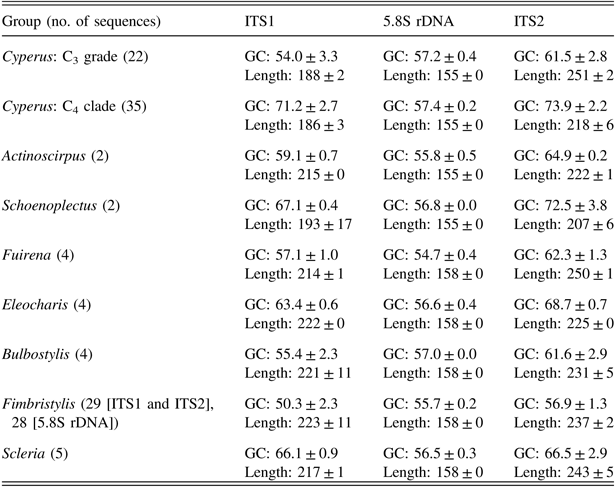
The 5.8S rDNA motifs M1 (CGATGAAGAACGTAGC), M2 (GAATTGCAGAATCC) and M3 (TTTGAAYGCA, whereby Y is represented by C in our sequences), which may serve to identify pseudogenes in angiosperms (Jobes & Thien, Reference Jobes and Thien1997; Harpke & Peterson, Reference Harpke and Peterson2008), are invariably present in all sequences. The conserved helices B4–B8 of angiosperm 5.8S rRNA are also present in all sequences (exemplified for Cyperus babakan in Appendix II; Harpke & Peterson, Reference Harpke and Peterson2008), the GC content of the 5.8S rDNA is rather uniform among all sequences (Appendix III), and there are no polymorphic sites in our 5.8S rRNA sequences. These results gave us no reasons to assume that non-functional gene copies (i.e. pseudogenes) were to be found among our sequences, so we were able to use all the sequences for phylogenetic analysis.
The GC content as well as the length of the sequences of ITS1 and ITS2 varies greatly among the genera (Appendix III). In ITS1, there was one polymorphic site with two nucleotide peaks in Bulbostylis barbata (Rottb.) C.B.Clarke (LS999524), one in Cyperus leptocarpus (F.Muell.) Bauters (LS999530), three in C. leucocephalus (LS999531), one in C. pumilus (LS999536), two in C. rotundus L. (LS999537) and one in each of two accessions of Fimbristylis quinquangularis (LS999551, LS999553). In ITS2, there were three such polymorphic sites in Bulbostylis barbata (LS999524), one in Cyperus leptocarpus (LS999530), one in C. leucocephalus (LS999531), three in C. rotundus (LS999537), one in Fimbristylis umbellaris (Lam.) Vahl (LS999556) and one in Scleria poiformis Retz. (LS999559). The infrequent occurrence of polymorphic sites suggests that the presence of paralogous variants is not common in the Cyperaceae genera studied (Nieto Feliner & Rosselló, Reference Nieto Feliner and RossellÓ2007).
Phylogenetic analysis
We provided new ITS sequences for the following species that have not previously been included in a molecular phylogenetic analysis: Cyperus babakan, C. leucocephalus, C. cf. paniceus, C. pulcherrimus, C. trialatus, Eleocharis koyamae, Fimbristylis hookeriana, F. insignis and Scleria levis Retz. The sequences of both accessions of Actinoscirpus grossus (L.f.) Goetgh. & D.A.Simpson (LS999522, LS999523) are identical, as are the sequences of both accessions of Cyperus diffusus Vahl (LS999526, LS999527), C. haspan L. (LS999528, LS999529), Fimbristylis cf. bisumbellata (LS999543, LS999544) and F. dichotoma (LS999545, LS999546). The sequences of the two accessions of Fimbristylis umbellaris (LS999555, LS999556) are almost identical.
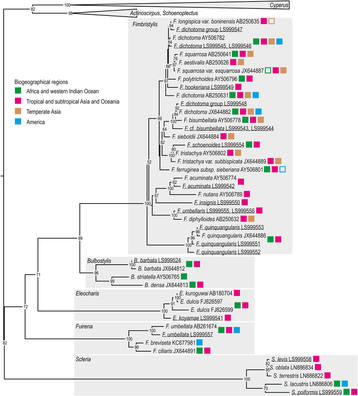
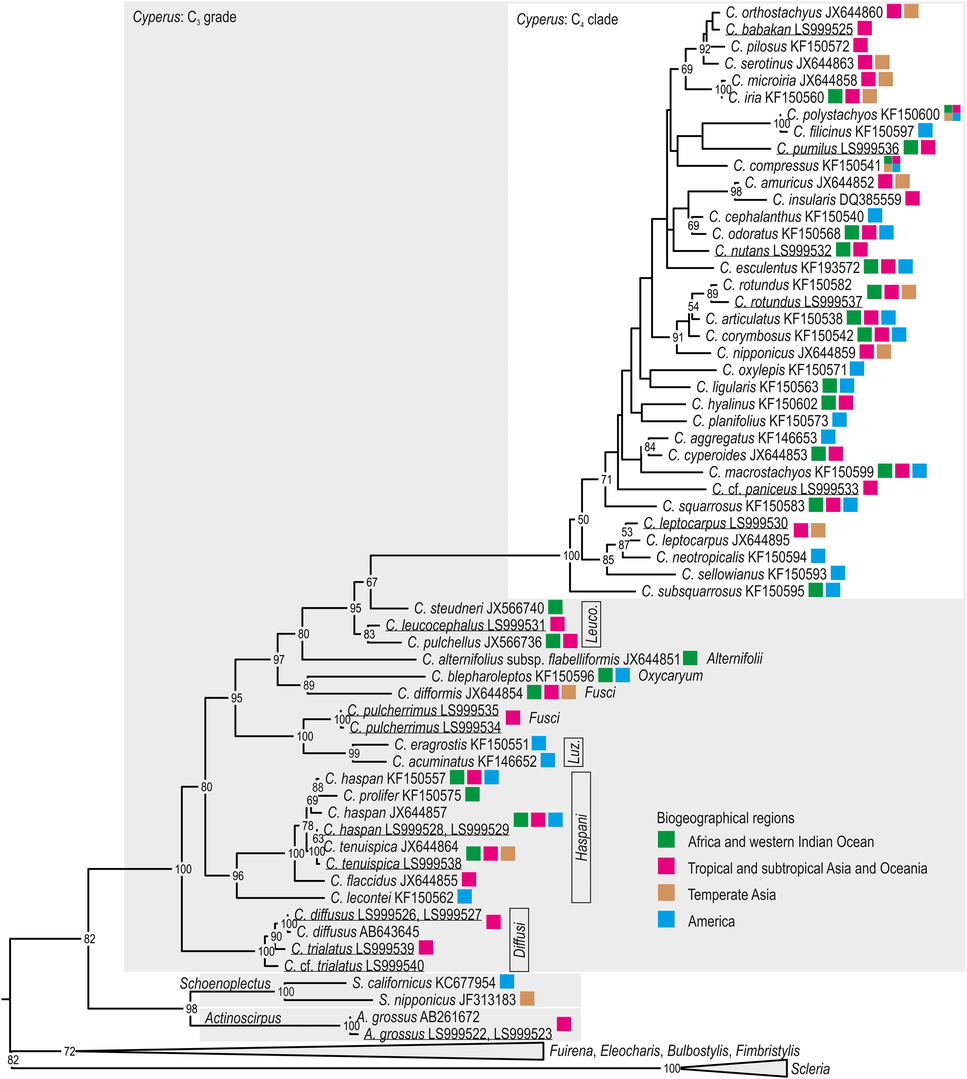
The MAFFT structure-based alignment of ITS sequences in conjunction with maximum likelihood phylogenetic estimation yielded a highly resolved phylogenetic tree (Figs 1, 2).
Midpoint-rooted best maximum likelihood tree of concatenated 18S rDNA (3′ end), internal transcribed spacer (ITS) 1, 5.8S rDNA, ITS2, and 26S rDNA (5′ end) sequences with individual GTR+G models of nucleotide substitution optimised for each partition. Node labels are bootstrap support values (1000 replicates). Only values ≥ 50 are shown. Newly provided sequences are underlined. Coloured boxes denote the main distribution of species in biogeographical regions. For subspecies or varieties, boxes for regions occupied by the species, but not the inferior taxon, are not filled. The clades comprising Actinoscirpus, Schoenoplectus and Cyperus are collapsed.


Discussion
Generic relationships
The order of appearance of the genera analysed on the phylogenetic tree reflects the order shown in Jung & Choi (Reference Jung and Choi2013), except for Scleria P.J.Bergius (tribe Sclerieae). As one of the early-diverged genera in subfamily Cyperoideae, it should be sister to the remaining genera we analysed, all of which belong to the FAEC clade consisting of four tribes (Fuireneae, Abildgaardieae, Eleocharideae and Cypereae). In our midpoint-rooted tree, however, Scleria is sister to Fuirena, Eleocharis, Bulbostylis and Fimbristylis but not to Actinoscirpus, Schoenoplectus or Cyperus. We suggest that this discrepancy results from the choice of molecular markers. Whereas the more slowly evolving rbcL and trnL–F used in addition to ITS by Jung & Choi (Reference Jung and Choi2013) would be better suited to resolving deeper phylogenetic relationships in the family, our phylogeny based on ITS would only be able to resolve species relationships within genera. However, deeper relationships, such as those among Scleria and the genera of the FAEC clade, might be distorted due to higher levels of homoplasy.
Tribe Fuireneae is split into four clades (Jung & Choi, Reference Jung and Choi2013), two of which are represented in our sample (the Fuirena Rottb. clade and the Actinoscirpus (Ohwi) R.W.Haines & Lye and Schoenoplectus (Rchb.) Palla clade). Eleocharideae (Eleocharis R.Br.) and Abildgaardieae (represented by Bulbostylis Kunth and Fimbristylis in our sample) are sister to each other, and together they are sister to Fuirena. The clade comprising Actinoscirpus, Schoenoplectus and Cypereae is characterised by a 3-bp deletion in the 5.8S rRNA gene (see also Yano et al., Reference Yano, Ikeda, Watson, Rajbhandari, Jin, Hoshino, Muasya and Ohba2012).
In the following, we discuss the phylogenetic placement and biogeographical relationships of the Cambodian taxa, with special emphasis on taxonomically unclear groups with need for further evaluation. The genera are discussed in the order in which they appear on the phylogenetic tree.
Scleria
Scleria is a pantropical genus, locally extending to warm temperate regions (Goetghebeur, Reference Goetghebeur and Kubitzki1998), with a presumed origin in South America (Spalink et al., Reference Spalink, Drew, Pace, Zaborsky, Starr, Cameron, Givnish and Sytsma2016). Our sequence of Scleria poiformis is almost identical to the sequence of the same species with the GenBank accession number LN886914 (Bauters et al., Reference Bauters, Asselman, Simpson, Muasya, Goetghebeur and Larridon2016), which was therefore not included in the analysis. Together with Scleria lacustris C.Wright, the species belongs to section Margaleia of subgenus Scleria. The hypothetical area of origin of this section is in Africa, where both species occur. The African origin is also supported by the sister group relationship of sections Margaleia and Acriulus of subgenus Scleria, as the basally branching species of section Acriulus are solely distributed in Africa (with one species also occurring in Madagascar; Bauters et al., Reference Bauters, Asselman, Simpson, Muasya, Goetghebeur and Larridon2016). We may thus hypothesise that Scleria poiformis expanded from Africa to tropical and subtropical Asia and Australia.
Scleria levis is nested within subgenus Scleria, section Elatae, as suggested by Bauters et al. (Reference Bauters, Asselman, Simpson, Muasya, Goetghebeur and Larridon2016) based on morphology. The species of this section occur in tropical and subtropical Asia and Oceania (with one species extending to the Seychelles), as does Scleria levis.
Fuirena
Fuirena occurs mostly in the tropics and subtropics, with the centre of diversity and presumed origin in Africa (Spalink et al., Reference Spalink, Drew, Pace, Zaborsky, Starr, Cameron, Givnish and Sytsma2016). Phylogenetic analysis revealed some sequence variation among the available sequences of Fuirena umbellata Rottb. (Hirahara et al., Reference Hirahara, Katsuyama and Hoshino2007; Jung & Choi, Reference Jung and Choi2013 [GenBank accession number JX644892, not included in analysis]), the only species in the genus with a worldwide tropical and subtropical distribution, and no close relatives. However, few species of this genus have yet been sequenced.
Eleocharis
Eleocharis is a cosmopolitan genus with a marked concentration of taxa in (sub)tropical America (Goetghebeur, Reference Goetghebeur and Kubitzki1998) and a presumed origin in North America (Spalink et al., Reference Spalink, Drew, Pace, Zaborsky, Starr, Cameron, Givnish and Sytsma2016). Eleocharis koyamae is closely related to E. dulcis (Burm.f.) Trin. ex Hensch. and belongs to the E. dulcis clade of Eleocharis subgenus Limnochloa (González-Elizondo & Peterson, Reference González-Elizondo and Peterson1997; Roalson & Friar, Reference Roalson and Friar2000; Yano et al., Reference Yano, Katsuyama, Tsubota and Hoshino2004; Hinchliff & Roalson, Reference Hinchliff and Roalson2009). Both species have round, transversely septate culms (Simpson & Koyama, Reference Simpson and Koyama1998). The distinguishing character is the shape of the glume apex. It is acute in Eleocharis koyamae versus obtuse to rounded-truncate in E. dulcis. The morphologically and genetically variable Eleocharis dulcis complex is distributed in the tropical and subtropical Old World. Eleocharis koyamae was thought to be endemic to Thailand (Simpson & Koyama, Reference Simpson and Koyama1998; Govaerts et al., Reference Govaerts, Koopman, Simpson, Goetghebeur, Wilson, Egorova and Bruhl2018) and is now also known from Cambodia. The species is distinct from Eleocharis dulcis and E. kuroguwai Ohwi in our tree, but sequencing of further individuals of the complex is necessary for a clearer picture.
Bulbostylis
Bulbostylis is distributed worldwide, mainly in the tropics and subtropics, with a primary centre of diversity and presumed origin in Africa and a secondary centre of diversity in America (Reutemann et al., Reference Reutemann, Ardissone, López, Muchut, Boldrini, Vegetti and Giussani2018). Only a few species occur in Asia. Based on the presently available sequences, phylogenetic analysis reveals an isolated, rather early-branching position within the genus and no close relatives of Bulbostylis barbata. This is one of the few species in the genus with a large, intercontinental distribution spanning tropical and subtropical Africa, Southeast Asia and Oceania.
Fimbristylis
In contrast to Bulbostylis, species of Fimbristylis are concentrated in the tropical and subtropical regions of Southeast Asia, Malesia and Northeast Australia (Goetghebeur, Reference Goetghebeur and Kubitzki1998). Some phylogenetic analyses have been undertaken (Yano & Hoshino, Reference Yano and Hoshino2006; Ghamkhar et al., Reference Ghamkhar, Marchant, Wilson and Bruhl2007; Jung & Choi, Reference Jung and Choi2013; Wangwasit et al., Reference Wangwasit, Muasya, Chantaranothai and Simpson2017), but a comprehensive phylogenetic study that could be used to test the sectional classification on morphological grounds proposed by Kern (Reference Kern and van Steenis1974) does not exist. The backbone of the phylogenetic tree of Fimbristylis is weakly resolved, which suggests a rapid radiation.
Sequence analysis revealed some variation among the Cambodian accessions of Fimbristylis quinquangularis. The Korean (GenBank accession number JX644886) and Japanese (AB250637; not shown) sequences are nested within the Cambodian sequences. The species has a wide distribution across tropical Africa, tropical and subtropical Asia, and Australia (Govaerts et al., Reference Govaerts, Koopman, Simpson, Goetghebeur, Wilson, Egorova and Bruhl2018). Phylogenetic analysis did not reveal any close relative. A relationship with Fimbristylis littoralis Gaudich. and some other species has been suggested based on morphology (section Miliaceae; Kern, Reference Kern and van Steenis1974) and combined ITS and plastid DNA sequences, but without bootstrap support (Jung & Choi, Reference Jung and Choi2013). Based on the sequences available to date, Fimbristylis quinquangularis thus appears to be a rather isolated early-diverged species within the genus.
The Cambodian sequences of Fimbristylis umbellaris (also section Miliaceae; Kern, Reference Kern and van Steenis1974) are related to the available sequence of F. umbellaris with the GenBank accession number JX644885 (not used in our analysis), which is almost identical to sequences of F. diphylloides Makino (JX644883 [not used] and AB250632). The two species are closely related (Jung & Choi, Reference Jung and Choi2013). Fimbristylis umbellaris is a perennial occurring in tropical and subtropical Asia and Oceania, whereas F. diphylloides is an annual or short-lived perennial occurring in more temperate regions of eastern Asia (southern and eastern China, southern Korea, and central and southern Japan; Lunkai et al., Reference Lunkai, Songyun, Shuren, Yancheng, Koyama, Tucker, Simpson, Noltie, Strong, Bruhl, Wilson, Muasya, Wu, Raven and Hong2010; Govaerts et al., Reference Govaerts, Koopman, Simpson, Goetghebeur, Wilson, Egorova and Bruhl2018).
Phylogenetic analysis did not conclusively support any close relative of Fimbristylis insignis, a species with a wide distribution in tropical and subtropical Asia and Oceania (section Cymosae; Kern, Reference Kern and van Steenis1974), among the sequences available to date.
The Cambodian sequence of Fimbristylis acuminata groups with the available sequence from Australia (AY506774), but with some sequence divergence. The species is related to Fimbristylis nutans (Retz.) Vahl (Ghamkhar et al., Reference Ghamkhar, Marchant, Wilson and Bruhl2007), as also suggested by morphology (section Nutantes; Kern, Reference Kern and van Steenis1974). Both species are widely distributed across tropical and subtropical Asia and Oceania.
The remaining taxa analysed in this study form a well-supported group. Fimbristylis schoenoides is related to F. tristachya R.Br., as also suggested by morphology (section Dichelostylis; Kern, Reference Kern and van Steenis1974; Simpson & Koyama, Reference Simpson and Koyama1998). The two species co-occur in tropical and subtropical Asia and Oceania, but Fimbristylis schoenoides extends its range to tropical Africa and F. tristachya to temperate regions of eastern Asia.
Two sequences (LS999543, LS999544) have been tentatively assigned to Fimbristylis bisumbellata, which is, however, difficult to differentiate from F. merrillii J.Kern. These Cambodian sequences are related to Fimbristylis bisumbellata (AY506778), a widespread species in tropical to warm temperate regions of the Old World (Simpson & Koyama, Reference Simpson and Koyama1998). They also group with sequences assigned to the complex of Fimbristylis dichotoma (JX644882, LS999548), which resembles F. bisumbellata morphologically (section Fimbristylis; Kern, Reference Kern and van Steenis1974). Other sequences of the Fimbristylis dichotoma complex (AB250631, AY506782, LS999545–LS999547), however, appear in a different but likewise well-supported group. Fimbristylis dichotoma is distributed in tropical to warm temperate regions worldwide (Simpson & Koyama, Reference Simpson and Koyama1998). Further investigations are necessary to unravel the cryptic variation in this complex, which is known for its wide range of morphological variation and taxonomic difficulty (Kern, Reference Kern and van Steenis1974; Yano & Hoshino, Reference Yano and Hoshino2006; Yarrayya & Ratna Kumar, Reference Yarrayya and Ratna Kumar2018). Fimbristylis hookeriana, a species distributed from Assam to Southwest Korea (Govaerts et al., Reference Govaerts, Koopman, Simpson, Goetghebeur, Wilson, Egorova and Bruhl2018), is also part of the group containing some sequences of the F. dichotoma complex as well as sequences of other species which all occur in Southeast Asia and partly extend to Africa or temperate Asia (e.g. F. polytrichoides and F. squarrosa).
Actinoscirpus
Actinoscirpus is a monotypic genus related to Schoenoplectus (Shiels et al., Reference Shiels, Hurlbut, Lichtenwald and Monfils2014). Whereas Schoenoplectus is cosmopolitan, Actinoscirpus grossus occurs from tropical and subtropical Asia to North Australia (Govaerts et al., Reference Govaerts, Koopman, Simpson, Goetghebeur, Wilson, Egorova and Bruhl2018).
Cyperus
This genus occurs worldwide from tropical to temperate regions, with a concentration of species and presumed origin in tropical Africa (Goetghebeur, Reference Goetghebeur and Kubitzki1998; Spalink et al., Reference Spalink, Drew, Pace, Zaborsky, Starr, Cameron, Givnish and Sytsma2016). Our results corroborate recent phylogenetic analyses, which show that the C4 clade (corresponding to subgenus Cyperus) is derived from the C3 species that branch off basally within the genus (C3 grade corresponding to subgenus Anosporum; Besnard et al., Reference Besnard, Muasya, Russier, Roalson, Salamin and Christin2009; Larridon et al., Reference Larridon, Reynders, Huygh, Bauters, Van de Putte, Muasya, Boeckx, Simpson, Vrijdaghs and Goetghebeur2011a, Reference Larridon, Reynders, Huygh, Bauters, Vrijdaghs, Leroux, Muasya, Simpson and Goetghebeur2011b, Reference Larridon, Bauters, Reynders, Huygh, Muasya, Simpson and Goetghebeur2013; Jung et al., Reference Jung, Ryu and Choi2016).
Among the C3 species, Cyperus trialatus and C. diffusus resemble each other morphologically (Simpson & Koyama, Reference Simpson and Koyama1998 [In the Flora of Thailand, C. diffusus is treated as a synonym of C. laxus Lam.]; Lunkai et al., Reference Lunkai, Songyun, Shuren, Yancheng, Koyama, Tucker, Simpson, Noltie, Strong, Bruhl, Wilson, Muasya, Wu, Raven and Hong2010). They are also closely related in the phylogenetic analysis. Both species belong to section Diffusi (Larridon et al., Reference Larridon, Reynders, Huygh, Bauters, Van de Putte, Muasya, Boeckx, Simpson, Vrijdaghs and Goetghebeur2011a), which is distributed across (sub)tropical regions in Africa, America and Asia. Cyperus diffusus grows in tropical and subtropical Asia and Oceania. Cyperus trialatus occurs sympatrically but has a narrower distribution from Southeast China to West Malesia. A comprehensive sampling of species in the section is needed to infer biogeographical relationships among the species.
Cyperus haspan and C. tenuispica are similar morphologically. Cyperus haspan may form creeping rhizomes so that the culms may be tufted or scattered, whereas the culms of C. tenuispica are always tufted (Goetghebeur, Reference Goetghebeur and Kubitzki1998; Simpson & Koyama, Reference Simpson and Koyama1998; Lunkai et al., Reference Lunkai, Songyun, Shuren, Yancheng, Koyama, Tucker, Simpson, Noltie, Strong, Bruhl, Wilson, Muasya, Wu, Raven and Hong2010). Both species belong to section Haspani (Larridon et al., Reference Larridon, Reynders, Huygh, Bauters, Van de Putte, Muasya, Boeckx, Simpson, Vrijdaghs and Goetghebeur2011a), which inhabits (sub)tropical regions in Africa, America and Asia, as does section Diffusi. The greatest concentration of species of section Haspani is in Africa. Cyperus haspan is widely distributed across tropical and subtropical regions worldwide. Cyperus tenuispica also occupies a large and mostly sympatric range but is absent from the New World and extends to more temperate regions in Asia. The phylogenetic analysis reveals that Cyperus haspan is paraphyletic with respect to C. tenuispica and C. prolifer Lam. The African Cyperus prolifer appears to be derived from C. haspan. A re-evaluation of specific limits based on morphological and molecular characters seems to be needed especially for the highly similar Cyperus haspan and C. tenuispica. The ITS sequences also suggest that the Australian Cyperus flaccidus R.Br. should be transferred from section Graciles (Larridon et al., Reference Larridon, Reynders, Huygh, Bauters, Van de Putte, Muasya, Boeckx, Simpson, Vrijdaghs and Goetghebeur2011a) to section Haspani (see also Jung & Choi, Reference Jung and Choi2013; Reid et al., Reference Reid, Carter and Urbatsch2014). As for section Diffusi, more comprehensive sampling is needed to resolve species limits and biogeographical relationships in section Haspani.
Interestingly, Cyperus pulcherrimus from tropical Asia and Oceania is more closely related to species of section Luzuloidei (represented here by C. acuminatus Torr. & Hook. and C. eragrostis Lam.; all species of the section occur in America) than to species of sections Fusci (represented here by C. difformis L.), in which it is placed on morphological grounds, or Oxycaryum (represented here by C. blepharoleptos Steud.; Larridon et al., Reference Larridon, Reynders, Huygh, Bauters, Van de Putte, Muasya, Boeckx, Simpson, Vrijdaghs and Goetghebeur2011a; Reid et al., Reference Reid, Carter and Urbatsch2014), apparently suggesting long-distance dispersals from the presumed African area of origin (Spalink et al., Reference Spalink, Drew, Pace, Zaborsky, Starr, Cameron, Givnish and Sytsma2016).
Internal transcribed spacer analysis confirms the close relationship of Cyperus leucocephalus and C. pulchellus R.Br., which are both placed in section Leucocephali (Larridon et al., Reference Larridon, Reynders, Huygh, Bauters, Van de Putte, Muasya, Boeckx, Simpson, Vrijdaghs and Goetghebeur2011a). The section occurs with a few species across tropical regions in Africa, Asia and America. Cyperus leucocephalus (Indian Subcontinent to Indochina) and C. pulchellus (Africa, Malesia and Australia) are the only members of the section occurring in Southeast Asia.
Among the C3 Cyperus, section Leucocephali sensu Larridon et al. (Reference Larridon, Reynders, Huygh, Bauters, Vrijdaghs, Leroux, Muasya, Simpson and Goetghebeur2011b), i.e. including Kyllingiella R.W.Haines & Lye (represented here by C. steudneri (Boeckeler) Larridon) is closest to the C4 clade (Larridon et al., Reference Larridon, Reynders, Huygh, Bauters, Van de Putte, Muasya, Boeckx, Simpson, Vrijdaghs and Goetghebeur2011a; Muasya et al., Reference Muasya, Viljoen, Dludlu and Demissew2014). Based on the distribution of species, Larridon et al. (Reference Larridon, Bauters, Reynders, Huygh, Muasya, Simpson and Goetghebeur2013) supposed that the C4 species originated in East Africa. Basal relationships among C4 Cyperus are poorly resolved, largely impeding a sectional classification (Larridon et al., Reference Larridon, Reynders, Huygh, Bauters, Vrijdaghs, Leroux, Muasya, Simpson and Goetghebeur2011b, Reference Larridon, Bauters, Reynders, Huygh, Muasya, Simpson and Goetghebeur2013; Reid et al., Reference Reid, Carter and Urbatsch2014). Nevertheless, some species show strong relationships.
Our sequence of Cyperus leptocarpus groups with the GenBank sequence of the same species (accession number JX644895). This plant from Asia and Oceania is related to species from Africa and America represented here by Cyperus neotropicalis Alain (Bauters et al., Reference Bauters, Larridon, Reynders, Asselman, Vrijdaghs, Muasya, Simpson and Goetghebeur2014).
Cyperus paniceus is morphologically similar to C. cyperinus (Retz.) Valck.Sur. and C. cyperoides (L.) Kuntze (Simpson & Koyama, Reference Simpson and Koyama1998). These species often cannot be distinguished easily (Prasad & Singh, Reference Prasad and Singh2002). Cyperus cyperoides is widely distributed across Africa, Asia and Oceania, and C. cyperinus across Asia and Oceania. Cyperus paniceus has a narrower distribution from the Indian subcontinent to Indochina (Govaerts et al., Reference Govaerts, Koopman, Simpson, Goetghebeur, Wilson, Egorova and Bruhl2018), but all three species occur sympatrically in Indochina. Our sample is probably Cyperus paniceus and is clearly distinct from C. cyperoides in the ITS tree. For Cyperus cyperinus, no sequence is available to date. A thorough revision of these variable and often-mistaken species is needed (Bryson & Carter, Reference Bryson, Carter, Naczi and Ford2008).
Cyperus rotundus is also a variable species (Bryson & Carter, Reference Bryson, Carter, Naczi and Ford2008). Our sequence groups with the available sequence of the same species (accession number KF150582). It is related to the pantropical species Cyperus articulatus L. and C. corymbosus Rottb. (Reid et al., Reference Reid, Carter and Urbatsch2014).
Our sequence of Cyperus nutans Vahl from Africa, Asia and Oceania is not resolved close to any of the available sequences.
No close relative of Cyperus pumilus was detected among the available sequences. It occurs in tropical and subtropical Africa, Asia and Oceania and belongs to the ‘basal Pycreus lineages’ represented here by Cyperus macrostachyos Lam., C. filicinus Vahl and C. polystachyos Rottb. (Larridon et al., Reference Larridon, Bauters, Reynders, Huygh, Muasya, Simpson and Goetghebeur2013).
Cyperus babakan occurs from Southeast Tibet to New Guinea and is closely related to C. orthostachyus Franch. & Sav., C. pilosus Vahl, which it resembles morphologically, and C. serotinus Rottb. These species are centred in Southeast Asia, from where they extend to other regions. Cyperus orthostachyus occurs from temperate Asia to Vietnam, C. pilosus from tropical and subtropical Asia to East Australia, and C. serotinus from temperate Eurasia to Indochina (Govaerts et al., Reference Govaerts, Koopman, Simpson, Goetghebeur, Wilson, Egorova and Bruhl2018).
Conclusions
More work is necessary to resolve the phylogeny and taxonomy of Cyperaceae of mainland Southeast Asia, as there are still many species from this region that have not yet been sequenced. A detailed phylogenetic analysis based on comprehensive sampling of species across their ranges and the use of additional, highly resolving markers in combination with a re-evaluation of morphological characters is necessary for species delimitation in some variable species groups (e.g. Fimbristylis dichotoma and Cyperus haspan). Several groups have supposedly speciated in Southeast or East Asia (e.g. Fimbristylis schoenoides and F. tristachya, Cyperus diffusus and C. trialatus, as well as C. babakan, C. orthostachyus, C. pilosus and C. serotinus). Some supposed speciation events included range extension from tropical to temperate Asia (e.g. in Fimbristylis umbellaris and F. diphylloides). Many species or species groups, however, have large intercontinental distributions, which relates to their high dispersal ability (Kern, Reference Kern and van Steenis1974; Goetghebeur, Reference Goetghebeur and Kubitzki1998; Bryson & Carter, Reference Bryson, Carter, Naczi and Ford2008; Viljoen et al., Reference Viljoen, Muasya, Barrett, Bruhl, Gibbs, Slingsby, Wilson and Verboom2013).
Acknowledgements
This research received support from the SYNTHESYS Project GB-TAF-3017 (http://www.synthesys.info/), which was financed by the European Community Research Infrastructure Action under the FP7 ‘Capacities’ Programme, and from the University of Natural Resources and Life Sciences, Vienna. We thank Michaela M. Wernisch for collecting with us in Cambodia, Karin Fohringer and Gudrun Kohl for work in the laboratory, Rafaël Govaerts (Royal Botanic Gardens, Kew) for nomenclatural advice, and two reviewers for constructive comments.
Appendix I Sequences downloaded from GenBank
Appendix table 1 shows the taxon names of the sequences downloaded from the National Center for Biotechnology Information GenBank for phylogenetic analysis in the present study. The names have been determined according to the World Checklist of Cyperaceae (Govaerts et al., Reference Govaerts, Koopman, Simpson, Goetghebeur, Wilson, Egorova and Bruhl2018).
Taxon names of sequences downloaded from Genbank for phylogenetic analysis in the present study

Appendix II 5.8S rRNA secondary structure of Cyperus babakan (LS999525)
The conserved helices B4–B8 (highlighted in grey in Appendix figure 1) were identified according to Harpke & Peterson (Reference Harpke and Peterson2008). The constraints used as input for the RNA-folding form of the mfold version 4.7 web server (Zuker, Reference Zuker2003) are denoted.
Model of the 5.8S rRNA secondary structure of Cyperus babakan (LS999525).

Appendix III GC content of sequences used
Appendix table 2 shows the GC content of the sequences used for phylogenetic analysis in the present study (Figs 1, 2).
GC content in percentage and length in bases (mean and standard deviation) of sequences used for phylogenetic analysis in the present study

ITS, internal transcribed spacer.