The medium is the space
In 1967 Marshall McLuhan wrote: ‘The medium is the message’, meaning that when a new medium appears – such as cinema, television, or the internet today – it borrows the language of the media from which it comes at before developing its own language. For example, in the beginning, cinema was essentially filmed theatre. The camera was fixed and the actors appeared on the screen from the left or the right, as though they were on a stage. There were no crane shots, or close-ups, and so on. Yet, progressively, cinema developed its own language, including the aforementioned shots, editing techniques, and camera movements. And if this new language was partly borrowed from the theatre, photography and literature, some elements were exclusive to cinema. The medium became the message. The question today is: what characteristics are specific to electroacoustic music? First, let us note that electroacoustic music is a media art much more so than a performance art such as instrumental music. This distinction plays an important part in specifying the medium of electroacoustic music. With its introduction in 1948, a form of music existed that, for the first time in history, did not need to be played by a live performer. Furthermore, there was the possibility for this new medium to introduce space as a musical parameter that could be used side by side with other musical parameters such as pitch, rhythm and duration.
1. The space of the sound
There are a few examples in history where composers have taken the notion of space into account. One can think of the music of Giovanni Gabrieli (c. 1557–1612) who used ‘stereo’ choirs in St Mark’s Basilica in Venice, or Hector Berlioz (1803–69) whose Requiem, created for Les Invalides in Paris, used distance effects with various wind instruments. However, their music was rarely determined by this spatial parameter. The space had been added afterwards, like an effect: sometimes spectacular, but rarely essential. Stereo listening, even with mono recordings, doesn’t change the musical value, whereas in some acousmatic music this idea has been developed to such an extent that the work loses interest when removed from its original context in space.
1.1. Internal space, external space
There are two types of space in acousmatic music: the internal space – put in the work by the composer – and the external one – added by the concert hall (Chion Reference Chion1988). The first is fixed and is part of the work on the same basis than the other musical parameters. The second is variable, changing according to the differences in hall and speaker configurations.
1.2. Invariable space
Yet, one can imagine that there exists in some works an invariable space where internal and external space are fixed in a standardised relationship, like in cinema with image and Dolby Surround sound. The idea behind this standardisation would be to minimise the role of a hall’s acoustics in a concert situation.
2. Multichannel composition
In 1990, the tools in my studio looked like this: a computer (a Mac Plus with 1 Mb of RAM with one of the first MIDI sequencers: Master Tracks Pro), a sampler (an Akai S-1000: the first stereo CD-quality sampler with eight outputs and 2 Mb of RAM!), and an analogue 16-track tape recorder (Fostex) on  inch with Dolby S. These tools were quite simple and the constraints that came with them implied two things for someone who was interested in composing multichannel works. Firstly, because this was before digital audio became affordable, there was only a small amount of memory available in samplers, so composers had no other option but to compose with sound objects of short duration. Secondly, these constraints had an effect on the relationship between the recorded material on tape and what was spatialised in concert. I was trying then to reach a point where the mix of the work was created in the computer and then recorded on the multitrack tape to be played in concert as it was. Consequently, the final result of the cumulated tracks – recorded two at a time – was really known only at the end of the process. But it was so precise that the computer kept the traces of every single gesture made by the composer, while in the past only the sounds or the mixes were kept on tape. In the analogue days, there was no way to record the movement of a fader or a rotary button. The recording of these gestures made by the composers was then a major change in the way they figured their relationship with sound material.
The push towards creating multichannel works is directly related to two main ideas. The first argues that if a speaker is sent a less complex sound, it is able to represent that sound with better accuracy and clarity. Thus, by dividing music into different layers and directing those layers to different loudspeakers, the result is much clearer than if you were to multiply a stereo signal over a group of speakers – even if all the speakers are placed side by side on a stage.
The second concept behind multichannel diffusion arises out of the ability of human ears (like all mammals’ ears) to localise sound in space with great accuracy. Thus, music spatialised over a group of speakers placed throughout a hall allows the listener to better hear the polyphony of the music: each layer arriving to the listener from a different location in space.
I started to compose multichannel works in 1990 with my first 16-track piece entitled Bédé (Normandeau Reference Normandeau1994). It was presented during the Canadian Electroacoustic Community conference >>PERSPECTIVES>> in 1991. This first piece was followed by a number of compositions that used multichannel sound diffusion in a one-to-one relationship: one track assigned to one speaker. Amongst those are works such as Éclats de voix (1991), Tangram (1992), Spleen (1993) (Normandeau Reference Normandeau1994), Le renard et la rose (1995) (Normandeau Reference Normandeau1999) and Clair de terre (1999) (Normandeau Reference Normandeau2001).
3. Timbre Spatialisation
With instrumental music in the 1960s, composers explored spatialisation, creating works that assigned performers to different locations in the concert hall (such as Stockhausen’s Gruppen or Carré). However, these works are limited to the timbre of the instruments: the violin on the left side will always sound like a violin on the left. The sound and the projection source are linked together. What is specific to the acousmatic medium is its virtuality: the sound and the projection source are not linked.
A speaker can project any kind of timbre. Furthermore, today, with the appropriate software, all these sounds can be located at any point between any group of speakers. What is unique in electroacoustic music is the possibility to fragment sound spectra amongst a network of speakers. When a violin is played, the entire spectrum of the instrument sounds, whereas with multichannel electroacoustic music timbre can be distributed over all virtual points available in the defined space.
This is what I call timbre spatialisation: the entire spectrum of a sound is recombined only virtually in the space of the concert hall. Each point represents only a part of the ensemble. It is not a conception of space that is added at the end of the composition process – an approach frequently seen, especially today with multitrack software – but a truly composed spatialisation. It is a musical parameter that is exclusive to acousmatic music.
4. A cycle of works
In the movement of Clair de terre (1999) entitled ‘Couleurs primaires et secondaires’ (Primary and Secondary Colours), I had the idea to divide the timbre of a group of transformed sounds of a Balinese gamelan into different registers and to send these different registers to different speakers. It was only a short movement (2′54″) of a large work (36′), but I had the feeling that this way of spatialising the sound was quite novel at the time. I decided then to push my music a little bit further in that direction.
4.1. StrinGDberg
StrinGDberg (2001–03; 18′) is a work commissioned by the Groupe de Recherches Musicales in Paris in 2001. The third and final version was completed in 2003 (Normandeau Reference Normandeau2005).
StrinG refers to the only sound sources of the piece – a hurdy-gurdy and a cello – both string instruments. StrinDberg refers to the origin of the piece. It was made for Miss Julie, a theatre play by August Strindberg with stage direction by Brigitte Haentjens, presented in Montreal in 2001.
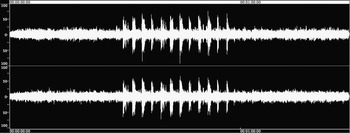
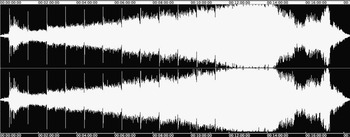
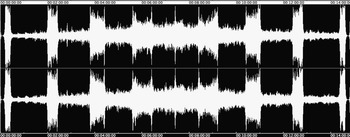
The two instruments used in the work represent two eras in instrument design and suggest differences in social class: the first belongs to a period where the sonorities were rude and closer to the people; the second evokes the refinement of the aristocracy. The piece is constructed using two superimposed layers. The first layer is composed of a single recording of an improvisation on the hurdy-gurdy that lasts about a minute. Stretched, filtered and layered, the sound of the hurdy-gurdy, distributed in a multiphonic space, is revealed, layer by layer, over the length of the piece (figure 1). A second layer, made from sounds of the cello, adds rhythm to the work, as well as a strong dramatic quality at the end.
The original recording of the hurdy-gurdy for StrinGDberg.

Using the hurdy-gurdy, the player improvised a three-part sequence: improvisation 1, melody and improvisation 2. I primarily used the middle part to compose the work. Out of the middle part of this improvisation, I kept the twelve ‘consonants’ – the attacks of the notes – and the twelve ‘vowels’ – the sustained parts between the attacks.
Both the consonants and vowels were then ‘frozen’. All 24 were filtered by four dynamic band pass filters, the parameters of which changed over sections and time. The opening of each filter increased over the duration of the work and the centre frequency changed constantly. That means that the sound was globally filtered at the beginning of the work and it ended up at a point where the entire spectrum was unfiltered.
In StrinGDberg, the form, duration, rhythms and proportions were derived from the original improvised melody (figure 2). All the sound files for the work were created and organised with multichannel diffusion in mind. This is another defining characteristic of what I call ‘spectral diffusion’ or ‘timbre spatialisation’. The different filtered bands are assigned to different loudspeakers: 16 in the original version. The final mix is then formed in the concert hall and in different ways for every listener. It solves the balance problems caused by the proximity of the listener to a specific speaker because the sounds are constantly changing and evolving in each speaker.
The general structure of StrinGDberg.

In an ideal situation, the piece is not presented in a conventional concert hall, but in a huge space where people can walk about during the concert. It is not an installation – the piece has to be listened to in its entirety – but it is a deep listening experience that allows the audience to move into the sound and to experience their own body completely immersed in the sound.
4.2 Éden
Éden (2003; 16′) is a work commissioned by the Groupe de Musique Expérimentale de Marseille in 2003 (Normandeau Reference Normandeau2005). It is based on music I composed for the play L’Éden cinéma by Marguerite Duras (actually, both the concert piece and the stage music were composed in parallel). In the concert version, the music represents the different aspects of the sonic universe of the play: Vietnam, where Marguerite Duras was born and where she lived up to her teenage years, the Éden cinema’s piano, the sea, the sound of Chinese balls, the omnipresence of the rhythm, the journey and the voice of a Laotian singer, used in Marguerite Duras’ film India Song.
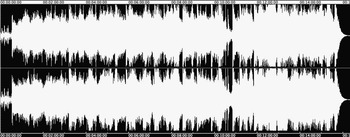
Contrary to StrinGDberg, where there is a progression in the integrity of the spectrum over time, in Éden, a progression is constructed through the rhythms and the density of the information (figure 3). The general amplitude of the work stays the same over time. The general form is based on the contraction/expansion of time around a point two-thirds of the way through the work. Similar to StrinGDberg, every sound file is filtered by four different band pass filters assigned to different loudspeakers. The central difference is that in Éden there are many different timbres that are superimposed, one on top of the other, and there is no progression over time – the entire spectrum is always present. Only the ‘inner’ nature of the sounds, the microvariations, change over time.
The general structure of Éden.

4.3. Palindrome
Palindrome (2006–09; 15′) is a work commissioned by the Institut de Musique Electroacoustique de Bourges in 2006. A palindrome is a succession of graphical signs (letters, numbers, symbols…) that can be read from left to right as well as from right to left.
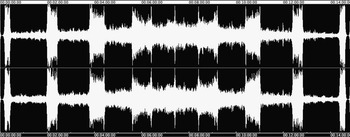
In this work, the palindrome exists in both the form of the piece and the sound material itself. Along with these elements, everything else was made in such a way that the listening experience would be the same in both directions, including the channels of the stereo files, the structure of the 24-track spatialisation, the levels of the different curves of the mix, and the musical phrases (figures 4 and 5).
Palindrome, the forward version.

Palindrome, the backward version.

The form is identical and symmetrical in both directions, and it is made from two mixes of the same 96 tracks whose ‘weight’, instead of the exact inversion, is the same from the beginning to the end and vice versa. The only difference between the two mixes, introduced for musical reasons, is that the first mix is a decrescendo that begins with a tutti which is gradually filtered to the high-frequency register, while the second mix is a crescendo that begins with the low-frequency register gradually increased to a tutti. One can consider this as a vertical palindrome!
In this work, the timbre spatialisation is made up of two elements that coexist. The first is a group of sound material that is equally distributed amongst the speakers without any filtering. The second is a group filtered with four band-pass filters, like in previous works, but with one difference: there is no evolution in the width of the filter, nor in the movement of the central frequencies over time. What changes over time is the mixing of these elements, from the low-frequency content at the beginning up to a tutti at the end in the first mix, and from the tutti to the high-frequency content at the end for the second mix.
5. Spatialisation on a dome of speakers, a little bit of history
5.1. Philips Pavilion, Brussels International Exhibition 1958 (Belgium)
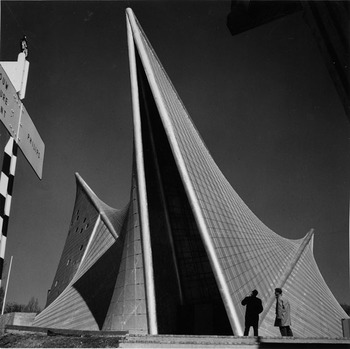
Varèse and Xenakis created an environment incorporating 350 speakers, including 25 subwoofers, for the Brussels International Exhibition in 1958 (Meyer Reference Meyer2007; figure 6).
Philips Pavilion, Brussels 1958. Image thanks to Philips Archives. Courtesy Electronic Music Foundation.

The audio component was to be a demonstration of the effects of stereophony, reverberation, and echo. Sounds were meant to appear to move in space around the audience. Varèse was finally able to realise the movement of sounds through space from different directions. The audio tape consisted of three tracks, to give the illusion of three simultaneous sound sources that could be moving around the space. There were 350 speakers in 20 amplifier combinations (six amplifiers assigned to track one, eight assigned to track two, and six assigned to track three). A fifteen track control tape sent signals to the projectors and amplifiers. A series of ‘sound routes’ were conceived so that the sounds could appear to move through the space from different directions. These were realised by designing an amplifier that would ‘span’ a group of speakers, iterating through them five speakers at a time. For example, a sound path might move through the space of speakers 121 to 145. The sound would come first from speakers 121–125, then 122–126, then 123–127, and so on. This was one of the most elaborate site-specific projects ever created. The sound was written for the space and vice versa. The quick crescendos and abrupt silences were calculated to exploit the reverberation of the space. (Meyer Reference Meyer2009)
Recent research conducted by Kees Tazelaar (Institute of Sonology, Den Haag Conservatory, Holland) and presented in Berlin in 2006 demonstrates that the original version of the work is 5 tracks but, for technical reasons, it was not possible to play it under this format at the time of creation. With 25 subwoofers it was the first 5.1 system!
5.2. Osaka International Exhibition (Japan)
In 1970, Karlheinz Stockhausen created a sphere of 50 groups of speakers on seven levels, including one below the audience (figure 7).
For the 1970 World Expo in Osaka in 1970, Germany built the world’s first, and so far only, spherical concert hall. It was based on artistic concepts by Karlheinz Stockhausen and an audio-technical concept from the Electronic Studio at the Technical University in Berlin. The audience sat on a sound-permeable grid just below the centre of the sphere, 50 groups of loudspeakers arranged all around reproduced, fully in three dimensions, electro-acoustic sound compositions that had been specially commissioned or adapted for this unique space. Works by composers including Bernd Alois Zimmermann and Boris Blacher were played from the multi-track tape, along with Bach and Beethoven. (Föllmer Reference Föllmer2009)
5.3. Sound Cupolas Roma
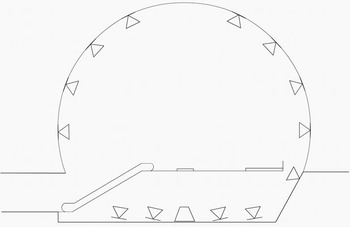
The Belgian composer Leo Kupper designed three Sound Cupolas between 1977 and 1984 (1977, 72 speakers, Rome [figure 8]; 1979, 62 speakers, Avignon; 1984, 104 speakers, Linz). The idea was to design a sound diffusion system that is ‘no more dependable from a traditional room form (classical rooms for traditional music)’ (Kupper Reference Kupper1988). These projects were also about the specificity of the space parameter in musical writing. As he explained, ‘The space parameter is no more an effect in pitch music, but pitch is only an effect in space music. Space as a finality in music expression.’
Osaka Pavilion, 1970.

5.4. SARC, Belfast (Northern Ireland)
The Sonic Lab, Sonic Arts Research Centre, Queen’s University, Belfast (figure 9), was created in 2004, with 40 speakers on four levels including one below the audience (SARC 2009). Unlike the first three examples above, which were temporary installations, Sonic Lab is a permanent space. Thus, it could be considered the first permanent hemispheric sound hall. One of the main design characteristics of the space, borrowed from the Osaka Pavilion, is the ‘transparent’ floor, below which speakers are located, giving the listeners the feeling that sounds are coming from everywhere.
Sound Cupola, Rome 1977.

5.5. Zentrum für Kunst und Medientechnologie, Karlsruhe (Germany), Klangdom
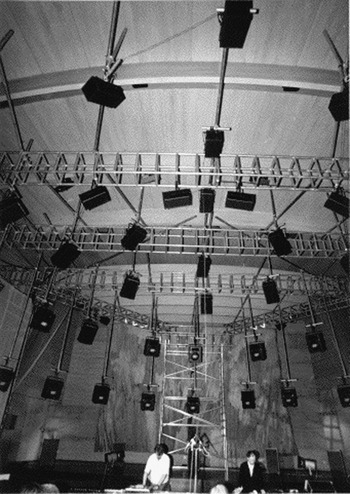
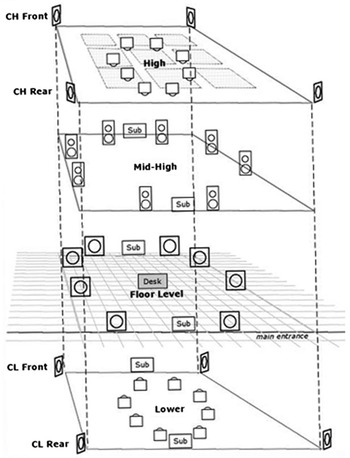
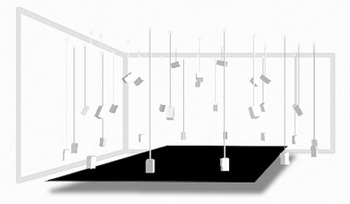
In Karsruhe, a dome of 43 speakers (figure 10) was built in 2006 (ZKM 2009). The dome is virtual in the sense that there is no real concrete structure supporting the form of a dome. Speakers are hung to create a form that represents the way sounds are generated in our natural environment. The real novelty here is not the dome itself, which has adopted the same shape found in Kupper’s Cupolas, but their development of software, Zirkonium, to manage the space (Ramakrishnan, Goßmann and Brümmer Reference Ramakrishnan, Goßmann and Brümmer2006). In creating a hardware/software combination, they have laid a foundation that promotes the flourishing of long-term relationships between perceptual researchers and composers.
SARC, Sonic Lab, Belfast 2004.

5.6. Université de Montréal (Québec)
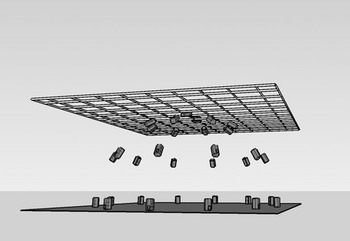
The dome at Université de Montréal is based on the one in Karlsruhe and those built by Kupper. It is constructed using of 32 speakers hung from a scaffold with four subwoofers (not shown in figure 11). Contrary to the previous systems, the speakers used are exactly the same, ensuring that sound perception is not tainted by the different colours introduced by different brands or models of speakers. The dome was built in 2008.
Schematic representation of the Klangdom in Karlsruhe.

Schematic representation of the dome of speakers, Université de Montréal

6. Composing for a dome of speakers
6.1. Kuppel
Kuppel (2006–09; 17′) is a work commissioned by the ZKM in Karlsruhe in 2006. The work was composed specially for the dome of 43 speakers installed in the Kubus of the ZKM. It is made of 26 audio tracks – 3 groups of 8 tracks and a stereo track.
In Kuppel, there was a major change in the way I considered the sound spatialisation. Because they made the decision to build a dome of speakers – probably the best way to represent the sounds that surround us – and also because they made the effort to design software to control spatialisation amongst the speakers – Zirkonium, coded by Chandrasekhar Ramakrishnan – it was suddenly possible to imagine a different perspective in the relationship between the audio tracks and the speakers.
Up to that point, a one-to-one relationship was used in my works, which means one track was assigned to one speaker. But with Zirkonium, which is a Vector Base Amplitude Panning based software (Pulkki Reference Pulkki1997), there is no need to lock a track to a speaker. Every point is spatialised in the space on the surface of the dome with the help of three speakers. Thus the spatialisation is virtual, and if the speaker setup is done properly (and it is certainly done properly in the Kubus!), the listeners don’t feel the presence of the speakers, only the presence of the sound.
I had the chance to work on different projects at the ZKM in the autumn of 2004 when Zirkonium development was in its initial stage. As a result, I had the opportunity to work a bit with the team and to make some suggestions about which directions the software could take in order to be helpful for composers. One of the first suggestions I made was to have the ability to group tracks together and to move them jointly. With that in mind, when I composed Kuppel I downsized the different layers of the work (which includes 58 audio tracks) into three groups of 8 tracks each. In concert, we added two external MIDI controllers (CMLab Motormix) to Zirkonium to allow for the possibility of controlling various spatialisation parameters: the height of the groups, the rotation of the groups, the rotation speed of the groups, and, finally, the volume of the groups. At the ZKM, they also had the great idea to build a mini sound-dome studio with 24 speakers where composers could work and experiment with sound spatialisation. And because Zirkonium is speaker independent, it is very easy to adjust the strategy developed in the mini dome to the larger one. It is then possible to interact directly with the acoustics of the big hall and to make changes in the spatialisation in real-time.
Kuppel has been played many times in concert since its premiere and I have revised it twice. It has been played once using one real dome (at the ZKM) and a few times using ‘fake’ domes (Leicester, 2008; Troy, NY, 2008; Bangor, 2008; Montréal, 2008). For the last three performances I had the opportunity to prepare the spatialisation on the newly installed dome at the Université de Montréal’s Faculty of Music (36 speakers, built summer 2008). Whatever the speaker configuration is in these different venues, the use of VBAP software allows me to make fine adjustments according to the specifications of these halls. This is something that would have been difficult to achieve with 16 or 24 track works based on a one-to-one track–to-speaker relationship.
7. And the future
7.1. Perception of space
We don’t know that much about the perception of the space in a musical context. Of course, psycho-acousticians have explored the perception of distance and localisation but most of the time they have done so by using very primitive sounds, such as static, that don’t address how musical gestures in space are perceived. As Robert Sazdov and others have mentioned recently, ‘Composers of electroacoustic music have engaged with elevated loudspeaker configurations since the first performances of these works in the 1950s. Currently, the majority of electroacoustic compositions continue to be presented with a horizontal loudspeaker configuration. Although human auditory perception is three dimensional, music composition has not adequately exploited the creative possibilities of the elevated dimension’ (Sazdov, Paine and Stevens Reference Sazdov, Paine and Stevens2007).
We still have a great deal to explore about space perception and I think that this research should be made in parallel with music composition. This research could include experiments on how we perceive sound movement in 3D, how we perceive the same musical gesture presented at the front of the audience compared to the back, how we perceive low-frequency content from different locations, what the perceptual threshold regarding location angle is, and thus how many speakers we need to feel completely immersed by the sound. In other words, what is relevant in terms of musical perception in an immersive environment?
7.2. Development of Zirkonium
The development of Zirkonium is currently being continued by both the Faculty of Music at Université de Montréal and the ZKM. Both institutions work collaboratively on this project. Future versions of the software will comprise:
• an Audio Unit plugin
• editable trajectory 3D representation and
• gestural control over the trajectories.
7.2.1. Audio Unit plugin
Better communication should be developed between a regular audio sequencer (such as Logic Pro and Digital Performer) and Zirkonium through Zirkonium Audio Unit plugins. These already exist, but they do not work properly at the moment. With improvements, composers will be able to compose the space of a work while they compose materials along a timeline. The space is not added as a flavor or an effect at the end of the process; rather, it is part of the composition.
7.2.2. Editable trajectory 3D representation
Software could be added to Zirkonium to help in editing and configuring the space. In fact, a model exists and has been developed at the Groupe de musique expérimentale de Marseille (France) and it is called Holo-Edit. At the moment, the only way to design trajectories in Zirkonium is to write every movement line by line, which is not adequate for complex movements. A trajectory software could be used, if properly connected to Zirkonium, to graphically design in 3D the way sound travels through space. Both pieces of software should use Open Sound Control (OSC) communication protocol (OSC 2009), in order to connect them together (Zirkonium is already compatible with OSC).
7.2.3. Gestural control over the trajectories
As mentioned above, it is possible to connect external devices such as MIDI automated mixers or joysticks to the Zirkonium, but we think that further development should include more adequate gestural controllers such as 3D controllers. Some already exist, including a number in Montréal at the CIRMMTFootnote 1 labs, where the Musical gestures, devices and motion capture axis group has designed many controllers that are able to detect 3D movements. Instead of using a mouse, a keyboard, or even a joystick, it would more appropriate to use these new devices to interact more directly with the space.
7.3. Research programmes, 2009–2012
In the summer of 2009, a research programme, subsidised by Hexagram, has taken place at Université de Montréal to work on the development of Zirkonium. The goal was to present a fully functional version of the software to the electroacoustic music community by the end of the summer. Then, over the next three years (2009–12), an important research programme at the school, financed by the Social Sciences and Humanities Research Council of Canada, will investigate immersive environments in audio and video.Footnote 2
Acknowledgement
Thanks to Theo Mathien and Terri Hron for the revision of the text.