







1. Introduction
We are interested in the following problem.
Problem 1.
Let k be a perfect field of characteristic not equal to 2. Let K be a finite extension of k. Let  $D\in k^*$. Find all solutions to the equation
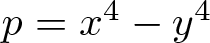
 \begin{equation}D=x^4-y^4.\\\end{equation}
By a solution (x, y) to Equation (1), we always mean  $(x,y)\in \mathbb{A}^2(K)$ satisfying Equation (1) and xy ≠ 0.
When  $k=K=\mathbb{Q}$, using a variety of methods, many authors have shown that Equation (1) has no solutions if
 $D=nz^p$ for integers n and prime numbers p; see [Reference Bajolet, Dupuy, Luca and Togbe1, Reference Bennett2, Reference Cao4, Reference Dabrowski6, Reference Darmon7, Reference Savin11].
It is natural to ask for solutions of Equation (1) when k and K are not the rational field. When k and K are number fields, since Equation (1) defines a curve of genus 3, by Faltings’ theorem [Reference Faltings8], Equation (1) only has a finite number of solutions, but to find all solutions to Equation (1) is in general a difficult task. We adopt here the method of Cassels’ [Reference Cassels5] and Bremner’s [Reference Bremner3], which is effective in finding solutions to Equation (1) in all cubic extensions of the base field in many situations. It is also worth mentioning that the work of Silverman [Reference Silverman13] on the equation  $x^4+y^4=D$ (and
 $x^6+y^6=D$) over number fields. But Silverman’s method does not apply when finding solutions in cubic extensions of the base field. The main result of this paper is as follows:
Theorem 1. Let k be a perfect field of characteristic not equal to 2. Let  $D\in k$ such that
 $D\not\in \pm k^2$. Assume that
(i) every solution
 $(X,y,z)\in \mathbb{A}^3(k)$ to $X^2-y^4=Dz^4$ satisfies z = 0,
(ii) every solution
$(x,Y,z)\in \mathbb{A}^3(k)$ to $x^4-Y^2=Dz^4$ satisfies z = 0.


If (x, y) is a solution to  $D=x^4-y^4$ in a cubic extension K of k, then
(1) (if
$-1\not \in k^2$)
where\begin{equation*}K=k(\theta),\quad
x=\pm \left(\dfrac{D}{s\theta}-\dfrac{s}{4}\right),\quad y= \pm \left(\dfrac{D}{s\theta}+\dfrac{s}{4}\right),
\end{equation*}$\theta^3-s^2\theta^2/8-2D^2/s^2=0$ and $s\in k^{*}$, and(2) (if
$-1\in k^2$)
where\begin{equation*}K=k(\theta),\quad
x=\pm \left(\dfrac{\theta}{s}-\dfrac{s}{4}\right),\quad y=\pm i\left(\dfrac{\theta}{s}+\dfrac{s}{4}\right),
\end{equation*}$i=\sqrt{-1}$, $\theta^3+s^4\theta/16+Ds^2/2=0$, and $s\in k^{*}$.


A nice corollary of Theorem 1 is
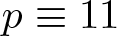
Corollary 1. Let p be a prime number. Let D = p if  $p\equiv 11$ (mod 16), and let
 $D=p^3$ if
 $p\equiv 3$ (mod 16). Then solutions to
 $D=x^4-y^4$ in all cubic extensions of
 $\mathbb{Q}(i)$ are
(1)
\begin{equation*}x=\pm \left(\dfrac{D}{s\theta}-\dfrac{s}{4}\right),\qquad y= \pm \left(\dfrac{D}{s\theta}+\dfrac{s}{4}\right),\end{equation*}where
$\theta^3-s^2\theta^2/8-2D^2/s^2=0$ for some $s\in \mathbb{Q}(i)^{*}$; and(2)
\begin{equation*}
x=\pm \left(\dfrac{\theta}{s}-\dfrac{s}{4}\right),\qquad y=\pm i\left(\dfrac{\theta}{s}+\dfrac{s}{4}\right),
\end{equation*}where
$\theta^3+s^4\theta/16+Ds^2/2=0$ for some $s\in \mathbb{Q}(i)^{*}$.


Remark 1. Theorem 1 finds all possible cubic extensions K of k and solutions to  $D=x^4-y^4$ in K. The defining polynomial of K,
 $F_s(x)=x^3-s^2x^2/8-2D^2/s^2$ or
 $F_s(x)=x^3+s^4x/16+Ds^2/2$, must be irreducible in
 $k[x]$, which in general is difficult to check since the irreducibility of
 $F_s(x)$ depends on s. However, if k is a number field, by Hilbert’s irreducibility theorem [Reference Serre12, Theorem 3.4.1], there exist infinitely many
 $s\in k$ such that
 $F_s(x)$ is irreducible in
 $k[x]$ and Theorem 1 finds all solutions to
 $D=x^4-y^4$ in these cases.
2. Proof of Theorem 1
We follow Cassels [Reference Cassels5]. Equation (1) can be written in the homogeneous form
 \begin{equation}
x^4-y^4=Dz^4.
\end{equation}
Let  $\mathcal{C}$ be the projective curve over k defined by Equation (2). Suppose that
 $P=[x_1:y_1:z_1]$is a point on (2) whose coordinates generate a cubic extension K of k. If
 $z_1=0$, then
 $[x_1:y_1:z_1]=[\pm 1:1:0]$; therefore K = k, which is impossible. Therefore,
 $z_1\neq 0$. Since
 $(x_1/z_1)^4-(y_1/z_1)^4=D$ and
 $|K:k|=3$, we have
 $x_1/z_1,y_1/z_1\not\in k$. Thus,
 \begin{equation}
k\left(\dfrac{x_1}{z_1}\right)=k\left(\dfrac{y_1}{z_1}\right)= k\left(\dfrac{x_1^2}{z_1^2}\right)=k\left(\dfrac{y_1^2}{z_1^2}\right)=K.
\end{equation}
Fix an algebraic closure  $\overline{k}$ of k. Let
 $P_i=[x_i:y_i:z_i] \in \mathbb{P}^{2}(\overline{k})$,
 $i=1,2,3$, be the Galois conjugates of P. The equation
 \begin{equation}
X^2-Y^2=DZ^2
\end{equation}
has a parametrization
 \begin{equation*}[X:Y:Z]=[l^2+Dm^2:l^2-Dm^2:2lm].\end{equation*}
Since  $[x_1^2:y_1^2:z_1^2]$ satisfies Equation (4), there exist
 $\lambda,\mu\in k$ such that
 \begin{equation}{
[x_1^2:y_1^2:z_1^2]=[\lambda^2+D\mu^2:\lambda^2-D\mu^2:2\lambda\mu]}.\end{equation}
Since  $z_1\neq 0$, it follows from Equation (5) that µ ≠ 0, λ ≠ 0, and
 \begin{equation}
{[\lambda:\mu]=[x_1^2+y_1^2:z_1^2]=[Dz_1^2:x_1^2-y_1^2]}.
\end{equation}
Let  $\theta=\lambda/\mu$. Then Equations (3) and (6) show that
 $\theta \not \in k$. Hence,
 $k(\theta)=K$. Therefore, there exists an irreducible cubic polynomial
 $P(x)=ax^3+bx^2+cx+d \in k[x]$ such that
 $P(\theta)=0$. In particular, ad ≠ 0. From Equation (5), we have
 \begin{equation}
\left(\dfrac{x_1}{z_1}\right)^2:\left(\dfrac{y_1}{z_1}\right)^2=\dfrac{\theta^2+D}{2\theta}:\dfrac{\theta^2-D}{2D}.
\end{equation}
Step 1: Consider the weighted projective curve
 \begin{equation}
\mathcal{C}_1\colon X^2-y^4=Dz^4.
\end{equation}
By points on  $\mathcal{C}_1$, we mean the equivalence classes of points
 $[X:y:z]$ in
 $\mathbb{P}^2_{2,1,1}(\overline{k})$ satisfying Equation (8). Since
 $x_i^2,y_i^2,y_iz_i,z_i^2$ are linearly dependent over k and
 $x_i\neq 0$, there exist
 $r,s,t\in \mathbb{Q}$ such that
 \begin{equation*}x_i^2=ry_i^2+sy_iz_i+tz_i^2,\end{equation*}
for  $i=1,2,3$. Consider the weighted projective curve
 \begin{equation}
\mathcal{D}_1\colon X=ry^2+syz+tz^2.
\end{equation}
By the weighted Bézout theorem [Theorem VIII.2][Reference Mondal10], the two curves  $\mathcal{C}_1$ and
 $\mathcal{D}_1$ intersect at 4 points in
 $\mathbb{P}_{2,1,1}^2(\overline{k})$. We know that three of these four points are
 $[x_i^2:y_i:z_i]$ for
 $i=1,2,3$. Let
 $v_1(T)$ be the fourth point of intersection. Since the set
 $\{[x_i^2:y_i:z_i]:i=1,2,3\}$ is stable under the action of
 $\operatorname{Gal}(\overline{k}/k)$,
 $v_1(T)$ is fixed by
 $\operatorname{Gal}(\overline{k}/k)$. Therefore,
 $v_1(T)$ is a k-rational point. By the assumption in Theorem 1, we have
 $v_1(T)=[\pm 1:1:0]$.
 $\bullet$
 $v_1(T)=[1:1:0]$. Then Equation (9) gives r = 1. Since
 \begin{equation*}(X-y^2-tz^2)^2-s^2y^2z^2=0,\end{equation*}
the homogeneous quartic in  $l,m$,
 \begin{equation*}(l^2+Dm^2-(l^2-Dm^2)-2tlm)^2-s^2(l^2-Dm^2)(2lm),\end{equation*}
has factors m and  $P(l,m)$. Therefore, there exists
 $q\in k$ such that
 \begin{align}
(l^2+Dm^2-(l^2-Dm^2)-2tlm)^2-2lms^2(l^2-Dm^2)=& 2qm(al^3+bl^2m\\& +clm^2+dm^3).
\end{align}
Thus,
 \begin{equation*}2m(Dm-tl)^2-ls^2(l^2-Dm^2)=q(al^3+bl^2m+clm^2+dm^3).\end{equation*}
Therefore,
 \begin{equation}\begin{cases}qa&=-s^2,\\
qb&=2t^2,\\
qc&=Ds^2-4Dt,\\
qd&=2D^2.
\end{cases}\end{equation}
Hence,
 \begin{equation*}
q(c+Da)=-4Dt,\quad
q^2bd=4D^2t^2,\ q\neq 0.\end{equation*}
Therefore,
 \begin{equation}
(c+Da)^2=4bd.
\end{equation}
Since  $a,d\neq 0$, system (11) gives
 \begin{equation}
\dfrac{a}{d}\equiv -2\pmod{k^2}.
\end{equation}
 $\bullet$
 $v_1(T)=[-1:1:0]$. Then Equation (9) gives
 $r=-1$. Since
 \begin{equation*}(X+y^2-tz^2)^2-s^2y^2z^2=0,\end{equation*}
the homogeneous quartic in  $l,m,$
 \begin{equation*}(l^2+Dm^2+l^2-Dm^2-2tlm)^2-s^2(l^2-Dm^2)(2lm),\end{equation*}
has factors l and  $P(l,m)$. Therefore, there exists
 $q\in k$ such that
 \begin{equation}
(2l^2-2tlm)^2-s^2(l^2-Dm^2)(2lm)=2ql(al^3+bl^2m+clm^2+dm^3).\end{equation}
Hence,
 \begin{equation*}2l(l-tm)^2-ms^2(l^2-Dm^2)=q(al^3+bl^2m+clm^2+dm^3).\end{equation*}
Therefore,
 \begin{equation}
\begin{cases}
qa&=2,\\
qb&=-4t-s^2,\\
qc&=2t^2,\\
qd&=Ds^2.
\end{cases}\end{equation}
Hence,
 \begin{equation*}
q^2ac=4t^2,\quad
q\left(b+\dfrac{d}{D}\right)=-4t,\ q\neq 0.\end{equation*}
Therefore,
 \begin{equation}
\left(b+\dfrac{d}{D}\right)^2=4ac.\end{equation}
Since  $a,d\neq 0$, system (15) also gives
 \begin{equation}
\dfrac{a}{d}\equiv 2D\pmod{k^2}.
\end{equation}
Step 2: Consider the weighted projective curve
 \begin{equation}
\mathcal{C}_2\colon x^4-Y^2={D}z^4.\end{equation}
By points on  $\mathcal{C}_2$, we mean the equivalence classes of points
 $[x:Y:z]$ in
 $\mathbb{P}^2_{1,2,1}(\overline{k})$ satisfying Equation (18). Since
 $y_i^2,x_i^2,x_iz_i,z_i^2$ are linearly dependent over k and
 $y_i\neq 0$, there exist
 $r,s,t\in \mathbb{Q}$ such that
 \begin{equation*}y_i^2=rx_i^2+sx_iz_i+tz_i^2,\end{equation*}
for  $i=1,2,3$. Consider the weighted projective curve
 \begin{equation}
\mathcal{D}_2\colon Y=rx^2+sxz+tz^2.
\end{equation}
By the weighted Bézout theorem [Theorem VIII.2][Reference Mondal10], the two curves  $\mathcal{C}_2$ and
 $\mathcal{D}_2$ intersect at 4 points in
 $\mathbb{P}_{1,2,1}^2(\overline{k})$. We know that three of these four points are
 $[x_i:y_i^2:z_i]$ for
 $i=1,2,3$. Let
 $v_2(T)$ be the fourth point of intersection. Since the set
 $\{[x_i:y_i^2:z_i]:i=1,2,3\}$ is stable under the action of
 $\operatorname{Gal}(\overline{k}/k)$,
 $v_2(T)$ is fixed by
 $\operatorname{Gal}(\overline{k}/k)$. Therefore,
 $v_2(T)$ is a k-rational point. By the assumption in Theorem 1, we have
 $v_2(T)=[1:\pm 1:0]$.
 $\bullet$
 $v_2(T)=[1:1:0]$. Then Equation (19) gives r = 1. We have
 \begin{equation*}(Y-x^2-tz^2)^2-s^2{x^2z^2}=0,\end{equation*}
so that the homogeneous quartic in  $l,m,$
 \begin{equation*}
(l^2-Dm^2-(l^2+Dm^2)-2tlm)^2-s^2(l^2+Dm^2)(2lm),
\end{equation*}
has factors m and  $P(l,m)$. Therefore, there exists
 $q\in k$ such that
 \begin{equation}
(l^2-Dm^2-(l^2+Dm^2))^2-2tlm)^2-s^2(l^2+Dm^2)(2lm)=2qmP(l,m).
\end{equation}
Thus,
 \begin{equation*}2m(Dm+rl)^2-ls^2(l^2+Dm^2)=q(al^3+bl^2m+clm^2+dm^3).\end{equation*}
Hence,
 \begin{equation}\begin{cases}
qa&=-s^2,\\
qb&=2r^2,\\
qc&=4Dr-Ds^2,\\
qd&=2D^2.
\end{cases}
\end{equation}
Therefore,
 \begin{equation*}
q(c-Da)=4Dr,\quad q^2bd=4{D^2}r^2,\ q\neq 0.\end{equation*}
Hence,
 \begin{equation}
(c-Da)^2=4bd.
\end{equation}
Since  $a,d\neq 0$, system (21) gives
 \begin{equation}
\dfrac{a}{d}\equiv -2\pmod{k^2}.
\end{equation}
 $\bullet$
 $v_2(T)=[1:-1:0]$. Then Equation (19) gives
 $r=-1.$ We have
 \begin{equation*}(Y+x^2-tz^2)^2-s^2{x^2z^2}=0,\end{equation*}
so that the homogeneous quartic in  $l,m,$
 \begin{equation*}(l^2-Dm^2+(l^2+Dm^2)-2rlm)^2-s^2(l^2+Dm^2)(2lm),\end{equation*}
has factors l and  $P(l,m)$. Thus, there exists
 $q\in k$ such that
 \begin{align}
(l^2-Dm^2+(l^2+Dm^2)-2tlm)^2-s^2(l^2+Dm^2)(2lm)=&2lq(al^3+bl^2m\\&+clm^2+dm^3).
\end{align}
Hence,
 \begin{equation*}2l(l-tm)^2-ms^2(l^2+Dm^2)=q(al^3+bl^2m+clm^2+dm^3).\end{equation*}
Therefore,
 \begin{equation}\begin{cases}
qa&=2,\\
qb&=-4t-s^2,\\
qc&=2t^2,\\
qd&=-Ds^2.
\end{cases}
\end{equation}
Hence,
 \begin{equation*}
q^2ac=4t^2,\quad
q\left(b-\dfrac{d}{D}\right)=-4r,\ q\neq 0.\end{equation*}
Thus,
 \begin{equation}
\left(b-\dfrac{d}{D}\right)^2=4ac.
\end{equation}
System (25) also gives
 \begin{equation}
\dfrac{a}{d}\equiv -2D\pmod{k^2}.
\end{equation}
It follows from (23), (27), (13) and (17) and the assumption that  $D\not\in \pm k^2$ that there are only two compatible cases for
 $v_1(T)$ and
 $v_2(T)$.
Case 1:  $v_1(T)=[1:1:0]$ and
 $v_2(T)=[1:1:0]$. From (12) and (22), we have
 \begin{equation*}(c-Da)^2=(c+Da)^2.\end{equation*}
Since aD ≠ 0, we have c = 0. From (21), we have  $r=s^2/4$. Thus,
 \begin{equation*}{qP(x)=-s^2x^3+\dfrac{s^4}{8}x^2+2D^2.}\end{equation*}
Therefore θ satisfies
 \begin{equation}
\theta^3-\dfrac{s^2}{8}\theta^2-2\dfrac{D^2}{s^2}=0.
\end{equation}
 \begin{equation}
\dfrac{\theta^2+D}{2\theta}=\left(\dfrac{s}{4}+\dfrac{D}{2\theta}\right)^2,\qquad \dfrac{\theta^2-D}{2\theta}=\left(\dfrac{s}{4}-\dfrac{D}{2\theta}\right)^2.
\end{equation}
 \begin{equation}
\dfrac{x_1}{z_1}=\pm \left(\dfrac{D}{s\theta}-\dfrac{s}{4}\right),\qquad\dfrac{y_1}{z_1}= \pm \left(\dfrac{D}{s\theta}+\dfrac{s}{4}\right).
\end{equation}
Case 2:  $v_1(T)=[-1:1:0]$ and
 $v_2(T)=[1:-1:0]$. This case also implies that
 $-1\in k^2$. From (17) and (25), we have
 \begin{equation*}\left(b+\dfrac{d}{D}\right)^2=\left(b-\dfrac{d}{D}\right)^2.\end{equation*}
Since d ≠ 0, we have b = 0. Hence, from (15), we have  $t=-s/4$. Therefore,
 \begin{equation*}qP(x)=2x^3+\dfrac{s^4}{8}x+Ds^2.\end{equation*}
Therefore, θ satisfies
 \begin{equation}
\theta^3+\dfrac{s^4}{16}\theta+\dfrac{Ds^2}{2}=0.
\end{equation}
It follows from (14) and (24) that
 \begin{equation}
\dfrac{\theta^2+D}{2\theta}=\left(\dfrac{\theta}{s}-\dfrac{s}{4}\right)^2,\qquad \dfrac{\theta^2-D}{2\theta }=\left(i\left(\dfrac{\theta}{s}+\dfrac{s}{4}\right)\right)^2,\end{equation}
where  $i\in k$ such that
 $i^2=-1\in k$. From (7) and (32), we have
 \begin{equation}
\dfrac{x_1}{z_1}=\pm \left(\dfrac{\theta}{s}-\dfrac{s}{4}\right),\qquad \dfrac{y_1}{z_1}=\pm i\left(\dfrac{\theta}{s}+\dfrac{s}{4}\right).
\end{equation}
3. Proof of Corollary 1
Corollary 1 is a consequence of Theorem 1 and the following lemma due to Izadi et al. [Reference Izadi, Naghdali and Brown9].
(1) For prime numbers,
$p\equiv 3$ (mod 16), then the equations $x^2{-}y^4={\pm} p^3z^4$ only have solutions $X=\pm y^2$ and z = 0 in $\mathbb{Q}(i)$.(2) For prime numbers,
$p\equiv 11$ (mod 16), then the equations $X^2{-}y^4={\pm} pz^4$ only have solutions $X=\pm y^2$ and z = 0 in $\mathbb{Q}(i)$.


Proof. See Izadi [Reference Izadi, Naghdali and Brown9, Theorems 3.2 and 3.4].
Acknowledgements
The author is supported by the Vietnam National Foundation for Science and Technology Development (NAFOSTED) (grant number 101.04-2023.21).
Competing Interest
The author declares none.



