National Special Security Events (NSSEs) are those designated by either the Secretary of the Department of Homeland Security (DHS) or the President of the United States as expected to have a significant impact on the hosting community, city, or region. During designated NSSEs, the US Secret Service serves as the lead agency for preparedness and response. 1
The World Meeting of Families (WMF), which is held every 3 years and is sponsored by the Holy See’s Pontifical Council for the Family, is the world’s largest Catholic gathering. In 2015, the WMF was designated as a NSSE by the DHS owing to the international significance and potential for terrorism. The WMF was held in Philadelphia, Pennsylvania, from Tuesday, September 22, to Friday, September 25, and culminated with a visit from Pope Francis on Saturday, September 26, and Sunday, September 27. Papal visit organizers estimated that 1.5 million visitors would come to Philadelphia, a city with a population of 1.5 million, to see Pope Francis and participate in public activities including a parade, public address, and open-air mass. Planning assumptions were that 30% to 40% of these visitors would be children; thus, an excess of 450,000 to 600,000 children were expected in the community.
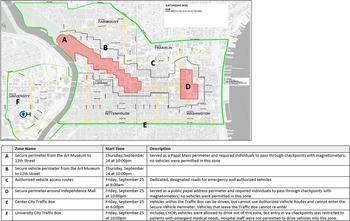
Several months in advance of the papal visit, the US Secret Service determined that the Children’s Hospital of Philadelphia (CHOP) would be within a highly secure zone (“traffic box”) in which vehicular traffic would be severely restricted (Figure 1). Hospital staff would not be able to access the traffic box with their private vehicles, and patients with emergencies would be directed to a checkpoint before entering this zone. Thus, CHOP emergency preparedness (EP) planners and other hospital leaders were confronted with planning for a mass gathering that would double the city’s population under circumstances in which patients, staff, and vendors could have severe difficulties accessing the hospital and in which widespread cell phone service disruption was anticipated. Planned school closures would likely adversely impact the ability of staff with school-aged children to report to work. Further, preparedness efforts included planning for the possibility of an act of terrorism resulting in mass casualties.
Secure Perimeter Zones Keeping Vehicles Out. Abbreviations: CHOP, The Children’s Hospital of Philadelphia.

This article focuses on the preparedness activities, response, and lessons learned during this event. The intent of sharing these details is to provide an overview of the planning process for other health care institutions planning for mass gatherings, enabling them to adopt best practices identified during the 2015 papal visit to Philadelphia.
SETTING
CHOP, a tertiary care referral and Level 1 trauma center, is positioned just west of the Schuylkill River in University City. CHOP has a 519-bed main hospital, a 70-bed emergency department (ED), 28 primary care centers, and 9 specialty care facilities. CHOP has an extensive number of affiliated practices in the Delaware Valley region comprising the CHOP Care Network, which serves approximately 30% of the 1.6 million children in the Delaware Valley region via more than 1.1 million patient visits each year, including over 90,000 ED visits and approximately 30,000 hospitalizations. CHOP also operates the After Hours Program, a service designed to have specially trained nurses provide telephone triage, assessment, and advice using computerized, standardized protocols for a parent concerning their ill child. The After Hours Program handles more than 100,000 calls per year.
PLANNING CONSIDERATIONS AND METHODS
The US Secret Service and the Philadelphia Office of Emergency Management (OEM) were the lead organizations for regional preparedness and response efforts. Citywide hospital planning was coordinated through the Hospital Association of Pennsylvania. At CHOP, the anticipated impact of this historic event prompted extensive hospital planning centered around 3 main phases beginning in February 2015. In the first phase, existing EP plans and job aids were reviewed and specific workgroups were formed. Phase 2 was marked by identifying goals and objectives and conducting exercises, and phase 3 was reserved for delineating and executing final planning decisions.
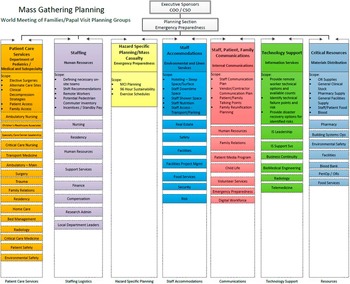
Executive leadership for hospital planning efforts was provided by the chief operating officer and chief safety officer. Focused workgroups were created to efficiently delegate roles and responsibilities to address all operational needs. These workgroups included (Figure 2):
-
∙ Patient care services;
-
∙ Staffing;
-
∙ Staff accommodations;
-
∙ Staff, patient, and family communications;
-
∙ Technology support;
-
∙ Critical resources; and
-
∙ Hazard-specific/mass casualty planning.
Mass Gathering Planning for the World Meeting of Families: Papal Visit Planning Groups. Abbreviations: COO, chief operating officer; CSO, chief safety officer; IS, information services; MCI, mass casualty incident; OR, operating room; PeriOp, perioperative.

Patient Care Services
Focus of the patient care services workgroup was to decrease demand on hospital services before the papal visit while increasing capacity throughout the visit. This was achieved through a variety of strategies.
The following strategies were utilized to decrease demand:
-
1. Defer elective medical and surgical admissions.
-
2. Discharge as many inpatients as possible prior to September 25.
-
3. Cancel, defer, or relocate social and administrative events scheduled for the main campus.
-
4. Close main campus outpatient specialty clinics to decrease the need for families to access nonemergent hospital services.
The following strategies were utilized to increase capacity:
-
1. Increase the number of frontline ordering clinicians and surgical and operating room staff.
-
2. Collate surgical service provider availability and contact information for rapid notification in the event of a mass casualty incident (MCI).
-
3. Increase staffing and extend hours of CHOP Care Network and Urgent Care center locations in Philadelphia County.
-
4. Increase from 2 to 5 the number of operating rooms staffed and immediately available for patients throughout the weekend.
-
5. Increase capacity of the CHOP Transport Team by increasing staffing and ambulances.
-
6. Open a 10-bed inpatient unit (short-stay unit) 1 week earlier than planned to coincide with the WMF conference week.
CHOP’s Home Care program provides comprehensive medical care to patients in their homes as an alternative to hospitalization. An audit determined that 150 Home Care patients lived within the traffic box; supplies, equipment, and medications were delivered to these patients in advance of the papal visit.
The large international population expected to attend the conference warranted review and update of screening procedures for travelers’ diseases. Guidance documents, as well as updates to the ED triage electronic medical record system were made to ensure children with communicable diseases could be quickly identified, isolated, and treated appropriately. Also, an increased number of on-site interpreters was to be made available.
Staffing
The staffing workgroup employed several human resource–focused strategies to ensure that continued, uninterrupted medical care was provided to patients and families. Based on CHOP policy, all employees are deemed essential unless instructed otherwise by management. From this perspective, the staffing workgroup was tasked with identifying a subset of essential employees who were required to maintain hospital operations. Increased staffing was implemented in the ED, pediatric intensive care unit, and perioperative departments. Additional numbers of trauma attendings and fellows, general surgeons, and anesthesiologists were to be in-house. All subspecialty services identified staff who were either in-house or within walking distance of the hospital. Staff who were not considered essential were given the option of working from the main campus, working remotely from home or an alternative location, or utilizing paid personal leave. These options were not available to those employees who were considered essential.
The staffing workgroup created different staffing models for various departments to consider; most operated on a “12-hours on, 12-hours off” model in order to provide definitive work and sleep periods from September 25 through 28. To discourage staff from attempting to commute back and forth between shifts, staff were to be “hotelled” on-site and provided standby pay. That is, staff were compensated for any period of time they had to remain at CHOP in between shifts. City and archdiocese public and Catholic schools were to be closed September 23-25; this required CHOP staff with school-aged children to arrange for child care.
Staff Accommodations
Restrictions to vehicular travel and impaired accessibility required CHOP to plan as if it were an island without a bridge. In addition to the traffic zones, there were closures of several sections of major US interstate highways, and the Benjamin Franklin Bridge was to be closed to traffic in both directions from September 25 at 10:00 PM through the morning of September 28. These unprecedented road closures encompassed 4.7 total square miles.Reference Hall and Duchneskie 2 Zones were slated to reopen the evening of Sunday, September 27, upon crowd dispersal. This necessitated strategies for having staff arrive to CHOP prior to the Pope’s arrival and hotelling staff on the hospital campus throughout the visit.
Leading up to September 25, employees driving to CHOP without an assigned parking space were to be provided with temporary parking. In coordination with local police, staff who would potentially require emergent access to the hospital were provided with placards for their vehicles that would grant them hospital access for emergencies only and not for routine travel to and from CHOP.
Individual staff members completed a questionnaire indicating their need to remain on campus to sleep in between shifts. On the basis of the results of this survey, estimates for the number of staff requiring accommodations were made and a sleep space assessment was completed. These spaces included exam rooms, treatment rooms, conference space, and private offices in several buildings throughout the main hospital campus. Most of the staff were accommodated in a new, 13-story, 700,000-square foot ambulatory care building that was only partially occupied at the time of the papal visit. A facilities management software program with a hotelling function was used to reserve sleep space. In this way, staff knew their assigned room location in advance and the problem of having multiple people reporting to a single space could be minimized. In addition, all employees utilizing sleep space were provided with a locker, cot or air mattress, linens, pillows, towels, access to showers, and footwear for showers. Shower locations were preidentified and available in the main campus buildings; in addition, 2 shower trailers were rented and set up for the weekend.
Downtime space was designated on the ground floor of a research and administrative building located on the main campus. This space was modified to include quiet rooms for watching movies, complimentary snacks, and yoga sessions. Meal vouchers were provided to staff for 3 meals per day. Complimentary food and refreshments were available and special events planned included an arrival reception, employee barbeque, daily continental breakfast, and dessert buffet.
Staff, Patient, and Family Communications
Pre-event communications were targeted to ensure all staff, patients, and families were updated on both internal and external planning decisions. Unique staffing models, hospital operation modifications, road closures, use of public transportation, and functionality should there be a disruption of cellular service required the dissemination of consistent, reliable communications internally to staff.
CHOP utilized an internal SharePoint (Microsoft, Redmond, WA) site to serve as a venue where staff could ask questions, voice concerns, and receive clarification from workgroup leaders. In addition, these leaders were available for several town hall informational sessions in advance of the papal visit. SharePoint was also used to post external information as it was released from the Philadelphia OEM and the US Secret Service. Resources for CHOP staff to reference when responding to patient or family questions and concerns regarding the impact of WMF on our operations were drafted in partnership with patient and family services, public relations, EP, and the legal department to ensure all messaging was appropriate and consistent. Much of the external messaging was focused on assuring patients and families that CHOP would remain open and capable of providing high-quality care.
The CHOP webpage served as a portal of information for families. A Frequently Asked Questions section was provided, as was detailed information regarding public transportation, road closures, and optional routes for accessing checkpoints staffed by University of Pennsylvania police for emergent hospital access. For medical emergencies, families were encouraged to call 9-1-1 rather than attempt to drive directly to CHOP due to concerns about the potential for significant traffic delays. CHOP implemented limited visitation to lessen traffic and the need for multiple family members to be housed with inpatients.
The After Hours Program continued full operations by triaging patients and directing them to the most appropriate care provider. After Hours nurses, CHOP subspecialists, and referring physicians directing children to the ED were asked to contact the Hospital Command Center (HCC). The HCC would then provide the patient’s name along with make and model of the car they were using to the OEM and law enforcement at the checkpoint admitting entry into the traffic box.
Technology Support
Owing to the increased number of visitors to Philadelphia, challenges with technology were expected from overloading. In order to prepare for and mitigate some of these challenges, a technology support workgroup was tasked with
-
∙ Providing remote worker technical options,
-
∙ Identifying technical failure points and risk, and
-
∙ Providing disaster recovery options for identified risks.
Widespread disruption of cell phone service was anticipated owing to the sheer number of people attempting to utilize these services simultaneously. CHOP utilizes independent, internal wireless telephones with the ability to send and receive text pages and voice calls on the main campus. These internal wireless phones were distributed to clinical personnel who relied solely on cell phones for communication. A master list was created linking these phone numbers to personnel. In the event of cell phone service disruption, in-house personnel were instructed to page staff either to an internal wireless phone or landline. In addition, CHOP employees were required to update their personal contact information and provide alternative contact numbers.
An assessment of the number of staff who use Virtual Private Network (VPN) access to work remotely was conducted. Information Services (IS) increased VPN bandwidth to support additional staff who could work remotely. Firewalls were separated on both the guest and main networks to better support high volume during anticipated slowness. Because of its proximity to WMF and papal visit events, the guest network at CHOP’s business occupancy building in Center City Philadelphia was temporarily disabled beginning the evening of September 25 to prevent the network from becoming overwhelmed.
Critical Resources
The Critical Resources workgroup was tasked with identifying resources and procuring supplies to sustain operations. These resources included but were not limited to blood products and other clinical supplies, staff and patient food, and supplies for the pharmacy, perioperative services, and facilities.
Increases to par levels of medical equipment and supplies was made in the weeks leading up to the event. Vendors were notified of the need to schedule deliveries earlier in the week. An additional 2-week supply of pharmaceuticals inventoried from mass casualty and intensive care use were stockpiled. Also, par levels of blood product were increased. Blood and blood products come from the local branch of the American Red Cross, which is also located within the traffic box. In the event CHOP required additional blood or blood products emergently, a plan was devised for the American Red Cross to drive product to CHOP via designated emergency routes.
Throughout the weekend, 1 medical supply truck, 1 refrigerated truck, and 2 linen trucks were parked at the main building loading dock with critical medical supplies, food products, and linens. While much of the critical resource planning was to ensure hospital operations would function under the premise of “normal” conditions, anticipation for events such as a MCI were also considered.
Hazard-Specific/Mass Casualty Planning
The unique complexity of planning for the papal visit required the use of portions of several existing hazard-specific response plans within CHOP’s Emergency Operations Plan including 96-hour sustainability, MCI, severe weather emergency with hotelling of staff, and IS interruption. In anticipation of the event, CHOP conducted 2 functional exercises to test response procedures related to a mass gathering and MCI. The first focused on ED management of patients in a hazmat-related MCI, and the second was conducted under circumstances expected during the weekend of the papal visit including high ED volume, high inpatient census, planned staffing models, and inability of staff to quickly arrive from home to provide support. After-action reports were created and areas for improvement were quickly identified and problems remedied before the papal visit weekend.
RESPONSE AND RESULTS
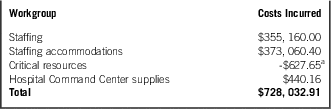
Planning for and responding to the papal visit cost CHOP over $700,000 (Table 1). Planning assumptions were that the expected number of visitors to Philadelphia would result in increased hospital utilization including ED visits, admissions to medical/surgical and intensive care units, and surgeries. Further, this increased demand would occur under circumstances in which staff would have limited freedom to travel to and from the hospital and challenges communicating. In fact, as the data below show, CHOP and area hospitals did not experience these expected impacts to hospital operations primarily because the actual number of visitors was far below the predicted number.Reference Avril 3 Further, issues beyond the control of planning that could have greatly increased the number of children requiring medical attention did not materialize, including extreme heat and humidity, which prevented heat-related illnesses or dehydration for those outside for extended periods. Also, the fact that there was not a seasonal viral respiratory epidemic helped reduce utilization of hospital services by those living in the community who were not part of the mass gathering.
Papal Planning Purchases by The Children’s Hospital of Philadelphia

a Negative variance due to the return and credit of Medline supplies.
Hospital Command Center Operations
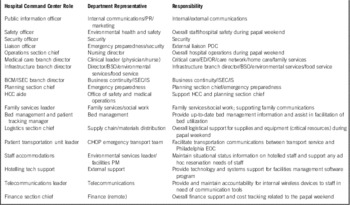
Hospital operations functioned largely unaffected throughout the WMF conference. Beginning at noon on Friday, September 25, CHOP’s HCC and Incident Management Team (IMT) were activated and the HCC operated continuously through noon on September 28. The IMT comprised individuals who had predesignated roles and responsibilities for this mass gathering response (Table 2).
IMT Roles and ResponsibilitiesFootnote a

a Abbreviations: BCM, Business Continuity Management; BSO, Building System Operations; CHOP, The Children’s Hospital of Philadelphia; ED, emergency department; EOC, Emergency Operations Center; HCC, Hospital Command Center; IS, information services; ISEC, information security; OR, operating room; PM, project management; POC, point of contact; PR, public relations.
During the 72-hour HCC activation, staff fielded a total of 785 phone calls centering around 3 main areas of response:
-
1. Hospital access for patients and coordination of medical transports to CHOP with the Philadelphia OEM Healthcare Desk. For those seeking emergency care, HCC personnel notified police officers of details such as names of driver and patient, and make and model of the vehicle. This notification occurred via the OEM Healthcare Desk, which was established for this purpose. A total of 36 medical transport requests from area hospitals were coordinated through the HCC.
-
2. Internal staff hotelling issues such as room lockouts and multiple staff being assigned sleeping spaces designed for 1 person.
-
3. General internal and external communications and situational updates for staff.
In addition, the HCC was responsible for the allocation and distribution of internal wireless phones and handling any unanticipated issues. To maintain daily situational awareness and real-time coordination with other health care facilities, public health departments, and offices of emergency management, an electronic emergency management tool was used. During the WMF, all health care facilities and first responders in the region utilized this tool to provide situational updates, share bed availability, monitor demand for patient care services, and coordinate resource sharing. This tool was also used by medical personnel working in medical tents in the restricted zones to communicate to hospitals the need to transport patients.
Patient Care Services
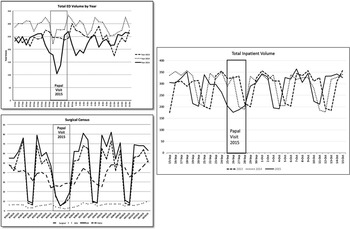
As shown in Figure 3, the number of ED visits during the papal weekend was significantly lower than in the corresponding time frame in 2013 and 2014. A review of data from 2 other pediatric hospitals in the region suggests that this decrease was not due to patients seeking ED care elsewhere. For each hospital, the number of ED visits over the papal weekend was virtually identical to that in 2014 (data not shown). This, coupled with the spike in visits to CHOP immediately after the visit, indicates that families anticipated difficulties traveling and deferred nonemergent ED visits. Efforts to decrease the inpatient census entering the papal visit weekend were successful and the inpatient census remained lower than historical norms throughout the weekend (Figure 3). A total of 14 emergency surgeries were performed during the 48-hour weekend period, including 6 related to traumatic injuries and 3 related to either ovarian or testicular torsion.
Number of Emergency Department (ED) Visits, Surgical Census, and Inpatient Volume During the Papal Visit Weekend and in the Corresponding Time Frame in 2013 and 2014.

Staffing and Staff Accommodations
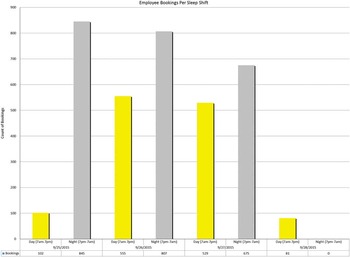
Staff hotelling was a critical element to ensuring hospital operations were maintained throughout the papal weekend; 900 to 1000 employees were hotelled for each of 3 consecutive nights (Figure 4). Whereas most sleep space was pre-assigned, in-house support from Applied Data Systems, Inc, allowed for assistance with space allocation and technical issues with the facilities management software program. During the course of the weekend, over 26,000 meals were served to CHOP staff. Designated sleep rooms were disassembled from September 28 to October 1, with those needed for clinical operations being disassembled first.
Employee Bookings for Sleep Space Per Sleep Shift.

Staffing models were maintained throughout the papal weekend without issue. There were no reported issues with excessive callouts or staffing shortages in any clinical or clinical support units nor any events that necessitated staff being called in emergently from home. On September 27, after the crowd participating in the papal open-air mass dispersed, nursing leadership began sending home staff who lived within walking distance of the hospital before their shift’s end. Human resources representation was on-site to assist with any potential staffing policy issues.
Many staff who were able to work remotely from home or from alternate locations within the CHOP Care Network were assigned space and VPN access. A total of 1232 staff worked remotely and 48 worked from an alternative CHOP Care Network location on Friday, September 25, both of which were record high totals for CHOP.
Communications
Members of CHOP’s internal communications team served as the public information officer throughout HCC activation. Messages were predrafted and disseminated to staff as needed through the hospital intranet, SharePoint community, and e-mail messaging. Messaging to families was achieved through updates on the external CHOP website, social media posts, and in-person communication with families already in the hospital. Social media monitoring was conducted in the HCC to quell concerns, remedy rumors, and answer questions. On one occasion, personnel in the HCC used CHOP’s Twitter (Twitter, San Francisco, CA) feed to direct the family of a child with asthma to the police checkpoint to gain access to the hospital ED. On September 27, there were reports on Twitter that the Pope would be visiting CHOP that afternoon. This was investigated by personnel in the HCC and a communication was sent to dispel the rumor.
Technology
During the event, there were no reported outages, interruptions, or degradation of cell phone or other services. In-house support was provided in the HCC by business continuity, information security, and IS leadership. Additional leadership from telecommunication was available to help provide and maintain accountability of the 80 internal wireless phones redistributed to essential clinicians who remained on campus for the weekend. All phones were returned or distributed to the appropriate owner in the week following the papal visit.
Critical Resources
Throughout the WMF and papal visit, critical resources were consumed as normal; there was no need to utilize any of the staged MCI supplies. On September 26, there was an emergency pharmaceutical delivery for an unscheduled surgery that was coordinated by pharmacy leaders and the IMT. The HCC coordinated the delivery with the University of Pennsylvania police command center and the pharmaceutical was delivered without incident. Supplies, which had increased par levels, were either utilized or absorbed into rotation. The items staged on the Medline trailer were returned and credited.
DISCUSSION
Previous mass gatherings have proven a need for early, detailed planning,Reference Soomaroo and Murray 4 but little has been published regarding impact on area hospitals, making it difficult to predict the extent to which demand for hospital services would be increased and which services would be most affected.Reference Ackermann, Lahm and Pfohl 5 - Reference Shafi, Booy and Haworth 8 With 10,000 athletes from 197 countries and an influx of approximately 2.2 million visitors, the 1996 summer Olympic Games in Atlanta, Georgia, was the largest sporting event ever held in the United States.Reference Brennan, Keim and Sharp 9 Hospitals provided information on bed and resource capacities to a central coordinating center, which generated an Olympic Bed Report twice daily. Based on this, “neither the four metropolitan nor the four non-metropolitan sentinel hospitals had a significant increase in ED visits during the Olympics.”Reference Brennan, Keim and Sharp 9 In 2010, approximately 250,000 persons took part in the Love Parade in Germany with only 473 patients requiring treatment at area hospitals.Reference Ackermann, Lahm and Pfohl 5 Consistent with our experience, participant numbers in other mass gatherings worldwide have been substantially overestimated.Reference Avril 3 , Reference Ackermann, Lahm and Pfohl 5
Preparedness activities at CHOP began 6 months in advance of the papal visit, quickly recognizing the need for full engagement of multiple stakeholders. As a result, 7 workgroups were created to delegate tasks, roles, and responsibilities; prioritize needs; prevent duplication of efforts; and ensure accountability. Additionally, this allowed the hospital to transition from planning into response without difficulty. It was essential to have EP planners facilitate progress and integrate the plans of the individual workgroups to prevent planning in silos.
The key objective of planning efforts was to safely maintain all hospital operations. An important goal was to decompress the hospital, which was successfully achieved. The inpatient census was reduced to 76% capacity on the morning of September 25, well below historical norms. In contrast, the widely anticipated increased demand for patient services did not materialize. We theorize that dire forecasts of crowds and traffic kept many potential visitors away, and that CHOP’s location within the restricted traffic zone dissuaded others from seeking care for all but the most emergent medical conditions.
A unique challenge posed by this scenario was the need to house almost 1000 employees each night, for 3 consecutive nights. While we were able to utilize elements from existing plans and rely on experiences from housing staff during winter storms, the sheer number of employees needing hotelling was unprecedented. Planning members and frontline staff who hotelled at the hospital throughout the weekend reported on post-event surveys that their accommodations allowed for restful sleep.
Owing to the financial implications of this event, obtaining executive support early in the process was imperative. Increasing inventory of medical supplies, augmenting staffing capabilities, and hotelling staff required significant financial support from the institution (Table 1). We acknowledge that not every health care system will have the resources to prepare as we did. In total, it cost approximately $150.56 per employee housed. This is based on expenses for sleep surfaces, sleep space modification, food and refreshments, and staff rewards.
The expectation of cell phone service disruption was a particular concern because many clinicians use hospital-issued cell phones as a primary means of communicating. This potential challenge, which did not materialize, was mitigated by distributing internal wireless communication devices to staff within the hospital and acquiring landline numbers for those outside the hospital.
Post-event surveys showed that the multimodal methods of communication were effective in providing accurate and timely information. Directing staff to the internal SharePoint and intranet and directing families to the CHOP webpage proved efficient ways to share up-to-date and fluctuating information. Executives and directors conducted rounding on units throughout the weekend to gauge staff morale and ensure that employees’ concerns were recognized and addressed. Additionally, transparency, engagement, and commitment from key leadership regarding planning expectations and decisions resulted in staff feeling well supported.
CONCLUSION
Although the City of Philadelphia and the US Secret Service have not released attendance figures, it is widely accepted that the actual number of visitors to Philadelphia was far below the projected number of 1.5 million.Reference Avril 3 As such, many of the challenges that had been anticipated for the papal visit to Philadelphia did not materialize. Thus, although lessons learned from the response phase are limited, the successful planning strategies shared here will provide EP planners a blueprint for mass gathering preparedness.