Down syndrome, or trisomy 21, is the leading genetic cause of intellectual disability, with an incidence of 1 in 691 live births, which means ~6000 infants with Down syndrome are born annually in the United States of America.Reference Parker, Mai and Canfield 1 Children with Down syndrome are at increased risk for a CHD, with a reported prevalence of 41–56% compared with 1–5% in the general paediatric population.Reference Freeman, Taft and Dooley 2 – Reference Freeman, Bean and Allen 5 Atrioventricular septal defect, the most common form of CHD in Down syndrome, occurs in 31–61% of children with Down syndrome and CHD, but is observed in only 1 in 10,000 live births in those without Down syndrome.Reference Wells, Barker and Finley 6 – Reference Loffredo, Hirata and Wilson 8 This represents a 2000-fold increase in risk for atrioventricular septal defect among newborns with Down syndrome compared with the general paediatric population.Reference Freeman, Taft and Dooley 2 – Reference Freeman, Bean and Allen 5 , Reference Kerstann, Feingold and Freeman 9
Survival rates in the Down syndrome population have increased tremendously, from a median age of 25 years in 1983 to almost 60 years at present.Reference Englund, Jonsson and Zander 10 Routine echocardiogram screening of all newborns with Down syndrome has improved detection of CHD, which has contributed to the growing number of early survivors. In addition, rapid advancements in both surgical procedures and peri-operative care have also decreased the mortality rate and improved survival rates among individuals with Down syndrome and CHD.Reference Baird and Sadnovnick 11 , Reference Mathew, Moodie and Sterba 12 Indeed, the morbidity and mortality rate in all children – Down syndrome and non-Down syndrome – with atrioventricular septal defect is ~3%, with only 2.7% requiring additional operations. In children with Down syndrome and atrioventricular septal defect, the 5-year post-operative survival rate is ~90%.Reference Bando, Turrentine and Sun 13 – Reference Malec, Mrozcek and Pajak 16 Therefore, it is becoming increasingly important to evaluate the impact of atrioventricular septal defect and/or its treatment on their neurodevelopmental outcomes and family psycho-social functioning – for example, parenting stress and impact on the family.
Neurodevelopmental outcomes in typically developing children with CHD have been studied extensively. Neurodevelopmental studies in this population have shown that they have more problems with reasoning, learning, executive function, inattention, language skills, and social skills compared with peers without CHD.Reference Gaynor, Ittenbach and Gerdes 17 – Reference Mahle, Visconti and Freier 19 Notably, research on neurodevelopmental outcomes among individuals with Down syndrome and CHD is limited to two studies, which confirm that children with Down syndrome and CHD have an increased risk of developmental deficits, particularly in the language domain, compared with children with Down syndrome without CHD.Reference Visootsak, Mahle and Kirshbom 20 , Reference Visootsak, Hess and Bakeman 21
Despite our extensive knowledge about the cognitive and behavioural phenotypes of Down syndrome, the influence of CHD in this population is often under-recognised in neurodevelopmental and family outcome studies. There has been no study to date to evaluate the family psycho-social outcomes associated with children with Down syndrome and CHD, and the impact of these variables on the child’s neurodevelopmental outcome. Thus, this study is the first to determine whether maternal and family factors are important in mediating neuropsychological outcomes for children with Down syndrome and CHD. Our findings will help clinicians – for example, cardiologists and paediatricians – and parents pinpoint the most effective interventional therapies and resources that are responsive to the needs of children with Down syndrome and CHD and their families.
Materials and methods
This was a cross-sectional study that consisted of children with Down syndrome after atrioventricular septal defect repair (cases) and children with Down syndrome with a structurally normal heart (controls). Participants were recruited through the Down Syndrome Clinic at Emory University in Atlanta, Georgia. The patients’ parents gave written consent for participation, as approved by the Emory University’s Institutional Review Board.
The patients included 57 children with Down syndrome – 20 with atrioventricular septal defect and 37 without a CHD – of ~12–14 months of age. This age range was selected because it allows parents to adjust to the needs of their newborn and also provides time to allow a child with an atrioventricular septal defect to recover from cardiac surgery; surgical repair of atrioventricular septal defect is typically performed when the child is roughly 10 pounds and/or 6 months of age. In addition, this age range represents an ideal period of time to implement interventions for the child and family in the event that our study reveals developmental deficits and lower family psycho-social outcomes. Patients with Down syndrome and atrioventricular septal defect were ascertained after the cardiac repair. We only considered patients with atrioventricular septal defects for this study to make our study sample as homogeneous as possible with respect to their cardiac status. Furthermore, the operative techniques and timing of repair of other types of CHDs such as ventricular septal defects and atrial septal defects differed when compared with atrioventricular septal defects. Controls were patients with Down syndrome who has a structurally normal heart as documented by echocardiograms. Patients were eligible for participation if he/she had a confirmed trisomy 21 based on chromosomal karyotype, was delivered after 34 weeks of gestational, had vision and hearing within normal limits, and parents spoke English as the primary language. Patients with other medical conditions – for example, congenital hypothyroidism, gut abnormalities, seizures, congenital infections, ophthalmological problems, and hearing complications – were excluded from the study. Patients were also excluded if they had a gestational age of <34 weeks at delivery, 5-minute Apgar score <7, or intrauterine exposure to substance abuse.
The child’s development was assessed using the Bayley Scales of Infant and Development, Third Edition, or Bayley-III.Reference Bayley 22 The Bayley-III provides subscale scores on cognitive, language, and motor developmental indices, with a mean of 100 and a standard deviation of 15. Mothers completed the Parenting Stress Index, a self-reported questionnaire that consists of 101 items to assess parental stress levels.Reference Abidin 23 The questionnaire examines stress related to parental characteristics – Parent Domain score – and child characteristics – Child Domain score. The Parent Domain score is based on the parent’s perception related to competence, isolation, attachment, health, role restriction, depression, and spouse/parenting partner relationship. The Child Domain score is based on the child’s adaptability, distractibility/hyperactivity, parent–child interaction, demandingness, mood, and acceptability.
The quality of the child’s home environment was assessed by the Disability Adapted Infant/Toddler Home Observation for Measurement of the Environment-Developmental Delay or HOME assessment.Reference Caldwell and Bradley 24 The HOME assessment has the following six subscales: emotional and verbal responsiveness, avoidance and restriction, organisation and physical environment, learning materials, parental involvement with child, and opportunities for variety in daily life. The HOME assessment is conducted at the home with the parent and child present, and it consists of a combination of interview and observation by a qualified psychometrician. The questionnaire is the standard research instrument for the assessment of environmental factors associated with development in children with disabilities. Of note, the psychometricians who conducted the Bayley-III and HOME assessments were not aware of the child’s cardiac status.
Statistics
The two cohorts were compared for variables such as child age, demographic information, and birth characteristics using χ2 tests, t-test, and Wilcoxon signed-rank tests as appropriate. Raw outcome scores from the Bayley-III, HOME, and Parenting Stress Index were analysed between groups using the same methods. It has been noted that developmental quotients instead of standard scores can be used to track the developmental progress of intellectually disabled children against their chronological ages in order to compare their levels of functioning in different developmental domains.Reference Gentile, Tan and Horowitz 25 The developmental quotient in children with intellectual disabilities correlated well with intellectual quotient scores later in life.Reference Goldstein and Sheaffer 26 Therefore, we calculated the developmental quotient for each domain by dividing the developmental age by the chronological age and multiplying by 100. For the Bayley-III, we report the scores in the domains of cognition, gross motor, fine motor, receptive language, and expressive language. In order to account for potential confounding between groups, outcome scores from the Bayley-III, HOME, and Parenting Stress Index were also analysed using multiple linear regression analysis with case status as the main predictor and adjusting for child age, sex, and race, as well as for parental age, education level, and annual household income. The confounders included in the final model included only those variables whose removal altered the β estimate of the main predictor – case status – >10%. Total scores from the HOME assessment and Parenting Stress Index were also tested as significant predictors of Bayley-III scores.
Results
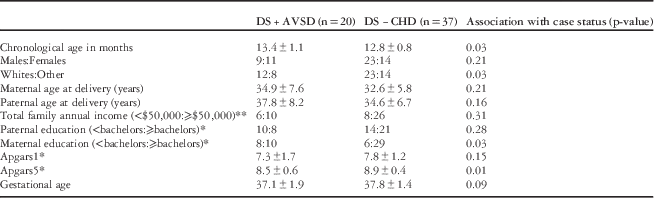
As indicated in Table 1, the participants with Down syndrome with CHD group (n=20) was tested at approximately the same age as the controls (n=37), although the cases were slightly older at 13.4±1.1 months compared with controls (12.8±0.8 months) (p=0.03). The notable differences in demographics between the two groups were maternal education, with significantly more mothers with a bachelor’s degree or higher among the control group (82.6%) compared with the case group (55.6%) (p=0.03) and race, with more control patients identifying as white (62.2%) compared with the case group (60%) (p=0.03). Birth information among the two groups was also relatively similar; however, the case group had significantly lower Apgar scores (8.5±0.6) at 5 minutes compared with the control group (8.9±0.4) (p=0.01).
Demographic details of patients with DS+AVSD compared with DS−CHD.

AVSD=atrioventricular septal defect; DS=Down syndrome
* Data are missing for two patients in the DS+AVSD group and for two patients in the DS−CHD group
** Data are missing for four patients in the DS+AVSD group and for three patients in the DS−CHD group
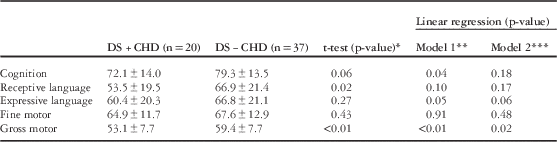
Analysis of the raw Bayley-III scores (Table 2) reveals that the composite scores are lower across all domains – that is, cognition, receptive language, expressive language, gross motor, and fine motor – for the Down syndrome with CHD group compared with the Down syndrome without CHD cohort. In the receptive language domain, the Down syndrome with CHD cohort’s score (53.5±19.5) was significantly lower than that of the control group (66.9±21.4) (p=0.02). The gross motor scores were also significantly different, with a score of 53.1±7.7 for the Down syndrome with CHD group and 59.4±7.7 for the Down syndrome without CHD group (p<0.01). In the cognitive domain, the CHD cohort score (72.1±14.0) was lower than the Down syndrome without CHD score (79.3±13.5), although this difference did not reach statistical significance (p=0.06). After adjusting for confounders – for example, demographic information – the CHD group scored significantly lower in the areas of cognition (p=0.04), expressive language (p=0.05), and gross motor (p<0.01) compared with the Down syndrome without CHD group; however, if we also adjust for the HOME and Parenting Stress Index scores, only the gross motor scores are significantly different between the two groups (p=0.02), indicating that parental stress and the home environment are significant confounders between the case and control groups with regard to neurodevelopmental outcomes.
Bayley-III scores for DS+CHD and DS−CHD.

DS=Down syndrome
* Unadjusted analyses
** Models adjusted for covariates: child’s age at testing, child’s sex/gender, child’s race, maternal age at testing and level of education, paternal age at testing and level of education, and household income
*** Models adjusted for the covariates above as well as HOME assessment and Parenting Stress Index scores
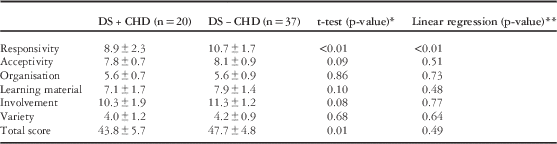
In the HOME analysis (Table 3), the Down syndrome with CHD group scored lower in all subscales compared with the Down syndrome without CHD group. The responsivity score, which includes emotional and verbal responsiveness of the mother, was 8.9±2.3 in the Down syndrome with CHD group and was 10.7±1.7 in the Down syndrome without CHD group (p<0.01), with mothers of children with Down syndrome without CHD demonstrating higher levels of responsiveness/interaction with their children. This association remains significant after adjusting for potential confounders – for example, parental education level and income. There were no statistically significant differences in acceptivity, organisation, learning material, involvement, or variety between mothers of the two groups. Overall, the total HOME score was significantly higher for the Down syndrome without CHD group compared with the Down syndrome with CHD group (p=0.01), with the Down syndrome without CHD group scoring 47.7±4.8 compared with 43.8±5.7 of the Down syndrome with CHD group. This result indicates a better overall home environment for the control group; however, this association does not remain significant after adjusting for potential confounders.
HOME assessment scores for DS+CHD and DS−CHD.

DS=Down syndrome
* Unadjusted analyses
** Models adjusted for covariates: child’s age at testing, child’s sex/gender, child’s race, maternal age at testing and level of education, paternal age at testing and level of education, and household income
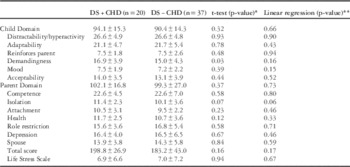
The overall Parenting Stress Index score (Table 4) was higher for the Down syndrome with CHD group (198.8±26.9) compared with the Down syndrome without CHD group (183.2±43.0), although the differences were not statistically significant (p=0.94). Furthermore, in the child demandingness subscale, the Down syndrome with CHD group scored 16.9±3.9, significantly higher than the control group’s score of 15.0±4.3 (p=0.03). The association, however, did not remain after adjusting for confounders. Among the other subdomain scores, there were no statistically significant differences between the two groups in either the Child or the Parent Domains; however, among the Parent Domain scores, differences in isolation between the two groups were noted, which did not reach statistical significance (p=0.07).
PSI scores for DS+CHD and DS−CHD.

DS=Down syndrome; PSI=Parenting Stress Index
* Unadjusted analyses
** Models adjusted for covariates: child’s age at testing, child’s sex/gender, child’s race, maternal age at testing and level of education, paternal age at testing and level of education, and household income
Discussion
Neurodevelopmental outcomes in typically developing children with CHD have shown specific deficits in cognitive function, behaviour, and learning.Reference Gaynor, Ittenbach and Gerdes 17 – Reference Mahle, Visconti and Freier 19 Furthermore, a diagnosis of CHD may impact the family psycho-social outcomes, and family – in particular maternal factors such as stress – may be a more important determinant of neurodevelopmental outcomes than operative management.Reference McCusker, Doherty and Molloy 27 , Reference Brosig, Mussatto and Kuhn 28 Studies have also shown that parents of children with Down syndrome experience greater parental stress than parents of age-matched typically developing children.Reference Brosig, Mussatto and Kuhn 28 These studies, however, do not take into account co-morbid medical problems such as CHD. Our study is the first to determine whether maternal and family functions are important in contributing to outcomes in neurodevelopment for children with Down syndrome and CHD.
Based on the Bayley-III scores among the two groups, our results support previous studies showing significant differences in neurodevelopmental outcomes between the two groups.Reference Visootsak, Mahle and Kirshbom 20 , Reference Visootsak, Hess and Bakeman 21 The Down syndrome with CHD group had greater developmental delay in all domains – motor, cognitive, and language – compared with the Down syndrome without CHD group (Table 2). The differences in receptive language (p=0.02) and gross motor (p<0.01) scores were the only significantly different scores. After adjusting for demographic and parental variables – for example, education and income – the scores for cognition (p=0.04), expressive language (p=0.05), and gross motor skills (p<0.01) remained significant between the two groups; however, when accounting for parental stress and home environment based on the Parenting Stress Index and HOME assessment scores, only gross motor skills (p=0.02) remained significantly different between the two groups, indicating that there is a possible relationship between the level of stress and home environment and the child’s neurodevelopmental outcomes.
The diagnosis of a CHD in addition to the diagnosis of Down syndrome may provide additional stress to the child and parents, elevating parental concern and disrupting family dynamics, resulting in further developmental deficits. Based on the Parenting Stress Index, parents of children with Down syndrome with CHD consistently reported more stress than parents of those with Down syndrome without CHD, in both Child and Parent Subdomain factors (Table 4). The only significant Child Subdomain was child demandingness (p=0.03), and in the Parent subdomain isolation differed between the two groups (p=0.07). This finding is consistent with the extra parental care in the CHD group, who may require medications, specialised feeding routine, and additional appointments with specialists and therapists after cardiac surgical repair. The overall Parenting Stress Index score was also higher among the Down syndrome with CHD group, but the difference was not statistically significant (p=0.16); therefore, the presence or absence of CHD does not significantly affect the total level of parental stress among mothers of children with Down syndrome. This finding may be due to parents completing our study early in their experience in caring for a child with Down syndrome. Further studies should be conducted as these children age in order to assess whether continued increased medical needs related to CHD lead to increased levels of parental stress.
Based on the HOME assessment (Table 3), the Down syndrome with CHD group differed significantly from the control group in the area of verbal and emotional responsiveness (p<0.01) and total score (p=0.01), with the Down syndrome with CHD group having lower scores, which may be indicative of a lower quality of home environment for the children in this group. Mothers of children with Down syndrome without CHD demonstrate higher levels of responsiveness, both emotional and verbal, to their children than mothers of children with Down syndrome with CHD. Children with CHD in general are fragile, which may lead parents to have decreased play activity and/or interaction. When looked at in conjunction with the Parenting Stress Index results, it may be possible that the increased demandingness seen in children with Down syndrome with CHD plays a role in the level of responsiveness. The differences in responsiveness remain significant (p<0.01) after adjusting for potential confounders – for example, race and education. The difference in total score, however, does not remain significant after adjusting for potential confounders, suggesting that the CHD status alone is not responsible for the lower overall home environment score in the Down syndrome with CHD group.
Our study had certain limitations. We did not evaluate the impact of other CHD subtypes on neurodevelopmental outcomes and family functioning. As our study is cross-sectional, further longitudinal study is needed to determine the trajectory of neurodevelopmental outcomes and parental/family functioning in children with Down syndrome with CHD compared with children with Down syndrome without CHD. In addition, future studies should consider the neurodevelopmental trajectory of children with Down syndrome with other CHD subtypes, such as ventricular septal defect and atrial septal defect.
Our results provide evidence that clinicians must recognise the developmental needs of those who have a CHD, as well as consider the needs of the family. Children with Down syndrome with CHD have greater delays than their peers with Down syndrome without CHD. Furthermore, it is possible that mothers and families of children with CHD are more prone to increased stress and other challenges at home, putting their children at even greater risk for developmental delay. Even when the cardiac defect is repaired, parents continue to experience personal stress and/or lack guidance in setting appropriate expectations for their child, which may lead to decreased parent–child interaction. The finding that parental stress and home environment partially account for some of these differences in neurodevelopmental outcome between the two groups may prompt new family-directed interventions and anticipatory guidance for the families of children with Down syndrome with CHD. For example, paediatricians and cardiologists evaluating families of children with Down syndrome who have a CHD may ask about parental stress and family support as part of the routine care.
Acknowledgements
The authors thank the parents and children for their participation in this study.
Financial Support
Grant sponsors: NIH/NICHD; Grant number: 1K23HD058043-01A1, 5R01HD074346-02, and 1U54NS091859-01(JV). Contents are the authors’ sole responsibility and do not necessarily represent the official views of the NIH.
Conflicts of Interest
None.
Ethical Standards
The authors assert that all procedures contributing to this work comply with the ethical standards of the relevant national guidelines on human experimentation and with the Helsinki Declaration of 1975, as revised in 2008, and has been approved by the Emory University’s institutional committees.