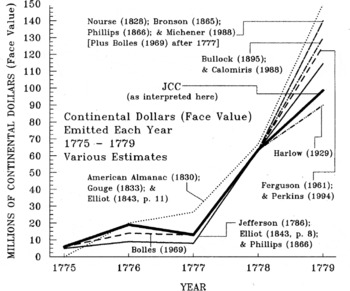
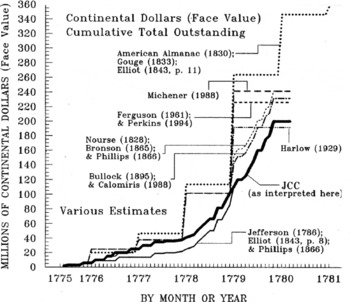
The U.S. Congress financed the American Revolution by issuing paper money—the Continental Dollar. How much was issued has never been firmly established (see Figures 1 and 2). In the old “authoritative” literature the total ranges from $191.5 to $387.5 million. In the modern literature, it ranges from $204 to $250 million. If a current consensus exists, it would be $241 million.Footnote 1 Little has been done to reconcile conflicting estimates. This note corrects this oversight.
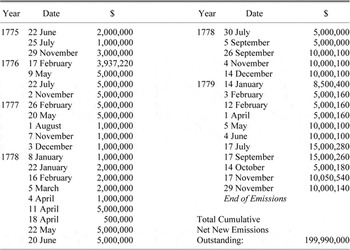
Table 1 presents corrected estimates for net new emissions of Continental Dollars—also shown as the JCC (for Journals of the Continental Congress) lines in Figures 1 and 2. The first emission was authorized on 22 June 1775 and the last on 29 November 1779. The cumulative total was $199,990,000. All were still outstanding as of 1780.Footnote 2 With one exception, this is the lowest total in the literature—20 percent lower than the current consensus. Table 1 combines evidence in the JCC with that in the Papers of the Continental Congress—Report of the Board of Treasury on the State of Emissions and Loans, September 14, 1779 (PCC hereafter).
The PCC reported emissions through 2 September 1779 with the cumulative total to that date being $159,948,880—the only time Congress reported such a total prior to permanently ending emissions. Scholars have used this total but not noted the details of its construction. These details make several corrections to the evidence in the JCC. They reveal that not all of the $4 million authorized on 17 February 1776 were printed, that the $500,000 mentioned on 2 November 1776 were not printed at all, and how the emissions of 20 May 1777 and 11 April 1778 were counted. They also counted $10,000 from 5 January 1776 as a new emission when in fact it was not—an error that Congress did not catch.Footnote 3
NET NEW CONTINENTAL DOLLARS EMITTED EACH YEAR FROM 1775 THROUGH 1779 (FACE VALUE)—VARIOUS ESTIMATES

Why are the estimates in Table 1 preferred? The answer is that entropy has overtaken the literature on the Continental Dollar. Errors in early estimates were copied by subsequent scholars who in turn added their own errors until now a plethora of different estimates co-exist. When these errors are identified and corrected, all collapse to that in Table 1.Footnote 4 Prior estimates suffer from errors of omission, errors of addition, errors of transcription, and errors of definition. For example, Thomas Jefferson erroneously omitted $16 million from his 1786 account. This error was repeated in the report given to Congress by Jonathan Elliot in 1843. Elliot in turn is one of the primary sources used by James Ferguson. Henry Bronson erroneously included $500,000 from 2 November 1776. Albert Bolles erroneously omitted $5 million from May 1776. Henry Phillips made several transcription errors, and Charles Bullock made an addition error of $9.95 million when summing his entries—errors often uncorrected by subsequent scholars.Footnote 5
THE CONTINENTAL DOLLAR: CUMULATIVE TOTAL NET NEW EMISSIONS OUTSTANDING (FACE VALUE), 1775–1781—VARIOUS ESTIMATES

The highest estimate—$357 million—comes from an error in definition. It counts all disbursements measured in Continental Dollar units-of-account rather than the emission of Continental Dollars per se. While the current literature follows Ferguson in discarding this estimate, a credible case for doing so, or even for establishing the estimate's origin, has never been made.Footnote 6 It turns out this estimate comes from tables compiled by Henry Knox, Secretary of War, that were included in a report assembled by Joseph Nourse, Registrar of the Treasury, on 30 August 1790 for a Congressional committee. Therein, Nourse states on page 35 that Knox's tables (so converted and listed there in specie value) included “Loan Office Debt.” This affirms that the $357 million estimate is measuring more than just the emission of Continental Dollars.Footnote 7
CONTINENTAL DOLLARS EMITTED BY CONGRESS, 1775-1779: CORRECTED ESTIMATES OF TOTAL NET NEW EMISSIONS (FACE VALUE)

Note: The date is the day Congress first authorized the emission listed.
>Sources: Grubb, “Continental Dollar”; Journals of the Continental Congress, v. 2, pp. 103, 105, 207; v. 3, p. 390; v. 4, pp. 32, 157, 339; v. 5, pp. 599, 651, 697; v. 6, pp. 912, 918; v. 7, pp. 161, 373; v. 8, pp. 377–80, 597, 646; v. 9, pp. 873, 993; v. 10, pp. 28, 82–83, 174–75, 223, 309, 337–38, 365; v. 11, pp. 524, 627, 731; v. 12, pp. 884, 962, 1100, 1218; v.13, pp. 64, 139, 209, 408; v. 14, pp. 548, 687–88, 848–49; v. 15, pp. 1019, 1053, 1076–77, 1171–72, 1285, 1324–25, 1436; Papers of the Continental Congress, m247, r146, i136, p. 647.Correcting these errors leaves only one remaining point of discrepancy, namely how to count the emission authorized on 14 January 1779. Because of extensive counterfeiting, Congress on 2 January 1779 called in “. . . the whole emissions of May 20, 1777, and April 11 1778.” These old bills were to be exchanged for new bills—with the old bills being “examined and burned.” On 14 January 1779 Congress authorized a total of $50,000,400 in bills of a new design “. . . to be emitted for exchanging others, agreeable to the resolutions of the 2nd instant, or for supporting the war the ensuing year . . .”Footnote 8 How much of this emission was new spending and how much was bill-swapping was not recorded. Guesses in the literature vary widely. At one extreme, Nourse and Ron Michener count the entire emission as new. At the other extreme, Ralph Harlow assumes that all $50,000,400 were merely swapped for existing bills.Footnote 9
One obvious question is how many old bills were eligible to be swapped for new? The authorizing legislation of 2 and 14 January 1779 explicitly listed the entire emissions of 20 May 1777 and 11 April 1778 and no others as eligible. Thereafter, only these two dates were mentioned, and mentioned often, in reference to exchanging bills.Footnote 10 Scholars differ over how to count these emissions. Bullock assumes that each authorization date represents a unique emission. Because only $5 million was authorized on 20 May 1777 and another $5 million on 11 April 1778, he assumes that only $10 million were eligible for exchange—the residual $40,000,400 would be new emission.Footnote 11 Congress, however, had never authorized more than $10 million in new emissions on a single date before.
By contrast, Eric Newman assumes that authorization dates do not represent unique emissions. A given emission represented all authorized amounts—even if authorized on different dates—that were printed from the same cut. Thus, the emission of 20 May 1777 includes not only the amount authorized on 20 May 1777 but also that authorized on 15 August, 7 November, and 3 December of 1777 and on 8 and 22 January, 16 February, 5 March, and 4 and 18 April of 1778. The bills from these separate authorization dates were all indistinguishable from one another but were distinguishable from all other emissions.Footnote 12
Newman considers the emission of 11 April, 1778 to include not only the amount authorized on 11 April, 1778 but also that authorized on 22 May, 20 June, 30 July, and 5 September, 1778. The bills from these separate authorizations were all indistinguishable from one another but were distinguishable from all other emissions. In total then, the emissions of 20 May 1777 and 11 April 1778 amounted to $41.5 million.Footnote 13 If all were exchanged, it would leave $8,500,400 out of that authorized on 14 January 1779 as new emission—an amount clearly within the $5 to $10 million typical of new emissions authorized on a single date.
The authorizing language supports this interpretation. The nine authorizations Newman identified after 20 May 1777 carried the same instructional language “. . . that the bills shall . . . be of the same tenor and date as the emission now executing . . .” The language authorizing the 11 April 1778 emission explicitly stated that for these bills “. . . new cuts be used for striking off and printing: That the form of the bills be as follows: . . . according to a resolution passed by Congress, at York, 11 April, 1778.” The next four authorizations Newman listed carried the same instructional language, “That the bills shall . . . be of the same tenor and date as the emission directed on the eleventh day of April last . . .”Footnote 14
The PCC provides definitive corroboration for this interpretation. Therein the Treasury explicitly identifies the emissions of 20 May 1777 and 11 April 1778 as comprising the additional authorization dates listed above with a cumulative total of $41.5 million emitted.Footnote 15 The Treasury subtracted this sum from the $50,000,400 authorized on 14 January 1779 when tallying up the cumulative net new emissions outstanding as of 2 September 1779—which was then stated to be $159,948,880.
Congress accepted this total. However, the sum of new emissions authorized as of 2 September 1779 as listed in the JCC—counting the 14 January 1779 emission as $8,500,400—totaled $160,001,660. The difference between the JCC and PCC totals to that date equals $52,780. This discrepancy is fully accounted for by the fact that the PCC, but not the JCC, adjusted the 17 February 1776 authorization down by $62,780 to account for bills not printed, and by the fact that the PCC, but not the JCC, mistakenly counted $10,000 from 5 January 1776 as new. As such, the true JCC total ($160, 001,660 − $62,780) = the true PCC total ($159,948,880 − $10,000) for cumulative net new emissions as of 2 September 1779.Footnote 16
Were all $41.5 million Continental Dollars eligible for exchange actually exchanged? Ferguson assumes that little of the eligible amounts were swapped leaving more as a new emission.Footnote 17 Direct evidence on the amount swapped, however, can be taken from reports by the Registrar of the Treasury, Joseph Nourse, and the Continental Treasurer, Michael Hillegas.
On 14 January 1786, Nourse reported to Congress the amount of Continental Dollars paid into the U.S. Treasury through 1785. These amounts included bills sent in as part of the exchange of the emissions of 20 May 1777 and 11 April 1778 for the emission of 14 January 1779. The JCC recorded the amount of new bills sent out to be exchanged during late June through early August of 1779. This amount totaled $15.3 million. The Pennsylvania Packet stated that $19.8 million old bills had been exchanged for the new bills by January 1780. These numbers are close to the total Nourse reported ($19.1 million) as being sent back to the Treasury for 1779.Footnote 18
Although the exchange ended on 1 January 1781, the Treasury was still destroying the old bills that had been exchanged for new as late as January 1782. In May of 1782, Hillegas reported to state Governors a portion of the report given by Nourse to Congress—the part covering from 25 November 1780 through 23 February 1782. Unlike Nourse, Hillegas identified which remittances were merely bill exchanges. Cross-referencing the two reports indicates that the remittances in the Nourse report through April 1781 are mostly exchanges of the 20 May 1777 and 11 April 1778 emissions.Footnote 19
The total sum eligible for exchange was $41.5 million. Nourse's report of remittances from May 1779 through 1 January 1781 totaled $34.4 million and through April 1781 totaled $39.9 million. This total rises to $41 million when the amounts that Hillegas explicitly identifies as being exchanges of the 20 May 1777 and 11 April 1778 emissions that took place after April 1781 are added. The closeness of these estimates ($41.5 versus $41 million), given that Nourse admits that his numbers are not complete, is further corroboration that of the $50 million Continental Dollars authorized on 14 January 1779 only $8.5 million should be counted as new.
When the addition, omission, transcription, and definition errors in the past literature are corrected, the discrepancies between the JCC and PCC evidence taken into account, and the method for calculating the net new emission from the 14 January 1779 authorization described above used, the discrepancies across the literature are eliminated—revealing a single estimate of $199,990,000 Continental Dollars emitted from 1775 through 1779 and still outstanding as of 1780. In addition, the different time paths of emissions across the literature all collapse onto that reported in Table 1 and shown as the JCC lines in Figures 1 and 2.Footnote 20
The history of the Continental Dollar is important to understanding the U.S. financial revolution. It clearly influenced debate over monetary powers at the 1787 Constitutional Convention.Footnote 21 Just how culpable the Continental Dollar was in reality, as opposed to in rhetoric, for shaping the course of that revolution cannot be fully understood unless we know how much was really issued. Nor can meaningful monetary analysis of Congressional spending, money creation and its impact on the economy, during the revolution be pursued unless we know the exact time path of emissions. That history, however, has been cloudy regarding the exact amount and time path of emissions. The estimates presented here better establish those numbers. In particular, a total of only $199,990,000 Continental Dollars were issued as Congressional spending, far fewer than previously thought.