INTRODUCTION
Despite the advances in the oceanographical research of the Brazilian oceanic islands (Mohr, Reference Mohr2009), information about cetaceans is still scarce, with the present studies based on opportunistic sightings (Skaf & Secchi Reference Skaf and Secchi1994; Dalla Rosa, Reference Dalla Rosa1998; Baracho et al., Reference Baracho, Cipolotti, Marcovaldi, Rossi-Santos, Silva and Apolinário2005, Reference Baracho, Cipolotti, Marcovaldi, Apolinário and Silva2007) and a few attempts at systematic studies (e.g. Moreno et al., Reference Moreno, Ott, Tavares, Oliveira, Danilewicz, Siciliano, Bonnato, Viana, Hazin and Souza2009; Instituto Baleia Jubarte, unpublished data).
Among the Brazilian oceanic islands, the Fernando de Noronha Archipelago (03°50′S 32°25′W), about 345 km north-east from Natal, Rio Grande do Norte State, in waters of 4000 m is the only area presenting a systematic long-term study about the natural history of the spinner dolphin (Stenella longirostris) (Gray, 1828) (eg. Silva Jr et al., Reference Silva, Silva and Sazima2005, Reference Silva, Silva, Sazima and Sazima2007).
Despite the bottlenose dolphin (Tursiops truncatus) (Montagu, 1821) being considered as one of the most well studied dolphin species around the world (Wells & Scott, Reference Wells, Scott, Perrin, Würsig and Thewissen2009), the data on basic parameters such as distribution and behaviour in the south-western Atlantic Ocean are basically limited to coastal populations (eg. Simões-Lopes & Fabian, Reference Simões-Lopes and Fabián1999; Rossi-Santos et al., Reference Rossi-Santos, Wedekin and Sousa-Lima2006; Lodi et al., Reference Lodi, Wedekin, Rossi-Santos and Marcondes2008; Wedekin et al., Reference Wells, Scott, Perrin, Würsig and Thewissen2008), with the exception of the recent research efforts in other oceanic islands, such as São Pedro and the São Paulo Archipelago (00°56′N 29°22′W), 1010 km from Natal, at 4000 m depth (Caon & Ott, Reference Caon and Ott2000, Reference Caon and Ott2004; Moreno et al., Reference Moreno, Ott, Tavares, Oliveira, Danilewicz, Siciliano, Bonnato, Viana, Hazin and Souza2009), and the Biological Reserve of Atol das Rocas (03°50′S 33°49′W) (Baracho et al., Reference Baracho, Cipolotti, Marcovaldi, Rossi-Santos, Silva and Apolinário2005, Reference Baracho, Cipolotti, Marcovaldi, Apolinário and Silva2007), 260 km from Natal, in waters of 3000 m.
The oceanic island of Trindade (20°30′S 29°18′W) is unpopulated and controlled by the Brazilian Navy, constituting the most distant island from the Brazilian coast, located at 1140 km east from the Espirito Santo State, south-east region. Because of its location and inaccessibility, it is an island for which biological data are scarce, especially for cetaceans, with no direct sightings previously reported (see IBAMA, 2001; Alves & Castro, Reference Alves and Castro2006), apart from some bone evidence (a lumbar vertebra) of a stranded bottlenose dolphin collected in 1995 (Siciliano & Franco, Reference Siciliano and Franco2005).
In this paper we aim to contribute to the knowledge about the cetacean occurrence in Trindade Island, reporting the first records of bottlenose dolphins in the area through opportunistic sightings.
MATERIALS AND METHODS
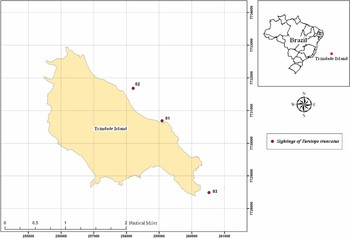
Trindade Island is characterized by an abrupt relief associated with a transversal fracture of submarine volcanic mountains (Weaver, Reference Weaver1990; Almeida et al., Reference Almeida, Carneiro and Mizusaki1996; Alves, Reference Alves1998). The emerged part of the island presents an eroded cone form, the highest peaks about 600 m altitude, and lies over the oceanic bottom at 5500 m depth. The geological environments are characterized by sodic–alkaline volcanic rocks, algae reefs, narrow beaches, dunes and little fluvial deposits (Castro & Antonello, Reference Castro, Antonello, Alves and Castro2006) (Figure 1).
Sightings of the bottlenose dolphin, Tursiops truncatus, around Trindade Island, off Brazil.

Through a voluntary collaboration inside the research programme of the Brazilian Marine Turtle Project (Projeto Tamar), established in Brazil in the 1980s (see Marcovaldi & Marcovaldi, Reference Marcovaldi and Marcovaldi1999), with support from the Brazilian Navy in Trindade, 9 days of opportunistic surveys were performed between December 2009 and March 2010, totalling 54 hours of sampling effort. These surveys were conducted during a routine island monitoring, performed by the Brazilian Navy utilizing a 4 m zodiac equipped with an off-board 25 HP engine, with one biologist and three mariners as observers on-board. When dolphins were sighted and approached we utilized group focal sampling (Lehner, Reference Lehner1996) observing and recording the behaviour of the multiple individuals inside the pod. A cellular phone Nokia N95 inside a plastic case was utilized, despite its poor quality photographic images, to acquire surface and underwater images of the dolphins.
RESULTS
Three sightings of the bottlenose dolphin were obtained around Trindade Island (Figure 1). The first group was observed on 15 December 2009 at 7:40 am, comprising 10 individuals (7 adults and 3 calves). They were at 70 m from the coast and at 5 m depth. Two individuals approached the zodiac, keeping a distance of about 15 m away, while a third dolphin was sighted performing three breachings. Animals were filmed for 3:08 minutes.
The second group was observed on the same day, later at 8:35 am, consisting of 5 individuals (4 adults and 1 calf). They were at 307 m from the coast and at 20 m depth. A snorkelling dive was performed to observe the underwater behaviour of some this group and it was possible to obtain 0:42 seconds of video footage.
Underwater, the four dolphins stayed away from the zodiac at a distance of about 15 m. Afterwards, two adult animals came briefly to the diver and then returned to their group. It was possible to hear the dolphins vocalizing occasionally.
The third sighting was on 23 February 2010 at 4:10 pm with a single adult animal observed, at 290 m from the coast and at 35 m depth. The dolphin came to bow ride in the zodiac, then stayed for some minutes at about 20 m distance and thereafter swam away. No images could be obtained for this sighting.
DISCUSSION
Due to the scarcity of data for the oceanic islands in the Brazilian Territory, especially for Trindade Island, this paper provides the first reported sightings for the bottlenose dolphins in Trindade Island and constitutes important information for future studies, with at least two projects in the implementation phases (Instituto Baleia Jubarte, unpublished data; Ignácio Moreno, personal communication). Such studies can bring important insights about the biology and conservation of oceanic cetaceans in the south-western Atlantic Ocean.
The group sizes reported here are similar to those reported by Baracho et al. (Reference Baracho, Cipolotti, Marcovaldi, Apolinário and Silva2007) for the Atol das Rocas, who sighted two groups containing six and fifteen animals, while in São Pedro and the São Paulo Archipelago, the sighted group size was 1 to 25 individuals (mean 9) (Moreno et al., Reference Moreno, Ott, Tavares, Oliveira, Danilewicz, Siciliano, Bonnato, Viana, Hazin and Souza2009). The locations of the sightings in these oceanic islands are also similar, in the more sheltered waters around the islands, suggesting a probable distribution pattern that can be incorporated in future experimental designs to get a good sampling of these poorly studied places.
The presence of calves in Trindade Island (present study), Atol das Rocas (Baracho et al., Reference Baracho, Cipolotti, Marcovaldi, Apolinário and Silva2007) and São Pedro and the São Paulo Archipelago (Moreno et al., Reference Moreno, Ott, Tavares, Oliveira, Danilewicz, Siciliano, Bonnato, Viana, Hazin and Souza2009) suggests that the species may be using the oceanic islands off Brazil to socialize and take care of the young dolphins.
The hypothesis of residence should be considered because bottlenose dolphin sightings were reported here in two different months, January and March 2010, and there have been two more recent sightings in August 2010 (Instituto Baleia Jubarte, unpublished data).
Oceanic islands represent today one of the last barriers to a better understanding of marine environments, mainly because of their geographical isolation. This fact also highlights the importance of conservation of the marine life in these islands, including top predator animals such as the bottlenose dolphins.
ACKNOWLEDGEMENTS
We thank the Projeto Tamar in Trindade Island for the opportunity to be on the island, the Brazilian Navy, especially Sargento Ramos and Cabo Dornellas, Ignácio Moreno for providing useful literature, Paulo Simões-Lopes for a kind review of an early draft of this manuscript and Guilherme Maurutto for producing Figure 1.