Introduction
The wheat stem sawfly, Cephus cinctus Norton (Hymenoptera: Cephidae), is native to North America and was first described in Colorado, United States of America in 1872 (Norton Reference Norton1872). Since the 1920s, severe C. cinctus infestations have occurred in many cultivated cereal (Poaceae) crops, including common wheat (Triticum aestivum Linnaeus), durum wheat (T. durum Desfontaines), barley (Hordeum vulgare Linnaeus), and triticale (× Triticosecale Wittmer ex A. Camus; Wallace and McNeal Reference Wallace and McNeal1966; Cockrell et al. Reference Cockrell, Griffin-Nolan, Rand, Altilmisani, Ode and Peairs2017; Varella et al. Reference Varella, Talbert, Achhami, Blake, Hofland and Sherman2018; Cárcamo et al. Reference Cárcamo, Beres, Wijerathna and Schwinghamer2023). Cephus cinctus populations impact cereal crop producers in the northwestern provinces (Alberta, Saskatchewan, and Manitoba, Canada) and states (Montana, North Dakota, South Dakota, Nebraska, Colorado, and Wyoming, United States of America) of the North American Great Plains region (Criddle Reference Criddle1923; Holmes Reference Holmes1982; Morrill et al. Reference Morrill, Gabor and Wichman1993; McCullough et al. Reference McCullough, Hein and Bradshaw2020; Cockrell et al. Reference Cockrell, Randolph, Peirce and Peairs2021). Adult wheat stem sawflies emerge from wheat stubble in late spring, and females oviposit individual eggs into their host plants from June to July (Holmes Reference Holmes1977). Larvae develop within the plant stem and feed on parenchymal tissue and vascular bundles throughout the summer (Holmes Reference Holmes1977). Larval feeding decreases kernel head weight, protein content, and photosynthetic capacity of the host plant (Macedo et al. Reference Macedo, Peterson, Weaver and Morrill2005, Reference Macedo, Weaver and Peterson2007). From August to mid-September, as plant moisture begins to decrease, mature larvae travel to the base of the stem and cut the stem to create their overwintering hibernaculum (Holmes Reference Holmes1979). The cereal stems that host C. cinctus larvae are susceptible to lodging as the result of winds or other incidental contact, making it difficult for producers to harvest their crops. Using modern commodity prices, economic losses in years with high C. cinctus population densities (i.e., when 50% or more of wheat stems in a field have been cut) can be upwards of $CAD 400M annually (Beres et al. Reference Beres, Cárcamo and Byers2007, Reference Beres, Hill, Cárcamo, Knodel, Weaver and Cuthbert2017).
Sowing of resistant solid-stem cultivars and implementing methods that enhance local established populations of natural enemies are the primary tactics used to manage C. cinctus. Solid-stem plants develop greater amounts of pith within the stem that increases juvenile wheat stem sawfly mortality (Holmes and Peterson Reference Holmes and Peterson1961, Reference Holmes and Peterson1962) and reduces adult fitness (Morrill et al. Reference Morrill, Gabor, Weaver, Kushnak and Irish2000; Cárcamo et al. Reference Cárcamo, Beres, Clarke, Byers, Mündel, May and DePauw2005). Several wheat and durum solid-stem cultivars like “AC Lillian” (DePauw et al. Reference DePauw, Townley-Smith, Humphreys, Knox, Clarke and Clarke2005), “AAC Stronghold” (Ruan et al. Reference Ruan, Singh, DePauw, Knox, Cuthbert and McCallum2019), and “CDC Fortitude” (Pozniak et al. Reference Pozniak, Nilsen, Clarke and Beres2015) are registered for use in Canada to mitigate wheat stem sawfly damage but are not widely selected as preferred cultivars by producers for seeding (Agriculture Financial Services Corporation 2021).
Two idiobiont ectoparasitoids, Bracon cephi Gahan and B. lissogaster Muesebeck (Hymenoptera: Braconidae), are the most common natural enemies of C. cinctus in North America (Nelson and Farstad Reference Nelson and Farstad1953; Somsen and Luginbill Reference Somsen and Luginbill1956). Bracon cephi is the predominant parasitoid species in Canada; however, B. lissogaster has been reported in small numbers southeast of Lethbridge, Alberta (Cárcamo et al. Reference Cárcamo, Weaver, Meers, Beres and Mauduit2012). First-generation adult B. cephi parasitoids attack wheat stem sawfly larvae in early summer (e.g., in July in the southern Canadian prairies), before they cut the host plant stem (Nelson and Farstad Reference Nelson and Farstad1953). The success of the second generation of parasitoids depends on abiotic factors (i.e., cold, wet conditions) that prolong the growing season and delay host plant senescence (Holmes et al. Reference Holmes, Nelson, Peterson and Farstad1963). Parasitism rates vary substantially by geographic region, with some areas having over 90% of C. cinctus attacked (Morrill et al. Reference Morrill, Kushnak and Gabor1998). Within the stem, C. cinctus larvae are susceptible to infection and subsequent death by a complex of Fusarium (Nectriaceae), including F. acuminatum Ellis and Everh sensu Gordon, F. avenaceum (Fr.) Sacc., F. culmorum (W.G. Smith) Sacc., F. equiseti (Corda) Sacc. sensu Gordon, and F. graminearum (Schwabe) (Sun Reference Sun2008; Wenda-Piesik et al. Reference Wenda-Piesik, Sun, Grey, Weaver and Morrill2009). Wheat stem sawfly larvae are also susceptible to predation by the clerid beetle Phyllobaenus dubius Wolcott (Coleoptera: Cleridae) (Morrill et al. Reference Morrill, Weaver, Irish and Barr2001; Meers Reference Meers2005). Despite extensive research over the last 100 years on C. cinctus and its natural enemies, it is not always clear how these larval mortality factors are influenced across time and space or how abiotic factors affect larval mortality. Regional data on biotic and abiotic factors need to be augmented.
Insect populations are dynamic and constantly fluctuate over time and geographic area in response to biotic and abiotic factors. Availability of suitable hosts (Sétamou et al. Reference Sétamou, Schulthess, Gounou, Poehling and Borgemeister2000; Opedal et al. Reference Opedal, Ovaskainen, Saastamoinen, Laine and Nouhuys2020), abiotic conditions (e.g., temperature, precipitation; Kingsolver Reference Kingsolver1989; Crozier Reference Crozier2004; Khokhar et al. Reference Khokhar, Rolania, Singh and Kumar2019), natural enemy populations (Alyokhin et al. Reference Alyokhin, Drummond, Sewell and Storch2011; Bouchard et al. Reference Bouchard, Martel, Régnière, Thierrien and Correia2018), and anthropogenic activities (e.g., habitat destruction and chemical pesticide use; Ciesla Reference Ciesla2015; Wagner et al. Reference Wagner, Grames, Forister, Berenbaum and Stopak2021) can heavily influence population densities. To better understand the population ecology of an insect, researchers and integrated pest management practitioners use species-specific biological parameters and climatic factors to create complex population models (Nietschke et al. Reference Nietschke, Magarey, Borchert, Calvin and Jones2007). For example, mechanistic or process-based population models (i.e., phenology models) and distribution models have been developed for a number of insect pests of Canadian agriculture, including Melanoplus sanguinipes Fabricius (Orthoptera: Acrididae) (Olfert and Weiss Reference Olfert and Weiss2006; Olfert et al. Reference Olfert, Weiss, Giffen and Vankosky2021), Plutella xylostella Linnaeus (Lepidoptera: Plutellidae) (Li et al. Reference Li, Zalucki, Yonow, Kriticos, Bao and Chen2016), Aphis glycines Matsumura (Hemiptera: Aphididae) (Bahlai et al. Reference Bahlai, Weiss and Hallett2013), and Sitodiplosis mosellana Géhin (Diptera: Cecidomyiidae) (Olfert et al. Reference Olfert, Weiss, Vankosky, Hartley and Doane2020). These models are excellent integrated pest management tools for researchers. In addition, output from these models provides important information to producers and helps them to make appropriate agronomic and pest management decisions to protect their crop yields. To date, a phenology model with predictive capacity within and between growing seasons has not been developed for C. cinctus.
The present study aimed to explore how C. cinctus larval mortality and the associated causes of mortality change between crop growing seasons and across a regional scale because these two pieces of information will be required for the development of a forthcoming phenology model for C. cinctus. Previously developed multiple decrement life tables (Peterson et al. Reference Peterson, Buteler, Weaver, Macedo, Sun, Perez and Pallipparambil2011; Buteler et al. Reference Buteler, Peterson, Hofland and Weaver2015; Achhami et al. Reference Achhami, Peterson, Sherman, Reddy and Weaver2020) and population matrix models (Rand et al. Reference Rand, Richmond and Dougherty2017, Reference Rand, Richmond and Dougherty2020) have demonstrated the influence of parasitism and fungal infection on larval morality during the summer and that the impact of parasitism and fungal infection drops during the overwintering period. However, Rand et al. (Reference Rand, Richmond and Dougherty2017) and Olfert et al. (Reference Olfert, Weiss, Catton, Cárcamo and Meers2019) have pointed out that additional information is required to better understand the potential effect of these mortality factors on C. cinctus during the early spring growing period when postdiapause larvae are completing their development. The present study’s sampling strategy was designed to address the impact of parasitism and fungal infection during the understudied portions of the C. cinctus life cycle. Within C. cinctus–infested regions, past studies have shown that populations vary spatiotemporally (Sing Reference Sing2002; Nansen et al. Reference Nansen, Weaver, Sing, Runyon, Morrill and Grieshop2005b) and that C. cinctus mortality is not uniform from field to field (Holmes et al. Reference Holmes, Peterson and McGinnis1957; Perez-Mendoza and Weaver Reference Perez-Mendoza and Weaver2006); however, these studies did not specifically question if larval mortality factors were also variable across spatial scales. The recent increase in C. cinctus population densities in areas of southern Alberta (Prairie Pest Monitoring Network 2023) provided an excellent opportunity to examine the impacts of parasitism and fungal infection on C. cinctus population dynamics across a large portion of the prairie agroecosystem.
Methods
Experimental locations and sampling protocol
Commercial wheat fields in southern Alberta, Canada with reported wheat stem sawfly damage were sampled. Fields were initially sampled as part of the annual wheat stem sawfly survey conducted by Alberta Agriculture, Forestry, and Rural Economic Development (now Alberta Agriculture and Irrigation) in late summer–early fall of 2019 and 2020. Permission to resample the fields for the present study was granted by the farmers. All fields were seeded with a hollow stem wheat variety in both years of the study. In fall 2019, six harvested wheat fields in Alberta with known C. cinctus infestations were visited and sampled for stems cut by wheat stem sawfly (Table 1). The sampling procedure followed the survey protocol provided by the Prairie Pest Monitoring Network (https://prairiepest.ca/monitoring-protocols/) but was modified to focus on field edges where wheat stem sawfly larval densities are typically highest (Nansen et al. Reference Nansen, Payton, Runyon, Weaver, Morrill and Sing2005a). Using this protocol, the total number of wheat stems, including the number of wheat stubs (cut by wheat stem sawfly larvae) and long stems (cut mechanically during harvest), was counted along 1-m transects at four locations in each field, with each location separated from the others by 50 m. The protocol ensured that more than 200 wheat stems were collected from each of the fields surveyed, giving confidence in our estimations of overall field population densities (Cárcamo et al. Reference Cárcamo, Entz and Beres2007).
Field locations in southern Alberta, Canada and sampling dates for the survey of Cephus cinctus; due to logistical constraints, fields sampled in fall 2019 could be sampled only once in spring 2020.

All wheat stub samples were transported to Agriculture and Agri-Food Canada’s Saskatoon Research and Development Centre (Saskatoon, Saskatchewan), where we determined the number of C. cinctus–cut stems and presence of C. cinctus larvae in the cut stems, and we dissected the stems to assess the condition of the wheat stem sawfly larvae inside the stubs. Wheat stem sawfly larval presence was tallied when C. cinctus larvae (regardless of condition) or parasitoid pupae were recovered from a dissected stem. The number of live C. cinctus larvae, dead C. cinctus larvae, and probable causes of mortality (e.g., parasitism, fungal pathogen, and unknown) were recorded. Unknown mortality may have been due to malnutrition, diseases not detectable using our methods, abiotic conditions including heat or cold stress (over the winter), or other factors. The average percentage of wheat stems cut was calculated for each field. In April 2020, the sites (excluding the Vulcan site, where sawfly larval populations were very low in fall 2019) were resampled, using the process described above.
In fall 2020, six new fields were selected for the wheat stem sawfly mortality survey (Table 1). Samples were collected between 8 and 21 September from each site to determine the infestation pressure and larval state before winter. In spring 2021, the fields were resampled twice, first in April and then in May. Sampling and stem dissections were conducted using the same protocol as that described for fall 2019. Voucher specimens from the field collections are stored in the Ecological Entomology Lab at the Agriculture and Agri-Food Canada, Saskatoon Research and Development Centre.
Statistical analysis
Data analyses were performed with R, using RStudio, version 3.6.1 (R Core Team 2019). All data were tested and successfully met the analysis of variance testing assumptions of normal distribution and homogeneity of variance as confirmed by nonsignificant (P > 0.05) Kolmogorov–Smirnov and Levene tests, respectively (model residual testing completed using the R package “DHARMa”, version 0.4.6). Generalised linear mixed-effects models with binomial discrete probability distributions were used to test for the effect on field site on the presence versus absence of live C. cinctus larvae using the R package “lme4”, version 1.1-27.1, with separate analyses for each sampling year where α = 0.05. For these models, field site was treated as the fixed factor, and sampling period nested within site was the random factor. Differences between field sites were determined using a Type II analysis of variance with Wald Chi-square test statistics. Within each sampling year, individual fields were further analysed using generalised linear models with binomial discrete probability distributions to determine the effect of sampling period (e.g., fall 2019 versus spring 2020) on the presence versus absence of live C. cinctus larvae, α = 0.05 for the comparison of sampling period for each site.
Results
From September 2019 to April 2020, 4237 stems were collected and dissected from six wheat fields (Table 2). The Vulcan site was the only field that did not have any measurable C. cinctus damage or larvae in September 2019, so it was not resampled in April 2020. The remaining five fields had stem cutting, with the percentage of stems that were cut and that contained C. cinctus larvae ranging from 5.4 to 68.6% and from 3.3 to 66.2%, respectively, in September 2019 (Table 2). Field was a significant factor that influenced the percentage of live C. cinctus larvae recovered, regardless of when the fields were surveyed (x 2 5 = 65.678, P < 0.0001). Within each field, mortality did not change significantly from September 2019 to April 2020 (Table 3). Larval mortality factors were not uniform across the five fields (Fig. 1B–D). If parasitoids were present, then parasitoid-associated mortality contributed most to C. cinctus larval mortality (Fig. 1C). Mortality in April 2020 resulting from pathogen infection and unknown causes ranged from 1.1 to 14.2% and from 1.6 to 5.2%, respectively (Fig. 1B and D).
Total number of stems dissected, percentage of Cephus cinctus–cut stems, and percentage of cut stems with C. cinctus larvae present (± standard error) when fields were sampled in September 2019 and again in April 2020.

Analysis of variance results for the effect of sampling time on larval Cephus cinctus mortality observed at five wheat fields surveyed between September 2019 and April 2020 and at six wheat fields surveyed in September 2020, April 2021, and May 2021. Statistically significant results (α < 0.05) are denoted with an asterisk (*).

Observations (% ± standard error) of A, live Cephus cinctus larvae; B, fungal-associated larval mortality; C, parasitism-associated larval mortality; and D, unknown larval mortality from fall 2019 and spring 2020 larval mortality surveys.

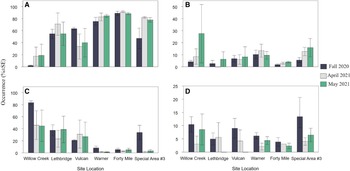
A total of 7342 stems were collected from six new wheat fields sampled in September 2020 and resampled in April 2021 and May 2021 (Table 4). All fields in each sampling period had measurable C. cinctus damage or C. cinctus larvae, but numbers ranged widely, based on where the samples were taken. Stem cutting was lowest at the Willow Creek site and highest at the Forty Mile site during all sampling periods (Table 4). At Forty Mile, the proportion of cut stems with larvae was highest, whereas the Lethbridge field site had the lowest proportion of stems with larvae (Table 4). Larval mortality varied based on field (x 2 5 = 177.25, P < 0.0001) but was not affected by sampling period at any field except the field site in Special Area #3 (a rural municipality in southeastern Alberta; Table 3). At this field, mortality was lower in fall 2020 compared to the two sampling periods in spring 2021 (Fig. 2A). Fungus-associated and unknown mortality were irregular in the second year of the study, ranging from 0 to 27.6% and from 0 to 9.0%, respectively (Fig. 2B and D). Notably, the rate of fungal infection at the Willow Creek field site was nearly double that of the other fields during the May 2021 sampling period (Fig. 2B and D).
Total number of stems dissected, percentage of Cephus cinctus–cut stems, and percentage of cut stems with C. cinctus larvae present (± standard error) when fields were sampled in September 2020 and again in April and May 2021.

Observations (% ± standard error) of A, live Cephus cinctus larvae; B, fungal-associated larval mortality; C, parasitism-associated larval mortality; and D, unknown mortality from the fall 2020 and spring 2021 larval mortality surveys.

Discussion
Sequential sampling of harvested wheat fields in the fall and following spring yielded two key observations. First, in the majority of the wheat fields, C. cinctus mortality was not affected by time, and the proportion of the larval population alive in the preoverwintering larval phase was approximately equal to that observed during the spring postoverwintering phase of larval development. In addition, mortality due to unknown factors, which could have included abiotic stress, was minimal in all sampling periods in both years of the study (i.e., < 10%), which provides indirect evidence that it is unlikely that winter weather, even extreme conditions, impacts C. cinctus populations. These results agree with past studies, which also concluded that overwintering abiotic conditions do not affect C. cinctus mortality (Morrill et al. Reference Morrill, Gabor and Wichman1993; Cárcamo et al. Reference Cárcamo, Beres, Herle, McLean and McGinn2011). Second, the present study highlighted the field-level variability of C. cinctus larval mortality in wheat fields in southern Alberta. Both of these key observations have implications for management of C. cinctus. Specifically, scouting and surveying as many individual fields as possible is needed in the fall of one year to provide the highest level of resolution for accurate predictions of potential C. cinctus densities in the upcoming growing season. Sampling many fields is needed because of the variability between field locations that we observed in this study. However, because there was very little unexplained mortality between the fall and spring sampling periods, sampling once in the fall and accounting for parasitism of C. cinctus can provide a putative forecast of C. cinctus risk between years. Insect population forecasting, coupled with in-season scouting, helps to ensure that appropriate actions (e.g., planting solid-stem wheat or planting an alternative crop) can be taken to avoid yield losses.
In addition, both of our key observations provide important information that will contribute to the future development of phenology models and forecasting systems for C. cinctus in Canadian agroecosystems. For example, phenology models are initiated in the spring with an estimate of larval density (see Olfert et al. Reference Olfert, Weiss, Vankosky, Hartley and Doane2020). In the case of C. cinctus, the density of viable larvae observed in the fall can be used as an estimate of the viable larval density in the spring with confidence. This is because we observed that abiotic conditions have minimal, if any, impact on overwintering survival and that the proportion of viable larvae in the fall is approximately equal to the number of viable larvae found in the spring. Phenology models can also incorporate the impact of natural enemies and other mortality factors (see Olfert et al. Reference Olfert, Weiss, Vankosky, Hartley and Doane2020); because mortality factors varied spatially, it could be difficult to accurately incorporate the effects of mortality due to natural enemies on C. cinctus into models for wide geographic areas.
The present study aimed to sample fields in southern Alberta with known C. cinctus populations, but logistical constraints prevented us from obtaining detailed information about field histories for all of the fields (e.g., previous crop rotations, products applied, etc.). Therefore, that information could not be accounted for in our analyses. Despite this, our results allude to the potential effect of field-scale differences in pest management, agronomic practices, and overall landscape ecology on C. cinctus larval mortality. Several past studies have highlighted the effect of field configuration on the survivorship and overall population densities of C. cinctus. For example, cultural methods that influence C. cinctus infestation rates and female oviposition behaviour, such as changing wheat row spacing and seeding rates (Luginbill and McNeal Reference Luginbill and McNeal1958; Beres et al. Reference Beres, McKenzie, Cárcamo, Dosdall, Evenden, Yang and Spaner2012), delaying seeding date (Morrill and Kushnak Reference Morrill and Kushnak1999; Sing Reference Sing2002), and managing soil nitrogen and phosphorus levels (Luginbill and McNeal Reference Luginbill and McNeal1954; Delaney et al. Reference Delaney, Weaver and Peterson2010), decreased wheat stem sawfly densities within fields or in greenhouse experiments. Crop rotation can also affect C. cinctus population densities because adults are regarded as poor fliers (Ainslie Reference Ainslie1929). Although these studies focused on understanding field-level C. cinctus population densities, cultural control tactics may also influence larval mortality and C. cinctus natural enemies. Currently, agronomic practices relating to C. cinctus larval enemies have primarily focused on parasitoid conservation. For example, overwintering B. cephi larvae can be preserved in a field by leaving the bottom one-third of wheat stems standing after harvest (Meers Reference Meers2005). Parasitoid populations can also be protected from cannibalism by nonparasitised C. cinctus larvae when other suitable C. cinctus host plants (i.e., wild oats, Avena fatua Linnaeus (Poaceae)) are present to act as population sinks (Weaver et al. Reference Weaver, Sing, Runyon and Morrill2004). Future studies could explore how other agronomic practices influence populations of both C. cinctus and their natural enemies to further improve integrated pest management strategies for Canadian wheat producers.
Larval mortality of C. cinctus did not change significantly between the sampling periods in either study year except for one field, located in Special Area #3, between fall 2020 and spring 2021. In this field, the proportion of larvae that were alive in the fall 2020 sampling period was much lower than in the two spring 2021 sampling periods. In the same samples, parasitism rates decreased from about 39% in fall 2020 to less than 5% in spring 2021. Although these differences were statistically significant, the difference is likely a sampling artefact, arising from the destructive nature of the sampling protocol that did not permit the same wheat stems sampled in fall to be examined again in the spring. By chance, the samples collected in the fall simply had more dead C. cinctus larvae and more parasitoid larvae than the samples collected in the spring did. Overall, the minimal difference in C. cinctus larval mortality over time at the majority of the study fields agrees with past research that found the overwintering larval mortality was low and had little influence on wheat stem sawfly population dynamics (Morrill et al. Reference Morrill, Gabor and Wichman1993; Cárcamo et al. Reference Cárcamo, Beres, Herle, McLean and McGinn2011).
The lack of difference in C. cinctus larval mortality between fall and spring sampling periods was unlikely the result of cold stress or other abiotic factors associated with winter weather because mortality due to “other” or unknown factors did not change between fall and spring. Cephus cinctus larvae overwinter in hibernacula inside wheat stems near the soil surface, where they are protected from harsh winter weather; several authors have previously observed that mortality associated with the overwintering period is negligible (Morrill et al. Reference Morrill, Gabor and Wichman1993; Cárcamo et al. Reference Cárcamo, Beres, Herle, McLean and McGinn2011). Our results agree with their observations.
Cephus cinctus larval mortality was also effectively static between fall and spring sampling periods because we observed no real change in mortality attributed to parasitism or fungal pathogens between sampling periods. From our samples, we observed two biotic sources of mortality: parasitism and disease related to fungal pathogens. There was no evidence of predation on C. cinctus larvae by clerid beetles in our study, although predation has been documented by others (Morrill et al. Reference Morrill, Weaver, Irish and Barr2001; Meers Reference Meers2005). To our knowledge, all of the fields sampled grew conventional hollow stem wheat, so we do not expect that any wheat stem sawfly larval mortality occurred in this study due to host plant resistance. Parasitism by both parasitoids, Bracon cephi and B. lissogaster, was grouped together for our analyses because differentiating between the parasitoids in their larval stage is not possible (Runyon et al. Reference Runyon, Hurley, Morrill and Weaver2001). The majority of parasitism was likely caused by B. cephi because it is the predominant parasitoid species in Alberta (Cárcamo et al. Reference Cárcamo, Weaver, Meers, Beres and Mauduit2012). Parasitoids overwinter as larvae within the lower internodes of wheat stubble and resume their development the following spring (Nelson and Farstad Reference Nelson and Farstad1953). Therefore, although parasitoids are an important larval mortality factor for the summer C. cinctus larval phase, they are not expected to influence mortality between growing seasons. The next most common mortality factor, fungal infection, was observed in every field but never at levels above 30%. This result matches the conclusions from Sun’s (Reference Sun2008) postharvest survey, which was conducted in Montana winter wheat fields and reported that fungal infection could cause 10–30% mean overwintering larval mortality. Similar to parasitism, fungal infection levels are unlikely to have changed between growing seasons because dormant fungal pathogens overwinter within remaining wheat stubble and other crop residues and only become active again under warm and moist conditions (Sutton Reference Sutton1982). Although fungal pathogens may become active again in the early spring months under ideal environmental conditions, the fungus may still not infect the postdiapause C. cinctus larvae because the fungal hyphae still need to break through the larva’s protective hibernaculum. In scenarios where fungal infection did seem to increase in the spring, such as was seen at the Willow Creek field in 2021, fungal infection did not contribute to additional C. cinctus larval mortality in that sampling period. Similar conclusions from a C. cinctus multiple decrement life table study from Montana, wherein the authors used barley cultivars, corroborate the findings of the current study (Achhami et al. Reference Achhami, Peterson, Sherman, Reddy and Weaver2020). Overall, C. cinctus larval survivorship from the fall into the early spring months did not significantly change, probably because the major mortality factors were inactive in the winter and early spring and because C. cinctus are well adapted to survive winter weather.
Conclusion
Here, we demonstrate that C. cinctus infestation levels vary between fields in southern Alberta, Canada, including in years where the overall population density is observed to increase. The causes of C. cinctus larval mortality also varied in terms of their impact between fields during our study. Although not tested explicitly here, the degree of variation we observed between fields could arise from differences in landscape dynamics and agronomic practices (i.e., conservation of wheat stubble at harvest) that influence C. cinctus (and B. cephi) field population dynamics. Future research is needed to further elucidate the factors driving variation in C. cinctus population dynamics across western Canadian landscapes.
The present study also highlighted that C. cinctus population dynamics are not susceptible to measurably increased mortality due to abiotic conditions or biotic mortality factors between growing seasons as larvae undergo their overwintering phase and subsequent spring development. This information will contribute to the future development of phenology models and C. cinctus population forecasting tools. Recently constructed Leslie matrix population models have emphasised that winter larval mortality should have the greatest impact on the growth rate of wheat stem sawfly because individuals are in this life stage the longest (Rand et al. Reference Rand, Richmond and Dougherty2017, Reference Rand, Richmond and Dougherty2020). However, in the absence of consistent and wide-reaching mortality pressure on late-stage C. cinctus larvae, as we observed, it is unlikely that overwintering and early-season larval mortality is an important factor in the overall population dynamics of wheat stem sawfly in western Canadian agroecosystems.
Acknowledgements
This project was funded by the AgriScience Program as part of the Canadian Agricultural Partnership, a federal–provincial–territorial initiative. The project (Activity 2 of the Integrated Crop Agronomy Cluster) was funded in the AgriScience Program by Western Grains Research Foundation, Saskatchewan Wheat Development Commission, Manitoba Crop Alliance, Saskatchewan Pulse Growers Association, Alberta Wheat Commission, Manitoba Canola Growers, Manitoba Pulse and Soybean Growers, Saskatchewan Canola Development Commission, and Prairie Oat Growers Association. Graduate scholarships supporting D.M.S. were awarded by the Saskatchewan Wheat Development Commission. We gratefully acknowledge Scott Meers for his early advice on the study design, Shelley Barkley (Alberta Agriculture and Irrigation) for her assistance in locating fields for sampling during the project, and the farmers who gave D.M.S. permission to sample their fields.
Competing interests
The authors declare that they have no competing interests.