Introduction
In nursing homes, death and dying are a common reality, for both the resident older people and the staff. How death and dying is articulated in such a context, and the actions that take place there, could be described as constituting a discourse in which staff interpret and understand their practices. The nursing-home discourse manifests through the caring actions of staff, and can be interpreted with reference to society and its attitudes to older people and their death and dying (Howarth Reference Howarth2007; Walter Reference Walter1994). During the 20th century in the western world, discussion of death became taboo, and encounters with death and dying were concealed and displaced from people's homes to be managed by hospitals and professionals. The overall goal in hospital was cure, and death and dying did not fit in. Death could be seen as a medical failure (Callahan Reference Callahan1993; Walter Reference Walter1994; World Health Organization (WHO) 2004).
Older people's death and dying has not attracted the same level of interest as death and dying among younger people (Hallberg Reference Hallberg2004; McIlfatrick and Johnston Reference McIlfatrick and Johnston2007; WHO 2004), even though many of the oldest old, aged 85 or more years, die in institutions (Ahmad and O'Mahony Reference Ahmad and O'Mahony2005; Gomes and Higginson Reference Gomes and Higginson2008). Older people do not have the same access as younger individuals to specialised end-of-life care (i.e. palliative care), and are thus disadvantaged (Addington-Hall, Altmann and McCanhy Reference Addington-Hall, Altmann and McCanhy1998; Dwyer Reference Dwyer2008; Hallberg Reference Hallberg2006; Steers, Brereton and Ingleton Reference Steers, Brereton and Ingleton2007; WHO 2004). Frailty, ageing, dying and death challenge the prevailing discourse in society, which emphasises values such as health, strength, autonomy, and healthy and active ageing (WHO 2002). Such discrimination could be interpreted as an expression of ageism, in which the deaths of older people are seen as very natural and therefore have no claim to any special treatment. There is a risk that older people are treated as homogeneous. Studies, however, stress the importance of meeting the unique needs of individual older people (Seymour et al. Reference Seymour, Whiterspoon, Gott, Ross, Payne and Owen2005), including that good palliative care be taken into account and also given in nursing homes.
Dying in old age has been described as difficult to recognise (Hockley Reference Hockley, Hockley and Clark2002; WHO 2004), and the breakpoint between an early and a late palliative phase has also been described as evasive (Jakobsson et al. Reference Jakobsson, Bergh, Gaston-Johansson, Stolt and Öhlén2006). Another factor that may contribute to the problem of recognising the onset of dying is that some older people have difficulties communicating their needs. In Sweden, a move to a nursing home is preceded by an assessment of the need for such accommodation. Radical organisational and funding changes in recent years mean that now only those older people whose care needs cannot be met in any other way are given a room in a nursing home. Consequently, most of those who move into a nursing home are in advanced old age and sick, frail or dependent (Meinow Reference Meinow2008; Österlind et al. Reference Österlind, Hansebo, Lindqvist and Ternestedt2009), and many are in what could be described as an early palliative phase. Lack of beds also means there are few opportunities to choose between different homes (Sainio and Hansebo Reference Sainio and Hansebo2008).
It is evident from various health-care and social-care steering documents that the end-of-life is an important area of care but that nonetheless consistent national guidelines are lacking. Many municipalities and county councils have no end-of-life care programmes, regardless of the age of care recipients, although the number is increasing. These care programmes are distinctive in that they provide detailed, concrete tools for health-care staff rather than being abstract and general. The process by which older people's need for palliative care is rendered invisible can be interpreted in part as a conflict of goals between activating older people in various ways at the end-of-life and providing good palliative care. In order to shed light on how the prevailing discourse is perceived in the nursing-home setting, the aim of this study is to explore the discourse of death and dying by drawing on the understanding and reasoning of the staff.
Discourse analysis
In recent decades, discourse analysis has led to increasing interest in qualitative and nursing research (Buus Reference Buus2004; Cheek Reference Cheek2004; Crowe Reference Crowe2005; Traynor Reference Traynor2006). This method of analysis offers nursing researchers several approaches for analysing empirical data and enables them to identify how sources such as the media, words, phrases, and texts influence particular discursive contexts and how these in turn influence practice (Crowe Reference Crowe2005; Howarth 2000/Reference Howarth2007). As a research tool, discourse analysis enables one to gain an understanding of a social practice that may be hidden. A discourse can be described as a web of threads between nodes that form different positions. The positions can have different meanings in the discourse, depending on the context, but they can also unify it (Howarth 2000/Reference Howarth2007). This study is based on a discourse theory derived from Foucault (Reference Foucault1971/1993). Discourse theory focuses our perception on our actions and knowledge about the world as interpreted by, and influenced by, the language, texts and practices we use. Science is, from this perspective, a way of establishing the framework and limits of what is possible in efforts to make life more manageable. Without discourses, there are no opportunities to create meaning. Each individual entity or event stands for itself, without relation to meaningful categories. As such, discourse theory is post-structural thought, and unlike the latter focuses on interaction and creative significance (Potter Reference Potter1996). Such a theoretical and methodological springboard implies a search for categories and organised concepts that create ‘temporary pinning of sense’ (Nilsson Reference Nilsson2009). The method involves a deconstruction of the text to search for contradictions and hegemony (Laclau and Mouffe Reference Laclau and Mouffe2001).
To summarise, discourses are ongoing processes under negotiation. A discourse theoretically represents a social wholeness, or distances itself from its surroundings. This means that the nursing home and its staff can be seen as a practice that forms a discourse. It is not as simple as that, however, as several discourses are usually present at the same time (Howarth 2000/Reference Howarth2007). Social structures are more often found in subjects that can be placed in several positions; these positions are seldom rigid.
Methods
The study sample
To gather knowledge of the nursing-home discourse, focus-group discussions were chosen as the method of data collection. Focus-group discussions have been described as a suitable method for gaining access to people's everyday communication and for collecting data from several people at the same time, concerning how and why they talk and think about a particular topic in a certain way (Kitzinger Reference Kitzinger1995). To a large extent, this everyday communication increases our understanding of people's acknowledged or hidden knowledge of the subject in focus and the context this reflects. Kitzinger (Reference Kitzinger1995) argued that focus-group discussions facilitate discussions, promote the articulation of reflections on earlier unspoken experiences, and encourage individuals to talk and contribute to discussions of taboo topics.
Five focus-group discussions were held with a total of 28 staff (19 women and nine men) aged 20–64 years, who were on duty on the day of the discussions. The participants were recruited from four nursing homes. One had over 100 residents in different wards, while the other three each housed about 60 older people with differing needs. Focus groups 1 and 2 comprised staff from two different wards of the large nursing home. Each focus group involved between three and nine staff and was homogeneous in the sense that the staff worked on the same ward. On the other hand, the focus-group members were various professionals, including registered, enrolled and assistant nurses of both genders and of various ages. A physiotherapist participated in one of the focus-group discussions. The staff had been employed in their then wards for between nine months and 46 years (mean 5.3 years, median 2.6 years), with previous experience of caring ranging from none to 46 years (mean 12.7 years, median 9.6 years).
The focus-group discussions
Each focus-group discussion lasted between 45 and 60 minutes and took place in a room by the participants' ward. At the start of each discussion, the participants briefly introduced themselves to make it easier to identify each voice when transcribing and analysing the data (Jamieson and Williams Reference Jamieson and Williams2003). The moderator (first author) posed introductory questions to stimulate the whole group to become involved in the discussions. Two experienced researchers alternated as observers and wrote field notes about the participants' activity and interactions. The staff were asked to share with the other focus-group participants their thoughts about and experiences of death, dying, and end-of-life care of older people. The participants' responses were followed up with prompts and probes such as, ‘Can you give a concrete example?’ The moderator and observer discussed each focus-group session immediately upon its conclusion.
Data analysis
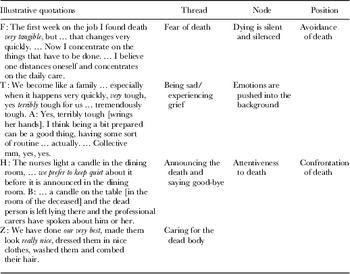
Discourse analysis is more of an interpretive process than a step-by-step research method and takes account of interpretations from both speech and text in relation to their social context (Howarth 2000/Reference Howarth2007). The transcriptions of the interviews were read through several times to gain an initial impression of the participants' descriptions of death and dying in relation to social practice; that is, the nursing home context. The text was examined with respect to how dying was addressed and how older people's death and dying was communicated. After the initial reading, dominant statements were labelled concerning what was said and how. During the reading, labelling and interpretation, three nodes and two positions were expressed (Table 1). The following presentation of the findings gives examples of the interaction among staff members to exemplify the discourses.
The discursive web – threads, nodes and positions

Note: The initials are of pseudonyms.
Ethical considerations
The local Research Ethics Committee approved the study (2001). First-line nurse managers from the four nursing homes informed the staff about the study and provided them with both oral and written information. The interviewer (first author) repeated this information at the start of each focus-group discussion. All the participants gave their informed consent to be involved in the focus groups.
The findings
The focus-group sessions were one of very few occasions when the staff had had the opportunity to sit down and engage in a focused discussion about death and dying. Their daily work was mainly characterised by ‘doing’ not ‘reflecting’. The main findings have been conceptualised in three nodes: dying is silent and silenced, emotions are pushed into the background, and attentiveness to death occurs after the moment of the older person's death. These nodes represent a nursing-home discourse that distances death and dying from life and characterises a movement between two partly overlapping positions, avoidance and confrontation of death and dying.
Dying is silent and silenced
This node is distinguished by the thread ‘fear of death’ because first and foremost it appeared to express this emotion among the staff. The staff keep death at a distance by concentrating on tasks and routines. Death and dying is not a subject that they discuss with the older people or each other. Death is surrounded by silence. In the first focus-group discussion, Evelyn, who had been employed in one of the nursing homes for almost a year, recalled that when she started to work there, she experienced dying as extremely tangible and present. She described how she quickly suppressed such feelings by becoming involved in the daily routines at the nursing home, such as cleaning the old people's rooms or the common areas. Others, like Carl, who had over 20 years' experience of caring for frail older people, were personally extremely afraid of death. Carl said that his own fear of death prevents him from going near a dying person. Monique said that she could understand his fear of death, as she had also experienced it previously. She elaborated, ‘I am no longer afraid [of death]. But not to the extent that I volunteer to care for someone who is dying, although I don't think that it is scary any more’. Monique's attitude to death was ambivalent. She led us to understand that she no longer has the same fear of death that she experienced in the early days of her career, while at the same time she tries to avoid caring for older people who are dying.
Angelina, who was just over 20 years old, joined the discussion and expressed the view that the death and dying of old people as a natural phenomenon was associated with advanced age. She was frightened by the death of an old person, because it reminded her of her own mortality. For Janet, who had over ten years' experience of the death and dying of old people in a nursing home, however, death did not pose a threat. The fear associated with the death of old people in a nursing home was evident in the other focus-group discussions. In Group 2, for example, Susan reflected on how the staff's feeling of inadequacy had a negative effect on the old person's final phase of life:
It is difficult for us staff to accept that a person can actually sense and know that his/her life will soon end. Perhaps we could do more if we had the strength and ability to accept the situation as it is.
Susan believed that the care of older people would be improved by increased knowledge about death and dying. Her statement was followed by a long silence; some of the participants cleared their throats, and after a while, Susan gave a deep sigh and whispered that ‘death and dying is difficult’. After that there was another pause in the discussion, and Susan began to talk about her feelings of inadequacy and difficulties in facing and talking about death and dying. Death was silenced in discussions among the staff members, as well as in parallel monologues in the focus-group discussions.
In the Group 3 discussion, Frank stated that they, as staff, do not talk about death and dying, except in cases where the end-of-life phase deviated from the usual pattern. He said, ‘I don't think we actually talk very much about it [death and dying]. At the moment I don't reflect on it, at all’. Frank continued by drawing a parallel with what he thought was the attitude of old people towards death and dying. He said, ‘I suppose they [older people] avoid it in exactly the same way as the staff do’. Frank paraphrased when he talked about death and dying or mentioned that one of the old people had died. Frank interpreted the silence to mean that the staff were uncertain about how to deal with the situation – in this way death is made silent. In the Group 5 discussion, Gina and Mary related how older people had opportunities to talk about death and dying, but that the staff left the responsibility for starting the conversation to the old people:
Gina: We [sighing] actually never talk with them about death and the final phase of life. We don't do that.
Mary: They have the opportunity [to talk about death]. They have a contact person with whom they discuss most issues that they need help with. The issue can arise. But we actually don't raise it. It is difficult; one does not know how to deal with the matter and how to talk about it.
Mary's opinion was the residents had opportunities to talk about death and dying but did not use them to a great degree. The quotations make clear, however, that the staff distanced themselves from dying persons, while life goes on in the nursing home.
Emotions are pushed into the background
The node ‘emotions are pushed into the background’ refers to the low prominence in staff discourse of references to relationships between the staff and the nursing home residents and to the associated emotions. This is supported by the thread being sad/experiencing grief. The staff's accounts indicate that caring for older people at the end-of-life has two aspects: it provides paid employment for the staff, and they perceive themselves sometimes as family. In the Group 4 discussion, Peter stated that death is emotionally exhausting:
It is distressing [when somebody dies]. One gets to know a person over a longer period and has sat [at the old person's bedside] and washed [him/her]. In one way, we are like relatives who do their bit.
Other staff had had similar experiences and explained that they have had to negotiate with themselves in different ways and develop strategies to contain the emotions aroused by the old person's death. Angelina said:
One forms a bond with all the residents. I think it is difficult every time one of them passes away. I think that it depletes one's energy, and you know that the same thing will happen again and again. You cannot allow yourself to be hurt too much, because if you do, you would not be able to work here.
Ruth had a different perception of how staff can best cope with the death of an old person and the emotions it gives rise to. She considered it important to allow oneself to grieve. Ruth held that sorrow will only multiply if one fails to address it, even when the source of the distress is one's job, working in close proximity to death. In her words:
People deal with sorrow and death in different ways. It is important to deal with it [the sorrow], that I have a sorrow inside that is building up and becoming even greater. It is quite okay to mourn for a resident who has passed away.
Ruth had the opinion that emotions should be dealt with. For her, addressing sorrow is a pro-active way of becoming more aware of her own way of dealing with emotions. The staff described a feeling of emptiness after the death of a resident, while at the same time they experienced peace and calm when they considered that, from the old person's perspective, death had come at the right time. Brenda expressed the opinion that there is a lack of routine support for staff members when they provide end-of-life care. In effect, the staff's emotions are swept under the carpet.
Attentiveness to death
The moment of death is a turning point. The node ‘attentiveness to death’ is task-oriented and arises when the old person dies. The person within the dead body becomes visible in the staff's thoughts and actions. The fact that the old person's spirit is difficult to capture leads to a sense of uncertainty among the staff. Awareness of his/her death is one reason for a greater focus on him/her as a person. This node is supported by the threads announcing the death and saying good-bye and caring for the dead body. A feeling of emptiness as well as a sense of loss is experienced by both the nursing-home staff and the residents, when an old person has died. As Angelina put it, ‘when someone passes away, it means that someone is missing. Even if not everyone knew him/her other than by name, they contribute something to the group [of old people]’. Different rituals seemed to have been developed in the nursing homes. In one, all the staff were given the opportunity to say good-bye to the deceased, while in others the staff members lit a candle to announce the death. Holly did not know what the old people think or feel about the rituals performed by the staff. As she reflected:
Suddenly a candle appears on the table at her place and then they know that she is dead. I wonder what it feels like. We have no idea, because hardly anyone passes any comment.
While rituals fulfil a function for the staff, they could be especially important to the residents, which became clear when Brenda recollected a time when the staff forgot to light a candle to mark a death. An unspoken ritual became evident, because the residents themselves provided a candle and lit it.
The death of an old person leads to a different way of talking about him or her. Proximity to death and the dead person is something powerful, and the deceased is described as a person who should be shown consideration. Zaida explained such situations very well:
It is awesome. One actually feels very brave afterwards. I have never experienced death in my own culture, where it is a very important event. Now I am close to it, I see the reality, a person who we washed and made presentable [sighs]. That is awesome and it is clear that it is draining.
Holly agreed, and emphasised that it is still a person lying there, not just a body. Preparing the deceased reflects the importance the staff place on the dead body looking perfect. Proximity to the deceased demands extra care, both in terms of actions and discussions among staff members. As Holly explained:
Although we are aware that he/she is gone, we don't want to cause offence. We turn the body and when it is lying on its back again we take care that the hair is nicely combed. Everything should be perfect. … One almost feels like whispering.
As the staff treated the dead person as a live human being, they saw their responsibility extending beyond the nursing home to include the journey to the mortuary. One example of the importance of showing respect for the deceased as a person concerned dressing the body. Carol described how the staff dressed the deceased person in their own clothes and chose colours that they had liked to dress in during their life. It was obvious during the focus-group discussions that it was important for the staff that the deceased could be recognised as a living person who still needed care after his/her death.
Discussion
The discourse of death and dying in the nursing-home context was characterised by movements between three nodes of interest. It was an obvious struggle for meaning in relation to death and dying that created a rather unstable structure of discourse. Two of these, ‘dying is silent and silenced’ and ‘emotions are pushed into the background’ highlight the fact that the death and dying of older people and the relationships that are built between the staff members and their elderly clients need attention. The structure of the discourse was characterised by the contrary positions of avoiding and confronting the death, with the main focus being on avoidance. Death was held at bay, and the emotions experienced by the staff when an old person died were ignored. According to Lloyd-Williams, Sixsmith and Sixsmith (Reference Lloyd-Williams, Sixsmith and Sixsmith2007), issues related to death and dying are seldom addressed by professionals in nursing homes (cf. Andersson-Segesten Reference Andersson-Segesten1989), and old people could be left alone in silence (Dwyer Reference Dwyer2008; Walter Reference Walter1994; Whitaker Reference Whitaker2004).
This study's findings can be related to the prevailing discourse about independency, dependency and the fear of frailty in society. The values of independence and autonomy are stressed in different steering documents for elder care, for example in the Swedish Social Service Act (Ministry of Health and Social Affairs Reference Lloyd-Williams, Sixsmith and Sixsmith2001). It seems reasonable to assume that a combination of individual and organisational factors have contributed to the small attention given to death and dying in nursing homes. In a way, death and dying could be described as silenced. Invisibility and silence can be related to the staff's belief that death can be held at bay if they maintain normality (cf. Yates and Stetz Reference Yates and Stetz1999), such as encouraging a person close to death to eat (cf. James, Andershed and Ternestedt Reference James, Andershed and Ternestedt2007) or concentrating on practical duties (cf. Blomberg and Sahlberg-Blom Reference Blomberg and Sahlberg-Blom2007). By so doing, the staff distance themselves emotionally from difficult situations. Dunn, Otten and Stephens (Reference Dunn, Otten and Stephens2005) revealed that staff who fear death have more negative thoughts about caring for dying people than those with less fear of death. It has also been found that nursing-home staff tend to avoid becoming deeply engaged in the process of older people's dying, because of the emotional stress caused by their daily workload (Jenull and Brunner Reference Jenull and Brunner2008). The present study has indicated that organisational factors could contribute to emotions being pushed into the background. It is essential that the staff's experiences of and reactions to death and dying are given attention (Dwyer, Nordenfelt and Ternestedt Reference Dwyer, Nordenfelt and Ternestedt2009), and that they receive support and guidance (Karlsson, Fagerberg and Ekman Reference Karlsson, Fagerberg and Ekman2008). Otherwise, there is a risk that their unmet expectations will lead staff to quit their jobs (Fläckman et al. Reference Fläckman, Fagerberg, Häggström, Kihlgren and Kihlgren2007).
The third node of interest was somewhat surprising. ‘Attentiveness to death’ was associated with an older person's death, something that can be perceived as obvious and an inescapable fact. This resulted in rituals about taking care of the dead body, whereby the staff members strived to do what they believed the deceased would have wanted. They tried to respect the person within the dead body. Death became linked to life through the performance of rituals, when caring for the dead body. Walter (Reference Walter1994) described rituals as functioning as mediators for transforming death into a manageable event for the staff. Another such ritual was the announcement of death, such as the lighting of a candle. Walter (Reference Walter1994) describes such rituals as signs of traditional death. The popularity of this ritual can be understood against this background, although that is probably not the only reason for it.
The articulation and practices of silence are obvious and have been noted by other studies (cf. Costello Reference Costello2006; Dwyer Reference Dwyer2008; Whitaker Reference Whitaker2004). This raises several ethical questions, including the issue of human dignity. A fundamental question is whether elderly people's need for palliative care is marginalised because they are old and dependent, which, if so, is an expression of ageism. Seeing older people's death as something natural could also lead to lack of awareness of the need for palliative care, as well as for the education and support required by staff in this area. Our study has demonstrated that many staff wished for more knowledge and support in order to do a good job. The articulation and practices of silence highlight the need for a change in the content and scope of care for older people in a way that visualises dying as a process requiring attention before the moment of death. Much can be learnt from the development of hospice and palliative care, as described in several studies (Davies and Seymour Reference Davies, Seymour, Hockley and Clark2002; Dwyer Reference Dwyer2008; Kristjanson, Walton and Toye Reference Kristjanson, Walton and Toye2005; Lo and Woo Reference Lo and Woo2006; Österlind Reference Österlind2009). Another natural part of palliative care philosophy is supporting staff by means of education and supervision. One assumption is that this also could promote personal growth and enhance clinical competence.
Methodological considerations
Discourse analysis is usually regarded as a qualitative research method. Such methods can highlight topics that are important and merit further investigation. The intention was not to generalise, but to reflect a common discourse of death and dying in nursing homes located in a narrow geographical area in a large city of Sweden. The convenience method of recruitment of informants was a limitation of this study. First-line nurse managers at each nursing home were informed of the study, and they invited the staff to participate. Only those staff who were on duty on the day of the focus-group discussions participated in the study. How this might have affected the results is not clear.
The most appropriate size for a focus-group is frequently debated (Kitzinger Reference Kitzinger1995; McLafferty Reference McLafferty2004). One of our focus groups had only three staff. Although this can be considered a limitation in methodological terms, we decided to hold the session for ethical reasons in order to allow the voices of the staff to be heard, despite the small size of the group. On the other hand, all participants were employed on a regular basis in the nursing homes and thus represent a nursing-home discourse built on the current values and norms in a particular geographical area. Furthermore, it seems reasonable to question whether the structure of the focus groups influenced the results. The heterogeneity of the various professional categories was offset by the homogeneity of the working group as a whole (Kitzinger Reference Kitzinger1995). Kitzinger (Reference Kitzinger1995) argues that a range of professionals in the same group can illuminate different perspectives in the focus-group discussions, while McLafferty (Reference McLafferty2004) states that homogeneous focus groups appear to function better than heterogeneous ones. The staff also had different cultural backgrounds and thus their attitudes to life and death differed. The age of the staff was another important aspect. Some were very young, around 20 years of age, while others were older and had many years' experience of elder care. The differences in age may have influenced the results. Although the focus-group sessions had some limitations, their strengths outweighed their weaknesses.
Conclusions
Given the diminishing number of nursing-home beds in Sweden, today only older people whose care needs cannot be met in any other way are admitted. Most of those who move to a nursing home are in advanced old age (Froggatt and Payne Reference Froggatt and Payne2006; McCallum et al. Reference McCallum, Simson, Simson and Friedland2005), are in deteriorating health and their dependence on others is increasing. Death and dying in a nursing home is common, receives little attention, and is seen as a ‘natural’ conclusion of life, yet it still evokes fear and avoidance. Obviously, life and death are present all the time in the nursing home. The staff have to balance between these realities. The nursing-home discourse can be viewed as a social practice representing two positions, one that holds death and dying at bay – avoidance of death – and one that acknowledges death – confrontation of death. Based on the staff's accounts, it is reasonable to assume that they move between these two positions, and that both can be present at the same time. An alternative discourse or way of thinking is possible, where life and death are intertwined and equally supported. It is important that death is not made invisible, and that life at the same time has room for death. This does not mean that we want to replace the present discourse with another, but rather complement it with the framework of palliative care. This should, however, take place by supporting staff to take advantage of their existing knowledge and experience, and can be achieved through education, ongoing support and supervision.
Acknowledgements
The study reported in this paper was part of a larger project entitled ‘The significance of the home as the final care site – ethics in the spheres of the home and the institution’. Both the larger project and this study were supported by a generous grant from the Vårdal Foundation in Sweden. This study was also supported by grants from the Family Erling Persson Foundation and the Johanniter Foundation, Sweden.