

The status of women and politics research in State Politics and Policy Quarterly in some ways reflects women’s status in the centers of state politics themselves – state capitol buildings. Across the US, states face the need to renovate and restore capitol buildings that date back, in many cases, to the 18th and 19th centuries. Among the key renovations in these chambers is adding women’s restrooms. For example, the Kentucky Capitol, built in 1870, offers women legislators two stalls, compared to multiple stalls, complete with speakers to broadcast the discussion in the chambers, in men’s facilities. “Potty parity,” notes the AP, remains an issue in many capitol buildings because they were built in an era when women were not allowed to be legislators.Footnote 1 While two stalls might have functioned for the 11.6% of legislators who were women (16 people) in the Kentucky legislature when SPPQ began in 2000, it is certainly inadequate for the 29.7% of legislators in Kentucky who are women (41 people) in 2026. Even West Virginia, stubbornly inhospitable to women legislators with only 11.2% women (15 people), could probably use more (Center for American Women and Politics 2026a, 2026b).
While issues of restroom access for women legislators may not be the most paramount concern for modern state legislatures, the issue of bathroom access neatly demonstrates the paradox of studying women in state politics. On the one hand, states, rather than the national government, offered earlier forays into politics for women and thus cases for researchers of women and politics to study. Early work on women and politics often focused on the states simply because more women existed to study at this level, compared to Congress (e.g., Carroll Reference Carroll1985; Diamond Reference Diamond1977; Githens and Prestage Reference Githens and Prestage1977; Kathlene Reference Kathlene1994; Kirkpatrick Reference Kirkpatrick1974; Mansbridge Reference Mansbridge1986; Rule Reference Rule1990; Sapiro Reference Sapiro1981; Stewart Reference Stewart1980; Thomas Reference Thomas1994; Werner Reference Werner1968). Furthermore, pressing issues of women’s rights during the early phase of research on political women, such as abortion laws and the ERA, often played out in state contexts.
Despite offering fascinating arenas for study, however, states can also be frustrating places to work, much like a legislature without enough bathrooms. States have various histories, cultures, constitutions, geographies, and unique social forces. Fifty state legislatures, with varying rules and spotty record-keeping practices, can frustrate researchers seeking to understand their subjects. Electoral and policy advancements for women in government are equally complex to analyze because gender intersects with institutions as well as other identity markers, making explanations more complicated than political science prioritizing parsimony and elegance might prefer.
Further, though the study of women and politics has offered important insights to the field of political science and to state politics, most of these insights have not come from the flagship journal for state politics, State Politics and Policy Quarterly. Many concepts fundamental to politics – the gender gap, descriptive and substantive representation, political recruitment and ambition, state feminism, feminist institutionalism, intersectionality – have been coined and/or significantly expanded by women and politics scholars. Most formative research on women and politics appears in books or in journals dedicated to gender studies, such as Women and Politics (1980–2004), Politics & Gender (2005–current), and Journal of Women, Politics, and Policy (2005–current, previously Women and Politics). Recent attention to the gender gap in women authors in the discipline’s top journals highlights the underrepresentation of women scholars in these journals – which is then detrimental to publishing substantive work on women and politics when the women and politics subfield itself is over 90% female (Mealy Reference Mealy2018).
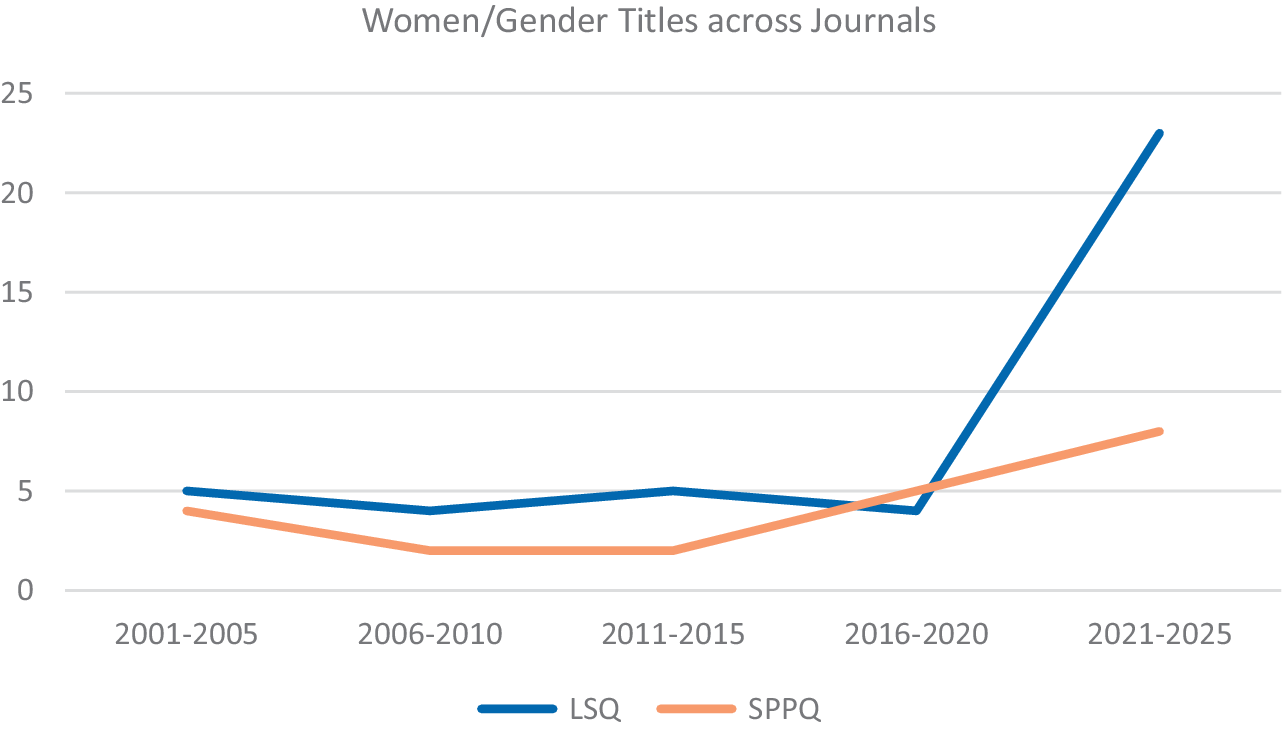
Significant efforts have been made to expand the publication of women and politics research beyond gender-specific journals in recent years; likewise, similar patterns in gender scholarship appear in SPPQ. Over SPPQ’s 25 years (through December 2025), only 21 articles feature the word(s) gender, female, woman/women, and/or diversity (with a focus on women) in their title. For comparison, 24 articles in that time feature the word “diffusion” in the title; this topic, while important to state politics, is arguably a significantly smaller literature than women in state politics. Legislative Studies Quarterly (LSQ), the official American Political Science Association journal for a similarly gendered subfield (Legislative Politics), published 41 articles with “women” titles from 2001 to 2025. However, as Figure 1 shows, both journals increased their gender content substantially in the most recent five years of publication; in fact, half of these articles in LSQ appeared in the most recent five years.Footnote 2 Thus, while women themselves began to appear in significant numbers in state politics in the 1970s and 1980s, it has taken until very recently for women and politics scholarship to integrate into the subfield’s official journal (and arguably, other subfields’ official journals).
Articles featuring women, gender, and/or diversity in their title in State Politics and Policy Quarterly and Legislative Studies Quarterly, 2001–2025.
Source: Compiled by authors.

Figure 1. Long description
A line graph titled Women forward slash Gender Titles across Journals. The Y-axis represents frequency in increments of 5, ranging from 0 to 25. The X-axis lists five-year intervals from 2001-2005 to 2021-2025. Two lines are plotted.
L S Q (blue line):
- 2001-2005: 5
- 2006-2010: 4
- 2011-2015: 5
- 2016-2020: 4
- 2021-2025: Sharp exponential increase to 23
S P P Q (orange line):
- 2001-2005: 4
- 2006-2010: 2
- 2011-2015: 2
- 2016-2020: 5
- 2021-2025: Linear increase to 8
The graph shows both journals remained relatively flat and below 5 units until 2016, after which both saw increases, with L S Q experiencing a much more dramatic rise in the final period.
While one could (as we do here) take a wider scope with what constitutes women and politics research in SPPQ beyond title words, these numbers suggest that there is room to expand the amount of research on women and state politics in the flagship state politics journal. Looking across 25 years of SPPQ articles on women, politics, and policy yields important insights about institutional variation, gendered public policies, and intersectional gendered identities. We know less, however, about women’s political behavior across states. Further, conceptual and measurement challenges still exist between the concepts of sex and gender and the integral role of intersectionality in state politics. We encourage future women, gender, and politics researchers in SPPQ to confront these challenges as we continue to trace women’s presence, impacts, and public policies in the states.
SPPQ as an outlet for women and state politics
Existing research in SPPQ furthers a number of insights about women and politics in the states. These insights center around three key observations about women and politics. First is that we need to understand how institutional variation among the states shapes women elites’ ability to represent women or otherwise participate in politics. One area where institutions vary significantly is in state legislatures; professionalization, sponsorship and cosponsorship rules, and party control can shape the relationship between the presence of women and women’s policy production and effectiveness (Cammisa and Reingold Reference Cammisa and Reingold2004). For example, comparing 74 legislative chambers, Swift and VanderMolen (Reference Swift and VanderMolen2021) conclude that women collaborate via cosponsorship more often in chambers with less polarization, a women’s caucus, and fewer women in leadership positions. Similarly, the presence of more leadership positions in a chamber leads to more women serving in legislative leadership (Hansen and Clark Reference Hansen and Clark2020).
Electoral institutions also vary significantly across states. For instance, moving from multi-member legislative districts to single-member districts decreases the number of women elected to the legislature (King Reference King2002). Term limits, likewise, decrease the election of women to office (Schraufnagel and Halperin Reference Schraufnagel and Halperin2006). Candidate selection mechanisms also matter, particularly for statewide elective office. When lieutenant governors are nominated in primaries, women are less likely to be selected by Republicans, whereas when gubernatorial nominees choose running mates, women and men are equally likely to be chosen (Hennings and Urbatsch Reference Hennings and Urbatsch2016). The effects of these electoral institutions also persist over time. The number of women elected to statewide office and the history of electing women to the state legislature increase the number of Democratic women elected to the legislature while reducing the number of Republican state legislators (Manento and Schenk Reference Manento and Schenk2021). Similarly, when a district increases in women-friendly qualities – for example, its level of urbanity – Democratic women, and particularly non-white Democratic women, are more likely to be elected (Fahey, Pyeatt, and Yanus Reference Fahey, Pyeatt and Yanus2025). Women gubernatorial candidates also fare better in states with a history of electing women and traditions of gender equality and progressive gender views (Windett Reference Windett2011).
Unique to the states, variation in judicial election and selection mechanisms also shapes the degree to which women serve in state judiciaries. The larger the state supreme court bench, the more likely women are to sit on that bench; this structural asset is not the case for racial and ethnic minorities, however (Hurwitz and Lanier Reference Hurwitz and Lanier2003). When women run as challengers to sitting incumbent judges on state supreme courts, they receive an increase in vote share relative to men. This advantage does not apply to women running for open seats or incumbent contexts, nor does it indicate that women challengers are more likely to win, however (Gill and Eugenis Reference Gill and Eugenis2019). Women also do not face bias when state supreme courts choose chief justices, as seniority drives most peer selection (Fife, Goelzhauser, and Loertscher Reference Fife, Goelzhauser and Loertscher2021), although only some states use peer selection, while others use voters to choose the chief justice (Wilhelm, Vining, and Hughes Reference Wilhelm, Vining and Hughes2023).
Importantly, institutional change can exist for the express purpose of gender diversity in state politics. Eleven states have passed legislation that requires gender balance on state-appointed boards. McQueen (Reference McQueen2021) argues that this gender balance legislation, however, does not seem to have increased the candidate pool of women for state office. While other legislative changes, such as term limits, have failed to increase the number of women elected to office (e.g. Schraufnagel and Halperin Reference Schraufnagel and Halperin2006), still others remain to be tested. For example, public financing for state legislative elections has the potential to increase the number of women candidates who run because raising campaign money is a prominent obstacle women name when asked about running (Mancinelli Reference Mancinelli2022).
A second insight on women and politics is that states are of paramount importance to public policy making about issues of importance to women. One policy at the state level that disproportionately affects women is abortion. Research in SPPQ demonstrates that even before the Dobbs decision in 2022, states with Republican partisan control passed more restrictive abortion laws. Democratic women’s presence in chambers decreased some anti-abortion laws but not others (Kreitzer Reference Kreitzer2015). Abortion laws respond to mass public opinion, rather than elite public opinion, in the states (Camobreco and Barnello Reference John and Bargello2008), particularly in states with initiatives and referenda (Arceneaux Reference Arceneaux2002) and depending on restrictions set by state and federal courts, such as judicial rulings and precedents that define the constitutional limits of abortion regulation (Kastellec Reference Kastellec2018). With the rapid change in state abortion laws following the Dobbs decision, some of these relationships between state characteristics and abortion law arguably need reassessment, however.Footnote 3
Similarly, welfare policies writ large set by states disproportionately affect women because women are more likely to experience poverty and thus be affected by variation among state programs.Footnote 4 Barrilleaux and Rainey (Reference Barrilleaux and Rainey2014) conclude that politics, such as the partisanship of the state legislature and governor, outweigh the impact of need in the decision to expand Medicaid under the Affordable Care Act. State government welfare spending also responds to these political cues, favoring the “deserving poor” of senior citizens over other economically disadvantaged groups when political competition is high (Barrilleaux and Bernick Reference Barrilleaux and Bernick2003). Experiments in policy delivery, such as second-order devolution of TANF requirements from states to localities, can be double-edged swords for welfare policy. States with devolved TANF policies experience drops in caseloads and have more punitive restrictions on TANF, but they also show higher earnings for TANF recipients as well. As federal-state devolution allows states to vary the ways in which they deliver social welfare policies, understanding this variation has direct effects on women’s welfare.
Similarly, understanding the relationship between race and welfare policies is women and politics research.Footnote 5 Ojeda et al. (Reference Ojeda, Whitesell, Berkman and Plutzer2019) show that racial threat in a state does not necessarily lead to more restrictive TANF policies, despite the dominance of this narrative in the literature. Higher Black caseloads lead states to have higher requirements for work hours and stronger sanctions for not working; however, they also allow a wider variety of possibilities to fulfill work requirements. Yet, Gordon-Rogers (Reference Gordon-Rogers2025) demonstrates that racial resentment, rather than the percentage of Black population or Black users of welfare, leads to more stringent drug testing policies for welfare recipients in the state. Similarly, Filindra (Reference Filindra2013) argues that states with higher Black populations are less likely to extend TANF to legal immigrants – yet the Black population has no effect on the extension of Medicaid to this same group.
These studies of abortion and welfare policy demonstrate the immense utility provided by comparing policy development across states and over time. Hoekstra (Reference Hoekstra2009) uses historical data on federal and state court decisions, legislators, and constituent preferences to determine whether legislators opted to set a minimum wage for women workers in the early 20th century. She finds that legislators look to signals from the US Supreme Court about whether their laws will be upheld or challenged, even more than they pay attention to signals within their state. Certainly, this scholarship on the minimum wage is applicable to other Supreme Court decisions and state politics that affect women in the 21st century. Recent research suggests a mix of federal signaling and partisan politics drives recent changes in domestic violence firearm laws (Schiller and Sidorsky Reference Schiller and Sidorsky2022), yet the absence of federal policy, and instead women’s representation, drives sick leave policy adoption in the states (Kriner and Way Reference Kriner and Way2025). Federalism has consequences for women’s lives, and these policy analyses are just a few examples of what is possible when centering gender in the study of state politics. Numerous other historic and current examples of policy making on issues that disproportionately impact women are yet to be tapped. Seizing these research opportunities helps us center women who can often be silenced in policy processes.
The third key observation is that women in state politics are not a monolith. While we can continue to learn about women in state politics, while focusing on the “difference” narrative between women and men, the complex differences among women are just as worthy of study as the differences between women and men. For example, early in SPPQ’s trajectory, Cammisa and Reingold (Reference Cammisa and Reingold2004) implored the field to move beyond only comparing women to men and seek to explain differences among women and how these differences condition whether and how women legislators affect public policy. The states, of course, offer a perfect vantage point for comparison among women to explore these differences. Unlike at the federal level, state politics contains significant numbers of Democratic and Republican women, white women and women of color, as well as other differences in comparative institutional, social, and cultural contexts. As of 2025, 31.6% of statewide elective office holders are women, and 33.6% of state legislators are women. Of these women state legislators, 16.4% are Black and 8.8% are Latina.Footnote 6 Thirty-four percent of state court judges are women.Footnote 7 Women of color make up 11–12% of state supreme court justices.Footnote 8
Chief among these significant differences is the exploration of intersectionality in state politics, wherein scholars may consider unique iterations of discrimination and privilege that accompany various political social identities (Crenshaw Reference Crenshaw1989). Race, ethnicity, class, and other characteristics differentiate women across the states, and states offer the necessary variation to study these cleavages. Uhlaner and Scola (Reference Uhlaner and Scola2016) demonstrate that states with higher collective representation of various groups increase voter turnout, but only if one considers the groups intersectionally. Having more women in the state legislature increases white women’s voter turnout, but having more Black representation in the state legislature motivates Black women more. Electing white and Black women to the state legislatures is also a matter of difference. States with more professional women, moralistic cultures, and more liberal ideologies elect more white women, while states with higher percentages of minority populations and traditionalistic cultures elect more women of color (Scola Reference Scola2013). This attention to differences among women more clearly illustrates the unique paths and barriers to all kinds of women’s participation in the exercise of power within their respective context.
Overall, existing research on women in state politics in State Politics and Policy Quarterly often provides a reevaluation and reinterpretation of existing knowledge about political processes and political phenomena at the state level. These findings offer key insights to both researchers and policy practitioners who wish to expand both how political institutions respond to women’s issues in political processes and how to integrate further women into the policy process. The scholarship published in State Politics and Policy Quarterly that centers gender as an analytical category moves our knowledge of women and state politics forward; yet, important questions remain to be addressed.
New directions in women, gender, and state politics
While gendered institutions, gendered policy decisions, and differences among women remain important areas for study, a number of subjects in state politics have received little attention where gender is concerned. Here, we highlight areas for growth in women and state politics research. One such area is understanding women’s mass political behavior in state politics more clearly.
Though sex differences in voting often appear as control variables in models, we have few studies that focus on women’s voting patterns and other political behaviors in the states. Existing studies of women’s voting often connect these decisions to women’s candidacies or views of women. For example, Matson and Fine (Reference Matson and Fine2006) show that in the nonpartisan, low-information local elections for Miami-Dade Community Councils, voters relied on gender and ethnic cues from names to make decisions. Between women and men, voters chose women, but once Latinx ethnicity was introduced, Latinos fared better than Latinas. Similarly, Koch and Thomsen (Reference Koch and Thomsen2017) use advances in public opinion data to develop a measure of state gender equality mood across time, yet this measure is more about how people feel about women in the states rather than how women themselves behave.
Yet voting studies or public opinion research that examine the effects of gender are rare, aside from those that reach incidental conclusions about differences between women and men because sex is a control variable. This use of sex as a control variable can yield some novel information. For instance, Hood et al. (Reference Hood, McKee, Shino and Smith2025) find that women are significantly less likely to register to vote as “No Party Affiliation,” but since sex differences are not the focus of this work, we lose the chance to understand what women’s lesser tendency to be a political independent might indicate. Similarly, Rogers’ (Reference Rogers2023) recent work on political knowledge in state politics finds that only roughly 1 in 4 Americans can accurately identify the percentage of women in their state legislature. However, we do not know if women or men are more accurate in their assessment or whether the perpetual knowledge gap between women and men in federal political knowledge persists at the state level. These examples are not meant to chastise the authors; Rogers (Reference Rogers2023), particularly, notes his analysis is meant to be descriptive, and neither paper centered on gendered topics. Instead, we intend to highlight two articles that suggest exciting new insights about women as voters and participants in state politics within their already-extant work. Their conclusions suggest that moving beyond sex as a control variable could be key to utilizing the unique contexts within state politics to focus on women as the center of the study.
The use of sex as a control variable itself also raises questions about the relationship between sex and gender in state politics research. Sex as a dichotomous variable in models captures simply the categories of male and female, whereas gender as a concept incorporates the “social construction of biological sex” in politics, as we discuss below (Lovendusky Reference Lovendusky1998, 335). While there is no harm, particularly at the outset of a study, in identifying distinct differences between men and women, focusing only on sex and not gender misses the rich context possible in state politics and potentially overgeneralizes women in politics. Further, gender as a concept continues to expand within state politics with the recent focus in states on transgender laws. In their study of Canadian public opinion, Bittner and Goodyear-Grant (Reference Bittner and Goodyear-Grant2017) conclude that when comparing a dichotomous measure of sex as a proxy for gender to a more detailed measure of the extent of masculine or feminine identity a respondent has, the more detailed measure of gender captures variation in the gender gap in public opinion that the more common dichotomous measure misses.
One other observation about gender and mass political behavior in SPPQ is that sex as a control variable often stands separate from control variables for partisanship and for race and ethnicity. Thus, unless we use interaction variables, qualitative data, or another alternative method, we lose much of the variation among women. Black women and Latinas, particularly, often fall outside of such analyses, even though they exist across states in large numbers. Survey data often struggle to collect enough respondents in these categories to do such an analysis as well, which means we can fail to understand political behavior differences among women at the state level, particularly across states.
A second area in which gender research could grow in SPPQ is in the very word itself: gender. Gender is often used as a shorthand to replace and give space to women; however, the larger concept of gender includes the expressions of femininity and masculinity in ascribed roles in society. Women and politics research is our focus in much of this review; however, masculinity continues to influence elections, governance, policy, and political engagement (see Hearn Reference Hearn2024). To understand how women voters and political elites experience state politics requires not only a focus on their motivations and behaviors, but also those of their male peers. Further, due to men’s historical dominance in political life, appreciating their response to increased women’s incorporation as voters and elites will tell us about the strength of our institutions and the quality of our representation. In a federal system, states often control policies that affect minoritized groups, and policy change is a constant of studying state politics. Policy studies must also recognize how policies both shape our contemporary understanding of gender and how gender norms and expectations shape the policies we produce (Kenney Reference Kenney1996; Schneider and Ingram Reference Schneider and Ingram1993; Smooth Reference Smooth2017).
Understanding gender as a social construction means appreciating how gender is practiced throughout state institutions, behavior, and policy beyond the use of a dichotomous variable. A rich qualitative approach can provide a deep and nuanced understanding of the roles different women have in state politics. Notably, SPPQ does publish qualitative research and has developed criteria for this research to meet the replicability requirement of the journal. Further, we should embrace the importance of single case studies to build hypotheses and provide rich detail in addition to favoring generalizability in large-N studies. Shifting research paradigms to interpretivism, which acknowledges that the language researchers use shapes their perceptions of their interlocutors, would also expand the various worldviews and lived experiences that different types of women navigate in state politics (Finlayson Reference Finlayson2004). Interpretivism as a paradigm centers the worldview of political actors to understand their decision making and the meaning-making processes that shape state politics. This bold shift in methodology and/or paradigm would require expanding scholarship beyond quantitative or post-positivist work, but states are ripe for this opportunity. State Politics and Policy Quarterly could be the type of journal where many types of research that demonstrate deep knowledge of the US states and federal systems are appreciated.
Qualitative research is particularly well-suited to intersectional inquiry at the state level because it allows scholars to trace how intersecting systems of power are experienced, interpreted, and navigated within specific institutional contexts. In-depth interviews, archival analysis, case studies, and focus groups illuminate how race, gender, class, and other axes of identity jointly shape understandings of representation, governmental accountability, and citizen empowerment. Centering intersectionality in qualitative design moves beyond documenting discrete group experiences to examining how overlapping structures of inequality are constituted and contested across states, thereby producing more conceptually precise and empirically grounded accounts of lived political experience. For example, backlash against diversity in legislatures is an oft-discussed concept in need of refinement and empirical analysis (Mansbridge and Shames Reference Mansbridge and Shames2008; Sanbonmatsu Reference Sanbonmatsu2008). Similarly, quantitative work on violence against state and local officeholders demonstrates both that violence is increasing and more likely to be experienced by women and people of color.Footnote 9 Qualitative scholarship can help conceptually tighten the characteristics of this violence and illuminate the ways in which intersectional identities experience this violence uniquely (see Krook and Sanin Reference Krook and Sanin2020).
Furthermore, state-level variation offers substantial analytical leverage toward intersectional issues and policies. Exploiting institutional heterogeneity across states enables scholars to exploit differences in electoral systems, demographic competition, and policy regimes, which structure how race, gender, and class – alongside other politically salient identities – are mobilized across contexts. State-level analysis provides researchers with the opportunity to examine how institutional arrangements shape the political experiences and outcomes of minoritized groups.
Intersectional gender research especially benefits from a variety of methods. Studies that examine minoritized women often rely on an intersectional framework to address how race, gender, and class may impact a group’s ability to legislate, lead, or have their policy priorities recognized by the state. These studies offer a much-needed view of the roles that under-theorized and understudied groups play in state politics and policy. On the one hand, this attention to minoritized groups has increased intersectionality’s incorporation within the academy and helped to legitimize these groups as political actors in the United States (Alexander-Floyd Reference Alexander-Floyd2012). On the other hand, intersectional scholarship runs the risk of being descriptively rich but analytically under-specified if the research design lacks measurement precision, comparative leverage, and identification strategies to examine the minoritized women’s political influence. Rather than treating race and gender as additive covariant, researchers should consider modelling intersectional identities as analytically distinct categories. Designs incorporating interaction terms, subgroup analysis, and stratified sampling can more accurately capture conditional processes that would otherwise remain obscured in main-effects models. Particularly as advances in computing and statistical techniques expand data opportunities in state politics to items like legislative speeches and videos, large public opinion samples across states, and access to historical data, our prospects for a deeper understanding of women as a political entity multiply.
Scholars of state politics can look to several new areas to incorporate ideas from an intersectional discourse into even “traditional” political science research. For example, one possibility is to reexamine what is political from the lens of that particular group and add spaces inhabited by these groups or axes of power as part of our study of state politics. In studying public policy, how we design healthcare policy, educational curriculum, and transportation systems are all implicated by our assumptions about how men and women, and different kinds of women and men, move through the world (Schneider and Ingram Reference Schneider and Ingram1993). Evaluations of the quality of those programs may be determined by our social identity and/or location. State politics is rich with opportunities to explore this dynamic interplay.
As we have outlined, state institutions like legislatures vary in their structural design and day-to-day processes. They also have varying levels of women’s incorporation both in presence and status over time. This diversity enables examination of institutional designs that facilitate and promote diversity and incorporation, co-optation, or isolation. Beyond its impact on political science, study of these institutions can inform other fields such as organizational psychology, sociology, and gender studies. For example, as gendered workplaces, legislatures are a prime location to study sexual harassment policy implementation, leadership styles variation, and the relationship between informal and formal power when diversity increases. We might also reconsider how legislative rules and norms are gendered. For example, Childs (Reference Childs2016) notes that voting rules, lack of childcare, and dress codes remaining in the UK Parliament continue to make the institution less accessible to women legislators. Rethinking the items we use to evaluate state institutions and how these measures might be gendered is a way to introduce new ideas into the state politics literature.
Conclusion
As state capitol buildings across the US remodel to meet modern needs – including adding more women’s restrooms – State Politics and Policy Quarterly continues to evolve to address modern scholarship within the state politics subfield. As we stated initially, women and politics research, and gender research more widely considered, in the states has both a rich history and incredible potential. Early work on women and politics often focused on the states simply because there were more women in state government to study relative to the federal level, and many policies that directly and disproportionately affect women also get chiefly crafted and executed at the state and local level. Yet much of this work on women in state politics and policy did not appear in the flagship journal for state politics, SPPQ. Thus, we encourage scholars of gender and state politics to submit their work to SPPQ. This research should be seen by scholars of state politics beyond only gender researchers as work that advances our knowledge about state politics as a whole. Understanding the effects of institutional variation and change, other legal changes like voting laws, and policy change across states instructs both our knowledge about women and politics but also state politics writ large. Work on women and politics should be read and cited more widely by all types of state politics scholars.
Much women and politics research in SPPQ has focused on gendered public policy outcomes, how women legislators, judges, governors, and candidates navigate institutional variation across states, and on identifying patterns and behavior among the diverse sets of women in state government. Surprisingly less of the existing research has identified gendered patterns in mass political behavior beyond including sex as a control variable. That is, there is little attention to the gendered context that leads the dichotomous sex variable to be significant, and the implications of that significance. Additionally, though good intersectionally focused work already appears in SPPQ (e.g., Hansen and Clark Reference Hansen and Clark2020; Scola Reference Scola2013), we encourage scholars to think about how intersectionality matters beyond identifying the behavior of different groups. Thinking about intersectional discourse and gendered and raced institutions requires an openness to new methods and types of evidence, but the growth of state politics research would benefit from this expansion with a more complete understanding of state politics and policy. Chamallas (Reference Chamallas2012) offers a useful method for arriving at these innovative questions, including centering women’s experience, unmasking implicit bias, exposing double binds, recognizing systems’ capacity to update dominance as culture shifts, and unpacking “choices” made within these systems.Footnote 10
In the next 25 years of SPPQ, state politics scholars also have access to an astonishing number of changes, both good and bad, creating new opportunities to study women and politics in the states. For example, as of the 2024 state legislative elections, a record seven chambers have achieved parity or majority-women status in the chamber.Footnote 11 While Thomas (Reference Thomas1994), in her foundational book on women in state legislatures, lamented the lack of women’s representation to test the effects of critical mass theory in the state legislatures, we now can compare among multiple state chambers with female majorities. Topics such as increased violence against political officials, which women and people of color are more likely to suffer than men, begs a deeper understanding of how this violence affects women’s election and representation. Women and politics scholars in the states also continue to benefit from the gold standard in data production for public use from the Center for American Women and Politics at Rutgers University (https://cawp.rutgers.edu). The transition and backlash to society’s expanded understanding of gender, finally, is a timely subject for state politics scholars to address.
Our call to expand SPPQ’s consideration of women, gender, and intersectional research topics is not an appeal to normative claims of equality or an ambition to enact ephemeral political fashions. Scholars simply cannot understand politics and policy comprehensively without taking these categories seriously as informing both the practical performance of politics and the foundations of perennial political philosophies and values. Without this focus, our capacity to interrogate institutions, political behavior, and ideology is diminished. We will simply know less about state politics and policy, just like those women legislators waiting in line for a stall while the business of policymaking goes on without them.
Data availability statement
Replication materials are available on SPPQ Dataverse at https://dataverse.harvard.edu/dataverse/sppq, Osborn Reference Osborn2026.
Acknowledgments
We wish to acknowledge Allison Markman of Dartmouth University for her excellent research assistance.
Funding statement
The authors received no financial support for the research, authorship, and/or publication of this article.
Competing interests
The authors declared no potential conflicts of interest with respect to the research, authorship, and/or publication of this article.
Author biographies
Tracy Osborn is an Associate Professor of Political Science at the University of Iowa. She specializes in research on women and politics, legislatures, state politics, and political parties.
Nadia Brown is a Professor of Government, Director of the Women’s and Gender Studies Program, and affiliate in the Black Studies Program at Georgetown University. Her research interests lie broadly in identity politics, legislative studies, and Black women’s studies.
Guillermo Caballero is an Assistant Professor of Political Science and a faculty affiliate of the Center for the Study of Race, Ethnicity, and Social Justice at Stonehill College. His research interests include Black political representation, public policy, and identity politics, particularly social movements.
Anna Mahoney is the Executive Director of the Rockefeller Center for Public Policy and the Social Sciences and a Lecturer in the Department of Government at Dartmouth College. Her research centers on women’s representation and gendered institutions.

 Open access

