Pulmonary tuberculosis (TB) remains a significant cause of morbidity and mortality in the United States. According to the Centers for Disease Control and Prevention (CDC), 9,105 cases (2.8 cases per 100,000 persons) were identified in the United States in 2017.1 Pulmonary tuberculosis cases in the state of Tennessee in 2018 totaled 139 (2.1 cases per 100,000 persons), with 29 of those cases (4.1 cases per 100,000 persons) in Davidson County (ie, Nashville).2
CDC guidelines, first issued in 1994 and most recently updated in 2005, have provided guidance on the prevention of healthcare-associated transmission of TB.3,Reference Jensen, Lambert, Iademarco and Ridzon4 These guidelines recommend the use of airborne infection isolation (AII) in cases of suspected or confirmed TB disease of the lungs, airway, or larynx. Patients in AII should be in single-patient rooms with controlled ventilation, negative pressure, and air filtration.Reference Jensen, Lambert, Iademarco and Ridzon4,5 Any healthcare personnel (HCP) who enter AII rooms should wear an N95 disposable respirator or comparable device, such as a powered air-purifying respirator (PAPR). AII is continued until TB disease is considered unlikely and another diagnosis is made, or until the patient has produced 3 sputum samples, collected in 8- to 24-hour intervals, with sputum smears staining negative for acid-fast bacilli (AFB).Reference Jensen, Lambert, Iademarco and Ridzon4
Consideration of AII use is recommended in certain groups at high risk for TB disease, including people living with human immunodeficiency virus (HIV; PLWH) with abnormal chest imaging or respiratory symptoms, symptomatic patients who have immigrated from TB-endemic countries within the past 5 years, and patients with signs or symptoms of TB disease with pulmonary infiltrates on chest imaging.Reference Jensen, Lambert, Iademarco and Ridzon4
At our institution, a conservative policy for use of AII has been in place since a high-profile nosocomial outbreak in 1992.Reference Haas, Milton, Kreiswirth, Brinsko, Bifani and Schaffner6 Although this policy does match the 2005 CDC recommendations,Reference Jensen, Lambert, Iademarco and Ridzon4 the result has been placement of all PLWH into AII if presenting with any respiratory symptoms or abnormal chest imaging. This protocol is followed regardless of CD4 count, duration of symptoms, or presence of an alternative underlying diagnosis.
Isolation can have potentially negative effects, including impacts on patients’ mental well-being and behavior, the time HCP spend with patients, patient satisfaction, and patient safety.Reference Abad, Fearday and Safdar7 Also of concern are the overuse of finite resources, such as negative-pressure rooms, and the cost of AII, with cost estimates ranging from $33.74 to $40.40 per inpatient day.Reference Verlee, Berriel-Cass, Buck and Nguyen8 Operationally, AII placement can delay important procedures due to requirements that TB be ruled out prior. Discharges are often delayed, and prolonged length of stay occurs due to difficulty obtaining adequate sputum samples for discontinuation of AII. Induced sputum samples can be difficult to obtain and uncomfortable for patients.
In this study, we examined the characteristics of patients being placed in AII at our institution to identify clinical factors that may indicate a higher likelihood of diagnosis with pulmonary TB. Identifying these factors would allow for more judicious use of AII.
Methods
This case-control (retrospective) study was approved by the Institutional Review Board of Vanderbilt University. The study included all adult patients admitted to Vanderbilt University Medical Center (VUMC) from October 1, 2014, through October 31, 2017, who were placed in AII for possible pulmonary TB. Lists of all admitted patients in AII, maintained by the VUMC Department of Infection Prevention, were used to capture the eligible population. Patients were excluded if they had pulmonary TB diagnosed prior to admission or if they were placed in AII due to concern for infections other than TB. Cases were defined as those patients placed in AII who were diagnosed with active pulmonary TB as a result of laboratory testing (cultures) obtained during their admission or were diagnosed clinically with high enough suspicion to start TB treatment that continued after discharge. Controls were defined as those patients who were placed in AII to evaluate for TB but ultimately were not diagnosed with pulmonary TB. To ensure that there were no cases of pulmonary TB in patients who had not been placed in AII, logs of all positive mycobacterial cultures hospital-wide from the study period were reviewed.
Medical records of all included patients were reviewed in detail. Study data were collected and managed using REDCap (Research Electronic Data Capture) electronic data capture tools hosted at Vanderbilt University.Reference Harris, Taylor and Minor9,Reference Harris, Taylor, Thielke, Payne, Gonzalez and Conde10 Stata/IC version 15.1 software (StataCorp, College Station, TX) was used for statistical analyses. Comparisons used the χ2 test for categorical variables and the Mann-Whitney test for continuous variables. Logistic regression was used for multivariate analyses.
The data set included patients with multiple admission on AII during the study period. Initial analysis included all admissions with AII, including some patients with repeat admissions. If statistical significance was reached, the analysis was repeated including only the first admission of each patient to ensure significance was maintained in the context of accounting for multiple admissions. Univariate and multivariate analyses included each patient only once.
Results
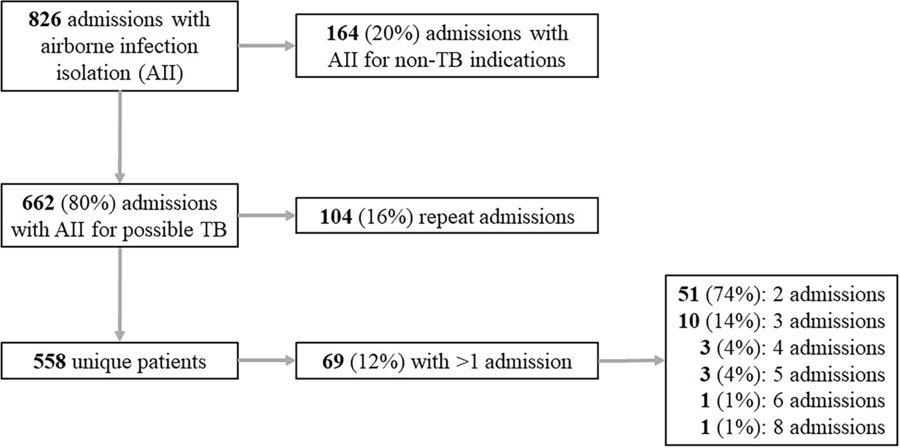
In total, 662 admissions were identified, during which patients were placed in AII due to concern for pulmonary TB. This cohort included 558 unique patients with 69 of those patients (12%) having multiple admissions with placement in AII due to concern for TB (Fig. 1). A total of 23 cases of TB (at any site) were identified in patients who had been placed in AII, including 15 patients (2.7%) with pulmonary TB. Furthermore, 8 patients (1.4%) had extrapulmonary TB only, with pulmonary TB ruled out by 3 negative AFB sputum cultures, and 6 patients (1.1%) had both pulmonary and extrapulmonary TB. Based on a review of laboratory culture records, no cases of pulmonary TB were identified in patients who had not been placed into AII.
Inclusion and exclusion criteria applied to lists of patients in airborne infection isolation (AII) identified on from daily hospital-wide isolation lists maintained by the VUMC Department of Infection Prevention. Some patients had multiple admissions on AII during the study period so the number of admissions is also shown.

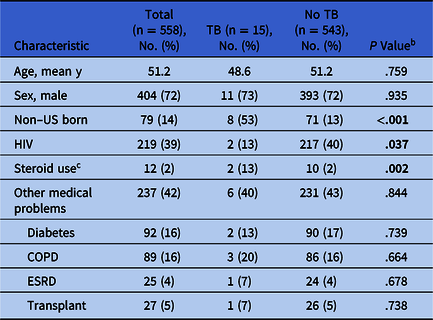
The average age of all patients was 51 years, and 404 (72%) were male. In total, 79 patients (14%) had been born outside the United States. Of those diagnosed with pulmonary TB, 8 (53%) had been born outside the United States, compared to 71 (13%) in the control group (P < .001).
In total, 219 patients (39%) placed on AII were PLWH. Of those diagnosed with pulmonary TB, 2 were PLWH (13%) and of those not diagnosed with pulmonary TB, 217 (40%) were PLWH (P = .037). Notably, the 2 PLWH diagnosed with pulmonary TB had additional TB risk factors beyond HIV. Patient 1 (culture-confirmed pulmonary TB) had a CD4 count of 244 cells/mm3 and an HIV viral load of 61,184 copies/mL. This patient was not taking antiretroviral therapy and had recently been incarcerated; prior TB testing had been positive. He presented with fever, night sweats, weight loss, and subacute cough. A computed tomography scan (CT) of the chest showed tree-in-bud nodularity and lymphadenopathy. Patient 2 (with clinically diagnosed pulmonary TB) had a CD4 count of 323 cells/mm3 and an HIV viral load of 74 copies/mL; this patient had been intermittently compliant with antiretroviral therapy. Chest x-ray and CT showed an infiltrate and mass thought to be indicative of pulmonary TB. He started TB therapy that was continued at discharge, but sputum AFB cultures were ultimately negative. He was also clinically diagnosed with TB meningitis, though cultures of cerebrospinal fluid were ultimately negative as well.
No significant differences were detected in the frequency of comorbid conditions such as diabetes, chronic obstructive pulmonary disease, end-stage renal disease (requiring dialysis) or taking immunosuppressive medications such as anti-rejection/transplant medications, TNF-α inhibitors, or chemotherapy. A significant difference was observed in the frequency of steroid use (Table 1).
Demographics of Entire Study Population (Total) and Comparison Between Case (TB) and Control (No TB) Groupsa

Note. TB, pulmonary tuberculosis; HIV, human immunodeficiency virus; COPD, chronic obstructive pulmonary disease; ESRD, end-stage renal disease.
a All patients were placed in airborne infection isolate (AII) due to concern for possible pulmonary TB.
b Statistically significant P values are shown in bold.
c Steroid use included >15 mg of prednisone (or equivalent) for >1 mo.
Regarding tobacco use, a greater frequency of smoking was observed among patients who were not diagnosed with pulmonary TB (65%) than among patients with pulmonary TB (29%; P = .005). No significant difference was observed in alcohol use (38% vs 39%; P = .993), intravenous drug use (5% vs 0%; P = .420), incarceration (16% vs 13%; P = .763), homelessness (10% vs 7%; P = .554), or international travel within the past year (5% vs 13%; P = .121). Symptoms on admission (eg, fever, night sweats, weight loss, cough, cough duration, shortness of breath, sputum production, hemoptysis) also showed no significant difference between groups.
All patients with pulmonary TB had abnormal chest imaging during admission; chest x-rays were abnormal in 11 patients (73%) and chest CTs were abnormal in 13 (87%). No significant difference was observed compared with admissions of those patients not diagnosed with pulmonary TB. Types of abnormalities on chest imaging (infiltrate, effusion, lymphadenopathy, nodule, etc) were also not significantly different between the groups, though a greater frequency of cavitary lung lesions was observed in patients with pulmonary TB (33% vs 16%; P = .070).
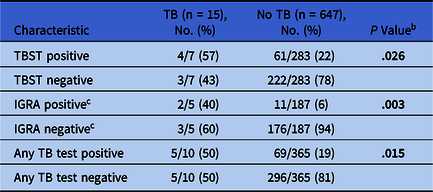
Of 662 total admissions, 375 (57%) had any TB testing prior to admission, either TB skin testing (TBST) or an interferon-gamma release assay (IGRA) such as the QuantiFERON-TB Gold or T-SPOT.TB test (Table 2). Moreover, 10 patients diagnosed with pulmonary TB had prior TB testing and 5 (50%) had positive results. There were 365 admissions of patients without pulmonary TB who had prior TB testing, of whom 69 (19%) had positive results (P = .015). In addition, 5 patients with pulmonary TB had IGRA testing prior to admission, of whom 2 (40%) had positive results and 3 (60%) had negative results. Of 647 admissions of patients without pulmonary TB, 201 had prior IGRA testing: 11 (5%) positive, 14 (7%) indeterminate, and 176 (88%) negative (P = .007). If indeterminate results were excluded, the difference remained significant (P = .003). Furthermore, 7 patients with pulmonary TB had had TBST prior to admission, of whom 4 (57%) were positive. In those patients not diagnosed with pulmonary TB, 283 of 647 admissions had prior TBST, of whom 61 (22%) were positive (P = .026).
Results of TB Testing in Case and Control Groupsa Prior to Admission

Note. TB, pulmonary tuberculosis; TBST, TB skin testing; IGRA, interferon-gamma release assay.
IGRA test results were excluded in this table
a Case group = TB; control group = no TB.
b Statistically significant P values are shown in bold.
c Indeterminate IGRA test results excluded.
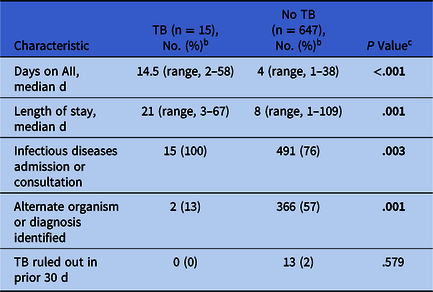
The median length of stay was longer for patients diagnosed with pulmonary TB (21 days; range, 3–67 days) than for those not diagnosed with pulmonary TB (8 days; range, 1–109 days; P = .001). Patients diagnosed with pulmonary TB were also in AII for a longer duration, with a median of 14.5 days versus 4 days (P < .001) (Table 3). Alternative organisms were identified in 2 patients diagnosed with pulmonary TB, including Aspergillus fumigatus, Haemophilus influenzae, and Mycobacterium avium; however, in clinical context these organisms likely represented colonization. In patients without pulmonary TB, alternative diagnoses were identified in 366 of 647 admissions (57%). Infectious causes included bacteria (n = 118, 18%), mycobacteria (n = 103, 16%), fungi (n = 76, 12%), and viruses (n = 74, 11%). The most common was Mycobacterium avium (n = 82), though not all patients with M. avium growth in culture were felt to have true mycobacterial disease. Other commonly isolated organisms included staphylococci (n = 36), streptococci (n = 31), Pneumocystis spp (n = 23), Histoplasma spp (n = 21), rhinovirus (n = 25), and Pseudomonas aeruginosa (n = 18). Noninfectious diagnoses (eg, malignancy) were made during 75 admissions (12%).
Comparison of Clinical Outcomes for Case and Control Groups by Admissiona

Note. TB, pulmonary tuberculosis; AII, airborne infection isolation.
a Case group = TB; control group = no TB.
b Unless otherwise stated.
c Statistically significant P values are shown in bold.
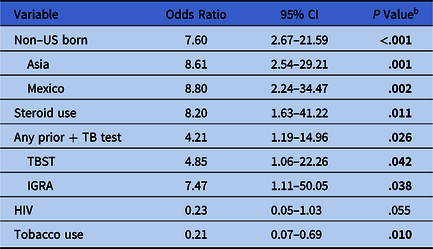
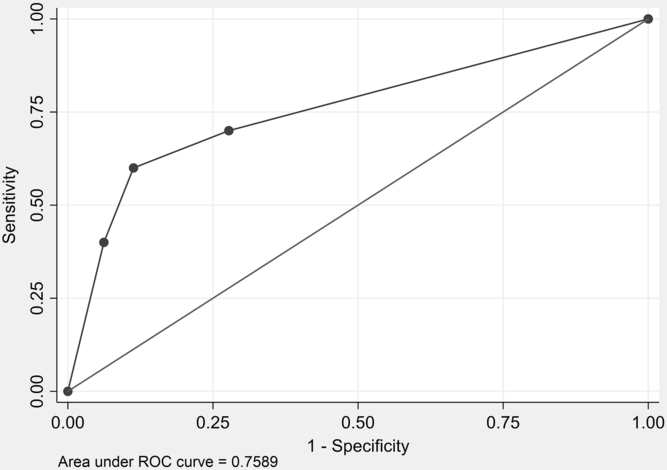
A univariate analysis of statistically significant factors was performed (Table 4). A multivariate analysis, limited in scope due to the low number of cases, included factors pragmatically available to providers on admission and relevant factors well established in prior literature, including CDC guidelines5: birth outside the United States and positive TB testing (either IGRA or TBST) prior to admission, regardless of any previous treatment for latent TB. Receiver operating characteristic (ROC) curve analysis showed an area under the curve (AUC) of 0.7589, indicating moderate discrimination of the model for prediction of TB diagnosis (Fig. 2). According to this analysis, birth outside the United States and prior positive TB test result predicts 18.2% probability of pulmonary TB diagnosis when present, compared to 1.0% if both factors are not present.
Univariate Analysis by Logistic Regression of Significant Factors Identified by Initial χ2 Analysisa

Note. CI, confidence interval; TB, tuberculosis; TBST, TB skin test; IGRA, interferon-gamma release assay; HIV, human immunodeficiency virus.
a Wide confidence intervals are due to small number of TB cases identified, limiting analysis.
b Statistically significant P values are shown in bold.
Receiver operating characteristic (ROC) curve multivariate analysis of non–US birth and prior positive tuberculosis testing (regardless of any prior treatment for latent TB) as predictors of ultimate diagnosis with pulmonary TB.

Discussion
Our analysis of 558 patients (662 admissions) placed in AII during evaluation for pulmonary TB yielded only 15 cases (2.7%) who were ultimately diagnosed. This number was surprisingly low (despite inclusion of clinical diagnoses), and no missed cases were identified upon review of all positive mycobacterial cultures hospital-wide. Notably, nearly 40% of patients placed in AII were PLWH. However, only 2 of 219 PLWH (<1%) placed in AII were diagnosed with pulmonary TB.
Excluding 44 admissions without a clear number of days of AII, >3,000 patient days of AII were used during the study period in patients without pulmonary TB, with a cost estimate of $35,000–$45,000 per year.Reference Verlee, Berriel-Cass, Buck and Nguyen8 This estimate does not account for the use of other finite resources, adverse effects on patient care, or increased length of stay.
The most significant factors indicating a higher risk of pulmonary TB diagnosis were birth outside the United States and prior positive TB testing. Although the low number of cases limited our statistical analysis, a multivariate analysis did indicate moderate discrimination of the model for prediction of TB diagnosis (AUC of ROC, 0.7589).
This study included in-depth reviews of the medical records of a large number of patients with inclusion of many different risk factors in the analysis. A low number of TB cases were identified, representing a significant limitation in the ability to perform statistical analyses, though the low number of cases in and of itself indicates likely overuse of AII. Also indicating AII overuse, HIV was surprisingly associated with lower risk of pulmonary TB diagnosis in our study, indicating that an alternative diagnosis was more likely when PLWH were admitted with a respiratory illness. Possibly limiting generalizability, this study was conducted at a single center with a particularly conservative policy for use of AII, especially among PLWH, which likely amplified the number of patients placed in AII.
Another limitation of this study is potential biases in population selection. Most patients are placed in AII due to clinician concern, and at times there may be variable enforcement of the infection control policy regarding placement in AII of all PLWH with respiratory symptoms or abnormal chest imaging. Use of matched controls for comparison would have been ideal to limit bias, but this was not feasible for our study given a recent change in the electronic medical record system. Clinical diagnoses of pulmonary TB (without culture confirmation) were used as defined cases in this study because follow-up information from the health department was not available. Also, a small number of patients (if any) may not have been captured based upon our inclusion criteria because hospital isolation lists (used for identifying patients to include) were not updated on weekends or holidays. It is unlikely, however, that a patient would have AII both initiated and removed in such a short period of time (ie, during a weekend) and be overlooked. A patient also possibly could have been admitted, not placed on AII, and later diagnosed elsewhere with pulmonary TB.
We plan to revise our policy for the use of AII with cessation of the practice of requiring AII for all PLWH with respiratory symptoms or abnormal chest imaging. Patients with previous positive TB testing (either TBST or IGRA) and birth outside the United States represent a high-risk group in whom AII should be considered in the appropriate clinical setting. Further prospective studies are needed to confirm the risk model predicted by our limited multivariate analysis.
Acknowledgments
The contents of this article are solely the responsibility of the authors and do not necessarily represent official views of the National Center for Advancing Translational Sciences or the National Institutes of Health.
Financial support
This project was supported in part by the National Center for Advancing Translational Sciences (grant no. UL1 TR002243).
Conflicts of interest
None of the authors have any conflicts of interest to report.