Introduction
In recent years, attempts have been made to reduce the use of synthetic pesticides, especially, of broad-spectrum insecticides for plant protection. Also, finding alternative and innovative methods for pest control has been the primary challenge for the twenty-first century (Ishaaya and Horowitz, Reference Ishaaya and Horowitz2009). Among the available options, the possible use of plant derivatives has recently been considered.
The review by Jindal et al. (Reference Jindal, Dhaliwal and Opender2013) shows that researchers have screened more than 6000 plant species for insecticidal activity throughout the world, and more than 2500 species belonging to 235 families have been found to contain toxins. Some plant families, such as Lamiaceae, Myrtaceae, Lauraceae, Rutaceae, Asteraceae, Apiaceae, Cupressaceae, Poaceae, Zingiberaceae and Piperaceae, are known to have insecticidal properties in their essential oils (Tripathi et al., Reference Tripathi, Upadhyay, Bhuiyan and Bhattacharya2009; Ayvaz et al., Reference Ayvaz, Sagdic, Karaborklu and Ozturk2010).
Genus Eucalyptus L'Herit belongs to the family Myrtaceae and is native to Australia. Over 700 species of this genus are distributed throughout the world (Brooker and Kleinig, Reference Brooker and Kleinig2006; Batish et al., Reference Batish, Singh, Kohli and Kaur2008). Eucalyptus species not only provides fuel biomass and reduces atmospheric carbon dioxide levels, but it also confers some indirect benefits as their essential oils are used as insecticides and repellents (Batish et al., Reference Batish, Singh, Kohli and Kaur2008; Martin, 2002). Eucalyptus essential oil has also been known for its antibacterial, antifungal and antiseptic properties (Brooker and Kleinig, Reference Brooker and Kleinig2006; Batish et al., Reference Batish, Singh, Kohli and Kaur2008).
Stored-product pests are a chronic problem, because they damage and contaminate food products in storage. Rhyzopertha dominica (F.) and Tribolium castaneum (Herbst) are among the most devastating insect pests of stored products because they are distributed worldwide and attack numerous warehouses in tropical areas (Pimentel et al., Reference Pimentel, Faroni, Tótola and Guedes2007). These insects have been controlled by pyrethroid and organophosphate insecticides, and by fumigants, such as phosphine (Sousa et al., Reference Sousa, Faroni, Guedes, Tótola and Urruchi2008). However, the high level of resistance to these insecticides (Pimentel et al., Reference Pimentel, Faroni, Tótola and Guedes2007) warrants further studies on alternative techniques to control these pests. In recent years, scientists have directed their efforts towards the search for plant-derived pesticides as cost-effective alternatives to synthetic pesticides in the control of stored-product insect pests.
Essential oils obtained from different species of eucalyptus possess well-known insecticidal qualities (Batish et al., Reference Batish, Singh, Kohli and Kaur2008, Bett et al., Reference Bett, Deng, Ogendo, Kariuki, Mugisha, Mihale and Torto2016). Workers have proven their effects against some pests, e.g., Orgyia trigotephras (Slimane et al., Reference Slimane, Ezzine, Dhahri and Jamaa2014), vectors of diseases, e.g., Rhodnius neglectus (Gomes and Favero, Reference Gomes and Favero2013) and blood-feeding insects, e.g., mosquitoes or Lutzomyia longipalpis (Maciel et al., Reference Maciel, Morais, Bevilaqua, Silva, Barros, Sousa, Sousa, Brito and Souza-Neto2010; Tian et al., Reference Tian, Zhou, Zhou and Huang2011). Furthermore, differences in insecticidal traits and the repellency of eucalyptus essential oil have been studied to control different stored-product pests (Papachristos and Stamopoulos, Reference Papachristos and Stamopoulos2002a; Lee et al., Reference Lee, Annis, Tumaalii and Choi2004; Papachristos et al., Reference Papachristos, Karamanoli, Stamopoulos and Menkissoglu-Spiroudi2004; Tapondjou et al., Reference Tapondjou, Adler, Fontem, Bouda and Reichmuth2005; Negahban and Moharramipour, Reference Negahban and Moharramipour2007; Rajendran and Sriranjini, Reference Rajendran and Sriranjini2008; Olivero-Verbel et al., Reference Olivero-Verbel, Nerio and Stashenko2010; Izakmehri et al., Reference Izakmehri, Saber, Mehrvar, Hassanpouraghdam and Vojoudi2013; Bett et al., Reference Bett, Deng, Ogendo, Kariuki, Mugisha, Mihale and Torto2016). Lee et al. (Reference Lee, Annis, Tumaalii and Choi2004) reported the fumigant toxicity of E. nicholii Maiden & Blakely, E. codonocarpa Blakely & McKie and E. blakelyi Maiden against Sitophilus oryzae (L.), R. dominica and T. castaneum. Olivero-Verbel et al. (Reference Olivero-Verbel, Nerio and Stashenko2010) investigated fumigant toxicity and repellent activity of E. citriodora Hook essential oil against T. castaneum. Also some reports on the chemical composition of different species of eucalyptus (Tapondjou et al., Reference Tapondjou, Adler, Fontem, Bouda and Reichmuth2005; Sartorelli et al., Reference Sartorelli, Marquioreto, Amaral-Baroli, Lima and Moreno2007; Maciel et al., Reference Maciel, Morais, Bevilaqua, Silva, Barros, Sousa, Sousa, Brito and Souza-Neto2010; Olivero-Verbel et al., Reference Olivero-Verbel, Nerio and Stashenko2010; Tyagi and Malik, Reference Tyagi and Malik2011; Bett et al., Reference Bett, Deng, Ogendo, Kariuki, Mugisha, Mihale and Torto2016) exist. Bignell et al. (Reference Bignell, Dunlop, Brophy and Jackson1996) investigated the chemical composition of essential oil from Australian E. occidentalis, but to the best of our knowledge no reports on the insecticidal activity of Eucalyptus occidentalis oil on stored-product insects are found in the literature. The present study was undertaken to investigate chemical composition and bioactivity (contact and fumigant toxicity, and repellent activity) of E. occidentalis essential oil from southwestern Iran against two important stored-product pests, R. dominica and T. castaneum.
Materials and methods
Plant material
Green mature leaves of E. occidentalis (25 years old) were collected from trees growing on the campus of the Ramin Agriculture and Natural Resources University in southwestern Iran in the spring of 2014. Dr Mehrangiz Chehrazi from Department of Horticulture of Shahid Chamran University identified the plants and voucher specimens were deposited at the Herbarium of Horticulture Department of the Ramin Agriculture and Natural Resources University.
Insect culture
Specimens of T. castaneum used in this study were reared on a standard mixture of wheat flour with powdered dry yeast in a ratio of 95:5. Whole wheat grains were used as a food substrate for R. dominica. Both insects were originally obtained from cultures maintained in the Entomology Lab of the Ramin Agriculture and Natural Resources University from 2009 and kept at 27 ± 2 °C in a dark environment in glass containers (1000 mL).
Extraction and analysis of essential oil by GC and GC/MS
The essential oil of leaves was extracted by hydro-distillation in a Clevenger Apparatus. In total 50 g of fresh leaves and 600 mL of distilled water were heated in a round-bottomed flask to approximately 100 °C, and vapours were condensed using cool water. Essential oil gathered in the storage chamber was collected after 4 h, dried over anhydrous sodium sulphate, and stored in a refrigerator (4 °C) until needed. The hydro-distillation was repeated until the quantity adequate for experiments had been gathered.
The chemical composition of the essential oils was identified using a gas chromatograph (GC) coupled to a mass spectrometer (MS), and a Saturn 2000 MS Varian Chrompack with ZB-1 (Phenomenex) column (30 m × 0.25 μm film × 0.25 mm ID). The MS was equipped with an ion-trap analyser set at 1508 for all analyses with an electron multiplier voltage of 1350 V. Scanning (1 scan/s) was performed in the range of 39–400 m/z using electron impact ionization at 70 eV. The analyses were carried out using helium as the carrier gas at a flow rate of 1.0 mL/min in a split ratio of 1:20 using the following program: 60 °C at the beginning and held for 3 min; 3 °C/min to 120 °C; 15 °C/min to 300 °C. The injector was held at 200 °C and the detector at 300 °C. Most of the compounds were identified by using three analytical methods: Kovats indices (KI), GC/MS retention times of authentic chemicals-standards (S) and mass spectra of compounds, and NIST05 (NIST, 2015) spectral library collection (MS). The retention index standards used in this study consisted of a mixture of aliphatic hydrocarbons ranging from C5 to C20 dissolved in methanol. All experiments were conducted twice.
Bioassays
Contact toxicity
Filter paper discs (Whatman No.1, 8 cm diameter, 50.24 cm2 area) were placed in glass Petri dishes to evaluate contact toxicity. The essential oil was diluted in acetone to obtain concentrations 30.1, 35.15, 42.7, 50, 60 μL in 500 μL acetone equivalent to 0.6, 0.7, 0.85, 1.0 and 1.2 μL/cm2 for R. dominica and to 40.2, 45.2, 50, 60, 75.5 μL in 500 μL acetone equivalent to 0.8, 0.9, 1.0, 1.2 and 1.5 μL/cm2 for T. castaneum. In total, 500 μL of each solution was applied on the filter papers. Twenty adults were released into each Petri dish after 10 min, when the acetone had evaporated. The Petri dishes were kept in the dark at 27 ± 2 °C, 65 ± 5% R.H. Insect mortality was recorded after 24 h. Five replications were considered for each treatment.
Fumigant toxicity
Fumigation bioassays were carried out with 20 adults placed in 50 mL vials with screw caps. Filter papers (Whatman No. 1) were cut in the same diameter with vial cap and attached to the inner surface. Then the filter papers were impregnated with 30, 52, 94, 168 and 300 μL/L air of pure essential oil for R. dominica and 40, 58, 94, 132 and 200 μL/L air for T. castaneum, and the caps screwed tightly to the vials. Each dose was replicated five times. The experimental condition was the same as that explained above for contact toxicity. Adult mortality was assessed after 24 h of exposure to the essential oil.
Repellent activity
The repellent activity of essential oil against R. dominica and T. castaneum was evaluated by an area preference method (Zandi-Sohani et al., Reference Zandi-Sohani, Hojjati and Carbonell-Barrachina2012). Petri dishes with 8 cm diameter were used. The bottom of the Petri dishes was covered with filter paper that had been cut into equal halves, one half of the filter paper was impregnated with 300 μL of acetone and the other half was treated with acetonic solutions of different concentrations of essential oil, including 1.19 × 10⁻⁵, 1.19 × 10⁻⁴, 1.19 × 10⁻³, 1.19 × 10⁻² and 1.19 × 10⁻¹ μl/cm2. The filter papers were dried for 10 min before the insects were released. Twenty adults of R. dominica and of T. castaneum were introduced separately into each Petri dish and the lid was sealed with parafilm. The experiment was replicated five times with the experimental conditions described in the aforementioned bioassays. The number of insects on each half of the filter paper was counted after 2 and 4 h of exposure. Percentage repellency (PR) values were computed as follows:
 $$\begin{equation*}
PR = \left[ {\left( {{N_c}--{N_t}} \right)/\left( {{N_c} + {N_t}} \right)} \right]\;100,
\end{equation*}$$
where Nc and Nt are the numbers of insects after the exposure period on the untreated and treated areas, respectively.
Data analysis
The formula of Abbott (Reference Abbott1925) was used to correct for the natural mortality observed in the control treatments. Data obtained from dose-response bioassays were subjected to probit analysis (Finney, Reference Finney1971) to estimate LD50 and LD99 values for fumigant and contact toxicity bioassays, using SAS software version 6.12 (SAS, 1996). The mean repellent activity after 2 and 4 h and the differences in contact and fumigant toxicity of essential oil between the two pests were compared using the paired t-test at P<0.05 with the IBM SPSS statistics version 20. Repellency observations in different concentrations were subjected to ANOVA and the Tukey's least significant difference multi-comparison test was used to compare means.
Results and Discussion
Chemical composition of essential oil
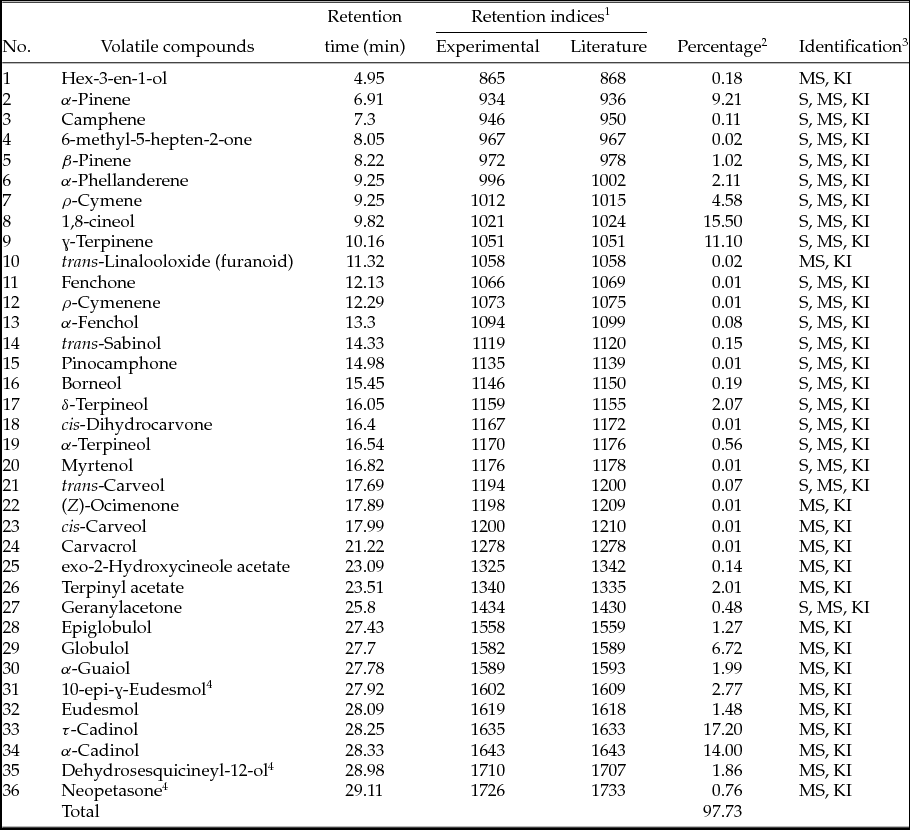
The qualitative and quantitative composition of E. occidentalis essential oil is presented in Table 1. The main constituents were τ-cadinol (17.20), 1,8-cineol (15.50%), α-cadinol (14.00%) and α-pinene (9.21%). The composition of essential oil from different species of Eucalyptus spp. has been described in different studies (Bignell et al., Reference Bignell, Dunlop, Brophy and Jackson1996; Tapondjou et al., Reference Tapondjou, Adler, Fontem, Bouda and Reichmuth2005; Sartorelli et al., Reference Sartorelli, Marquioreto, Amaral-Baroli, Lima and Moreno2007; Olivero-Verbel et al., Reference Olivero-Verbel, Nerio and Stashenko2010; Tyagi and Malik, Reference Tyagi and Malik2011). In Bignell et al. (Reference Bignell, Dunlop, Brophy and Jackson1996) the main compounds of E. occidentalis were bicyclogermacrene (28.52%), α-pinene (18.85%), β-caryophyllene (5.44%), viridiflorol (5.13%) and globulol (4.31%). According to their results, the composition of Australian E. occidentalis essential oil is completely different from the Iranian one in the current study. The only compound common to the two analyses is α-pinene that was 9.21% in the current study. Olivero-Verbel et al. (Reference Olivero-Verbel, Nerio and Stashenko2010) demonstrated that E. citriodora essential oil is rich in citronellal (40%), isopulegol (14.6%) and citronellol (13%). The essential oil in leaves of E. saligna Smith was shown to have α-pinene (39.5%) and ρ-cymene (31.1%) as the main components (Tapondjou et al., Reference Tapondjou, Adler, Fontem, Bouda and Reichmuth2005). The chemical composition of essential oils from E. robusta and E. saligna has also been previously described in the literature, and the main compound of E. robusta oil was α-pinene (73%). However, in the case of E. saligna, the composition depended on the phenological stage of the plant. In the vegetative phase, the major constituents were ρ-cymene (54.2%) and γ-terpinene (43.8%); during the blossoming stage, α-pinene (45.1%) became the major constituent followed by ρ-cymene (Sartorelli et al., Reference Sartorelli, Marquioreto, Amaral-Baroli, Lima and Moreno2007). Another study on the composition of E. globulus essential oil has shown that the dominant compounds were 1,8-cineole (45.4%) and limonene (17.8%) (Tyagi and Malik, Reference Tyagi and Malik2011). Although the chemical composition of E. occidentalis essential oil differs from that of other eucalyptus species that have been studied, 1,8-cineol exists as a main compound. Other predominant compounds in E. occidentalis oil are α and τ-cadinol that possess known insecticidal characteristic (Chang et al., Reference Chang, Chen, Wang and Wu2001; Deveci et al., Reference Deveci, Sukan, Tuzun and Kocabas2010). This variation is due to the differences in Eucalyptus spp. However, several factors (such as climate, soil, season and other edaphic factors) can affect the chemical composition of essential oil (Sartorelli et al., Reference Sartorelli, Marquioreto, Amaral-Baroli, Lima and Moreno2007).
Chemical composition of essential oil from Eucalyptus occidentalis leaves

1 Retention indices were calculated for a ZB-5 column and literature values were obtained from National Institute of Standards and Technology (2015).
2 Relative percentage obtained from peak area.
3 Identification methods: MS – mass spectrum; KI – Kovats retention index; S-standard.
4 Tentatively identified.
Bioassays
Contact toxicity
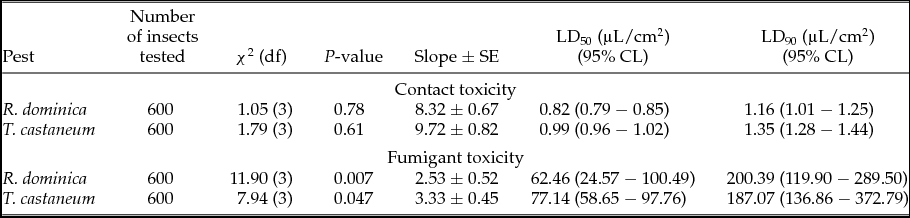
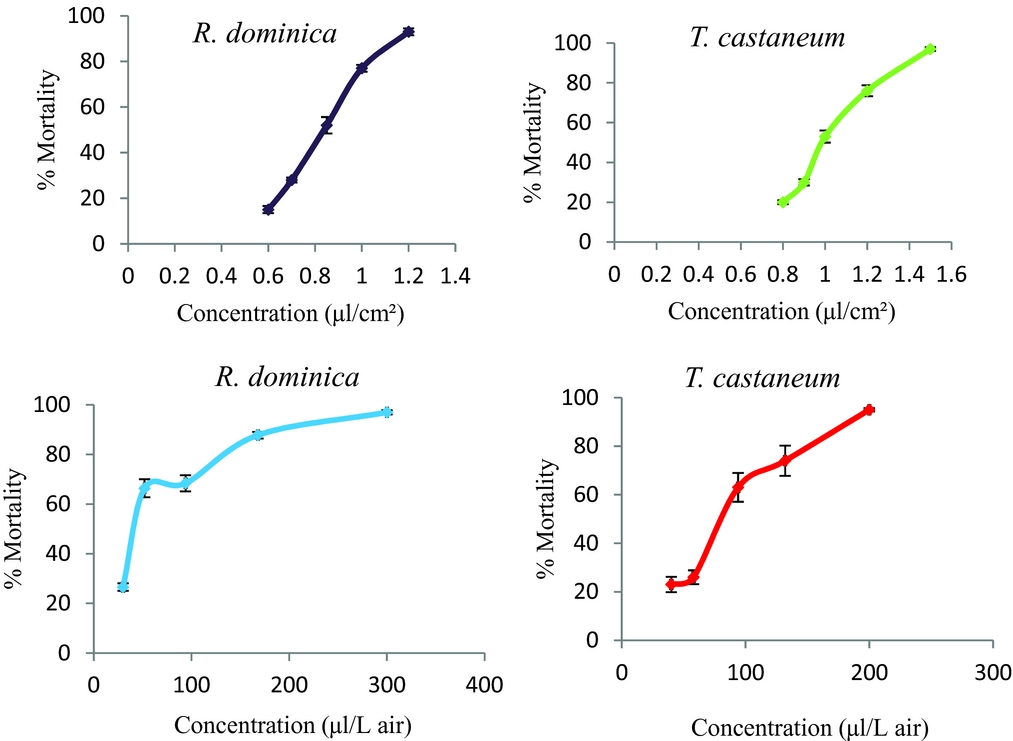
The contact toxicity of E. occidentalis essential oil on the test insects is shown in Table 2. The LD50s of the oil were calculated to be 0.82 μL/cm for R. dominica and 0.99 μL/cm for T. castaneum. According to the 95% confidence limit, E. occidentalis essential oil is more toxic to R. dominica than to T. castaneum. The mortality values were significantly increased in relation to the increase in essential oil concentration for R. dominica (F = 74.568; df = 5, 29; P<0.05) and T. castaneum (F = 74.344; df = 5, 29; P<0.05) (Fig. 1A). Olivero-Verbel et al. (Reference Olivero-Verbel, Nerio and Stashenko2010) investigated the contact toxicity of Cymbopogon citratus Stapf and E. citriodora against T. castaneum. According to their results C. citratus oil presented more potency and efficacy than E. citriodora oil and for both species the toxicity was dose dependent. In another study, Tapondjou et al. (Reference Tapondjou, Adler, Fontem, Bouda and Reichmuth2005) considered the contact toxicity of Cupressus sempervirens L. and E. saligna essential oils against Sitophilus zeamais Motschulsky and Tribolium confusum du Val. The results demonstrate that eucalyptus oil is more toxic to both insect species (LD50 = 0.36 μL/cm for S. zeamais and 0.48 μL/cm for T. confusum). From a comparison of these LD50 values with the current study it looks as if E. saligna oil is more toxic to stored-product pests than E. occidentalis oil. However, the insect species and experimental conditions were different in these studies.
Probit analyses of the contact and fumigant toxicity of Eucalyptus occidentalis essential oil against Rhyzopertha dominica and Tribolium castaneum

Contact (above figures) and fumigant (below figures) toxicity of Eucalyptus occidentalis essential oil against Rhyzopertha dominica and Tribolium castaneum.

Fumigant toxicity
The results for fumigant toxicity of the examined essential oils are shown in Table 2 and Fig. 1B. No significant differences between the fumigant toxicity of E. occidentalis oil against the two test insects, according to the 95% confidence limit (Table 2), were seen. However, the LC50 value for T. castaneum (77.14 μL/L air) was more than for R. dominica (62.46 μL/L air). The fumigant lethality had a significant increase when the dose of oil was increased for R. dominica (F = 56.388; df = 5, 29; P<0.05) and T. castaneum (F = 16.903; df = 5, 29; P<0.05). Lee et al. (Reference Lee, Annis, Tumaalii and Choi2004) investigated fumigant toxicity of 42 essential oils extracted from Myrtaceae family against T. castaneum, S. oryzae and R. dominica. According to their results, E. nicholii, E. codonocarpa and E. blakelyi were among the most effective oils against the test insects. The calculated LC50 against T. castaneum and R. dominica was 15.5 and 9.7 μL/L air for E. blakelyi oil, 18.2 and 10.4 μL/L for E. codonocarpa oil, and 13.7 and 9.5 μL/L for E. nicholii oil. Our results are similar to their study in that the LC50 value for T. castaneum is higher than that for R. dominica. However, the LC50 values in the current study show that the eucalyptus species' oils mentioned in their study are more toxic than E. occidentalis to T. castaneum and R. dominica. Papachristos and Stamopoulos (Reference Papachristos and Stamopoulos2002b) reported fumigant toxicity of Eucalyptus globulus Labill against larvae and pupae of Acanthoscelides obtectus (Say) despite their protection inside the bean cotyledons. The LC50 values for different larval stages, including L1, L2, L3–4 and the pupal stage, were 3.4, 4.8, 18.7 and 76.6 μL/L, respectively. The results show that tolerance increases as the immature stages age (Papachristos and Stamopoulos, Reference Papachristos and Stamopoulos2002a). Eucalyptus essential oils also showed potent fumigant activity against the rice weevil S. oryzae (LC50 = 28.9 μL/L) (Lee et al., Reference Lee, Choi, Lee and Park2001). In another study, the LC50 values for essential oil of E. camaldulensis, E. grandis, E. viminalis, E. microtheca and E. sargentii on adults of S. oryzae were found to be 17.49, 15.65, 14.73, 11.11 and 11.94 μL/L, respectively (Nowrouziasl et al., Reference Nowrouziasl, Shakarami and Jafari2014). In comparison with our study, these essential oils have more toxic effects against S. oryzae. The use of different essential oils and other pests may be the reason for this disagreement. Regarding the mode of action of E. occidentalis oil, in which the compounds are the blend of mono- and sesquiterpenes, the toxic effects may be related to reversible competitive inhibition of acetylcholinesterase by occupation of the hydrophilic site of the enzyme's active centre (Ryan and Byrne, Reference Ryan and Byrne1988).
Repellent activity
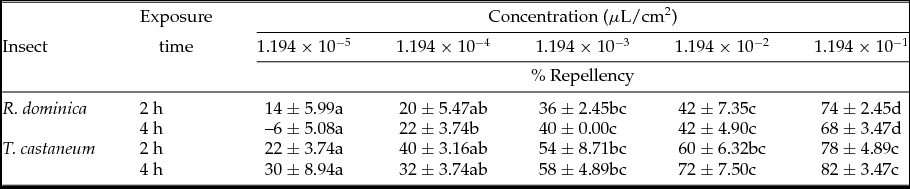
Table 3 shows the repellent activity of E. occidentalis oil against T. castaneum and R. dominica at two different exposure times. According to the results, the oil repelled T. castaneum significantly more than R. dominica and exhibited high repellency against tested insects after 2 h (t = 2.07; P = 0.044) and 4 h (t = 2.98; P = 0.004). The repellency increased with the increase in the concentration of oil in both insects and changed from 14 to 75% for R. dominica and from 22 to 78% for T. castaneum after 2 h. The results also show no significant difference concerning the repellency between 2 and 4 h exposure time for T. castaneum (t = 0.563; P = 0.576) and R. dominica (t = 0.596; P = 0.554), which revealed that increasing the exposure time did not have a significant effect on repellency. Some previous studies have demonstrated the repellent activity of different essential oils against stored-product pests (Papachristos and Stamopoulos, Reference Papachristos and Stamopoulos2002b; Zandi-Sohani et al., Reference Zandi-Sohani, Hojjati and Carbonell-Barrachina2012; Bett et al., Reference Bett, Deng, Ogendo, Kariuki, Mugisha, Mihale and Torto2016), but the studies of repellent effects of Eucalyptus spp. on pests are restricted. Tapondjou et al. (Reference Tapondjou, Adler, Fontem, Bouda and Reichmuth2005) demonstrated high mean repellency of E. saligna against T. confusum (about 98%) and S. zeamais (about 73%) with which our results correspond well. In another study E. citriodora showed 90% repellency against T. castaneum after 2 h of exposure time and with a concentration of 10 mL/L (Olivero-Verbel et al., Reference Olivero-Verbel, Nerio and Stashenko2010). Bett et al. (Reference Bett, Deng, Ogendo, Kariuki, Mugisha, Mihale and Torto2016) reported the highest repellent activity of E. saligna against T. castaneum compared with other stored product pests in their experiments where our results are the same.
Percentage repellency after two exposure times for Eucalyptus occidentalis essential oil against Rhyzopertha dominica and Tribolium castaneum

Means in a row followed by the same letter are not significantly different at the 0.05 level when tested by Tukey's multiple-range test (P<0.005).
The current study reveals the potential of E. occidentalis for its fumigant, contact and repellent abilities against stored-product insects. It is clear that the use of essential oils may be suitable for control of pests in closed places (such as greenhouses and stores), because of their fumigant toxicity. According to our results, the oil shows contact toxicity against pests, so that it might have useful effects for the control of pests under field conditions, but the cost of production of high amounts of oils for use in the field is probably one of the restraints. The chemical composition analysis showed that 1,8-cineole (eucalyptol) is one of the major components of the oil known for its insecticidal and repellency attributes. This compound is a food flavouring agent in some countries, so the use of essential oils in high amounts of this compound may be safe for humans. Another experiment may be designed to study the insecticidal properties and safety of τ-cadinol and α-cadinol, the other significant components of E. occidentalis essential oil. In short, since E. occidentalis oil presents an inexpensive and environmentally friendly alternative for pest control (provided it has a proper formulation), it may be used as a fumigant in stored products.
Acknowledgement
We would like to thank Khuzestan Agricultural Sciences and Natural Resources University for financial support and also Dr Antoni Szumny for his help in the analysis of chemical composition of the essential oil.