In 1909, the korean monarch Sunjong (r. 1907–10), claiming a desire to inspect his subjects' daily lives, embarked on two imperial progresses in which he traversed the length of the Korean peninsula. Traveling by train and carriage over the span of three weeks, he strode through provincial capitals in the south and northwest and met with government officials and local community leaders along the way. As he paraded along freshly cleared boulevards of his daily destination, he was greeted by school children waving national flags and shouting Manse! (Long live the emperor!). He nodded approvingly as speeches were made on the importance of maintaining stability in East Asia and promoting “new education” and commerce, and he gave special recognition to those meritorious subjects who had contributed to these efforts. When appropriate, he handed out awards to filial sons and virtuous widows and toured the local historical monuments. Newspapers at the time praised the emperor for “responding to the mandate of renovation (yusin) and attempting to renew the general administrative affairs of the state (sŏjŏng)” (Hwangsŏng sinmun, January 27, 1909).
At first glance, it would appear that the political underpinnings and timing of these processions place them squarely within the framework of nation-building exercises that flourished worldwide at the time. In his well-known essay on mass-producing traditions, Eric Hobsbawm (Reference Hobsbawm, Hobsbawm and Ranger1983) demonstrates how late nineteenth-century imperial rivalries prompted European states to create official ceremonies, implement primary education, and produce public monuments as a means to forge a common identity across the ranks of society. But rising in tandem with the age of empire was a tide of political modernity, and consequently, many of the dynastic states utilized the new practices as mechanisms to reinforce the significance and centrality of the royal house within the newly emerging conceptualization of the nation. Political pageantry constituted the most self-conscious and conspicuous deployment of “official nationalism,” to use Benedict Anderson's term (Reference Anderson1991), by which thrones encountering demands to broaden the political franchise sought to placate their subjects. Although 1914 would emerge as a turning point for many royal houses, before then, spectacles of extravagance, or at least novelty, appeared to succeed in seducing subjects with the notion that king and country were one and the same.
Much like the political exercises that unfolded throughout Europe, as in Japan, at the height of new imperialism, the Korean emperor's provincial tours represented an effort to unify the country through the medium of the royal house. Even as late as 1909, the vast majority of Koreans had never stepped foot in the capital, and few outside the major urban centers had laid eyes on a photographic likeness of the monarch. The progresses thus presented an unprecedented opportunity to create, however fleetingly, a sense of meaningful contact between the throne and its subjects. As tens of thousands of people lined the streets at each stop to witness this extraordinary event, newspapers closely reported on the progress, thereby extending a sense of national simultaneity to those excluded from the official itinerary. Their coverage focused extensively on the tour's promotion of modern changes, contributing to an emerging image of Sunjong as “a model of enlightenment” (Tawara Reference Tawara Magoichi1909, 18).
Yet Korea in 1909 existed as a protectorate of the Japanese empire, and looming behind the calculated efforts to cast Sunjong as a modern monarch was a larger imperial project underwritten by the semi-colonial office of the residency-general (K. T'onggambu, J. Tōkanfu). Created in the aftermath of the Russo-Japanese War (1904–5) as a key feature of the ŭlsa protectorate treaty (1905), the administration was headed by the preeminent Meiji statesman Itō Hirobumi (1841–1909) and enjoyed a broad imperial mandate to manage Japan's “paramount interests” on the peninsula. Although nominally serving at the pleasure of the Korean emperor, the residency-general, according to the logic of imperialistic legal practices, operated as the peninsula's de facto government (Dudden Reference Dudden2005). Nevertheless, until Korea's formal annexation, the two offices continued to engage in an awkward two-step of reign-and-rule as each relied on the other for assurances of its continued existence. The Korean emperor might have appeared to be nothing more than a puppet through whom the voice of the resident-general was piped, but as long as informal imperialism remained the blueprint of Japanese expansionism, he persevered as a critical member of the protectorate infrastructure. Without a doubt, this was a relationship in which Itō and the colonial agenda enjoyed the upper hand, but vital to the protectorate's continuing survival was at least the appearance of a dynasty that was content with, and flourishing under, Japanese guidance.
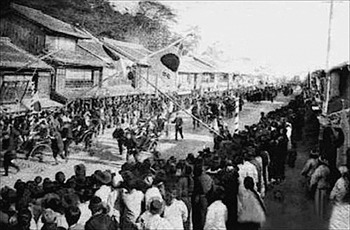
Nothing illustrates the contradictions and ambiguities of power inherent in the system of informal empire better than the political pageants that unfolded in the Korean protectorate in 1909 (see figure 1). Drawing upon the lessons of Japan's modern nation-building exercises, officials in the protectorate administration conceived of fashioning a modern Korean emperor à la Meiji as a means of shoring up support for the regime. Yet by placing the monarch front and center in their efforts and creating a nationally shared experience, the protectorate administration provoked an upswell of nationalism melding traditional and modern elements that largely fortified Korean resistance. Sunjong's imperial progresses thus reveal much about the development of Korean nationalism, as well as the gross underestimation on the part of the Japanese imperial project that sought to mobilize the sentiment for its own political ends. The failure of the residency-general to seize the symbolic capital of the imperial house ultimately helped bring an end to the protectorate administration and usher in the formal colonization of Korea.
Sunjong's parade in Pusan, January 7, 1909. Courtesy of Wôlgan Chosôn (Monthly Chosun), Feb. 2009.

The Invention of Sunjong
When Sunjong set out on his tour of the countryside, he had occupied the throne for all of eighteen months. Yet already in his brief reign, remarkable changes to traditional royal practices had taken place. Conspicuous among them was the monarch's increased visibility to his subjects—in print and photos, as well as in person. Whereas his father Kojong had rarely set foot beyond the confines of the palace after 1900, Sunjong started his tenure with a visit to the royal tombs in October 1907, just weeks after his accession rites. Several days later, he boarded a train to Inch'ŏn to welcome the arrival of the Japanese crown prince Yoshihito (the future Taishō emperor, r. 1912–26) on Korean shores (Hara Reference Hara Takeshi and Ikhan2000),Footnote 1 and in the following year, he traveled to Suwŏn to review the opening of a commercial exposition that showcased Japanese industrial products alongside Korean handicrafts. Seeking to overcome the pattern of contention between the throne and the protectorate administration, the residency-general assiduously deployed the timid “new emperor” to promote the perception of close ties between the two countries and expand Japan's presence on the peninsula.Footnote 2 The shaping of Sunjong's public image was indeed a central preoccupation of the Japanese government, just as the fashioning of the Meiji emperor had consumed the oligarchy for decades following the Restoration of 1868.
Like the Japanese emperor Meiji, who emerges from Donald Keene's recent biography (Reference Keene2002) as a mere cipher to the oligarchs' grand strategy for building a modern state, little can be discerned about Sunjong beyond the public records. Born in 1874, he was the only son of Kojong (r. 1863–1907) and his queen consort Min to survive into adulthood. (Kojong sired additional offspring through palace ladies.) Despite this singular claim to dynastic legitimacy, the prince's position as heir apparent was a precarious one. Indeed, life in the palace proved to be anything but sheltered; as a young man, he witnessed the brutal killing of his mother, Queen Min, at the hands of Japanese assassins in 1895, and only narrowly escaped an attempt on his own life in 1898. Described in contemporary accounts as feeble in body and spirit,Footnote 3 Sunjong was an ideal pawn in the political machinations of the protectorate government—especially in comparison to Kojong, who had demonstrated uncharacteristic resolve against the Japanese administration, ultimately leading to his forcible removal from the throne. Installed as the “new emperor” in August 1907, Sunjong quickly became the poster child for a wide range of political agendas, including modern education, bilateral friendship, and co-prosperity, that served to justify Japan's presence in Korea. Whereas the Japanese government's applying pressure to the Korean court for influence can be traced back to the signing of the Treaty of Kanghwa in 1876, Tsukiashi Tatsuhiko (2002) notes that during the protectorate period, reforming the Korean royal house came to be seen as a worthy project of reform in its own right, and not merely as a useful tool for shoring up support of Japan's imperial project and suborning the Korean people to its will. Moreover, cultivating and “civilizing” the royal house was a cause that appealed to Korean reformists.
Monarch-centered imperialist politics brought together a strange alliance between the residency-general and the pan-Asian organization Ilchinhoe (Advance in Unity Society), as well as the nationalist newspapers. Above all, the new policy that enlisted the Korean emperor to promote Japan's imperial project bore the imprimatur of Itō. A towering figure in Meiji politics, Itō's extensive contributions to early Meiji nation building included a lengthy appointment as president of the Survey Bureau for Imperial Household Institutions (Teishitsu seido chōsakyoku) in the 1880s and into the early 1890s. Many of the defining moments of courtly splendor that were exhibited on the national stage were choreographed by Itō, and in Takashi Fujitani's rich study (Reference Fujitani1996), one gets a sense of how inventively he approached seemingly all aspects of monarchy—from the quotidian to the majestic—as an opportunity to create a sense of national community in which the imperial household occupied the center. After 1907, there are abundant examples of a similar agenda in Korea that underwrote the proliferation of pageantry and symbolic acts for the purpose of promoting loyalty to the throne; these included the frequent public appearances of Sunjong, the designation of the emperor's birthday as a national holiday (K. kŏnwŏnjŏl, on March 25), and the proliferation of his portraits in government buildings and educational institutions (see figure 2).
A 1908 portrait of Sunjong. Kŏnwŏnjŏl wŏnyuhoe kinyŏmch'ŏp (Commemorative Album of Emperor Sunjong's Birthday Garden Party), Reference Kŏnwŏnjŏl wŏnyuhoe kinyŏmch'ŏp1908.

Standard historical accounts consider the Ilchinhoe, whose members notoriously petitioned the throne to invite Japanese annexation, a blight on Korean nationalism during the nation's twilight years, a “front organization” of Japanese design at best, and an organization of traitorous pro-Japanese collaborators at worst. Recent scholarship, however, makes a persuasive claim that the organization's confoundingly broad appeal—the society had an estimated membership of more than 140,000 paying supporters, making it the largest political subscription entity—was rooted in a populist reform platform that drew in followers of the Independence Club and the Tonghak movement (Hayashi Reference Hayashi Yūsuke1999; Moon Reference Moon2005). Somewhat paradoxically, even as the organization sought to reorganize the state–society relations of the ancien régime, the leaders of the Ilchinhoe maintained a strong attachment to the sanctity of the royal house. In a manifesto first published in 1904, allegiance to the throne and the promotion of national autonomy headed a short list of principles that prevailed throughout changes in the society's leadership, organization, a revolving door of Japanese advisors, and an increasingly pro-Japanese political orientation (Chandra Reference Chandra1974, 47). Ultimately, the progressive nature of the Ilchinhoe's activities was overshadowed by the naive view that regarded Japanese expansionism as an antidote to the prevailing white imperialism, but it is important to note here that throughout its six-year existence, the society saw no contradiction among the impulses to uphold the royal house of Korea, to upend the traditional social order, and to modernize the nation under Japanese auspices.
Korean newspapers such as Taehan maeil sinbo (Korea Daily News) and Hwangsŏng sinmun (Capital Gazette) naturally were reluctant to support to any agenda of the residency-general and harbored ambivalence toward Sunjong's use by the protectorate regime. Even they, however, found it difficult to oppose the general thrust of the policy that sought to modernize the Korean nation. Such was the political dilemma confronting Korean intellectuals in the twilight of empire: How to follow the prescriptions of modern Japan without falling under its influence? The pressing desire to put Korea on a path toward prosperity and strength led even those social reformers who were skeptical of Japan's ulterior motives to discount them in favor of enacting palpable changes to the existing order. This attitude allowed journalists writing for the newspapers that played a defining role in shaping national priorities occasionally to side with the modernizing impulses of the protectorate regime rather than the “less civilized” forms of nationalism demonstrated by their unenlightened countrymen. Korean papers thus were often quick to criticize the ham-fisted tactics of the “righteous armies” (ŭibyŏng), the ill-fated anti-Japanese guerrilla forces that frequently lapsed into rectifying local justice, by referring to them derisively as “bandits” (Schmid Reference Schmid2002, 44–46). In a similar manner, despite the obvious contradictions in the protectorate administration's highly publicized embrace of Sunjong, both papers aided in the project by carrying almost daily reports on the affairs of members of the royal family, often accompanied by photographs. Thus, without intending to be complicit in the imperial project, the nationalist newspapers' belief in the symbolic capital of the royal house compelled them to report widely on Sunjong's progresses.
In the winter of 1909, the three principal political bodies came together to create an experience of national communion like none other before. The driving force behind the progresses, of course, was the residency-general, which was responding to demands in the metropole to resolve the intractable problem of the Korean “insurgency”—the ŭibyŏng assaults on the Japanese presence. Beginning in the fall of 1907, as a consequence of forcing the abdication of Kojong and disbanding the Korean military, an anti-Japanese force consisting of an estimated 140,000 guerrilla fighters confronted and challenged the protectorate regime with outbreaks of armed resistance in the countryside. To counter the hard-line faction pushing for the formal annexation of Korea, Itō lobbied the Tokyo government for one last opportunity to sell the Korean leadership and population on the idea of Korean-Japanese co-prosperity (Lone 2000, 163). Itō's belief was that the tours, by creating opportunities for direct contact between Sunjong and his subjects, would persuade the Korean people of the emperor's authority and benevolence, on the one hand, and demonstrate the “spirit of cooperation” that existed between himself and the emperor, on the other (Hamada Reference Hamada1936, 206).
Politics and Prose
Although it was the confluence of Korean resistance activities and hawkish policy makers in Tokyo that spurred the residency-general to action, the idea of an imperial progress built upon a plan that had been in development for quite some time. Itō had first floated a proposal of sending the Korean emperor on a national tour to members of the Korean cabinet almost a full year earlier in the winter of 1907–8, apparently as a test run for a future visit to Tokyo (Saionji Reference Saionji Kōyō1930, 111). The plans were nevertheless developed in the utmost secrecy, involving only the highest-level members of the protectorate administration and the Japanese police force. Matsui Shigeru, who was then serving as chief of the Korean Police Bureau, supervised a vast operation to improve the general conditions of all key stops on the emperor's itinerary, which included paving roads, renovating accommodations, erecting welcoming arches, and razing dilapidated grass roof huts along the railroad tracks.Footnote 4 The police force was instructed to use the occasion to canvas local populations on a wide range of issues, including their attitudes toward the Japanese presence in Korea, popular sentiments on the royal house, and reactions to the modern institutions that were being introduced in Korea.
On New Year's Day 1909, Itō unveiled the grand plan by “proposing” to the emperor that he tour the country. The announcement managed to surprise even close Japanese advisors to the court (Gondō Reference Gondō Shirōsuke1926, 18). Three days later, newspapers announced the emperor's imminent journey to the south, publishing in its entirety a carefully scripted imperial edict:
We have given our thoughts to this matter: the people are the foundation of the dynasty, and if the foundation is not solid, the dynasty cannot be stable. Having acceded to the throne in accordance with the enlightened instructions of our father, His Imperial Majesty [Kojong], we have hoped only to stabilize the dynasty's precarious situation and provide relief to the despondent people. For this reason did we promise to improve the political affairs last year at the Royal Temple (Chongmyo) and ancestral shrines (Sajik). But the chaos in the countryside has not abated, and there has been no end to the people's hardship. This pains us. Under these dire circumstances, it is evident that the people's hardship can only worsen. How can we pretend not to take notice, and remain oblivious to their suffering? Having been invigorated with the New Year, we are resolutely determined to travel across the country with officials in toe to observe and inspect personally the prevailing conditions in the countryside, and to acquire intimate knowledge of the people's hardships. Marquis Itō, Resident-General and Royal Tutor to the Crown Prince, has devoted himself with all sincerity to our country, assisting and guiding us. Last summer, despite his advanced age and failing health, he escorted our Crown Prince throughout Japan in an effort to broaden the prince's education, and for this we are eternally grateful. On this occasion, he will accompany the progress and assist in various tasks to solidify the dynasty's foundations and address the disasters. Hear ye, all subjects high and low. (Kojong Sunjong sillok 1970, January 4, 1909)
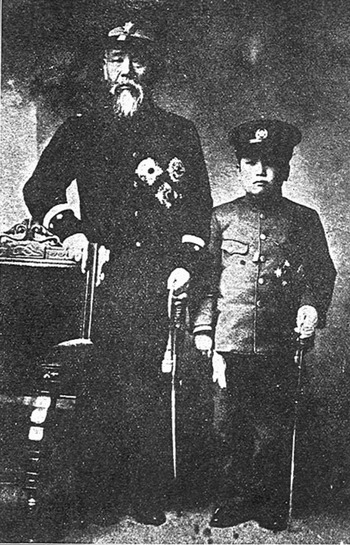
The official announcement of the imperial tour served as an instrument of propaganda, notable as much for what it stated as for what it elided. Employing classic Confucian rhetoric, it sought to buttress Sunjong's legitimacy by emphasizing the moral virtues of a traditional ruler: his benevolence (Mencian concern with the people's welfare), concern with the dynastic line (ancestor worship), and filial piety (submission to father's orders). Conveniently glossed over were the circumstances through which Sunjong had come to the throne—that is, the heavy-handed presence of the Japanese administration that had forced his father Kojong off the throne. By decontextualizing the dynastic instability, the people's hardships in the countryside were represented as the result of irrational “chaos”—a coded reference to the ŭibyŏng insurgency—rather than of patriotic resistance against the Japanese regime. The script's fawning recognition of Itō similarly played up his “sincerity,” conjuring up the image of a loyal minister who was on death's door but nevertheless felt such devotion to the throne that he was compelled to accompany the emperor, when in truth it was the emperor whose health remained precarious. The text gave official sanction to Itō's self-appointment as royal tutor to the crown prince, a matter of significant controversy at the time, as it gave him moral authority to remove the eleven-year-old heir to Tokyo for the ostensible purpose of providing him with a proper, modern education (see figure 3).
Resident-General Itō Hirobumi posing with the Korean crown prince Yi Ŭn. Taiyō 15.15 (1909).

As Sunjong set out for a tour of the provinces, the official propaganda alternated in its promotion of conservative and modern values. On the one hand, the procession retained many of the traditional hallmarks of royal authority that reinforced the Chosŏn state ideology of Neo-Confucianism: ancestor worship, as demonstrated by the homage paid at the royal tombs; public commendations of filial piety and female virtue; the official recognition of worthy Confucian scholars at their shrines; and the commemoration of notable patriots who had given their lives in defense of the dynasty. Although it was a well-established practice for Chosŏn rulers to publicly honor individuals of merit, the progresses marked the rare instance in which the monarch personally visited with his subjects, living and deceased, to commemorate their accomplishments, and their public commendation served as assurances that these virtues would continue to be valued by the new regime. On the other hand, Itō's conceit of the imperial progresses as an opportunity to herald the new era of modern Korea and, above all, Korean-Japanese co-prosperity, which demanded the promotion of modern values. Sunjong's role was to endorse modern institutions—be it the train, his “Westernized” appearance, or the daily telegrams that enabled the performance of his filial, uxorial, and diplomatic duties to Kojong, his queen, and the Meiji emperor. Appropriating the contemporary practices of the Japanese imperial house and going one step beyond, Sunjong was represented as a family man and an acolyte of the Japanese empire.
In Korea with Marquis Ito
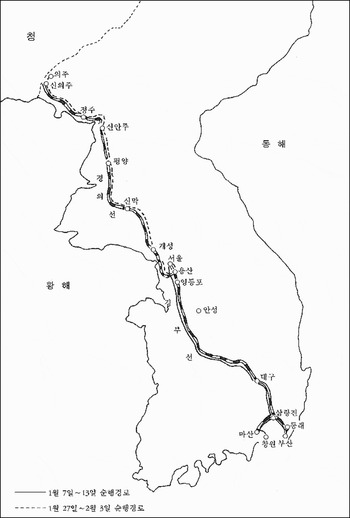
On the morning of January 7, 1909, Sunjong set out for the southern provinces. The itinerary included overnight visits to Taegu, Pusan, and Masan, as well as a number of stops along the Seoul–Pusan Line (kyŏngbusŏn). Sunjong was accompanied by a retinue consisting of more than 100 officials, including Itō, members of the royal family, cabinet ministers, and high-ranking courtiers, each of them donning Western ceremonial attire (tae yebok) of “European uniforms, dark marine-blue tunics, with many black and gold badges and heavily braided dark red trousers … of the best material and highly finished, apparently made far beyond Korea's frontiers” (Vay de Vaya Reference Vay de Vaya1906, 265).Footnote 5 Although covered by a cap, Sunjong's hair was visibly cut in the “Western style,” shorn of the traditional topknot. The streamlined appearance of the procession, both in the conformity of modern attire and the orderliness of the parade, provided a stark contrast to the “sea of colour” and “riot of imperious discord” that had characterized the occasional royal procession by Kojong through the streets of Seoul (Hamilton Reference Hamilton1904, 248–49; Savage-Landor Reference Savage-Landor1924, 138–39). After heading to Tŏksu Palace for a morning audience with his father, Sunjong headed to Seoul Station, where he boarded a specially equipped train. There, he composed the first of numerous telegrams dispatched to the palace with daily updates, conspicuous demonstrations of a son's devotion. As Sunjong headed south to Kyŏngsang Province, a region of conservatism whose political significance, as measured by the number of scholar-officials in bureaucratic service, had witnessed a decline, and had been the site of many an ŭibyŏng outbreak, the daily reminders of Sunjong's virtues were intended to appease the recalcitrant and conservative yangban elite and rebels by playing up his moral qualities.
Every leg of the tour followed a tightly scripted agenda. Sunjong entered each town amid crowds of people shouting “Long live the king!” (Manse!) and waving flags. The imperial marching band struck up at each stop the recently composed national anthem, Aegukka, whose pre-annexation lyrics exhorted subjects to venerate the imperial house (Chang Reference Chang Sahun1974, 189–92, 210).Footnote 6 The emperor received greetings from provincial governors and officials, local dignitaries, and community leaders. He visited important historical sites, temples, and shrines and donated funds for their maintenance. He awarded gifts to the elderly and individuals of merit, such as filial sons (hyoja) and virtuous women (yŏllyŏ). At schools and model commercial sites, he offered words of encouragement to students and workers. In Pusan, Sunjong boarded a battleship of the Japanese Imperial Navy, where he reviewed military exercises and received a twenty-one-gun salute. These visits usually concluded with a lavish dinner banquet, organized by welcoming committees consisting of both Koreans and Japanese of the highest civil and military ranks, including members of the Ilchinhoe.
Although the progresses ostensibly were a showcase for the emperor, and crowds turned out to catch a fleeting glimpse of him, in reality, it was Itō with whom the hundreds of thousands of Koreans who thronged the train stations and town plazas made direct contact (see figure 4). Sunjong's addresses were limited to a handful of toasts he gave at the nightly banquets, and they essentially reiterated the official themes of renovation and co-prosperity (Naegak kirokkwa 1909). Thus, it was Itō who commandeered the podium in each passing town to deliver a speech that emphasized the historical affinities between Korea and Japan and cast the protectorate relationship in positive terms. In a speech that was repeated across the peninsula, Itō claimed that Japan's “sincere aspiration in Korea” was to bring it “the same blessings of civilization which the people of Japan enjoy” by encouraging Koreans to “aspire for knowledge and industry.” He stressed that an alliance with Japan was not only the key to national prosperity, but also a vital element for securing stability in the Far East” (Hamada Reference Hamada1936, 207).
Map outlining the itinerary of the “southern” and “western” imperial progresses, along the Seoul–Pusan and Seoul–Ŭiju lines. Courtesy of Hara Takeshi (Reference Hara Takeshi and Ikhan2000).

The impact of Sunjong's highly publicized appearances varied widely over the course of the progresses. According to a detailed internal report assessing the impact of Sunjong's public appearance prepared by the Education Department (Hakpu), the fleeting vision of the emperor in all his trappings of modernity moved scores of male students in the southwestern cities of Taejŏn and Ch'ŏngju, in Ch'ungch'ŏng Province, to pledge their loyalty by lopping off their topknots at the train station (Tawara Reference Tawara Magoichi1909, 2)Footnote 7; fifteen years earlier, an official decree to rid the adult male population of this appendage had galvanized opposition to the Kabo reformers and pushed them out of power.Footnote 8 Sunjong's personal visits to schools, where he donated scholarship monies, were seen as having “heightened awareness to the importance of modern education” and prompted a spike in school enrollments in Kwangju and Pusan (Tawara Reference Tawara Magoichi1909, 16–17, 23). These endeavors prompted the local progressives who were engaged in the patriotic enlightenment movement (aeguk kyemong undong) to sing the praises of the emperor for bringing attention to the nation's need to modernize. In the March 1909 edition of the monthly newsletter of the Kyŏnggi and Ch'ungch'ŏng Provincial Society to Promote Education (Kiho hŭnghakhoe wŏlbo), one writer expressed his gratitude to the emperor for issuing a mandate of renovation (yusin ŭi myŏng) to the Korean people and for personally braving the elements of the deep winter to reach his subjects. With echoes of Itō's exhortations to modernize mixed with a class-based anxiety over diminishing yangban privileges, the author exhorted his fellow members to redefine their elite credentials by discarding the “useless” yangban hobbies of poetry and verse and acquiring more practical skills to keep in step with the modern age:
In this day of feverish competition in the twentieth century Pacific, there is no hope for a state (kuk) to be a state, or for a people (min) to be a people, by holding on to old thoughts and old attitudes… . These days, without teaching and learning politics, the law, industry and commerce, it will be impossible to maintain our yangban status, and our state and nation will face ruin. Yet our fathers and brothers remain deadly opposed to [their study]. Such is the difficulty of changing old customs (Han'gukhak 1976, 10:85–87).Footnote 9
Author Yun Sanghyon's residual class consciousness was representative of his time. Since the official abolition of the four social strata in 1895 as part of the Kabo reforms, and with social upheaval manifest in virtually every aspect of the traditional order, members of the yangban elite were as anxious to perpetuate their hereditary privileges as they were concerned with the specter of lost sovereignty. The imperial progress played to this foreboding by holding out the promise of continuity in the social order, through demonstrations of respect for the elders, the virtuous (as defined by a Confucian moral code), and the well-born that were reinforced throughout the pageants.
The pageants, of course, sought to appeal to a broader audience than the yangban elite, and if the reactions of the townspeople of Tongnae, Kyŏngsang Province, are any indication, a close encounter with the razzle-dazzle of Western costumes and a marching band was sufficient to link the emperor to modern changes. Moreover, local surveys conducted at the time concluded that the emperor's brief appearance resulted in generating “heightened respect for the dignity of the imperial house” (Tawara Reference Tawara Magoichi1909, 15–16). Descriptions of the welcoming crowds, the festival-like atmosphere that enveloped the parades, and the speeches delivered by Itō made their way back to Tokyo and appeared in the popular magazines Taiyō (Sun) and Chōsen (Korea), which were initially quick to praise the success of Itō's strategy in winning Koreans popular support.
Even as the Tokyo monthlies prepared their glowing reports for publication, however, Itō's tightly choreographed programs in the Korean countryside encountered glitches in the forms of everyday resistance as well as indifference. Although it is difficult to account for the varieties of the crowds' reactions to the imperial tours from one place to the next, numerous Japanese police reports filed from the field suggest that the protectorate administration anticipated resistance to Japanese rule at certain places. In Ansŏng, Kyŏnggi Province, for example, a town labeled by the Japanese police as “a place of high anti-Japanese stubbornness,” the residents' forceful rendition of the Korean national anthem was seen not as a sign of submission to the disciplining force of the gendarmerie (kenpeitai) but as an act of defiance (Tawara Reference Tawara Magoichi1909, 7–8). Elsewhere, as in Inch'ŏn, Japanese officials remarked upon the public's utter indifference to the pageantry and its significance, and filed reports bemoaning the fact that people failed to recognize the national flag or were unpracticed in the patriotic protocol of shouting Manse! (Tawara Reference Tawara Magoichi1909, 7). In towns such as these, school enrollment figures actually dropped, apparently as parents who witnessed the parade of Sunjong's procession reached the grim conclusion that in a world governed by Japan, their children would be better off learning practical skills (Tawara Reference Tawara Magoichi1909, 7–8).
Face-to-face encounters with the emperor—no matter how fleeting—also stripped him of any mystique or imperial aura, and drove home his mortality. Contrary to enhancing the prestige of the throne, the residency-general's exercise elicited sympathy for the visibly frail emperor, and brought criticism to the regime for parading him around in the dead of winter. Sunjong thus became an object of pity, as his image failed to conjure up an impression of sovereign authority, much less one of personal autonomy. Among the rumors circulating at the time were that the progresses represented a thinly disguised plan to kidnap Sunjong to Tokyo (like the crown prince) or exile him to Cheju Island (Hwang Reference Hwang Hyŏn and Chun1994, 823). Conspiracy theories enveloped the resident-general as well, giving rise to an insidious rumor that Itō had committed regicide in his own country and had been dispatched to the peninsula to execute a similar mission (Ch'oe Reference Ch'oe Ikhyŏn1977, 231–35; Lee Reference Lee1996, 404–6). In Taegu, the persistence of such rumors mobilized a group of conservative Confucian scholars (yusaeng) to come to the emperor's defense. Men in the audience, interrupting Itō in the middle of a speech, presented him with a petition of protest; only after Prime Minister Yi Wanyong had given them his personal assurance of the emperor's safety did they agree to disband. Suspicions of a conspiracy lingered and dogged the progress, however, and when Sunjong boarded the Japanese battleship Azabu off the coast of Pusan to review a military exercise of the Second Squadron, agitated Koreans circled the naval vessel in a hastily arranged flotilla comprised of sixty fishing boats to demand his release. Similarly, hundreds of men lay down on the railroad tracks outside the town of Mokp'o to prevent the train from traveling further south, where suspicious minds believed a ship was bound for Tokyo. In Masan, the crowd's heckles prevented the resident-general from completing his speech (Kuksa 1965, 1:390).
Thus, Itō's efforts to replicate the positive effects of the Meiji progresses in the Korean protectorate, rather than engendering subordination, instead unexpectedly raised the level of nationalist consciousness. When Itō arranged for Sunjong to visit hallowed sites on the national landscape, he directed the emperor to various sites commemorating Korean cultural patrimony, the Chosŏn ruling house, or its loyal subjects. In addition to those of his forebears, Sunjong visited several shrines commemorating Neo-Confucian scholars such as Yi Hwang (1501–70), Kim Changsaeng (1548–1631), and Song Siyŏl (1607–89). Sunjong was also directed to pay homage to a number of civil and military officials who had mobilized forces in times of national threat, including not only figures of the distant past, such as the Silla dynasty general Kim Yusin (595–673) and defenders of the realm against the Manchu invasions of the mid-seventeenth century, but also exemplars of Korean patriotism, such as the Admiral Yi Sunsin (1545–98) and Chŏng Pal (1553–92), figures lionized in the dynasty's history whose reputations had been built on anti-Japanese military exploits during the Hideyoshi invasions (1592–98). It is plausible that Itō, in his eagerness to convince the Korean population of Japan's sincerity, made the decision to honor even those heroes who embodied anti-Japanese nationalism. This tactic and its numerous manifestations subsequently came under fire in the Japanese media, as advocates of formal expansionism castigated Itō for “placing the concerns of Koreans above those of the empire.”Footnote 10 In the weeks that followed, Itō's critics found even greater cause for alarm as the cities on the northerly tour erupted in a nationalist frenzy over the issue of the national flag.
The Northern Region
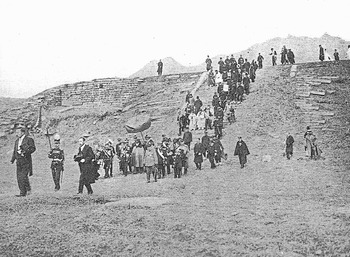
On January 27, Sunjong returned to Seoul Station to travel along the Seoul-Ŭiju Railroad and embark on his second progress, through the northwestern provinces of the peninsula. With stops at the major urban centers of P'yŏngyang, Ŭiju, and Kaesŏng, the emperor's daily agenda bore close resemblance to that of the southern tour (see figure 5). But in an apparent effort to muscle through the tide of public reproach that had been mounting for two weeks, the residency-general instructed local police forces to mobilize schoolchildren and to instruct them to wave the national flags of Korea and Japan at the welcoming parades and at school visits. The entourage packed on added splendor and swelled to a size of 139 officials, while security was heightened.
Emperor Sunjong and his entourage tour the site of Mansudae in P'yŏngyang. Taiyō, 1909.

In the three weeks since Sunjong had first set out for the southern provinces, the political landscape had shifted considerably. The Korean press and popular mobilization shaped national discourse in a way that soon rendered it impossible to regard the imperial progress merely as a celebration of the royal house or modernity. Rather, Korean subjects across the political spectrum and along the ladder of social hierarchy responded negatively to the residency-general's manipulative use of the emperor in a manner that blended personal sympathy and political outrage. The negative predisposition was all the more apparent in the northwest, particularly in the provinces of Hwanghae and P'yŏngan, where the highest concentration of the peninsula's Christian population lived. Historically marginalized by the political and social center of Seoul, the northern region emerged in the late nineteenth and early twentieth centuries as a dominant force in the transformation of modern Korea with a distinctive local identity (Hwang Reference Hwang2004).
The Japanese authorities got their first taste of Korean recalcitrance in Kaesŏng, where the faculty of a mission school refused to instruct its students to wave the Japanese flag. The instructors maintained that they had received no directive from the Education Department in Seoul to fly the hinomaru, and that the authority of the local police did not supersede that of the central government; this claim was subsequently backed up by the education minister himself (Matsui 1952, 251). In fact, Education Minister Yi Chaegon added insult to injury, stating that as an attendant to the Korean emperor, Itō warranted neither salutes nor flag-waving receptions. Once again, the prime minister was brought in to intercede, while local chapters of the Ilchinhoe scrambled to compensate by hoisting their own crudely drawn Japanese flags. Meanwhile, word of the brouhaha over the flag issue spread, emboldening Korean nationalists to take matters—literally—into their own hands. Seemingly overnight, all throughout the northwest region, the hinomaru flags on display were seized, then torn apart, stomped upon, or burned. In Ŭiju, townspeople descended upon a small factory assembling Japanese flags and seized them, while in Sinŭiju, students and teachers fanned out on a search and destroy mission. The Taesŏng Academy (Taesŏng hakkyo) in P'yŏngyang placed itself at the center of the storm by refusing to raise the Japanese colors on its campus, precipitating police intervention that shut the school down.Footnote 11 What might have remained a local event became a national cause célèbre when the Taehan maeil sinbo published the spirited exchange between the school's principal, An Ch'angho (1878–1938), and the police (Pak Reference Pak Kapchu1958, 77; Pak Reference Pak1999). In this manner, the northerly imperial progress helped popularize the use and symbolism of the t'aegŭkki as a touchstone of Korean national identity that defied the presence of Japan's protectorate administration and its control of the peninsula.
Korea and the Politics of Imperialism
Japanese media coverage of Sunjong's progresses had initially started out on a high note, carrying the tone of paternalism that persisted into the colonial period, by congratulating the emperor on his good fortune to enjoy Itō's counsel. As Itō himself regarded the tours as something of a farewell tour after spending three years in Korea, he had consciously employed the Tokyo-based press to maximize its coverage and drum up interest on Korean affairs in the metropole. This is evident during the early stages of the southern progress, when the leading Japanese publications on Korean affairs, Chōsen and Taiyō, dedicated their editorial space to carry the text of an Itō's speech in its entirety, the latter providing even an English-language translation. In the speech, a template for the numerous addresses he delivered on the road, Itō went to great lengths to dispel lingering suspicions of Japanese imperial ambitions on the peninsula. He acknowledged that historical relations between Korea and Japan had been broken at intervals “by temporary enmity,” but insisted that “affairs then were different from those of the present day…. Japan's only desire and aim [in Korea is] to have the situation here altered for the better, to guide its people in enlightenment and industry, to allow her to enjoy the blessings of a civilization similar to that enjoyed by Japan.” After stressing that the two countries' different stages of development merely reflected their respective attitudes toward modernization, Itō offered assurances of “his firm belief in the intellectual and physical capacity of Koreans,” and “expectations that he could ultimately bring about a hopeful change in [Korea].”Footnote 12 The message, so representative of the rhetoric of the civilizing mission proliferating throughout the world at the time, elicited a favorable reaction in Japan. In a letter dated January 30, 1909, Itō Miyoji (no relation), the resident-general's longtime associate from their days of constitution drafting, congratulated his colleague on pulling off a public relations success: “Your efforts have brought unity to the hearts of our people, and attracted the favorable attention of the world” (Itō Reference Itō Hirobumi1974, 449).Footnote 13
As news of the political fracas in the Korean south and northwest traveled to Tokyo, however, journals that only weeks earlier had extolled the achievements of the protectorate government began to run opinion pieces that were highly critical. An outraged Japanese media initially pounced on the “national flag issue” (kokki mondai) as evidence of the backward social behavior of Koreans that justified the presence of the residency-general. But as the dust settled, commentators moved beyond simplistic castigation of the Korean “hooligans” (yobo), instead seeking to identify the source of Korean resistance. One article, focusing on the opinions of Police Chief Matsui, cited the influence of Protestantism as the root cause of the region's anti-Japanese sentiment and pushed for stricter controls on the churches and mission schools. Others expressed general fears that “the roots of the incident ran deep” and laid the blame at the resident-general's feet, arguing that the rise of anti-Japanese attitudes among Koreans was in fact “the by-product of Itō's protectorate government that placed Korean interests ahead of those of the empire.” In those assessments, the flags were viewed as a catalyst that “provided the anti-Japanese faction with an opportunity to express their feelings of loyalty to the Korean nation.”Footnote 14 Collectively, these articles succeeded in transforming the Japanese public opinion on the protectorate administration's influence in Korea from favorable to damning.
Criticism of the residency-general's policy naturally focused on the man in charge, Itō. One writer for Chōsen weighed in with a scathing analysis of Itō's previously celebrated speech. While praising the “courage, self-confidence, sincerity and oratory skills” that recalled the Meiji statesman at the height of his formidable powers, the author opined that Itō's repeated promises to “develop the Koreans' mental faculties through widespread education and enrich their country by promoting industrial development” lost sight of the true intentions of Japan's imperial project. The author described Itō's views on Korea as “arbitrary” and “a blunder,” and accused him of placing the interests of Korea ahead of those of the empire, in effect “cultivating [Korean] desire for independence through his declarations and administration.” Itō's “Korea-First ideology” (Kankoku honi shugi), the article continued, had created the conditions for the flag incident, encouraged a pervasive anti-Japanese sentiment among the Korean population, and generated hostility toward Koreans among the Japanese officials and settlers there.Footnote 15
This criticism of Itō's so-called Korea-First ideology mirrored arguments made by other promoters of the empire's project on the peninsula. Some, such as Uchida Ryōhei, leader of the right-wing Amur Society (Kokuryūkai), had had opportunity to observe firsthand the consequences of the imperial progresses. Writing from Seoul, where he was retained as a member of Itō's staff and was actively involved in the affairs of the Ilchinhoe, Uchida repeated concerns that he had first voiced in 1907 on the occasion of Crown Prince Yoshihito's visit. At that time, Uchida had openly questioned the wisdom of parading Sunjong beyond the city walls and raising his political profile. With renewed vigor, he now warned that such measures “instructing Koreans in the ways of loyalty to the king and country” had fostered their desire for independence from Japan's protection, and questioned why Itō persisted in pursuing a track that was “harmful and useless to the policies of the Residency-General” (Kuzuu Reference Kuzuu Yoshihisa1930, 1:354–55, 2:47–54). While acknowledging their utility as propaganda that “demonstrated the sincerity of Japan to the world,” Uchida expressed concern that the progresses diminished the power of the resident-general by heightening loyalty to the Korean king and patriotism among the Korean people” In Uchida's mind, Itō's use of the Korean imperial house amounted to placing it on equal footing with the Japanese imperial house, which constituted nothing short of an act of lèse majesté to the chrysanthemum throne (Kuzuu Reference Kuzuu Yoshihisa1930, 2:48, 54).
Such vituperative opinions on both sides of the channel proved to be devastating to Itō's reputation and to his imperial plans for Korea. In the months that followed, opinion makers who had previously promoted Itō's policies and heralded the protectorate's achievements instead published article after article portraying the winter journeys as a political disaster and openly accused Itō of provoking Korean nationalism. In a wholesale repudiation of Itō Miyoji's earlier assessment, the editors of Chōsen voiced concerns that “the sprouts of opinions that Koreans hold about their imperial house might gradually cast a negative influence on Japan-Korea relations,” and openly admonished the policies of Itō's administration for the diffusion of anti-Japanese sentiment throughout Korea.Footnote 16 Lauded as a public relations coup only weeks earlier, the progresses and their outcome now compelled one analyst to write that the flag incident had broadcast to the world the Koreans' lack of confidence in the protectorate government.Footnote 17 Shortly thereafter, Taiyō published a special issue to examine “the failure of protectorate politics” and “the real facts of the anti-Japanese issue.”Footnote 18 The resident-general's last-ditch effort to preserve the Korean protectorate, by galvanizing anti-Japanese resistance on the peninsula, instead helped solidify Japanese public opinion against the enterprise and formalize its demise.
The Emperor and the Flag
In the same manner that the media's take on the imperial progresses unwittingly galvanized public opinion against the direction of the imperial project in Japan, newspapers in Korea, too, helped shape the national debates on identity and politics in a manner entirely unanticipated by the residency-general. In the pages of Taehan maeil sinbo and Hwangsŏng sinmun, it is possible to discern the emergence of two national identities that revolved around the symbols of the emperor and the flag. Although both icons started out as sacred entities representing the Korean nation and its pressing agenda for renovation, in short order, their paths diverged, with the emperor representing an official nationalism that appeared to accommodate the colonial regime—the unity and modern trajectory of the dynasty within Japan's imperial project—while the flag represented an anti-Japanese nationalism that refused subordination to Realpolitik and the residency-general.
In an editorial published in February 1909, in the aftermath of Sunjong's northerly progress, Hwangsŏng sinmun featured an article on Yi Sŭnghun, a champion of modern education who was given recognition by Sunjong during his stopover in Chŏngju, P'yŏngan Province. A successful entrepreneur and a prominent Presbyterian, Yi was the founder of the Osan Academy (Osan hakkyo), a school that, like many privately funded institutions that opened during the protectorate years, promoted a curriculum of national reconstruction (Kim Reference Kim2005). Representing an entirely different perspective from that of the Kiho hŭnghakhoe wŏlbo, the editorial criticized the conservative elitism of old-school scholars (sajok) and local officials for opposing the spirit of modernization and erecting numerous bureaucratic obstacles for the Academy. While attacking “the high and mighty who make up the Royal Library (Kyujanggak) and provincial governments, who do not spare expenses for their own corrupt causes but give no heed to schools or learning societies,” the article praised Sunjong as a benevolent and modern monarch. By conferring imperial grace (sŏngdŏk) upon Yi, it claimed, the cause of modern learning was likely to encourage “thousands, nay ten thousands” of new students to enroll throughout the country (February 9, 1909). The article's paean to Sunjong, established by linking him to Yi's philanthropic educational endeavor, was representative of the nation-building efforts pursued by the newspapers at this time, which often subordinated the regional particularity of the newsworthy item—in this case, Yi and the school—for the sake of promoting a larger, common identity: the nation and the imperial house.
Like the crowd's enthusiasm for the emperor in the south, what is notable about this article is how themes of kingly allegiance and modernization trumped national sovereignty as the writer's primary concerns. The protectorate regime's insistence that the Japanese flag be flown and waved throughout the north shifted the priorities in such a manner that publications subsequently diminished the role of the emperor to highlight the symbolic cachet of the t'aegŭkki. As the Japanese press clearly noted, the northerly progress jumpstarted a widespread anti-Japanese response—whipping up political consciousness among a large segment of the Korean population whom the residency-general had complacently thought it could cajole into accommodation. By publishing articles and editorials on the incident, the Korean newspapers staked their positions in the nationalist controversy. Amid the mayhem, it was the national flag that emerged as the symbol of a defiant Korean identity, while the throne came to be perceived as fatally compromised by Japan's imperial project. As Tsukiashi Tatsuhiko (Reference Tsukiashi Tatsuhiko2000) notes, the progresses marked a turning point from which Taehan maeil sinbo consciously distanced itself from the throne, initially by publishing fewer articles stressing loyalty to the imperial house, and eventually refuting its earlier stance through outright criticism of those who insisted on linking king and country.
Conclusion
The Japanese administration's best-laid plans to bring Koreans into the empire's fold through a program of pomp and propaganda indeed proved to be an unprecedented event, although not in the manner envisioned. In the early stages of his journey, Sunjong elicited the anticipated response in many places along the official itinerary, but this was by no means universal, and palpable apathy or resignation registered in others. Yet in either case, the protectorate-sponsored exercise in political pageantry connected the imperial house, the Korean nation, and modernity in a manner that found keen support across the political spectrum, from conservatives to progressives, nationalists and pan-Asianists. Ultimately, however, the progresses through the peninsula highlighted tensions—between the throne and the residency-general, Korea and Japan—and forced them to play out on a set of national stages. Critics in both countries then published their reviews to devastating, and long-lasting, effect.
The outcome was particularly devastating for Itō, whose plans to prolong the Japanese hold on Korea through means of informal control were completely sidelined by the show of flags in the north. Fueled equally by the desire to appropriate the symbolic capital of the Korean throne and promote the image of Japanese imperial benevolence, the resident-general had blithely applied the lessons of Meiji nation building to Korea with the assumption that the imperial showcase would move the Korean people to submission—to their monarch, and to the cause of modernity that he represented. Instead, the Korean emperor became a catalyst for nationalism, in the northern region at first, and eventually, through the medium of the nationalist press, throughout the peninsula. The ŭibyŏng insurgency hardly subsided during or after the progresses took place, and the public uproar occasioned by the flag incident undermined the entirety of Itō's governing strategy in Korea, just as he was preparing to leave his post that spring. Moreover, the progresses carried grave personal consequences for Itō, whose high-profile exposure to the Korean populace during the journeys established him as the face of the Japanese empire. Five months after resigning his post, Itō was assassinated by a young Korean nationalist—a northerner—while visiting Harbin.
The consequences for the monarchical institution in Korea were no less significant. To the Japanese government in Tokyo, the progresses raised a different kind of awareness of the symbolic capital of the Korean throne, namely its ability to incite nationalist passions. Subsequent colonial policies on the peninsula took great pains to circumscribe it in co-optive ways, beginning with the Treaty of Annexation of 1910, which went to great lengths to assimilate the Chosŏn dynastic house into Japan's imperial structure, granting courteous treatment and generous financial allowances to its members. Yet even as the Japanese government persisted in according great significance to the Korean throne, the experience of the progresses had launched a profound disquiet on the peninsula. Although many Koreans would continue to link the fate of the nation to that of the royal house—at least until 1919, when Kojong's death was experienced as marking the end of an era—disaffection with the compromised crown moved many to question traditional assumptions of sovereignty. The events of January 1909 thus illustrate the inherent difficulties faced by Japan in seeking to colonize a country in which some inchoate form of modern nationalism was already emerging.
Acknowledgments
I am grateful to all those who read earlier drafts or commented on presentations of this work, including Mark Caprio, Kevin Doak, Carter Eckert, Andrew Gordon, Kyung Moon Hwang, Sun Joo Kim, Hyung Gu Lynn, Andre Schmid, Aparna Vaidik, and two anonymous readers for the Journal of Asian Studies.