Introduction
Worldwide, children and families suffer physical and emotional consequences of disasters. Myriad public health and clinical interventions have been developed to address children's disaster reactions.Reference Forman-Hoffman, Zolotor and McKeeman1-Reference Pfefferbaum, Varma, Nitiéma and Newman9 Many of these interventions are multimodal, comprised of various components associated with cognitive behavioral therapy (CBT).Reference Pfefferbaum and Shaw6, Reference Pfefferbaum, Sweeton and Newman7 For the most part, child disaster intervention evaluation studies have not examined the benefit of specific intervention components. Thus, this report provides a review of the components included in available child disaster mental health interventions as a prelude to formal study of the effectiveness of these components.
Methods
The Compilation of Studies
The research on child disaster mental health intervention studies was identified through a literature search of EMBASE (Elsevier, Amsterdam), ERIC (US Department of Education, Washington, DC), Medline (US National Library of Medicine, Rockville, Maryland USA), Ovid (Ovid Technologies Inc., New York), PILOTS (US Department of Veterans Affairs, Washington, DC), PsycINFO (American Psychological Association, Washington, DC), and Social Work Abstracts (National Association of Social Workers, Washington, DC) conducted in July, 2013. The search was confined to English-language materials on children and adolescents, aged 0 through 17 years. The following terms were used: accident(s), adolescent(s), child(ren), disaster(s), intervention(s), terrorism, terrorist event(s), terrorist incident(s), treatment(s), and war. Identified titles and abstracts were reviewed to select material for potential inclusion in the analysis. To focus the review on disasters and terrorism, studies addressing accidents and war were excluded. Publications known to the authors that were not identified by the search were incorporated as appropriate. The reference sections of articles identified by the search were examined to identify other materials not already generated. The review included only intervention studies, not materials on the organization or delivery of services or qualitative descriptions of interventions not subjected to empirical testing. The process yielded a total of 50 publications on interventions with 35 (70.0%) using disaster samples, 10 (20.0%) using terrorism samples, three (6.0%) using heterogeneous samples, one (2.0%) using a hostage-taking sample, and one (2.0%) on disaster preparedness. Eleven (22.0%) studies used another intervention (as opposed to a waitlist) as the control group, resulting in 61 interventions included in this review.
Components
While there has been some effort to identify the practice elements used by providers in the field to address childhood trauma (eg Borntrager et alReference Borntrager, Chorpita, Higa-McMillan, Daleiden and Starace10), this work has not focused specifically on disaster interventions. Cohen and colleaguesReference Cohen, Mannarino and Deblinger11, Reference Cohen, Mannarino, Deblinger and Berliner12 generated an acronym, “PRACTICE,” to describe nine core trauma-focused CBT components used with child trauma survivors: (1) psychoeducation; (2) parenting skills; (3) relaxation skills; (4) affective modulation skills; (5) cognitive coping and processing; (6) trauma narrative; (7) in vivo mastery of trauma reminders; (8) conjoint child-parent sessions; and (9) enhancing future safety and development. These components were endorsed in the American Academy of Child and Adolescent Psychiatry (AACAP) practice parameter on posttraumatic stress disorder (PTSD).13 The nine components were examined in the studies in this review, with some modification. Affect modulation included techniques aimed at identifying, processing, or moderating emotions. Coping skill enhancement included any techniques focused on promoting adaptive coping in which coping skill development or enhancement was the objective. In vivo and in vitro desensitization were consolidated as exposure, and parenting skills and conjoint child-parent sessions were combined as parent involvement. With the reorganization, this review describes the following CBT intervention components: (1) psychoeducation; (2) relaxation skills; (3) affect modulation; (4) coping skill enhancement; (5) exposure; (6) trauma narrative; (7) techniques to enhance future safety and/or development; (8) garnering social support; and (9) parent involvement.
Rating Procedures
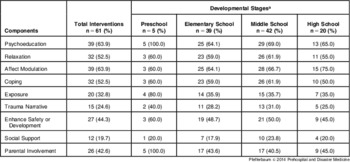
Two investigators (BP and PN) scored all interventions to identify the components used. To be scored, the component had to be explicitly mentioned in the description of the intervention, and any component mentioned in the report, even if minimally described, was scored as present. Moreover, while some studies described using the same interventions (eg Cohen et alReference Cohen, Jaycox, Walker, Mannarino, Langley and DuClos14 and Jaycox et alReference Jaycox, Cohen and Mannarino15), these were counted separately to reflect the number of studies using the components rather than the intervention itself. For example, Cohen and colleaguesReference Cohen, Jaycox, Walker, Mannarino, Langley and DuClos14 reported using Trauma Focused-Cognitive Behavioral Therapy (TF-CBT) and Cognitive Behavioral Intervention for Trauma in Schools (CBITS), interventions also studied by Jaycox and colleagues,Reference Jaycox, Cohen and Mannarino15 but Cohen's group described only the trauma narrative in their 2009 report. Thus, TF-CBT and CBITS were each scored more than once but only the trauma narrative was scored in the study by Cohen's group.Reference Cohen, Jaycox, Walker, Mannarino, Langley and DuClos14 The simple kappa coefficient estimate for inter-rater agreement of the identified components was 0.86 (95% CI, 0.80-0.91). Discrepancies were settled through consensus. Table 1 summarizes the number of interventions studied that included each component.
Frequency Distribution of Intervention Components and Developmental Stages

aSeveral interventions were used across different age ranges so the total number of components for the developmental stages exceeds 61 in some cases.
Two investigators (BP and PN) also scored the populations studied for each intervention using three categories. Clinically-indicated interventions were delivered to children receiving treatment for disaster-related clinical conditions, symptomatic children, or children identified through screening to receive the intervention. Selected interventions were delivered to children based on their disaster exposures. Universal interventions were delivered to all children, regardless of their disaster reactions or exposures. The simple kappa coefficient estimate for inter-rater agreement on populations was 0.83 (95% CI, 0.71-0.96).
Results
Two sets of results are presented. First is a presentation of summary data on the frequency of components used and of the populations receiving the interventions examined in this analysis of the research. Second is a qualitative description of the findings related to the nine components examined in the review.
Summary Data on the Frequency of Component Use and the Populations Served
Table 1 presents summary information on the frequency of components used in the interventions studied. Psychoeducation and affect modulation were the most commonly-used components, followed by relaxation and coping skill enhancement, and then enhancement of future safety and/or development, parental involvement, and exposure. Trauma narrative and social support were the least frequently-used components.
Therapeutic Components and Child Developmental Stage
As also shown in Table 1, most interventions included children of elementary and middle school age, with many fewer interventions for children of high school age. Among the intervention studies that included high school students, the most frequently employed components were affect modulation and psychoeducation. Five interventions were examined in four samples of preschool age children,Reference Brown, Pearlman and Goodman16-Reference Scheeringa, Weems, Cohen, Amaya-Jackson and Guthrie19 with one studyReference De Roos, Greenwald, den Hollander-Gijsman, Noorthoorn, van Buuren and de Jongh17 examining two interventions—eye movement desensitization and reprocessing (EMDR) and CBT. Not surprisingly, all interventions studied in preschool children included a parent component, though this was not the case with other developmental stages. Psychoeducation also was included in all interventions studied in preschool children. Exposure was used in four of the five interventions for this age group.Reference Brown, Pearlman and Goodman16-Reference Scheeringa, Weems, Cohen, Amaya-Jackson and Guthrie19
Therapeutic Components and Child Populations
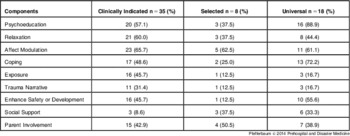
The interventions were delivered to children with a range of exposures in research conducted in locations around the world. Table 2 displays the frequency of components according to the populations studied. The majority of interventions were delivered to children in treatment for clinical problems, symptomatic children, and/or children identified through screening (clinically indicated). Next most common was delivery to all children in the population regardless of symptoms or exposure (universal), and the fewest interventions were delivered to children identified as at risk due to their disaster exposures (selected). Strikingly, over one-half of the interventions studied for clinically-indicated populations used affect modulation, relaxation, and psychoeducation. Among interventions designed for selected populations, affect modulation and parent components were used in over one-half of the studies. Among interventions designed for universal populations, psychoeducation, affect modulation, coping skill enhancement, and techniques to enhance future safety and/or development were used in over one-half.
Frequency Distribution of Intervention Components by Study Population

Therapeutic Components and Timing of Intervention Delivery
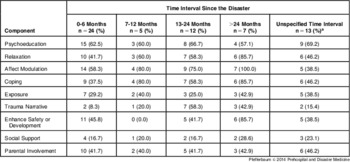
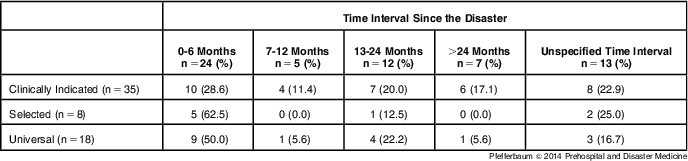
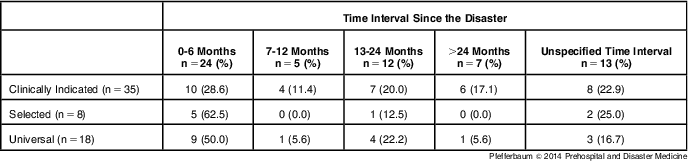
Descriptive statistics presented in Table 3 suggest that relaxation, affect modulation, and trauma narrative components were used more frequently as time since the disaster increased. It is possible that rather than due to timing since the event, the frequency of inclusion of some components was related to the differences in populations served. Indeed, while almost one-half (n = 17; 48.6%) of the clinically indicated interventions were delivered more than six months after the event, only 12.5% (n = 1) of the selected interventions, and one-third (n = 6; 33.3%) of the universal interventions, were reported to have been offered in the same time frame (Table 4).
Frequency Distribution of Intervention Components by Time Elapsed Since the Event

aIncludes the two preparedness interventions (“usual condition” and “emergency management condition”) implemented by Ronan and Johnston.Reference Ronan and Johnston40
Frequency Distribution of Populations Studied by Time Elapsed Since the Event, N = 61
Therapeutic Components and Effectiveness of the Interventions on PTSD Reactions
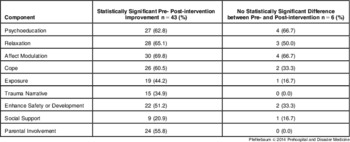
The current analysis of outcomes focused on PTSD reactions because these were the most common outcomes measured in the child disaster mental health intervention researchReference Pfefferbaum, Sweeton and Newman7 and because the components under investigation in this review were envisioned to address trauma reactions. Of the 61 interventions evaluated for this review, 49 (80.3%) examined PTSD reactions. Statistically significant pre/post intervention improvement in PTSD reactions was documented in 43 (87.8%) of the 49 interventions that measured PTSD reactions while six (12.2%) of the interventions resulted in no statistically significant change in PTSD reactions (Table 5). Noticeably, trauma narrative and parent involvement were not included in the interventions that reported no improvement over time. Additionally, exposure and coping skill enhancement were markedly less frequently described as components of interventions with no statistically significant change in PTSD reactions after intervention (16.7% and 33.3%, respectively) than in those with a statistically significant decrease in PTSD reactions (44.2% and 60.5%, respectively). Unfortunately, however, given the small number of studies in which there was no statistically significant change (n = 6), and given the prospect that some intervention components may have been offered to the study participants but not reported in the published manuscripts, no definitive conclusions should be drawn about which specific components were most effective.
Frequency Distribution of Intervention Components by Intervention Effect on PTSD Reactions

Qualitative Analysis of the Components Studied
The quantitative data are difficult to interpret due to inconsistencies in the descriptions of components in the literature. A qualitative summary of the components, presented below, adds richer detail to the understanding of their use.
Psychoeducation
Psychoeducation, which typically provides health and behavioral health education, is a basic component of many interventions. Psychoeducation entails teaching children about disaster-specific issues (eg, describing weather events), common reactions to disasters, and healthy coping strategies appropriate to the child's age and culture and to the disaster situation and phase. Providing psychoeducation simultaneously to parents as well as children may facilitate parental support by educating parents about common disaster reactions, helping them to recognize reactions that warrant evaluation and intervention, clarifying expectations of intervention, and providing them information about available resources and services. This information and available educational resources can be disseminated through health and mental health programs, schools, other community outlets, and the media.
Most (n = 39; 63.9%) of the interventions reviewed used psychoeducation, delivering one or more sessions as a discrete component or integrating education throughout the intervention. For example, to provide empathy and to normalize children's reactions as well as to educate them about the intervention, Brown and colleaguesReference Brown, McQuaid, Farina, Ali and Winnick-Gelles20 explained the connection among cognition, emotion, and behavior in one of the early sessions of their classroom intervention, while Giannopoulou and colleaguesReference Giannopoulou, Dikaiakou and Yule21 integrated psychoeducation using a hypothetical example of one child's experience with the disaster throughout the intervention.
In the most focused evaluation of psychoeducation for children in the disaster context, Sahin and colleaguesReference Sahin, Yilmaz and Batigun22 tested an intervention that provided psychoeducation as the primary component for children and parents after a 1999 earthquake in Turkey. The investigators distributed information about normal disaster reactions and effective coping mechanisms through a variety of means, including brochures and seminars. Groups of children participated in the counselor-facilitated seminars in their school classrooms while their parents attended a seminar. Children who received psychoeducation scored no better on a quiz about earthquakes than the comparison group of children who did not attend the seminars, though the children and their parents reported the program to be beneficial. For children, perceived benefit was related to the number and variety of activities incorporated in the seminars; for parents, perceived benefit was related to the number of topics discussed. The authors recommended that future psychoeducation programs include greater use of participatory activities, concrete examples, role modeling of adaptive coping and communication skills, visual aids, repetition, and time for discussion.Reference Sahin, Yilmaz and Batigun22
Relaxation Skills
Behavioral stress management strategies typically involve building bodily awareness, practicing relaxation strategies, and/or learning controlled breathing techniques. Relaxation skills were used in more than one-half of all interventions across all ages. Many interventions incorporated specific breathing exercises used before, or in combination with, other intervention components. Muscle relaxation, typically progressive muscle relaxation, was commonly included. Some researchers highlighted the importance of alternative stress management and relaxation. For example, the intervention described by Vijayakumar and colleaguesReference Vijayakumar, Kannank, Kumar and Devarajan23 used meditation and the one described by Catani and colleaguesReference Catani, Kohiladevy, Ruf, Schauer, Elbert and Neuner24 used meditation in combination with relaxation exercises.
Weems and colleaguesReference Weems, Taylor and Costa25 implemented a 5-session intervention for adolescents exposed to Hurricane Katrina (USA, 2005) which focused on reducing elevated test anxiety. Youth first learned about manifestations of anxiety and test-taking skills and then participated in relaxation training, combined with gradual exposure to test-related stimuli. Interestingly, in addition to significant reductions in test anxiety and improvements in academic performance, the intervention contributed to diminished posttraumatic stress symptoms as a result of decreased test anxiety.
In addition to specifying relaxation techniques by that name, other studies described the use of techniques with similar goals; these were not included in the counts in the summary data presented in the tables. For example, Lesmana and colleaguesReference Lesmana, Suryani, Jensen and Tiliopoulos26 used spiritual hypnosis after a terrorist incident in Bali. In another study, Israeli children exposed to chronic terrorism learned to attend to stress-induced bodily sensations and to apply sensory-motor “bio-energy” strategies to manage stress.Reference Berger, Pat-Horenczyk and Gelkopf27
Affect Modulation
The expression, processing, and modulation of painful trauma symptoms promote short- and long-term wellbeing of child disaster survivors. Thirty-nine (63.9%) interventions described affect awareness, emotional modulation, anxiety management, and/or anger management as part of the intervention being evaluated. Some researchers specifically identified emotional expression as a component of their intervention but did not emphasize techniques to modulate or cope with feelings. Some interventions encouraged children to express their emotions through play, drawing, role-playing, and storytelling. Some had children identify and rate their emotions. Other interventions taught children specific techniques to manage their emotions. For example, March and colleaguesReference March, Amaya-Jackson, Murray and Schulte28 taught children diagnosed with PTSD a grading technique to quantify their distress levels across multiple situations and an interpersonal problem-solving procedure to regulate anger. In two Israeli studies, children first increased emotional awareness of anger and then learned to express and cope with it appropriately.Reference Berger, Pat-Horenczyk and Gelkopf27, Reference Gelkopf and Berger29 Children also may develop emotion modulation skills as a result of learning and practicing other components even when affective-specific components are not included in an intervention.
Coping Skill Enhancement
Child disaster studies have begun to explore children's copingReference Pfefferbaum, Noffsinger, Wind and Allen30 and interventions have incorporated techniques to enhance coping. Coping skill enhancement was used in more than one-half (n = 32; 52.5%) of the interventions studied and was most commonly used in universal interventions (n = 13 out of 18 universal interventions; 72.2%; Table 2) and least commonly used in the interventions conducted within the first six months after the event (n = 9 out of 24 interventions; 37.5%; Table 3). Cognitive Behavioral Therapy approaches, by design, involve an exploration of children's attributions about their experiences, which may be important for their adaptation, and efforts to reframe them in healthy and beneficial ways. Cognitive restructuring was employed to address children's intrusive thoughts, cognitive distortions, misattributions, and harmful thought patterns. Several interventions using CBT or EMDR taught children to identify positive and negative cognitions (eg, Brown et al,Reference Brown, McQuaid, Farina, Ali and Winnick-Gelles20 Chemtob et al,Reference Chemtob, Nakashima and Carlson31 and March et alReference March, Amaya-Jackson, Murray and Schulte28) and to counteract or replace negative trauma-related thinking, for example, by making specific positive statements to substitute for intrusive trauma-related images or thoughtsReference March, Amaya-Jackson, Murray and Schulte28 or by replacing the thoughts with more adaptive coping statements.Reference Brown, McQuaid, Farina, Ali and Winnick-Gelles20 In EMDR, other therapeutic tasks, such as distracting eye movements, occur at the same time the child engages in this cognitive restructuring activity.
Other coping techniques were employed as well, including, for example, thought stopping, self-talk, and positive imagery. In their grief and trauma intervention, Salloum and OverstreetReference Salloum and Overstreet32 used several techniques to reinforce coping skills—children made coping puppets and collages, they role played using coping skills, and they constructed a book on coping to share with a caring adult.
Exposure
Exposure-based approaches involve repeatedly exposing the child to the thoughts, images, and feelings associated with the traumatic experience with the goal of processing the traumatic event, reducing distress, and promoting healing typically through desensitization to traumatic stimuli or memories, overcoming avoidance, creating new associations, and/or instilling a sense of control. Both in vivo and in vitro (imaginal) exposure techniques were used in the child disaster interventions studied (n = 20, 32.8%). These techniques were used in a high proportion of the studies involving preschool aged children.
To help them master distressing situations of increasing intensity, in vivo desensitization gradually exposes children to the actual feared stimuli with greater intensity over time. March and colleaguesReference March, Amaya-Jackson, Murray and Schulte28 devoted six of their 18 group therapy sessions to exposure techniques. In one exposure session, the therapist assisted children in constructing their own personal stimulus hierarchies. Succeeding sessions introduced narratives, modeled a trial exposure task, and assigned in vivo desensitization as homework.
In in vitro exposure, sometimes referred to as imaginal exposure, children are exposed to anxiety and fear-provoking memories of the traumatic event starting with the least fearful memory and working up toward more distressing memories. In vitro exposure shares some elements with both the trauma narrative and in vivo exposure. Similar to the trauma narrative, in vitro exposure involves exposing children to memories of the traumatic event. Similar to in vivo exposure, in vitro exposure involves graduated exposure. Therapy approaches often incorporate one or more of these exposure techniques in conjunction with relaxation and breathing exercises to help children manage their anxiety while practicing exposure. For example, in their individual intervention, Brown and colleaguesReference Brown, McQuaid, Farina, Ali and Winnick-Gelles20 delivered four sessions of imaginal exposure with relaxation and cognitive techniques used at the end of the exposure session to reduce anxiety.
Some interventions used both in vivo and in vitro (imaginal) techniques. For example, as part of a prolonged exposure intervention, Gilboa-Schechtman and colleaguesReference Gilboa-Schechtman, Foa and Shafran33 aided trauma victims in constructing an in vivo exposure hierarchy and assigned in vivo exposure exercises as homework. Imaginal exposure required the children to recount their traumatic memory verbally in the present tense; this was tape-recorded and participants were instructed to listen to the tapes daily at home.
Trauma Narrative
Approximately one-fourth (n = 15, 24.6%) of the interventions studied specifically identified a trauma narrative component. The trauma narrative involves talking and/or writing about one's experience to create a detailed description of the thoughts, feelings, and bodily associations that occurred before, during, and after the trauma. In some interventions, the trauma narrative component was conducted individually with children, while in some interventions, children openly discussed their traumatic experiences as a group or with their parents. In some studies, the narrative was conceptualized as a form of exposure, whereas in other studies, it was described as a mechanism for meaning-making or not described well.
To date, only one disaster study has attempted to examine the specific contribution of the trauma narrative to the efficacy of a trauma and grief-based intervention. Salloum and OverstreetReference Salloum and Overstreet32 studied children exposed to various traumatic events who participated in either a grief and trauma intervention with both a coping skills and a trauma and loss narrative component or a grief and trauma intervention including the coping skills component only (with no trauma and loss narrative). Because both intervention groups experienced similar reductions in distress, the results suggest that the trauma narrative did not add extra benefit. The authors noted, however, that even in the coping skills intervention, children talked about their experiences and engaged in emotional processing about the trauma. Children in the group receiving both the trauma narrative and coping skills components had more clinically-elevated distress scores pre intervention than did the group which did not receive the trauma narrative. Thus, the coping skills and trauma narrative group may have benefitted more from the combined intervention than they would have from the coping component alone. Future studies should focus on determining the degree to which trauma narratives and emotional processing occur in the context of interventions that do not include a formal trauma narrative component. Additionally, specific features of the trauma narrative itself require further exploration to determine which techniques contribute to symptom reduction.
Techniques to Enhance Future Safety and/or Development
Enhancing future safety was a goal of a number of cognitive behavioral interventions. Some interventions included disaster-specific future planning (eg, preparing for future earthquakes or terrorist attacks). For example, Brown and colleaguesReference Brown, McQuaid, Farina, Ali and Winnick-Gelles20 worked with children to develop a safety plan (eg, assemble phone numbers of significant adults and police departments). Some interventions focused on reinforcing coping skills and planning for a better future. For example, the intervention described by Salloum's groupReference Salloum, Garside, Irwin, Anderson and Francois34 incorporated education about safety and prevention and specific coping strategies for dealing with future trauma. An intervention studied by Brown and colleaguesReference Brown, Pearlman and Goodman16 used a conjoint parent-child session to identify and develop plans to address upcoming challenges.
Few (n = 3, 4.9%) of the interventions in this review described components addressing the children's developmental trajectory. Goenjian and colleaguesReference Goenjian, Karayan and Pynoos35 identified missed developmental opportunities and promoted normal development by engaging the child survivors of a massive earthquake in discussions about the disaster's effects on their development and by actively helping them develop coping strategies. Goodman and colleaguesReference Goodman, Morgan, Juriga and Brown36 addressed issues of individuation in an adolescent who received client-centered therapy for traumatic grief after the September 11 attacks (New York, 2001).
Garnering Social Support
After a disaster, children are likely to require and benefit from a variety of supports. One-fifth (n = 12; 19.7%) of the interventions reviewed included a social support component. For example, interventions helped children learn to garner social support from family members.Reference Shooshtary, Panaghi and Moghadam37 Goenjian and colleaguesReference Goenjian, Walling, Steinberg, Karayan, Najarian and Pynoos38 broadened potential sources of social support beyond the family and assisted children in identifying persons who could provide three different types of support—advice, counseling, and/or companionship. Wolmer and colleaguesReference Wolmer, Hamiel, Barchas, Slone and Laor39 implemented a teacher-facilitated group preventive intervention with Israeli children exposed to continuous rocket attacks emphasizing coping through the enhancement of communication with others. Similarly, Gelkopf and BergerReference Gelkopf and Berger29 emphasized social support by leading children through activities designed to explore their social needs. Their intervention helped children to assess their own social needs and find ways to build and strengthen their support system by, for example, encouraging them to ask others for help and to practice empathy toward others.
Parent Involvement
Parents are central figures of caretaking and support for children and can influence their adjustment post disaster. Parents may function as agents of change for children by extending the therapeutic efforts of professionals. In addition, potential long-term benefits may emerge from increased parental ability to support their children as the children become more able to openly discuss feelings about the traumatic experience. Twenty-six (42.6%) of the interventions used a parent component, and it was included in all interventions for preschool children.
Parental psychoeducation was commonly used to teach parents about normal and maladaptive reactions to disaster, to deliver instruction on how to enhance their children's adaptive coping, to provide information about seeking further assistance if indicated, and to address expectations. Some interventions instructed parents about the various skills taught to their children so that parents could encourage their children to practice and use these skills between sessions. Interventions also offered supportive interactions and therapy for parents. A variety of approaches were used to involve parents, including parallel parent sessions, conjoint sessions, or a combination of the two. Giannopoulou and colleaguesReference Giannopoulou, Dikaiakou and Yule21 provided a 30-minute conjoint session at the end of each child group session to educate parents about techniques used during child sessions and to inform the parents of specific homework assignments. The intervention also created a supportive environment by providing a setting for parents to meet together informally while their children were being seen. An intervention studied by Scheeringa and colleaguesReference Scheeringa, Weems, Cohen, Amaya-Jackson and Guthrie19 used several approaches with maternal caretakers of traumatized preschool children. In some of the sessions, to help them become better attuned to their children, caregivers spent time observing their children on television to learn the material being taught. Part of the time, caretakers met alone with the therapists to help the therapists interpret the children's words and body language, to discuss homework, and to receive supportive therapy and advice.
Discussion
This review of nine components used in child disaster mental health interventions was intended as a preliminary step in creating a foundation and framework for future research, and ultimately, clinical work. Limitations in the extant literature and recommendations for the next generation of study are discussed below.
The quantitative findings are limited by inconsistencies and lack of detail in description of the interventions in some studies. To be scored as present, the component had to be mentioned in the intervention study, and the component was scored as present even if not well described. For example, in their description of two case studies related to Hurricane Katrina, Cohen and colleaguesReference Cohen, Jaycox, Walker, Mannarino, Langley and DuClos14 reported using TF-CBT and CBITS, both of which contain numerous CBT elements, but in this publication, they described only the trauma narrative and parent involvement for TF-CBT and only the trauma narrative for CBITS; thus, only those components were scored as present. Ronan and JohnstonReference Ronan and Johnston40 called their brief control intervention the “exposure and normalizing condition” which was coded as exposure even though the description of the intervention raised doubt about the use of conventional exposure techniques. These rating procedures were chosen because the actual implementation of an intervention may not have included all components of the intervention and/or may not have conformed strictly to the specified intervention (ie, a question of fidelity). Moreover, it was felt that to be useful to readers, each study had to stand on its own.
The inconsistency in detail about the components included in the interventions studied is a major limitation in this analysis of the extant literature. A related issue is that the terminology used to describe intervention components was inconsistent. Clear definitions of the components utilized in intervention studies would facilitate a more accurate review of accumulated knowledge and comparison among studies.
Investigators did not dismantle interventions to examine the effectiveness of specific components used. In their study of an intervention delivered to children during the Bosnian War (1992-1995), Layne and colleaguesReference Layne, Pynoos and Saltzman41 addressed dismantling when they compared children who received their full (psychoeducation, skill building, adaptive grieving, and adaptive development) and partial (psychoeducation and skill building only) interventions. Salloum and OverstreetReference Salloum and Overstreet32 concluded that the trauma narrative was not a necessary component of their trauma and grief intervention to enhance coping. While these findings suggest that some intervention components may not be essential for improved outcome, it is unclear which component, or components, of an intervention is, or are, the “active ingredient” responsible for benefit. For instance, in the present review, trauma narrative and parental involvement were not mentioned as components in any of the six interventions with no statistically significant change in PTSD reactions after the intervention. Fifteen (34.9%) and 24 (55.8%) of the 43 interventions that reported a statistically significant decrease in PTSD reactions after the intervention included trauma narrative and parental involvement respectively, however. Thus, the next generation of studies should dismantle interventions to examine and compare the efficacy of particular components.
While dismantling and examining the various CBT components is important, so is identifying common elements across various modalities that may be responsible for beneficial outcomes. These common elements include, for example, the sensitivity of human concern and the systematic focused attention on the child's trauma history and symptoms. Moreover, it appears that multiple different approaches lead to improved outcome. For example, there is evidence of efficacy for exposure and narrative therapies,Reference Vijayakumar, Kannank, Kumar and Devarajan23, Reference Catani, Kohiladevy, Ruf, Schauer, Elbert and Neuner24, Reference Ronan and Johnston40 but it is unclear if these approaches are superior to othersReference Catani, Kohiladevy, Ruf, Schauer, Elbert and Neuner24, Reference Ronan and Johnston40 at least over time.Reference Gilboa-Schechtman, Foa and Shafran33 Thus, future studies should explore common elements associated with different approaches.
Researchers have yet to determine the ideal sequencing of the components within the available interventions. The trauma bereavement intervention used by Brown and colleaguesReference Brown, Pearlman and Goodman16 recognized the importance of addressing trauma before the child can proceed through the grief process while Salloum and OverstreetReference Salloum and Overstreet42 noted that an “explicit” focus on grief and bereavement may facilitate the processing of trauma and decrease posttraumatic stress symptoms. The optimal sequence of intervention components may not be the same for all children or all situations and should be examined in future work.
The interventions reviewed in this analysis were administered to various populations of children. Some interventions were clinically indicated, some were delivered to children with specific exposures, and some were delivered to all children without consideration of their exposures or emotional status. The interventions were delivered to children across the age span from preschool age through adolescence but, unfortunately, the studies reported no analysis of age effects. Of interest, five of the interventions were delivered to preschool children.Reference Brown, Pearlman and Goodman16-Reference Scheeringa, Weems, Cohen, Amaya-Jackson and Guthrie19 This attention and the alternative criteria for PTSD in this age group, recognized in the American Psychiatric Association Diagnostic and Statistical Manual (DSM 5),43 promise increased attention to these young trauma survivors in the future. Clearly, intervention components, such as psychoeducation and exposure, which were used in all and most of the interventions administered to preschool children, respectively, must be tailored to the child's developmental level.
Interventions were administered to children across all phases of disaster and in countries around the world. For the most part, studies have not addressed the importance of timing in intervention delivery.Reference Pfefferbaum, Sweeton and Newman8 The findings of this review suggest that children from across cultures respond to disaster interventions but modifications may be needed to address specific cultural issues. For example, Berger and GelkopfReference Berger and Gelkopf44 explored emotional expression and processing in adapting an intervention for Sri Lankan children exposed to the 2004 Indian Ocean tsunami. They focused on body processes in emotional expression, encouraged acceptance, and included spiritual and religious practices (eg, meditation and prayer). Because of the influence of the spiritual world in their culture, Lesmana and colleaguesReference Lesmana, Suryani, Jensen and Tiliopoulos26 used spiritual hypnosis in the Balinese children they assisted following a set of bombings. In reporting the results of a play intervention used with Chinese children after an earthquake, ShenReference Shen45 noted problems with compliance because the culture does not value play.
Conclusion
This review of the extant literature constitutes a preliminary step to better understanding the essential mechanisms of action for child disaster mental health interventions. The analysis revealed considerable consistency in the components included in many multimodal interventions currently in use. To advance the field as it pertains to the constituent components of child disaster mental health interventions, future studies should define and operationalize the components, dismantle them for empirical evaluation, and distinguish them in discussions. Other issues related to intervention delivery that warrant attention include examining the exposure of the populations receiving the intervention, assessing demographic and cultural influences, and exploring issues related to intervention delivery such as timing and the optimal sequencing of components.
Disclaimer
Points of view in this document are those of the authors and do not necessarily represent the official position of Courtroom Sciences, Inc.; the National Child Traumatic Stress Network; the National Institute of Mental Health; the National Institute of Nursing Research; the Substance Abuse and Mental Health Services Administration; the University of Oklahoma Health Sciences Center; the University of Tulsa; or the US Department of Veterans Affairs.