


Introduction
Hoarding is characterized by the acquisition of and difficulty discarding objects, regardless of their actual value (Frost and Hartl, Reference Frost and Hartl1996). The study of excessive or pathological hoarding has received increasing attention in recent years. Studies of clinical samples indicate that 18–40% of Obsessive Compulsive Disorder (OCD) adults and children/adolescents report hoarding symptoms (Frost, Krause and Steketee, Reference Frost, Krause and Steketee1996; Mataix-Cols, Nakatani, Micali and Heyman, Reference Mataix-Cols, Nakatani, Micali and Heyman2008; Rasmussen and Eisen, Reference Rasmussen and Eisen1989; Samuels et al., Reference Samuels, Bienvenu, Riddle, Cullen, Grados and Liang2002), but fewer than 5% of patients with OCD consider hoarding as a clinically significant problem (Mataix-Cols, Rauch, Manzo, Jenike and Baer, Reference Mataix-Cols, Rauch, Manzo, Jenike and Baer1999). A recent study (Tolin, Meunier, Frost and Steketee, Reference Tolin, Meunier, Frost and Steketee2011) found that approximately 12–25% of individuals requesting treatment for anxiety symptoms reported significant hoarding symptoms.
While most of the studies published in the last two decades have considered hoarding as a symptom dimension of OCD, there is a growing body of evidence supporting the separation of hoarding from OCD (Mataix-Cols et al., Reference Mataix-Cols, Frost, Pertusa, Clark, Saxena and Leckman2010; Olatunji, Williams, Haslam, Abramowitz and Tolin, Reference Olatunji, Williams, Haslam, Abramowitz and Tolin2008; Pertusa et al., Reference Pertusa, Fullana, Singh, Alonso, Menchon and Mataix-Cols2008; Pertusa, Frost and Mataix-Cols, Reference Pertusa, Frost, Fullana, Samuels, Steketee and Tolin2010; Rachman, Elliott, Shafran and Radomsky, Reference Rachman, Elliott, Shafran and Radomsky2009). For example, a number of studies (Abramowitz, Wheaton and Storch, Reference Abramowitz, Wheaton and Storch2008; Grisham, Frost, Steketee, Kim and Hood, Reference Grisham, Frost, Steketee, Kim and Hood2006; Olatunji, Williams, Haslam, Abramowitz and Tolin, Reference Olatunji, Williams, Haslam, Abramowitz and Tolin2008; Pertusa et al., Reference Pertusa, Fullana, Singh, Alonso, Menchon and Mataix-Cols2008; Wu and Watson, Reference Wu and Watson2005) have consistently shown that correlations between hoarding and OCD symptoms are similar to correlations with hoarding and other non-OCD measures (e.g. depressive symptoms) and that there are important differences between hoarding and traditional OCD symptoms in terms of hypothesized underlying cognitive-behavioural processes (Frost and Hartl, Reference Frost and Gross1996; Pertusa et al., Reference Pertusa, Frost and Mataix-Cols2010; Steketee and Frost, Reference Steketee and Frost2003) as well as in neural substrates (An et al., Reference An, Mataix-Cols, Lawrence, Wooderson, Giampietro and Speckens2009; Saxena, Reference Saxena2008; Tolin, Kiehl, Worhunsky, Book and Maltby, Reference Tolin, Kiehl, Worhunsky, Book and Maltby2009).
Furthermore, a close association between compulsive hoarding and compulsive buying has been reported (Frost and Gross, Reference Frost and Gross1993; Frost et al., Reference Frost, Kim, Morris, Bloss, Murray-Close and Steketee1998; Frost, Steketee and Williams, Reference Frost, Steketee and Williams2000; Mueller, Mitchell, Crosby, Glaesmer and de Zwaan, Reference Mueller, Mitchell, Crosby, Glaesmer and de Zwaan2009). A recent study (Torres et al., Reference Valence, d'Astous and Fortier2012) showed that hoarding symptoms were associated with higher anxiety scores and major depressive disorders. Moreover, Reid et al. (Reference Reid, Arnold, Rosen, Mason, Larson and Murphy2011), analyzing hoarding behaviours among non-clinical elderly adults, indicated that depressive symptoms explained the most variance in hoarding behaviours.
Recent epidemiological studies suggest that hoarding is frequent in the general population. The lifetime prevalence of hoarding symptoms in epidemiological surveys ranged from 14% in the National Comorbidity Survey Replication of US adults (NCS-R; Ruscio, Stein, Chiu and Kessler, Reference Ruscio, Stein, Chiu and Kessler2008) to 2.6% in the European Study of the Epidemiology of Mental Disorders (Fullana et al., Reference Fullana, Vilagut, Rojas-Farreras, Mataix-Cols, de Graaf and Demyttenaere2010). Samuels et al. (Reference Samuels, Bienvenu, Grados, Cullen, Riddle and Liang2008) estimated that the lifetime prevalence of hoarding was 3.7% in a non-clinical sample of 742 participants, and found that the prevalence of hoarding increased with age and was more than two times greater in men than in women. However, hoarding was measured by the hoarding criterion of Obsessive-Compulsive Personality Disorder (OCPD). In a recent epidemiological survey conducted on a nationally representative sample of the German population, Mueller, Mitchell, Crosby, Glaesmer and de Zwaan (Reference Mueller, Mitchell, Crosby, Glaesmer and de Zwaan2009) found the prevalence of hoarding to be 4.6% using the German version of the Saving Inventory-Revised. Individuals with compulsive hoarding did not differ significantly from those without compulsive hoarding in terms of age, gender, and other sociodemographic characteristics. In a second epidemiological study of hoarding in Germans, Timpano et al. (Reference Timpano, Exner, Glaesmer, Rief, Keshaviah and Brahler2011) reported a prevalence rate of 5.8%. Despite the magnitude of the impairment associated with hoarding and the relatively high prevalence of this phenomenon in other countries, nothing is known about the prevalence and correlates of hoarding in non-clinical populations in Italy.
In the current studies, we assessed hoarding behaviour in an Italian non-clinical sample of adults. Study 1 aimed to estimate the prevalence of hoarding behaviour using the Italian version of the Saving Inventory-Revised (Chiorri and Melli, in press; Melli, Chiorri, Smurra and Frost, in press) and its association with sociodemographic variables (i.e. gender, age, marital status, level of education, and employment status). Given that some previous studies showed relationships between hoarding and various clinical correlates including obsessive-compulsive symptoms, compulsive buying, anxiety, and depression, Study 2 aimed to investigate these associations in our non-clinical sample.
Study 1: Method
Participants
The total study sample comprised 1092 participants, who were divided into two groups. The first group of 473 participants visited an interactive website designed with the Limesurvey platform (http://www.limesurvey.org/) for the administration of the Saving Inventory-Revised. These participants were recruited through advertisements on some popular Italian websites, blogs and social networks. Self-referred participants received an e-mail with a short description of the study and an access token. To gain access to the website they had to declare their Italian nationality and enter their given unique study identification number. To maintain anonymity, authors did not know participants’ identification numbers. Once logged in, participants were presented with a detailed description of the procedure on the website's welcome page. To be allowed to answer the inventory, they had to answer “Yes” to a question asking whether they accepted participation in the study. Participants were included if they were older than 18 years of age, possessed a level of education equal to or higher than primary school, and had not received any psychiatric diagnosis. These criteria were selected to guarantee the correct understanding of the self-administered measures and to limit the inclusion of psychiatric participants in this group. The second group of 619 participants living in North-Central Italy urban and suburban areas who had responded to advertisements requesting volunteers between January and August 2010 were invited to come to our CBT Institute and to complete the paper-and-pencil version of the Saving Inventory-Revised. To prevent a potential selection bias (whereby individuals with hoarding tendencies may have been more prone to self-refer and take part in the survey) the advertisement did not state what the study was about. Participants were excluded if they did not provide any answers (or the number of items missing was equal or greater than 5; N = 66) or if their age was younger than 18 years (N = 14). The two groups were combined for analyses. The final group therefore consisted of 1012 participants. Informed written consent was obtained for all participants and they were treated in accordance with the Ethical Principles of Psychologists and Code of Conduct (American Psychological Association, 2002).
Measures
The Saving Inventory-Revised (SI-R; Frost, Steketee and Grisham, Reference Frost, Steketee and Grisham2004) is a 23-item self-report measure consisting of three subscales (Clutter, Difficulty Discarding, and Excessive Acquisition) designed to provide an assessment of hoarding behaviours. Respondents are asked to indicate the extent to which each statement describes them on a 5-point Likert-type response scale ranging from 0 (strongly disagree) to 4 (strongly agree). Research has shown that the SI-R has adequate internal consistency, test-retest reliability, construct, and criterion validity (Frost et al., Reference Frost, Steketee and Tolin2004). SI-R total and subscales are sensitive to cognitive behaviour therapy treatment effects (Steketee, Frost, Tolin, Rasmussen and Brown, Reference Steketee, Frost, Tolin, Rasmussen and Brown2010).
The Italian version of the SI-R (Chiorri and Melli, in press; Melli et al., in press) has been found to have good internal consistency (alpha = .92), test-retest reliability (r = .94), and convergent validity (r = .65 with the Hoarding subscale of Vancouver Obsessive Compulsive Inventory), and its factor structure has been confirmed using confirmatory factor analysis. The psychometric properties of the online version of SI-R are as good as those of the paper-and-pencil version and they are described in detail elsewhere (Chiorri and Melli, in press; Melli et al., in press).
Statistical methods
Descriptive statistics were used to characterize the sample with regard to demographic variables such as gender, age, marital status, level of education, and employment status. Participants were classified as hoarding or non-hoarding based on the SI-R cut-off score (SI-R total score >41) for clinically significant hoarding symptoms (Frost and Hristova, Reference Frost and Hristova2011). This cut-off was established by constructing Receiver Operating Characteristic (ROC) curves, distinguishing individuals who met the proposed diagnostic criteria for pathological hoarding from a community control sample (see Tolin, Fitch, Frost and Steketee, Reference Tolin, Fitch, Frost and Steketee2010).
Mean scores by hoarding status were calculated and levels of significance across means were performed using the Student's t-test. Chi-square analyses were performed to investigate the relation between caseness as defined by SI-R scores and demographic variables. Logistic regression was used to examine the contribution of each demographic variable to scoring above or under the threshold of 41 on the SI-R total score, adjusted for the contribution of all other variables. Analyses were performed using STATA statistical software, release 11.1 (StataCorp, 2009).
Results
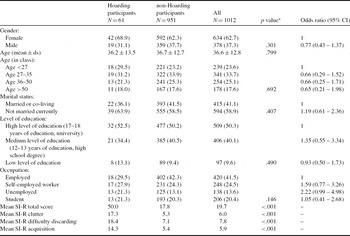
The demographic characteristics of the 1012 participants in the study sample are shown in Table 1. The mean age was 36.6 years (SD = 12.8), with a range of 18–84; more than 80% were under 50 years old. Almost two-thirds of all participants were female (62.7%) and more than half (58.9%) were not married. About 50% of participants had a high level of education (16 or more years of education, degree, or PhD) and 668 (66.0%) participants were employed.
Socio-demographic characteristics, mean SI-R and subscales total score of Hoarding, non-Hoarding participants and All (N and column percentage), levels of significance and odds ratio

a χ2 for frequencies, and Student's t-test for continuous variables; SI-R: Saving Inventory-Revised.
Using a cut-off above 41 in the SI-R total score for defining caseness (e.g. presence of pathological hoarding behaviour) (Frost and Hristova, Reference Frost and Hristova2011), the point prevalence of hoarding in our sample was 6.0%. Participants who scored above the cut-off score of 41 on the SI-R did not show significant differences in gender, age, marital status, level of education, or employment status (Table 1) compared to non-hoarding participants. Adjusted estimates of the effect of demographic characteristics on hoarding status are shown in Table 1. None of the odds ratios reached statistical significance. The odds for scoring above the cut-off of 41 were more than twice as high in unemployed participants, but this difference did not reach statistical significance (p = .05).
The mean SI-R score for all participants was 19.7, with a range of 0–75. Mean SI-R total and subscales scores for hoarding and non-hoarding are shown in Table 1. As expected, hoarding participants endorsed higher mean scores in SI-R total score and all three subscales and these differences were statistically significant (p < .001).
Discussion
Study 1 set out to estimate the prevalence of problematic hoarding based on a cut-off score in the Saving Inventory-Revised and to examine some sociodemographic variables of hoarding participants in a non-clinical Italian sample. The point prevalence of compulsive hoarding was 6.0%, which is higher than the 4.6% found by Mueller et al. (Reference Mueller, Mitchell, Crosby, Glaesmer and de Zwaan2009) and comparable to 5.8% reported by Timpano et al. (Reference Timpano, Exner, Glaesmer, Rief, Keshaviah and Brahler2011), both in nationally representative samples of the German population, and much higher than the lifetime prevalence of 2.6% found by Fullana et al. (Reference Ghisi, Flebus, Montano, Sanavio and Sica2010) in the European Study of the Epidemiology of Mental Disorders (ESEMeD). The high prevalence rate in this study is surprising in light of the fact that efforts were made to limit the number of participants with psychiatric diagnoses. Since hoarding is associated with high levels of psychiatric comorbidity (Frost, Steketee and Tolin, Reference Frost, Steketee and Tolin2011), the 6.0% figure may be an underestimate. However, it is also possible that the threshold for hoarding status on the SI-R does not apply across cultures and may be set too low for this sample. Further research on the validity of the SI-R threshold in Italian samples is needed.
We did not find any significant gender differences in the prevalence of hoarding in our sample. Two epidemiological studies (Iervolino et al., Reference Iervolino, Perroud, Fullana, Guipponi, Cherkas and Collier2009; Samuels et al., Reference Samuels, Bienvenu, Grados, Cullen, Riddle and Liang2008) have reported a significantly greater prevalence of hoarding behaviour among men, while two (Mueller et al., Reference Mueller, Mitchell, Crosby, Glaesmer and de Zwaan2009; Timpano et al., Reference Timpano, Exner, Glaesmer, Rief, Keshaviah and Brahler2011) did not. The question as to whether pathological hoarding is more prevalent in men as opposed to women still remains unclear as methodological differences across studies hinder comparisons. We did not find any significant age differences in the prevalence of hoarding in our sample. Although little is known on the natural history of hoarding, research to date suggests that prevalence increases with age. In fact, studies using clinical samples have found hoarding participants to be generally older than other clinical and non-clinical comparison groups (e.g. Pertusa et al., Reference Pertusa, Fullana, Singh, Alonso, Menchon and Mataix-Cols2008). Thus, it is possible that studies with non-clinical samples are not sufficiently empowered to find significant age differences between hoarding and nonhoarding individuals.
Some previous studies have suggested that people with hoarding problems are less likely to be married (Frost and Gross, Reference Frost and Gross1993; Pertusa et al., Reference Pertusa, Fullana, Singh, Alonso, Menchon and Mataix-Cols2008), while others do not (Mueller et al., Reference Mueller, Mitchell, Crosby, Glaesmer and de Zwaan2009). The fact that in our study this difference did not reach statistical significance may also be due to the use of a non-clinical sample, as the severity of hoarding behaviour in a non-clinical sample may not be enough to significantly impact the marital status. Unemployed participants in the present study were twice as likely to be classified with hoarding than employed participants, although this difference did not reach statistical significance.
Study 2: Method
Participants
Study participants comprised 473 individuals living in urban and suburban areas of North-Central Italy who had responded to advertisements requesting volunteers for a psychological study between October 2010 and May 2011. To prevent a potential selection bias (whereby individuals with hoarding tendencies may have been more prone to self-refer and take part in the survey) the advertisement did not state what the study was about.
Inclusion criteria were age, greater than 18 years (N = 11 participants aged under 18 years were excluded), the ability to read and understand the questionnaires and the individual's consent. Additionally, two individuals were not included because several items of the SI-R were missing. This provided a final sample of 460 individuals.
Procedure
Participants were invited to come to the CBT Institute of Florence. After informed written consent was obtained, they were asked to complete a series of self-report questionnaires that included the paper-and-pencil version of Saving Inventory-Revised (SI-R), the Compulsive Buying Measurement Scale (CMBS), the Vancouver Obsessive Compulsive Inventory (VOCI), the State-Trait Anxiety Inventory-Y2 form (STAI-Y2), and the Beck Depression Inventory-II (BDI-II). After a brief explanation of the study, a research assistant waited until participants completed all questionnaires. All participants were treated in accordance with the Ethical Principles of Psychologists and Code of Conduct (American Psychological Association, 2002).
Measures
Saving Inventory-Revised (SI-R; Frost et al., Reference Frost, Steketee and Grisham2004). The Italian version of SI-R is described in Study 1.
Vancouver Obsessive Compulsive Inventory (VOCI; Thordarson et al., Reference Thordarson, Radomsky, Rachman, Shafran, Sawchuck and Hakstian2004). The VOCI is a 55-item self-report questionnaire that assesses a variety of symptoms and characteristics of obsessive-compulsive disorder (OCD). Items are rated on a 5-point Likert-type agreement scale from 0 (not at all) to 4 (very much). Along with a total score, the VOCI also contains six subscales, each assessing a specific symptom area of OCD: Contamination, Checking, Obsessions, Hoarding, Just Rightness, and Indecisiveness. The Italian version of the VOCI (Chiorri, Melli and Smurra, Reference Chiorri, Melli and Smurra2011; Melli and Chiorri, in press) has shown adequate psychometric properties. Internal consistency ranged from .78 to .89, whereas test-retest correlations ranged from .51 to .80. Correlations of the Italian VOCI with other measures of OCD (e.g. Padua Inventory and the Y-BOCS) supported its construct validity.
Compulsive Buying Measurement Scale (CBMS; Valence, D'Astous and Fortier, Reference Valence, d'Astous and Fortier1988). The CBMS is a 13-item self-report measure for the assessment of pathological or excessive buying behaviour. Items are rated on a 5-point Likert scale from 1 (strongly disagree) to 5 (strongly agree) and relate to difficulties in managing money, impulsive buying behaviour, the use of buying as a coping mechanism, and the feeling of guilt following buying binges. In a series of studies, the Italian version of the CBMS (Pani and Biolcati, Reference Pani and Biolcati1998, Reference Pani and Biolcati2006) has been found to have adequate internal consistency and correlate with other measures of compulsive buying (e.g. Compulsive Buying Scale, by Edwards, Reference Edwards1993).
Beck Depression Inventory-II (BDI-II; Beck, Steer and Brown, Reference Beck, Steer and Brown1996). The BDI-II is a 21-item self-report questionnaire used to assess the presence and severity of the affective, cognitive, motivational, psychomotor, and vegetative components of depression, with higher scores indicating more severe depressive symptoms. Statement choices are scored from 0 (absent) to 3 (severe) and can total from 0 to 63. Studies of the Italian version of the BDI-II (Ghisi, Flebus, Montano, Sanavio and Sica, Reference Ghisi, Flebus, Montano, Sanavio and Sica2006; Sica and Ghisi, Reference Sica, Ghisi and Lange2007) reported adequate internal consistency (αs in the range .80-.87), test-retest reliability (r = .76) and construct validity.
State-Trait Anxiety Inventory−Y2 form (STAI-Y2; Spielberger, Gorsuch, Lushene, Vagg and Jacobs, Reference Spielberger, Gorsuch, Lushene, Vagg and Jacobs1983). The STAI-Y2 is a 20-item self-report measure of anxiety proneness requiring participants to rate their frequency of anxiety symptoms on a 4-point Likert frequency scale ranging from 1 (almost never) to 4 (almost always). The Italian version of the STAI-Y2 (Pedrabissi and Santinello, Reference Pedrabissi and Santinello1989) showed good internal consistency (αs in the range .85-.90), test-retest reliability (r = .82) and construct validity.
Statistical methods
Participants were classified as hoarding or non-hoarding participants based on the SI-R cut-off score (SI-R total score >41) for clinically significant hoarding symptoms (see Tolin et al., Reference Tolin, Fitch, Frost and Steketee2010). Mean scores by hoarding and non-hoarding participants were calculated for each study measure (SI-R and subscales, VOCI and subscales, CBMS, STAI-Y2, BDI-II) and levels of significance across means were performed using the Student's t-test. The association between hoarding and other clinical correlates (compulsive buying, obsessive-compulsive symptoms, anxiety, and depressive measures) was explored using Spearman's rho. Partial correlations were used when adjusting for the effects of confounding variables (anxiety and depression). Following Cohen's classification (Reference Cohen1988), large correlations will be defined as .50 or greater, moderate correlations between .30 and .49, and small correlations from .10 to .29. Analyses were performed using STATA statistical software, release 11.1.
Results
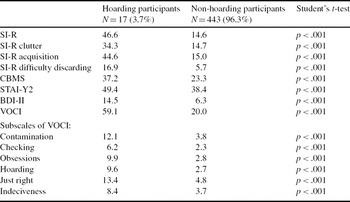
Mean total scores for each study measure (SI-R and subscales, VOCI and subscales, CBMS, STAI-Y2 and BDI-II) are presented in Table 2. The point prevalence of hoarding in study 2 was 3.7%. Hoarding participants reported higher scores in the VOCI (59.1 vs. 20.0, p < .001), in the CBMS (37.2 vs. 23.3, p < .001), in the STAI-Y2 (49.4 vs. 38.4, p < .001) and also in the BDI-II (14.5 vs. 6.3, p < .001) compared to non-hoarding participants. The association between scores on the Saving Inventory-Revised and the other self-report measures are displayed in Table 3.
Mean total scores for each study measure (SI-R and subscales, CBMS, STAI-Y2, BDI-II, VOCI and subscales) by Hoarding/non-Hoarding participants (i.e. SI-R total scores above/below cut-off of 41) and levels of significance (Student's t-test)

Notes: SI-R: Saving Inventory-Revised; CBMS: Compulsive Buying Measurement Scale; STAI-Y2: State-Trait Anxiety Inventory-Y2 form; BDI-II: Beck Depression Inventory-II; VOCI: Vancouver Obsessional Compulsive Inventory
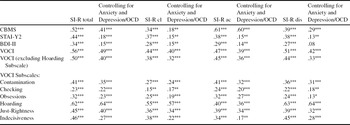
Correlations among hoarding behaviours, as measured by SI-R Total Score and subscales, and CBMS, STAI-Y2, BDI-II, VOCI, VOCI (excluding Hoarding Subscale), and VOCI subscales. Partial correlations of Hoarding behaviours (SI-R total score and SI-R subscales) with CBS, VOCI, VOCI (without Hoarding items) and VOCI subscales, controlling for anxiety and depression

Notes: N = 460; * p < .01; ** p < .005; *** p < .0001;
SI-R: Saving Inventory-Revised; CBMS: Compulsive Buying Measurement Scales; STAY-Y2: State-Trait Anxiety Inventory-Y2 Form; BDI-II: Beck Depression Inventory; VOCI: Vancouver Obsessional Compulsive Inventory
The SI-R total and component scores were significantly correlated with the total scores of all other self-report measures, and these correlations ranged from moderate to large in magnitude (.34 to .56). To examine whether the relationship between hoarding behaviours and obsessive compulsive symptoms persisted when the effects of anxiety and depression were controlled for, partial correlations of hoarding behaviours (SI-R total and subscale scores) with VOCI total score controlling for anxiety and depressive symptoms were calculated. As shown in Table 3, these partial correlations were moderate in magnitude (.39 to .49) and all significant (all p's < .0001).
To find out whether the Hoarding subscale of the VOCI had inflated correlations between VOCI and SI-R scores, partial correlations between SI-R and VOCI total score minus the hoarding items were calculated. Again, the SI-R total score was significantly correlated with the VOCI total score minus the hoarding items (rho = .50, p < .0001). This relationship was also maintained after controlling for anxiety and depression.
Partial correlations between the SI-R and depression and anxiety controlling for OCD symptoms (VOCI minus the hoarding subscale) indicated that the SI-R and its subscales (except for Difficulty Discarding) remained correlated with depression and anxiety, but the correlations were reduced in magnitude.
Considering the SI-R subscales, only Acquisition subscale had the same correlation coefficient with VOCI total score and VOCI total score excluding Hoarding subscale. This relationship did not change even when adjusted for the effects of confounding variables (anxiety and depression), suggesting that the association between SI-R Acquisition and OC symptoms was not mediated by hoarding items. For the other subscales, there were differences when the association was with VOCI total score or with VOCI total score without Hoarding items. For example, the Clutter subscale was significantly correlated with VOCI total score excluding the Hoarding subscale, but the magnitude of association was reduced from .40 to .32 when controlling for anxiety and depression. The reduction was similar for Difficulty Discarding, moving from .42 to .33. The relationship between Clutter and Difficulty Discarding and VOCI total score without Hoarding items was lower in magnitude.
The correlation between CBMS and Saving Inventory-Revised total score remained statistically significant, also when controlling for anxiety and depressive symptoms (Spearman's rho = .41, p < .001). As expected, the largest correlation was found between the SI-R Acquisition subscale and the CBMS total score (rho = .61, p < .001).
With regard to the correlation between the VOCI subscales and the SI-R (Table 3), as predicted the SI-R total score was most strongly correlated with the VOCI Hoarding subscale (rho = .62). Correlations of the SI-R total score with the Just-Rightness and Indecisiveness subscales were also high (.45 and .46 respectively). When adjusted for the effects of confounding variables (anxiety and depression), only the Hoarding subscale maintained the same correlation coefficient. Correlations between SI-R subscales and VOCI subscales were also explored. The Acquisition subscale of the Saving Inventory-Revised showed the lowest correlation with the VOCI Hoarding subscale (rho = .36), while the associations between Clutter and Difficulty discarding subscales and VOCI Hoarding subscale were large (.57 and .64, respectively).
Discussion
The aim of Study 2 was to explore the association between compulsive hoarding and various clinical correlates (compulsive buying, OCD-symptoms, anxiety and depression). We found significant correlations between hoarding and obsessive-compulsive symptoms even after controlling for anxiety and depressive symptoms. In our study, the association between hoarding and obsessive-compulsive symptoms was statistically significant even after the exclusion of the Hoarding subscale of VOCI, although reduced in magnitude. However, the magnitude of the correlation between VOCI minus hoarding items and the SI-R was not much higher than that between the SI-R and anxiety and depression. This is consistent with previous findings from both nonclinical and clinical samples (Frost, Kyrios, McCarthy and Mathews, Reference Frost, Kyrios, McCarthy and Mathews2007; Frost et al., Reference Frost, Steketee and Williams2011), and suggests that hoarding is associated with a wide variety of measures of psychopathology rather than specific to any particular one.
Hoarding behaviour was significantly correlated with all types of OC symptoms. The high correlation between SI-R total score and VOCI Hoarding subscale is likely due to the overlapping item content. Hoarding behaviour was also strongly correlated with Just-rightness experience, Indecisiveness, and Contamination, although only the correlations with the Just-rightness and Contamination subscales remained moderate after controlling for anxiety and depression. The finding that the Contamination subscale was associated with hoarding is inconsistent with previous work (Baer Reference Baer1994; Frost et al., Reference Frost, Krause and Steketee1998) showing that hoarding and contamination represented two different factors. Conversely, the Just-rightness experience has been suggested as a core feature underlying symmetry/ordering symptoms (Ecker and Gonner, Reference Ecker and Gonner2008) that were more closely associated with hoarding than other OCD subtypes (Pertusa et al., Reference Pertusa, Fullana, Singh, Alonso, Menchon and Mataix-Cols2008; Pertuse, Frost and Mataix-Cols, Reference Pertusa, Frost and Mataix-Cols2010; Samuels et al., Reference Samuels, Bienvenu, Pinto, Fyer, McCracken and Rauch2007; Wheaton, Timpano, LaSalle-Ricci and Murphy, Reference Wheaton, Timpano, LaSalle-Ricci and Murphy2008). Consistently with these findings, our study reported that, excluding the Hoarding subscale, the most robust correlation between SI-R total score and VOCI subscales was with Just-rightness experience.
In addition to correlations with OCD, hoarding measures were also correlated with depression and anxiety, and remained so when the influence of OCD symptoms was removed. This also suggests that hoarding may be associated with a wide range of psychopathology and not just specifically with any one, and is consistent with the wide variety of comorbidities observed in recent studies (Frost et al., Reference Frost, Steketee and Williams2011) and the high levels of hoarding behaviours observed in anxiety disorders in addition to OCD (Tolin et al., Reference Torres, Fontenelle, Ferrão, do Rosário, Torresan and Miguel2011).
Significant correlations were also found between compulsive hoarding and compulsive buying measures, even after controlling for anxiety and depression. Previous research has indicated that from two-thirds to more than 80% of hoarding participants suffer from compulsive buying (Frost, Tolin, Steketee, Fitch and Selbo-Bruns, Reference Frost, Tolin, Steketee, Fitch and Selbo-Bruns2009; Mueller et al., Reference Mueller, Mitchell, Crosby, Glaesmer and de Zwaan2009).
Interestingly, the prevalence of hoarding in study 2 was somewhat lower than it was for study 1 (3.7% vs. 6.0%). The reason for this is not clear. Together the findings of these investigations indicate that the rating of significant hoarding behaviour in Italy is between 3.7 and 6.0%.
There two major limitations in the present studies, one having to do with the measurement of hoarding and the other having to do with the representativeness of the samples. Although there is evidence for the validity of the SI-R, it is a self-report instrument with a clinical cut-off that has been validated in a US sample (Frost and Hristova, Reference Frost and Hristova2011) but not in an Italian one. A self-report assessment may differ from clinician-administered interviews such as the Structured Interview for Hoarding Disorder (SIHD; Pertusa and Mataix-Cols, in preparation). In particular, the SIHD can be used to diagnose hoarding disorder and to distinguish it from OCD-based hoarding behaviour while the SI-R cannot (Pertusa et al., Reference Pertusa, Frost and Mataix-Cols2010). Because we used a cut-off score that has been established in a different cultural context and may be set too low for these samples, the prevalence rates derived here may be incorrect estimates of pathological hoarding behaviour in Italy. Furthermore, despite the comparability of the paper-and-pencil and online versions of the SI-R (Melli et al., in press), the use of both in study 1 may have added error variance that could have influenced the findings.
The second limitation was that although study 1 contained a large sample (N = 1012), it was not a representative one since it was a sample of convenience, and individuals with known psychiatric disorders were screened out. In addition, a part of the sample completed the SI-R via the internet. This could have biased the sample to include a higher percentage of people with access to the internet as well as other external influences (e.g. the possibility that individuals complete the questionnaires together).



Comments
No Comments have been published for this article.