It is widely recognized that the final decades of the twentieth century were an economic watershed in Latin America; a period in which virtually every country in the region shifted from an inward-oriented, state-led model of capitalist development toward market liberalization and global economic integration.Footnote 1 What is less widely recognized is that this economic shift also created a watershed in the political development of the region. Although scholars have analyzed the wave of democratic transitions in the 1980s and 1990s in great detail, they have generally studied political change in isolation from the parallel process of market restructuring or “neoliberal” reform.Footnote 2 Consequently, the democratization literature had little to say about political change at the subregime level of analysis, where economic crises and market reforms were reconfiguring the structural bases of sociopolitical organization, representation, and competition.
In particular, economic dislocation wreaked havoc on a mode of political representation that was rooted in the labor and popular mobilizations triggered by state-led industrialization in the middle of the twentieth century. Following the Great Depression and the Second World War, most Latin-American states adopted strategies of import substitution industrialization (ISI), which sought to reduce economic dependence on volatile export markets and imported manufactured goods by promoting national industries that produced for domestic consumers. Initially, at least, ISI policies created opportunities for developmentalist states to build multiclass (though often predominantly urban) political alliances. Since domestic consumer demand was the engine for economic growth, state efforts to increase wages, employment, and social benefits could provide a stimulus for domestic production. Trade unions grew rapidly during this period of industrial expansion, and they often developed close political ties to governing parties and states through the corporatist exchange of material benefits for political loyalty.Footnote 3 States were located at the epicenter of this social order, with extensive entrepreneurial, regulatory, and social welfare roles that led Marcelo Cavarozzi to speak of a “state-centric matrix” of development.Footnote 4
This matrix, however, spread unevenly across the region, with major consequences for the development of party systems and labor movements. Deeper and more ambitious ISI experiments were associated with stronger labor movements and the reconfiguration of party systems around mass-based, labor-mobilizing populist or leftist parties. An elective affinity existed, then, between strong developmentalist states, mass party organizations, and dense trade-union movements. Alternatively, more shallow versions of the ISI model were usually found in countries with relatively weak labor movements and party systems that were dominated by traditional economic elites or patrimonial figures. These alternative paths of development during the ISI era, which spawned what I call “labor-mobilizing” and “elitist” types of party systems, heavily conditioned patterns of political and economic change during the subsequent transition from ISI to neoliberalism in the 1980s and 1990s.
The collapse of ISI in the 1980s debt crisis and the wrenching process of market restructuring that followed were especially traumatic for countries with labor-mobilizing party systems. These outcomes were sharply at odds with the conventional wisdom drawn from the West-European experience, which stressed both the positive economic record of strong left-labor blocs and their contributions to political stability.Footnote 5 Latin America's divergence from this European pattern attests to the severe disruption of the organizational models and party-society linkages that undergirded labor-mobilizing party systems during the ISI era. As shown below, this disruption undercut the organization of workers in the workplace as well as in the electoral arena, that is, in both partisan and trade union spheres of interest representation.
Party System Differentiation Under ISI: Elitist and Labor-Mobilizing Patterns
Prior to industrialization and the onset of mass politics in the twentieth century, Latin-American party systems varied in their stability and competitiveness, but they were strikingly similar in their social bases and organizational characteristics. Parties represented competing factions of oligarchic interests and had little need to organize popular constituencies for electoral contestation, given extant restrictions on suffrage. This oligarchic matrix of political representation was sharply challenged by forces of socioeconomic modernization, however, spawning two quite different trajectories of party system development during the ISI era. The first trajectory formed what I call “elitist” party systems, whereby nineteenth-century oligarchic parties adapted to the era of mass politics, attracted support from popular constituencies, and remained electorally dominant (Colombia, Uruguay, Honduras, and Paraguay), or else were displaced by patrimonial figures and new multiclass parties that provided little stimulus to labor organization (Ecuador, the Dominican Republic, Panama, and Costa Rica).Footnote 6 Elite-dominated parties developed clientelist or personalist linkages to popular constituencies, and electoral competition between them was vertical or “segmented,” cutting across class distinctions.
Under the second trajectory, however, party systems were reconfigured by the rise of new, mass-based, labor-mobilizing populist (Argentina, Brazil, Bolivia, Mexico, Peru, and Venezuela) or leftist (Chile and Nicaragua following the 1979 revolution) parties with a commitment to redistributive social reforms. Although class divisions were rarely as sharply-defined or well-organized as in Western Europe, these party systems were more class-based than those found elsewhere in Latin America, with an axis of competition that cut between core elite and popular constituencies. Labor-mobilizing party systems emerged in the larger Latin-American countries (Brazil, Mexico, and Argentina) that had domestic markets capable of stimulating inward-oriented industrialization, along with countries that had major extractive sectors or episodes of leftist or revolutionary government that were conducive to labor organization (Chile, Peru, Bolivia, Venezuela, and Nicaragua).Footnote 7
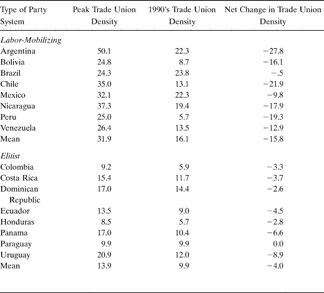
Union movements in these latter countries were substantially stronger in the two key dimensions that are stressed in the comparative study of labor-movement political influence: the level of trade-union density (i.e., the percentage of the total workforce that belongs to trade unions), and the degree of organizational concentration (i.e., the percentage of organized workers affiliated with the largest national confederation). The first dimension attests to the representativeness of the union movement and the scope of its organizational encapsulation, while the second measures its political coherence and capacity for unified political action.Footnote 8 The available data on these indicators of union strength are inconsistent and not fully reliable for Latin America, but they are sufficient to illustrate the differences between countries with elitist and labor-mobilizing party systems. As shown below (see Table 1), the highest or “peak” level of unionization attained by the eight labor-mobilizing cases during the period from 1970 to 1995 averaged over thirty percent, more than double the level in Latin-American countries that retained elitist party systems. Clearly, far more workers were organized in countries where a major populist or leftist party mobilized labor as a core constituency.
Changes in Trade Union Density in Elitist and Labor-Mobilizing Party Systems

Likewise, the organizational concentration of the union movement was generally higher in the labor-mobilizing cases, demonstrating a greater level of political cohesion. In five of the eight labor-mobilizing cases, over seventy percent of unionized workers belonged to the largest national labor confederation. Only Uruguay attained this level of organizational concentration among the countries with an elitist party system. Indeed, membership in the largest national confederation was less than forty percent of unionized workers in six of the eight elitist cases, but in only one country (Brazil) with a labor-mobilizing party system. This attests to the organizational fragmentation of union movements where vigorous partisan leadership was lacking. It also reflects the general tendency toward pluralistic civil societies and forms of representation in the elitist cases, as opposed to the more corporatist logic of monopolistic representation in the labor-mobilizing cases.
Furthermore, countries with labor-mobilizing party systems differed from those with elitist party systems in the depth of their commitment to ISI policies and state-led development models. The labor-mobilizing cases were more highly industrialized, with an average peak score of 24.4 percent of GDP in manufacturing between 1970 and 1980, the final decade of the ISI era.Footnote 9 The only labor-mobilizing cases below twenty percent, Bolivia and Venezuela, had labor movements that were invigorated by mining and petroleum extractive activities, respectively, making them less dependent on the depth of industrialization. The highest scores in the region belonged to the three labor-mobilizing countries with the largest domestic markets—Mexico, Brazil, and Argentina—which pursued especially vigorous ISI models, trying to “deepen” industrialization by shifting from the production of consumer durables to intermediate and capital goods. In contrast, the elitist cases attained an average peak manufacturing score of only 19.5 percent of GDP, indicative of the relatively shallow character of their ISI experiments and their continued economic dependence on agricultural exports.
Not surprisingly, state institutions performed a more active developmental and interventionist role in the labor-mobilizing cases. The peak share of gross fixed capital formation accounted for by public enterprises between 1970 and 1980 averaged 27.5 percent in the labor-mobilizing cases, compared to only 16.7 percent in the elitist cases.Footnote 10 These differences reflect vigorous state efforts to use public investment to accelerate economic development in the former set of countries. Although Costa Rica and Uruguay developed relatively strong welfare states by Latin-American standards, and Uruguay adopted much of the ISI model, on average the countries with elitist party systems strayed less far from economic liberalism during the era of state-led development.
Consequently, strong labor movements and labor-party blocs were neither uniform nor randomly distributed across Latin America. Instead, they were selectively embedded in larger developmental matrices with distinctive alignments of states, markets, and societal actors. Not surprisingly, then, the realignment of states, markets, and societies associated with the demise of ISI and the transition to globalized market liberalism in the 1980s and 1990s proved more traumatic in the labor-mobilizing cases, which had more thoroughly embraced the “state-centric matrix” of the ISI era. Indeed, there was considerable variation in the severity of the economic crises associated with this transition and the depth of the economic adjustments required for stabilization. The labor-mobilizing cases possessed more densely organized and politically influential labor movements and labor-backed mass parties, which naturally opposed reforms that forced popular sectors to shoulder much of the burden of stabilization and structural adjustment.
Attempts to impose austerity measures generated fierce political resistance and distributive conflicts in these countries, often producing political gridlock and policy uncertainties that exacerbated capital flight and deepened economic crises. Stabilization was frequently delayed until foreign exchange reserves were nearly exhausted and hyperinflation had wreaked havoc on popular living standards.Footnote 11 Indeed, many of the labor-mobilizing countries initially sought to avoid unpopular orthodox adjustment programs by adopting more politically-palatable heterodox reforms, such as wage and price controls, that produced short-term gains but ultimately culminated in hyperinflation. Therefore, having developed more extensive forms of the state-centric matrix, and suffering from more severe economic disequilibria, the labor-mobilizing cases required more traumatic and far-reaching structural adjustment packages—the so-called “shock” treatments—before they could establish credible commitments to reform and bring their economies into alignment with the globalized market logic of the neoliberal era.
In contrast, most of the elitist cases never strayed so far from economic liberalism, and they suffered less severe economic disequilibria during the crisis of ISI and the transition to neoliberalism. Likewise, the political and organizational weakness of labor unions helped to moderate distributive conflicts in an era of scarcity, as well as to ameliorate the political costs of subjecting labor to the discipline of the marketplace. Simply put, the elitist cases did not have as far to adjust at the onset of the neoliberal era; with weaker forms of the state-centric model and relatively mild economic crises, they were better positioned to implement more moderate and gradual adjustment programs.
Not surprisingly, then, the inflationary crises that accompanied the demise of ISI were far more severe in the labor-mobilizing cases, and the economic contractions and wage cuts associated with stabilization measures were also much deeper. All of the countries that experienced hyperinflationary spirals greater than 500 percent in the 1970s and 1980s—Chile, Bolivia, Argentina, Peru, Brazil, and Nicaragua—belonged to the labor-mobilizing camp. The latter five of these countries all experienced annual hyperinflationary rates greater than 2000 percent. Collectively, the average peak inflation rate in the eight labor-mobilizing cases was 5035.3, compared to 59.2 in the countries with elitist party systems. The two countries with labor-mobilizing party systems that avoided hyperinflation, Mexico and Venezuela, were characterized by close ties between their central labor confederation and the governing party for all or most of the period. These two countries used a combination of price controls and wage agreements with domesticated labor movements to contain inflationary pressures, but in the process they pushed much of the burden of economic adjustment onto the backs of workers, in the form of especially steep declines in real minimum wages.
Even more striking, of the fifty-eight annual years with inflation rates over 100 between 1970 and 2000 in the full sample of countries, fifty-six occurred in countries with labor-mobilizing party systems. All of the labor-mobilizing cases experienced at least three years with triple-digit inflation rates during this time period except for oil-rich Venezuela, which peaked at 99.9 percent. Argentina suffered through no less than sixteen years with triple digit rates of inflation, while Brazil was not far behind with thirteen years. Among the elitist cases, only Uruguay (twice) experienced triple-digit inflation, with a peak rate of 112.5.
Given these dramatic differences in the frequency and severity of inflationary crises, it is not surprising that the costs of economic stabilization—including recessions and wage cuts—were also greater in the labor-mobilizing cases. Every Latin-American country had at least one year of negative GDP growth between 1980 and 2000, but the contractions were deeper in the labor-mobilizing cases (an average peak contraction of 12.3 percent) than in the elitist cases (an average peak contraction of 8 percent). Five of the eight labor-mobilizing cases experienced a double-digit economic contraction, compared to only two elitist countries. The difference between the two sets of countries would be even greater were it not for the anomalous case of Panama, where US sanctions against the Noriega regime caused a severe recession that had little to do with the larger regional patterns of economic stabilization and adjustment.
Likewise, the decline in the real minimum wage between 1980 and 1997 averaged 45.4 percent in the labor-mobilizing cases, nearly four times the 12.1 percent contraction experienced in countries with elitist party systems. Half of the elitist countries achieved real minimum wage growth between 1980 and 1997, but only Chile—whose economic adjustment occurred before 1980—had a higher real minimum wage in 1997 than in 1980 among the labor-mobilizing cases.Footnote 12 Paradoxically, then, the nations with the strongest labor movements and party-labor blocs suffered the most severe declines in real wages during this period of economic crisis and adjustment.
Among the elitist cases, Uruguay registered the worst score on all of these indicators of economic crisis and adjustment. This is understandable, since Uruguay had a deeper ISI experience and a stronger labor movement (in terms of both trade-union density and organizational concentration) than the other elitist cases. Indeed, by the 1960s Uruguayan unions were increasingly detached from the traditional elitist parties that had sponsored the initial process of labor incorporation early in the twentieth century, and they forged a new alliance with small leftist parties that would eventually found the Frente Amplio (FA, or Broad Front) in 1971. Consequently, Uruguay approximated some of the traits associated with labor-mobilizing party systems, and it suffered an intermediate level of economic crisis, despite the continued electoral dominance of elitist parties throughout the ISI era and the period of structural adjustment.Footnote 13
Altogether, there is persuasive evidence demonstrating that more profound ISI development experiments culminated in severe economic disequilibria by the 1970s or 1980s, which in turn led to extreme free-market “shock treatments” to achieve stabilization. Countries that developed labor-mobilizing party systems during the middle of the twentieth century were especially prone to this sequence of crisis and shock. These findings should not be interpreted as “blaming” labor movements for the economic turmoil of the 1980's; macroeconomic performance is far more likely to hinge on the behavior of those who own capital than those who sell labor. The key question, then, is what political and economic conditions induce capitalists to save, invest, or flee to more attractive climes? By the 1970s and 1980s, the logic of capital accumulation was increasingly at odds with the national political economies in which strong labor movements were embedded; the transition from ISI to neoliberalism would thus realign states, markets, and social relations around a new model of accumulation in more globalized circuits of investment, production, and exchange.
But what, however, were the political consequences of this period of economic trauma and transition? To what extent were established political institutions and representative patterns disrupted? It is to these questions that I now turn.
Economic Crisis, Market Reform, and the Transformation of Political Representation
The collapse of ISI and the transition to neoliberalism altered the structural foundations of political representation in Latin America. There are reasons, however, to suspect that these changes were more politically disruptive in countries that had developed strong labor movements and labor-mobilizing party systems during the ISI era than in those that retained elitist patterns of political representation. In part, this could simply reflect the political costs and anti-incumbent vote swings associated with more severe economic crises in the labor-mobilizing cases. More fundamentally, however, it may also be the result of an erosion in the social alignments and organizational forms that distinguished labor-mobilizing from elitist party systems.
As explained above, labor-mobilizing party systems were more reliant on encapsulating, corporatist linkages between mass-based labor and party organizations, but these bonds were seriously eroded by economic crisis and market reform. Industrial restructuring, the privatization of public enterprises, the deregulation of labor markets, and the creation of a more informal, precarious, and temporary workforce wreaked havoc on labor movements in Latin America. As seen in Table 1, trade-union density has declined in virtually every country in the region, but the plunge was especially dramatic in the labor-mobilizing set of cases: from an average “peak” level of 31.9 percent to a 1990s average of 16.1 percent, compared to a dropoff from 13.9 to 9.9 percent in the elitist cases.Footnote 14 In short, the organized social blocs that used to supply labor-mobilizing parties with grassroots activists, strong collective identities, and loyal voters are far weaker than they were in the ISI era, and they do little to provide a stabilizing organizational foundation for class-based or stratified partisan divisions in the electoral arena. These socioeconomic changes parallel technological innovations that have transformed political communication and electoral campaigns, as television and public opinion surveys have also undercut mass party organizations by allowing candidates to appeal directly to voters and gauge public opinion without organizing grassroots constituencies. The net results are professionalized, top-down party organizations that are largely detached from an increasingly individualized, independent, and more volatile electorate.
Political fault lines—that is, partisan or electoral divides based on ideological or programmatic distinctions—were also blurred during the transition from ISI to neoliberalism. There are two basic preconditions for the construction of these programmatic partisan divisions: (1) meaningful differentiation must exist in the platforms and policy preferences of competing parties, and (2) voters must be reasonably confident that these platforms will shape the policies adopted by parties after they are elected to office. Neither of these preconditions was present during Latin America's transition from ISI to neoliberalism. During the ISI era, party systems offered a broad range of development policy options, from economic liberalism to state-led capitalist development and socialism.Footnote 15 The demise of ISI and the collapse of socialism, however, dramatically narrowed the development debate, as least through the 1990s. As the “Washington Consensus” spread across the region,Footnote 16 limiting development options to one or another variant of economic liberalism, it became more difficult for parties to generate loyalties or construct collective identities on the basis of increasingly nuanced ideological distinctions.
This programmatic convergence was especially challenging for countries with labor-mobilizing party systems, as their large populist or leftist parties were more likely historically to have mobilized working- and lower-class support around commitments to social reform and redistributive measures. Reformist policies helped differentiate these parties from their more conservative and elite-based competitors, anchoring labor-mobilizing party systems in both social and programmatic distinctions. Programmatic alternatives, however, became far less distinctive as leftist and populist parties backed away from historic reformist commitments to embrace the core tenets of market liberalism. Campaign pronouncements often ceased to provide reasonable expectations about actual party behavior, as tightening national and global market constraints created large gaps between party platforms and their conduct in public office.
Blatant and widespread policy reversals—as when parties win an electoral mandate to resist market-oriented “shock” programs, only to impose such programs as soon as they take officeFootnote 17—are highly incompatible with the construction of programmatic linkages between parties and social constituencies. Such “bait and switch” tactics sever the connection between voter preferences and public policy, stripping the electoral process of its policy content and transforming it into a mere exercise in the selection of delegative authority.Footnote 18 In six of the eight countries with labor-mobilizing party systems, either the historic labor-based party (the Peronists in Argentina, the Partido Revolucionario Institucional [PRI] in Mexico, Acción Democrática [AD] in Venezuela, the Movimiento Nacionalista Revolucionario [MNR] in Bolivia, and the Sandinistas in Nicaragua) or an independent leader associated with “popular” sectors (Alberto Fujimori in Peru) assumed political responsibility for initiating structural adjustment policies in the midst of economic crises. In each case, this entailed a sharp departure from previous policy commitments, straining political ties to organized labor and other popular constituencies. Although these policy shifts sometimes made it possible to garner new support from middle- and upper-class constituencies that were positioned to benefit from economic liberalization,Footnote 19 they often flagrantly violated candidates' or parties' electoral mandates, and they encouraged a reshuffling of partisan loyalties and a loosening of stratified partisan support bases. Among the labor-mobilizing cases, only in Chile (under Augusto Pinochet) and Brazil (under Fernando Collor do Mello) was structural adjustment initiated by conservative political leaders with core elite constituencies and weak ties to labor movements. Elsewhere, structural adjustment policies clashed with the interests or preferences of significant portions of ruling coalitions, producing serious political dislocations.
Consequently, the transition from ISI to neoliberalism not only saddled labor-mobilizing party systems with the direct political costs of severe economic crises, but also exerted a corrosive effect on their historic social alignments, organizational models, and societal linkages. To adapt to the new social landscape and remain electorally competitive, labor-mobilizing parties loosened their organizational and programmatic ties to labor unions, and they sought to forge new societal linkages based on some combination of patron-clientelism, leadership appeal, and political marketing. In the elitist cases, however, parties had never relied as heavily on mass-based labor and party organizations, and they were less inclined to forge strong programmatic linkages to voters. They relied, instead, on patron-client bonds and personalistic appeals. Linkage patterns, therefore, were less disrupted by the transition to neoliberalism, and less profound adjustments were required for elitist parties to adapt to the individualized social landscape of the neoliberal era. In the generalized movement away from mass-based, ideological parties, relative continuity existed in the political roles and organizational models of parties in the elitist systems. It remains to be seen, however, whether this continuity was translated into electoral stability as well, or, conversely, whether the disarticulation of party-society relations in the labor-mobilizing cases was associated with electoral instability. These questions are addressed more systematically below.
The Puzzle of Electoral Volatility in Latin America
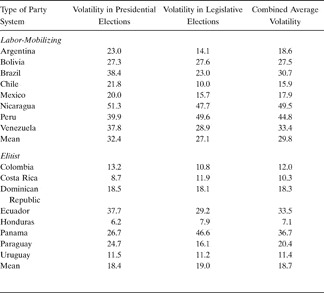
By international standards, party systems in Latin America during the “Third Wave” of democratizationFootnote 20 have been highly unstable. Using the most common indicator of party system stability, the Pedersen index of electoral volatility,Footnote 21 the instability of Latin-American party systems in the 1980s and 1990s is readily apparent. Electoral volatility in nineteen West-European democracies from the 1950s to the 1990s averaged 8.9 on the Pedersen index, indicating an average net vote shift of less than 9 percent from one election to the next. In the US, volatility averaged only 4.5 on the Pedersen index in congressional elections and 11.2 in presidential elections between 1948 and 1996. Although the European literature during this period was rife with discussions of electoral dealignment and instability,Footnote 22 the mean regional volatility score in the 1990s was still only 11.5 on the Pedersen index.Footnote 23 By contrast, mean volatility in the sixteen Latin-American countries included in this study was 19.6 in congressional elections during the 1980s and 17.4 in presidential elections. Volatility increased in both types of elections between 1990 and 2000, averaging 22.8 in congressional elections and 27.2 in presidential elections, more than double the levels prevailing in the US and Western Europe. This increase in volatility in the 1990s defies earlier predictions that party systems were becoming more institutionalized in Latin America.Footnote 24 Perhaps more importantly, it demonstrates that volatility cannot simply be attributed to the unique constellation of regional factors in the 1980s, when new democratic regimes were struggling to consolidate and economic turmoil triggered by the debt crisis produced widespread anti-incumbent voting. Despite the gains made in democratic consolidation and economic stabilization in the 1990s, electoral volatility increased, suggesting that more deeply-rooted destabilizing factors were present.
Nevertheless, these regional averages in Latin America obfuscate substantial cross-national variation in party system stability. Party systems in Honduras, Costa Rica, Uruguay, and Colombia were highly stable in the 1980s and 1990s, the critical period of transition from ISI to neoliberalism. These countries boasted low volatility scores comparable to those found in Western Europe, whereas Peru, Brazil, Nicaragua, Bolivia, Venezuela, Panama, and Ecuador experienced dramatic vote shifts from one election to another. And although some nations, such as Brazil, began this time period with high levels of volatility only to become more stable over time, others like Venezuela started out stable and then became more volatile. Clearly, there is no uniform pattern that holds across the region, and the statistical generalization that Latin-American party systems are unusually volatile needs to be heavily qualified by the identification of intraregional differences and the specification of the conditions that account for them.
What, then, explains this cross-national variation in party system stability? The scholarship on this topic raises as many questions as it answers. Recent studies have confirmed the presumption that party systems are destabilized by economic turmoil and changes in the institutional rules of the game under democratic regimes.Footnote 25 Clearly, prospects for the establishment of stable electoral alignments are undermined when parties operate in political and economic environments fraught with uncertainty and insecurity. As already mentioned, however, volatility increased in a context of growing economic stability and democratic consolidation in the 1990s, suggesting that other causal factors must also be at work.
If exogenous economic and institutional conditions do not fully account for electoral volatility, endogenous attributes of party systems that are associated with stability or volatility are even less certain, as the recent Latin-American experience flouts much of the conventional wisdom drawn from the study of other regions. Research on party systems in both the US and Europe suggests that aging electoral alignments are less stable than those forged in response to more contemporary social- or issue-based partisan divisions.Footnote 26 The European literature also assumes that the organizational encapsulation of class divisions is a fundamental source of party system continuity.Footnote 27 In Latin America, however, previous research has found that older party systems are less volatile than younger ones, and that the most stable party systems are rooted in anachronistic disputes between long-forgotten ruling elites rather than the organization of class divisions.Footnote 28
These anomalies are not adequately explained by the argument that older party systems are more highly institutionalized and thus more stable. Samuel P. Huntington's influential work associates institutionalization with chronological age,Footnote 29 and Scott Mainwaring and Timothy R. Scully,Footnote 30 as well as Kenneth M. Roberts and Erik Wibbels,Footnote 31 have used chronological age as an indicator of party-system institutionalization in Latin America. As Steven Levitsky suggests, however, it is necessary to differentiate between two dimensions or meanings of institutionalization that are often conflated, but do not necessarily vary together.Footnote 32 Party systems dominated by longstanding, elitist parties such as those in Honduras, and (until recently) Colombia and Uruguay may be institutionalized in the sense that traditional parties have been “infused with value” and have developed stable and loyal electorates.Footnote 33 These parties are not highly institutionalized, however, in the sense of developing strong bureaucracies with formal rules and procedures to govern internal party affairs such as the selection of candidates and the promotion and tenure of party officials. Likewise, despite the strength of partisan identities and subcultures, their electoral constituencies are not well-organized at the grassroots level, and they do not possess strong ties to organized social constituencies. These parties are typically decentralized and loosely-organized coalitions that link local elites to more extensive patronage networks,Footnote 34 and they are a far cry from the centralized, mass-based, bureaucratically-organized parties with highly institutionalized mechanisms of labor encapsulation that have historically stabilized European electorates.
Indeed, party systems in Latin America that were anchored by strong mass party organizations were highly susceptible to electoral discontinuities during the period of economic adjustment in the 1980s and 1990s. As seen in Table 2, on average the labor-mobilizing party systems were far less stable electorally than elitist party systems during this period of economic crisis and transition. Electoral volatility scores from 1978 to 2000 averaged 27.1 in congressional elections for the eight labor-mobilizing cases and 32.4 in presidential elections, compared to 19.0 in congressional elections for the elitist cases and 18.4 for presidential elections.Footnote 35 The four most stable party systems—Honduras, Costa Rica, Uruguay, and Colombia—all belonged to the elitist category, whereas five of the seven most volatile party systems were labor-mobilizing. Among labor-mobilizing party systems, Chile proved to be the most electorally stable. This is not surprising given the historic strength of parties in Chile and the consolidation of neoliberal reforms under the Pinochet dictatorship prior to the restoration of electoral competition in 1989. Nevertheless, the resiliency of Chile's party system is impressive considering the severity of political repression directed against it and the profound disarticulation of traditional party-society relations that accompanied the country's free-market revolution. The combination of political repression and economic adjustment decimated Chile's organized labor and peasant movements while dramatically weakening their political ties to the partisan left. Chile's party system may have survived the military dictatorship and established a new competitive equilibrium, but it could hardly be considered labor-mobilizing by the 1990s.
Average Electoral Volatility in Elitist and Labor-Mobilizing Party Systems, 1978–2000

Among the elitist cases, the stability of party systems rooted in nineteenth-century oligarchic divisions in Honduras, Uruguay, and Colombia was striking. These party systems not only adapted to the era of mass politics at the beginning of the twentieth century, but they also weathered the transition from ISI to neoliberalism with a minimum of political disruption. Although the recent political decline of traditional parties in Uruguay and Colombia demonstrates that oligarchic party systems are far from immune to pressures for change, their ability to ride out the economic transition of the 1980s and 1990s was distinctive in the region.Footnote 36 Costa Rica's post-1948 two-party system was also highly stable during the period of economic transition, but the patrimonial variants of elitist party systems that were configured following the onset of mass politics in the twentieth century were relatively volatile. Ecuador and Panama demonstrate that personalistic, underinstitutionalized elitist party systems may be unstable electorally even when there is relative continuity in their modes of party-society articulation.
Overall, high levels of electoral volatility indicate that large numbers of voters are detached from parties and do not possess strong, stable partisan identities in contemporary Latin America. Nevertheless, the variation across cases, or, more importantly, across types of party systems, is striking. The political resiliency of several elitist party systems, particularly those with roots in nineteenth-century oligarchic disputes, stands out, as does the upheaval in most of the labor-mobilizing party systems. These findings suggest that electoral stability and volatility in contemporary Latin-American politics cannot be explained simply by analyzing electoral rules; it is essential to explore how different kinds of party systems are embedded in societal relationships, that is, how parties cleave the electorate, organize their constituencies, and appeal to supporters. The party-society relationships that developed in historically labor-mobilizing party systems proved highly vulnerable to disruption during Latin America's transition from ISI to neoliberalism.
The extreme volatility of labor-mobilizing party systems is especially striking when one considers that they entered the neoliberal critical juncture with a series of organizational attributes that should have enhanced their electoral stability. In comparison to elitist party systems, they had more densely-organized grassroots structures and more encapsulating linkages to organized social blocs. Likewise, they were more inclined to have at least some measure of grounding in social and ideological distinctions, and their electoral divisions were less likely to be buried in the distant, oligarchic past. The European experience suggests that these factors should bind voters to parties and diminish voter mobility.Footnote 37 These organizational features, however, were precisely those that were the most incongruent with the socioeconomic and political landscape of the neoliberal era. Deeply embedded in the ISI-era state-centric matrix of development, they shared in the crisis of this matrix in the 1970s and beyond. Rather than sources of stability, then, these party system attributes were precursors to severe social and political dislocation during the transition from ISI to neoliberalism. Consequently, the dynamics of electoral stability and instability in contemporary Latin America diverge sharply from those found historically in Western Europe, and they defy much of the scholarly conventional wisdom on the subject.
These findings also suggest that there were larger, even systemic, political costs associated with the demise of labor movements and labor-based parties in Latin America. Strong labor movements helped to anchor and align systems of political representation during the ISI era, for their supporters and opponents alike. As labor unions grew weaker and more detached from political parties, electoral competition may have become less polarized, but it also became less programmatic, less grounded in collective social interests, and more fluid and personalistic. Parties became more professionalized as their grassroots organs shriveled, and voters became more mobile. More fundamentally, perhaps, the capacity of working and lower classes to articulate and defend their interests in the political arena was diminished, insulating political elites from organized popular pressures and accentuating the technocratic logic of the policymaking process. As such, the decline of organized labor may not have doomed representative democracy in Latin America, but it surely skewed its character and content in ways that were hardly propitious for popular sectors in the region.
Conclusion
This article has argued that the development of labor movements and the onset of mass politics sharply differentiated party systems in twentieth-century Latin America. In a handful of countries, traditional oligarchic parties broadened their bases and remained electorally dominant following the onset of mass politics, while in others they were eclipsed by new multiclass or personalistic parties that did little to organize the working and lower classes and posed few threats to traditional elite interests. In another set of countries, however, elite interests were sharply challenged by the reconfiguration of party systems around a mass-based, labor-mobilizing populist or leftist party. Countries with these labor-mobilizing party systems typically adopted more aggressive versions of the ISI model and more extensive forms of state economic intervention. They also developed far stronger labor movements and more elaborate corporatist linkages between unions, parties, and states.
Having gone further with the state-centric matrix of development, countries with labor-mobilizing party systems were plagued by more severe economic crises when this matrix was undercut by public indebtedness and market globalization. For these countries, the transition from ISI and the state-centric matrix to neoliberalism was highly disruptive in terms of economic performance, social organization, and party-society relationships. As states retreated and civil societies fragmented, parties could no longer mediate state-society relations in the same way, and partisan social alignments, organizational forms, and linkage patterns were all transformed. The end result was electoral upheaval, as labor-mobilizing party systems proved to be more volatile than elitist systems despite their firmer grounding in social divisions, ideological distinctions, and encapsulating forms of social and political organization.
These findings suggest that Latin America's widely-noted “crisis of representation” is, at least in part, a crisis of a particular type of sociopolitical representation, one based on large-scale secondary associations of workers in close affiliation with mass-based party organizations. This mode of representation has been thoroughly disarticulated and largely eclipsed throughout the region. In the short-term, this disarticulation caused most labor-mobilizing party systems to decompose and/or converge on the organizational forms and representational patterns that have long characterized elitist party systems. More recently, electoral trends have brought left-of-center options into power in a number of countries, especially those that developed labor-mobilizing party systems during the ISI era.Footnote 38 Even where these options include historic labor-mobilizing parties, however, as in Chile and Argentina, labor movements are a shell of their former selves, and they are far less integral to reformist parties' strategies for popular mobilization and coalition-building. Elsewhere, unions have taken a backseat to new (primarily indigenous) social movements or unmediated, personality-based modes of populist mobilization.
As such, Latin America's “left turn” may provide opportunities for organized labor to restore channels of access to policymaking spheres, but it is a long way from reviving its historic organizational weight. Globalization and neoliberalism have fundamentally altered the sociopolitical landscape for both labor unions and labor-backed parties in contemporary Latin America. Popular movements for social and economic justice in the neoliberal era are thus likely to take very different organizational and political forms from those which existed during the heyday of import substitution industrialization.