Introduction
Behavioural problems in childhood have been connected to psychiatric disorders and poor psychosocial functioning in adulthood (Caspi et al. Reference Caspi, Moffitt, Newman and Silva1996; Hofstra et al. Reference Hofstra, van der Ende and Verhulst2002; Hatch et al. Reference Hatch, Harvey and Maughan2010), but only a relatively small number of studies have investigated the connections between adolescence, development and psychopathology. In particular, information on the continuity of psychopathology in the transition from preadolescence to adolescence remains scarce. Epidemiologists agree in recognizing that in this critical turning point between childhood and adulthood (Hofstra et al. Reference Hofstra, van der Ende and Verhulst2002) the burden of mental disorder may still be prevented by well-designed interventions based on empirical research (de Girolamo et al. Reference de Girolamo, Dagani, Purcell, Cocchi and McGorry2012). The potential role of adversities in precipitating and maintaining both internalizing and externalizing disorders in adolescence has also been recognized (Haggerty et al. Reference Haggerty, Sherrod, Garmezy and Rutter1994; Bot et al. Reference Bot, de Leeuw den Bouter and Adriaanse2011). More recently, adversities have been conceptualized within a gene–environment interplay framework, which suggests that adversities not only perpetuate existing disorders but may also be consequences of existing disorders (Mash & Barkley, Reference Mash and Barkley1996).
Studies of the longitudinal consistency of psychopathology across adolescence must therefore take into account three key theoretical and practical issues, namely the co-variation of different forms of psychopathology, the reciprocal effects of adversities and psychopathology, and the costs and benefits of different strategies for conducting longitudinal research. The first issue refers to the moderate-to-high reciprocal co-variation between different forms of psychopathology. This should be taken into account when trying to make reliable predictions in time for both homotypic and heterotypic continuity (Copeland et al. Reference Copeland, Shanahan, Costello and Angold2009a). Homotypic prediction refers to a psychopathological trait predicting itself over time; heterotypic prediction refers to different psychopathological traits predicting one another. Failure to adequately consider the multiple co-variation of diagnoses (Angold et al. Reference Angold, Costello and Erkanli1999) may limit the meaning of measured pairwise associations of childhood and adolescence disorders. The reason behind this is that apparent homotypic and heterotypic continuities between any two diagnoses could in fact be explained by uncontrolled ‘third’ variables. In a similar way, when looking at the influence of stressful life events (SLEs) upon specific diagnoses (e.g. depression/anxiety), lack of consideration for the effect exerted by SLEs upon other, co-varying forms of psychopathology, would limit the meaning of the estimated associations between adversities and the psychopathological dimension under study. As a matter of fact, few studies only analysed the effects of life events upon a range of mental health dimensions taken into account simultaneously (Copeland et al. Reference Copeland, Shanahan, Costello and Angold2009b). Available studies typically focused on one or two narrow-band domains (depression and anxiety), or broadband problems domain (e.g. internalizing, externalizing and total problems) (Essex et al. Reference Essex, Kraemer, Armstrong, Boyce, Goldsmith, Klein, Woodward and Kupfer2006; Amone-P'Olak et al. Reference Amone-P'Olak, Ormel, Huisman, Verhulst, Oldehinkel and Burger2009).
The second issue refers to the possible reciprocal effects of adversities and psychopathology. The fact that many stressful agents – such as SLEs – have a complex causal architecture that encompasses genetic determinants further complicates the picture and often requires sophisticated conceptualizations and computational approaches (Rutter et al. Reference Rutter, Moffitt and Caspi2006). This brings about the complex issue of gene–environment interplay (and gene–environment correlation), and adds substantial support to the idea that psychopathology can both be caused by, and cause, SLEs (Plomin et al. Reference Plomin, DeFries and Loehlin1977). While these causal chains can become very complex and hard to prove even within the context of large, well-designed behavioural genetic studies (Rutter et al. Reference Rutter, Moffitt and Caspi2006), contemporary longitudinal epidemiological studies cannot ignore the dual nature that SLEs can assume in developmental psychopathology. As a consequence, epidemiological studies now need to consider adversities and psychopathology in their reciprocal influence over time, rather than within the context of unidirectional causal chains (from stressors to psychopathology) only. Specifically, while associational studies of stressors and developmental psychopathology – the former in both moderational and mediational roles – are available (Grant et al. Reference Grant, Compas, Thurm, McMahon, Gipson, Campbell, Krochock and Westerholm2006), data are needed on the mediational role of life stressors in sustaining the continuity of a broad spectrum of emotional and behavioural problems in adolescence. The few available studies of this kind looked at the mediational role of SLEs in the reciprocal cycle of stress-generation in anxiety and depression (Hammen, Reference Hammen2006). For instance, in a 2-year follow-up study Rudolph et al. (Reference Rudolph, Flynn, Abaied, Groot and Thompson2009) supported a reciprocal cycle of interpersonal stress and depression among girls (but not boys) aged 10–14 years.
The third issue is related to more practical and economic considerations. It is clear that longitudinal general population studies of youth based upon direct psychiatric interviews are a gold standard for the field. By these designs one can address the homotypic and heterotypic patterns of prediction while accounting for multiple co-variation of comorbidities (Costello et al. Reference Costello, Angold, Burns, Stangl, Tweed, Erkanli and Worthman1996; Ford et al. Reference Ford, Goodman and Meltzer2003). These research designs also enable the study of the role of SLEs on stability and change in psychopathology, but unfortunately they are extremely costly. Inasmuch as we are currently facing a contrast between a global need for better health and budgetary restrictions for research, general population longitudinal studies based upon paper-and-pencil instruments can contribute substantially to the field within more affordable budgetary limits. One of the difficulties that have hampered this type of investigation, however, has been the lack of widely adopted questionnaires that could be referred to currently employed diagnostic systems, such as the DSM-IV or the ICD-10, for the developmental age. In an attempt to overcome this limitation, Achenbach & Rescorla (Reference Achenbach and Rescorla2001) developed a new scoring system based on consensus between clinicians that allows better correspondence between the vastly adopted Child Behavior Checklist (CBCL) scale and the currently employed DSM-IV diagnostic criteria. The six different CBCL DSM-oriented scales (DOSs) include Affective, Anxiety, Somatic, Attention Deficit/Hyperactivity, Oppositional-Defiant and Conduct Problems.
Here, we show the results of a 5-year follow-up investigation of a broad range of emotional and behavioural problems measured with the DOSs among the general population-based PrISMA (Progetto Italiano Salute Mentale Adolescenti) sample (Frigerio et al. Reference Frigerio, Vanzin, Pastore, Nobile, Giorda, Marino, Molteni, Rucci, Ammaniti, Lucarelli, Lenti, Walder, Martinuzzi, Carlet, Muratori, Milone, Zuddas, Cavolina, Nardocci, Tullini, Morosini, Polidori and De Girolamo2006, Reference Frigerio, Rucci, Goodman, Ammaniti, Carlet, Cavolina, De Girolamo, Lenti, Lucarelli, Mani, Martinuzzi, Micali, Milone, Morosini, Muratori, Nardocci, Pastore, Polidori, Tullini, Vanzin, Villa, Walder, Zuddas and Molteni2009). Our first aim was to assess the continuity and discontinuity of DOSs between 10–14 years and 15–19 years, while taking into account the reciprocal co-variation of scales. The second aim was to investigate the differential association between SLEs and DOSs, while taking diagnostic co-variation into account. The third aim was to test the mediational role of SLEs in sustaining the continuity of psychopathology during this time interval.
Methods
Subjects
This study is a 5-year follow-up of the PrISMA project, which started in 2003, with the purpose of assessing the prevalence of mental disorders in preadolescents (10–14 years) living in Italian urban areas, and of analysing the demographic and biological correlates of emotional and behavioural problems (Frigerio et al. Reference Frigerio, Vanzin, Pastore, Nobile, Giorda, Marino, Molteni, Rucci, Ammaniti, Lucarelli, Lenti, Walder, Martinuzzi, Carlet, Muratori, Milone, Zuddas, Cavolina, Nardocci, Tullini, Morosini, Polidori and De Girolamo2006, Reference Frigerio, Rucci, Goodman, Ammaniti, Carlet, Cavolina, De Girolamo, Lenti, Lucarelli, Mani, Martinuzzi, Micali, Milone, Morosini, Muratori, Nardocci, Pastore, Polidori, Tullini, Vanzin, Villa, Walder, Zuddas and Molteni2009; Nobile et al. Reference Nobile, Giorda, Marino, Carlet, Pastore, Vanzin, Bellina, Molteni and Battaglia2007, Reference Nobile, Rusconi, Bellina, Marino, Giorda, Carlet, Vanzin, Molteni and Battaglia2009, Reference Nobile, Rusconi, Bellina, Marino, Giorda, Carlet, Vanzin, Molteni and Battaglia2010). The original study population consisted of 3418 Italian preadolescents aged 10–14 years selected through public and private schools. At the time of the PrISMA 1st wave (W1) study participants were attending the 6th to 8th grade and were living in seven urban areas encompassing five small-to-average-size urban areas and two metropolitan areas (the cities of Rome and Milan).
Three research groups out of the seven originally involved in the PrISMA W1 study, and whose participants had been sampled from the three small-to-average-sized urban areas of Lecco (n = 435), Conegliano (n = 426) and Rimini (n = 344), continued the PrISMA study by setting a follow-up phase (W2). Participants in the W1 study were invited by mail and/or by telephone to the W2 study after 5 years. Of the 1205 adolescents who were candidates in the W2, 32.9% (n = 398) were no longer available due to change of address, incomplete mail/phone data, or relocation. Questionnaires were thus sent in sealed envelopes to the families of the remaining 808 adolescents, with 420 subjects (52%: 49.3% boys, 50.7% girls, aged 15–19 years) accepting participation in the study. As only about half of the potential families participated in the follow-up, attrition analyses were conducted to compare participants with non-participants, as described below.
Procedures
The study protocols were approved by the ‘Eugenio Medea’ Scientific Institute Ethical Committee. Parents' and adolescents' (when required) written informed consent was obtained for all participants.
Emotional and behavioural assessment
The CBCL/6–18 is an empirically based checklist of social competence and behavioural problems filled out by parents of children and adolescents aged 6–18 years (Achenbach & Rescorla, Reference Achenbach and Rescorla2001). According to the Achenbach System of Empirically Based Assessment (ASEBA) CBCL/6–18 items can be scored to obtain the following DSM-Oriented Scales (DOSs): Affective Problems, Anxiety Problems, Somatic Problems, Attention Deficit/Hyperactivity Problems, Oppositional Defiant Problems and Conduct Problems. Although the DOSs are not directly equivalent to any clinical diagnosis, they satisfactorily predict DSM-IV diagnoses (Lengua et al. Reference Lengua, Sadowski, Friedrich and Fisher2001; Krol et al. Reference Krol, De Bruyn, Coolen and van Aarle2006; Spatola et al. Reference Spatola, Fagnani, Pesenti-Gritti, Ogliari, Stazi and Battaglia2007; Ferdinand, Reference Ferdinand2008). In the present sample DOSs at W1 and W2 showed acceptable internal reliability (Affective Problems: W1-α = 0.65, W2-α = 0.71; Anxiety Problems: W1-α = 0.64, W2-α = 0.68; Attention Deficit/Hyperactivity Problems: W1-α = 0.80, W2-α = 0.77; Oppositional Defiant Problems: W1-α = 0.67, W2-α = 0.76; Conduct Problems W1-α = 0.68, W2-α = 0.83) with the exception of Somatic Problems (W1-α = 0.46, W2-α = 0.50).
Socio-demographic form
The individual and family characteristics of the sample were gathered by an ‘ad hoc’ form filled in by parents. This was an expanded version of the questionnaires originally employed during the PrISMA W1 assessment that encompassed questions on socio-demographic data, child's education, possible contacts with the health services and family socio-economic status (SES) (Frigerio et al. Reference Frigerio, Vanzin, Pastore, Nobile, Giorda, Marino, Molteni, Rucci, Ammaniti, Lucarelli, Lenti, Walder, Martinuzzi, Carlet, Muratori, Milone, Zuddas, Cavolina, Nardocci, Tullini, Morosini, Polidori and De Girolamo2006). A section bearing a list of 14 SLEs was added to the W2 questionnaire: it was mainly based on a list of 11 psychologically threatening events for children, as developed and adopted by Meltzer et al. (Reference Meltzer, Gatward, Corbin, Goodman and Ford2003), to which we added three items (namely: child has been bullied, child has been victim of violence and child has been a victim of sexual harassment) based on evidence from previous work on emotionality in adolescents (Brown et al. Reference Brown, Bifulco and Harris1987; Grant et al. Reference Grant, Compas, Thurm, McMahon, Gipson, Campbell, Krochock and Westerholm2006). The original SLEs include: parent had separated or broken up in a steady relationship; child had a serious illness which required a stay in hospital; parent had a severe physical or mental illness or serious accident; child had been in a serious accident or badly hurt in an accident; parent, brother or sister death; grandparent death; close friend death; pet death; child had broken off close friendship or steady relationship; parent had a major financial crisis; parent had a problem with the police involving a court appearance (Meltzer et al. Reference Meltzer, Gatward, Corbin, Goodman and Ford2003). Parents were asked if their children had ever experienced any of these adversities; response categories were ‘yes’ or ‘no’; when any such adversity was endorsed, parents were asked to report age at first occurrence. We considered the number of life stressors without taking into account their perceived severity. For the present study, we defined ‘recent SLEs’ as all those adversities that had occurred after the first evaluation at W1, therefore chronic SLEs (such as the chronic illness of a relative), which had begun prior to the first evaluation at W1 were not considered. Likewise, SLEs where age at first occurrence was not reported were not included in the analyses.
Data analyses
Attrition analyses were conducted to test socio-demographic and clinical differences between participants and non-participants in the W2 phase. Specifically, we analysed all the DOSs scores and age at W1 by ANOVA, and gender, father's and mother's education level and family structure at W1 by χ2. To study the continuity and discontinuity of psychopathology from early- (W1) to late-adolescence (W2), we used the following indicators:
– Changes in mean DOS scores: changes in mean score were calculated on the basis of mean and standard deviations (s.d.) of the six DOSs raw scores measured at W1 and W2. Repeated-measure ANOVA was employed to detect significant differences between scores at W1 and W2, with ‘gender’ as a between-subjects' factor. Effects sizes were categorized according to Cohen's criteria: eta square <0.06 = small; 0.06–0.14 = medium, >0.14 = large effect size (Cohen, Reference Cohen1988).
– Stability: Pearson's correlation coefficient was calculated between DOS raw scores at W1 and W2, to index the degree of stability of behavioural/emotional problems. We used Cohen's criteria to evaluate the magnitude of Pearson's correlation coefficients as follows: small (r = 0.10–0.29), medium (r = 0.30–0.49), or large (r ≥ 0.50) (Cohen, Reference Cohen1988).
– Predictors: to determine whether DOS scores at W1 predicted scores at W2, all predictors were entered simultaneously and then backwards stepwise selection was used to remove non-significant predictors from the model (criterion for entrance: p < 0.05; criterion for removal p ≥ 0.1; likelihood ratio test). Gender was included as an additional predictor. The Wald statistic was used to test the significance (p < 0.05) of independent variables, whereas model f tests were used to test the significance (p < 0.05) of any full regression models. The number of tests in this study may suggest the need for a correction for chance findings for multiple tests, such as a Bonferroni procedure. However, the probability of chance findings in the logistic regression analyses was minimized by applying significance tests for the full regression models.
– Mediational role of SLEs having occurred after the first evaluation: to test the possible mediational role of SLEs we followed the classic steps for the establishment of mediation recommended by Baron & Kenny (Reference Baron and Kenny1986). A mediator is a variable that conceptually and statistically accounts for the relation between a predictor and a criterion variable, so that: (a) the predictor is significantly related to the criterion, (b) the predictor is significantly related to the mediator, (c) the mediator is related to the criterion and (d) the variance accounted for in the criterion, by the predictor, decreases when the mediator is controlled (Baron & Kenny, Reference Baron and Kenny1986). Accordingly, step (a) was resolved by the multiple backward stepwise linear regression analysis described at the end of the previous paragraph (predictors). Step (b) was addressed by regressing the number of recent SLEs on each DOS at W1. The relation between SLEs (mediator) and psychopathology at W2 (criterion) was tested by setting a regression of the six DOSs at W2 on the number of recent SLEs (step c). In order to obtain results that could be specifically informative for each DOS, in every regression carried out, other DOS scales at W1 – as well as gender – were included as co-variates.
We assessed the presence of mediation (step d) by determining the degree of attenuation that was observed in the relation between DOS at W1 and DOS at W2, as a result of adding SLEs as a co-variate to the regression model. The attenuation in the relation between DOS at W1 and DOS at W2 was scaled as the percentage decrease relative to the regression coefficient for psychopathology at W1. To assess statistical significance of each conditional indirect effect we then applied the bootstrapping method to obtain 95% confidence intervals (CIs) for the observed indirect effect (Preacher & Hayes, Reference Preacher and Hayes2008). CIs based on bias corrected bootstrapping have been shown to be the most accurate method of assessing mediated effect. Bootstrapping can be used to generate an approximation of the sampling distribution in order to obtain CIs that are more accurate than CIs using standard methods, while making no assumption about the shape of the sampling distribution (e.g. Sobel test assumes normality of the sampling distribution). If zero is outside of the upper and lower limits, then the parameter being estimated is deemed statistically different from zero at the alpha level corresponding to the CI (e.g. 0.05 for a 95% CI) (Preacher & Hayes, Reference Preacher and Hayes2008).
To place the same weight on information throughout different time measurements and to ensure that all variables in the regression and mediation models would be comparable we standardized DOSs and recent SLEs to a mean of zero and SD of 1 (z scores) (Kraemer & Blasey, Reference Kraemer and Blasey2004). For all regression analyses, the Tolerance Index and the Variance Inflation Factor (VIF) were computed to index collinearity. All analyses were conducted by PASW Statistics, version 18.0, with an alpha p-value = 0.05.
Results
Attrition results
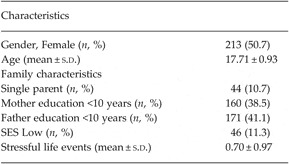
The demographic characteristics of the study group are shown in Table 1. No significant differences were found for scores at all the DOSs, age, gender and father's education level at W1 between participants and non-participants in the W2 phase. Significant differences were found for mother's education level (χ2 = 8.55; p = 0.003), SES (χ2 = 5.71; p = 0.017) and family structure (χ2 = 7.51; p = 0.006); however, with lower level of mother's education, lower SES and more single-parent families among non-participants.
Socio-demographic characteristics of the study sample at W2 (n = 420)

Changes in mean DOS scores
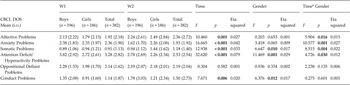
Complete emotional, behavioural and socio-demographic data were available for 382 subjects (196 boys and 186 girls) at W1 and W2. Table 2 shows the mean DOS raw scores in male and female participants at W1 and W2. Both Anxiety and Attention Deficit/Hyperactivity Problems scores decreased significantly (η2 = 0.04 and 0.08; p < 0.001). Attention Deficit/Hyperactivity problems also showed a linear effect of gender (male, η2 = 0.03, p = 0.001), and both Attention Deficit/Hyperactivity problems and Anxiety DOS yielded significant time × gender interactions (η2 = 0.01, p = 0.001 and η2 = 0.03, p = 0.03, respectively), sustained by a more marked decrease of scores in time among boys. There was, on the contrary, a significant increase in time of the mean scores for Affective (η2 = 0.03, p = 0.001) and Somatic Problems (η2 = 0.03, p < 0.001), with a significant time × gender interaction (η2 = 0.02, p = 0.016 and η2 = 0.02, p = 0.004, respectively) sustained by a more marked increase of scores in time among girls. There was also a significant increase in time for the mean scores of Conduct Problems (η2 = 0.02, p = 0.006), but no significant time × gender interaction. There was a significant effect of gender on Somatic Problems (η2 = 0.02, p = 0.01) with higher scores for girls, Attention Deficit/Hyperactivity (η2 = 0.03, p = 0.001) and Conduct Problems (η2 = 0.02, p = 0.012) with higher scores for boys. There were no significant effects of time, gender or time × gender interaction on Oppositional Defiant Problems score. Effect sizes were medium for the effect of time on Attention Deficit/Hyperactivity Problems, and small for all the other significant effects.
CBCL DOS raw scores in male and female participants at W1 and W2
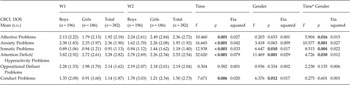
Note. All variables were analysed by repeated-measure ANOVA with ‘gender’ as a between-subjects' factor. Significant ps are reported in bold.
Stability
Across DOSs, the zero-order correlation coefficients were medium and significant (all: p < 0.001) for Affective (r = 0.39), Anxiety (r = 0.42), Somatic (r = 0.32), Oppositional Defiant (r = 0.48) and Conduct Problems (r = 0.43), and larger and more significant for Attention Deficit/Hyperactivity Problems (r = 0.55; p < 0.001).
Predictors of psychopathology
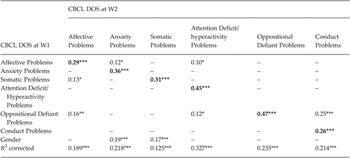
Table 3 shows the results (reported as standardized beta coefficient) of the backward stepwise linear regression model to predict psychopathology in adolescence. For all DOS, the score at W1 was the most consistent and significant predictor of the W2 score with βs ranging from 0.26 for Conduct Problems to 0.47 for Oppositional Defiant Problems (p < 0.001) which is a clear indication in favour of homotypy across all the newly established DSM-IV CBCL scales. Moreover, Affective Problems at W2 were significantly predicted by Somatic (β = 0.13; p = 0.014) and Oppositional Defiant Problems (β = 0.16; p = 0.002) at W1, Anxiety Problems at W2 were predicted by Affective Problems (β = 0.12; p = 0.029) at W1, Attention Deficit/ Hyperactivity Problems at W2 were significantly predicted by Affective (β = 0.10; p = 0.033) and Oppositional Defiant Problems (β = 0.12; p = 0.028) at W1, Conduct Problems at W2 were significantly predicted by Oppositional Defiant Problems (β = 0.25; p < 0.001) at W1.
Predictors of psychopathology at W2

Note. All data are given as standardized coefficient regression β derived from multiple regression analysis (backward stepwise), significance level α = 0.05, only significant results are presented. ***p < 0.001; **p < 0.010; *p < 0.050. Homotypic correlations β are reported in bold.
Gender was a significant predictor for Anxiety (β = 0.19; p < 0.001) and Somatic Problems (β = 0.17; p < 0.001). None of the independent variables showed serious collinearity effects: Tolerance Index scores ranged from 0.590 to 1 and VIF scores ranged from 1 to 1.694. All the full regression models were significant (F ranged from 23.08, df = 7.379, p < 0.001 – for Affective Problems – to 62.42, df = 7.379, p < 0.001 – for Attention Deficit/Hyperactivity Problems). The proportion of explained variance for the models ranged from R 2 = 0.13 (for Somatic Problems) to R 2 = 0.33 (for Attention Deficit/Hyperactivity Problems).
Mediational analysis
By regression analysis we found that the number of SLEs during the W1–W2 time frame was predicted by Affective Problems (β = 0.15; p = 0.002), Anxiety Problems (β = 0.13, p = 0.007), Attention Deficit/Hyperactivity Problems (β = 0.17, p = 0.001), Oppositional Defiant Problems (β = 0.21, p < 0.001) and Conduct Problems (β = 0.12, p = 0.015). This means that all DOSs except for Somatic Problems predicted SLEs to be more likely to occur in the W1–W2 time frame. However, when a stepwise multiple regression analysis was set to evaluate possible significant predictors of recent SLEs (step b) (with all the DOSs at W1 entered simultaneously in the regression, with gender as co-variate and with backwards stepwise selection used to remove non-significant predictors from the model), the only significant predictor was the Oppositional Defiant Problems scale (β = 0.20; p < 0.001; full model F = 2.873, d.f. = 6,209, p = 0.01). This means that the effect of different problem behaviours at W1 in heightening the probability of occurrence of recent SLEs could be more parsimoniously confined to the effect of Oppositional Defiant Problems only.
We set a second multiple regression analysis to resolve step (c) of Baron & Kenny (Reference Baron and Kenny1986) mediation approach by regressing all the W2 DOSs on the number of recent SLEs (while partialling out the effects of the DOSs measured at W1 and gender). This analysis showed that the number of recent SLEs predicted higher scores in Affective Problems (β = 0.23; p < 0.001), Anxiety Problems (β = 0.14; p = 0.002), and Oppositional Defiant Problems (β = 0.15; p = 0.001).
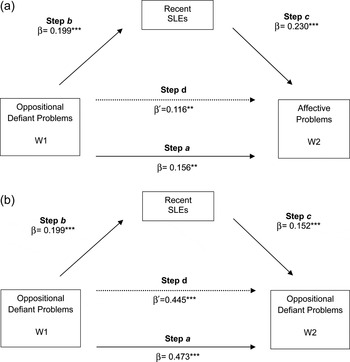
The only paths satisfying all the Baron Kenny (a), (b) and (c) criteria for mediation were the relation between Oppositional Defiant Problems at W1 and Affective Problems at W2, and the relation between Oppositional Defiant Problems at W1 and the homotypic Oppositional Defiant Problems scale at W2. Therefore, the last (d) step for the mediational analysis of recent SLEs included only these two paths. The inclusion of recent SLEs as a mediator significantly reduced the association between Oppositional Defiant Problems at W1 and Affective Problems (Fig. 1a) and Oppositional Defiant Problems (Fig. 1b) at W2: regression coefficients decreased by 26% for Affective Problems and by 6% for Oppositional defiant Problems. The bootstrap results showed significant mediation for both outcomes, with 95% CI: 9–53% for Affective Problems and 95% CI: 1–15% for Oppositional Defiant Problems. The proportion of explained variance for the model that included SLEs increased from R 2 = 0.189 to R 2 = 0.223 and from R 2 = 0.235 to R 2 = 0.246, respectively.
Mediational analysis. Step (a) represents the direct effect of CBCL DOS z scores at W1 on CBCL DOS z scores at W2; step (b) represents the direct effect of CBCL DOS scores at W1 on number of recent SLEs; step (c) represents the association of SLEs with DOS at W2. Step (d) and β′ represents the effect of CBCL DOS scores at W1 after recent SLEs were added to the model. All steps were conducted controlling for other psychopathologies at W1 and gender. For all regression analysis β values and significance level (*p < 0.05; **p < 0.01; ***p < 0.001) are reported.

Discussion
This is the first study with the CBCL DSM-oriented scales (DOSs) to evaluate the continuity and discontinuity of behavioural problems from early- to late-adolescence while taking into account the multiple co-variation of psychopathological traits and the possible influence of adversities. We found that the 5-year stability of the DOSs is, overall, satisfactory, as the size of the six DOSs' autocorrelations between W1 and W2 range from ‘medium’ to ‘large’. The highest stability indexes were found for Attention Deficit/Hyperactivity and Oppositional Defiant Problems (r = 0.55 and r = 0.48, respectively). This replicates the finding of higher stability for externalizing than internalizing problems (Stanger et al. Reference Stanger, McConaughy and Achenbach1992; Verhulst & Van der Ende, Reference Verhulst and Van der Ende1995; Hofstra et al. Reference Hofstra, Van der Ende and Verhulst2000). We also detected a moderate but significant decrease in Attention Deficit/Hyperactivity Problems (mostly in boys) and a small but significant increase in Affective and Somatic Problems (mostly in girls) and in Conduct Problems (both in boys and girls) in time. This age effect replicates similar tendencies that have been described by previous interview- and questionnaire-based studies (Roza et al. Reference Roza, Hofstra, van der Ende and Verhulst2003; Spencer et al. Reference Spencer, Biederman and Mick2007), and further support the validity of the DOSs.
In a model taking into account the multiple co-variation of the DOSs, we found that for all the six scales the best predictor at W2 was the score at the same scale at the first evaluation. This confirms the stability of the DOSs, and shows that homotypic evolution of psychopathology should be expected in the first place, when considering the transition from early- to late-adolescence. In supporting the psychometric stability and homotypic evolution of psychopathology, our data show that the DOSs yield long-term stability figures that are close to those obtained over a 6-year period in an epidemiological sample of Dutch children originally aged 4–11 years (Verhulst &Van der Ende, Reference Verhulst and Van der Ende1992) and in an American national sample of children originally aged 4–12 years (Achenbach et al. Reference Achenbach, Howell, McConaughy and Stanger1995) assessed with the ‘classical’ CBCL scales, while allowing for a more immediate reference to the DSM nosology.
Not only does our multivariate approach allow us to draw robust enough conclusions on homotypic stability and prediction but by multiple stepwise regressions we also found that most DOSs at W2 were predicted by more than one DOS at W1. Likewise, one DOS score at W1 often predicted several DOS scores at W2, albeit the sizes of heterotypic correlations were invariably smaller than those of the autocorrelations. These findings confirm the constructs of multifinality (i.e. dispersion of outcomes) and equifinality (i.e. diversity of pathways leading to a common outcome) described by Cicchetti (Reference Cicchetti, Rolf, Masten, Cicchetti, Nuechterlein and Weintraub1990) for most developmental psychopathological traits. Within this landscape, however, specific developmental trajectories are clearly more probable than others. This can be best appreciated in the externalizing domain. The clearest example of multifinality is provided by Oppositional Defiant Problems predicting Affective, Conduct and, to a lesser extent, Attention Deficit/Hyperactivity Problems. In contrast, Conduct Problems at first wave predicted only the respective homotypic scale, suggesting two different developmental patterns for these two externalizing domains, and striking similarity with the results of the interview-based analyses of the GSMS sample by Copeland et al. (Reference Copeland, Shanahan, Costello and Angold2009a) and with the results of the Canadian National Longitudinal Study of Youth mainly based on mother reported questionnaires (Boylan et al. Reference Boylan, Georgiades and Szatmari2010). Therefore, these data suggest Oppositional Defiant Problems as being part of a developmental pathway towards a host of internalizing and externalizing problems in late-adolescence (and probably young adulthood) over and above the comorbidity with, or the evolution towards, Conduct Problems.
Our second, major aim was to explore the complex relationship between adversities and psychopathology. We found that higher Affective, Anxiety, Oppositional Defiant and Conduct Problems scores predicted a higher number of SLEs in adolescence in a univariate approach. Controlling for other psychopathologies, i.e. the full spectrum of DOS, Oppositional Defiant Problems was the only dimension still able to predict a significantly higher number of SLEs, suggesting that this specific form of externalization constitutes a relatively robust predictor of adversities in youth. Unsurprisingly, a higher number of recent SLEs predicted higher scores on most DOSs longitudinally, confirming the importance of adversities in contributing to both internalizing and externalizing problems in youth (Cicchetti, Reference Cicchetti, Rolf, Masten, Cicchetti, Nuechterlein and Weintraub1990; Haggerty et al. Reference Haggerty, Sherrod, Garmezy and Rutter1994). Mediational analysis revealed that recent SLEs partially accounted for not only the continuity of Oppositional Defiant Problems in time but also for the heterotypic progression towards the development of Affective Problems. Our data confirmed longitudinally the cross-sectional findings of Rowe et al. (Reference Rowe, Maughan and Eley2006), i.e. that adversities support the association between oppositionality and depressed mood in youth. Moreover, our follow-up perspective allowed us to investigate and to confirm the existence of a reciprocal cycle of stress generation in maintaining specific developmental trajectories across externalizing and internalizing domains. These data may inform on the mechanisms underlying the continuity/aetiology of both Oppositional Defiant and Depression Problems from early- to late-adolescence: recent adversities in adolescence may contribute to the aetiology/maintenance of these disturbances playing a very complex role as they could be antecedent of psychopathology, but they also in part result from psychopathology and, according to the analyses of indirect effect, they partially mediate the perpetuation of Oppositional Defiant Problems over time and their evolution towards Affective Problems.
There are several limitations in this study. While the psychometric variables did not affect agreement to participate in the study, non-participants were more likely to belong to socially disadvantaged backgrounds, as suggested by the excess of mother's lower education level, lower SES and single-parent families. The sample may thus not be fully representative of a general population. However, the fact that non-participant adolescents did not differ from participants in terms of behavioural problems suggests that loss from analysis of those subjects is unlikely to have introduced a major bias. In the second wave of this study, the only sources on behavioural problems of adolescents were behaviour checklists filled in by parents. Other sources of information such as the adolescents themselves and their teachers could have been desirable. However, all the DOSs–parent versions were found to satisfactorily predict the corresponding DSM-IV diagnoses (Lengua et al. Reference Lengua, Sadowski, Friedrich and Fisher2001; Krol et al. Reference Krol, De Bruyn, Coolen and van Aarle2006; Ferdinand, Reference Ferdinand2008). The use of ‘repeated’ measures obtained by the same informants (i.e. parents) in time could suffer from shared method variance and inflate the estimates of stability of behaviour. Finally, the addition of a broader spectrum of adversities as well as of indicators of protective factors would have been desirable to build a more complete picture of risks and adaptation. Similarly, standardized information on treatment and help-seeking at follow-up would have been desirable in order to evaluate their impact on the problems reported at the DOSs.
Conclusion
We found good stability of the newly developed DOSs through adolescence, and considerable homotypic continuity both for Internalizing (Depression, Anxiety and Somatic Problems) and for Externalizing (Attention Deficit/Hyperactivity, Oppositional Defiant and Conduct Problems) DOSs. Parent-reported Oppositional Defiant Problems emerged to be a polyvalent predictor of both internalizing and externalizing problems in late-adolescence. These data suggest Oppositional Defiant Problems as being part of a developmental pathway towards a host of problems in late-adolescence (and probably young adulthood) over and above the comorbidity with, or the evolution towards, Conduct Problems.
Furthermore, we found that Oppositional Defiant Problems predict more SLEs, which, in turn, predict Depression and Oppositional Defiant Problems longitudinally. This chain of risk appears to deserve particular attention, although it should not be thought of as deterministic. For instance, if environmental reinforcements are disrupted, recovery and adaptation become likely.
More broadly, our data underscore early adolescence behavioural problems as an important focus for primary and secondary intervention. Primary prevention strategies emphasizing social (and educational) intervention may reduce the likelihood of persistence of behavioural problems (especially Depression and Oppositional Defiant Problems) from early- to late-adolescence and, perhaps, to early adult years. As far as secondary prevention is concerned, the CBCL DOS could be adopted in programmes aimed at identifying and treating general population individuals at increased risk of developing emotional/ behavioural problems.
Acknowledgements
The authors thank Mss Teresa Di Fiandra, Margherita Fossati and Chiara Steffenini for their valuable technical support, and the study families and participants for taking part to the study.
Declaration of Interests
This study is a part of the Progetto Italiano Salute Mentale Adolescenti (PrISMA) project. PrISMA has been financially supported by various grants from the Italian National Institute of Health and from the Italian ‘Centro per il Controllo e la prevenzione delle Malattie’ (CCM).
The Authors declare no potential conflicts of interest related to the present paper.