Dairy production systems are highly dependent on environmental factors. This applies especially to those that rely on grazing, making them highly vulnerable to changes in weather conditions. Many regions in the world are experiencing an increase in the average temperature as well as changes in rainfall patterns, causing very hot summers and prolonged droughts (Meehl et al., Reference Meehl, Stocker, Collins, Friedlingstein, Gaye, Gregory, Kitoh, Knutti, Murphy, Noda, Raper, Watterson, Weaver, Zhao, Solomon, Qin, Mandning, Chen, Marquis, Averyt, Tignor and Miller2007; Eslamizad et al., Reference Eslamizad, Albrecht and Kuhla2020). However, in these regions there has been little research on this topic because these climatic phenomena used to be rare (Arias et al., Reference Arias, Mader and Escobar2008). One important characteristic of grazing systems is that cows must travel twice or three times per day from paddocks to the milking parlour, which represents a challenge for their thermal balance in the summertime.
The adoption of mitigation strategies usually requires recognition of the threshold value of one of several thermal comfort indices. One of the most popular is the Temperature and Humidity Index (THI; Thom, Reference Thom1959). However, this index does not consider wind speed and solar radiation, two important climatic variables that influence animal thermal balance (Mader et al., Reference Mader, Davis and Brown-Brandl2006). The Comprehensive Climate Index (CCI; Mader et al. Reference Mader, Johnson and Gaughan2010) is a newer, multi-seasonal index that provides an adjustment of the ambient temperature based on relative humidity, wind speed and solar radiation. Mader et al. (Reference Mader, Johnson and Gaughan2010) established that at CCI ≥ 25°C cattle may respond to heat stress with behavioural adaptations. Jara et al. (Reference Jara, Keim and Arias2016) reported changes in the behaviour of dairy cows at CCI ≥ 25°C and higher tympanic temperature for CCI categories ‘mild’ (CCI > 25 and ≤30) and ‘moderate’ (CCI > 30 and ≤35) when compared to ‘no stress conditions’ (CCI ≤ 25). Similarly, Arias et al. (Reference Arias, Herrera, Larrain, Gonzalez, Mader and Velasquez2018) reported a greater proportion of cows using shade at ‘mild’ and ‘moderate’ CCI categories as well as higher tympanic temperature.
Finally, milk production and composition normally present seasonal patterns, that are influenced by genetics, nutrition, reproductive management, and weather conditions (Auldist et al., Reference Auldist, Walsh and Thomson1998; Mackle et al., Reference Mackle, Bryant, Petch, Hill and Auldist1999). Temperatures above 23°C would decrease total solids in milk, reducing fat and protein content (0.4 and 0.2%, respectively) during the summer months, whereas lactose concentration would not be affected by high temperatures (Collier et al., Reference Collier, Hall, Rungruang and Zimmerman2012). Shearer and Beede (Reference Shearer and Beede1990) indicate that changes in the composition of milk would be associated with a reduction in feed consumption due to heat stress. These responses are variable, depending on the productive level of the animals and the prevailing environmental conditions, that alter the nervous and endocrine systems as well water, nutritional and biochemical balances (Uribe-Velásquez et al., Reference Uribe-Velásquez, Oba, Brasil, Sousa and Wechsler2001).
At present, there is a strong and growing desire to keep dairy cows' health and production stable during the summer months in regions of temperate climate. In this context, we hypothesize that days with CCI ≥ 20°C will negatively affect cows, increasing body temperature and modifying behaviour, including a reduction in grazing time, reduced rumination time and higher respiration rate and activity. Also, under these conditions, milk production and quality may be negatively affected.
Material and methods
All animal care and handling procedures followed Chilean national legislation (Law No. 20,380 on Protection of Animals; Decree No. 29 about regulation on the protection of animals during their industrial production, their commercialization and in other areas to hold animals), whose application is supervised by the National Service of Agriculture and Livestock (SAG), the competent authority in this matter.
Location, animals and treatments
The study was conducted during the summer of 2017 at the Austral Agricultural Research Station of the Universidad Austral de Chile, Valdivia, Chile. In order to define periods of data collection, days were previously classified as thermo-neutral or heat stress using as criteria the Comprehensive Climate Index (CCI, see below) with a threshold value of 20°C (Jara et al., Reference Jara, Keim and Arias2016), which was estimated using the weather forecast (www.accuweather.com). The heat stress period was from January 21 to 26 (6 d), and thermo-neutral period from February 3 to 12 (10 d). A total of 30 multiparous lactating and pregnant Holstein Friesian dairy cows were randomly selected from the herd and divided into two groups according to days in milk. However, one cow was subsequently removed as non-pregnant. Thus, the medium lactation group (ML) included 15 cows between 99 to 170 d in milk, averaging 22.15 ± 3.3 kg/d and liveweight of 563 ± 67.9 kg. The late lactation (LL) group included 14 cows between 225 to 311 d in milk, averaging 15.32 ± 1.8 kg/d and liveweight of 585 ± 38.5 kg. During the study period the cows were kept in paddocks with access to water but not to artificial shade.
Thermal comfort index
The Comprehensive Climate Index was used to classify each hour of the day as thermo-neutral or heat stress and to compare cows' behaviour, milk production, and milk quality. The CCI was estimated from four climatic variables: ambient temperature (°C), relative humidity (%), wind speed (m/s), and solar radiation (W/m2). These data were collected at one-hour intervals from a meteorological station (Campbell Scientific CR1000, Utah, USA) located at the agricultural research station. The CCI adjusts ambient temperature (AT) based on three factors using the following equation: CCI = AT + FRH + FWS + FSR, where FRH is the adjusting factor of relative humidity; FWS for wind speed; and FSR for solar radiation (Mader et al., Reference Mader, Johnson and Gaughan2010). The criteria to consider an hour of the day as thermo-neutral was a CCI ≤ 20 °C. Values of CCI above this threshold were classified as heat stress. This value was defined based on previous research conducted in the same region (Jara et al., Reference Jara, Keim and Arias2016; Arias et al., Reference Arias, Herrera, Larrain, Gonzalez, Mader and Velasquez2018) since behavioural and physiological changes on cattle were reported from this value.
Vaginal temperature (VT) was used as an indicator of cow's thermal comfort and it was collected by using small, inexpensive, and low-accuracy loggers (Thermochron DS1921G-F5, Maxim Integrated Products, Inc., Santiago Chile). The devices were set to read at 10-minute intervals. Each device was attached to modified CIDRs (Controlled Internal Drug Release) following the procedure reported by Burfeind et al. (Reference Burfeind, Suthar, Voigtsberger, Bonk and Heuwieser2011). The CIDRs were hormone-free and underwent a prior disinfection process.
Behaviour and rumination time
Rumination time was recorded with the Heatime system (Tag Heatime HR, SCR Headquarters, Netanya, Israel) that contains a movement sensor, a microprocessor, a memory and a specially developed microphone to detect the cow's rumination times, the chewing rate and the time between feeding boluses. All data were stored at two-hour intervals. Cows´ behaviour was recorded daily and individually by a trained person during two periods (before morning milking from 08 : 00 to 13 : 00 h and after afternoon milking from 17 : 00 to 20 : 00 h). At time of observation, each 10 min, the activity was classified as grazing, standing, lying or seeking natural shade. Total activity's time per cow and day was calculated by summation of all intervals.
Respiration rates and panting scores
Respiration rates were collected twice daily in duplicate by the same observer that counted and timed 10 movements of animal’ flank. Then, those values were expressed as breaths per minute. The first measurement was made between 13 : 00–14 : 00 h when cows were waiting for milking. The second one was made between 19 : 00–20 : 00 h, when cows returned to the paddocks, after milking. Simultaneously, a panting score was assigned to each cow by the same observer using the panting score proposed by Mader et al. (Reference Mader, Davis and Brown-Brandl2006).
Milk production and composition
Cows were milked twice per day (07 : 00 and 16 : 00 h) and milk yield was recorded daily with a flow sensor (MPC580 DeLaval, Tumba, Sweden). Milk composition was analysed in seven different days during the study, allowing the comparison of those days classified as thermo-neutral v. heat stress. Milk composition was determined for morning and afternoon milking. Individual samples were collected using a Waikato milk meter (Waikato®, New Zealand) and subsequently analysed by mid-infrared spectrophotometry (Foss 4300 Milko-scan) at the Milk Laboratory of Instituto Nacional de Investigaciones Agropecuarias. The analysis included fat, protein, lactose, urea concentration and somatic cell count (SCC). Somatic cell counts were transformed to somatic cell score (SCS = log2 (SCC/100) + 3).
Statistical analysis
Data are presented as means ± sem and were analysed as a completely randomized experimental design with a 2 × 2 factorial arrangement of treatments. The first factor was the day's thermal condition according to CCI (thermo-neutral v. heat stress) and the second factor was days in milk with two levels (ML v. LL). Data were subjected to normality (Shapiro−Wilks) and homoscedasticity (Levene's) tests. The quantitative variables were analysed by ANOVA and Tukey's multiple comparisons where appropriate. Likewise, VT and respiration rates were modelled using a repeated measurement analysis (PROC MIXED statement in SAS) with VT and respiration rates as dependent variables with hour, days in milk, thermal condition and their interactions as independent variables in the model. The random effect was the cow. In addition, a Chi-square test was used in the categorical response variables. All analyses were performed using SAS Studio University and JMP v11.0 (SAS Institute, Cary, NC, USA), with significance established at P < 0.05.
Results
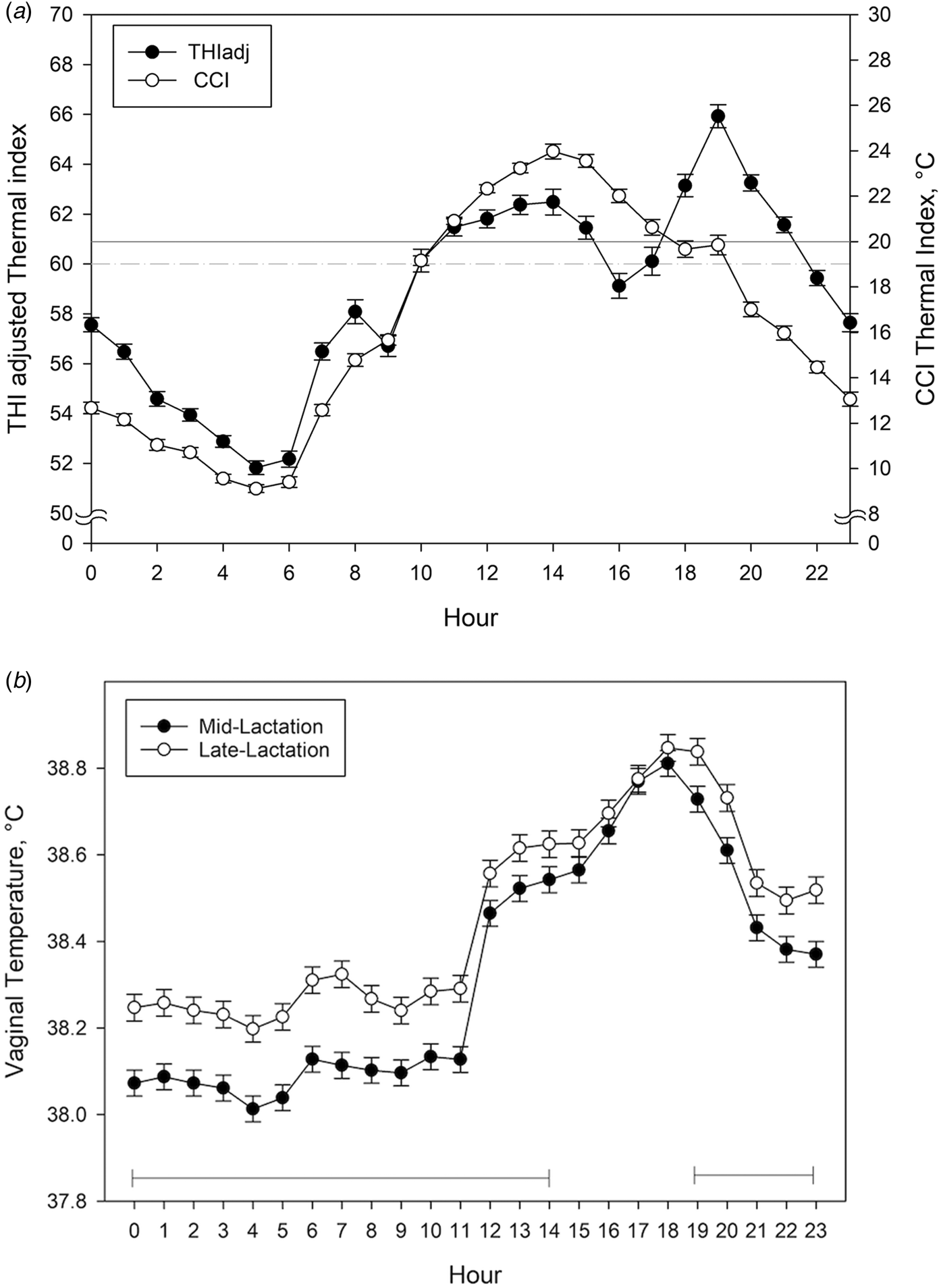
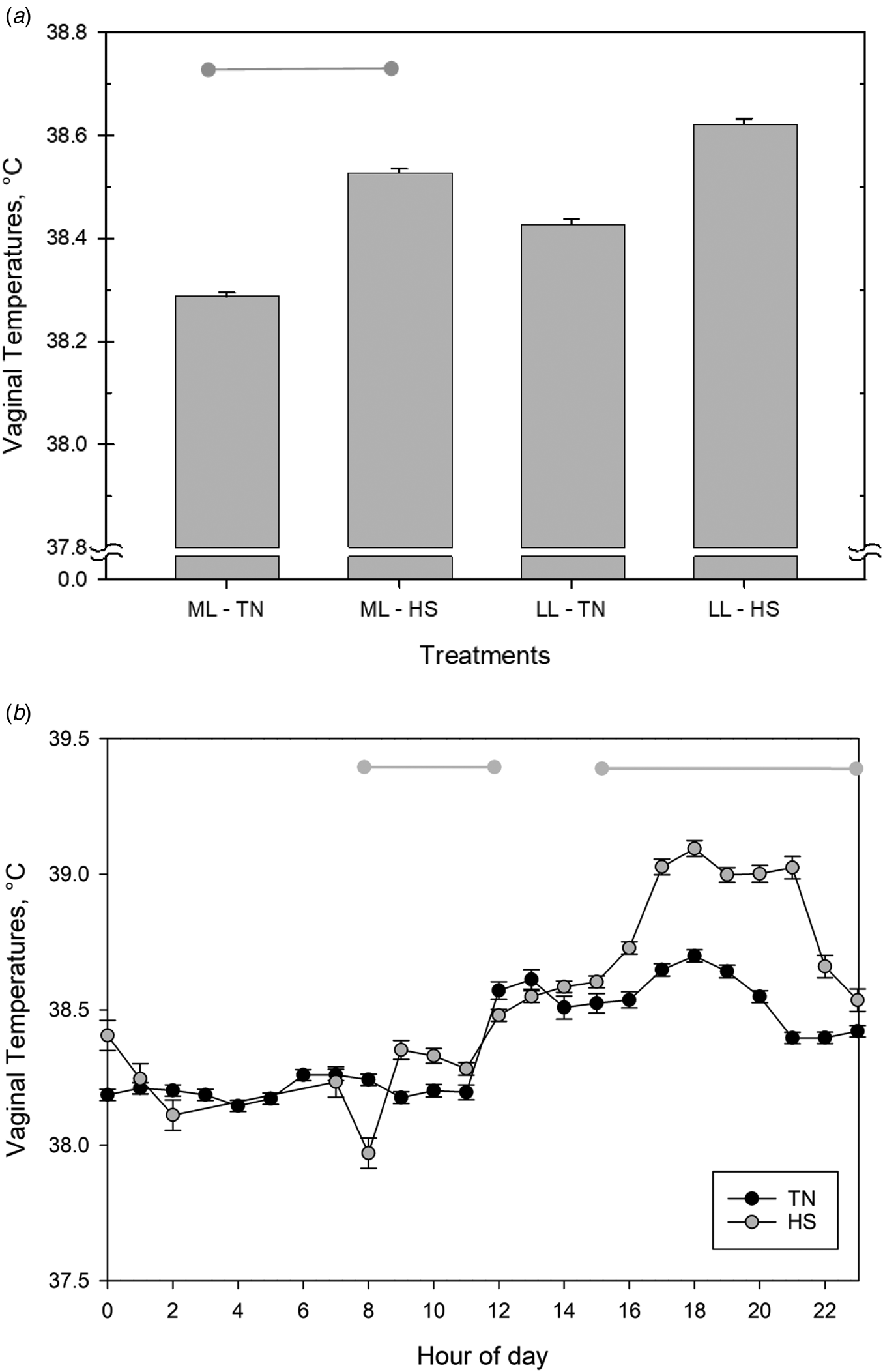
A summary of the weather conditions, CCI, and VT are presented in online Supplementary Table 1. Only 12.5% of the days of the study presented a daily average of CCI > 20. Like ambient temperature, the solar radiation progressively increased from 10 : 00 h decreasing sharply after 19 : 00 h. The maximum value on the week of data collection in January was 972 and 965 W/m2 in February. The dynamics of CCI (Fig. 1a) show that it exceeded the threshold value in 29% of the daytime, from 10 : 00 to 17 : 00 h. However, for January 25th and 26th, it extended until midnight. The adjusted THI values (shown as a reference) had a similar pattern until 16 : 00 h where they began to increase up to 19 : 00 h, whereas the CCI decreased progresively. Vaginal temperatures were dependent on the days in milk (Fig. 1b) and thermal condition of the day (P < 0.05; Figure 2b). Cows from ML group presented a higher VT at CCI ≥ 20°C, while LL cows did not show changes (Fig. 1b). The patterns of VT are shown in Figure 2b for cows under thermo-neutral and heat stress conditions. Cows under heat stress conditions (using CCI or THIadj) increased VT, independent of days in milk, especially from 15 : 00 h to midnight but also from 08 : 00 h to midday. When THIadj was used, no interaction effects were observed for VT (P > 0.05), but there was an effect of thermal condition of the day and of days in milk (both P = 0.01).
Least-square means for hourly for (a) CCI and adjusted THI (THI, Temperature−humidity index; CCI, Comprehensive climate index). The solid and dotted grey lines represent the threshold values for CCI and THIadj used in this study. (b) Vaginal temperatures by days of lactation. Solid lines at the bottom indicate statistical differences between groups at the same hour (P < 0.05).

Least square means for vaginal temperature per treatment as affected by (a) the interaction between thermal condition of the day based on CCI index and stage of lactation. ML, cows in mid-lactation; LL, cows in late lactation; TN, thermoneutral conditions (CCI < 20°C); HS, Heat stress conditions (CCI ≥ 20°C). (b) Vaginal temperature by day condition (TN or HS). Solid lines at the top in both Figures indicate a statistical difference (P < 0.05).

In the morning, before the first milking, 78.3% of cows were grazing, 19.6% lying down, and 2.1% standing when hours were neutral (CCI < 20°C). However, during heat stress hours, grazing was reduced to 47.3%, whereas lying down and standing increased to 32.9 and 16.2%, respectively (P < 0.001). Additionally, 3.6% of cows were seeking natural shade in the paddock. In the afternoon (post-milking), cow behaviour was modified (P < 0.001), with 51.5% of cows grazing, 42.9% lying down, 5.0% standing, and 0.6% under shade when CCI < 20°C. Likewise, values changed to 55.9% grazing, 5.6% standing, and 13.4% under natural shade when CCI ≥ 20°C. In addition, cows lying down was reduced by almost half (25.0%).
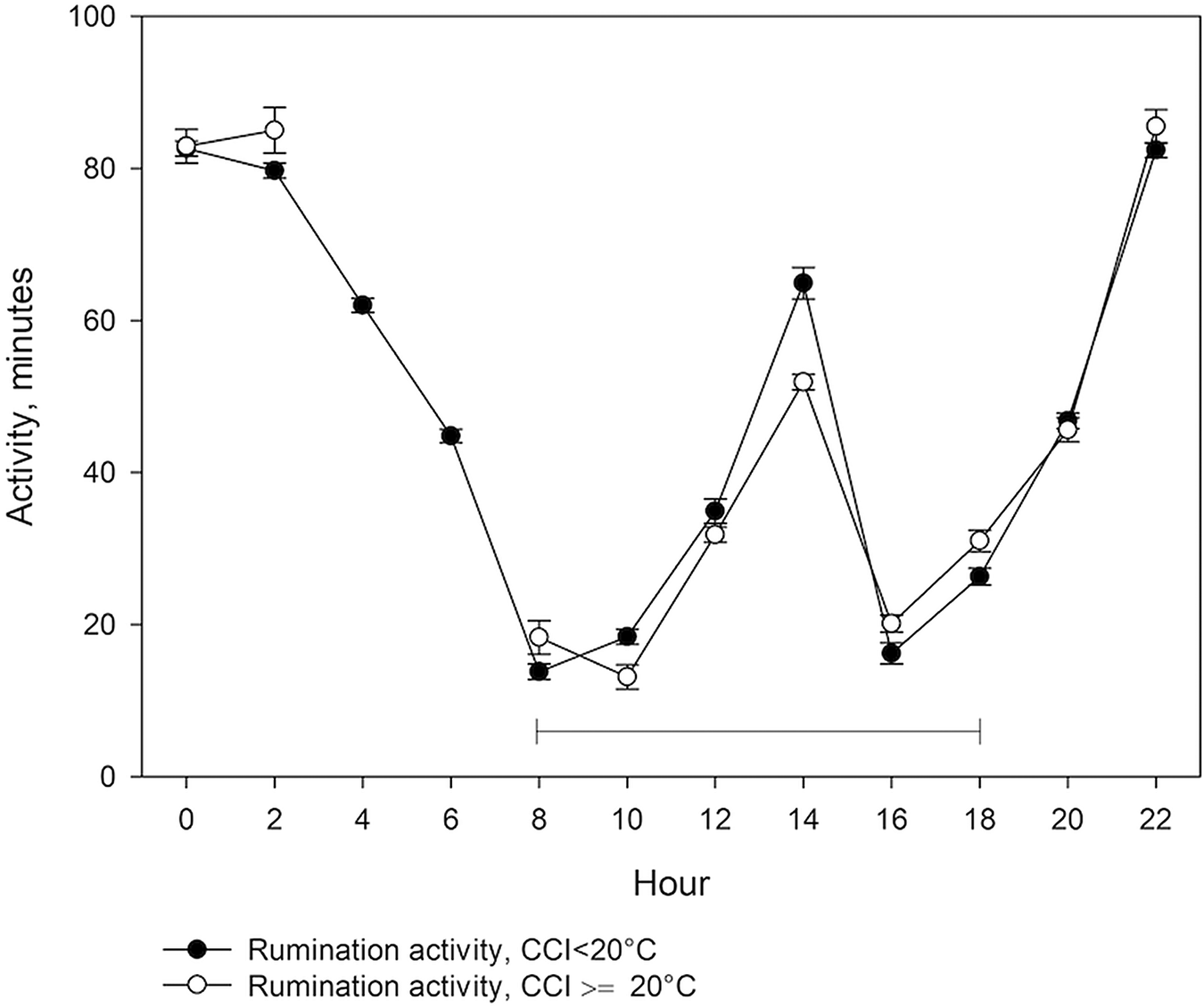
Rumination activity was dependent of time of day and thermal condition (P < 0.001). A greater RA was observed when CCI ≥ 20°C, whereas rumen activity decreased with CCI ≥ 20°C (Fig. 3). It should be noted that during most of the night-time (03 : 00 to 07 : 00 h) no hour presented CCI ≥ 20°C. The strongest falls in rumination time were at 10 : 00 and 14 : 00 h (5.3 and 13.0 min, respectively). When the conditions were thermally challenging for the animal, they compensated with an increase of 5.3 min at 02 : 00 h. Respiration rate was affected by thermal condition and day (P < 0.0001). It was greater when CCI ≥ 20°C but the magnitude of the increase was associated with the climatic conditions of each day. Most of the cows showed some panting (75.8% panting score = 1; 20.7% panting score = 2, and 3.5 panting score = 0) but no severe panting was observed at neutral condition. In contrast, moderate panting increased when the CCI ≥ 20°C (36.2 and 3.9%, panting scores = 2 and 4, respectively), and fewer cows had light or no panting (57.4% panting score = 1; 2.5% panting score = 0).
Rumination time (minutes) every two hours of all cows according to the Comprehensive Climate Index (CCI). Solid line at the bottom indicates statistical differences between groups at the same hour.

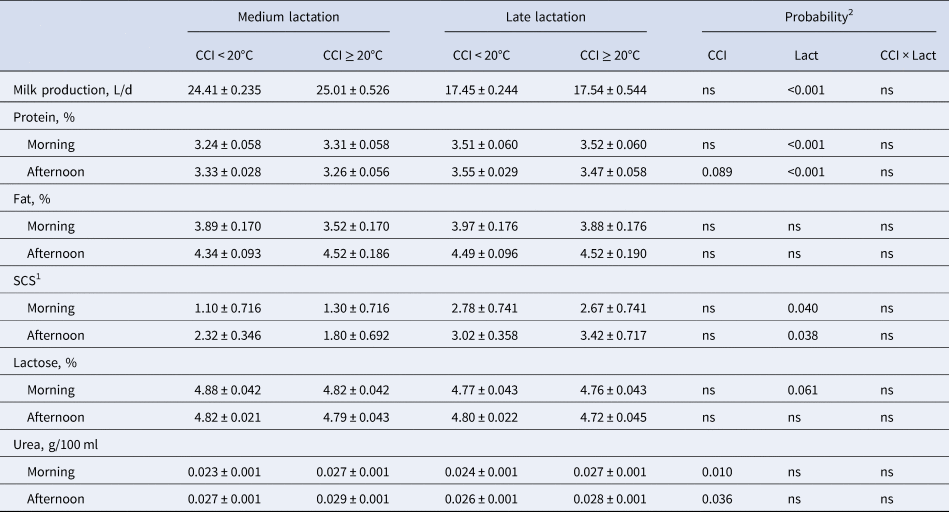
Table 1 summarizes milk production and milk composition according to the CCI category and stage of lactation. Cows of ML group produced more than the LL group. Protein concentration was numerically but non-significantly decreased at CCI ≥ 20°C and was greater for cows of LL group (P < 0.001). Milk urea increased both morning and afternoon (P < 0.05) when CCI ≥ 20°C, independent of days in milk group. The SCS was only associated with days in milk status (P < 0.05), being higher in the LL group but not affected by the thermal condition. Lactose content was similar during milkings in cows of the ML group, without showing variations according to the thermal condition. No changes were observed in the concentrations of fat, neither for the stage of lactation nor for the day's thermal condition.
Effect of thermal condition and stage of lactation on milk production and composition in dairy cows in a temperate region

1 SCC = Somatic cells count.
2 Probability of treatment effects: CCI = Comprehensive climate index; CCI < 20°C v. CCI ≥ 20°C condition; Lact = Stage of lactation; Medium v. Late lactation; CCI × Lact = interaction between thermal condition and stage of lactation.
Discussion
A pivotal discussion has been the minimum value at which an animal begins to suffer heat stress (Berman, Reference Berman2005). Nowadays, there is still controversy about the thresholds for dairy cows. For example, the thresholds for THI in Holstein cows range from 52 to 74 (Zimbelman et al., Reference Zimbelman, Rhoads, Rhoads, Duff, Baumgard and Collier2009; Sanker et al., Reference Sanker, Lambertz and Gauly2013; Hammami et al., Reference Hammami, Vandenplas, Vanrobays, Rekik, Bastin and Gengler2015; Müschner-Siemens et al., Reference Müschner-Siemens, Hoffmann, Ammon and Amon2020). However, there are few studies using the CCI as a thermal index in dairy cows. The critical thresholds proposed by Mader et al. (Reference Mader, Johnson and Gaughan2010) for CCI were theoretical and based on beef cattle, that are less sensitive to heat stress than dairy cows because milk production generates higher body temperature due to digestion and metabolism (Zimbelman et al., Reference Zimbelman, Rhoads, Rhoads, Duff, Baumgard and Collier2009). In the present study, we used a CCI threshold value ≥20°C based on previous studies conducted in the same region, that showed changes in the physiological and behavioural response of dairy cows. Furthermore, Mader et al. (Reference Mader, Johnson and Gaughan2010) mentioned that CCI has a flexible threshold due to the animal´s susceptibility to environmental factors, previous exposure, age, body condition and isolation. The maximum value for CCI was 37.9°C on January 22nd. However, in this region ambient temperature can reach more than 30°C during the daytime, but nights are cool, with ambient temperature falling more than 20 degrees (Arias et al., Reference Arias, Herrera, Larrain, Gonzalez, Mader and Velasquez2018). Thus, cows on this experiment had a chance during night-time to lose heat accumulated during the day.
Vaginal (or rectal) temperature has commonly been used as an indicator of thermal comfort in cattle (Hahn, Reference Hahn1999; Kaufman et al., Reference Kaufman, Saxton and Rius2018). In ruminants, an increase in body temperature marks a transition from an aversive stage to a harmful stage, considering rectal temperature as a sensitive indicator of the physiological response to heat stress (Kadzere et al., Reference Kadzere, Murphy, Silanikove and Maltz2002; Polsky and von Keyserlingk, Reference Polsky and von Keyserlingk2017). Collier et al. (Reference Collier, Doelger, Head, Thatcher and Wilcox1982) and Adin et al. (Reference Adin, Gelman, Solomon, Flamenbaum, Nikbachat, Yosef, Zenou, Shamay, Feuermann, Mabjeesh and Miron2009), reported differences of 0.3 to 0.8°C among animals in a comfortable state compared to animals with evident heat stress. An increase of 1.0°C or less in rectal temperature is enough to reduce performance in most livestock species (Vasconcelos et al., Reference Vasconcelos, Cooke, Jardina, Aragon, Veras, Soriano, Sobreira and Scarpa2011; Soriani et al., Reference Soriani, Panella and Calamari2013). However, Dikmen and Hansen (Reference Dikmen and Hansen2009) reported that milk yield does not influence rectal temperatures in high-producing Holstein cows maintained in subtropical environments. In this study, cows increased VT under heat stress conditions, but no changes in milk production were observed. It has been suggested that night cooling may be an effective natural method to alleviate the thermoregulatory limitations of a warm climate (Scott et al., Reference Scott, Johnson and Hahn1983), and may explain why the effects on milk production were not negatively associated with CCI. In addition, respiration rate and panting score data were collected when solar radiation was highest (14 : 00 to 16 : 00), after cows walked more than 1.1 km from the paddock to the milking parlour, thereafter, waiting in a concrete non shaded yard. Heat generation is also associated with the greater live weight, since greater body size is associated with a larger digestive system that allows more feed and, therefore, greater generation of metabolic heat (Purwanto et al., Reference Purwanto, Abo, Sakamoto, Furumoto and Yamamoto1990; Freetly et al., Reference Freetly, Nienaber and Brown-Brandl2003; Brosh, Reference Brosh2007). In our study, animals from LL presented higher VT than animals in ML, which may be related to the greater live weight of LL cows.
Anderson et al. (Reference Anderson, Bradford, Harner, Tucker, Choi, Allen, Hall, Rungruang, Collier and Smith2013), reported that an increase in body temperature can be positively correlated with the time that the animals remain standing in a 24-h period. Cook et al. (Reference Cook, Mentink, Bennett and Burgi2007) also observed that cows remain standing during the warmer periods, associated with decreases in milk production and increasing the prevalence of foot diseases. In our study cows spent most of the day grazing, regardless of the thermal condition and days in milk group, similar to data reported by Jara et al. (Reference Jara, Keim and Arias2016). Nevertheless, we observed a decrease in the number of cows grazing during heat stress conditions and an increase of cows standing, lying or under the shade, which reflects a predictable change in the behaviour in response to environmental conditions (Tucker et al., Reference Tucker, Rogers and Schütz2008; Schütz et al., Reference Schütz, Rogers, Cox and Tucker2009; Allen et al., Reference Allen, Hall, Collier and Smith2015; Vizzotto et al., Reference Vizzotto, Fischer, Thaler Neto, Abreu, Stumpf, Werncke, Schmidt and McManus2015). We also observed that cows that reduce grazing in the hottest hours preferred to graze in the afternoon, which agrees with Silanikove (Reference Silanikove2000). This could also explain the lack of milk production decrease in our study. It is important to mention that milk yield in our study was lower in comparison to other studies conducted in confined conditions (Horan et al., Reference Horan, Dillon, Faverdin, Delaby, Buckley and Rath2005) but similar (Castillo-Umaña et al., Reference Castillo-Umaña, Balocchi, Pulido, Sepúlveda-Varas, Pacheco, Muetzel, Berthiaume and Keim2020) or greater (Auldist et al., Reference Auldist, Walsh and Thomson1998) compared with mid- and late-lactating grazing dairy cows. In our study visual observations were only undertaken until 20 : 00 h. In general, cattle reared in temperate zones are not used to experience heatwaves regularly. Thus, changes in behaviour must be evaluated further since high temperatures are expected to increase due to climate change in the coming years (Chapman et al., Reference Chapman, Dassanayake, Hill, Cullen and Lane2012; Gauly and Ammer, Reference Gauly and Ammer2020). We observed a decrease of overall activity during the hottest hours of the day (12 : 00 and 18 : 00 h), which agrees with other reports (Cook et al., Reference Cook, Mentink, Bennett and Burgi2007; Allen et al., Reference Allen, Hall, Collier and Smith2015). The sudden increase in activity observed between 13 : 00 and 14 : 00 h for the heat stress condition correspond to the time when the herd begins to move to the milking parlour. It has been demonstrated that movement can increase body temperature between 0.5 and 3.5°C (Mader, Reference Mader2007; Arias et al., Reference Arias, Velásquez, Alvarado-Gilis, Keim and Gandarillas2017).
During heat stress conditions rumination is reduced (Acantincai et al., Reference Acantincai, Gavojdian, Cziszter, Tripon, Alungei and Popian2009; Müschner-Siemens et al., Reference Müschner-Siemens, Hoffmann, Ammon and Amon2020), thus there is less blood flow to the ruminal epithelium (Hales et al., Reference Hales, Bell, Fawcett and King1984). In this trial, rumination time was shorter during the day and increased progressively towards night, following a normal pattern, because cows spend more time ruminating during night, either standing or lying (Beauchemin, Reference Beauchemin1991). However, there was a decrease in rumination for the heat stress hours when compared to ‘neutral’ hours, but not during the night-time. Soriani et al. (Reference Soriani, Panella and Calamari2013) reported a decrease in rumination time during the day and night for the warmer periods evaluated with the THI but observing a more marked reduction during the day. Moretti et al. (Reference Moretti, Biffani, Chessa and Bozzi2017) also reported a negative association between heat load and rumination time in Holstein cows. Heat production increases during and after feeding, so the adaptation to shift a large part of feed consumption to night-time is due to the loss of non-evaporative heat from the animal to the environment, resulting in a lower energy expenditure during the day (Aharoni et al., Reference Aharoni, Brosh and Harari2005) that translates into a lower production of metabolic heat.
Most cows (94.5%) showed panting score > 0, similar to 90% reported by Jara et al. (Reference Jara, Keim and Arias2016). Panting (evaporative cooling) is one of the primary mechanisms by which an animal eliminates heat. Mader et al. (Reference Mader, Davis and Brown-Brandl2006) reported a negative relationship between wind speed and panting score, which would demonstrate the ability of animals to exchange heat by convection. In our study, wind speed always increased before and during milking, decreasing towards night-time, so it can be assumed that cows had the possibility to lose heat load. Mader et al. (Reference Mader, Davis and Brown-Brandl2006) also reported that wind speed would have a positive effect only if ambient temperature is below the animal's body temperature and the relative humidity also remained low. Otherwise, the effects of wind speed are uncertain. In this study, ambient temperature did not exceed cows´ body temperature. On the other hand, there is a strong impact of solar radiation on panting score (Mader et al., Reference Mader, Dahlquist and Gaughan1997; Mitlohner et al., Reference Mitlohner, Morrow, Dailey, Wilson, Galyean, Miller and McGlone2001). This demonstrates that ambient temperature alone is not a good predictor of heat stress on cattle.
Some researchers have challenged milk production as an acceptable indicator to estimate well-being in cows exposed to heat stress, mainly due to the disagreement between studies regarding the speed of response to episodes of heat stress (von Keyserlingk et al., Reference von Keyserlingk, Rushen, de Passillé and Weary2009). Furthermore, cows have the mechanisms to withstand short periods of adversity and compensate for losses when conditions return to normal, which is why significant changes in their performance are not always observed (Arias et al., Reference Arias, Mader and Escobar2008). Changes in milk composition may be more useful to evaluate immediate heat stress conditions in cows (Hu et al., Reference Hu, Zhang, Zheng, Cheng and Wang2016). We observed changes in urea concentration and a numerical (non-significant) change in protein concentration during heat stress. Collier et al. (Reference Collier, Hall, Rungruang and Zimmerman2012), stated that the pattern of protein production in milk seems to be more affected by temperature. On the other hand, days in milk is an important factor that determines the level of changes on milk composition during heat stress. Mid-lactation cows were suggested to be more sensitive to heat compared to early and late lactation cows (Zimbleman et al., Reference Zimbleman, Collier, Ben Abdallah and Collier2008). This does not agree with our results, since the small decrease in protein concentration was similar for both days in milk groups. However, others suggest that cows are more sensitive to heat stress in middle and at the end of lactation (Spiers et al., Reference Spiers, Spain, Sampson and Rhoads2004). The greater milk urea concentrations under heat stress conditions agree with the trend towards lower milk protein and may be related with less energy available for protein synthesis in the mammary gland (Mackle et al., Reference Mackle, Bryant, Petch, Hill and Auldist1999).
In conclusion, weather conditions during the day modified activity, rumination time and behaviour, regardless of the days in lactation. Based on vaginal temperature, respiration rate, and panting scores, it is possible to indicate that the animals suffered moderate heat stress which did not affect milk production or composition. No correlations were observed between the physiological or production responses and the CCI.
Supplementary material
The supplementary material for this article can be found at https://doi.org/10.1017/S0022029921000406.