


INTRODUCTION
The Huastecs (sometimes called Huaxtecs), an essentially sedentary society settled along the Gulf of Mexico, encompassed numerous ethnic groups who shared common cultural traditions. The initial stage of their culture appeared as early as 1500 BCE (Ramírez, Reference Ramírez and Marchegay2016, Reference Ramírez2019). However, very few chronological constraints exist. Despite the Aztec and Spanish conquests, this culture is still perpetuated today by groups of Huastec descendants. It is believed that their vast settlements along the Gulf of Mexico are the result of migrations made by the Mayan societies. Although the Huastecs never consolidated a strong political power, they were organized in city-states. Their particular language and rich cultural traditions offered them great cohesion, which survived the Aztec and Spanish interventions. The language of the Huastecs is apparently related to the great Mayan family, which occupies the Yucatan Peninsula and other regions of the Mesoamerican southeast. It has been suggested that their territorial separation is the product of the interference by Nahua and Totonaca groups that later settled in the center of Veracruz. Ekholm (Reference Ekholm1944, Reference Ekholm, Bernal and Davalos Hurtado1953) was the first to suggest that the Huastecs and the Totonacs were similar in some cultural aspects during the Classic period (200–700 CE).
The Huastecs are distinguished among the Mesoamerican people by the practice of tabular cranial deformation and various types of dental mutilation. Likewise, the Huastecs pierced their septum and lobes using shell and bone ornaments. From the information provided by the sculptures and figurines, it is known that they liked body painting and scarification. In pre-Columbian times (before about 1550 CE), the Huastec settlements were populated by various groups. Huastecs, Tepehuas, Otomies, and Totonacs lived in the south and southwest, and Nahuas, Guachichiles, Pames, and Chichimecas lived together in the north and northwest. Traditionally, it is accepted that the area in which the Huasteca culture developed includes the present-day states of Hidalgo, Puebla, San Luis Potosí, Veracruz, and Tamaulipas (Fig. 1). This culture was concentrated along the Pánuco River and the Gulf of Mexico coast. Currently, at least three indigenous languages can be recognized throughout the geographic area known as the Huasteca region. In Veracruz, and even in parts of San Luis Potosí, the teenek o huasteca language is still spoken.
Location of Chak Pet archaeological settlement near the port of Altamira in the state of Tamaulipas, Gulf of Mexico.
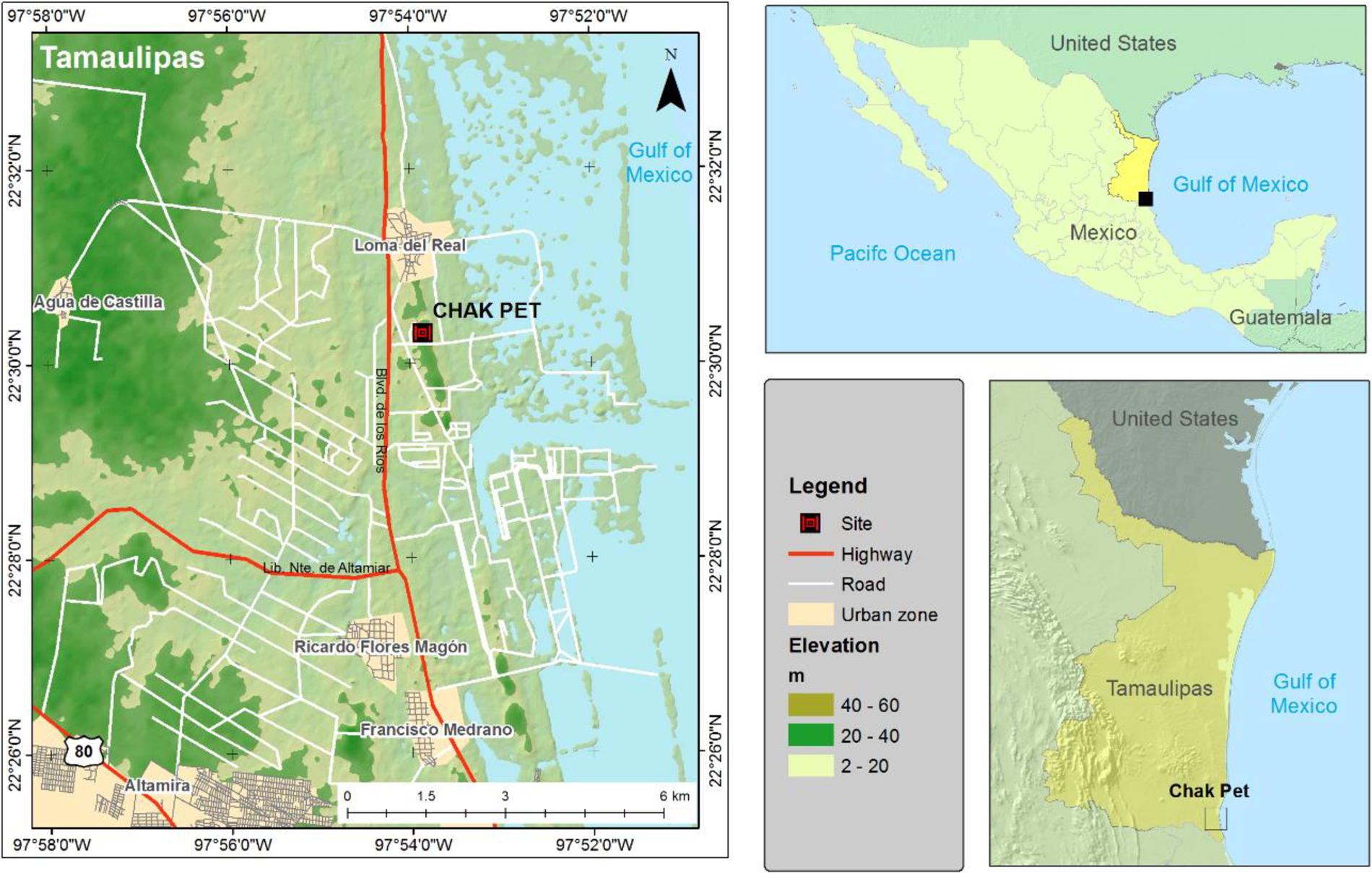
The absolute chronology for the Huasteca culture is still insufficient, which makes it extremely difficult to compare different archaeological materials. Moreover, the occupation phases are usually extensive, and thus a chronology of the spatial and temporal interactions is almost impossible to reliably correlate between different regions. Recent excavations led by the Mexican National Institute of Anthropology and History (INAH) unearthed several domestic hearths together with burned soils (floors) at the Chak Pet pre-Hispanic settlement. The site is located in the southern part of the state of Tamaulipas, between the north coast of the Gulf of Mexico and the lagoon system of the Tamesí-Pánuco Basin (Fig. 1). The available absolute dates that correspond to the Formative period occupations of the Huasteca come from some sites located in the states of Veracruz and San Luis Potosí, particularly from the Altamirano archaeological complex, while Chak Pet is, to date, the earliest intensively and extensively excavated site in Tamaulipas. The relative chronology indicated a rather continuous sequence of occupation between 900 BCE to 200 CE. During this time interval, the settlement grew in size and complexity. However, no absolute chronological data were available. We carried out a detailed magnetic mineralogy investigation on four hearths and one burned floor because these burned features have great potential for archaeomagnetic dating purposes.
ARCHAEOLOGICAL CONTEXT AND SAMPLE PROVENANCE
Archaeological surveys in the Huasteca area began toward the end of the nineteenth century. From that time and during the first half of the twentieth century, investigations focused on describing specific sites or limited zones such as the Tampico-Pánuco area (Ekholm, Reference Ekholm1944; MacNeish, Reference MacNeish1954; Ramírez, Reference Ramírez2000). For the second half of the same century, between 1978 and 1982, the first systematic regional investigation was carried out as the Huasteca Archaeological Project (Merino and García, Reference Merino and García1987). The project covered the lower basin of the Panuco River, revealing 525 pre-Hispanic settlements. Merino and García (Reference Merino and García1987) proposed the first cultural sequence based mainly on pottery analysis.
Since 1995, a greater number of systematic interventional surveys have been performed in the archaeological sites in the Huasteca region, the Tamesí-Pánuco lake basin (Ramírez, Reference Ramírez and Marchegay2016) and the Puerto Altamira areas (state of Tamaulipas). These surveys permitted the discovery of 13 archaeological sites, including Chak Pet (e.g., see Ramírez and Marchegay, Reference Ramírez and Marchegay2007, Reference Ramírez and Marchegay2008; Silva, Reference Silva2013; Ramírez, Reference Ramírez and Marchegay2016, Reference Ramírez2019).
The Chak Pet pre-Hispanic settlement is located in the southern part of the state of Tamaulipas (Fig. 1), between the north coast of the Gulf of Mexico and the lagoon system of the Tamesí-Pánuco Basin. According to different investigations carried out over 12 yr to analyze ceramics (Pérez García, Reference Pérez García2012, Reference Pérez García2014, Reference Pérez García and Marchegay2016, Reference Pérez García2020) and other cultural materials (Reza, Reference Reza2007; Domínguez, Reference Domínguez2014; Castañeda, Reference Castañeda2020), the settlement has been placed chronologically between 950 BCE and 200 CE. Márquez-Lorenzo (Reference Márquez-Lorenzo2021) characterized Thin Plain–type pottery based on materials obtained at the Chak Pet archaeological site in Altamira, Tamaulipas. Their analysis allowed them to propose a slightly different relative chronology. The temporality of this ceramic type was assigned to the end of the Tantuán III phase (100 BCE–200 CE) and the beginning of the hypothetical Coy phase (200–650 CE), that is, for some time interval between 150 and 250 CE.
Over several centuries, the settlement spread to the south, occupying both slopes of the hill, mainly to the east (Reza, Reference Reza2007; Valdovinos, Reference Valdovinos2007, Reference Valdovinos2018), denoting a population growth around 350 and 100 BCE. This hypothesis is based on the presence of clay and lime floors, hearths, waste areas, and an abundant number of human burials. Physical anthropology and bioarchaeology have already revealed some characteristics of the bioanthropological profile of the population, paleopathologies, occupational activities, and cultural practices around body modification (Velasco, Reference Velasco2010, Reference Velasco2019; Macías, Reference Macías2014, Reference Macías2015, Reference Macías2016; Valdovinos et al., Reference Valdovinos, Macías, Romero, Avila and Plata2016). During the last phase of occupation, important cultural changes occurred in the settlement. In particular, pottery was made with fine pastes, which implies manufacturing and technological improvements compared with previous cultural phases (Ramírez, Reference Ramírez2019; Márquez-Lorenzo Reference Márquez-Lorenzo2021). Burial systems also showed notable transformations (Valdovinos, Reference Valdovinos2018). Some of these changes could be linked to the arrival of migrants, probably from the Central Highlands. The occupation at Chak Pet ended around 200 CE for reasons not yet fully defined (Ramírez, Reference Ramírez2019).
The pottery analysis identified several chronological phases between 900 BCE and 200 CE. Multiple burials were located to the north of the sampled floor; these burials were composed of 12 individuals: adults, adolescents, and infants, both male and female (Hernández Manrique, Reference Hernández Manrique2020). This context may exemplify the essentially domestic character of the Chak Pet archaeological site. During the field seasons between 2018 and early 2020, archaeological exploration of the northern end of the settlement was carried out within a residential area considered to be one of the oldest of the entire occupation of the site's history. A series of floors of baked clay and lime indicated the remains of different houses on the upper part of the hill, where several hearths have subsequently been found. The color of the sandstone rocks provides evidence of direct exposure to fire, as do charcoal and ash remains inside the hearths or in their vicinity. These circular hearths with diameters of approximately 1.20 m were discovered in the open terraces on the west flank of the hill. Samples analyzed in this study belong to four hearths and one burned soil (Figs. 2 and 3). At least three hand samples oriented by magnetic compasses and leveled with plaster were collected for each structure. On average, eight small cubes (2 cm per side) were cut from each hand sample. All specimens were placed in a μ-metal shield with a magnetic vacuum inside for 20 days to diminish the potential viscous remanent magnetization.
Sampling procedure for burned floor (soil). See text for details.

Sampling of oriented samples of Hearth 2 (a) and Hearth 4 (b). See text for details.

LABORATORY MEASUREMENTS
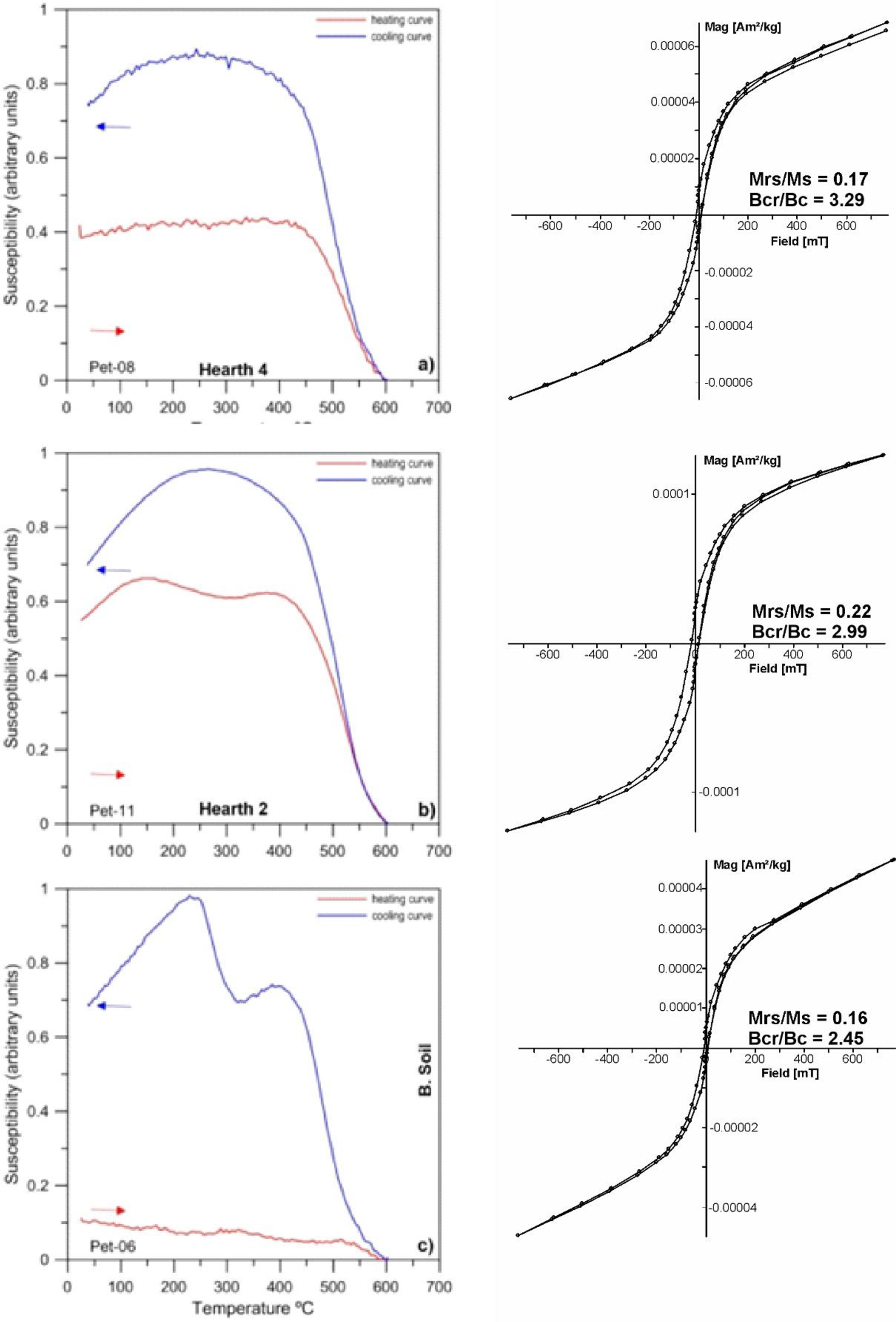
Before the magnetic treatments, we carried out susceptibility against high-temperature measurements aimed to reveal major magnetic carriers and estimate their thermal stability. Two samples per archaeological feature were selected for these experiments. Rock magnetic properties help to estimate the nature of the remanence carriers and their thermal stability. We measured magnetic susceptibility versus temperature (k-T curves) continuously. An AGICO Kappabridge (model MFK1 susceptibility meter equipped with a furnace) was used for this purpose. Approximately 1.5 g of powder was heated until 610°C, the heating rate was held at 20°C/minute, and then the powders were subsequently cooled down at the same rate. The measurements were performed in the presence of argon to reduce the possibility of oxidation during heating. The Curie temperatures were estimated using the method described in Prévot et al. (Reference Prévot, Mainkinen, Grommé and Lecaille1983). Hysteresis experiments were also carried out on all studied samples, but no relevant information was retrieved. All samples yielded evidence for pseudo–single domain ferrimagnetic grains without yielding any clues to explain such unstable thermal behavior.
Natural remanent magnetization (NRM; presumably thermoremanenence) of standard cube samples (about 8 cm3) was measured with AGICO JR5 and JR6 spinner magnetometers at the experimental facilities of the National Archaeomagnetic Service, UNAM Campus Morelia. Specimens were placed in μ−metal shield for 3 weeks to mitigate the effect of possible viscous remanence. Because the samples were not consolidated enough, we adopted alternating field cleaning to retrieve characteristic thermoremanent magnetization. Alternating field treatments with peak values of 90 mT permitted successful stepwise demagnetization of the majority of the samples using an AGICO LDA-5 AF demagnetizer. The primary magnetization component directions were determined by principal component analysis (Kirschvink, Reference Kirschvink1980); the mean directions of each independent archaeological combustion structure were computed using Fisher's statistics (Fisher, Reference Fisher1953).
Archaeointensity determination was also carried out for 12 selected samples from Hearth 4 through the Thellier-type double-heating technique (Thellier and Thellier, Reference Thellier and Thellier1959; Coe, Reference Coe1967; Coe et al., Reference Coe, Grommé and Mankinen1978). Specimens were heated and cooled in the air using an MMTD-80 Liverpool furnace with temperature steps distributed from room temperature to 560°C while the laboratory field was held at 50 μT. Because the samples were fragile, virgin (not heated and not demagnetized) fragments were broken into at least six specimens and pressed into salt pellets to facilitate their treatment as standard paleomagnetic cores.
MAIN RESULTS AND DISCUSSION
Essentially three types of behaviors are observed on continuous thermomagnetic curves. Type 1 was observed for five out of eight analyzed samples a single ferrimagnetic phase with a Curie point around 565°C, compatible with titanium-poor titanomagnetite (Fig. 4a). However, the cooling and heating curves are rather irreversible, probably due to the relatively low magnetic susceptibility signal and the magneto-chemical changes that may have occurred at high temperatures. Type 2, when two ferrimagnetic phases are observed on two samples during heating (Fig. 4b), was observed in other samples. The first phase is not clearly defined and shows a susceptibility drop around 190°C, while the second phase was observed at a temperature close to the temperature characteristic for magnetite or for extreme end-members of titanomagnetite solid solutions. This behavior can be interpreted as the coexistence of titanomaghemites and titanomagnetites (almost magnetite). During the cooling cycle, a single magnetic phase is observed for type 2 samples. Type 3 is observed only for one of the burned soil samples (Fig. 4c) that is marked with extreme irreversibility between heating and cooling cycles. The neoformation of magnetic minerals, most probably from nonmagnetic organic material during heating, is evident, judging from the thermomagnetic curve. Similar behavior was described by Minyuk et al. (Reference Minyuk, Subbotnikova and Plyashkevich2011) and attributed to the presence of goethite with or without sulfur. It is quite possible that these samples were not heated above 600°C and consequently did not carry thermoremanent magnetization. All associated hysteresis cycles (Fig. 4) are quite simple, yielding similar hysteresis parameters (Mrs/Ms ranges between 0.16 and 0.22, while Bcr/Bc ranges from 2.99 to 3.45) defining pseudo–single domain magnetic structure. It is true that the hysteresis loop for the burned soil sample (Fig. 4c) is slightly potbellied (Tauxe et al., Reference Tauxe, Mullender and Pick1996). However, whether this form may be due to the coexistence of two magnetic phases with different coercivities remains unclear.
Representative magnetic susceptibility vs. temperature curves for Hearths 2 and 4 and burned soil. The red (blue) branch corresponds to the heating (cooling) cycle. Also shown are associated hysteresis loops recorded using variable field translation balance.
Burned soil specimens (Fig. 5) showed nonuniform NRM demagnetization patterns. Characteristic remanent magnetization directions could only be retrieved for 10 out of 27 treated specimens. In many specimens, no primary components could be determined because of concave curves with no defined linear segments (see examples in Fig. 5a and b). Remaining burned soil specimens presented a single and stable paleomagnetic component, pointing toward the origin. More than two-thirds of the original magnetization was removed by applying fields of 70 mT (Fig. 5c and d).
Representative vectorial (Zijderveld) plots for burned soil samples obtained from the alternating field demagnetization process. Both accepted (c, d) and rejected (a, b) diagrams are illustrated. NRM, natural remanent magnetization.

Magnetic behavior of the samples belonging to hearths appears to be less complex (Fig. 6). In total, mean paleodirection could be determined for 7 specimens from Hearth 2 and 12 from Hearth 4. A few specimens belonging to Hearth 4 presented a strong magnetic overprint that was successfully removed by applying a 20 mT peak alternating field (Fig. 6a and b). The individual determinations of the characteristic component (ChRM) are usually based on 7 to 10 points (in two cases with only 4 aligned points), yielding maximum angular deviation between 0.3° and 2.2°. Figure 7 illustrates the magnetic behavior of additional unsuccessful samples due to the chaotic and unstable demagnetization patterns (sample 99P023a) and evidence of strong magnetic overprint (sample 99P013a). We tried to demagnetize the maximum number of samples using alternating field, because the thermal treatment was not feasible due to the unconsolidated material. It is true that paleointensity experiments involving heating were also intended, but in this case, small specimens were embedded in salt pellets, and thus the original orientation cannot be guaranteed.
Representative vectorial (Zijderveld) plots for hearth samples obtained from the alternating field demagnetization process. NRM, natural remanent magnetization.

Additional representative examples of unsuccessful samples (see text for more details). NRM, natural remanent magnetization.

Mean paleodirections obtained for burned soil are Dec = 352.1°, Inc = 29.1°, α95 = 6.3°, k = 62 (Fig. 8, Table 1). Hearth 2 provided Dec = 4.3°, Inc = 22.1°, α95 = 1.7°, k = 1299; while Hearth 4 yielded Dec = 346.6°, Inc = 35.2°, α95 = 3.3°, k = 178. The confidence cone values for the hearth paleodirections are reasonably well grouped and are higher for the burned soil (Fig. 8). For dating purposes, we choose the time interval between 1000 BCE and 500 CE, based on the available age of the pottery style and radiocarbon dates. Both available local paleosecular reference curves (Mahgoub et al., Reference Mahgoub, Juárez-Arriaga, Böhnel, Manzanilla and Cyphers2019; García-Ruiz et al., Reference García-Ruiz, Goguitchaichvili, Pavón-Carrasco, Soler, Pérez-Rodríguez, Osete and Kravchinsky2022) show the paucity of directional data obtained from well-dated burned archaeological artifacts between 1000 BCE and 500 CE. The recent global geomagnetic models SHAWQ2K and SHAWQ-Iron Age (Campuzano et al., Reference Campuzano, Gómez-Paccard, Pavón-Carrasco and Osete2019; Osete et al., Reference Osete, Molina-Cardín, Campuzano, Aguilella-Arzo, Barrachina-Ibáñez, Falomir-Granell and Foix2020) are of different age intervals. Thus, we used the model SHA.DIF.14k and MATLAB software from Pavón-Carrasco et al. (Reference Pavón-Carrasco, Rodríguez-González, Osete and Torta2011, Reference Pavón-Carrasco, Osete, Torta and De Santis2014) for our site's coordinates.
Equal area projection of mean archaeomagnetic directions for studied hearths and burned soil.
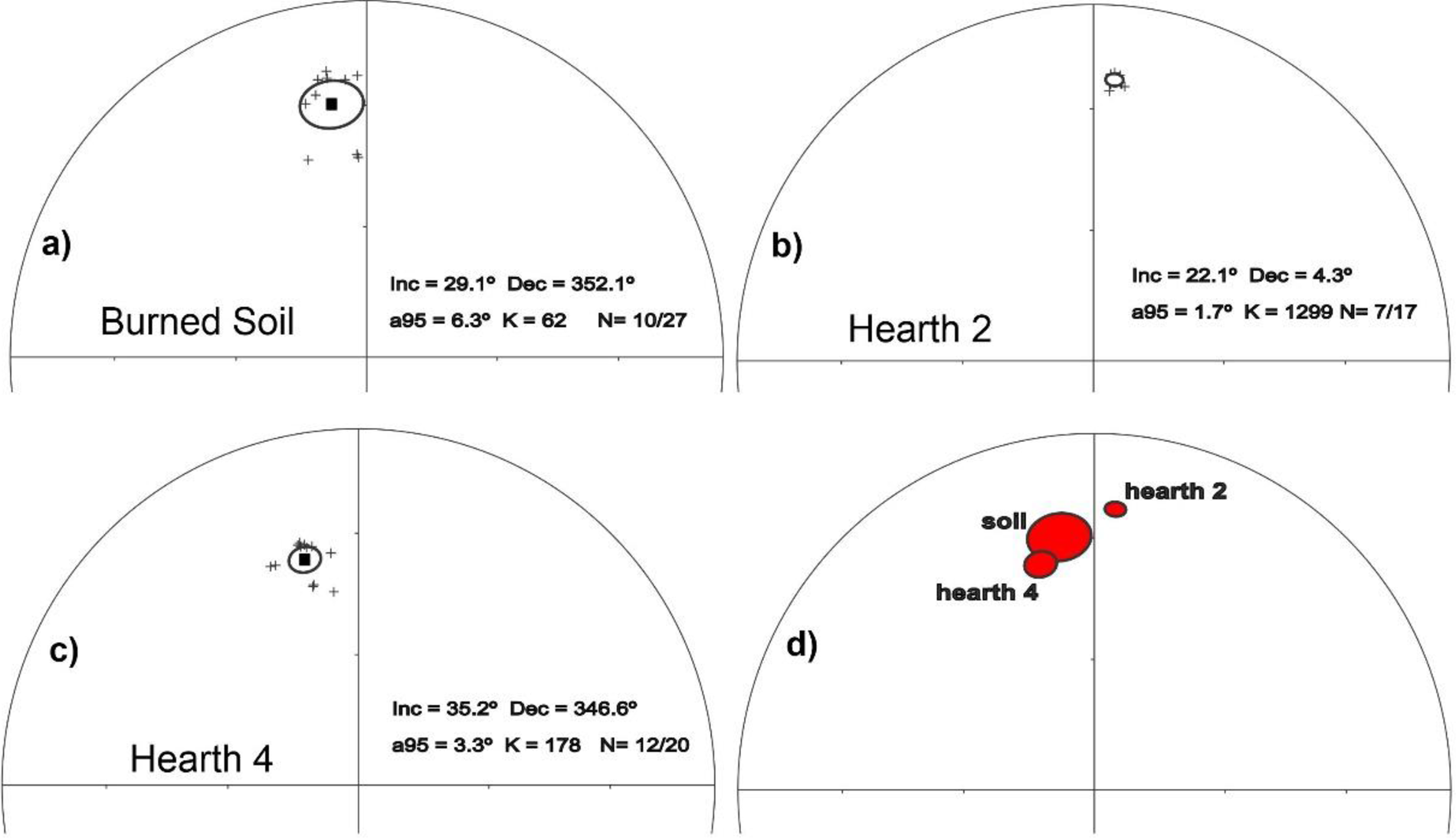
Mean directions with their respective confidence parameters of Fisher statistics for each analyzed structure.

We selected 12 samples of type 1 susceptibility versus temperature behavior and having mostly a single-component magnetization for absolute paleointensity. Unfortunately, no single determination was considered to have technical quality high enough to meet the minimum acceptance criteria. The principal cause of rejection resides in typical concave-up behavior (probably due to multidomain grains) and partial thermoremanent magnetization (pTRM) checks (Fig. 9).
Natural remanent magnetization (NRM) lost vs. thermoremanent magnetization (TRM) gained plots (so-called Arai-Nagata plots) for representative samples.

Our new chronological results in the Huasteca are supported by few absolute ages. The most recent published data correspond to monumental sites of regional importance such as Tamtok and Vista Hermosa, both located mainly toward the last pre-Hispanic period, the Postclassic (Córdova and Martínez, Reference Córdova, Martínez and Marchegay2016; Stresser-Péan and Pereira, Reference Stresser-Péan and Pereira2017; Martínez et al., Reference Martínez, Gendron, Calligaro, Stresser-Péan and Ladrón de Guevara2021). However, the period of occupation of the vast majority of the sites continues to be supported by a relative chronology based on the ceramic typology (Ekholm, Reference Ekholm1944; García, Reference García1982; García and Merino, Reference García and Merino2004; Castañeda, Reference Castañeda, Merino and García2005). The typology of figurines is also usually correlated with ceramics. In this sense, the work of Ekholm (Reference Ekholm1944) and, more recently, Gómez (Reference Gómez and Marchegay2016) and Gómez and García (Reference Gómez and García2016) represents the most important contributions to the regional-level studies (see also Marchegay, Reference Marchegay and Zaragoza Ocaña2009, Reference Marchegay, Orr and Looper2014).
Despite the fact that the most complete cultural sequence is provided by García and Merino (Reference García and Merino2004) for the northern Huasteca region, the clear differences in the materials require new absolute dates to chronologically locate the settlements (not just monumental sites) within a stratigraphic sequence and to contribute to the comparisons of the different archaeological materials, such as ceramics and anthropomorphic figurines. A large number of anthropomorphic figurines have been recovered in Chak Pet. Some figurines correspond to already known types, while others are of very different styles than those from other sites on the coastal plain (Marchegay, Reference Marchegay, Orr and Looper2014, Reference Marchegay, Stresser-Péan and Ladrón de Guevar2021; Gómez, Reference Gómez and Marchegay2016; Gómez and García, Reference Gómez and García2016).
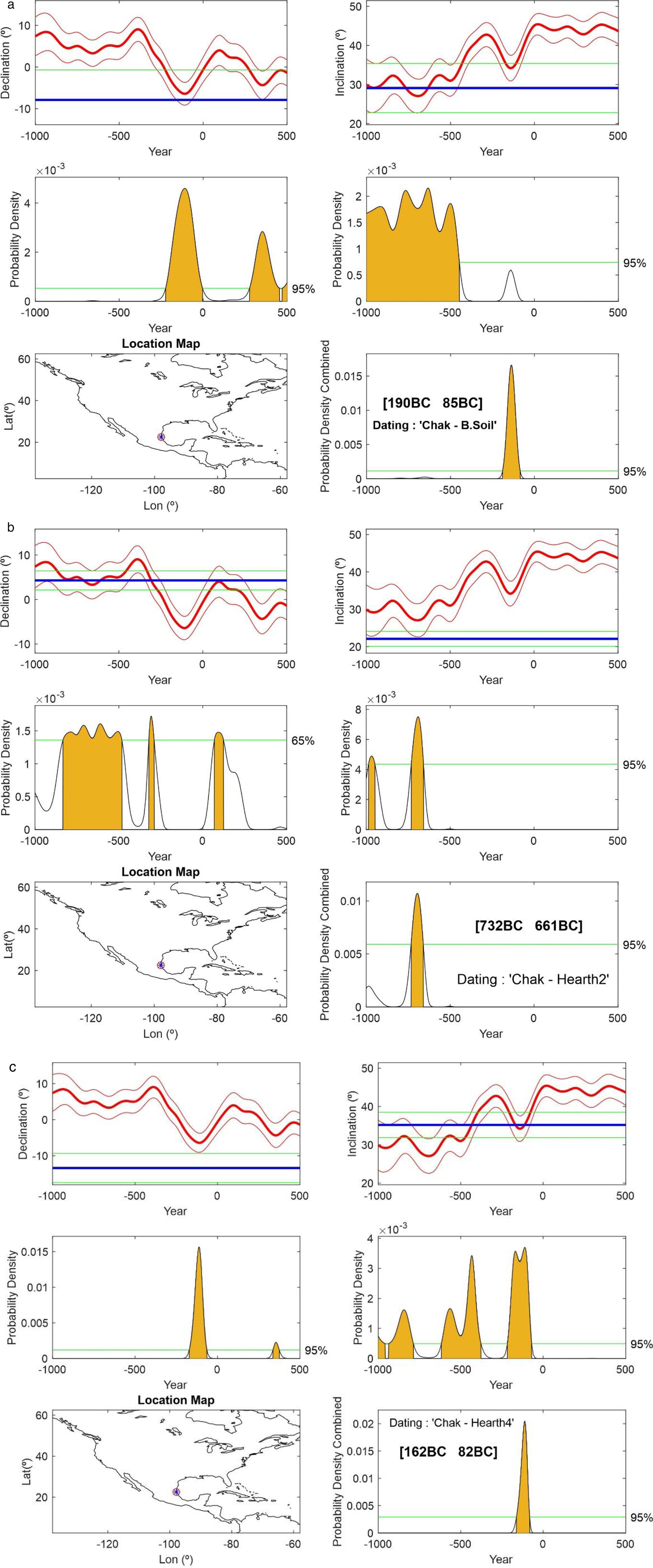
Our new archaeomagnetic age intervals (Fig. 10) for Chak Pet allow us to chronologically locate the origin of this settlement from the Middle Formative period (so-called Tampaón phase) until the Late Formative (Tantuán II phase). We compiled all available radiocarbon datings to create a regional-scale chronological framework associated to cultural phases for reference (Fig. 11). Archaeomagnetic dates are in accordance with the ceramic analysis of Pérez García (Reference Pérez García2012). The Tampaón phase was proposed initially based on a radiocarbon date obtained at the Hv-24 Altamirano site in the Huasteca region of Veracruz (Merino and García, Reference Merino and García1987). On the other hand, the Tantuán I phase is based on five absolute dates, while Tantuán II is supported by nine radiocarbon dates belonging to the same settlement (García and Merino, Reference García and Merino2004). Regarding the dates obtained in Chak Pet, the baked clay floor provided an interval from 190 to 85 BCE, corresponding to the Tantuán II phase (350–100 BCE). However, our archaeomagnetic dates do not match the dates based on stratigraphic location of the site and associated materials (Pérez García, Reference Pérez García2012, Reference Pérez García and Marchegay2016, Reference Pérez García2020), which indicate the Tampaón phase (900–650 BCE) or Tantuán I (650–350 BCE). The explanation may be that the last burning of the floor that we dated occurred during the Tantuán II phase. Regarding Hearth 2, our dating yielded an age interval from 732 to 661 BCE, corresponding to the second half of the Tampaón phase. Hearth 4 gave an age interval between 162 BCE and 82 BCE, the Tantuán II stage. The geostatistical analysis of the ceramic materials allows us to tentatively establish an empiric correlation between the absolute chronology of these hearths and some of the pottery types (Chila Blanco, Prisco Negro, Red Ware Painted) that correspond to the Tampaón, Tantuán I, and Tantuán II phases (Pérez García, Reference Pérez García2012, Reference Pérez García and Marchegay2016, Reference Pérez García2020).
Most probable age intervals derived from SHA.DIF.14k global geomagnetic model (Pavón-Carrasco et al. Reference Pavón-Carrasco, Osete, Torta and De Santis2014) based on declination and inclination for (a) burned floor (soil), (b) Hearth 2, and (c) Hearth 4. We used the MATLAB tool reported in Pavón-Carrasco et al. (Reference Pavón-Carrasco, Rodríguez-González, Osete and Torta2011).
Compilation of all published radiocarbon dating at the regional scale and related cultural phases for the Huastec area (Merino and García, Reference Merino and García1987; García and Merino, Reference García and Merino2004; Córdova and Martínez, Reference Córdova, Martínez and Marchegay2016; Stresser-Péan and Pereira, Reference Stresser-Péan and Pereira2017; Martínez et al., Reference Martínez, Gendron, Calligaro, Stresser-Péan and Ladrón de Guevara2021).

At the regional scale, 35 sites located along the Moctezuma-Pánuco river system were identified as belonging to the Tampaón phase (Merino and García, Reference Merino and García1987; García and Merino, Reference García and Merino2004). In this sense, Chak Pet joins a small number of early settlements that, due to their geographic positions, continue the range of settlements on the northern coast of the Gulf of Mexico. The similar cultural traits shared between the Hv-24 Altamirano and Chak Pet sites offer the opportunity to generalize the comparative studies inside and outside the Huasteca toward the Gulf Coast and the southeast. At the local level, the dated archaeological elements are associated with both ceramic types and different sets of burials, providing the guidelines for fine-tuning their chronological and stratigraphic positions.
New chronological constraints allow us to estimate the time intervals when ceramic technology changes occurred. The same is true for the diversity of burial systems and the appearance of new raw materials. Thus, we may estimate the manner in which the interaction between the coastal sites and those located on the plain areas occurred. New dates allow more reliable comparisons between the sites in the lower Pánuco River basin and those located in the Pánuco-Tamesí area. As for the dates obtained at Chak Pet, the burned floor provided an interval from 190 to 85 BCE, while Hearth 4 gave an age range between 162 and 82 BCE, both within the Tantuán II phase (350–100 BCE). The spatial relationship of both features allows us to argue that they are part of the same historical moment, representing the northernmost expansion of the occupation for that phase. As for Hearth 2, our dating yielded an age interval of 732 to 661 BCE, corresponding to the Tampaón phase (900–600 BCE). This result is consistent with the archaeological evidence, particularly with the diagnostic ceramic types. The close spatial location of the dated elements (floor and two hearths) does not contradict these results; the geostatistical analysis of ceramic types for each phase allows us to make the following observations: (1) an empirical correlation exists between the absolute chronology of Hearth 2 and various ceramic types (Heavy Plain and Chila) corresponding to the Tampaón phase (900–600 BCE), present in the lower strata of the extreme north of the site (Pérez García, Reference Pérez García2012, Reference Pérez García2020); 2) There is an empirical correlation between the absolute chronology of the burned floor and Hearth 4 with the materials of the Tantuán II phase, located at the eastern and south slopes of the settlement (Reza, Reference Reza2007; Pérez García, Reference Pérez García2012, Reference Pérez García2020, Valdovinos, Reference Valdovinos2017).
CONCLUDING REMARKS
A comprehensive archaeomagnetic survey was performed on four domestic hearths and a burned floor at the Chak Pet archaeological site in state of Tamaulipas (Gulf of Mexico).
Three types of thermomagnetic behavior were detected for Chak Pet samples while Ti-titanomagnetite, titanomaghemite, and goethites are responsible for remanent magnetization. The most characteristic feature is a marked thermal instability and irreversibility between heating and cooling segments detected for most of studied samples making them unsuitable material for retrieving archaeointensity data.
Although burned clays are considered ideal archaeomagnetic targets, in our case, characteristic magnetization can be determined on only 29 out of 87 specimens. The low success rate is related to the samples’ magnetic instability and rather chaotic demagnetization patterns.
Mean paleodirections obtained for burned soil are Dec = 352.1°, Inc = 29.1°, α95 = 6.3°, k = 61 (Fig. 7). Hearth 2 provided Dec = 4.3°, Inc = 22.1°, α95 = 1.7°, k = 1299; while Hearth 4 yielded Dec = 346.6°, Inc = 35.2°, α95 = 3.3°, k = 179.
Paleointensity determination on 12 specimens using the Thellier-type double-heating technique (Thellier and Thellier, Reference Thellier and Thellier1959) was completely unsuccessful due to well-defined concave-up behavior.
New possible archaeomagnetic age intervals for Chak Pet permit us to chronologically locate the origin of this settlement within the time interval of the Middle Formative period to the Late Formative period locate the origin of this settlement from the Middle Formative period until the Late Formative stages in accordance with pottery analysis.
Dated archaeological elements are associated with both ceramic types and variations in burial forms, providing the guidelines for fine-tuning their chronological and stratigraphic positions.
Acknowledgments
This work was supported by the DGAPA-PAPIIT grant no. IN101920 no. and Conahcyt grant no. CF1761. This study was partially funded by the Natural Sciences and Engineering Research Council of Canada for VK (NSERC grant RGPIN-2019-04780). AG is grateful for the support provided by UNAM-DGAPA for his sabbatical fellowship.



