INTRODUCTION
The identification of stocks for protection and management is a key objective of conservation genetics (Allendorf et al., Reference Allendorf, Luikart and Aitken2007). Management units (or ‘stocks’ in fisheries genetics) are generally defined as populations that substantially differ in their allelic frequencies, but do not exhibit long-term evolutionary isolation (Moritz, Reference Moritz1994).
Commercially exploited species usually experience marked population decline due to overfishing and/or degradation of their natural habitat. In addition, they become more sensitive to stochastic demographic changes (e.g. sex ratio), environmental changes (e.g. drought), and genetic changes (e.g. genetic drift, endogamy) due to reduced evolutionary potential as a result of loss of genetic diversity (Frankhan, Reference Frankham, Ballou and Briscoe2004; Allendorf et al., Reference Allendorf, Luikart and Aitken2007). Therefore, the quantification of genetic diversity as well as understanding of the patterns and extent of genetic structure of endangered/overexploited populations is crucial for developing effective management strategies (Moritz, Reference Moritz2002; Laikre et al., Reference Laikre, Palm and Ryman2005; Allendorf et al., Reference Allendorf, Luikart and Aitken2007; Palsbøll et al., Reference Palsbøll, Berube and Allendorf2007; Ovenden et al., Reference Ovenden, Berry, Welch, Buckworth and Dichmont2013).
Genetic analysis using highly variable molecular markers can provide important information on the genetic structure of populations, especially when combined with robust statistical approaches (Palsbøll et al., Reference Palsbøll, Berube and Allendorf2007; Chowdhury et al., Reference Chowdhury, Tanti, Rethy and Gajurel2014). However, regarding the choice of a specific molecular marker, one must not only consider the goal of the study, but also other issues related to accessibility and viability of techniques which are important aspects (Britto et al., Reference Britto, Mendes, Ogawa, Cintra and Diniz2011). In this context, molecular markers such as inter simple sequence repeats (ISSRs) have proved useful for solving a number of genetic problems in Crustacea, such as investigations on the genetic diversity and detection of genetic structure, especially in fine geographic scale (Schulz et al., Reference Schulz, Smietana and Schulz2004; Pannacciulli et al., Reference Pannacciulli, Manetti and Maltagliati2009; Ungherese et al., Reference Ungherese, Mengoni, Somigli, Baroni, Focardi and Ugolini2010; Britto et al., Reference Britto, Mendes, Ogawa, Cintra and Diniz2011; Fernandez et al., Reference Fernández, Maltagliati, Pannacciulli and Roldán2011; Eimanifar & Wink, Reference Eimanifar and Wink2013).
Popularly known as land blue crab Cardisoma guanhumi (Latreille, 1828) is a terrestrial crab belonging to the family Gecarcinidae (Decapoda: Crustacea) and it is distributed along the US Atlantic Coast from the Florida state in the USA to Santa Catarina in southern Brazil (Ferreira et al., Reference Ferreira, Mourão, Rocha, Nascimento and Bezerra2009). These crabs are known to inhabit the higher portions of the mangrove ecosystem, in open fields with tall grasses, and continental coastal forests, and they are not found at distances greater than 5 km from the shoreline (Gifford, Reference Gifford1962; Wolcott & Wolcott, Reference Wolcott and Wolcott1987; Pinder & Smits, Reference Pinder and Smits1993). Furthermore, Cardisoma guanhumi lives in burrows and exhibits a strong site-fidelity behaviour and rarely take up new builds or burrows (Forsee & Albrecht, Reference Forsee and Albrecht2012). The dispersion of this species over long distances is mainly dependent on the planktonic larval stage (mean of 23–47 days of larval stage; Costlow & Bookhout, Reference Costlow and Bookhout1968a, Reference Costlow and Bookhoutb; Abrunhosa et al., Reference Abrunhosa, do Nascimento Mendes, de Brito, de Oliveira, Ogawa and Ogawa2000).
Being considered as an important economic resource, Cardisoma guanhumi is heavily exploited as food and is freely sold at fairs, restaurants, and roadsides. Among fishing communities, the fishery activity of the land blue crab has a strong sociocultural appeal through the generation of jobs and income in the coastal areas of Brazil (Barboza et al., Reference Barboza, Neumann-Leitão, Barboza and Batista-Leite2008; Firmo et al., Reference Firmo, Tognella, Silva, Barboza and Alves2012). In recent decades, Cardisoma guanhumi has experienced a sharp population decline by overfishing owing to the loss and/or degradation of habitat (Amaral & Jablonski, Reference Amaral and Jablonski2005; Rodríguez-Fourquet & Sabat, Reference Rodríguez-Fourquet and Sabat2009). Studies have shown that in areas where fishing is allowed, many populations are classified as juveniles suggesting their low survival rate (Botelho et al., Reference Botelho, Santos and Souza2001; Govender et al., Reference Govender, Sabat and Cuevas2008; Shinozaki-Mendes et al., Reference Shinozaki-Mendes, Silva, Santander-Neto and Hazin2013). Besides, Cardisoma guanhumi has been found to be sensitive to changes in the water quality resulting from the discharge of domestic effluents, industrial or agricultural effluents, and aquaculture (Galli et al., Reference Galli, Fujimoto and Abrunhosa2012).
Cardisoma guanhumi has delivered a strong call for scientific research aimed at its conservation, because it is an important economic resource and is included in the National List of Threatened Species as critically endangered (IBAMA, 2014). A study using a partial fragment of the control region of mitochondrial DNA has revealed a lack of genetic structure in this species and satisfactory genetic variation among local samples from the coast of Brazil (Oliveira-Neto et al., Reference Oliveira-Neto, Pie, Chammas, Ostrensky and Boerger2008). However, analyses with markers derived from distinct regions of the genome may provide additional knowledge on the genetic diversity and structure of this species (Benevides et al., Reference Benevides, Vallinoto, Fetter Filho, de Souza, Silva-Oliveira, Freitas, Ferreira, Hostim-Silva, Bertoncini, Blanchardi and Torres2014). It has been reported that ecological factors can vary on a microgeographic scale and affect the patterns of genetic structure among the populations of estuarine species (Bilton et al., Reference Bilton, Paula and Bishop2002). Therefore we tested for the hypothesis of the lack of genetic structure and for the low level of genetic variation in Cardisoma guanhumi in a smaller geographic scale. Such information is very important for sustainable exploitation of the species given the genetic variation and the evolutionary processes to support it are the most important factors to be conserved (Moritz, Reference Moritz2002). Specifically the present study aimed to (i) inspect the level of Cardisoma guanhumi genetic diversity (potential adaptive/evolutionary) along a system of tropical mangroves on the coast of the state of Pernambuco (North-eastern Brazil); (ii) test the absence of genetic structure on a microgeographic scale over the mangroves studied; (iii) use the results to suggest possible ways of conserving this species and regulating its exploitation in this mangrove system and provide a model for assessing the genetic basis for the conservation of this species in other systems of mangroves around the world.
MATERIALS AND METHODS
Sampling and study area
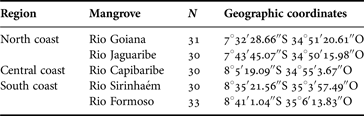
An average of 30 adult specimens of Cardisoma guanhumi were collected for each one of the five mangroves sampled (Figure 1; Table 1) with the aid of local fishermen during July 2012. The sampled mangroves are as close as possible to the shoreline of Pernambuco and had a minimum distance of 10 km and maximum of 150 km in order to represent different environmental constitutions and levels of conservation. The mangroves sampled were the estuary of the rivers Goiana, Jaguaribe (both in northern coast), Capibaribe (central coast), Sirinhaém and Formoso (both in south coast). The level of conservation was determined using the information of the Agência Estadual de Meio Ambiente do Estado de Pernambuco (CPRH/PE) (CPRH, 2010).
Map of Brazil highlighting the state (dark) and the coast of Pernambuco and the five sampled mangroves (geometric figures). The hatched fields indicate those mangroves located in Environmentally Protected Areas (APAs in Portuguese).

Number of specimens of C. guanhumi (N) sampled in each mangrove along the coast of Pernambuco, with the geographic coordinates and regions.

NORTH COAST
In the last three decades, the Goiana and Jaguaribe mangroves had suffered a reduction in 43.3% in their areas (Figure 1; Table 1). The Jaguaribe mangrove is considered well maintained and was recently included in the Environmental Protection Area (APA), Santa Cruz (CPRH, 2010).
CENTRAL COAST
The mangrove of the Capibaribe River estuary is located in the metropolitan area of the state capital of Pernambuco (Recife) (Figure 1; Table 1). The area has only a few patches of vegetation (CPRH, 2010).
SOUTH COAST
Being included in the Environmental Protection Area of Guadalupe (APA), Sirinhaém and Formoso mangroves are well maintained (Figure 1; Table 1). The Formoso mangrove has reef barriers near the shoreline, which ensures low amplitude of tides and provides conditions favouring the growth of vegetation and fauna in this area. As a result, this area has been included in the Environmental Protection Area of the Coral Coast, APA (Ferreira & Maida, Reference Ferreira and Maida2006).
Molecular analysis
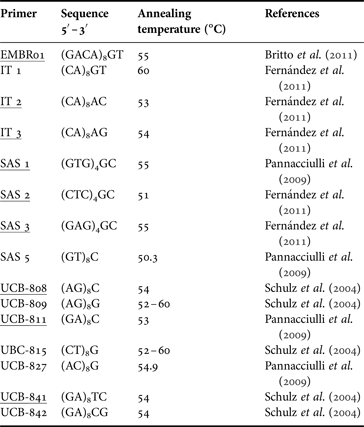
For DNA extraction, samples (about 2 cm3) of muscle tissue were taken from the last pereopod in a non-lethal manner and all applicable international, national and/or institutional guidelines for the care and use of animals were followed. The total DNA was extracted using the phenol-chloroform method as described by Sambrook & Russell (Reference Sambrook and Russell2001) and modified by Almeida et al. (Reference Almeida, Fungaro and Sodré2001). Based on the literature on the genetic diversity in crustaceans, 15 ISSR primers types were chosen (Table 2). The primers were tested using PCR on three specimens of each population randomly selected to identify the potential for amplification and reproducibility and also to determine the most polymorphic primers, as recommended by Nelson & Anderson (Reference Nelson and Anderson2013). A preliminary screening allowed identification of informative and reliable primers, which were selected and amplified in the remaining samples.
Primers tested in the ISSR literature and their respective sequences from which they were selected. The primers chosen for this study are underlined.

The PCR reactions followed the procedures suggested by Benevides et al. (Reference Benevides, Vallinoto, Fetter Filho, de Souza, Silva-Oliveira, Freitas, Ferreira, Hostim-Silva, Bertoncini, Blanchardi and Torres2014). The reactions were accompanied by a negative control comprising all the reaction components, except the DNA. The amplification products were subjected to electrophoresis on a 1.8% agarose gel, and the size of the fragments were estimated by comparison with 1-kb DNA ladder marker (Amresco). The samples were run adjacent to each other in the gel to reduce the standard error due to delays in the migration of the fragments during electrophoresis.
Statistical analyses
In the present study, the patterns displayed by the ISSRs were converted into a binary matrix (0 – absence of fragments and 1 – presence), and only fragments that were well resolved were recorded.
The genetic diversity of Cardisoma guanhumi was estimated globally and for each sampled mangrove by Nei's genetic diversity (h) (Nei, Reference Nei1978) using the POPGENE software (Yeh et al., Reference Yeh, Yang and Boyle1999) as well as by calculating the percentage of polymorphic loci (P), considering the total number of loci observed as 100%. The software STATISTICA V.7.0 (Statsoft, 2004) was used to test whether the levels of genetic diversity significantly differed among Cardisoma guanhumi in the five studied mangroves. The indices of genetic diversity of Nei (h) were subjected to analysis of variance (ANOVA), and all statistical assumptions of normality and homoscedasticity of the data was used. To test for the statistical significance among the differences of the percentage of polymorphic loci (P) the g test (Sokal & Rohlf, Reference Sokal and Rohlf1981) was used.
For the detection of loci under selection, differential tests of neutrality from the F ST outlier method implemented in Mcheza software was performed, which allowed identification of locus-specific effects generated by natural selection or genetic drift (Antao & Beaumont, Reference Antao and Beaumont2011). Under the default parameters, Mcheza was run three times with 500,000 simulations. For each locus, Mcheza plots the estimated F ST value against its heterozygosity (He) value. The function ‘Neutral mean F ST’ was used to determine a first candidate subset of selected loci in order to remove them from the computation of the neutral F ST. F ST values above the expected values were considered to be the candidate loci under directional selection. Thus, we examined (i) the existence of loci under positive selection and (ii) the effect of possible loci under positive selection in the genetic and evolutionary relationships among populations of Cardisoma guanhumi in the mangroves studied. The allelic frequencies of the candidate loci under positive selection were obtained using ARLEQUIN 3.5.1.2 software (Excoffier & Lischer, Reference Excoffier and Lischer2010).
The parameters of population genetics of Analysis of Molecular Variance (AMOVA), global ΦST, pairwise F ST, Nm (number of migrants per generation – gene flow) and Bayesian structuring were carried out in two rounds: (a) with the entire set of markers obtained and (b) with only the neutral marker (no outliers loci). This strategy were used to test whether differentiation observed was due to positive selection over some specific loci or whether it represents differences in the genome as a whole.
The parameters of population genetics of Nm were obtained using POPGENE software (Yeh et al., Reference Yeh, Yang and Boyle1999) both overall and those pairwise among the sampled Cardisoma guanhumi. The hierarchical patterns of the population structure were explored through the AMOVA (Excoffier et al., Reference Excoffier, Smouse and Quattro1992) using the software ARLEQUIN 3.5.1.2 (Excoffier & Lischer, Reference Excoffier and Lischer2010). Furthermore, three fixation indices were calculated (intraspecific fixation index variance (ΦST), fixation rates between groups (ΦCT), and fixation rates within groups (ΦSC)). For this analysis, the populations were grouped in two ways as follows: (i) all into one group and (ii) the datasets were partitioned into two regions defined geographically, namely, north central coast and south coast (the latter structure was tested according to the pattern observed using MDS analysis). Linear regression analysis between ΦST and geographic distances was performed using BioEstat 5.0 software (Ayres et al., Reference Ayres, Ayres-Júnior, Ayres and Santos2007) to test the hypothesis of genetic evolutionary isolation by distance. The geographic distances between the mangroves were estimated from the contour of the coast of Pernambuco using the Google Earth platform (Google Inc., 2013). For all statistical analyses, we adopted a significance level of 5%.
A Bayesian structuring analysis was conducted to infer the pattern of population structure, and the number of possible genetic K-populations was determined through STRUCTURE 2.3.3 software (Pritchard et al., Reference Pritchard, Wen and Falush2003). For each value of ‘K’ (1–10) 10 runs were performed and 100,000 burn-in interactions computed, followed by 1,000,000 Monte Carlo Markov Chain simulations (MCMC). The ‘K’ with the highest Delta K was chosen. Furthermore, Multidimensional Scaling (MDS) analysis was conducted to understand the structure of the data according to their spatial distribution in two and three dimensions. This test was also performed in two rounds (a) with the entire set of markers obtained and (b) only with the neutral loci (no outliers loci). The software PRIMER v.6 (Clarke & Gorley, Reference Clarke and Gorley2006) was used to group the samples according to the mangroves and region of origin (North/Central/South coast) from a matrix of Euclidean distance.
RESULTS
Genetic diversity and neutrality of the ISSR markers
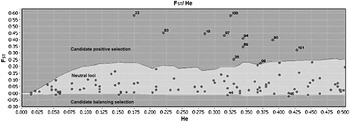
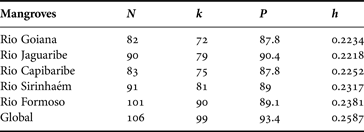
Nine primers were selected from the 15 ISSRs. These nine primers amplified 106 loci ranging from 300 to 2000 bp, as shown in Figure 2. Of these loci, 99 and 7 were polymorphic and monomorphic, respectively, indicating a polymorphism (P) of 93.4% and Nei's genetic diversity index (h) of 0.2587 for Cardisoma guanhumi in the coast of Pernambuco (Table 3). Despite the variation in the absolute values of P and h at each of the populations analysed (Table 3), the differences between all these populations were not statistically significant (P = 0.967 and P = 0.927, respectively). Furthermore, the genetic marker used generated a unique genomic fingerprint for each specimen. Among the 106 loci, 11 candidate loci exhibited positive selection or linked to genes under selection, suggesting that the allele frequencies were differentially distributed between the north (loci 99 and 94), central (loci 93, 99 and 101), and south coast regions (loci 23, 26, 89, 90, 97 and 100) (Figure 3; Table 4).
Electrophoretic profile in 1.8% agarose gel with the primer EMBR01 exemplifying polymorphisms between specimens of Cardisoma guanhumi. L = 1-kb DNA ladder; CA = mangrove of Capibaribe River; GO = mangrove of Goiás River; JA = mangrove of Jaguaribe River; SH = mangrove of Sirinhaém River; RF = mangrove of Formoso River.

F ST values for those loci under positive selection at the populations of Cardisoma guanhumi. The loci are represented by circles, and the legend indicates positive selection, neutral selection and balancing selection.

Genetic diversity observed in C. guanhumi in each studied mangrove.

N = total amplified loci in a mangrove; k = total number of polymorphic loci; P = percentage of polymorphic loci; h = Nei's genetic diversity.
Frequencies (decimal numbers) of loci (tenth and hundredth numbers) under selection and the F ST values for each of the loci under selection in studied populations of C. guanhumi.

a Highest values of the allele frequencies for each loci.
Population genetics
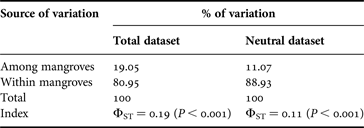
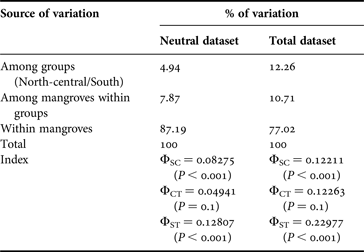
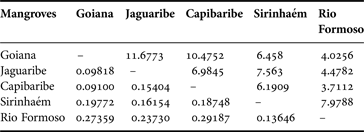
The global diversity revealed that the highest percentage of variation was found within populations (80.95%) and only 19.05% was observed among populations, with a global fixation index (ФST) of 0.19 (P < 0.01; Table 5). A smaller but a significant ФST value was obtained only at the neutral loci (ФST = 0.11) (P < 0.01; Table 5). The AMOVA for the entire dataset considering the two geographic groups (north-central coast/south coast) indicated no significant differences between the two groups (ФCT = 0.12; P = 0.1) (Table 6). The species exhibited an overall gene flow (Nm) of 3.8 migrants by generation. The F ST pairwise comparisons ranged from 0.09 to 0.29, while the Nm values ranged from 3.7 to 11.6 for the entire dataset (Table 7).
Analysis of the molecular variance for C. guanhumi in the mangroves studied.

ФST indicates the degree of genetic structuring among the mangroves studied based on the neutral dataset and total dataset. P = statistical significance.
Measures of population differentiation of C. guanhumi based on AMOVA for two groups (North-central/South) throughout the state of Pernambuco based on the neutral dataset and total dataset.

ФCT = Index of fixation of genetic variation among the mangroves of the same group; ФST = Index of fixation of genetic variation within mangroves; ФSC = Index of fixation of genetic variation among groups/regions (North-central/South); P = statistical significance.
Pairwise F ST (below diagonal) and Nm (above diagonal) values observed in C. guanhumi in the mangroves studied based on the total dataset (P < 0.001).

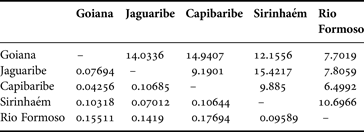
The pairwise FST comparisons ranged from 0.04 to 0.17, while the Nm values ranged from 6.4 to 15.4 for the neutral dataset (Table 8).
Pairwise F ST (below diagonal) and Nm (above diagonal) values observed in C. guanhumi in the mangroves studied, based on the neutral dataset (P < 0.001).

The Bayesian population structure considering all loci revealed two genetic populations (K = 2). The first population primarily consisted of Cardisoma guanhumi from the mangroves of the north and central coast. The second population was mainly composed of Cardisoma guanhumi from the mangroves of the south coast (Figure 4A). Evaluation of the Bayesian structure considering only the neutral loci showed the same pattern of K = 2 (Figure 4B). In addition, a cline type of population structure genetically more similar to those in the nearest mangroves was also noted. The extent of participation of individuals in the composition of these two clusters increased and then decreased from north to south, and vice versa. This pattern was also revealed in the multidimensional scaling using all loci (Figures 5A & 6A) (stress = 0.25) and only those neutral loci (Figures 5B & 6B).
Bayesian structuring showing the existence of two genetic populations of Cardisoma guanhumi (K = 2) geographically structured along the mangroves studied. (A) based on the total dataset and (B) neutral dataset. Each vertical bar represents each of the 154 analysed individuals and their lengths the proportion of each genetic profile. Group 1 (North-central regions) is represented in dark grey and Group 2 (South region) is shown in light grey.

MDS graphs (two-dimensional) of genetic distances of Cardisoma guanhumi along the regions studied. (A) Total dataset, note the north-central/south regional division, and (B) neutral dataset, with some overlap. The geometric figures in the legend indicate the region source of specimens.

MDS graphs (two-dimensional) of genetic distances of Cardisoma guanhumi along the mangroves studied. (A) Total dataset, and (B) neutral dataset. The geometric figures in the legend indicate the mangrove source of specimens.

Linear regression analysis performed among ФST and the average geographic distance (km) indicated an effect of the geographic distance (km) on the genetic differentiation (ФST) considering the whole dataset (P = 0.02; R 2 = 0.4629). However, when considering only the neutral data no significant correlations with the geographic distance (R 2 = 0.18; P = 0.2) were found. Comparison of the results obtained when using all loci with those measured only at the loci considered neutral revealed a reduction in the observed genetic differentiation among populations and regions when the loci under selection were removed (Figures 4–6).
DISCUSSION
Genetic diversity and population structure of Cardisoma guanhumi
The overall genetic diversity observed by ISSR markers in Cardisoma guanhumi from the coast of Pernambuco was considered high (Table 3). This level was found to be similar to that observed along the Brazilian coast using a partial fragment of the control region (Oliveira-Neto et al., Reference Oliveira-Neto, Pie, Chammas, Ostrensky and Boerger2008) and 12S gene (mitochondrial DNA). The percentage of polymorphic loci observed in Cardisoma guanhumi (P = 93.4%) was significantly higher than those reported for other species (Ucides cordatus; Ocypodidae (ISSR: P = 80%; Britto et al., Reference Britto, Mendes, Ogawa, Cintra and Diniz2011); Artemia urmiana; Artemiidae (ISSR: P = 65.8%; Eimanifar & Wink, Reference Eimanifar and Wink2013)). Similarly, the Nei's genetic diversity index for Cardisoma guanhumi was high (Table 1; h = 0.2587), when compared with the average genetic diversity observed in other species of crustaceans (h = 0.088; Ward et al., Reference Ward, Skibinski and Woodwark1992) and other commercially exploited shellfish species (Aristaeomorpha foliacea (ISSR: h = 0.1; Fernández et al., Reference Fernández, Maltagliati, Pannacciulli and Roldán2011); and Tesseropora atlantica, Chthamalus stellatus (ISSR: h = 0.12; Pannacciulli et al., Reference Pannacciulli, Manetti and Maltagliati2009)). Despite the evidence of Cardisoma guanhumi population reductions due to overfishing and habitat loss (Amaral & Jablonski, Reference Amaral and Jablonski2005; Govender et al., Reference Govender, Sabat and Cuevas2008; Rodríguez-Fourquet & Sabat, Reference Rodríguez-Fourquet and Sabat2009; IBAMA, 2014), greater adaptive potential (genetic variation) of Cardisoma guanhumi was identified from this tropical mangrove system, when compared with other shellfish equally exploited and/or living in affected areas. Besides, no significant differences were found between the levels of genetic diversity of the species in each sampled mangrove, despite the different levels of conservation observed among the mangroves from the north and central (most affected), and south (less affected) coastlines. This species has been diagnosed as resilient in terms of abundance faced with transformations on their natural habitat (Govender et al., Reference Govender, Sabat and Cuevas2008; Oliveira-Neto et al., Reference Oliveira-Neto, Batista, Metri and Metri2014). The results obtained in the present study reinforce the status of resilient Cardisoma guanhumi and attest a good conservation status of the species on the coast of Pernambuco.
The data rejected the hypothesis of panmixia in favour of a heterogeneous distribution of genotypes of Cardisoma guanhumi, suggesting a fine-scale pattern of genetic structuring. The overall ФST (ФST = 0.19; P < 0.01; Table 6) indicated a high differentiation (0.15–0.25; Hartl & Clark, Reference Hartl and Clark2010). The parameter F ST (or its analogue ФST) assumes neutrality of the loci analysed, and in the case of any loci experiencing selection, the estimates generated by these parameters enhanced the differences among the populations (Luikart et al., Reference Luikart, England, Tallmon, Jordan and Taberlet2003). The pairwise F ST values supported the hypothesis of high differentiation and suggested a cline-based structuring among the Cardisoma guanhumi from mangroves from the North and central coasts, when compared with those from the south coast of Pernambuco. The magnitude of gene flow was clearly higher among the north and central coastal regions than that on the south coast of Pernambuco. This pattern was further reinforced by different cluster analyses developed herein (Figures 4B, 5B & 6B), revealing a genetic division of the central-north/south coasts. This evidence also suggested population isolation by distance (IBD) and it was reinforced by the positive correlation between ФST and geographic distance considering all the loci observed.
In general, IBD has been categorized as a less common type of isolation between the populations of various species and it is determined by an increase in differentiation among populations with increasing geographic distance, thus limiting dispersion (low gene flow) and mainly affecting the neutral genetic variation (Wright, Reference Wright1943; Nosil et al., Reference Nosil, Funk and Ortiz-Barrientos2009; Sexton et al., Reference Sexton, Hangartner and Hoffmann2014). However, the apparent pattern of IBD detected in the present study did not appear to be consistent because the species showed high gene flow throughout the regions studied (Tables 7 & 8). Furthermore, there was no correlation between the geographic distance and the ФST values when analysing only the neutral set of data. This suggested that other forces besides the geographic distance have contributed to the genetic differentiation noted.
Natural selection and management units: perspectives on exploitation/conservation of Cardisoma guanhumi
Natural selection can act in opposite directions on the ends of a geographic area and generate a pattern of geographic cline, resembling IBD. The detection and distribution of the loci under selection (Figure 3; Table 4) as well as the correlation between geographic distances and ФST values considering all loci suggested this pattern of geographic cline mediated by selection in Cardisoma guanhumi along the coast of Pernambuco. Such a pattern has been shown in several populations of marine organisms (Hellberg et al., Reference Hellberg, Burton, Neigel and Palumbi2002). Furthermore, the different loci under positive selection in Cardisoma guanhumi along the mangroves of north-central (markers 99 and 93, 94, 101, respectively; Table 4) and south (markers 23, 26, 89, 90, 97, and 100; Table 4) coasts and the clear genetic structuring in north-central/south coasts revealed by Bayesian structure (Figure 4) reinforce the idea that those populations might be experiencing different selective pressures. Previous studies have demonstrated that microsatellite loci (harbours for ISSR markers) can be fixed under positive selection (Vasemägi et al., Reference Vasemägi, Nilsson and Primmer2005; Pampoulie et al., Reference Pampoulie, Ruzzante, Chosson, Jörundsdóttir, Taylor, Thorsteinsson and Marteinsdóttir2006) in a scenario of disparate selective pressures (Case et al., Reference Case, Hutchinson, Hauser, Van Oosterhout and Carvalho2005). Furthermore, patterns of population isolation have been detected by means of differential selection mediated by different ecosystems (Cooke et al., Reference Cooke, Chao and Beheregaray2012, Reference Cooke, Landguth and Beheregaray2014). Thus, the data obtained in the present study point to the phenomenon of isolation by the environment (IBE) in which high gene flow allows the genetic variations from a locality be present in another, but their frequency is mediated by their adaptive value in certain environmental circumstances favouring genetic structure (Cooke et al., Reference Cooke, Chao and Beheregaray2012; Shafer & Wolf, Reference Shafer and Wolf2013).
Genetic studies on exploited invertebrate populations have failed to detect genetic structure between the seemingly isolated populations or populations from different environments (Oliveira-Neto et al., Reference Oliveira-Neto, Pie, Chammas, Ostrensky and Boerger2008). Previous studies have found regions of the genome that may be influenced by natural selection, which can result in a large genetic differentiation among fishery stocks, despite the neutral loci indicating absence of genetic differentiation (Vasemägi et al., Reference Vasemägi, Nilsson and Primmer2005; Pampoulie et al., Reference Pampoulie, Ruzzante, Chosson, Jörundsdóttir, Taylor, Thorsteinsson and Marteinsdóttir2006). Such differentiation should be considered since the populations that differentiated are the result of adaptation to different habitats once the interbred individuals might not be adapted to either environment (Frankham et al., Reference Frankham, Ballou and Briscoe2004).
The portions of species that differ from others by exhibiting genome sections under selection are known as management units (Moritz, Reference Moritz1994). Accordingly, the present study suggests that the populations of Cardisoma guanhumi along the north-central and south coasts of Pernambuco might be considered as different management units and should be managed independently. Such a suggestion is supported by the finding of candidate loci under positive selection. Furthermore, the evidence on the significant differentiation between Cardisoma guanhumi along the coast of Pernambuco raise the need for other population studies, including differential gene expression and ecological data. These approaches could test for the hypotheses proposed in this study and could allow the identification of a more complete scenario of biological differentiation and local adaptation, as previously observed in other organisms (Cooke et al., Reference Cooke, Chao and Beheregaray2012). Morphological (Duarte et al., Reference Duarte, Maia-lima and Molina2008) and reproductive (Botelho et al., Reference Botelho, Santos and Souza2001; Shinozaki-Mendes et al., Reference Shinozaki-Mendes, Silva, Santander-Neto and Hazin2013) differences have been described for species in different localities, and broad information on the genetic structure (effective population size), survival rate, age at first maturity, and data on the exploitation of the populations may help in the development of strategies for the conservation of species in the long term. The prohibition of fishing at the mangroves that export settlers to other areas or activities of reintroduction and translocation (Allendorf et al., Reference Allendorf, England, Luikart, Ritchie and Ryman2008; Ovenden et al., Reference Ovenden, Berry, Welch, Buckworth and Dichmont2013) are possible examples of those mentioned strategies to conserve the populations of C. ganhumi. Such strategies are paramount because fishing of a particular species is totally dependent on their natural stocks and exhaustion of such stocks will lead to serious ecological and sociocultural impacts.
ACKNOWLEDGEMENTS
The authors are grateful to Drs Ralph Schwamborn, Marcelo Vallinoto, Uedson Jacobina, Flávia Andrade, Tainá Ottoni and Rita de Cassia Moura for their valuable comments on the original manuscript.
FINANCIAL SUPPORT
The authors thank CNPq and FACEPE for the financial support. R. A. Torres is particularly grateful to CNPq for the research fellowship provided (Grant Nos 306 099/301 208 and 2011-0/2012-3). This study is a contribution of inctAmbTrop – Brazilian National Institute of Sciences and Technology for Tropical Marine Enviroments CNPq/FAPESB Grants 565054/2010-4 and 8936/2011.