Hamas's boycott of the 1996 election to the Palestinian Legislative Council is more readily understood than its decision to participate in the 2006 election; Hamas is infamous for its suicide operations, it has consistently rejected the Oslo Accords of which the Palestinian National Authority and Palestinian Legislative Council are products, and still calls for the destruction of Israel. Hamas's strategic turnaround and participation in the 2006 elections therefore merits analysis, not least when considering the expected moderating effect of participation on radical parties and the importance of political parties for democracy and democratization processes (Randall and Svåsand Reference Randall and Svåsand2002; Schwedler Reference Schwedler2007; Stokes Reference Stokes1999). While the extant literature offers explanations as to why and how Hamas won the 2006 election (Chehab Reference Chehab2007; Shamir and Shikaki Reference Shamir and Shikaki2010: 132; Shikaki Reference Shikaki2006), the decision to replace boycott with participation remains unexplained.
To analyse Hamas's changing electoral strategy, theories of party behaviour and party change will be employed, as the analytical frameworks provided by these theories offer well-grounded explanations of radical party change (Harmel and Janda Reference Harmel and Janda1994; Panebianco Reference Panebianco1988; Strøm Reference Strøm1990). Although it is controversial to analyse Hamas as a political party because of its terrorist operations, its employment of such tactics is insufficient to disqualify it as a political party; a range of political parties have resorted to terrorism for various reasons.Footnote 1 Rather, it should be noted that Hamas has consistently called for municipal elections and participated in elections to professional associations, student councils and labour unions (Hroub Reference Hroub2006a: 6). As such, Hamas is a ‘political movement that presents at elections, and is capable of placing through elections, candidates for public office’, and thus qualifies as a political party according to Sartori's influential definition (Reference Sartori1976: 57). Furthermore, Hamas conducts most of the functions assigned to political parties: it generates symbols of identification and loyalty, thereby simplifying choice for and mobilizing voters; it recruits and nominates political leaders; it articulates and aggregates political interests; and it has organized both majority and coalition governments (Dalton and Wattenberg Reference Dalton and Wattenberg2000: 5–10; Gunther and Diamond Reference Gunther and Diamond2001: 7–8).
In addition to the explanatory power of party change theories, a theoretically grounded analysis avoids the essentializing approaches that often taint studies of political phenomena in the Arab world. The tendency has been to focus on the exceptional, producing an abundance of idiosyncratic, sub-par – and often politicized – knowledge (Khalidi Reference Khalidi1995; Said Reference Said1978). Applying established theories on new cases through context-sensitive analyses, however, promises both valid explanations and added confidence to the theories. The goals of the analysis therefore conform to the interpretative and theory-confirming case studies described by Lijphart (Reference Lijphart1971: 692), as it aims to explain Hamas's changing electoral strategy through established theories. Methodologically, the single unit, diachronic case study method described by Gerring (Reference Gerring2004: 343) is adopted. By explicitly making use of variables suggested by relevant theories, the number of potential explanatory factors is minimized, revealing co-variation on variables that might explain why Hamas changed its strategy from 1996 to 2006. In addition to secondary data collected from the scholarly literature on Hamas, the analysis also draws on a number of interviews with Palestinian scholars, commentators and associated and high-ranking Hamas cadres conducted on the West Bank in 2007 and 2011.
Party Change: Theoretical Perspectives
Despite the recent convergence among party theories, such as the softened requirements of rationality and the recognition that both organizational and structural factors affect party behaviour (Montero and Gunther Reference Montero and Gunther2002), the literature still suffers from two shortcomings: an absence of a unifying theoretical framework, and the literature's heavy bias towards Europe (Erdmann Reference Erdmann2004; Gloppen and Rakner Reference Gloppen and Rakner2007; Gunther and Diamond Reference Gunther and Diamond2003). While complementary theories dealing with different aspects of political parties constitute a ‘cumulative theory’, alleviating the lack of an overarching theory (Montero and Gunther Reference Montero and Gunther2002: 16–19), the European bias poses potentially serious challenges when party theories are applied elsewhere. This bias leads to a presumption that parties operate in relatively stable environments with a certain degree of predictability – qualities that the volatile and conflict-prone environment in which Hamas operates lacks. Employing party theories to investigate Hamas's changing electoral strategy therefore risks conflating and reducing the theories’ analytical value by stretching both intention and range (Collier and Mahon Reference Collier and Mahon1993).
While most party theories are developed for the analysis of parties in advanced democracies, they nevertheless contain elements relevant for the study of political parties in nascent democracies (Erdmann Reference Erdmann2004). And, from the plethora of theoretical approaches offered in the literature, the analytical framework proposed by Harmel and Janda (Reference Harmel and Janda1994) is intended to analyse exactly the type of fundamental strategic change that Hamas achieves by replacing boycott with participation. While staying alert to the potential challenges of theoretical stretching, this framework will be employed to analyse Hamas's changing strategy.Footnote 2
Harmel and Janda's theory rests on a slightly modified version of Strøm's behavioural theory of parties (1990), adding a fourth ideal party type to his three: (1) the vote-seeking party that aims to ‘maximize . . . electoral support for the purpose of controlling the government’; (2) the office-seeking party, whose primary goal is to win control of office;Footnote 3 (3) the policy-seeking party that has policy implementation as its primary goal, preferring to ‘stay true’ over winning votes or office; and (4) the intraparty democracy maximization party identified by Harmel and Janda (Reference Harmel and Janda1994: 269–71) – which aims to express and pursue the (changing) goals of its members. While admitting that ‘[p]ure vote seekers, office seekers, or policy seekers [or intraparty democracy seekers] are unlikely to exist’ (Strøm Reference Strøm1990: 570), the theories posit that parties are (soft) rational actors, and that the balance between different strategic aims determines party behaviour. By postulating that strategic aims dictate party behaviour, the theories avoid the spatial and temporal limits of Eurocentric theories, and are thus suited to travel to the occupied Palestinian territories and analyse Hamas (Wolinetz Reference Wolinetz2002: 163–4).
It is assumed that parties are conservative organizations, and consequently that ‘[p]arty change does not “just happen”’ (Harmel and Janda Reference Harmel and Janda1994: 261). Rather, altered party behaviour is a consequence of a reprioritizing of strategic aims, brought about by one or more of the following explanatory variables: external stimuli or shock; change of dominant faction(s); and change of party leader.Footnote 4 Of these, external stimuli and shocks are expected to be the salient initiators of change. While an adaptation to minor environmental challenges might be accommodated by an existing leadership, more serious challenges and shocks can bring about intraparty competition and lead to a change of leadership and/or the emergence of a new dominant faction – which in turn can produce dramatic changes in party behaviour (Harmel and Janda Reference Harmel and Janda1994: 267; Panebiano 1988: 243–4).Footnote 5 Again, given the volatile and unpredictable political conditions in the occupied Palestinian territories, environmental challenges often cited as producing party change such as electoral defeat are considered too narrow for Hamas. Instead, the analysis will focus on factors such as the Israeli occupation, the deteriorating security, political and economic conditions in the occupied territories and intra-Palestinian struggle. Resembling the effect that the fall of the Berlin Wall and the Soviet Union had on communist parties throughout Europe, such factors are expected seriously to affect both Hamas's organization and its strategy.
The Organization and The Environment
As Hamas is a complex organization, a short descriptive outline is called for to understand its strategic aims and behaviour better. A brief overview of the volatile environment in which Hamas operates is also needed to grasp the challenges facing the party.
History and Organizational Outline of Hamas
On the eve of the first intifada (uprising) in 1987, the Palestinian Muslim Brotherhood was under increasing pressure from its own rank and file to change its non-violent modus operandi and take active part in the uprising. Participating under its own banner, however, would put its wide network of welfare institutions at risk of repercussions by Israel. Hedging its bets, the Brotherhood therefore established Hamas as its armed proxy. Created to fight independently in the intifada but covertly in service of the Brotherhood, Hamas would allow the Brotherhood to claim credibly that it did not employ violent tactics and thus avoid reprisals from Israel, while also responding to the demands to join the intifada (Abu-Amr Reference Abu-Amr1993; Gunning Reference Gunning2008: 38–9; Mishal and Sela Reference Mishal and Sela2000: 35–7).
Hamas became popular because of its pivotal role in the intifada, and expanded rapidly. The party established local offices and regional headquarters on the West Bank and Gaza, a prisoners’ committee representing its members in Israeli captivity and a presence in Palestinian refugee camps abroad. In the course of a few years it had grown to become one of the most powerful Palestinian movements, and by 1992 it had surpassed the Brotherhood as the leading Palestinian religious political movement. Hamas eventually inherited the Brotherhood's network of welfare institutions and supplemented military operations with social work (Gunning Reference Gunning2008: 39; Knudsen Reference Knudsen2005: 1382–4).Footnote 6
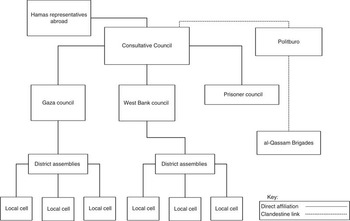
The diversification of operations and rapid expansion strained Hamas's bureaucratic capacity. In response, the topmost political body in Hamas, the Consultative Council, established a politburo in 1992. It was tasked with fundraising, foreign policy and the day-to-day management of Hamas, whereas the Consultative Council remained in charge of the overarching issues. In an attempt to shield the political leadership from the inevitable Israeli repercussions following military operations, Hamas established the al-Qassam Brigades in 1991–2 as the party's armed wing (Gunning Reference Gunning2008: 47; Mishal and Sela Reference Mishal and Sela2000: 156, 162; Tamimi Reference Tamimi2007: 75). The organizational layout of Hamas has changed throughout the party's existence; Figure 1 is a schematic representation of Hamas's most important sub-units in the years relevant for the analysis.
Hamas organogram
Source: Interviews with various Hamas members.

As the organization grew and important responsibilities were delegated to the external politburo, internal legitimacy and cohesion became at risk. Drawing on the Islamic tradition of shura, or consultation, Hamas introduced vertically inclusive decision-making procedures rather than leaving important decisions to the powers that be. Such intraparty democracy enhances the legitimacy of any one decision and can facilitate membership discipline. However, it can also lead to factionalism, a tendency that has been exacerbated because the branches of Hamas operate under different conditions, with high degrees of autonomy in an unpredictable environment.Footnote 7
The Environment
The three most important environmental factors affecting Hamas are domestic political actors, primarily represented by the Palestinian National Authority, the Palestine Liberation Organization (PLO), Fatah; certain international sponsors with limited but determining influence on Hamas; and Israel.
After the Six-Day War in 1967, Israel occupied the Gaza Strip and the West Bank. Despite immense international pressure on Israel to end the occupation, for example through a number of United Nations Security Council Resolutions, the occupation continues to define the conditions in the occupied Palestinian territories. Political and economic development have been curbed by a proliferation of Israeli settlements carving the occupied territories into disconnected enclaves, by tight Israeli control over import and export from the territories and by the arbitrary detention of Palestinian political activists. In times of upheaval, region-wide curfews have been put into effect, and the Israeli Defense Forces have assassinated Palestinian leaders (Gunning Reference Gunning2008: 226; Roy Reference Roy1999). In sum, Israel dictates the conditions in the occupied territories, and its changing policies and military interventions produce environmental challenges and shocks that seriously affect Hamas.
Hamas is also influenced by domestic actors, primarily the PLO. Long dominated by the Fatah party and its late leader Yasir Arafat, the PLO is the internationally recognized representative of the Palestinian people. Illustrative of its importance, the PLO has observer status in the UN General Assembly, and it was the PLO that signed the Oslo Accords on behalf of the Palestinians, thereby ending the first intifada and establishing the Palestinian National Authority as the Palestinian proto-state.Footnote 8 Although the Palestinian National Authority was nominally an independent political entity, it was cadres and guerrillas from Fatah and the PLO that filled its political positions and bureaucracy and formed the backbone of its security forces – in effect recreating the Palestinian National Authority as their own tool (Abu-Amr Reference Abu-Amr1997; Usher Reference Usher1996). This Fatah–PLO–Palestinian National Authority nexus is a formidable political force in the occupied territories, and is – apart from Israel – the most influential actor vis-à-vis Hamas.
There are also certain international actors wielding a limited but decisive influence over Hamas. Hamas's allies and sponsors include Iran, Syrian branches of the Muslim Brotherhood and private benefactors from the Gulf (Gunning Reference Gunning2008: 46, 226–7). While Hamas receives funding, military equipment and training from some of these, there is no evidence to support allegations that it operates as a proxy for any third party (Milton-Edwards and Farrell Reference Milton-Edwards and Farrell2010: 224–5). Having a number of sponsors means that none of them is indispensable, leaving Hamas with a high degree of autonomy vis-à-vis its patrons (Panebianco Reference Panebianco1988: 35–6, 55–9). Hamas's manoeuvrability has at times nevertheless been restricted by policies in the host country of its politburo, which in turn has had implications for the power balance within the movement (McGeough Reference McGeough2010).
Such a complex and unstable environment is expected to affect party stability negatively, since it ‘increases uncertainty and produces diversification among the [party's] internal groups’. This can produce ‘greater conflict over differences in political strategies’ among the internal groups – which in turn leads to factionalism (Panebianco Reference Panebianco1988: 205). It is further hypothesized that factionalism increases the likelihood of party change, as it can undermine the stability of the dominant coalition (Harmel and Janda Reference Harmel and Janda1994: 279).
Boycott
While Hamas's boycott of the 1996 elections to the Palestinian Legislative Council was anticipated, the decision merits analysis to better understand the radical strategic turnaround and participation in the 2006 elections. This section will outline some of the ideological, strategic and tactical reasoning behind the boycott.
Absolutist Ideology and Policy-seeking Strategy
Hamas's 1988 charter presents its goals and methods through five chapters and 36 articles, all underpinned by Islamist ideology, with references to conspiracy theories, and including racist allegations. The charter proclaims Hamas's ultimate goal as being to raise ‘the banner of Allah on every inch of Palestine’, and that attempts to solve the conflict with Israel through negotiation are futile. Instead, the charter asserts that ‘[t]here is no solution to the Palestinian Problem except by Jihad’.Footnote 9
The violent and vocal opposition to Israel, the denunciation of negotiations and the refusal to forgo any territorial claims were initially important sources of legitimacy for Hamas. Arguing that the PLO sold out the Palestinian national project by signing the Oslo Accords in 1993, Hamas gained followers not only from the religious segments of the population, but also from those who opposed the negotiations for nationalistic reasons (Kristianasen Reference Kristianasen1999: 22; Mishal and Sela Reference Mishal and Sela2000: 67–8; Usher Reference Usher1995: 68–9). By refusing to ‘[r]ecognise the Zionist existence [or c]ede . . . part of Palestine to the Zionist entity’,Footnote 10 Hamas positioned itself firmly in opposition to the incipient talks between the PLO and Israel. As is expected from a young, radical party, Hamas prioritized staying true to its stated aims rather than compromising on its ideology, thus closely resembling the policy-advocacy ideal party in the typology of Harmel and Janda (Reference Harmel and Janda1994; see also Panebianco Reference Panebianco1988: 17–20).
Faced with the option of participating in conventional politics, Hamas had to weigh the benefits of a participatory strategy against the loss of legitimacy and popularity such a move would entail. Hamas's raison d’être had been the intifada, and its legitimacy hinged largely on its condemnation of the negotiations between Israel and the PLO, coupled with violent resistance. Participation in elections to any Palestinian National Authority institution would in effect mean retracting its stated aims while at the same time lending credibility to negotiations that Hamas vehemently opposed. Hamas calculated that participating would be perceived as compromising on its overarching ideology, and that such a compromise would lead to loss of legitimacy and support (Mishal and Sela Reference Mishal and Sela2000: 127). As succinctly summarized by a Hamas cadre, it opted for boycott because ‘[t]he election in 1996 was seen by Hamas as a referendum over Oslo’, and Hamas's boycott was its ‘no vote’.Footnote 11 Participation implied acceptance of the Oslo Accords and thus negotiations with Israel, and Hamas was not ready to sacrifice fundamental parts of its ideology for uncertain electoral gains.
By boycotting the elections, Hamas avoided ideological compromise and thereby minimized the risk of alienating its followers. Prima facie, then, Hamas's boycott of the elections is unsurprising. However, when Hamas members explain the boycott, they often conveniently overlook Hamas's lack of support at the time of the election. Despite the increased popularity Hamas enjoyed by steadfastly opposing the negotiations with Israel in the early 1990s, it could never challenge the hegemony of Fatah. And, although important for its close adherents, Hamas's continued rejection of the Oslo Accords eventually pushed followers away as optimism for a future solution spread in the occupied territories. Support for Hamas consequently declined from a record 16 per cent in 1994 to only 6 per cent in 1996 (CPRS 2000). With insufficient support to gain any real influence, there were no incentives for an overly ideological party to run in elections (Mishal and Sela Reference Mishal and Sela2000: 129). As summed up by a Hamas minister: ‘[the] reasons for boycotting the 1996 elections was [the] Oslo Agreement [and that] the Islamic Movement [Hamas] would not gain too much [sic] seats’.Footnote 12
Intraparty Democracy and Factional Dominance
Despite these straightforward reasons to boycott, Hamas seriously considered running in the elections. A year before the first Oslo Agreement was signed, a document circulated among Hamas members inviting ‘knowledgeable people’ to voice their opinions so that ‘a decision acceptable to the widest possible basis of [their] ranks’ could be taken. The question was whether Hamas should participate in elections that ‘might be held in the [West] Bank and the [Gaza] Strip’.Footnote 13 The letter and ensuing discussion underline the strong position of intraparty democracy in Hamas. Although Hamas's leaders both outside and inside the occupied Palestinian territories stress the unity and coherence of the organization, tension between the branches frequently arises. This is particularly true with regard to important issues such as the question of electoral participation (Gunning Reference Gunning2008: 40–1; Mishal and Sela Reference Mishal and Sela2000: 163–6).
This intraparty competition is partly a result of the mentioned inclusive consultative processes in Hamas, which, combined with the volatile environment, might lead to factionalism (Gunning 2008: 110–11; Harmel and Janda Reference Harmel and Janda1994: 269; Panebiano 1988: 51). Contributing to this tendency is the organizational design of Hamas, with its branches on the Gaza Strip, on the West Bank, in refugee camps abroad, the prisoners’ committees, the overarching consultative council, the exiled politburo and the al-Qassam Brigades. Power struggles between the branches emerge and intensify partly because they operate under widely different conditions: Israel frequently targets the Gaza wing; the West Bank wing, those in the refugee camps abroad and the prisoners’ committees are fragmented and at times marginalized; while the external leadership is largely out of reach of Israeli persecution (ICG 2004: 11).Footnote 14 Because the internal leaders are vulnerable to Israeli repercussions, they carefully consider the merit of any military action, and many of the leaders there advocate political participation as a strategic supplement to violent resistance. As the external leaders rarely suffer the inevitable repercussions from Israel, they have traditionally been more inclined towards military actions (Gunning Reference Gunning2008: 212; Hroub Reference Hroub2000: 59; Kristianasen Reference Kristianasen1999: 29, 35, n. 33; Mishal and Sela Reference Mishal and Sela2000: 166).
While the Gaza leadership initially called the shots within Hamas, they came under extreme pressure in the early 1990s when the Israeli Defense Forces imprisoned and deported hundreds of leaders and activists (Cardi Reference Cardi2010: 111). At the time of the first election to the Palestinian Legislative Council, it was therefore the politburo in Amman that wielded the most influence. Together with the al-Qassam Brigades, it constituted the dominant coalition at the time. Both were opposed to electoral participation, and together they shared enough organizational power to overrule the participatory strategy advocated by some of the domestic political leaders, thus keeping Hamas out of the elections (Gunning Reference Gunning2008: 112; Hroub Reference Hroub2000: 59; ICG 2006: 5–6; Mishal and Sela Reference Mishal and Sela2000: 88, 152, 163).
The ideological argument was that Hamas should not join ‘a system they hoped to replace for the sake of coexistence with a state they hoped to destroy’ (ICG 2006: 5–6) – that is, to join the political system was tantamount to forfeiting its opposition against negotiations and thereby defaulting on its aim to liberate historic Palestine. This, it was argued, would lead to a loss of support and a subsequent decrease of Hamas's influence. Although this appealed to ideology and legitimacy, another likely reason for the politburo and the military commanders advocating the boycott was a shared concern for power and positions. If political participation superseded armed resistance, many of the al-Qassam commanders would be rendered redundant. And if Hamas participated in elections, it would be the domestic cadres that ran as candidates and reaped the political benefits, gaining organizational influence at the expense of the external leadership (ICG 2004: 6).Footnote 15
It is important to underline that the division was never a simple hardliner outside vs. soft-liner inside dichotomy. While Hamas co-founder Sheikh Ahmed Yasin advocated participation, others, such as West Bank Hamas leader Bassam Jarrar, argued against (quoted in Cardi Reference Cardi2010: 121). As discussed, there were multiple other reasons for Hamas to boycott. In the end, however, the dominance of the politburo and the al-Qassam commanders is considered crucial for the outcome of the internal referendum.Footnote 16 In line with the theoretical expectations, Hamas's strategic aim of intraparty democracy, combined with the composition of its dominant coalition and its preference for ideology-advocacy over votes or office, helps explain the decision to boycott (Panebianco Reference Panebianco1988: 17–20; Strøm Reference Strøm1990: 577).
Participation
This section will show that Hamas came to replace boycott with participation after environmental challenges first disrupted the power balance within Hamas, and certain environmental shocks then brought about a change of dominant faction. Importantly, this new dominant faction subscribed to a set of ‘interim goals’ more compatible with participation. In addition, a number of exogenous factors also led Hamas to participate.
Environmental Challenges
The signing of the first Oslo Agreement in 1993 marked the end of the first intifada, and promised self-determination for the Palestinians in a not too distant future, prompting optimism and great, albeit cautious, expectations in the occupied Palestinian territories.Footnote 17 While the Oslo Accords at first seemed to produce some of the anticipated results, such as the withdrawal of Israeli troops from parts of the occupied territories, the return of the exiled PLO leadership, and the establishment of the Palestinian National Authority, matters soon took a turn for the worse.
For one, the violence continued even if the intifada had ended. In 1994, responding to the Hebron massacre, Hamas carried out its first suicide operations (Knudsen Reference Knudsen2005: 1381). Israeli security forces responded in kind, and in collaboration with the Palestinian National Authority a large number of suspected activists were arrested, assassinated or deported. However, as the Palestinian National Authority proved unable to halt the suicide operations – partly because of incompetence and partly because of a reluctance to crack down on its own constituents – the Israeli Defense Forces closed borders and roads in the occupied territories, and arrested thousands of suspected Hamas activists in a bid to stop the violence (Rabbani Reference Rabbani1996: 4; Tamimi Reference Tamimi2007: 194–6; Usher Reference Usher1996: 70–1).
In addition, Israel continued to confiscate Palestinian land to establish new or expand existing settlements. By the end of the interim period, some 200,000 new Israelis had settled in the occupied Palestinian territories. The Palestinian National Authority for its part suffered from administrative mismanagement, rampant corruption and – because of its extensive cooperation with the Israeli Defense Forces – came to be perceived as a mere repression tool of Israel. This de-development led to widespread disillusionment among Palestinians and undermined both the Oslo Accords and the Palestinian National Authority (Rabbani Reference Rabbani1996: 6; Roy Reference Roy1999, Reference Roy2002).
While this sorry state of affairs exceeded even Hamas's most dire warnings, the movement was in no position to capitalize politically on its ‘predictions’ or the failure of Fatah–PLO–Palestinian National Authority nexus. In 1996, the Israeli Defense Forces assassinated an al-Qassam leader, and Hamas responded with a wave of suicide attacks in Israel. While Hamas's attacks always provoked countermeasures, the harsh response by the Israeli Defense Forces and the Palestinian National Authority security forces almost dismantled the al-Qassam Brigades. Combined with the continued persecution of Hamas's military leaders throughout the mid-1990s, the al-Qassam commanders’ position within Hamas and Hamas's military capabilities were both weakened (Hroub Reference Hroub2004: 23; ICG 2006: 9).
Although the domestic political leadership also suffered persecution, Hamas's organizational roots provided an alternative strategy to violent resistance: the wide network of social and welfare institutions inherited from the Muslim Brotherhood. Unable to carry out military operations, Hamas reoriented its focus to the provision of services. The demand for welfare services in the occupied territories had increased proportionally to the failure of the Palestinian National Authority to provide for its population. By filling this welfare vacuum, Hamas gained followers from most segments of society and enjoyed increased popularity (Gunning Reference Gunning2008: 39, 48; Hilal Reference Hilal2006; ICG 2006: 6; Roy Reference Roy2003). This tactical reorientation strengthened Hamas's position and increased the relative power of the domestic political leadership at the expense of the military cadres – paving the way for a change of strategy.
External Shocks
Three external shocks in the late 1990s and early 2000s also affected Hamas's internal power balance, eventually leading the Gaza leadership to obtain factional dominance. The first of these shocks was the release of Sheikh Ahmed Yasin, in turn a direct result of a botched attempt by the Israeli security agency Mossad to assassinate the leader of Hamas's politburo in Amman. King Hussein of Jordan demanded Yasin's release from prison in exchange for the captured Israeli agents, as he calculated that by demanding a high price for the safety of its agents, Israel would abstain from such operations in the future. He also hoped that Yasin could counterbalance radical elements within Hamas and moderate the party (McGeough Reference McGeough2010; Mishal and Sela Reference Mishal and Sela2000: 111–12; Tamimi Reference Tamimi2007: 110).
The second shock affecting Hamas's internal power balance also originated in Jordan. While the relationship between Hamas and Jordan had always been strained, it took a turn for the worse when King Hussein passed away early in 1999 and was succeeded by King Abdullah II. The latter was more susceptible to the prolonged international pressure on Jordan to ‘do something’ about Hamas. By the end of 1999 he had expelled all senior Hamas cadres from Jordan. After temporarily operating from Doha, the politburo eventually settled in Damascus (Kumaraswamy 2001; McGeough Reference McGeough2010: 247–66). This forced relocation hampered the politburo's operations and allowed the leadership in Gaza to further consolidate its dominance of Hamas.
The outbreak of the second intifada in September 2000 threatened the newly won influence of the Gaza leadership, as military operations again took precedence over social and political work. With the assassinations of Yasin and his successor in the course of a few months in 2004, further moderation became at risk (Knudsen Reference Knudsen2005: 1373). According to minister Mohammad Barghouti, the assassinations could have re-radicalized Hamas, as even moderate voices called for retaliation against Israel.Footnote 18 However, any planned military retaliation was prevented by increasingly effective Israeli Defense Forces, assassinating and imprisoning a number of influential al-Qassam commanders (Gunning Reference Gunning2008: 226). Not only was the Gaza leadership able to retain factional dominance and keep Hamas on a moderate line, but it further consolidated its dominant position as the al-Qassam commanders became increasingly marginalized.
As stipulated by Harmel and Janda's theory, environmental challenges such as those posed by the de-development in the occupied Palestinian territories and the persecution of Hamas's military cadres disrupted the power balance within Hamas. The return of Sheikh Yasin, the forced relocation of the politburo and the marginalization of the al-Qassam commanders constituted environmental shocks that further exacerbated the situation. Eventually the Gaza branch obtained factional dominance at the expense of the coalition that had kept Hamas from participating in 1996 (Harmel and Janda Reference Harmel and Janda1994). As this new dominant faction was more inclined to participate, its rise to power is considered decisive for Hamas's strategic turnaround and participation in the 2006 elections (ICG 2006: 5, n. 25; Mishal and Sela Reference Mishal and Sela2000: 133).
Towards a Pragmatic Ideology and a Vote-seeking Strategy
In tandem with these organizational changes, the ideology of Hamas developed. A number of Hamas leaders had already distanced themselves from the 1988 charter early in the 1990s, arguing that it was a rushed and largely irrelevant document. A legacy from Hamas's intifada years, the radical rhetoric of the charter became increasingly at odds with the changing public sentiment in the occupied Palestinian territories, prompting Hamas to respond by proposing more pragmatic goals (ICG 2004: 13; Tamimi Reference Tamimi2007: 147–9).Footnote 19
The most important change in Hamas's ideology is the implicit recognition of the 1967 borders by calling for a temporary two-state solution (Hroub Reference Hroub2000: 73–86). While Hamas's version of the two-state solution is worded as a temporary measure, defended ideologically through the Islamic concept of hudna, or long-term truce, it implies an acknowledgement of Israel's long-term existence. Considering how important the liberation of Palestine from ‘the river to the sea’ initially was for Hamas, this acceptance of the 1967 borders, if only as a temporary measure, must be considered a major ideological change.
By redefining its final objective into a vague goal to be reached ‘later’ and concentrating on current issues, Hamas conforms to the theoretical expectations: an ideology-advocacy party obviously unable to fulfil its goals must respond by articulating more pragmatic goals or risk collapse (Harmel and Janda Reference Harmel and Janda1994: 281). Such adaptation rarely amounts to a complete ideological reorientation, but implies a reduced focus on the more idealistic goals and the introduction of temporary or additional, pragmatic goals. Hamas's distinction between an ‘interim solution’ within the 1967 borders and a ‘final goal of liberating historic Palestine’ is interpreted as a succession of ends, and it was a crucial factor when the Gaza leadership successfully advocated a participatory strategy while apparently remaining committed to the ultimate aims.Footnote 20
Interviewed Hamas cadres support this interpretation, ascribing changes in strategy to changing political and security conditions.Footnote 21 Or, as summed up by a Palestinian scholar, the changing discourse in Hamas came about because of changing political conditions, but did not constitute a surrender of the ultimate goals.Footnote 22 These interim goals nevertheless enabled Hamas ‘to justify its position in normative terms, defining [the] “concessions” as tactical moves’ (Mishal and Sela Reference Mishal and Sela2000: 86). By focusing on present problems and postponing its ultimate goals for the future, Hamas attracted an increasing number of followers while keeping its hardline activists, and it could supplement violent tactics with electoral participation without compromising on its ultimate aims. This succession of ends is therefore considered a crucial factor for Hamas's decision to adopt a vote-seeking strategy and participate in the 2006 elections (Hroub Reference Hroub2006b: 21; ICG 2004: 13; Panebianco Reference Panebianco1988: 16; Strøm Reference Strøm1990).
Additional Factors Conducive for Participation
Certain factors without a direct bearing on Hamas's ideology or internal power balance also contributed to the strategic turnaround. Probably most important of these was the suspension of the Oslo Accords following the breakdown of the Camp David talks in autumn 2000 and the eruption of the second intifada soon thereafter. With the end of the ‘Oslo era’, one of the major ideological obstacles for Hamas to run in elections to a Palestinian National Authority institution was removed. Most interviewed Hamas members underlined the importance of this ‘death of Oslo’ when discussing their participation in the 2006 elections.Footnote 23 As MP Dr Daraghme explained, Hamas could now participate without straying too far from its long-term goals – that is, without altering position on the peace process and without explicitly recognizing Israel. The suspension of the Oslo Accords allowed Hamas to pursue a participatory strategy without staking too much legitimacy, popularity or ideological capital.Footnote 24 As such, the demise of the Oslo Accords is considered a factor contributing to Hamas's decision to participate in the 2006 elections (see also ICG 2006: 5).
Another factor conducive for Hamas's participation was the long overdue institutionalization of the Palestinian National Authority. Throughout the Oslo years, the Palestinian president, Yasir Arafat, had exploited and maintained the institutional weaknesses of the Palestinian National Authority and tied its powers to his own person. Whatever institutional arrangements were theoretically in place, the Palestinian National Authority was de facto dependent on Arafat, whose leadership was characterized as the antithesis to institutionalization. Arafat refused to ratify laws drafted by the Palestinian Legislative Council, rendering the legislature into a consultative body, and used a set of security courts to sideline the official judiciary (Abu-Amr Reference Abu-Amr1997: 91–4; Khan et al. Reference Khan, Giacaman and Amundsen2004; Rabbani Reference Rabbani1996: 6).
Under international pressure Arafat eventually ratified a constitution aimed to remedy the shortcomings of the Palestinian National Authority. The 2002 Basic Law and its subsequent amendments strengthened the Palestinian Legislative Council by turning the Palestinian National Authority into a semi-presidential system with parliamentary rules. The legislative council was given indirect control over the prime minister and the government, and the control of the security forces was divided between the president and the government. In 2005 a new election law was passed, introducing a mixed majority and proportional representation electoral system (Butenschøn and Vollan Reference Butenschøn and Vollan2006: 25–6; Usher Reference Usher2005: 47).
While the constitution on paper empowered the Palestinian Legislative Council, it was not until Yasir Arafat passed away in 2004 that the Palestinian National Authority could institutionalize properly. As noted by renowned Palestinian scholar Dr Giacaman: ‘Arafat was the glue that bound first Fatah, and secondly the Palestinian National Authority’. Because his style of leadership effectively ‘deinstitutionalized Fatah [and] deinstitutionalized the Palestinian National Authority’, his death left Fatah and the Palestinian National Authority without their strongman.Footnote 25 The passing of Arafat thus allowed for the institutionalization of the Palestinian National Authority, and indirectly led to ‘the integration of Hamas into the political process’ (Shikaki Reference Shikaki2007: 5). Interviewed Hamas cadres widely credit the party's electoral participation to Arafat's absence. An anonymous senior Hamas member simply stated that ‘with Abu Ammar alive, there would be no election’,Footnote 26 while MP Dr Daraghme credited Arafat's weaker successor, stating that ‘Abu Mazen opened the door for Hamas to participate’.Footnote 27
Hamas's increasing popularity was a final factor contributing to the strategic turnaround. Its efforts in the social sector during the Oslo years, its role in the second intifada and disillusionment among Palestinians regarding the Fatah–PLO–Palestinian National Authority nexus all added to Hamas's popularity. Finally, Hamas capitalized greatly on the unilateral Israeli withdrawal from Gaza in 2005 – a move perceived by many Palestinians as a victory for Hamas's strategy of resistance. Hamas came to be seen as a viable alternative to the ancien régime, with polls indicating that the party would win considerable influence in the Palestinian Legislative Council if it took part in the elections. As a grassroots organization, Hamas could not afford to ignore these implicit popular demands for participation.
In sum, the 2006 elections provided Hamas with an opportunity to become a relevant player in institutionalized politics (Hilal Reference Hilal2006; Milton-Edwards and Farrell Reference Milton-Edwards and Farrell2010: 232–4, 244–5; Shikaki Reference Shikaki2006). Note, however, that although Hamas adopted a vote-seeking strategy, it did not seek office. Rather, it aimed to steer the political development as an opposition party in the Palestinian Legislative Council.Footnote 28 Because Hamas did not run to win office and govern, the theoretically postulated consequences of a vote-seeking strategy, such as a decreased focus on intraparty democracy and a low degree of leadership accountability (Strøm Reference Strøm1990: 593), did not materialize. Instead, it should be noted that the decision to participate was itself taken in an internal referendum, underlining the continued strong position of intraparty democracy in Hamas.Footnote 29
Conclusion
Assisted by theories of party change, this article has analysed Hamas's decision to replace electoral boycott with participation. Hamas initially prioritized ideology advocacy and intraparty democracy maximization over other concerns, and taking the circumstances into consideration, the boycott of the 1996 elections was therefore to be expected. The analysis further indicated that the boycott can be partly attributed to environmental conditions favouring those factions most closely tied to Hamas's radical ideology and violent tactics. As stipulated in Harmel and Janda's theory (1994: 278, specifically assumption A2), the preferences of the dominant coalition will influence or even dictate party behaviour, thus helping explain Hamas's 1996 boycott.
The assumed conservative nature of political parties led to the expectation that Hamas ‘would only change under pressure’. Harmel and Janda (Reference Harmel and Janda1994: 278, assumptions A1, A1’, A2b) also stipulated that party change would be ‘imposed by the dominant coalition at the time of change’. The analysis has demonstrated that environmental challenges and shocks pushed Hamas towards change, mainly by robbing the coalition responsible for Hamas's 1996 boycott of its dominance. This, in turn, gave rise to a faction advocating participation. As such, both the composition of the dominant faction and the strategic aims of Hamas changed, and according to the theory, a new dominant faction advocating a new strategy ‘should produce the maximum amount of party change’ (Harmel and Janda Reference Harmel and Janda1994: 282). These theoretical assumptions and propositions thus help explain Hamas's radical move from boycott to participation. Notably, certain exogenous factors without direct bearing on Hamas's internal power balance also played a part in the decision.
As an interpretative case study, the selected theories aided the analysis by providing relevant explanatory factors accounting for Hamas's strategic turnaround. As a theory-confirming case study, this article has demonstrated that the selected theories can be employed outside their intended range and assist in the study of political parties operating in complex, violent and unpredictable environment – provided that the need for contextual sensitivity is properly appreciated.
Acknowledgements
The author is grateful for valuable comments by Lars Svåsand, Are Knudsen, Michael Alvarez and two anonymous referees.