INTRODUCTION
Anthropogenic disturbances to natural populations of fur seals, by commercial hunting or by habitat destruction, often result in substantial reductions in population size (demographic bottlenecks) and loss of variability (genetic bottlenecks) (Weber et al., Reference Weber, Stwart and Lehman2004).
Historically, the South American fur seal, Arctocephalus australis, was exploited by humans for at least 6000 years along the Atlantic coast by Fuego-Magellanic canoe peoples who occupied the Beagle Channel and Chilean fiords (Schiavini, Reference Schiavini1987), and by Charrua Indians along the Uruguayan coast, until these people were exterminated by the Spaniards in the 1700s and 1800s (Reeves et al., Reference Reeves, Stwart and Leatherwood1992). The commercial exploitation of fur seals on the Uruguayan coast was started in 1515 by Europeans, with the arrival of Juan Díaz de Solis and remained until 1991 when the state-owned Industria Lobera y Pesquera del Estado (ILPE) was closed (Ximenez & Langguth, Reference Ximenez and Langguth2002). It was the longest sustained operation of its kind in the world (Reeves et al., Reference Reeves, Stwart and Leatherwood1992) and Uruguay was also the last country in South America to prohibit the commercial hunting of seals, in 1991 (Ximenez & Langguth, Reference Ximenez and Langguth2002). There is no precise information about the exact number of killed seals. Researchers believe that at least 750,000 fur seals were killed between 1893 and 1983 on the Isla de Lobos (Uruguay), which is the largest colony of this species in the world (Seal Conservation Society, 2007).
Regarding the Pacific coast of South America, and specifically along the Peruvian coast, native people hunted fur seals since c. 2000 BC (Bonavia, Reference Bonavia1982) and populations were nearly extirpated by indiscriminate commercial hunting from the early 1900s until 1946. In 1959 sealing of this species was totally banned in Peru, but poaching continued to occur albeit at lower levels (Majluf, Reference Majluf, Croxall and Gentry1987). Fur seals populations were managed to increase after the ban, but suffered at least two drastic reductions in numbers in the last 20 years due to El Niño Southern Oscillation (ENSO) effects (1982–83 and 1997–98) (Majluf, Reference Majluf1992; Majluf & Apaza, 1998). ENSO is a climatological phenomenon characterized by anomalous conditions in the atmosphere and ocean, mainly related to the warming of the sea-surface temperature (SST) from 2 to 9°C along the coast of Ecuador and Peru (Glantz, Reference Glantz1996). At intervals ranging between two and seven years (Cane, Reference Cane1983), the Humboldt Current upwelling system, which is the richest in the world (Idyll, Reference Idyll1973; Cushing, Reference Cushing1982), is affected by ENSO, with increased SST and reduced primary productivity directly influencing the depth distribution and abundance of Peruvian anchovy, Engraulis ringens, the most important prey of A. australis in Peru (Idyll, Reference Idyll1973; Majluf, Reference Majluf1992). During the severe ENSO in 1997–1998, the Peruvian population of this fur seal declined from 24,481 individuals counted in December 1996 (Arias-Schereiber & Rivas, 1998) to 8223 individuals in December 1999 (Arias-Schereiber, 2000), as a result of low food availability. However, the effective population size (N e) of the Peruvian population was lower than the remaining census size population. Oliveira et al. (Reference Oliveira, Arias-Schreiber, Meyer and Morgante2006) estimated the Peruvian fur seal N e as 2153 individuals, based on 1997 and 1999 censuses and male/female ratios (1 male to 9.54 females). Based on this drastic population decline the Peruvian fur seals were considered a demographically bottlenecked population and since 1999 A. australis was reclassified as in danger of extinction for the entire Peruvian coast (Decreto Supremo No. 013-99-AG) (Oliveira et al., Reference Oliveira, Arias-Schreiber, Meyer and Morgante2006). The South American fur seal is now listed in the Appendix II of the Convention on International Trade in Endangered Species of Wild Fauna and Flora (CITES) and at present there is no information available on the potential consequences of the period of commercial hunting or ENSO effects on the species' conservation status.
According to Cornuet & Luikart (Reference Cornuet and Luikart1996), many populations around the world are suffering demographic bottlenecks (reduction of census size) and genetic bottlenecks (reduction of N e) as a result of increasing habitat fragmentation and isolation. It is also important to recognize that populations suffering a reduction in census size may not suffer a severe reduction of N e (genetic bottleneck) if historical N e has always been low due to continuous fluctuations in population size, mating system dynamics (e.g. polygyny or inbreeding) or a metapopulation structure involving local extinctions and recolonizations (Pimm et al., Reference Pimm, Gittleman, McCracken and Gilpin1989). However, it is very important to identify recently genetic bottlenecked populations because these events can increase demographic stochasticity, rate of inbreeding, loss of genetic variation, and fixation of deleterious alleles, thereby reducing the adaptive potential and increasing the probability of population extinction (Frankel & Soulé, Reference Frankel and Soulé1981; Goodnight, Reference Goodnight1987; Lande, Reference Lande1988; Leberg, Reference Leberg1990; Hedrick & Miller, Reference Hedrick and Miller1992; Frankham, Reference Frankham1995).
In this sense, we present data concerning the demographic history of the Pacific and Atlantic populations of the South American fur seal and discuss the results within the scope of conservation framework. We test the occurrence of recent genetic bottlenecks in both populations using the method developed by Cornuet & Luikart (Reference Cornuet and Luikart1996), based on the reanalysis of allele frequency data from seven microsatellite loci provided by Oliveira et al. (Reference Oliveira, Hoffman, Hingst-Zaher, Majluf, Muelbert, Morgante and Amos2008).
We hypothesize that some loss of genetic variability should have occurred in both populations of fur seals due to the synergic effect of recurrent occurrences of ENSO events and the anthropogenic impact (sealing and prey overfishing) on the Pacific population and commercial hunting in the Atlantic population. Moreover, we predict that the strongest signature should be detected in the Pacific population due to its current and well-documented history of demographic bottlenecks along the Peruvian coast (Arias-Schereiber, 2000; Oliveira et al., Reference Oliveira, Arias-Schreiber, Meyer and Morgante2006).
MATERIALS AND METHODS
Studied populations
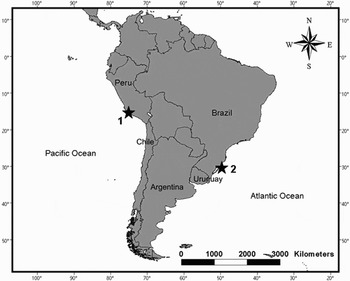
To test for genetic bottlenecks in Arctocephalus australis, we analysed genetic data of populations of the Pacific coast (Punta San Juan on the Southern Peruvian coast) and the Atlantic coast (southern Brazilian coast) (Figure 1) using seven microsatellite loci analysed by Oliveira et al. (Reference Oliveira, Hoffman, Hingst-Zaher, Majluf, Muelbert, Morgante and Amos2008). According to the authors these two populations have significant differences in skull morphology and in the allele frequency of seven microsatellite loci, and in this sense should be considered as evolutionarily significant units (ESUs). The Pacific population (N = 148) is represented by the Peruvian population, which suffered at least two drastic reductions in census size in the last 20 years (Majluf, Reference Majluf, Croxall and Gentry1987; Majluf & Apaza, 1998; Arias-Schereiber, 2000; Oliveira et al., Reference Oliveira, Arias-Schreiber, Meyer and Morgante2006). The Peruvian samples were collected from Punta San Juan (15°22′S 75°12′W) a state-managed guano reserve in southern Peru, containing eighteen breeding colonies of fur seals that has been extensively studied since 1984 (e.g. see Majluf & Trillmich, Reference Majluf and Trillmich1981; Majluf, Reference Majluf, Croxall and Gentry1987, Reference Majluf1992; Majluf & Apaza, Reference Majluf and Apaza1998; Majluf et al., Reference Majluf, Riveros, Parlane, Croxall and Gentry1996, Reference Majluf, Boness, Insley and Paredes2000; Arias-Schreiber & Rivas, Reference Arias-Schreiber and Rivas1998; Stevens & Boness, Reference Stevens and Boness2003; Oliveira et al., Reference Oliveira, Hingst-Zaher and Morgante2005, Reference Oliveira, Arias-Schreiber, Meyer and Morgante2006, Reference Oliveira, Hoffman, Hingst-Zaher, Majluf, Muelbert, Morgante and Amos2008).
Study area: (1) Punta San Juan (15°22′S) southern Peruvian coast in the Pacific Ocean and (2) southern Brazilian coast (29°20′S) in the Atlantic Ocean (modified from Oliveira et al., Reference Oliveira, Hoffman, Hingst-Zaher, Majluf, Muelbert, Morgante and Amos2008).

The Atlantic population (N = 48) is represented by individuals collected from the Brazilian coast, which according to morphological and molecular data belong to the Uruguayan population (for further explanations see Oliveira, Reference Oliveira2004; Oliveira et al., Reference Oliveira, Hoffman, Hingst-Zaher, Majluf, Muelbert, Morgante and Amos2008), which was commercially exploited for a long period (from 1515 to 1991). This population may have suffered a bottleneck event due to commercial sealing, but there is no information available on this matter.
DNA extraction and amplification
DNA extraction, microsatellite amplification and genotyping details are described by Oliveira et al. (Reference Oliveira, Hoffman, Hingst-Zaher, Majluf, Muelbert, Morgante and Amos2008). Genetic diversity was estimated using just seven of the eight polymorphic microsatellite loci studied by Oliveira et al. (Reference Oliveira, Hoffman, Hingst-Zaher, Majluf, Muelbert, Morgante and Amos2008). The locus Pv17 was excluded due to high frequency of null alleles. The seven remaining loci analysed were: M11a from Mirounga leonina (Hoelzel et al., Reference Hoelzel, LeBouef, Campagna and Reiter1999), Hg6.3 and Hg8.10 from Halichoerus grypus (Allen et al., Reference Allen, Amos, Pomery and Twiss1995), and PvcA, PvcE, Pv 9 and Pv11 from Phoca vitulina (Coltman et al., Reference Coltman, Bowen and Wright1996; Goodman, Reference Goodman1997).
Genetic diversity analyses included the number of alleles, allele frequencies, number of exclusive alleles, allelic richness and the expected heterozygosity as well as tests for deviations from Hardy–Weinberg equilibrium (HWE) and for linkage disequilibrium, which were determined using Genepop version 3.1 (Rousset & Raymond, Reference Rousset and Raymond1995). Null allele frequencies were calculated following Brookfield (Reference Brookfield1996) using the program MICRO-CHECKER (Van Oosterhout et al., Reference Van Oosterhout, Hutchinson, Wills and Shipley2004). The genetic diversity results from 226 individuals from both A. australis populations, using only unlinked loci that were in HWE, were then compared to values for other pinniped species: the Antarctic fur seal, Arctocephalus gazella (Hoffman et al., Reference Hoffman, Boyd and Amos2003), the southern elephant seal, Mirounga leonina (Fabiani et al., Reference Fabiani, Hoelzel, Galimberti and Muelbert2003) and the grey seal, Halichoerus grypus (Allen et al., Reference Allen, Amos, Pomery and Twiss1995; Worthington-Wilmer et al., Reference Worthington-Wilmer, Allen, Pomeroy, Twiss and Amos1999). All these species were also intensively hunted in the past, but currently present considerably high levels of genetic variability.
Bottleneck test
To test the hypothesis that both populations of South American fur seal (Pacific and Atlantic) had recently experienced genetic bottlenecks we compared the sample heterozygosity (He) at each of the seven microsatellite loci to the values expected for a sample of equal size and number of alleles, taken from a population under neutrality and in equilibrium conditions (Heq). As shown by Cornuet & Luikart (Reference Cornuet and Luikart1996), samples from populations that recently experienced bottlenecks have He > Heq. In other words, as mentioned by Luikart & Cornuet (Reference Luikart and Cornuet1998): ‘…In natural populations, allele number and heterozygosity at selectively neutral loci result from an equilibrium between mutation and genetic drift. The heterozygosity expected at a locus in an equilibrium population (Heq) can be calculated from the number of alleles observed and the sample size of individuals, assuming neutrality and mutation-drift equilibrium. In non-bottlenecked populations that are near mutation-drift equilibrium, the expected heterozygosity (Heq) will equal the measured Hardy–Weinberg equilibrium heterozygosity (He). But if a population has suffered a recent bottleneck, the mutation-drift equilibrium is transient disrupted and the heterozygosity measured at a locus (He) will exceed the heterozygosity (Heq) computed from the number of alleles sampled.’
In order to generate the expected heterozygosities under neutrality–equilibrium we used the program BOTTLENECK (Piry et al., Reference Piry, Alapetite, Cornuet, Paetkau, Baudouin and Estoup1999), which constructs a likelihood distribution of the parameter theta (θ = 4 Neµ) (where Ne is the effective population size and µ is the mutation rate), conditional on the observed number of alleles (k) and sample size (n). Coalescent simulations are generated using these values of theta in proportion to their likelihoods. The genealogies which have k that matches the observed value are used to construct the null distribution of the sample heterozygosity. The deviation of the observed heterozygosity with respect to that expected under neutrality–equilibrium is summarized by the statistic D = He – Heq/SD (Heq). Positive values for this statistic imply in excess heterozygosity, consistent with recent bottlenecks. To test for deviation from the neutrality–equilibrium results for each population, the deviations for all loci were tested using a Wilcoxon sign test.
This entire process was carried out for different microsatellite mutation models: the strict one-step stepwise mutation model (SMM; Otha & Kimura, Reference Otha and Kimura1973) and the infinite allele model (IAM; Kimura & Crow, Reference Kimura and Crow1964). Under the strict SMM, mutations change the state of an allele by one forward or backward step with equal probability. Thus, the SMM allows mutations to existing states, whereas under the IAM, mutations always result in new states. Most loci probably evolve according to a model intermediate between IAM and SMM (Di Rienzo et al., Reference Di Rienzo, Peterson, Garza, Valdes, Slatkin and Freimer1994), called general two-phase model (TPM). Here we focused on the TPM, which includes both stepwise mutations and mutations larger than single steps and appears to provide a reasonable fit to empirical evidence about the mutation process (Di Rienzo et al., Reference Di Rienzo, Peterson, Garza, Valdes, Slatkin and Freimer1994; Garza & Williamson, Reference Garza and Williamson2001).
This model runs considering two parameters: (1) the proportion of mutations that are greater than a single step (pg) and (2) the variance in the number of repeated unit changes (σm). According to Williamson-Natesan (Reference Williamson-Natesan2005), such parameters will affect the probability of occurrence of type I error (detecting a bottleneck when there was none) and type II error (failing to detect a bottleneck when there was one) under a variety of scenarios, as a result of not knowing the mutation rate, population size, or details of the mutation process. For these reasons, we explored a wide range of values for both these parameters: pg values of 0.06, 0.12, 0.20 and 0.30, and σm values of 1, 2, 4, 8, 16 and 32, resulting in 24 combinations of parameters. In addition, we also carried out the test using the SMM and the IAM. For each population, we recorded the number of loci for which sample heterozygosity exceeded neutrality–equilibrium expectations and whether the overall set of deviations was significant (based on an one-tailed Wilcoxon test, with the alternative hypothesis of heterozygosity excess).
RESULTS
Allele frequencies and genetic diversity
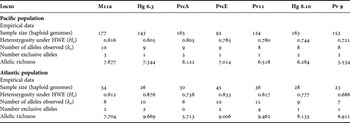
The number of alleles at each locus varied from six to 11 alleles per locus in the Atlantic population and from eight to ten in the Pacific population. The total number of alleles found over all loci (k = 61) was the same in both populations, and each population possessed a similar number of exclusive alleles (Pacific population k = 13; Atlantic population k = 12; see Table 1). However, the Pacific population had a larger sample size (N = 178) than the Atlantic population (N = 48). Despite the smaller sample size, the Atlantic population still presented greater average allelic richness (8.086) than the Pacific population (6.956) and also more exclusive alleles in three to seven loci (Hg 6.3, Pvc E and Pv11) and higher allelic richness in five to seven loci (Hg 6.3, PvcE, PV11, Hg 8.10 and Pv9; see Table 1). The expected heterozygosity (He) within each population, at individual loci, ranged from 69% to 88% in the Atlantic and from 72% to 82% in the Pacific population. Both populations presented similarly high levels of expected heterozygosity (see Table 1), suggesting high levels of genetic diversity within populations. Statistical comparison of the genetic diversity between these two populations is presented in Oliveira et al. (Reference Oliveira, Hoffman, Hingst-Zaher, Majluf, Muelbert, Morgante and Amos2008).
Results of the genetic diversity indices and heterozygosity expected under Hardy–Weinberg equilibrium (HWE) at seven polymorphic microsatellite loci for the populations of the South American fur seal, Arctocephalus australis.

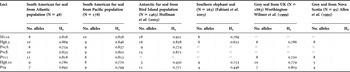
We compared the expected heterozygosity and the average number of alleles for seven loci from A. australis populations to the values of three other pinniped species (Table 2): the Antarctic fur seal, Arctocephalus gazella, the southern elephant seal, Mirounga leonina and the grey seal, Halichoerus grypus. We found that the variability in A. australis was commonly higher in three loci than that found in other species, even though the samples sizes for A. australis were smaller. For example, for the same six loci typed for the Antarctic fur seal, half the loci in the Pacific population of A. australis had higher variability (Table 2).
Heterozygosity under Hardy–Weinberg equilibrium (He) and the number of alleles (no. alleles) compared among populations of pinnipeds, those were also hunted in the past, like Antarctic fur seal, Arctocephalus gazella, southern elephant seal, Mirounga leonina and grey seal, Halichoerus grypus. *There are no available He values for the grey seal from Nova Scotia.

Bottleneck tests
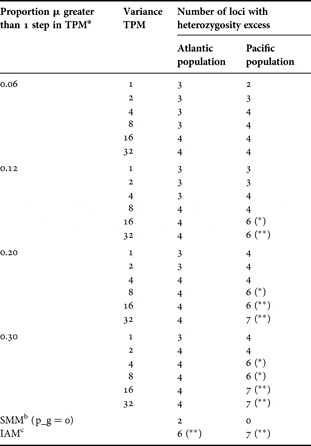
The results of the test for evidence of genetic bottlenecks are summarized in Table 3. Significant deviations from neutrality–equilibrium were obtained for nine of the 24 combinations of parameter values under the TPM. For the Atlantic population, all parameter values resulted in non-significant deviations from neutrality–equilibrium. Significance for the Pacific population was obtained when using models with a high proportion of mutations greater than single steps (0.12 or greater) and also high variance in the number of repeated unit changes (≥4). The combinations of parameters that resulted in significance and departed least from the SMM for either the parameter pg or variance were: pg = 0.12 and variance = 16, pg = 0.20 and variance = 8, and pg = 0.30 and variance = 4. When we modelled microsatellite mutation under the SMM model (with no mutations greater than single steps) no significant values were obtained for either population. When we used the IAM both populations deviated significantly from neutrality–equilibrium.
Number of loci for which the observed heterozygosity exceeded that expected under neutrality–equilibrium, for several combinations of parameters. *Indicates P < 0.05; ** indicates P < 0.01; aTPM, two phase mutation model; bSMM, stepwise mutation model; cIAM, infinite allele mutation model.

In summary, the results indicated that the Pacific population showed significant deviations from neutrality–equilibrium expectations in some scenarios and may have experienced a genetic bottleneck, while there is no suggestion of the Atlantic population having experienced a similar phenomenon.
DISCUSSION
Testing for a population bottleneck
When using mutation models that depart from the SMM by displaying a combination of high proportion non-SMM mutations (≥0.12) and high variance in the size of these mutations (>8) we obtained significant deviations from neutrality–equilibrium for the Pacific population. For the Atlantic population no deviation was observed, regardless of the mutation model used (Table 3). The values for the variance and amount of non-SMM mutations at which significance was attained are higher than those found in a literature survey carried out by Williamson-Natesan (Reference Williamson-Natesan2005). For example, when using pg = 0.12 we only found significant deviation for mutation size variance of ≥16. However, Garza & Williamson (Reference Garza and Williamson2001) suggested that typical parameter values are pg = 0.12 and variance = 2 (obtained by transforming the values reported by Garza & Williamson (Reference Garza and Williamson2001) for pg, the mean size of mutations greater than single steps, and estimating the value of the variance of the non-SMM mutations in the TPM model). Thus the cases for which we obtained significance were based on the use of parameter values that exceeded those for the variance in mutation size found by these authors in their survey.
Models with extreme departures from the SMM are expected to result in rejection of the null hypothesis of neutrality–equilibrium. The IAM model rejected the null hypothesis for microsatellite data in both datasets. Thus, using TPM models with a high proportion of non-SMM mutations can lead to false positives. Because we only obtained significant results when simulating the null distribution under fairly extreme values for pg and variance of mutation size, our results could be the result of type I error (detecting a bottleneck when there was none). This precludes definitive statements regarding deviation from neutrality–equilibrium for the Pacific population of South American fur seals.
However, because our dataset consists of two populations for which we have an a priori hypothesis about the demographic history, contrasting the results obtained for each one is informative. There are nine combinations of parameter values for which the Pacific population showed significant deviations from neutrality–equilibrium in the direction that is consistent with a recent bottleneck, and the Atlantic population showed no deviation for any combination of parameters. In addition, for all parameter values tested under the TPM model, the number of loci with He > Heq (data not shown) was always greater for the Pacific than the Atlantic population. This general trend is unlikely to be a consequence of the larger sample size of the Pacific population, which may affect the power of the test, but is not expected to bias the direction of the deviation.
In summary, our data indicate significant deviations from neutrality–equilibrium under fairly extreme mutation models for the Pacific population but not in the Atlantic one, supporting our a priori expectation that the Pacific population has undergone different demographic events with respect to the Atlantic population. One possible interpretation for our evidence of deviation from equilibrium in the Pacific population is a population bottleneck. Such a bottleneck could be a result of the synergic effect between the repetitive ENSO events and the human impact in the past. Future work should aim to incorporate additional populations and increase the number of markers screened to approximately 20 loci (as suggested by Cornuet & Luikart, Reference Cornuet and Luikart1996), substantially increasing our power to detect genetic signatures of past population processes in South American fur seals.
Implications of the demographic inferences in fur seals history
The effects of human activities on numbers of pinnipeds' populations are very well documented (e.g. Weber et al., Reference Weber, Stwart and Lehman2004) and their impact led to the recent extinction of at least two pinniped species: the Japanese sea lion, Zalophus japonicus, and the Caribbean monk seal, Monachus tropicalis. Nevertheless the influences of habitat features and oceanographic phenomena are only now being studied and understood. Despite the documented effects of human exploitation on the Atlantic population of the South American fur seal, we still found high levels of genetic diversity and no evidence of deviation from neutrality–equilibrium in the direction expected following a bottleneck, regardless of the mutation model used. The commercial sealing that hit the Atlantic fur seal population could be not equally intensive on all Atlantic colonies. Most probably it was concentrated on several sites, mainly in Uruguay, but leaving other sites unharmed, thus providing more opportunities for these populations to recover. The implications of these findings for the conservation or management plans of this fur seal population are important, since they suggest that even after a long period of commercial sealing pressure, the Atlantic population of A. australis does not show a particularly reduced level of variability. However, future research on genetic bottlenecks should be continued using more microsatellite loci in order to confirm these results. This is essential for the protection of the species and for any future management plans that might involve hunting, sanitary culling or commercial use of the South American fur seal on the Atlantic coast.
In contrast, the Pacific population of the South American fur seal, even though it presented high levels of genetic diversity, it still showed evidence of a bottleneck in extreme mutation models for microsatellites, perhaps as a result of constant human disturbances on important rookeries (Stevens & Boness, Reference Stevens and Boness2003), commercial hunting and poaching (Bonavia, Reference Bonavia1982; Majluf, Reference Majluf, Croxall and Gentry1987), prey overfishing (Pauly & Tsukayama, Reference Pauly, Tsukayama, Pauly and Tsukayama1987) or due to the severe reductions of effective population size resulting from frequent massive mortalities caused by ENSO events (Majluf, Reference Majluf, Croxall and Gentry1987; Arias-Schreiber & Rivas, Reference Arias-Schreiber and Rivas1998), or even a combination of all these effects.
Unfortunately there is no detailed information about the effects of the overfishing or the commercial hunt on the Peruvian fur seals. We just know that populations were decimated by hunting from the early 1900s until 1946 (Majluf, Reference Majluf, Croxall and Gentry1987). We can only speculate that all these activities intensify the magnitude of the population declines and human disturbances forced seals to abandon some historically important breeding sites. This is particularly alarming because new sites were not colonized (Stevens & Boness, Reference Stevens and Boness2003).
In the specific case of ENSO events on the Peruvian coast, recent censuses show that all fur seal breeding colonies in the region were similarly affected, registering declines in all censused sites (Arias-Schreiber & Rivas, Reference Arias-Schreiber and Rivas1998; Arias-Schreiber, Reference Arias-Schreiber2000). Therefore ENSO could be affecting the genetic signature of all Pacific populations (Peru and Northern Chile) in a similar way. As a consequence in at least two occurrences recently, the 1982–1983 and 1997–1998 events, classified as the strongest ENSO events in many centuries (Quinn et al., Reference Quinn, Neal and Antuñez de Mayolo1987; Glantz, Reference Glantz1996), dramatic population reductions of South American fur seal on the Peruvian coast were recorded (Majluf, Reference Majluf, Croxall and Gentry1987; Arias-Schreiber, Reference Arias-Schreiber2000; Steven & Boness, 2003). The strongest ENSO event reported before the collection of the studied samples (1994) occurred in 1982–1983, with high mortality levels for fur seals of all age-classes along the Peruvian coast (Majluf, Reference Majluf, Croxall and Gentry1987). However, in the 1997–1998 ENSO the original numbers of fur seals declined by 72%, mostly as a result of starvation due to low availability of Peruvian anchovies (Arias-Schreiber & Rivas, Reference Arias-Schreiber and Rivas1998; Stevens & Boness, Reference Stevens and Boness2003). The calculated Ne for the Peruvian (Pacific) population after this ENSO event was of 2153 specimens (Oliveira et al., Reference Oliveira, Arias-Schreiber, Meyer and Morgante2006) considered a critical value by the authors, because is significantly lower than the 7000 adults in breeding age estimated as the minimum viable population size (MVP), which was calculated for 102 vertebrate species (Reed et al., Reference Reed, Grady, Brook, Ballou and Frankham2003).
Besides the mortality, the starvation problem during ENSO events can cause reduction in the breeding potential and abnormal ontogenetic growth compromising the next generations of fur seals in the affected populations. In fact, according to Majluf & Apaza, (Reference Majluf and Apaza1998), the ENSO event from 1997 to 1998 not only caused the usual high juvenile and pup mortality, but also a high mortality of reproductive females and males, due to the long feeding trips of the mothers and also for the unusual timing of this event. Before this ENSO, most events began around Christmas, in December. The 1997–1998 ENSO, however, started as early as March, reducing food availability throughout the austral autumn and winter, when adults usually recuperate from the energetic strains of breeding and fatten up for the upcoming breeding and nursing seasons (November–March). Adult fur seals in late 1997 were, therefore, in less than optimal nutritional condition and particularly vulnerable to the very intense ENSO conditions that finally developed in December 1997 and throughout the summer of 1998 (January–March). Thus, high adult fur seal mortality was observed during this event.
ENSO is a recurrent and presumably ancient event (these events may have existed for approximately 5000 years (Sandweiss et al., Reference Sandweiss, Richardson, Reitz, Rollins and Maasch1996) or throughout the last 2 million years (DeVries, Reference De Vries1987)). Researchers suspect that many animal species living in marine environments affected by ENSOs, may have adapted to them by developing flexible life history traits, which allow them to adjust to and survive the ever changing environmental conditions (Majluf, Reference Majluf, Croxall and Gentry1987).
According to Oliveira et al. (Reference Oliveira, Arias-Schreiber, Meyer and Morgante2006) although the Pacific population of South American fur seal is most probably well-adapted to recurrent ENSO events, in its current depleted state, it may not be able to survive many more events of the magnitude and unusual characteristics of the 1997–1998 ENSO. Indeed, such a kind of drastic decline in effective population size could compromise the evolutionary potential of a population to respond to environmental changes.
We believe that the moderate genetic signature observed in our data could be consistent with a bottleneck and is most likely the result of the synergic effects of recurrent occurrences of ENSO events and anthropogenic pressures on the Pacific population of fur seals. This population suffered significant commercial hunting during the first half of the 20th Century (Majluf, Reference Majluf, Croxall and Gentry1987). Subsequently it slowly recovered but recurrent ENSOs of increasing frequency and intensity, combined with the anchovy overfishing crisis of the early 1970s (Pauly & Tsukayama, Reference Pauly, Tsukayama, Pauly and Tsukayama1987) have caused several crashes in the Pacific population of fur seals. Furthermore, this population scenario is getting worse due to the fact that the South American fur seal is a polygynous species. This mating system reduces the effective population size and can cause more rapid loss of genetic variation.
The detection of the suggestion of genetic bottleneck in the Peruvian (Pacific) fur seal population, combined with its small effective population size (Oliveira et al., Reference Oliveira, Arias-Schreiber, Meyer and Morgante2006), with ever rapidly recurrent ENSO events (Majluf & Apaza, Reference Majluf and Apaza1998) and with global warming models that predict stronger and more frequent ENSO events in the future (NCDC–NOOA, 2007), are enough reasons for concern regarding the survival for the species, and should be taken into account in future management plans for the conservation of this species on the Pacific coast of South America.
ACKNOWLEDGEMENTS
The authors would like to thank the Instituto del Mar de Perú (IMARPE), Proyecto Especial de Promoción del Aprovechamiento de Abonos Provenientes de Aves Marinas (PROABONOS) and Instituto Nacional de Recursos Naturales (INRENA) for the permission to conduct the study (022-2004 INRENA-IFFS-DCB). We are also grateful to: M. Borges-Martins, D. Danilewicz, M. Tavares, P.H. Ott, R. Machado, S.B. Nakashima and C.C. Trigo for collaborating in necropsies on the Brazilian coast; to the research team (1997 and 2003) of the Punta San Juan Project (Peru) N.A. Rueda, G. Battistini, R. Paredes, C. Zavalaga, A. Kurowia, M.A. Cardeña, M. Roca, S.A. Cárdenas, A. Valdés-Velásquez, H. Cabrera, M. Apaza and P. Llerena for collecting samples in Peru; to P. Johnson, R. Waldick and K. Acevedo-Whitehouse from the Molecular Ecology Laboratory (University of Cambridge, UK) for much laboratory advice; to I.B. Moreno, who kindly prepared Figure 1 and helped during field work in Brazil and to W. Amos (University of Cambridge, UK) for laboratory facilities. To the anonymous referees who provided valuable criticism to improve this article. To Fundação de Amparo à Pesquisa do Estado de São Paulo (FAPESP), which provided the post-doctoral fellowship to L.R.O. (FAPESP 2007/58728-9). This paper is GEMARS contribution No. 33.