Ideology has historically played a critical role in Chilean voters’ electoral choices. Before the 1973 coup, voters held clear and strong positions along the left-right continuum, and the party system was fragmented into three ideological groups: left, center, and right (Valenzuela Reference Valenzuela1978). After the democratic transition in 1990, ideology remained fundamental to Chilean politics, but now the new political system was structured around two main poles: support for authoritarianism (and its legacies) or support for democracy (Tironi and Agüero Reference Tironi and Felipe1999).Footnote 1
Survey evidence from recent years, however, has shown a significant decline in the number of citizens who self-identify with a particular ideology (Bargsted and Somma Reference Bargsted and Somma2016). There are several possible reasons for the decreased salience of ideological labels in Chile: an increase in the levels of political disaffection and malaise (Segovia Reference Segovia, Joignant, Morales and Fuentes2017), a reduction in the importance of the democratic-authoritarian cleavage over time (Luna and Altman Reference Luna and Altman2011), the programmatic congruence of the two main coalitions (Navia Reference Navia, Burdick, Oxhorn and Roberts2009), and the rise of nonprogrammatic strategies for appealing to low-income voters (Luna Reference Luna2014).
In 2012, Chile moved from compulsory to voluntary voting, which produced significant transformations in the composition of the electorate. Brieba and Bunker (Reference Brieba and Bunker2019) show how this reform in national elections increased class bias in urban districts, reduced age bias, and equalized turnout between small and large districts. As a result, analyses that do not differentiate between likely and unlikely voters might misestimate the importance of ideology. All of these changes in the political landscape raise the question, is ideology still relevant in a context of voluntary voting in Chile?
Answering this question is difficult, as even though there is a large body of literature on electoral politics in Chile, there is little evidence about the causal impact of candidates’ ideological labels on voters’ electoral choices. One of the main methodological challenges when studying ideological voting is reverse causality, which means that voters’ electoral decisions (e.g., voting for the incumbent) might affect their ideological stances (e.g., self-placement along the left-right scale). For instance, a voter who likes the incumbent might adopt this politician’s ideology when answering a survey. As a result, in this example, it is not the respondent’s ideology that explains his or her electoral choice, but rather the respondent’s electoral choice that explains the ideology.
To provide causal evidence about how ideology informs voters’ electoral choices in an era of voluntary voting, this article implements an original survey with a conjoint experiment embedded in three municipalities in the Santiago province. These municipalities have two crucial characteristics: first, they are good predictors of national electoral results, and as a consequence are not outliers; and second, they are composed of low- and middle-income neighborhoods, in which we expect to find fewer ideological voters.Footnote 2 The conjoint experiment allows us to assess the impact of different candidate attributes on the probability of being selected by voters. Respondents compare two hypothetical presidential candidates, with different ideological and valence attributes, and need to select one.Footnote 3 Due to the randomization of candidate characteristics, it is possible to evaluate the extent to which each of these attributes explains respondents’ choices (Hainmueller et al. Reference Hainmueller, Hopkins and Yamamoto2014).
The findings from the conjoint experiment show that even though there are several reasons to believe that ideology has become less salient over time, candidates’ ideological labels are still very relevant to voters’ political decisions, particularly for those who can be considered likely voters. Left- and right-wing respondents, who represent 40 percent of the sample, heavily rely on candidates’ ideological labels when making electoral decisions. In addition, likely left- and right-wing voters pay even closer attention to ideology.
Further evidence provides three other important findings. More than 50 percent of respondents can connect policy outcomes with ideological stances; 56 percent of respondents who place themselves at the center of the ideological scale (i.e., centrist respondents) or who do not respond to the ideology question have preferences for left- or right-wing candidates and therefore can be considered as latent left- or latent right-wing voters. Moreover, the group of respondents who use candidates’ ideological labels to make electoral choices (i.e., ideological respondents) is 32 percentage points more likely to vote than participants who do not rely on candidates’ ideological labels when selecting candidates (i.e., nonideological respondents).
The findings show that ideology is still very relevant in Chilean politics. A large proportion of low-to-middle-income urban respondents use candidates’ ideological labels in presidential elections, especially participants who are likely voters. As a result, if ideological citizens are the most likely to be politically involved in a context of voluntary voting, an increase in the number of nonideological citizens might not have a meaningful effect on the salience of ideology in explaining electoral outcomes because this latter group is not participating as much in the electoral process.
POLITICAL IDEOLOGY AND VOTE CHOICE
Scholars of political behavior have extensively discussed the role of ideology in voters’ electoral choices. A first set of arguments holds that the electorate does not engage in ideological abstractions and a majority of citizens do not have strong ideological beliefs. More specifically, this research shows that political ideas begin to lose importance when we move from more to less sophisticated voters (Converse Reference Converse1962). Evidence from France has shown that voters have problems identifying what falls on the left and what falls on the right of the political continuum (Converse and Pierce Reference Converse and Pierce1986), and survey results from Britain illustrate that when voters do understand ideological terms, they have issues identifying where parties stand on the ideological scale (Butler and Stokes Reference Butler and Stokes1974). All these voter inconsistencies have made researchers argue that a majority of citizens are innocent of ideology (Achen and Bartels Reference Achen and Bartels2016).
Conversely, a second set of arguments holds that people do make electoral decisions that are consistent with their ideological positions and that they use ideological labels to describe parties, presidents, and issues (Levitin and Miller Reference Levitin and Miller1979). This line of research has its origin in Anthony Downs’s work, in which parties and voters can be placed on an ideological scale. Downs assumes that voters will prefer the party that is closest to their position as a way to maximize their satisfaction with the electoral outcome (Downs Reference Downs1957). This theory has been used to understand how voters make electoral choices in different countries across the world, such as Spain (Sánchez-Cuenca Reference Sánchez-Cuenca and Maravall2008), the United States (Jessee Reference Jessee2009), and Chile (Calvo and Murillo Reference Calvo and Murillo2019). As Jost (Reference Jost2006) shows for the US case, since 1972, more than two-thirds of survey respondents in an American National Election Studies survey, and since 1996 more than three-fourths, could place themselves on the liberal-conservative scale. Furthermore, as multiple studies have suggested, people who place themselves on the ideological spectrum are able to do so in a stable and coherent way (Knight Reference Knight2006; Jost Reference Jost2006).
One of the reasons that political ideology has been underestimated by part of the literature is because of a confusion between political sophistication and the use of the left-right scale. As Jost holds,
the end-of-ideologists made an unwarranted assumption that a lack of political sophistication among the general public should be counted as evidence for the meaninglessness of left and right. It does not follow that when citizens struggle to articulate a sophisticated, coherent ideology, they must be incapable of using ideology with either sophistication or coherence. (Jost Reference Jost2006, 657)
Indeed, ideology can work as a simple heuristic that helps people make political decisions (Lau and Redlawsk Reference Lau2001). For example, ideological labels can be easily connected with political issues, such as social welfare or iron fist crime reduction policies.
Is ideology an important factor for understanding how people make electoral decisions in Latin America? On the one hand, some research holds that Latin American voters do not, or only barely, use ideological labels to make electoral choices (Echegaray Reference Echegaray2005). This lack of ideological voting might be explained by the absence of long-term party competition based on left-right labels (González Ferrer and Queirolo Velasco Reference González Ferrer and Velasco2013). On the other hand, there is evidence that ideology is a significant determinant of the vote choice in Latin America and that voters do not lack for policy or ideological content (Saiegh Reference Saiegh2015). These findings, however, are conditional on individual (e.g., political sophistication, education, and political interests) and contextual factors (e.g., polarization, fragmentation, programmatic party system structuration) (Ames and Smith Reference Ames and Smith2010; Zechmeister and Corral Reference Zechmeister and Corral2012; Harbers et al. Reference Harbers, de Vries and Steenbergen2013).
Evidence from joint correspondence analysis shows that people with the same ideological beliefs also share coherent preferences, which illustrates that having a position on the left-right scale carries ideological content. In other words, Latin American voters do form consistent ideological groups that have common political convictions (Wiesehomeier and Doyle Reference Wiesehomeier and Doyle2012). These results align with previous findings using survey data showing that most Latin American voters have high and consistent ideological beliefs, despite the existence of significant levels of alienation from the party system (Colomer and Escatel Reference Colomer and Escatel2004) and voter reliance on positional issue voting when making electoral choices (Baker and Greene Reference Baker and Greene2011).
Recent research has provided more nuanced findings about the political relevance of ideology in Latin America. Most voters are able to place themselves on the left-right scale, but a large proportion do not. Also, though there is a connection between policy stances and left-right identification, this link is not particularly strong in some countries. Furthermore, there is an association between ideological self-placement and vote choice, but this connection is weak in Argentina, Brazil, Costa Rica, Ecuador, and Panama (Zechmeister Reference Zechmeister2015).
The emergence of the left in the 2000s in Latin America revitalized the discussion about the role and importance of ideology in the region. Scholars have identified ideological factors that might explain this political and electoral process, such as a shift in voters’ self-placement on the ideological scale toward the left (Seligson Reference Seligson2007), the existence of a moderate policy mandate granted to new leftist presidents (Baker and Greene Reference Baker and Greene2011), and the rise in anti-US sentiment (Remmer Reference Remmer2012). The literature, however, has also provided nonideological arguments to explain the turn to the left, such as the desire to punish underperforming right-wing incumbents (Arnold and Samuels Reference Arnold, Samuels, Levitsky and Roberts2011).
In sum, there is evidence that political ideology is a relevant variable in people’s electoral choices in Latin America, in combination with other important nonideological factors such as gender, ethnicity, party identification, economic conditions, religion, and clientelism (Kitschelt et al. Reference Kitschelt, Hawkins, Luna, Rosas and Zechmeister2010; Morgan Reference Moreno2015; Moreno Reference Morgan2015; Lupu Reference Lupu2015; Gélineau and Singer Reference Gélineau and Singer2015; Boas Reference Boas2016). Together, all these factors provide a more complete picture of voters’ political decisions in the region.
THE END OF IDEOLOGY IN CHILE?
Is ideology a meaningful political factor in Chile? The historically high level of programmatic party structuration in this country has contributed to the identification of Chile, along with Uruguay and Venezuela, as one of the “Latin American systems in which left-right identifications are rich in policy content and very relevant to voter choice” (Zechmeister Reference Zechmeister2015, 217). After the transition to democracy, scholars still considered ideology to be a significant factor in voter choice (Fontaine Reference Fontaine1995).
Recent survey evidence, however, has started to call this premise into question. An increasing proportion of survey respondents refuse to place themselves along the left-right spectrum (Bargsted and Somma Reference Bargsted and Somma2016; Morales Reference Morales2010) or to identify with political parties (Luna and Altman Reference Luna and Altman2011; Bargsted and Maldonado Reference Bargsted and Maldonado2018). Indeed, evidence from national representative surveys implemented by the Centro de Estudios Públicos (CEP) shows an increase in the number of nonresponses to the ideology question between 2005 and 2017. Specifically, and when focusing on electoral years: 21 percent of respondents in 2005 did not place themselves on the left-right scale, 24 percent in 2009, 25 percent in 2013, and 30 percent in 2017 (CEP 2017). Thus, the high levels of electoral stability after the transition to democracy seem to be explained not by voters’ high levels of ideological commitment or party identification, but instead by the consequences of specific institutional arrangements, such as the binominal electoral system (Ortega Reference Ortega2003; Cabezas and Navia Reference Cabezas and Navia2005).Footnote 4
Why would ideology become less important in Chile? The literature offers four main answers to this question: voters’ increasing disaffection with the political system, the lower salience of the democracy-autocracy cleavage, a process of party convergence toward the center, and the rise of nonprogrammatic strategies by parties to appeal to voters.
The first explanation is supported by extensive research that depicts increasing malaise in representation: a combination of disaffection, disapproval, and distrust (Joignant et al. Reference Joignant, Morales and Fuentes2017). The crisis of representation has a wide variety of symptoms, including lower levels of satisfaction with democracy and representative institutions (Rovira Kaltwasser and Castiglioni Reference Rovira Kaltwasser and Castiglioni2016); an increase in protests and social mobilization (Donoso and Von Bülow Reference Donoso and Von Bülow2017); the emergence of independent or outsider candidates who receive large proportions of the vote, such as Marco Enríquez-Ominami in the 2009 presidential election (Došek and Freidenberg Reference Došek and Flavia2014); the lack of young voters to shake up the current electorate (Toro Reference Toro2008); and the decline in valid and rise of blank and null votes (Carlin Reference Carlin2006). This crisis of representation exploded in the social protests of October 2019, which were considered “the fiercest social outburst in Chile during the last three decades” (Somma et al. Reference Somma, Matías, Rodolfo Disi and Medel2020, 1).
What explains this (longstanding) crisis of representation in Chile? Luna and Mardones (Reference Luna and Mardones2017) offer a structural argument by holding that this corresponds to a reconfiguration of the logic of mediation between the state, parties, and society. More specifically, traditional political parties have failed to adapt to a new context and to incorporate demands from social groups (Morgan and Meléndez Reference Morgan and Meléndez2016; Rosenblatt Reference Rosenblatt2018). Siavelis (Reference Siavelis2017) proposes a more institutional argument by holding that this deterioration of representation emerged from constraints that formal and informal institutional legacies of the dictatorship imposed on the posttransition democratic regime, reinforcing a model that facilitated a decline in support for democracy.
The second explanation for the lower salience of ideology argues that, over time, the conflict between authoritarianism and democracy has become less central to Chilean politics. In the early twentieth century, a class divide emerged in Chile, generating clear groups of left, center, and right-wing parties that represented different social sectors (Scully Reference Scully1992). Since the 1988 plebiscite ending the Pinochet regime, the Chilean party system has revolved around two multiparty coalitions, and spatial maps of the party system show that an authoritarian-democratic cleavage accurately describes the posttransition political system in Chile (Bonilla et al. Reference Bonilla, Carlin, Love and Méndez2011). In the context of the plebiscite, the center-left coalition was formed to oppose the dictatorship, while the center-right coalition attempted to do precisely the opposite: to continue the legacy of the authoritarian period.
This conflict, however, has become less salient over time. The relative lesser importance of the dictatorship in everyday politics has partially blurred the traditional boundaries between these coalitions. For example, the first right-wing president elected after the dictatorship, Sebastián Piñera (2010–14, 2018–present), has publicly commented that he did not vote for the continuation of Pinochet’s regime in the 1988 plebiscite (Salgado Reference Salgado2013), and traditional right-wing parties have begun to discuss removing references to the dictatorship from their party manifestos (Toro Reference Toro2014).
The emergence of new, politically divisive issues has also contributed to the lower salience of the authoritarian regime. Therefore, as time passes, it will probably become more difficult to mobilize voters based on memories of the dictatorship (Torcal and Mainwaring Reference Torcal and Scott2003). Of course, this does not mean that the legacies of the authoritarian period do not remain part of the political discussion. For instance, the 2011 student protests were motivated both by resistance to the neoliberal policies enacted during the dictatorship and by grievances about the reforms adopted during the democratic period (Disi Reference Disi2018).
The third argument about the waning significance of ideology in Chile points to the convergence of the two traditional coalitions toward the center, largely a result of the center-left democratic governments’ decision to continue most of the market-based reforms introduced by the military (Maillet Reference Maillet2013). As a result, partisan differences regarding the state-market divide have decreased over time (Luna Reference Luna2014).
However, the center-left coalition is not the only one that has moved toward the center of the ideological spectrum. Piñera, the first right-wing president democratically elected in Chile since 1958, distanced himself from classic right-wing positions in his first successful presidential campaign in 2009. He did it by appropriating elements of social welfare policies, which he combined with a rhetoric of efficiency and managerial skills (López and Baeza Reference López, Baeza, Tagina and Sáez2011; López et al. Reference López, Miranda and Valenzuela-Gutiérrez2013). In the 2017 runoff campaign, Piñera again blurred the ideological distinction between the two main coalitions by supporting free technical and vocational education (Jara Reference Jara2017). Additionally, the emergence of Evópoli, a more socially liberal right-wing party within the center-right coalition, also aligns with this trend. Survey evidence shows that leaders from this party are more likely to support same-sex marriage and to decriminalize abortion than leaders from the two more traditional right-wing parties (Alenda et al. Reference Alenda, Le Foulon and Suárez-Cao2018).
Certain institutional features, such as the binominal electoral system, have also contributed to the convergence (Guzmán Reference Guzmán1993). This consensus across parties has been confirmed by analysis of their manifestos. Specifically, political parties have evolved from high levels of polarization before the dictatorship to increasing programmatic congruence since the transition to democracy (Gamboa et al. Reference Gamboa, López and Baeza2013).Footnote 5
The fourth argument about why ideology has become less relevant over time centers on the increasing importance of nonprogrammatic factors, such as the distribution of goods, for understanding voters’ electoral choices in Chile. For example, reports on campaign spending show that money has been used to buy products, such as diapers, canes, and food (Díaz Rioseco et al. Reference Díaz, Diego, Luna and Núñez2006). In a similar vein, parties have become less likely to rely on their party labels to attract voters in legislative elections (Giannini et al. Reference Giannini, Bahamonde, Luna, López, Astete and Recart2011). Chile once had one of the strongest programmatic linkages between parties and voters in Latin America (Kitschelt et al. Reference Kitschelt, Hawkins, Luna, Rosas and Zechmeister2010), but those linkages have deteriorated over time (Luna Reference Luna2014). Clientelism, however, has not become the primary strategy for appealing to voters, but rather a complement to more traditional linkages (Morgan and Meléndez Reference Morgan and Meléndez2016).
The rise of nonprogrammatic strategies such as clientelism, particularism, and candidate-based mobilization can have direct consequences on the use of ideology as a cue to make informed political decisions. Specifically, these appeals offer an alternative mechanism for selecting candidates, depreciating the salience of right- and left-wing labels by making them less meaningful to voters (Ruth Reference Ruth2016). The use of nonprogrammatic strategies to appeal to citizens in low-income municipalities has been fostered by the high levels of social inequality and spatial segregation in Chile. Parties can maintain a portfolio of electoral strategies that they implement according to the socioeconomic composition of a district (Luna Reference Luna2014).
Even though ideology may seem to have been relegated to a lesser role in citizens’ electoral decisions, recent findings show that ideological labels may still be important to Chilean voters. For example Visconti (Reference Visconti2018) provides evidence from the combination of a natural and a survey experiment to show how voters from a low-to-middle-income locality in northern Chile use ideological labels to identify the candidate most likely to pass the policies they need after a natural disaster.
Meanwhile, Boas (Reference Boas2016) holds that Pinochetismo remains salient for a new generation of right-wing voters in Chile. Ideological labels are sticky, and even though respondents may be less likely to place themselves on the left-right continuum, they may still use them as heuristics to make political decisions. Therefore, due to the tension between different findings, it is important to understand whether Chilean voters still rely on ideological markers when making electoral decisions, or whether they have become less attached to those labels, as most of the literature suggests.
Despite strong theoretical and empirical reasons to hold that ideology is not as crucial for explaining how Chilean voters make electoral decisions as it was in previous decades, when we take into account the adoption of voluntary voting in 2012, we might be inclined to reconsider that conclusion. Indeed, this electoral reform generated significant effects in the composition of the electorate: turnout decreased from 86.3 to 59.6 percent of the voting-age population from 2009 to 2012 (Traugott Reference Traugott2015).
Furthermore, Contreras et al. (Reference Contreras, Joignant and Morales2016) confirm the existence of class bias, especially in urban districts. This finding can have consequential effects on the type of people who participate, since Chile is predominantly urban, with 84 percent of the population living in urban areas, according to the 2017 census. Therefore, even though previous evidence might indicate that ideology has become less relevant, the importance of those findings would be conditional on who is actually voting in a context of voluntary electoral participation. More specifically, ideology might have become less relevant for the entire electorate, but not necessarily for the subset of people who vote and participate in politics—which, according to the 2017 presidential election, is just 45 percent of eligible voters.
RESEARCH DESIGN
The traditional strategy for studying ideological voting has entailed checking whether a voter’s self-placement along the left-right scale correlates with their vote choice. This approach, however, does not provide causal evidence about the importance of ideology. For example, these results could be explained by reverse causality: if voters want to reward a left-wing incumbent, they might be more likely to identify them as left-wing.Footnote 6
Using a conjoint survey experiment, in which voters evaluate hypothetical candidates with multiple attributes, can improve the drawing of causal inferences. This methodology rules out, by design, the problem of reverse causality. Since respondents need to select between hypothetical candidates on the basis of randomized attributes, we can discard the possibility that they may identify themselves as right- wing because they want to vote for a candidate, such as Sebastián Piñera, and are trying to provide coherent answers across the survey.
Another advantage of conjoint experiments is that they allow us to study people’s multidimensional preferences. This type of design identifies the impact of different attributes on the probability of selecting a candidate, allowing us to mimic more realistic scenarios, in which people evaluate politicians along different dimensions when making electoral choices. Such experiments have been used to understand how people evaluate immigrants (Hainmueller et al. Reference Hainmueller, Hopkins and Yamamoto2014), US Supreme Court judges (Sen Reference Sen2017), and mayoral candidates (Mares and Visconti Reference Mares and Giancarlo2020), among other subjects.
Of course, the nature of a conjoint experiment, in which respondents evaluate hypothetical candidates, raises the question of whether respondents would make the same decisions in real life. Nevertheless, different studies have validated results from conjoint analyses by comparing them with behavioral benchmarks in Switzerland (Hainmueller et al. Reference Hainmueller, Hangartner and Yamamoto2015) and Chile (Visconti Reference Visconti2018).
This study uses a conjoint experiment in which participants need to select one of two presidential candidates with different attributes. Thanks to the randomization of candidate characteristics across profiles, it is possible to identify and compare the impact of each of these attributes on the probability of being preferred as president (Hainmueller et al. Reference Hainmueller, Hopkins and Yamamoto2014). The conjoint experiment was embedded in a face-to-face survey that was implemented in three low-to-middle-income municipalities in the Santiago province in August 2017 (three months before the presidential election).
The sampling strategy was structured into two steps. The first was to select the municipality that best predicted Chilean presidential election results. Since the transition to democracy and before the implementation of this study, the country had held six presidential elections (1989, 1993, 1999, 2005, 2009, and 2013), in which 32 candidates competed. The presidential election results in the 345 municipalities were compared with national election results.
The analysis for each municipality began by summing up the absolute differences between the municipality and the national results for the 32 candidates who ran in the six presidential elections. This summation produced the total absolute difference (TAD). The municipality with the lowest TAD between 1990 and 2013 was Cerrillos, which is part of the Santiago province (see online appendix A for more details). To increase the sample size, the survey was extended to the second and third municipalities that best predicted national election results in the Santiago province: Recoleta and Independencia (see appendix B for more details). The goal of this strategy was to avoid implementing the survey in outlier municipalities that do not represent average political preferences in Chile. Because these municipalities consist of low- and middle-income neighborhoods, the analysis excluded, by design, areas where we would expect voters to attach more weight to the ideological component of the vote—namely, the more educated and wealthy neighborhoods.
In a second step, four enumerators selected respondents by taking a random walk through the area. Specifically, they invited participants in every third house-hold on a given street to answer the questionnaire (see appendix C for more details).
The survey included a conjoint experiment to measure respondents’ electoral choices. The candidate profiles were generated using R in advance of the implementation of the survey. Each questionnaire had five pairs of candidates attached at the end. Profiles were presented side by side in an illustrative manner, and after selecting one candidate, participants were able to observe the next pair of candidates. The survey and conjoint experiment were implemented on paper.
Participants were asked to decide between two hypothetical candidates who would be competing for the presidency in the 2017 elections. Respondents saw information about three attributes these two candidates had: ideology (left or right), profession (gardener, teacher, or engineer), and age (30, 40, or 50).Footnote 7 The second and third sets of attributes attempted to measure the valence dimension of candidates: the profession and age can function as heuristics for the candidates’ managerial quality, preparation, and experience.Footnote 8
These attributes were randomly chosen to generate the candidate profiles, and they attempted to capture both the ideological and nonideological components of the vote. Each respondent rated five pairs of candidates, each pair providing two outcomes (a 1 for the preferred candidate and a 0 for the nonpreferred candidate). After they observed the two profiles, participants answered the question, for whom would you vote for president?
The sample was composed of three hundred respondents. Thus, there was a maximum number of three thousand observations available for the analysis (since each respondent rated five pairs of candidates). The unit of observation corresponded to each candidate profile, and standard errors were clustered at the respondent level. Table 1 provides an example of a possible pair of randomly generated profiles a respondent would evaluate.
Example of Experimental Design

As noted earlier, the randomization of candidate characteristics allows us to identify the effect of each attribute on the probability of being preferred as president, which can be estimated by regressing the outcome on the attributes (Hainmueller et al. Reference Hainmueller, Hopkins and Yamamoto2014). The comparison between candidates is based on the fact that, for example, the right- and left-wing candidate profiles will have, on average, the same distribution for profession and age.
Before implementing the conjoint experiment, the survey included a battery of questions to identify respondents’ background (age, education, etc.) and to better understand their ideological preferences. For example, they had to place themselves on the left-right scale and also had to connect policy outcomes, such as social welfare benefits, with ideological labels. The goal of these inquiries was to learn whether participants used ideology to define themselves politically and whether they were able to provide content to ideological markers. They also answered questions to help identify who was more likely to participate in the next election, in a context of voluntary voting.
Though the conjoint experiment allows us to learn the impact of candidates’ ideological labels on respondents’ electoral choices, we also want to know whether ideological voting differs across likely and unlikely voters. This is important because identifying the people who are actually going to show up and vote is not easy in places with voluntary voting systems, largely due to a social desirability bias associated with reporting an intention to vote or not to vote (González and Mackenna Reference González and Bernardo2017). To identify likely voters, the analysis used an adapted version of the Traugott and Tucker (Reference Traugott and Tucker1984) approach to identify likely voters in the United States. It used the answer to three different questions to construct a binary indicator of a likely voter. A 1 was assigned to respondents who expressed at least a small interest in politics, who had voted in the last presidential election, and who had chosen a candidate for the next presidential election; and a 0 otherwise. With the understanding that no existing approach can perfectly measure who is going and not going to vote, the experiment used two other variations of this coding strategy. For the second approach, a 1 was assigned to respondents who had voted in the last presidential election and who had chosen a candidate for the next presidential election; and 0 otherwise. For the third approach, a 1 was assigned to respondents who expressed at least a small interest in politics and who had voted in the last presidential election; and 0 otherwise.
Using the first indicator of likely voters, 35 percent of respondents were likely to participate in the next election, which increased to 43 percent using the second indicator and 44 percent with the third. These numbers are not far from actual participation rates in Cerrillos, Recoleta, and Independencia, where turnout was 46, 44, and 43 percent, respectively, in 2017. This analysis used the first strategy because it is the most similar to the three-question approach used by Traugott and Tucker (Reference Traugott and Tucker1984) and because it is the most conservative one. Appendix D shows the use of the other two approaches. The results are the same regardless of the strategy used to code likely voters.
To study whether ideological voting differed across likely and unlikely voters, the binary indicator of likely voters was interacted with all the candidates’ attributes. This interaction will show the effect of the randomized attributes for likely and unlikely voters and the differences between them. As mentioned earlier, the results from the conjoint experiment can conveniently be implemented using a linear regression (Hainmueller et al. Reference Hainmueller, Hopkins and Yamamoto2014). Therefore, the analysis used the following estimation equation:
 $$\matrix{
{Y = {\rm{\alpha }} + {{\rm{\beta }}_1}Ideology + {{\rm{\beta }}_2}Profession + {{\rm{\beta }}_3}Age + {{\rm{\gamma }}_4}Likely\,\,vote{r_i}} \hfill \cr
{\quad + {{\rm{\delta }}_1}Ideolog{y^*}Likely\,\,vote{r_i} + {{\rm{\delta }}_2}Professio{n^*}Likely\,\,vote{r_i}} \hfill \cr
{\quad + {{\rm{\delta }}_3}Ag{e^*}Likely\,\,vote{r_i} + {{\rm{\varepsilon }}_i}} \hfill \cr
} $$
Y is a binary indicator of whether a given hypothetical candidate was selected or not. The b coefficients refer to the effect of the randomized candidates’ attributes on the probability of being preferred as president (in comparison to a reference category) for unlikely voters (that is, when the variable for likely voter is equal to 0). The δ coefficients capture the change in the effect of candidates’ attributes between unlikely and likely voters. This interaction, thus, will allow us to see the impact of ideology for likely and unlikely voters, and the difference between them. Appendix J presents the results of the conjoint experiment without the interaction with likely voters. Appendix M presents the wording of the survey questions used in the study.
RESULTS
The sample of respondents from these three municipalities seems to provide a reasonable representation of a low-to-middle-income urban voter in Chile: 76 percent of participants have FONASA (public health insurance), 64 percent have only a high school education or less, and 19 percent receive financial support from the state.
Since the results come from three municipalities in the capital city of Chile, external validity may be a concern: could the results be a consequence of a particularity of the sample composition? Appendix E compares this sample with a nationally representative survey implemented in July–August 2017 by the Centro de Estudios Públicos. Even though the former uses a nonprobabilistic sampling strategy, the results of the comparison between both samples show very similar averages for gender, age ranges, intention to vote in the next election, reported voting in the most recent election, and electoral preferences. Additionally, respondents who participated in this study are not from high-income neighborhoods or highly educated, which is what the literature has assumed to be associated with strong ideological preferences. Of course, this does not mean that this sample is as good as a nationally representative survey, but rather that this sample is not biased with respect to the population on key observed characteristics.
Ideology and Ideological Labels
Before studying the impact of ideology on respondents’ electoral choices, the study asked several questions to contextualize the role of ideology in these low-to-middle-income neighborhoods. First, in terms of self-placement on the left-right scale, 87 percent of respondents were able to locate themselves on the ideological spectrum. Using the CEP’s 2017 coding scheme, those who responded 1 to 4 were coded as left, 5 to 6 as center, 7 to 10 as right, and those who did not know or did not answer as nonidentifiers. Twenty-three percent of respondents placed themselves on the left side of the ideological spectrum, 16 percent on the right side, 47 percent at the center, and 13 percent did not know or did not answer the question. Taking into account the social context of the neighborhoods, this is a very high number, which makes us reconsider traditional arguments about the link between socioeconomic background and ideological identification, at least in urban settings.Footnote 9
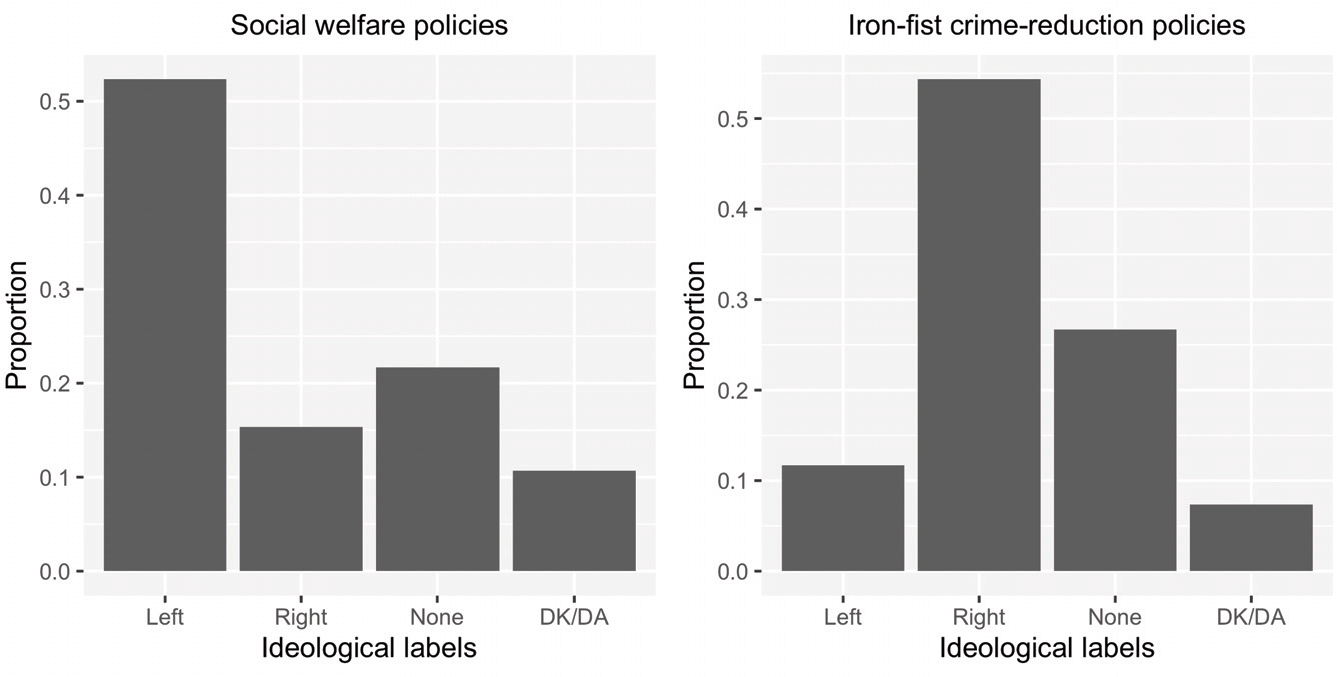
Subsequent questions evaluated whether respondents understood the difference between ideological labels; specifically, whether voters were able to connect social welfare and “iron fist” crime reduction policies with particular ideological markers. As previous research has shown, the former can be typically associated with left-wing politicians (Pribble Reference Pribble2013) and the latter with right-wing politicians (Cohen and Smith Reference Cohen and Smith2016). Figure 1 reveals that 52 percent of respondents were able to connect social welfare policies with left-wing politicians and 54 percent were able to connect iron fist policies with right-wing politicians (see questions in appendix M). These results show that more than half of the respondents could provide content to ideological labels.
Ideological Labels and Policy Content

Conjoint Experiment: The Role of Ideology for Voters and Nonvoters
The main goal of this study is to assess whether a candidate’s ideology is a relevant attribute for explaining voters’ electoral choices in the era of voluntary voting in Chile. If this label is important, we would expect respondents who identify themselves with a particular ideology to actually vote for candidates with that ideological marker. Thus, self-identifying on the left-right spectrum is meaningful. When evaluating the conjoint experiment, the size of these effects will also provide information about the salience of ideology; specifically, it will make it possible to directly compare them with the impact of candidates’ profession and age (that is, valence attributes).
The study includes an interaction between the randomized candidate attributes (ideology, age, and education) and the binary indicator of likely voters to study the role of ideology in times of voluntary voting. The estimation equation is implemented in four subsamples: left, right, centrist, and nonidentifiers. Appendix F constructs the subsamples using Zechmeister’s 2015 coding approach as a robustness check, since it is slightly different from the one used by the CEP (2017). The results are the same regardless of the coding strategy.
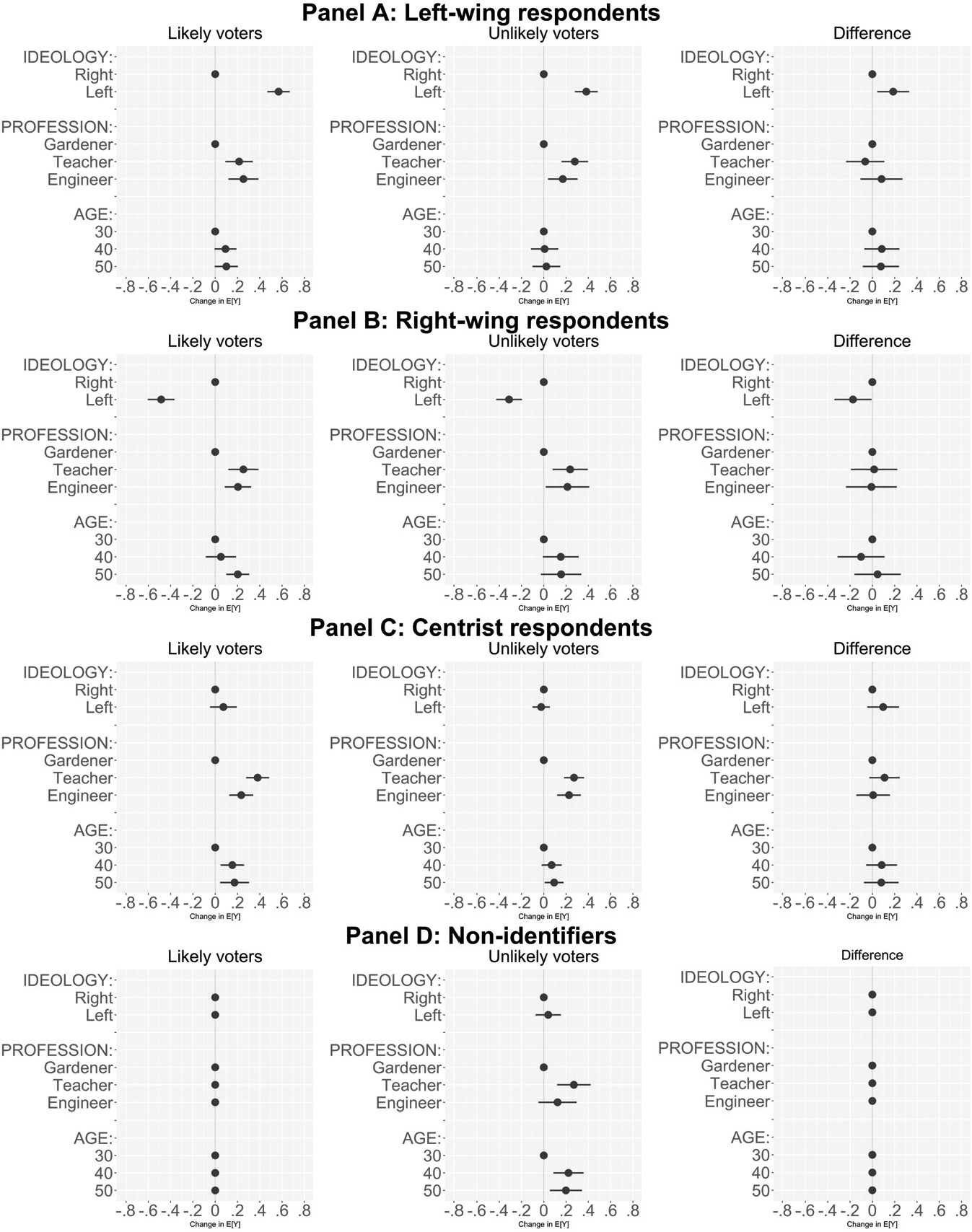
Figure 2 summarizes these main findings. The first panel provides results for likely and unlikely left-wing voters (310 and 384 observations).Footnote 10 The second panel does the same for likely and unlikely right-wing voters (230 and 244 observations), the third for likely and unlikely centrist voters (508 and 876 observations), and the fourth for likely and unlikely nonidentifiers (0 and 320 observations). The dots indicate point estimates, and the lines indicate 95 percent confidence intervals. The reference categories are the dots without confidence intervals (the first category for each attribute).Footnote 11
Effects of Candidates’ Attributes on Probability of Being Preferred for President

Panel A reports the results for left-wing respondents. The first figure focuses on likely voters, showing that they are 57 percentage points more likely to vote for a left- rather than a right-wing presidential candidate (reference category). When comparing this point estimate with the valence categories, the coefficient for ideology is more than 2.2 times larger than the second-largest estimate. The second figure shows that unlikely left-wing voters are 38 percentage points more likely to vote for a left- rather than a right-wing candidate (reference category). However, in this case, the point estimate for ideology is only 1.4 times larger than the second-largest estimate. Therefore, ideological voting has much more explanatory power in explaining likely rather than unlikely left-wing respondents’ electoral choices. The third figure confirms this difference by showing that likely left-wing voters are 19 percentage points more likely than unlikely left-wing voters to rely on candidates’ ideological labels when making electoral choices.
Panel B reports the results for right-wing respondents, showing that likely voters are 49 percentage points less likely to vote for a left-wing than for a right-wing candidate (reference category). This point estimate is 1.9 times larger than the second-largest point estimate. The second figure shows that unlikely voters are 31 percentage points less likely to vote for a left- rather than a right-wing candidate (reference category). The point estimate for ideology is only 1.3 times larger than the second-largest estimate. The third figure shows, as in the case of left-wing respondents, that there is a significant difference between likely and unlikely right-wing voters. The former are 17 percentage points more likely than the latter to rely on candidates’ ideological labels when making electoral choices.
Panel C summarizes the results for centrist respondents. Here the story is different: they do not rely on candidates’ ideological labels to make electoral choices, and there is no significant difference between likely and unlikely voters. Accordingly, centrist respondents pay attention to valence attributes, such as profession and age, to choose between candidates.
Panel D reports the results for the nonidentifiers. As illustrated in the first figure, there are zero nonidentifiers that can be classified as likely voters using the three questions mentioned in the previous section. Therefore, there are no results for the first and third plots. The coefficients from the second figure show that the non-identifiers rely on valence attributes to make electoral choices.
However, making strong inferences about centrists’ and nonidentifiers’ lacking ideological preferences requires further analysis. Those individuals might actually be latent left- or right-wing voters, and thus they could be canceling out their ideological preferences when analyzing them as a group. This possibility is explored next. The regression tables used to construct figure 2 are presented in appendix G, and a diagnostic for profile effects and a balance check appear in appendix H.
Unraveling the Preferences of Centrists and Nonidentifiers
The results for centrists and nonidentifiers can have different explanations. First, it might be the case that they are not ideological and therefore do not have preferences for either left- or right-wing candidates. Second, some of these respondents might be hidden ideological voters who do have ideological preferences for left- or right- wing candidates but are canceling them out when we cluster them in the same group of citizens.
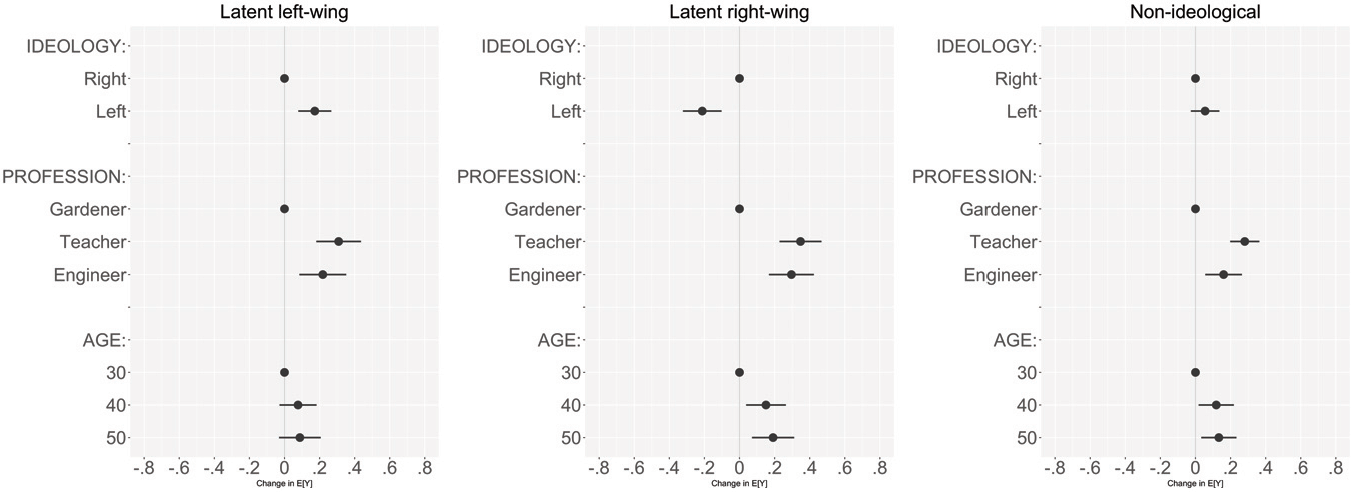
In an attempt to identify hidden or latent ideological respondents among centrists and nonidentifiers, three extra survey questions were used: approval of the government, support for iron fist policies, and connection between iron fist policy preferences and politicians’ ideological labels. Using these questions, a sample of latent left- and latent right-wing respondents was generated. Centrists and nonidentifiers who were not latent left- or right-wing were considered to be nonideological. Appendix I expands on how these groups were created. Figure 3 shows the results for the conjoint experiment in each of these three groups (516, 440, and 748 observations, respectively).
Effects of Candidates’ Attributes for Centrists and Nonidentifiers

Latent left-wing respondents are 17 percentage points more likely to vote for a left- than for a right-wing candidate. Therefore, these results illustrate that there are hidden left-wing respondents who place themselves at the center of the ideological spectrum or who do not answer the ideology question but prefer left-wing candidates. As expected, the importance of ideological labels for these respondents is not as high as for self-identified left-wing respondents. The size of the point estimate is similar to the results for profession.
Latent right-wing respondents are 21 percentage points less likely to vote for a left- than for a right-wing candidate. These results show again that there are hidden right-wing respondents among the participants who consider themselves centrists or nonidentifiers. As with latent left-wing respondents, the salience of the ideological attributes is similar to the salience of the valence attributes. Therefore, latent left- and right-wing respondents do rely on candidates’ ideological labels but less so than do self-identifying left- and right-wing respondents, and they rely more on valence attributes to make electoral choices. Moreover, nonideological respondents, as expected, do not rely on candidates’ ideological labels. Latent left- and right-wing respondents represent 56 percent of the subgroup of centrists and nonidentifiers. This evidence opens new doors for exploring this group of subjects who do not self-identify as left or right but who rely on ideological labels when making electoral decisions.
Ideological and Nonideological Respondents
The results from the conjoint experiment show that candidates’ ideological labels are the most important factors in electoral decisionmaking for left- and right-wing voters. They also illustrate that ideological labels are relevant for certain centrists and nonidentifiers. This group of left, right, and latent left- and right-wing respondents represents 72 percent of the sample, and from now on we will call them ideological respondents. This is the subset of the sample that used ideological labels to make electoral choices. The respondents who do not rely on ideology are the nonideological respondents identified in previous sections, who correspond to some centrists and nonidentifiers who do not consider candidates’ ideological labels to select between candidates.
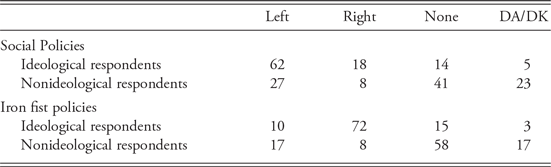
Table 2 shows how ideological respondents do a better job at providing ideological content to policy preferences than nonideological respondents. This might help explain why these individuals rely more on candidates’ ideological labels when making electoral decisions, since these labels are meaningful markers for them. The same questions were used as in figure 1, where respondents connected social policies and iron fist crime reduction policies with ideological labels (i.e., left, right, and none).
Ideological Respondents and Policy Content (percent)

The results show that 62 percent of ideological respondents connect social policies with left-wing politicians, and only 27 percent of nonideological respondents make the same association. Additionally, 72 percent of ideological respondents connect iron fist policies for reducing crime with right-wing politicians, while only 8 percent of nonideological respondents make the same association.
However, in a country with voluntary voting, such as Chile, the importance of ideology will be determined not only by the number of ideological citizens, but also by those individuals’ willingness to engage with and participate in the electoral process. Therefore table 3 presents a direct comparison between ideological and non-ideological citizens in terms of their willingness to participate in the electoral process.
Ideological and Likely Voters

*p < 0.1; **p < 0.05; ***p < 0.01
Two-sample t-test
The results show that ideological respondents are 32 percentage points more likely to vote than nonideological respondents. In a context of voluntary voting, this is particularly significant, since it means that this group has a greater chance of influencing electoral outcomes.
Thus, despite evidence that ideology has become less important over time, the findings from this study show that ideological voting remains common across a large subset of voters, and that this group is the most likely to participate in elections. Therefore, the reduction in the number of respondents who self-identified as left- or right-leaning might not have affected electoral outcomes because the adoption of voluntary voting provided an opportunity for those nonideological voters to opt out of the system.
Making a distinction between different types of voters can have meaningful implications for understanding the role of ideological voting, not only in Chile but also in other Latin American countries with voluntary voting. Though seeing a large proportion of respondents who do not place themselves on the ideological scale might make us think that this factor is not relevant for understanding people’s electoral choices, we should not underestimate the salience of ideology if latent ideological respondents are present and if nonidentifiers are less likely to engage and participate in politics.
CONCLUSIONS
The literature shows that ideology is, in fact, a significant predictor of vote choice in Latin America (Saiegh Reference Saiegh2015), and that voters from this region do form coherent ideological groups (Wiesehomeier and Doyle Reference Wiesehomeier and Doyle2012). However, the connection between policy stances and ideological labels is not always strong, which might suggest that for many voters in the region, the heuristic value of ideological markers is limited (Zechmeister Reference Zechmeister2015).
Since the early twentieth century, ideology has shaped citizens’ political decisions in Chile. This premise, however, has been called into question in recent years, due to the crisis of representation, the high level of congruence between the two main coalitions, the lower salience of the dictatorship in the political system, and the role of nonprogrammatic strategies for appealing to non–high-income voters. Nevertheless, the adoption of voluntary voting in 2012 makes things more complicated, because even if ideology is less relevant for the entire electorate, it might be very relevant for the people who are more engaged and interested in politics and are, as a result, the ones who vote.
To reevaluate the role of ideology in an era of voluntary voting, this study implemented a conjoint survey experiment in three municipalities that could represent election results at the national level. In these low-to-middle-income municipalities, voters should be less likely to rely on ideology when making voting decisions. The conjoint experiment allows us to simultaneously estimate the impact of multiple candidate characteristics and, therefore, to compare the importance of ideological and nonideological attributes in explaining respondents’ electoral decisions. The candidates’ attributes were interacted on a binary indicator of likely voters, which showed that subjects who have a greater likelihood of participating are more ideological than those who do not.
These findings provide context for the trend in the literature by showing that ideology remains a significant predictor of vote choice among people who vote. Though seeing an increasing proportion of respondents who do not place themselves on the left-right scale might make us think that ideology is becoming less relevant for explaining electoral outcomes, if these respondents are not participating in politics, the salience of ideology can remain stable (or even increase), since the people who vote are more ideological.
The Chilean Spring of 2019–20 resignified the debate about ideological voting. At the beginning of the conflict, the ideological divisions between the main political actors blurred, since most of them attempted to connect with the deep sense of unfairness and anger expressed by the protesters. Shortly afterward, however, the ideological groups reconsolidated into their traditional forms. Some of the issues that divided political groups along ideological lines were support for the front line (primera linea) or the yellow vests (chalecos amarillos), to provide two symbolic examples.Footnote 12
In short, this study shows that ideology remains central to Chilean politics, and its salience seems unlikely to decrease in the near future. Indeed, the emergence of new parties and candidates with high programmatic and ideological commitments speaks to this continuity. In the 2017 presidential elections, for example, the two most-voted-for candidates who did not belong to the traditional center-left or center-right coalitions, Beatriz Sánchez and José Antonio Kast, were able to obtain large shares of the vote with clear (and also antagonistic) ideological speeches. Though ideological labels can mutate over time and voters might be less likely to speak in ideological terms, ideology is a sticky concept that helps voters make electoral choices based only on a few pieces of information. The issues that divide society in Chile today, as well as in other Latin American countries, such as inequality, immigration, abortion, and same-sex marriage, show that ideology continues to take on new forms and to remain central to political discourse and policy.
SUPPORTING INFORMATION
Additional supporting materials may be found with the online version of this article at the publisher’s website: Appendix. For replication data, see the author’s file on the Harvard Dataverse website: https://dataverse.harvard.edu/dataverse/laps