On July 14, 2016, in Nice, France, a terrorist attack by a heavy truck rushing in the crowd occurred after the traditional National Day fireworks along the “Promenade des Anglais.” Around 30,000 people were present, including many babies, children, and their parents; 86 people were killed, including 10 children and adolescents, and about 500 others were injured. This attack was particularly violent, including the vision of horror scene and the eruption of panic. Exposure and proximity to an attack of such violence make the pediatric population vulnerable to the development of posttraumatic stress disorder (PTSD).Reference Santiago, Ursano and Gray 1 It is important to detect symptoms early,Reference Kessler 2 because, if left untreated, they can be severely debilitatingReference Cohen, Bukstein and Walter 3 and may lead to developmental problems.Reference Yates, Dodds, Sroufe and Egeland 4 - Reference Scheeringa, Myers, Putnam and Zeanah 5 The effects on public health care, social cohesion, and societal evolution of the city of Nice and surrounding areas have been extreme, involving a large pediatric population aged from a few days to 18 years. Therefore, this article aims to testify the type and characteristics of the psychological intervention that were carried out in the emergency context.
Organization of the Care Setup Within an Hour Following the Attack (11:00 PM)
After severe events, such as disasters or terrorist attacks, the emergency organization of hospitals in France, Plan Blanc (“white plan”), is immediately activated. This device defines emergency procedures for the reception and treatment of a large number of victims, including a psychiatric component. The “white plan” includes an emergency cellule with representatives of all hospital departments, as well as dedicated professionals especially trained for such events. Therefore, within the hour after the attack, an operational multidisciplinary child and adolescent psychological team was fully operative, with the first health care professionals being present within 20 minutes. The team was situated outside of the emergency department using the pediatric outpatient facilities, and composed of 5 child and adolescents psychiatrists, 2 nurses-in-chief, 2 nurses, a psychologist, and a secretary. In addition, a child psychiatrist, psychologist, and psychiatry resident were present directly in the pediatric emergency unit.
Upon arrival, a census of patients was taken. Until midnight, 17 persons were officially counted (5 children and 12 adults), underestimating the actual number of consultations. In fact, some victims were not registered in this first hour due to the initial lack of registration facilities.
The main objective of the immediate therapeutic intervention was to provide a secure framework, to give information, to contain the distress of individuals, and to arrange early preventive interventions for posttraumatic reactions, such as acute stress disorder.Reference Peltonen and Punamäki 6 - Reference Kearns, Ressler, Zatzick and Rothbaum 7
In addition, caregivers at the pediatric emergency unit have been confronted with the following unusual demands and practices: (1) trying to help parents find their children; (2) handling the announcement of deaths; and (3) taking care of all family members (children, parents, brothers, sisters, cousins, grand-parents, etc).
Creation of the Pediatric CUMP
In response to the ongoing demand of psychological emergency consultations and the distress of children, adolescents, and their families, a pediatric medico-psychological emergency unit (Cellule d’Unité Medico-Psychologique, CUMP) has been organized during the following 15 days, officially related to the CUMP Provence-Alpes-Côte d’Azur and validated by the Ministry of Health. In fact, the intervention of CUMP corresponds to a specific organization in FranceReference Cremniter and Laurent 8 as a response to important emergency situations. CUMP has been created in 1997 following the 1995 subway bombing in Paris as a mental health care mobile unit in each department providing immediate and short-term intervention for collective psychological trauma.Reference Crocq 9 Nevertheless, the creation of a specific pediatric CUMP within a general pediatric hospital has been a novelty for the French health care system. In addition, this pediatric CUMP had the specificity to be organized in a specific place dedicated to children and their families, and worked in conjunction with (1) the adult CUMP; (2) hospital emergency units; (3) child and adolescent psychiatry; and (4) adult community centers.
Psychological Care During the 48 Hours Following the Attack
The majority of French child and adolescent psychiatrists have both psychotherapeutic (eg, psychodynamic and/or cognitive-behavioral) and family therapy training. The main objectives of the pediatric CUMP were to (1) create a response to a psychiatric emergency, (2) organize and relay care, and (3) detect risk factors for clinical pathologies. In particular, we observed (1) acute stress disorders; (2) dissociative responses with derealization, depersonalization, and amnesia; (3) anxiety reactions; (4) depressive reactions; and (5) somatic troubles. 10 Children with extreme or complicated stress reaction or presenting prior mental health disorders were oriented to follow up care. Families had been advised to recontact the emergency unit in the case of the aggravation of symptoms or persistence beyond the first month.
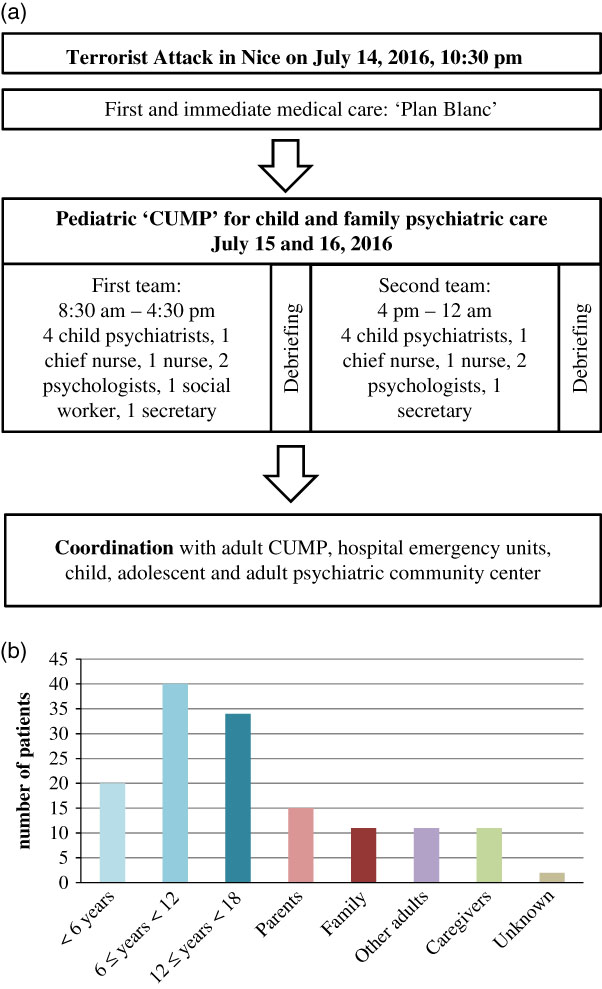
During the first two days, on July 15 and 16, the medical staff consisted of 15 child and adolescent psychiatrists, 6 psychologists, 2 chief nurses, 4 nurses, 1 social worker, and 4 secretaries, with each day divided into 2 teams (8:30 AM – 12 AM; Figure 1a). The number of children and adults received at the pediatric CUMP on July 15 and 16, 2016, is represented in Figure 1b: 146 individuals, including 94 children (64.5%), with an average age of 9 years (y) and 4 months (m; SD 5y, 2 m), and 52 adults (34%) with an average age of 36 y, 2 m (SD 14 y, 2 m). Among them, 87 people were present on the “Promenade des Anglais” at the time of the attack, including 62 children (71%) and 25 adults (29%).
1a. Organization of the Psychological Emergency Care Within the Children’s Hospitals of Nice CHU-Lenval During the First 48 Hours After the Terrorist Attack of July 14, 2016. 1b. Age Distribution of Individuals Seen at the Pediatric CUMP on July 15 and 16, 2016.

DISCUSSION
Our experience leads us to conclude that it seems necessary to adapt the logistics and training of health care workers to psychotrauma and its pediatric specificities to be able to cope with an unexpected emergency situation of mass psychotrauma as experienced in Nice. In addition, it is important to have a computerized data processing system with trained personnel to register people arriving in such context, essential for identification as well as tracking immediate clinical evaluation and the organization of follow-up.
Furthermore, the Nice pediatric CUMP underlines the importance to organize a specialized psychiatric reception dedicated to children and family victims of a terrorist attack. In fact, the particularities of stress reactions in children, child-parent interaction as well as the impact on the whole family need specialized trained professionals. Consultations of families should include a time for the reception of the whole family followed by a time for the evaluation of each child as well as the parents, thus implicating several professionals. There is also need of adapted material for consultations of children to mediate the expression by additional means than language, such as specific toys, pencils, and pens. The time of such consultations should not be underestimated and will generally be of at least 1 hour, depending on the family composition and symptoms.
Unfortunately, our unique experience does not allow concluding for the optimal number and configuration of mental health care professionals in the situation of mass trauma including children and families, and experiences of different sites should be pooled and analyzed to respond to this question. In addition, according to the experience of previous natural or industrial disasters, despite the rapid setup of emergency psychological care, it is important to set up a medium- and long-term care for exposed children.Reference Pfefferbaum, Newman and Nelson 11 In fact, especially infants under age 3 years represent a particularly vulnerable population requiring specialized health care professionals,Reference Scheeringa, Myers, Putnam and Zeanah 5 needing to be considered in the immediate care but also for the follow-up.
Finally, up to today, it is not possible to completely evaluate the impact of the Nice terrorist attack on the pediatric population and its families as well as on child development. To respond to these questions, follow-up studies should be conducted.
Acknowledgments
The creation of the pediatric CUMP in Nice was supported by the CHU-Lenval hospital and principally funded by the General Health Administration (DGS). We gratefully thank all participating professionals.
Conflict of Interest
The authors declare no conflict of interests.