There has been a steady increase in international student enrolments in industrialised English-speaking countries (e.g., Bhandari & Blumenthal, Reference Bhandari and Blumenthal2010). Australia has outpaced its fellow English-speaking nations in this regard, with a 600% increase in enrolments over a 15-year period, predominantly (>80%) from Asian countries (Australia Education International [AEI], 2010).
Despite the many advantages of international study — to the student, the university, and the local community (Wang, Reference Wang2004) — a number of studies have reported an increased risk of stress-related difficulties in students transitioning from school to university (Morton, Mergler, & Boman, Reference Morton, Mergler and Boman2014), particularly international students (Galloway & Jenkin, Reference Galloway and Jenkins2005). It has been suggested that this is in part because international students are confronted by sociocultural stressors, including the challenge of acculturating to the host university environment, to the culture, and even the language (Cheng & Erben, Reference Cheng and Erben2012) of the host society (Khawaja & Dempsey, Reference Khawaja and Dempsey2008), as well as the challenges of forming new cohesive peer groups with domestic students of the host culture (Mikal, Yang, & Lewis, Reference Mikal, Yang and Lewis2015). There is also evidence that exposure to such acculturative stressors can have a pervasive and long-term impact on psychological wellbeing. Acculturative stress is not only a common feature of international students seeking university counselling services (Khawaja & Dempsey Reference Khawaja and Dempsey2008; Nilsson, Butler, Shouse, & Joshi, 2004), but it is also linked to substance abuse (Félix-Ortiz, Reference Félix-Ortiz1999), anxiety (Hovey, Reference Hovey2000), depressive symptomatology, and suicidal ideation (Walker, Wingate, Obasi, & Joiner, Jr., Reference Walker, Wingate, Obasi and Joiner2008) in students.
There is reason to suspect that not all international students are equally affected by, or vulnerable to, acculturative stressors. Perfectionism, particularly maladaptive perfectionism, is thought to play an important role in the experience of acculturative stress and vulnerability to depression. Perfectionism is a stable personality trait (Cox & Enns, Reference Cox and Enns2003), one that involves setting high standards and having high expectations of self and others (e.g., Flett, Hewitt, Blankstein, & Gray, Reference Flett, Hewitt, Blankstein and Gray1998). In maladaptive perfectionism these expectations can be irrational and unrealistic; the individual may experience debilitating concern over minor mistakes and criticism from others and may be overly sensitive to perceived discrepancies between their expectations and actual performance (Slaney, Rice, Mobley, Trippi, & Ashby, Reference Slaney, Rice, Mobley, Trippi and Ashby2001). Maladaptive perfectionism is associated with numerous negative psychological outcomes, including vulnerability to stress and depression (Hewitt, Flett, & Ediger, Reference Hewitt, Flett and Ediger1996); it has been shown to co-occur with acculturative stress, depressive symptoms, and suicidal ideation (Nilsson et al., Reference Nilsson, Butler, Shouse and Joshi2008; Wang, Wong, & Fu, Reference Wang, Wong and Fu2013; Wei et al., Reference Wei, Heppner, Mallen, Ku, Liao and Wu2007), and it is prevalent in international students (Thomas & Althen, Reference Thomas, Althen and Pedersen1989).
In the present study we surveyed Asian international students studying in Australian universities in order to test two models of the relationship between acculturative stress and maladaptive perfectionism in relation to students’ depressive symptoms.
According to the moderation or diathesis-stress model (Hewitt, Flett, & Ediger, Reference Hewitt, Flett and Ediger1996; Hewitt & Flett, Reference Hewitt, Flett, Flett, Hewitt, Flett and Hewitt2002), maladaptive perfectionism is thought to constitute a risk factor for negative psychological outcomes, including depression, when stress is present and prolonged. Support for this model in the acculturative context comes from a study of Chinese international students studying in the United States (Wei et al., Reference Wei, Heppner, Mallen, Ku, Liao and Wu2007) for whom high levels of maladaptive perfectionism and acculturative stress were independently associated with depression for students who had only been in the United States for a short period of time. But, for those students who had been there longer, low maladaptive perfectionism was found to reduce — that is, buffer — the adverse effects of acculturative stress on depression. The inference from this was that all students experienced similar acculturative stress at the outset, but that those with low maladaptive perfectionism were better able to acculturate in the long term.
According to the mediation model (Hewitt et al., Reference Hewitt, Flett and Ediger1996; Hewitt & Flett, Reference Hewitt, Flett, Flett, Hewitt, Flett and Hewitt2002), maladaptive perfectionism has an impact on depressive symptoms indirectly by contributing to increased acculturative stress. No empirical evidence currently exists to support this model in the acculturative context. However, research does support a causal role for maladaptive perfectionism in other contexts. For example, Chang (Reference Chang2000) conducted a series of path analyses that revealed significant negative paths from maladaptive perfectionism to life satisfaction, and positive paths from maladaptive perfectionism to worry and negative affect, that were all significantly and positively mediated by stress. Significant direct paths were also observed. That is, maladaptive perfectionism was both a direct and indirect contributor to poor psychological outcomes. Extrapolating from Chang's (2000) results to the acculturative context, one would predict that maladaptive perfectionism contributes to depressive symptoms both directly and indirectly via acculturative stress.
The present study used path analyses to compare moderation and mediation models of the relationships between trait maladaptive perfectionism, acculturative stress, years in Australia and depressive symptoms in Asian international students studying in Australia. We hypothesised that both acculturative stress and maladaptive perfectionism would be positive predictors of depressive symptoms. On the basis of the moderation model, we further hypothesised that the two-way interaction between maladaptive perfectionism and stress would also be positively associated with depressive symptoms. If this interaction is due to the mitigating effects of low maladaptive perfectionism in students who have resided in Australia for a longer period of time (cf. Wei et al., Reference Wei, Heppner, Mallen, Ku, Liao and Wu2007), then a three-way positive interaction would also be expected between maladaptive perfectionism, stress, and years in Australia. On the basis of the mediation model, we hypothesised that maladaptive perfectionism would be positively associated with depressive symptoms by way of increased acculturative stress.
Method
Participants
Participants were 384 Asian international students (189 female, 193 male, 2 undeclared) aged between 17 to 47 years (M = 25.5, SD = 5.0) studying in Australia, for between .08 and 10.3 years (M = 2.3, SD = 1.7). Most were from China or Hong Kong (N = 156, 40.6%), India (N = 65, 16.9%) or Sri Lanka (N = 20, 5.2%), followed by Malaysia (N = 21, 5.5%), Indonesia, (N = 18, 4.7%), Iran (N = 17, 4.4%), and Vietnam (N = 15, 3.9%). Several other Asian nationalities were also represented with a count less than 10, including from the Philippines, Pakistan, South Korea, Bangladesh, Iraq, Japan, Thailand, Bhutan, Brunei, and Cambodia. The majority (90.6%) cited English as their second language.
Measures
The Acculturative Stress Scale for International Students (ASSIS)
The ASSIS uses 36 items to measure acculturative stress in international students (Sandhu & Asrabadi, Reference Sandhu and Asrabadi1994). Items assess perceived discrimination and hate, homesickness, fear, stress, guilt, and general concerns. Five-point Likert scales are used, ranging from 1 (strongly disagree) to 5 (strongly agree). Responses are summed, with higher scores representing greater acculturative stress. Validity and reliability of the scale are adequate (Constantine, Okazaki, & Utsey, Reference Constantine, Okazaki and Utsey2004; Sandhu & Asrabadi, Reference Sandhu and Asrabadi1994).
The Almost Perfect Scale Revised (APS-R)
The APS-R uses 23 items to measure perfectionism (Slaney et al., Reference Slaney, Rice, Mobley, Trippi and Ashby2001). Seven-point Likert scales are used, ranging from 1 (strongly disagree) to 7 (strongly agree). Responses are summed, with higher scores representing greater perfectionism. In the present study, only the 12-item ‘discrepancy’ subscale was used as the measure of maladaptive perfectionism (cf. Wei et al., Reference Wei, Heppner, Mallen, Ku, Liao and Wu2007). This subscale has adequate validity and reliability (Wang, Slaney, & Rice, Reference Wang, Slaney and Rice2007).
The Centre for Epidemiological Studies — Depression Scale (CES-D)
The CES-D uses 20 items to measure depressive symptomatology (Radloff, Reference Radloff1977). Respondents use 4-point Likert scales ranging from 0 (rarely or none of the time) to 3 (most or all of the time). Their responses are summed, with higher scores representing greater frequency of depressive symptoms over the previous week. The scale has adequate reliability and validity (Constantine et al., Reference Constantine, Okazaki and Utsey2004; Wang et al., Reference Wang, Slaney and Rice2007). Note that in the present study, one item from this scale was removed due to insufficient internal reliability (item total correlation <.2).
Procedure
The research was conducted in accordance with the National Statement on Ethical Conduct in Human Research and the project received ethical clearance from the Human Research Ethics Committee of the University of Ballarat and Deakin University. An online survey was used to collect the data. Recruitment was through email invitations sent to all international students enrolled at the University of Ballarat or Deakin University, as well as through snowball sampling via associates of the authors. Both universities are located in Victoria, Australia. Participation in the study was voluntary, anonymous, and open to students from all ethnicities and country of origin.
Results
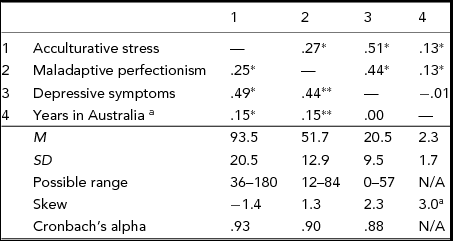
A total of 450 people responded to the survey. Four failed to provide country of origin and 53 were of non-Asian origin and excluded from analyses; one failed to provide information relating to years in Australia, one was removed as an extreme outlier (20 years in Australia), and one was removed as an extreme age outlier (89 years). Of the remaining cases, missing variable analysis revealed no item with greater than 2.6% missing values, and all missing values randomly distributed. Composite variables used in inferential analyses were constructed by summing internally consistent items (no items were excluded), and less than 1% of cases (six in total) had missing values for these variables and were excluded from analysis. The remaining 384 cases were retained. Variables for these participants were screened for normality and no violations were detected, with the exception of years in Australia, which was positively skewed, and thus a square-root transform was used in inferential analyses. Means, standard deviations, and Cronbach's alphas for these variables are shown in Table 1. Although the CES-D is not a diagnostic tool, its author proposes a cut-off of 16 for mild depressive symptoms (Radloff, Reference Radloff1977). Application of this cut-off to the current data suggests that a substantial proportion (54%) of our sample reported at least mild levels of depressive symptomatology. This confirms that depressive symptomatology is potentially important to a significant proportion of the international students we surveyed.
Descriptives and Bivariate Correlations Between Acculturative Stress, Maladaptive Perfectionism and Depressive Symptoms for Asian International Students (N = 384)

Note: *p < .01 (two-tailed); skew = skew statistic/standard error of skew; aThe square-root transformed version of this variable was used in inferential analyses. Right-diagonal cells contain correlations between latent variables calculated from raw scores; left-diagonal cells contain correlations calculated from factor scores obtained from confirmatory factor analysis. Note that descriptives are provided only for variables created from raw scores.
A MANOVA on acculturative stress, maladaptive perfectionism, years in Australia, and depressive symptoms by gender revealed no multivariate difference, F(4) = .98, p > .05, as well as no univariate between-subject differences for these variables, F(1, 382) = 3.20, .32, .91, .25, p > .05, respectively. Therefore, data from female and male participants were combined in subsequent analyses.
Inspection of the bivariate correlations in Table 1 reveals that acculturative stress and maladaptive perfectionism were both positively correlated with depressive symptoms, r = .51 and .44, p < .01, respectively. Although a significant quadratic relationship between maladaptive perfectionism and depressive symptoms was also obtained, the quadratic fit was not as reliable as the linear one, F = 47.9 versus 91.9, p < .001, respectively, and fit the data asymmetrically by way of only the right-ascending portion of the function; note that the inflection point of the quadratic fit was at -.03, an impossible value for maladaptive perfectionism, well below the mean of this variable (51.6), and even below the lowest score obtained for this variable (13). Therefore, hypotheses concerning the nature of the relationships between these variables were tested using linear path analyses conducted through the AMOS™ structural equation modelling package. To take into account measurement error in each of the latent variables in the model (maladaptive perfectionism, acculturative stress, and depressive symptoms), the version of these variables included in the model were calculated from factor scores (rather than raw scores) obtained via confirmatory factor analysis.
The following sections describe the results of the moderation and mediation models tested. By including all predictor variables and their interactions (two-way and three-way), and by modelling acculturative stress as both a direct and indirect predictor, we suggest that these analyses are comprehensive in that no meaningful equivalent or alternative models could be tested.
Moderation
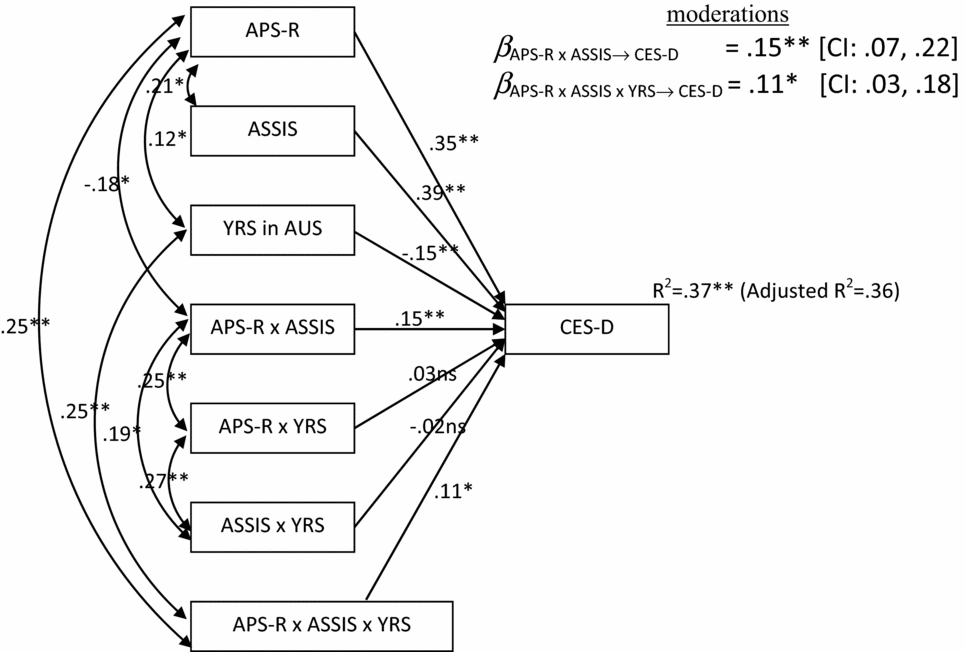
The model used to test the moderation paths is shown in Figure 1. It includes direct paths to depressive symptoms from three ‘main effects’ (maladaptive perfectionism, acculturative stress, and years in Australia), three ‘two-way interaction effects’ (product variables corresponding to two-way moderators), and a single ‘three-way interaction effect’ (a product variable corresponding to the three-way moderator). The tested model, with non-significant paths removed, accounted for significant variance in depressive symptoms in Asian international students, R 2 = .37, p <. 01 (adjusted R 2 = .36), and possessed acceptable fit statistics: CMIN (df = 15) = 43.38, p < .01, GFI = .97; NFI = .89; CFI = .92; RMSEA = .07. (We note that similar results and fit statistics were obtained regardless of whether the latent variables were represented by factor scores or raw scores.)
Structural equation model used to test direct and moderated paths on data from 384 Asian international students studying in Australia.

As can be seen from the significant, direct, standardised beta weights, maladaptive perfectionism and acculturative stress positively predicted variance in depressive symptoms. The two-way interaction between maladaptive perfectionism and acculturative stress also positively predicted variance in depressive symptoms, βAPS-R x YRS → CES-D = .15 [CI = .07, .22], p < .01, consistent with the hypothesis that acculturation mitigates the negative influence of perfectionism on depression. And a significant three-way interaction between maladaptive perfectionism, acculturative stress and years in Australia, βAPS-R x ASSIS x YRS → CES-D = .11 [CI = .03, .18], p < .05, suggests that this effect was more pronounced for students who had spent more time in Australia.
Mediation
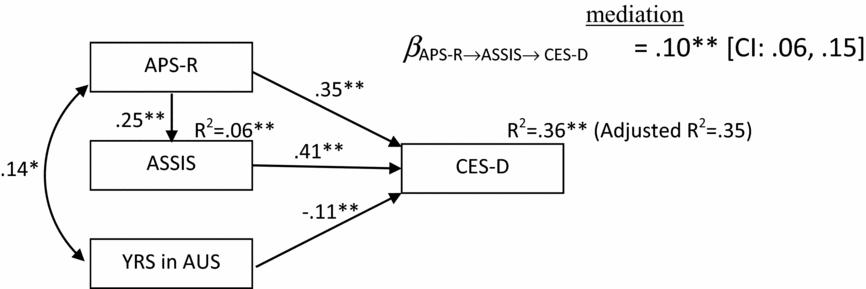
The model used to test the mediated path is shown in Figure 2. It includes direct paths to depressive symptoms from maladaptive perfectionism, acculturative stress and years in Australia, and a single indirect path to depressive symptoms — from maladaptive perfectionism by way of acculturative stress. The tested model, with non-significant paths removed, accounted for significant variance in depressive symptoms in Asian international students, R 2 = .36, p < .01 (adjusted R 2 = .35), and possessed acceptable fit statistics: CMIN (df = 1) = 5.22, p < .05, GFI = .99; NFI = .98; CFI = .98; RMSEA = .11. (Again, we note that similar results and fit statistics were obtained regardless of whether the latent variables were represented by factor scores or raw scores.)
Structural equation model used to test direct paths and a single mediated path on data from 384 Asian international students studying in Australia.

A bias-corrected bootstrap resampling method (Shrout & Bolger, Reference Shrout and Bolger2002) was used within AMOS to test the significance of the indirect path from maladaptive perfectionism to depressive symptoms via acculturative stress. The standardised beta weight corresponding to this indirect path was significant, βAPS-R → ASSIS → CES-D = .10, [CI = .06, .15], p < .01, and indicates that for every standard unit increase in maladaptive perfectionism, depressive symptoms increase by .1 units by way of increased acculturative stress.
Collectively, the results indicate that maladaptive perfectionism explained a total of 26% of variance in depressive symptoms, 12% directly, 10% indirectly by increasing acculturative stress, and 4% by increasing vulnerability to the effects of acculturative stress.
Discussion
Acculturative stress was found to be directly associated with increased depressive symptoms. This finding confirmed — in the Australian context — that prolonged acculturative stress in international students from Asia can have negative psychological consequences (Hewitt et al., Reference Hewitt, Flett and Ediger1996). Sources of acculturative stress may include perceived discrimination, language difficulties, homesickness and lack of support networks, financial/work difficulties, fear, guilt and stress, due to change that flows from difficult social experiences (Eustace, Reference Eustace2008; Sandhu & Asrabadi, Reference Sandhu and Asrabadi1994; Wang, Reference Wang2004; Wei, Wang, & Ku, Reference Wei, Wang and Ku2012; Yeh & Inose, Reference Yeh and Inose2003). Maladaptive perfectionism was also found to be directly associated with increased depressive symptoms in our international students. This finding confirmed that perfectionistic tendencies, such as setting unrealistic standards, engaging in critical self-evaluation, and employing rigid thinking that equates success with perfection and imperfection as a failure can be associated with negative psychological outcomes (Chang, Reference Chang2000).
The more interesting question addressed in the present study concerned the nature of the relationship between maladaptive perfectionism and acculturative stress in the context of depression. We compared a moderation and mediation model using separate path analyses that allowed for the possibility that both moderation and mediation paths (as well as the aforementioned direct paths) exist (see Figure 1). The moderation component of these analyses tested a diathesis-stress explanation of depression. In a previous test of this model, it was reported that low levels of maladaptive perfectionism mitigated the negative effects of acculturative stress on depression, at least in international students who had been in the United States for a relatively long period of time (Wei et al., Reference Wei, Heppner, Mallen, Ku, Liao and Wu2007). We observed a similar moderation effect in our study, one that was related to years spent in Australia, which thus provides support for the diathesis-stress model in the Australian context. Possible mechanisms to explain this moderation result might include unrealistic expectations by international students, based on earlier academic successes in their native country, and an over-valuation of academic excellence and/or family pressures to perform, particularly when overseas study is regarded as a costly investment by the family (Thomas & Althen, Reference Thomas, Althen and Pedersen1989). These mechanisms might be particularly salient for students of Asian origin as Asian families are particular likely to value academic excellence in their children (Castro & Rice, Reference Castro and Rice2003).
Maladaptive perfectionism was also found to predict depressive symptoms indirectly by way of increased acculturative stress. This result was thus in accordance with the mediation model proposed by Hewitt et al. (Reference Hewitt, Flett and Ediger1996). We suggest that maladaptive perfectionism is profoundly at odds with the process of acculturation and thus interferes with international students’ efforts to achieve authentic and healthy acculturative outcomes. Such outcomes require self-reflection, decision making, confrontation and compromise; that is, they require adaptation. The tendency for perfectionists to be unrealistic and rigid in their expectations and standards is counter to this.
Limitations
First, the study relied on self-report measures. This is potentially problematic considering that past studies have found that individuals from Asian cultures are more likely to conceal stress and depression from others (Kim, Atkinson, & Umemoto, Reference Kim, Atkinson and Umemoto2001; Sue & Sue, Reference Sue and Sue2003). Second, our results are not necessarily generalisable to the diverse Asian ethnicities that study in Australia and elsewhere in the Western world. Having said this, it is worth noting that the results of the path analyses were essentially unchanged when the 10% of non-Asian participants were included in analyses. Third, a cross-sectional design and correlational analyses were also employed, making it impossible to infer the presence or direction of causality.
Conclusions
Our confirmation of a direct relationship between acculturative stress and depression adds to a growing body of research recommending that university counsellors focus on addressing sources of adjustment-related stress in international students (Khawaja & Dempsey, Reference Khawaja and Dempsey2008). This should include the provision of programs that increase awareness among students, their parents and university staff about the consequence of poor transcultural coping (Cross, Reference Cross1995; Kaul, Reference Kaul2001). Given that international students commonly have fewer social supports than their domestic counterparts and are more likely to feel socially isolated (Jackson, Ray, & Bybell, Reference Jackson, Ray and Bybell2013), strategies aimed at bolstering social support in international students, such as providing peer mentoring programs and organising social activities, in addition to professional counselling (Nilsson et al., Reference Nilsson, Butler, Shouse and Joshi2008; Tung, Reference Tung2011), are also warranted.
Our discovery of complex relationships in which the influence of maladaptive perfectionism appears to be both mediated and moderated by acculturative stress has additional implications for university counsellors. Clearly, international students experiencing acculturative stress should be considered at particularly high risk if they also exhibit signs of maladaptive perfectionism. Moreover, at the level of prevention, we believe that early interventions might benefit from using maladaptive perfectionism to identify at-risk students and then targeting the acculturative stressors present (or soon to be present) in these students’ lives. Our reasoning is that unlike acculturative stress, perfectionism is a stable trait, one that can be measured reliably and thus potentially used to screen at-risk students even before they have relocated, commenced their studies and been exposed to any acculturative stressors. In this regard, it is encouraging to note that in our study, maladaptive perfectionism was a potent and reliable predictor of negative outcomes in students, explaining 26% of variance in depressive symptoms directly, as well as by a combination of indirect and interaction effects involving acculturative stress.
These results suggests that it is feasible to screen for maladaptive perfectionistic tendencies and to allocate resources (e.g., counselling, social support, mentoring) where appropriate to counter present and future sources of acculturative stress. More generally, our findings should encourage future research in the area to consider mediation models in addition to moderation models of acculturative stress in relation to other maladaptive traits.
Acknowledgments
None.
Financial Support
This research received no specific grant from any funding agency, commercial, or not-for-profit sectors.
Conflicts of Interest
None.