1. Introduction
When I was invited to give a plenary at the International Conference on Task-Based Language Teaching (TBLT), I hesitated because my research has not been carried out within TBLT theory, research, and practice. I expressed concerns to the conference organizers that as an ‘outsider’ I do not bring TBLT credentials to the table and wondered whether the conference delegates would prefer to have a TBLT expert on this podium – someone with proprietary rights in the TBLT community. When I communicated my reservations, the conference organizers assured me not to worry … that one of the reasons I had been invited was to provide an ‘outsider's perspective’ on some of the issues facing TBLT. Admittedly, the perspective that I bring does not come from too far away. My research is situated within instructed second language acquisition (ISLA), a subfield of SLA that is concerned with second language (L2) acquisition in ‘classrooms, language laboratories, or other settings where language is intentionally taught and/or intentionally learned’ (Spada & Lightbown, Reference Spada, Lightbown and Robinson2013, p. 319).
Even though ‘instruction’ is included in the ISLA acronym, there has been a tendency to focus more on learning than on teaching and the broader educational practices around L2 learning. This is related to the fact that most of ISLA research takes place in laboratory or quasi-laboratory settings. My own research has primarily taken place in intact classrooms with children, adolescent, and adult L2 learners and a good deal of it has focused on observing, describing, and characterizing language teaching in addition to investigating its contributions to L2 learning. Thus, I often feel more comfortable situating myself within the domain of classroom research in L2 learning and teaching. But for the purposes of this presentation, I will be using ISLA as the general reference point from which to examine ongoing and future work in TBLT.
2. TBLT and ISLA
Of course, there are strands of TBLT research that are also considered to be part of ISLA. This is because TBLT and ISLA have a shared history. Both have their roots in language education. Indeed, the origins of TBLT were to develop L2 curricula. Many TBLT and ISLA researchers started their careers as L2 teachers and were motivated to engage in research to improve teaching practices. They found a place to do this within the field of second language acquisition (SLA). Over the years, and as their work became more specialized, the two subfields of TBLT and ISLA emerged, with the focus on tasks in TBLT and instruction more broadly defined in ISLA.
Because of their common history, ISLA and TBLT share a similar path in terms of theoretical influences and empirical approaches and their evolution over time. Both emphasized psycholinguistic frameworks in the early years, and this has expanded to include sociolinguistic and sociocultural frameworks more recently. An emphasis on laboratory and quasi-laboratory studies using quantitative methods has been typical of research in both domains although this is slowly shifting to more classroom-based studies using qualitative and mixed methodologies.
In preparation for this plenary presentation, I have been catching up on my reading in the TBLT literature with two of the themes for this year's conference to guide me: Instruction and Outcomes. With respect to the first theme, I will focus my discussion on type and timing of instruction and corrective feedback (CF) in TBLT and ISLA research. With respect to the second theme, I will focus on how outcomes have been measured in TBLT (e.g. complexity, accuracy, fluency) and ISLA (e.g. accuracy, implicit/explicit knowledge). I will examine how these themes have been investigated in TBLT and ISLA and reflect on a few ways that research in each inform and enhance one other.
I added a third theme that I had not planned on addressing when I submitted my abstract a year ago – connections between theory, research, and pedagogy. As I read through the TBLT literature, it became evident that this has emerged as an important issue. Because this is a topic that is also of concern within ISLA and one that I have thought and written about, I decided to briefly address it as well.
3. Instruction
My research investigates the effects of instruction on L2 learning. More specifically, I have examined the effects of drawing learners’ attention to language in meaning-based contexts – that is, in communicative language teaching (CLT) programs where the primary focus and organizing unit is topics and themes rather than linguistic units. Within these contexts, I have been interested in the different ways in which learners’ attention can be drawn to language forms and whether there may be optimal times in the instructional sequence to do so. The central question motivating my research and that of many other ISLA researchers is whether and how these aspects of instruction affect L2 learning. Most of the research to investigate the effects of type of instruction on L2 learning have focused on explicit versus implicit approaches and this has resulted in several research syntheses and meta-analyses. The overall findings show that both types of instruction are beneficial but that there are stronger effects for explicit instruction (Spada, Reference Spada1997; Ellis, Reference Ellis2000; Norris & Ortega, Reference Norris and Ortega2000; Spada & Tomita, Reference Spada and Tomita2010; Goo, Granena, Yilmaz, & Novella, Reference Goo, Granena, Yilmaz, Novella and Rebuschat2015). These results are likely due to the fact that in most studies learners’ progress is measured using controlled written grammar tests. There is also a bias in the research literature with a larger number of studies investigating explicit as opposed to implicit instruction (Doughty, Reference Doughty, Doughty and Long2003). In recent years, however, there has been an increase in research to investigate the effects of implicit instruction on L2 learning that include tests to measure learners’ use of language in more natural, unrestricted, and communicative ways. Early findings indicate greater benefits for implicit compared with explicit instruction over the long term (Kang, Sok, & Han, Reference Kang, Sok and Han2018). These results clearly have relevance for TBLT with its focus on meaning-based communicative tasks to promote SLA.
4. Timing of instruction
Much more can be said about research that has examined the effects of type of instruction on L2 learning but I would like to turn my attention to the timing of instruction and specifically the question as to whether there are better times in the instructional sequence to draw learners’ attention to language form. It is a question that I have investigated in my ISLA research and is one that I believe has direct applicability for TBLT. My own research on the timing of instruction has been guided by a distinction that Patsy Lightbown and I make between isolated and integrated form-focused instruction (FFI). We define isolated FFI as attention to language that is provided separately from communicative practice and integrated FFI as attention to language embedded within communicative practice. Both isolated and integrated FFI include attention to form and meaning. The only difference is when attention to form is provided in the instructional sequence, that is, before, after, or during communicative input and interaction activities. Both isolated and integrated FFI include instruction and CF, which can be explicit or implicit (Spada & Lightbown, Reference Spada and Lightbown2008).
There are pedagogical arguments in support of both types of FFI. For example, some teachers and teacher educators argue that isolated FFI is best because learners, particularly those at low proficiency levels, are not able to pay attention to everything at once. Thus, it makes sense to separate attention to form and meaning. Isolated FFI is also thought to be more motivating for learners because they are not interrupted with CF or information about how language works when they are engaged in communicative interaction. Other L2 educators argue that integrated FFI is best because it is more efficient, that is, students can focus on form and meaning at the same time. Integrated FFI is also considered to be motivating for learners because they know that immediate help (e.g. CF) is available precisely when they need the correct forms to express their meanings. Interestingly, in research to investigate teachers’ opinions about isolated and integrated FFI, even though they express a distinct preference for integrated FFI, they also emphasize the value of isolated FFI. Second and foreign language learners express similar views (Valeo & Spada, Reference Valeo and Spada2015).
A theory in cognitive psychology that is compatible with the view that both isolated and integrated FFI are beneficial for L2 learning is transfer appropriate processing (TAP). It is based on the hypothesis that when we learn something our memories record not only the item learned but the cognitive and perceptual processes that were engaged during learning. For example, when we learn a new word, our memories encode information about the word and the context and processes engaged in when we learned it. Later, when we try to remember the word, the chances of retrieval are better if we are in a situation that is similar to the one in which it was originally learned (Morris, Bransford, & Franks, Reference Morris, Bransford and Franks1977; Blaxton, Reference Blaxton1989). If we extend TAP to L2 learning, one could argue that L2 knowledge that derives from attention to language form in an isolated manner will be more easily retrieved in isolated grammar activities and L2 knowledge that derives from attention to form embedded in communicative interaction will be more easily retrieved in communicative interaction.
Viewing isolated and integrated FFI as complementary approaches, Patsy Lightbown and I hypothesized that their effects on L2 learning might differ depending on the type of language feature targeted. For example, isolated FFI may be more appropriate when it comes to learning less salient language features – ones that are not easily heard or noticed in the input (3rd person ‘s’ in English) or with first language (L1) influenced features that are difficult to overcome. Integrated FFI, however, might work better with task-essential structures – ones that are highly likely to occur in communicative tasks (e.g. the use of the conditional in hypothetical situations). Integrated FFI might also be more beneficial for language features with complex rules that are difficult to teach in an isolated manner (e.g. articles in English) (Spada & Lightbown, Reference Spada and Lightbown2008). To date, few studies in ISLA have investigated whether isolated and integrated FFI contribute to differences in L2 learning. I carried out one study with my research group at the University of Toronto (Spada, Jessop, Suzuki, Tomita, & Valeo, Reference Spada, Jessop, Suzuki, Tomita and Valeo2014) and there have been a handful of others (File & Adams, Reference File and Adams2010; Elgün-Gündüz, Akcan, & Bayyurt, Reference Elgün-Gündüz, Akcan and Bayyurt2012; Barrot, Reference Barrot2014). The results are mixed, showing equal benefits for both types of instruction as well as greater benefits for either integrated or isolated FFI in relation to different types of L2 knowledge and ability. Indeed, the diversity of findings almost matches the number of studies!
Reading through the TBLT literature, I was interested to discover that there is some recent research that has focused on the timing of FFI (Li, Zhu, & Ellis, Reference Li, Zhu and Ellis2016). This is situated within TBLT work that calls for more attention to language form and is based on the assumption that meaningful interaction and implicit reactive feedback alone are not sufficient for L2 development. Indeed, the majority of instructed L2 learners do not have access to the vast amounts of input required to learn language in this way. Even L2 learners who have opportunities for considerable exposure do not acquire all aspects of language implicitly and continue to experience difficulties with specific aspects of language. This has been thoroughly documented in ISLA research investigating the L2 development of learners in content-based language teaching programs (Lightbown, Reference Lightbown2014; Tedick & Lyster, Reference Tedick and Lyster2020). Research in TBLT that has focused on questions about when to draw learners’ attention to form is based on the view that there are benefits of explicit instruction and CF in L2 learning and that there is a role for a proactive approach to focusing on language. This necessarily involves a greater role for the teacher.
Looking at this strand of TBLT research from the prism of isolated and integrated FFI, it appears that most of it is consistent with integrated FFI. This is undoubtedly related to the fact that instruction has played a less prominent role in TBLT research. The focus has been on corrective CF and other interactional moves in communication, all of them by definition integrated FFI, and specifically on the type of CF (explicit or implicit). Indeed, many studies in TBLT and ISLA have been conducted to determine the utility and/or efficacy of different types of oral CF feedback in promoting L2 development. A beneficial role for CF is well established; several reviews and meta-analyses collectively indicate that CF facilitates L2 development and that both implicit and explicit CF are effective depending on a wide range of variables including learning context, linguistic targets, and learners’ age and proficiency levels (e.g., Russell & Spada, Reference Russell, Spada, Norris and Ortega2006; Mackey & Goo, Reference Mackey, Goo and Mackey2007; Li, Reference Li2010; Lyster & Saito, Reference Lyster and Saito2010; Lyster, Saito, & Sato, Reference Lyster, Saito and Sato2013). As with ISLA research, few TBLT studies have investigated questions about whether the timing of CF makes a difference, but they are beginning to emerge.
5. Timing of CF
Questions about the timing of CF in TBLT have theoretical and pedagogical relevance. For example, the Interaction Hypothesis (Long, Reference Long, Ritchie and Bahtia1996) and Skill Acquisition Theory (SAT) (DeKeyser, Reference DeKeyser, Van Patten and Williams2007) argue for the benefits of providing immediate CF during communication (i.e. integrated FFI). This is thought to lead to implicit knowledge from the perspective of the Interaction Hypothesis and to proceduralized explicit knowledge within SAT. Another theory, Preparatory Attention and Memory (McDaniel, Robinson, & Einstein, Reference McDaniel, Robinson and Einstein1998), is based on the claim that learning is enhanced when complete attention is given to the task at hand rather than divided between multiple tasks. This is used to support delayed CF provided after communicative practice. It is thus consistent with isolated FFIFootnote 2. Teachers are often advised to avoid correction when fluency practice is the objective (Hedge, Reference Hedge2000) and to provide immediate correction if accuracy is the objective (Scrivener, Reference Scrivener2005). These recommendations are based to some extent on theory but primarily on the basis of pedagogical knowledge and experience. However, what is lacking in both these theoretical predictions and pedagogical recommendations is evidence. That is, what does research to examine these questions reveal about the timing of CF?
One of the earliest experimental studies to investigate the timing of CF was conducted by Paul Quinn, a former PhD student, and situated within the framework of isolated and integrated FFI (Quinn, Reference Quinn2014; Quinn & Nakata, Reference Quinn, Nakata, Nassaji and Kartchava2017). A TBLT study that investigated the effects of delayed versus immediate CF on L2 learning was carried out by Shaofeng Li and colleagues (Li et al., Reference Li, Zhu and Ellis2016). Both studies focused on the passive voice and measured learners’ knowledge of the target form in terms of implicit/procedural and declarative/explicit knowledge. Quinn's study revealed equal benefits for immediate and delayed CF on all language measures. The Li et al. (2016) study also indicated that both CF types were effective in improving learners' use of the passive, and that for the development of explicit/declarative knowledge. To my knowledge, there are no other carefully designed experimental studies that have manipulated timing of instruction and CF and measured their effects on L2 learning in either the ISLA or TBLT literature.
An early descriptive TBLT study that documented when in the pedagogical sequence a teacher focused on language in meaning-based instruction and interaction was conducted by Virginia Samuda (Reference Samuda, Bygate, Skehan and Swain2001). What motivated her study was not the timing of instruction per se, but rather her observation that the teachers’ role in TBLT was not getting sufficient attention despite the fact that the teacher is a crucial mediating factor in task-based language development. In her research, Samuda described in detail how the teacher can ‘lead from behind’ to help learners make important meaning-form connections by moving from a focus on meaning into a focus on form, back to meaning and then form again in implicit and explicit ways via instruction and CF. Her analyses highlighted the complementary roles of task and teacher – how tasks create opportunities for negotiation of meaning and how teachers guide learners in making form-meaning connections. From my perspective, this is an excellent example of integrated FFI.
There is a need for more research – observational and experimental – to explore the effects of differential timing of instruction and CF on L2 development. It seems to me that TBLT is an ideal context in which to investigate this question precisely because it is premised on the development and implementation of meaningful/communicative/purposeful tasks as the primary organizational unit of instruction. The use of tasks easily permits the manipulation of the integration or separation of attention to language and an examination of their effects on L2 learning.
6. Outcomes
Having considered the timing of instruction and CF I now turn to learner outcomes. Figure 1 illustrates that outcomes in TBLT research are most often measured in terms of complexity, accuracy, and fluency – referred to as the CAF triad. Definitions for these constructs vary. Some examples are: complexity refers to the learners’ ability to use a range of sophisticated structures and vocabulary in the L2 (Bulté & Housen, Reference Bulté, Housen, Housen, Kuiken and Vedder2012); accuracy refers to the extent to which an L2 learner's performance deviates from the norm (i.e. usually the native speaker) (Housen, Kuiken, & Vedder, Reference Housen, Kuiken and Vedder2012); fluency is intended to capture the rate and/or amount of production in a given time (Segalowitz, Reference Segalowitz2010) and can include speed fluency, breakdown fluency and repair fluency (Skehan, Reference Skehan2009). While all three dimensions of L2 ability have been used in TBLT studies, according to a recent review of research on CAF in TBLT, the most frequently-used dimension is accuracy (Plonsky & Kim, Reference Plonsky and Kim2016).
Measurement of outcomes in TBLT and ISLA

In ISLA research, outcomes have also been measured primarily in terms of accuracy and typically in pre/post-test designs. While there have been studies that have measured the effects of instruction on the learners’ developing language using interlanguage (e.g. Doughty & Varela, Reference Doughty, Varela, Doughty and Williams1998) and emergence criteria (Mackey, Reference Mackey1999; Spada & Lightbown, Reference Spada and Lightbown1999), they are few in number. Most recently, efforts are underway to measure instructional effectiveness in terms of explicit (conscious, declarative) and implicit (unconscious, intuitive) knowledge (Ellis et al., Reference Ellis, Loewen, Elder, Erlam, Philp and Reinders2009; Akakura, Reference Akakura2012)
Within the TBLT literature, several issues have been raised about CAF including differences in their definition and operationalization, concerns that CAF research is primarily performance based not developmental, and that CAF descriptors are not specific to particular domains of language (e.g. grammar, vocabulary, discourse) (Bygate, Reference Bygate2020). Other concerns point to a lack of clarity as to how CAF dimensions relate to functional dimensions of proficiency and communicative adequacy (Pallotti, Reference Pallotti2009), and the need to investigate CAF as a dynamic and interrelated set of constantly changing subsystems (Norris & Ortega, Reference Norris and Ortega2009).
Recognizing the concerns with the CAF triad, I am nonetheless intrigued to explore how it might play a greater role in ISLA research – particularly fluency and complexity – given the predominance on accuracy as the focus of research. CAF analyses have the potential to provide a more multidimensional view of L2 development over time in instructional settings. Furthermore, given that the aim of L2 teaching is to develop the ability to communicate successfully, and that these three performance dimensions play important roles in L2 communicative success, this seems to be a worthwhile and important avenue to pursue.
Investigating the link between CAF measures in relation to the effects of instruction on L2 development has both theoretical and pedagogical significance. One could argue, for example, that isolated FFI leads to greater attention to accuracy and increased monitoring behavior on the part of learners. If one takes the perspective of L2 speech production models, this attention is likely to slow down speech formulation processes and lead to a decrease in fluency (Kormos, Reference Kormos2006). Thus, a potential pedagogical implication is that teachers should provide minimal CF during fluency work. On the other hand, attention to accuracy within communicative interaction (e.g. integrated FFI) could lead to greater fluency without a decrease in accuracy. Some models of task-based production predict a trade-off between accuracy and complexity (Skehan, Reference Skehan1998, Reference Skehan and Bygate2015) or a simultaneous increase in both (Robinson, Reference Robinson2001). While these issues have been addressed in relation to learner performance under different task conditions, few studies have used CAF to measure instructional effects on L2 learning over time. Two exceptions include Alan Tonkyn (Reference Tonkyn, Housen, Kuiken and Vedder2012), who documented gains in CAF in L2 speaking skills after a 10-week English for Academic Purposes course, and Parvaneh Tavakoli and colleagues, who investigated the effects of a 4-week intervention of awareness-raising activities and fluency strategy training on learners’ fluency development (Tavakoli, Campbell, & McCormack, Reference Tavakoli, Campbell and McCormack2015).
No research, to my knowledge, has investigated the development of all three dimensions of the CAF triad in relation to different types of instruction. One explanation for this absence is that CAF measures are global in nature and not sufficiently sensitive to capture slight differences in performance after pedagogical interventions that typically focus on a specific linguistic feature. However, as pointed out by Marije Michel (Reference Michel, Loewen and Sato2017), ‘with the development of more fine-grained measures (for example, the ones proposed by Lambert & Kormos, Reference Lambert and Kormos2014, for syntactic and by Jarvis, Reference Jarvis2013, for lexical complexity, respectively) and scores (for example, Foster & Wigglesworth, Reference Foster and Wigglesworth2016, weighted accuracy score) future work will hopefully aim to capture instructional effects by means of CAF’ (p. 63).
A focus of increased attention in ISLA is the development of measures for explicit and implicit L2 knowledge – especially implicit knowledge because it is more difficult to measure. Several efforts have been made to develop and validate different measures of implicit knowledge (Jiang, Reference Jiang2007; Ellis et al., Reference Ellis, Loewen, Elder, Erlam, Philp and Reinders2009; Spada, Shiu, & Tomita, Reference Spada, Shiu and Tomita2015; Zhang, Reference Zhang2015; Suzuki & DeKeyser, Reference Suzuki and DeKeyser2015; Vafaee & Kachisnke, Reference Vafaee and Kachisnke2017; Shiu, Yalçın, & Spada, Reference Shiu, Yalçın and Spada2018). This activity is motivated by a fundamental question in ISLA: Does instruction contribute to the development of both implicit and explicit knowledge? Some researchers argue that instruction contributes only to explicit knowledge (e.g. Krashen, Reference Krashen1982; Schwartz, Reference Schwartz1993). Others claim that instruction can lead to implicit knowledge via noticing (e.g. Schmidt, Reference Schmidt1993), while others argue that instruction leads to implicit knowledge via practice (e.g. DeKeyser, Reference DeKeyser, Doughty and Williams1998, Reference DeKeyser2005). This last argument is based on SAT, where the prediction is that through practice, explicit or declarative knowledge can become proceduralized and over time automatic, so that while it looks like implicit knowledge it is actually explicit proceduralized knowledge. This is most likely the case with the majority of instructed learners because we know that implicit learning requires vast amounts of exposure to the language and large quantities of time – two elements missing from the lives of most instructed L2ers.
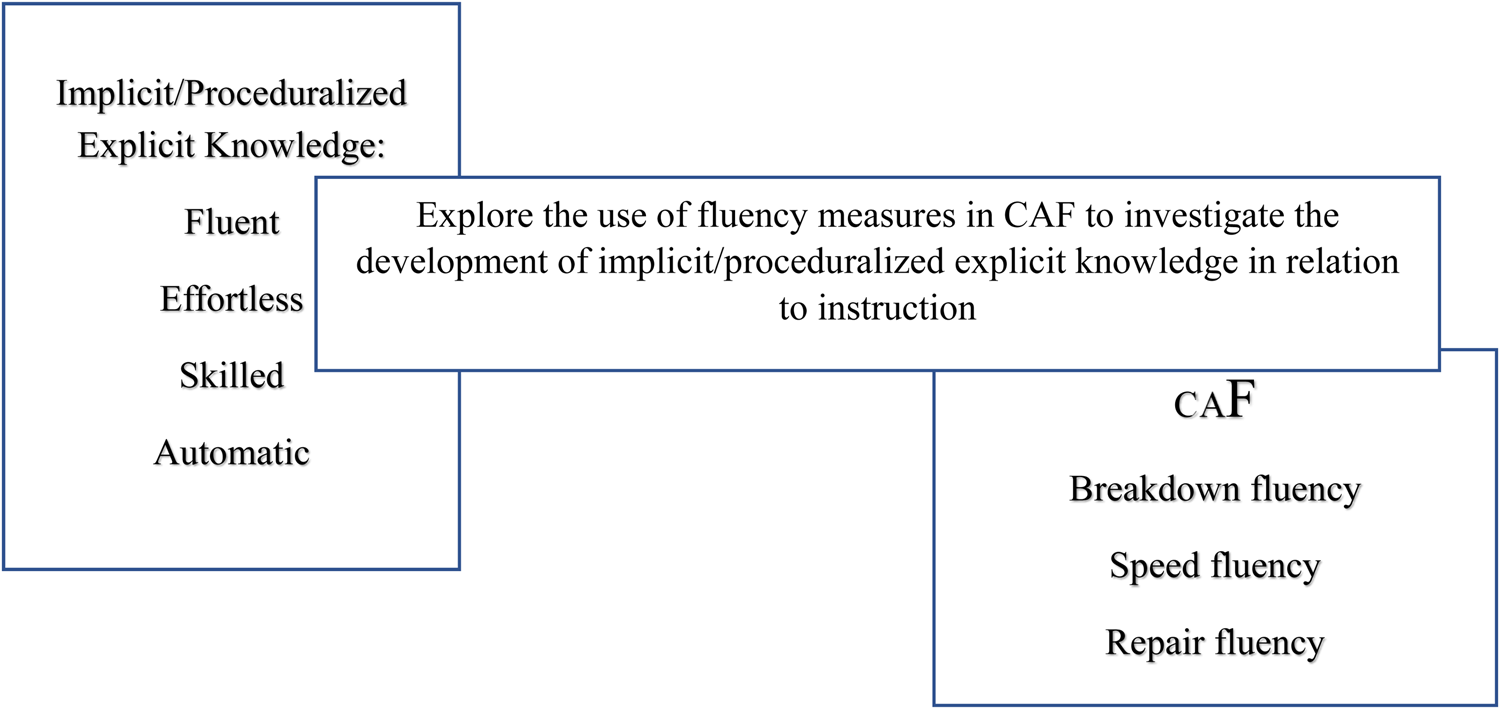
As indicated in Figure 2, typical descriptors of implicit/proceduralized explicit knowledge are: fluent, effortless, skilled, and automatic. Fluency measures in CAF (e.g. breakdown, speed, and repair fluency) are designed to capture these dimensions of language use. It would be valuable if more ISLA research explored the ways in which these fluency measures can be used to investigate the effects of instruction on the development of implicit/proceduralized explicit knowledge. To be sure, the development of such measures is not easy, and they are often extremely time consuming to use. However, the growing availability of computerized tools to measure CAF dimensions both reliably and quickly (MacWhinney, Reference MacWhinney2000, CLAN; de Jong & Wempe, Reference de Jong and Wempe2009, Praat-script; Leijten & Van Waes, Reference Leijten and Van Waes2013, InputLog) offers much promise for ISLA research to examine how complexity, accuracy, and fluency develop over time in relation to different types of instruction. Such research could also provide insights into the interactions between them and their relationships with other measures of proficiency (e.g. communicative adequacy) (Révész, Ekiert, & Torgersen, Reference Révész, Ekiert and Torgersen2016).
Fluency measures in CAF: Implicit/proceduralized explicit knowledge

7. Theory, research, and pedagogy
In the introduction to their edited volume TBLT as researched pedagogy, Virginia Samuda, Kris Van den Branden, and Martin Bygate state that ‘the application of research to classroom practice has always been at the heart of the TBLT project’ (Samuda, Van den Branden, & Bygate, Reference Samuda, Van den Branden and Bygate2018, p. 6) but they express concerns that most of the research has focused on the psycholinguistic dimensions of tasks and that there is a need for more research to address the pedagogical dimensions. They are quick to point out that this does not mean that the psycholinguistically-oriented research on the design, sequencing, and implementation of tasks is not relevant to pedagogy. Their concern is that while a good deal of it is relevant to pedagogy, it is not focused on pedagogy. This is related to a distinction often made in education (and other professional disciplines) between top-down and bottom-up research. With the former, insights are derived from theoretically-motivated questions, the research often takes place in laboratory settings and the emphasis is not on pedagogy or broader issues of L2 educational practices. Bottom-up research typically starts from pedagogically-motivated questions and the research takes place in ‘real’ classrooms. Similar issues are raised in the distinction that Kris Van den Branden (Reference Van den Branden and Bygate2015) makes between prescriptive and descriptive research in TBLT. In the former, pedagogical guidelines and recommendations are based on research that documents how people acquire the L2 in task-based interaction, and in the latter, the focus of research is on the pedagogical actions and decisions that are actually taken by teachers and students in authentic classrooms while they are working with tasks.
Some examples of descriptive research in TBLT include the long-term, large scale studies by Van den Branden and his colleagues researching all aspects of implementing TBLT language programs from curriculum development to the role of the teachers to assessment of learning outcomes and program evaluation (Van den Branden, Reference Van den Branden2006, Reference Van den Branden2009, Reference Van den Branden and Bygate2015). Another example within TBLT is the collaborative research on teachers’ implementation of tasks in German secondary schools (Müller-Hartmann & Schocker, Reference Müller-Hartmann and Schocker2011, Reference Müller-Hartmann, Schocker, Samuda, Van den Branden and Bygate2018). There are also several descriptive case studies of teachers and learners engaged in TBLT activities in intact classrooms (McDonough & Chaikitmongkol, Reference McDonough and Chaikitmongkol2007; Andon & Eckerth, Reference Andon and Eckerth2009; Oliver & Bogachenko, Reference Oliver, Bogachenko, Samuda, Van den Branden and Bygate2018).
One of the places where researchers and teachers come together is in teacher education and professional development courses. These contexts have enormous potential for both groups to share and build knowledge together. Martin East's work with novice teachers in the development, use, and interpretation of tasks is a good example of this (East, Reference East2012, Reference East, Samuda, Van den Branden and Bygate2018), as well as the work of others in TBLT (Baralt, Reference Baralt, Samuda, Van den Branden and Bygate2018; Nguyen, Newton, & Crabbe, Reference Nguyen, Newton, Crabbe, Samuda, Van den Branden and Bygate2018). In ISLA, a good deal of the pedagogy-based research also comes from teacher professional development initiatives that have emerged in response to research findings. This includes investigations of how experienced teachers explore ways of focusing on language within content-based language teaching via professional development courses (Tedick & Zilmer, Reference Tedick and Zilmer2018); studies investigating teachers collaborating with researchers to develop and implement instructional materials focusing learners’ attention on language in subject-matter French immersion classes (Lyster, Collins, & Ballinger, Reference Lyster, Collins and Ballinger2009; Lyster, Reference Lyster2019); and investigations of the role of the teacher in creating opportunities for learners to co-construct knowledge of academic language in content and language integrated learning (CLIL) classrooms (Nikula, Reference Nikula2015; Van Gorp & Van den Branden, Reference Van Gorp and Van den Branden2015).
Much has been written about the research-practice gap in ISLA and in applied linguistics generally (e.g. Bygate, Reference Bygate2005; Borg, Reference Borg2009; Ellis, Reference Ellis2010; Ortega, Reference Ortega, Hinger, Unterrainer and Newby2012; Spada, Reference Spada2015, 2021). Some of the explanations for it include the fact that laboratory-studies outnumber classroom studies by 3 to 1, making the results less relevant/meaningful to teachers; research reports often appear in journals targeted at researchers and are written in technical language making them inaccessible to most language teachers, and teachers are skeptical of pedagogical recommendations from researchers who have little or no classroom experience. A top-down approach in which researchers are considered the ‘experts’ and teachers the ‘recipients’ of their knowledge fails to recognize that teachers and researchers have different types of knowledge. Some of that knowledge overlaps and some is specific to each group. What is important is that the knowledge be shared. There are a variety of ways to do this including writing for teachers, collaborative research, and professional development (Spada & Lightbown, Reference Spada and Lightbown2019).
It appears that a good deal of the ISLA pedagogy-based research has taken place in content-based language teaching (CBLT) programs in the North American context as well as in CLIL programs in Europe and elsewhere. Clearly, TBLT, CBLT, and CLIL have much in common. They are all concerned with the simultaneous teaching of language and meaning/content. The focus in CBLT and CLIL is subject-matter instruction and in TBLT experiential and goal-oriented learning. While these programs differ in several respects (e.g. target populations, language learning contexts), in all three programs ‘teachers and students must interact and collaborate to do things with words in ways that maximize the learning of language while equally promoting the creation of “meaning”’ (Ortega, Reference Ortega2015, p. 1).
The connections between TBLT, CBLT and CLIL were recently brought to the forefront in a special issue of System entitled: The interface between task-based language teaching and content-based instruction and edited by María del Pilar García Mayo (Reference García Mayo2015). Central questions within all three programs concern: whether, when, and how to integrate a focus on language within meaning/content/task-based instruction. These questions have theoretical and pedagogical relevance and are compatible with pedagogy-based and research-based studies allowing for explorations of questions of mutual interest from different perspectives. They also lend themselves to collaborative work between teachers and researchers and have the potential to merge empirical insights from top-down prescriptive approaches with those from bottom up/descriptive approaches.
8. Conclusion
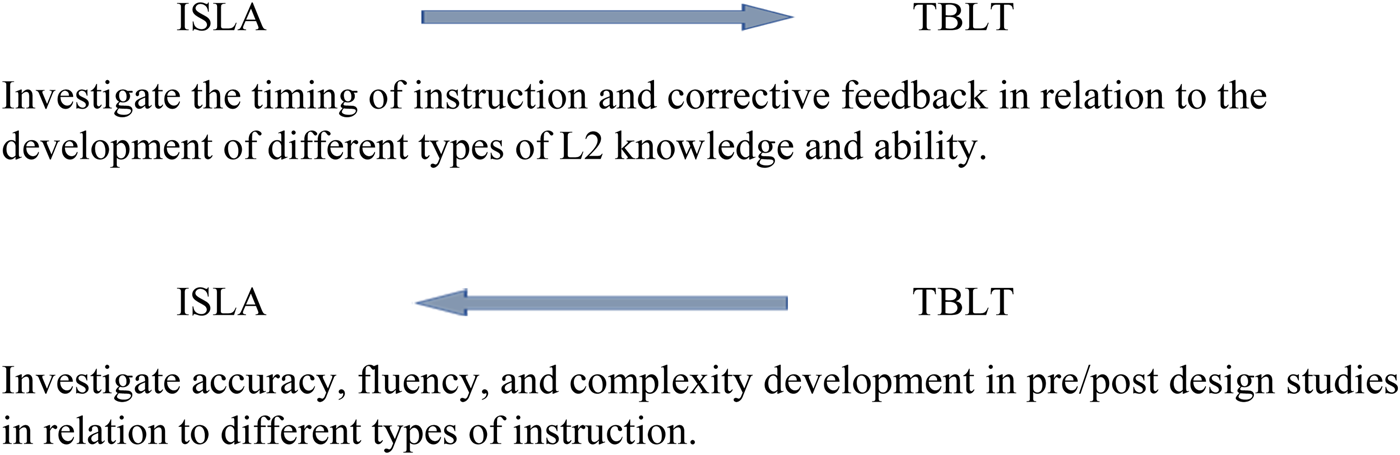
To summarize and conclude, my goal in discussing the two primary themes of Instruction and Outcomes has been to offer some reflections on how research in ISLA and TBLT can further inform, build on, and enhance one another. With respect to Instruction, I see conceptual work and research on the timing of instruction in ISLA contributing to current and future work in TBLT (Figure 3). Specifically, more research to investigate isolated and integrated FFI would provide insights into whether and how the separation (before/after tasks) or integration (within tasks) contributes to different aspects of L2 learning. In terms of Outcomes, I view TBLT research on CAF as having the potential to expand the measurement of L2 learning in ISLA research by moving from almost exclusively accuracy-based descriptions of learning outcomes to exploring ways in which fluency and complexity measures can be used to characterize L2 development in relation to instruction.
TBLT and ISLA influencing each other

With respect to the third theme, Theory, Research, and Pedagogy, my intent is to emphasize that both ISLA and TBLT have much to gain if there is more of a balance in terms of research carried out to investigate theoretical and pedagogical questions. It is equally important not to lose sight of the fact that the connections between theory, research, and pedagogy are not one-way. Just as theory and research can inform pedagogy, pedagogy can inform theory and research. Furthermore, given that ISLA and TBLT share the goal of improving L2 learning and teaching, a greater focus on research that is pedagogically motivated and situated will stimulate new questions, produce new knowledge, and provide insights into whether and to what extent the findings are compatible with those from theoretically-motivated research. This should help to create a better balance and synergy within both ISLA and TBLT.
Nina Spada is Professor Emerita in the Language and Literacy Education Program at OISE University of Toronto. Dr. Spada's research is concerned with the role of instruction in second language acquisition (SLA). Her classroom-based research investigates the contributions of the type and timing of attention to language form within meaning-based/communicative instruction and their effects on different aspects of L2 knowledge and ability. Included in Dr. Spada's publications are over 100 articles in journals and collected editions and five books/edited volumes. She is a co-author of How languages are learned, currently in its fifth edition and published by Oxford University Press. She is co-editor of the John Benjamins book series Language Learning and Teaching and co-editor of the Oxford Key Concepts for the Language Classroom book series.